Fairy Tale Reading

This semester, I’ll be teaching a class on fairy tales. I thought you might like to know what I’m asking my students to read, because if you read this blog, you’re probably interested in fairy tales. Right?

So here’s my reading list:

The central text of the course is Maria Tatar’s The Classic Fairy Tales, from Norton. It contains most of the tales we’ll be reading, as well as important criticism. As we study each tale, the students will read Tatar’s introduction to that tale to provide historical and critical context. We will also be reading Bruno Bettelheim’s The Uses of Enchantment, not because I necessarily agree with his psychoanalytic interpretations (I usually don’t) but because they give students a useful theoretical stance to argue for or against. The semester is arranged by fairy tales, so I’ll give you the stories and poems we’ll be reading by tale, mostly in the order we’ll be reading them.

We’ll start the semester with J.R.R. Tolkien’s “On Fairy Stories,” so we can consider the question “What is a fairy tale?” And then we’ll get into the tales themselves.

Little Red Riding Hood:
“The Story of Grandmother”
Charles Perrault, “Little Red Riding Hood”
Brothers Grimm, “Little Red Cap”
James Thurber, “The Little Girl and the Wolf”
Angela Carter, “In the Company of Wolves”

Snow White:
Brothers Grimm, “Snow White”
Anne Sexton, “Snow White and the Seven Dwarfs”
Neil Gaiman, “Snow, Glass, Apples”

Cinderella:
Charles Perrault, “Donkeyskin”
Brothers Grimm, “Cinderella”
Anne Sexton, “Cinderella”
Aimee Bender, “The Color Master”

Beauty and the Beast:
Madame de Beaumont, “Beauty and the Beast”
Angela Carter, “The Courtship of Mr. Lyon”
Angela Carter, “The Tyger’s Bride”

Bluebeard:
Charles Perrault, “Bluebeard”
Joyce Carol Oates, “Blue-Bearded Lover”
Sylvia Townsend Warner, “Bluebeard’s Daughter”
Angela Carter, “The Bloody Chamber”
Margaret Atwood, “Bluebeard’s Egg”

Sleeping Beauty:
Charles Perrault, “Sleeping Beauty”
Brothers Grimm, “Briar Rose”
Ursula Le Guin, “The Poacher”
Jane Yolen, Briar Rose

We’ll finish the semester with a few classes on Hans Christian Andersen and Oscar Wilde. By Andersen, we’ll be reading “The Little Mermaid,” “The Shadow,” and “The Snow Queen.” By Wilde, we’ll be reading “The Selfish Giant” and “The Fisherman and His Soul.” To go with “The Snow Queen,” we’ll be reading Kelly Link’s “Travels with the Snow Queen.” We will also be reading two essays that touch on these stories: Jane Yolen’s “From Andersen On: Fairy Tales Tell Our Lives” and Ursula Le Guin’s “The Child and the Shadow.”

Throughout the semester, we will be reading critical articles, which I’ll list as well:

Sandra Gilbert and Susan Gubar, “Snow White and Her Wicked Stepmother”
Robert Darnton, “Peasants Tell Tales: The Meaning of Mother Goose”
Karen Rowe, “To Spin a Yarn: The Female Voice in Folklore and Fairy Tale”
Marina Warner, “The Old Wives’ Tale”
Zohar Shavit, “The Concept of Childhood and Children’s Folktales”
Jack Zipes, “Breaking the Disney Spell”
Maria Tatar, “Sex and Violence: The Hard Core of Fairy Tales”

Of course, the students will need to go out and find articles themselves, for their papers. I always find that the most useful for them to start with are those by Terri Windling, and anything linked to on the Sur La Lune website.

So there you go. That’s what we’ll be reading during the semester. I hope you go out and find some of the stories yourself — or even the essays and articles, if you’re interested in fairy tales! (And I think you are . . .)
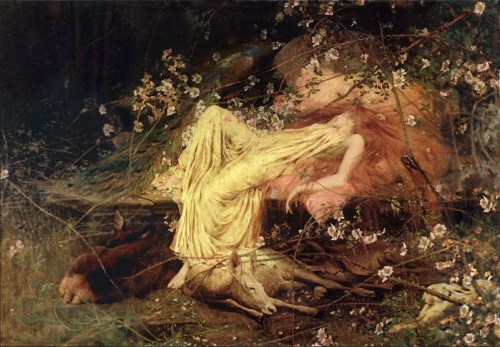
A Fairy Tale by Arthur Wardle

A Fairy Tale
by Arthur Wardle

Posted in Uncategorized | 16 Comments

The Poetry Collection

So, I have this poetry collection coming out?

You can hear the hesitation with which I write that. I trained myself, over many years, to take compliments well. When someone said “You look beautiful,” I learned to say “Thank you.” (I didn’t train myself to believe it, but I did train myself not to say something like, “Oh, but I looked dreadful this morning, you should see me when I first wake up.”) I think I need to train myself to talk about my poetry in the same way, so I can say “I have a poetry collection coming out” as though it were a normal thing, as though I didn’t worry about it terribly.

Why do I worry about it? Because I’ve never in my life had confidence in myself as a poet. No, wait, I did have confidence once, when I was in high school. Back then, I wrote poetry constantly and confidently. I published some of it in the school poetry magazine. It was college that created problems for me, specifically the poetry classes I took at the University of Virginia. UVA has a famous creative writing program, with famous poets teaching in it. And, I’m sure without intending it or perhaps even realizing it, they convinced me that what I wrote was not worth writing.

Here, by the way, is the poetry collection, and I can tell you that I’m very proud of it. It’s forthcoming from the wonderful Papaveria Press.

Songs for Ophelia-Tangerine-lilac.indd

In my literature classes, we studied poetry from all eras. But in creative writing classes, we were expected to read modern poetry, and to appreciate modern poets specifically. A lot of what we were reading, I simply did not like, but I got the distinct sense that I was supposed to write that sort of thing. (I should say, here, that there is a great deal of modern poetry I love, if by modern we mean 20th century. But we were reading the poetry of the 1970s and 80s, and I had a difficult time getting excited about any of it. Contemporary poetry feels more spacious now than it did back then.)

The last poetry class I took was with a famousish poet, the kind of poet who gets into all the anthologies. My first poem was about a woman who has dragons moving into her house — small ones, that get “tangled in her hangers.” I remember those words from the poem. When we critiqued it, my classmates couldn’t understand what I was trying to do — why dragons? They were, of course, a metaphor — but I wasn’t treating them as a metaphor in an obvious way, just writing about what a pain it was to have dragons (small ones) in your house.

That class didn’t stop me from writing poetry. I kept writing and even publishing poetry, all through law school. (I published poetry before I published prose.) But I didn’t talk about it, as though poetry were some sort of disease it was best not to discuss too much. I was surprised when people liked my poems — it’s been a surprise to me, over the last few years, that they’ve been reprinted in Year’s Best anthologies, and that editors like Terri Windling and Ellen Datlow ask me for poems. The greatest surprise was when, with great trepidation, I posted some poems on Facebook and people told me how much they liked them — shared them with friends, commented.

And now I have this poetry collection coming out, so I’m determined to talk about it.

It’s not polite to write about poetry without including some, so here is a poem that should be appropriate for the season:

Autumn, the Fool

The leaves float on the water like patches of motley.
Autumn, the fool, has dropped them into the lake,
where they rival the costume, not of the staid brown duck,
but the splendid drake.

He capers down the lanes in his ragged garments,
a comical figure shedding last year’s leaves,
but as he passes the crickets begin their wailing
and the chipmunk grieves.

The willow bends down to watch herself in the water
and shivers at the sight of her yellow hair.
Autumn the fool has passed her, and soon her branches
will be bare.

By the way, if you’re interested in the collection, it’s meant as a companion to my short story collection In the Forest of Forgetting, which is being reissued by Papaveria Press in a beautiful new edition:

Forest of Forgetting

It’s going to be available in paperback and is already available for the Kindle and in epub and mobi versions.

Posted in Uncategorized | 18 Comments

The Lady Code

In Victorian novels, there is one thing characters always seem to know: whether or not a woman is a lady. And whether or not she’s a lady determines how they talk to her, treat her. It’s as though there’s “lady code” that immediately signals her status. The code has to do with the tangible, such as clothing, but also the intangible, such as attitude.

I was thinking about this recently because I saw a photograph of a college student who had written on her leg, in black marker, what the different skirt lengths meant. A skirt that came to the middle of the thigh meant “flirty.” One just below the knee meant “proper.” One at the bottom of the calf meant “prudish.” And of course one close to the top of the thigh meant “whore.” There were gradations in between.

If we look at this idea historically, it’s the same old lady code. That code always had to do, in part, with sexuality. But it also had to do with social class, and what the photograph can’t represent, being a photograph, is the extent to which the lady code is about economic and educational status.

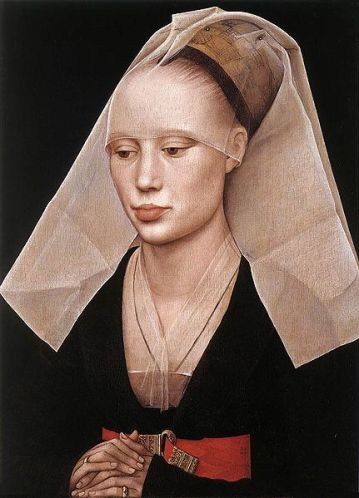
Portrait of a Lady by Rogier van der Weyden

Portrait of a Lady
by Rogier van der Weyden

In American, we are raised with an implicit lady code, because we tend not to talk about social status. But upper-middle class girls are educated into it: they are taught what to wear, usually by their mothers. They are taught which skirts are too short, which shirts too tight. They are taught to signal their social status in coded ways. My family is Eastern European, so the lady code was much more explicit. If I wore something inappropriate, my mother told me that I was not allowed to wear it because I would look like a prostitute. For me, raised as an American child, this was a shocking statement. Here, girls are explicitly taught to wear clothing that is sexually alluring: they are taught this by every magazine and television show. But they are implicitly judged by the lady code.

Portrait of a Lady by John Hoppner

Portrait of a Lady by John Hoppner

So dressing, for a woman, is a complicated affair. When you look into your closet in the morning — and even before that, when you buy your clothes in a store or online — you are making a choice about what you want to communicate. You are speaking in a coded language. If you were raised by an upper-middle-class mother, you know the lady code. You are fluent in that particular language. You know that what you wear should vary depending on the occasion. You will not wear a cocktail dress to the ballet. (I use that as an example because it’s one I see whenever I go to the ballet: women wearing dresses that signal “I don’t go to the ballet often.” The lady code is nuanced: one kind of black dress is fine for the ballet, another kind of black dress is not.) You will not wear a suit that is either flirty or prudish to a job interview: a skirt that is too long is as wrong as a skirt that is too short.

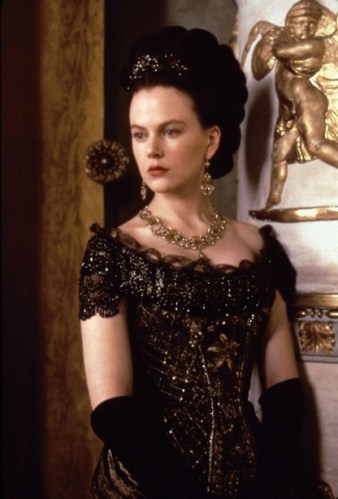
Nicole Kidman in Portrait of a Lady

Nicole Kidman in Portrait of a Lady

Perhaps the place I saw the lady code operating most clearly was at law firms, when I was a lawyer. There was a clear, although implicit and coded, distinction between female lawyers and female secretaries. They wore different clothes, different jewelry, did their hair and makeup differently. We did not have many male secretaries in those days, so male lawyers did not need to signal their difference so clearly. What they wore was relatively simple: a suit. For women, it was not simple at all, and I still remember endless discussions about whether or not a pants suit would be appropriate, and in what circumstances. I don’t think I wore pants once, as a corporate lawyer.

I write this not to make a statement about it, because I don’t know what statement I would make: the lady code has been with us since at least the Middle Ages, and I suspect that reading each others’ clothing as though it were a language goes back to when we first started wearing clothes. Should we abolish the lady code? I doubt we can. Should we be conscious of it? Yes, probably. We have an example of absolute mastery of that code in our First Lady. Michelle Obama’s clothing choices are brilliant: always perfectly appropriate, but also implicitly referring back to one of our great national examples of a lady, Jacqueline Kennedy. Her clothes are a form of political speech that invite us to compare her husband’s administration to Camelot. There is a whole other blog post to be written about the lady code and race, but it should be written by someone who knows the situation from the inside.

What I want to do here is simply notice that the code exists, despite the fact that mothers no longer tell their daughters to be ladylike. Instead, they are taught to be “appropriate,” which means pretty much the same thing. And to notice the ways in which the code is about, and signals, social and educational status.  Which is important, because what a woman signals in that code will determine how she is treated and thought of in our society — just as it did for the Victorians.

Posted in Uncategorized | 15 Comments

Finding the Balance

The thing about being me is, I have things coming at me all the time. I know other people have lives like this too — not everyone, but certainly anyone in the arts. I was having lunch with two friends who are also writers recently, and we talked about how busy we were, all the different things we were doing. We all taught and wrote, so we had teaching deadlines as well as writing deadlines. We were all doing fascinating things — I think I’m doing fascinating things, and I’m so grateful to be able to do them. But we were all also working very hard.

So one thing I need to do, especially now that I’m back from traveling and focused on work, is find the balance. I need to make sure that I’m not burning myself up or out, that I’m doing the ordinary things I need to do, to keep myself balanced and happy. That means eating and sleeping. (Don’t laugh! There are days when eating well, and getting enough sleep, are a challenge. I sometimes need to remind myself that a cereal bar and some chocolate are not lunch.) And I need to make sure that among all the work, I do actually have fun — have a life, as well as a working life.

I’m including pictures from two things I did recently, two small outings that were fun breaks. The first was meeting a friend for chocolate at Burdick, the famous chocolate shop. Here are the interior of Burdick and what I had to eat — my favorite, the Hazelnut Orange Cake.

OLYMPUS DIGITAL CAMERA

OLYMPUS DIGITAL CAMERA

Finding the balance is also crucial to what my last blog post is about: managing darkness. Because it’s so easy for one’s mood to be affected by what one eats, or lack of sleep, or lack of exercise. So I’m trying to make sure that I get all the things I need to be healthy. There are so many stories of writers who were not healthy, who drank to excess for example. But productivity takes a certain measure of sanity and health. So I’m working on those things.

(And I recently discovered a way to deal with insomnia, which has been a problem for me since I was a child. It involves doing at least a half hour of pilates and then listening to a meditation CD that a friend gave me. It’s called Meditation for Busy People, and I was too busy to try it for about six months. But it’s incredibly, wonderfully relaxing.)

My second outing was downtown, where I stopped by a cart selling hats in Faneuil Hall. This is the hat I bought for myself, to keep the sun out of my eyes. Sitting at the cart was a lovely Frenchwoman who told me how to make a hat fit if it’s a little too large: put tissue paper inside the inner band. Frenchwomen know these things. (I did not need tissue paper inside the band, because my head is rather large, as you might expect! I’ve stuffed a lot of things into it.)

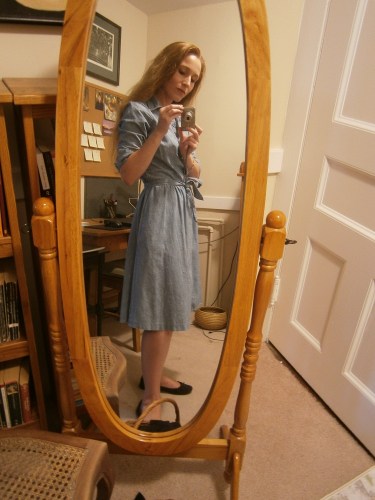
The first picture is of me wearing my 1950s-style Audrey Hepburn dress, because I was channeling Audrey that day.  I think that’s how I ended up with a hat.  It was an Audrey sort of hat . . .

OLYMPUS DIGITAL CAMERA

OLYMPUS DIGITAL CAMERA

Finding the balance is always hard for me. I tend to take on too much and push myself too hard, expect too much of myself. But I think I have to focus on it now, because the truth is that I can’t create good art when I’m too tired, or unhappy with the world or myself. And that’s the goal, finally, isn’t it? To create good art . . .

Posted in Uncategorized | 1 Comment

Managing Darkness

Last night, I dreamed that I was standing on a beach. It was a sandy beach: I could feel the sand between my toes and the sun on my arms. The sky was blue above me. I was watching the waves, a camera in my hand, ready to take pictures. And then, while I watched, one of the waves grew larger and larger. It crashed over me and swept me out to sea. Since I saw the wave growing and could anticipate what might happen, I had enough time to put my glasses and camera into my camera bag. And then the wave crashed over me. I opened my eyes and saw swirls of blue and green, the roiling water. I felt the confusing of being swept out. When I surfaced again, I was far from shore, still holding the camera bag by its strap. I was afraid that I wouldn’t get back to land, that I couldn’t do it by myself. That I wasn’t strong enough. But the sea helped me: another wave washed back to shore and carried me along with it. I made it to land again.

I woke exhausted.

Sometimes I wish I didn’t dream the way I do: vividly, intensely. I have many dreams each night, and in each one, it’s as though the dream is my life for the length of it. I’m completely in the dream. It becomes my reality. Sometimes this is wonderful, and I wish for the dream life, not wanting to wake up. Sometimes it’s terrible, because I can have dreams that are vivid yet mundane. Dreams of being lost in enormous subway systems, where I inadvertently leave my purse and all my identification on the subway. Of being trapped in falling elevators. But of course I also have dreams in which I can fly, or I am in love, or I write an entire novel. Wonderful dreams.

I thought some images from my visit to Peaks Island would be appropriate for this blog post. They are from my bike ride around the island, when I took pictures of the rocky shore. The shore in my dream was not rocky, but I was holding the same camera.

OLYMPUS DIGITAL CAMERA

I posted about my dream on Faceook, and several people suggested that the dream represents my fear of being overwhelmed. One said that water often represents the emotions. And I think there’s truth in that: I’m afraid of being overwhelmed, in part by all my obligations and responsibilities, and there is certainly an emotional component to it. I’ve spent the last two months traveling, and the truth is that I wish I were still traveling. I don’t particularly want to be back. I loved freeing free . . .

OLYMPUS DIGITAL CAMERA

There were entire days, entire weeks, while I was traveling, when I felt what I can only describe as wild joy. I felt it on the day I rode on a bicycle around Peaks Island. I felt the wild joy of riding through warm, salty air, of hearing the waves crashing on the rocks, of feeling the sunlight on my arms. The wild joy of movement, and the sea. Now I am back to work.

If you’ve been through depression, even once, you’re conscious of it ever after. It’s like having had any other disease that can recur. You watch for symptoms. That’s why I called this blog post “Managing Darkness.” Because the dream is a symptom, so now I need to manage my mood and responses. Now I need to be aware, to make sure I take care of myself. Because the truth is, I don’t want to be back here yet. I miss traveling . . .

OLYMPUS DIGITAL CAMERA

I might write more about that, about how one manages the darkness, in my next blog post.  But I think it means something, too, that a wave swept me back.  That the sea took me out, but then helped me back to shore.  That it returned me, safely, to land.

Posted in Uncategorized | 9 Comments

The Best Revenge

You probably don’t think of me as a particularly vengeful person, but there have been times when I’ve felt vengeful! It doesn’t happen often, and I have to admit that at the moment, there are only two people in the world I feel vengeful toward. Two people out of seven billion isn’t that bad, right?

I think that I’m usually a relatively nice person, but there are times when I get angry, or envious — or even vengeful. By vengeful, I don’t mean that I would wish actual harm on anyone, because that wouldn’t be nice. No, what I wish is that the universe would give the gentlemen in question (yes, they are both men) a good talking-to. Something like this: “You have been rude beyond the call of rudeness, and I suggest that you stop. Because karma.”

(In both cases, it’s for exactly the same reason: a male friend, about whom I cared very much, for whom I was there during various travails, says the following: “I am romantically involved with X, so we can no longer be friends.” To which I respond, “What? Wait, why?” To which the reply is silence. That’s rude beyond the call of rudeness, right? Anyway, I think it is. And it’s ultimately very silly, because any romantic relationship that does not allow you to maintain your friendships is going to be unpleasant. Relationships without trust usually are.)

But this blog post isn’t about feeling vengeful. It’s about revenge, the best revenge. I’m going to tell you how to get it. There are basically two steps.

1. Live a fabulous life. This step is absolutely crucial. When you feel vengeful, ask yourself, am I doing something fabulous? And if you’re not, go do something! It doesn’t have to be something extravagant. It can involve getting ice cream, or buying flowers, or walking by a river.

2. Write about it. Or take pictures! Share that fabulous life, share your story. The purpose of sharing your life is not to make anyone else envious, but to allow other people to participate in it. And of course you should participate in their stories and lives as well . . . I love it when my friends are living fabulous lives too. (But Step 1 is absolutely crucial: the point is not to post pictures, but to actually have a fabulous life. The pictures come afterward.)

This is a very satisfying way of getting revenge, which has the additional benefit that you get ice cream, or flowers, or a walk by the river — or you get to visit fabulous places. Or buy cocktail dresses! (I bought two cocktail dresses just yesterday, for $10 each at a thrift store. Now I need to find two cocktail parties . . .)

I’m going to post some pictures of the fabulous things I did on my last day on Peaks Island. First, I had some ice cream (blackberry chip with fudge topping). I walked along the main street, eating my ice cream, looking at Casco Bay and all the beautiful houses.

OLYMPUS DIGITAL CAMERA

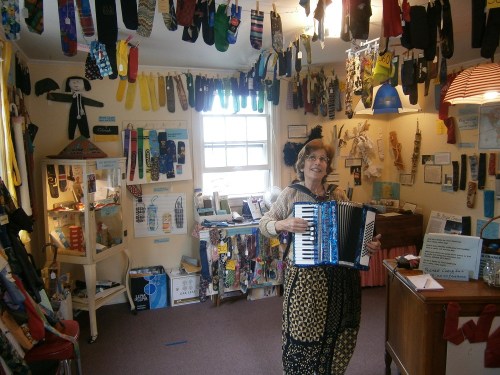
Then I went to the Umbrella Cover Museum (which does actually exist). This is a picture of the proprietor, Nancy 3, playing her accordion for visitors. You can see all the umbrella covers she has collected.

OLYMPUS DIGITAL CAMERA

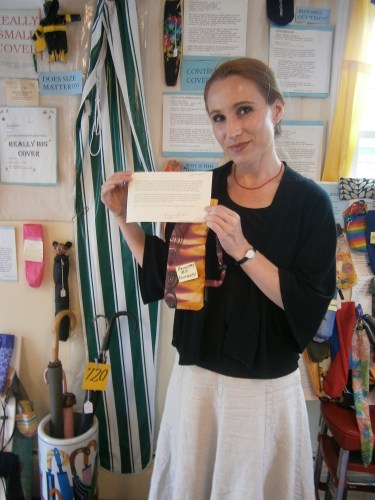
In the Umbrella Cover Museum, there was a very special cover, with a story. The cover is the one Catherynne Valente brought back after spending several weeks in Budapest with me last summer. Nancy 3 took a picture of me with the cover and the story Cat had written describing where it came from.

OLYMPUS DIGITAL CAMERA

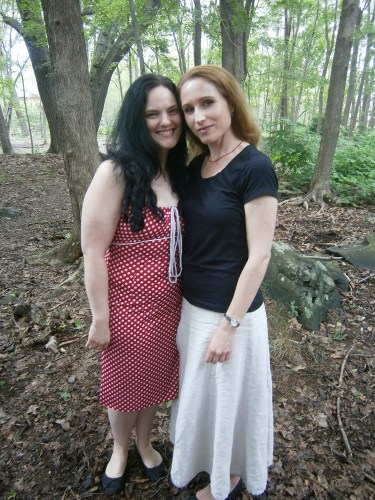
Then it was time for me to leave, but before I did, Cat and I posed for a picture together. (There, by the way, is a woman with a fabulous life! It was such a privilege to visit her on Peaks Island.)

OLYMPUS DIGITAL CAMERA

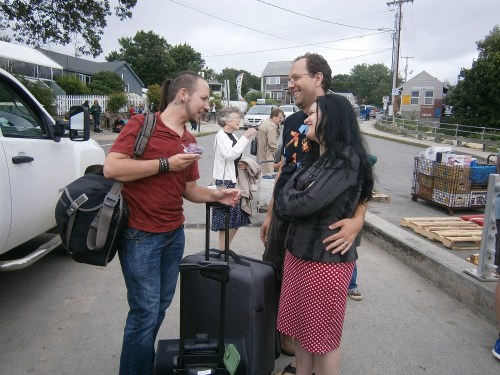
Here are the people I stayed with that week, saying goodbye on the ferry landing: Cat, Dmitri Zagidulin, and fellow guest Lee Harrington (who got the same flavor ice cream I had been eating earlier). I was sad to leave, but it was time to go home, where other adventures were waiting for me.

OLYMPUS DIGITAL CAMERA

So there you go, that’s the best revenge: having a fabulous life and then getting to talk about it, share pictures — and be part of the fabulous lives of other people.

If you’re ever feeling particularly vengeful, and I mean deeply, angrily vengeful, you can go look at the Facebook page of the person you’re angry with and see if he’s living a fabulous life yet. Not yet? Nope, not yet. Because karma. But then? Go back to living your own fabulous life. Because ice cream, and riding bicycles around islands in Maine, and going to cocktail parties in fabulous dresses that only cost $10. And having fabulous friends. You might actually forget, for a while, about taking revenge . . . And if you remember, there’s always Facebook!

Posted in Uncategorized | 6 Comments

Being the Adventure

This past week, I was in Brunswick, Maine, teaching at the Stonecoast MFA Program summer residency. Then I went to Portland, and then to Peaks Island in Casco Bay, so I could visit one of my favorite people, fantasy writer Catherynne Valente. While I was there, one of the Stonecoast students posted what I thought was an interesting and important Facebook update: she said that after the intensity of the residency, it was difficult returning to ordinary life. And I completely understand that.

How do we do that, after having an adventure? How do we return to ordinary life?

I have an answer, but I’m afraid it’s one that may disappoint you. My answer is: don’t. Create a life that isn’t ordinary.

Oh, I know it’s difficult. It’s particularly difficult when you’re just starting out as a young writer. You may have a life filled with obligations. Financial obligations, obligations to family. But you can start small? That’s why I titled this blog post “being the adventure.” Because when you can’t have an adventure, when you have to grade papers or care for a child, you can still be the adventure. You can still find the adventure in what may not initially seem adventurous. You can create adventure, wherever you are.

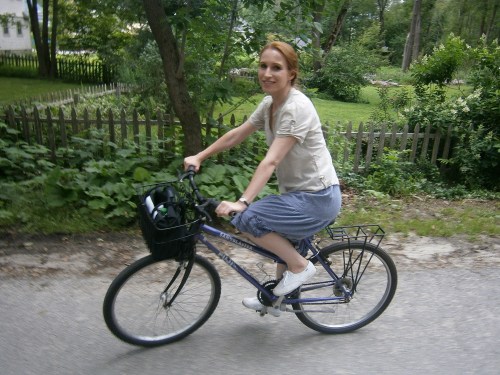
On Peaks Island, I had a wonderful adventure, although it was a very simple one. I rented a bicycle and rode all the way around the island. Here is a picture of me on the purple bicycle I rented:

OLYMPUS DIGITAL CAMERA

(Thank you for taking this picture, Dmitri Zagidulin!)

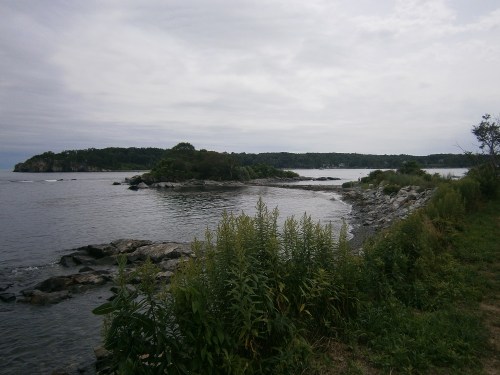
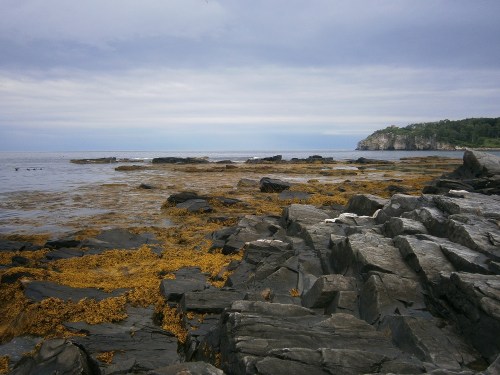
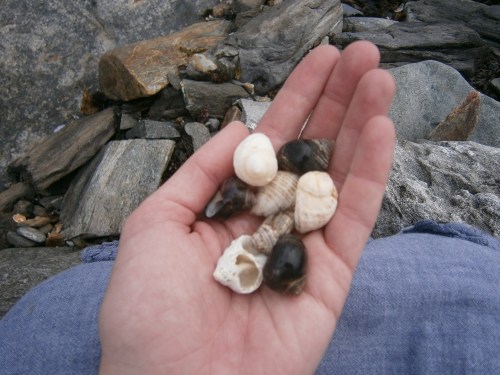
The island is four miles around, so it was not very difficult to bike all around it. But I saw the most beautiful things. A small island connected to the larger one by a causeway, where I later clambered among rocks covered with bright yellow seaweed, and smelled the last of the rosa rugosa, and collected shells. A stony beach where people had piled stones on top of each other to form sculptures. Miles of road by the sea, where I rode to the crashing of waves and said hello to everyone I passed. Houses painted pink and blue and yellow, surrounded by gardens filled with the sorts of flowers that grow in a moist, cold climate.

Here is the island connected by the causeway:

OLYMPUS DIGITAL CAMERA

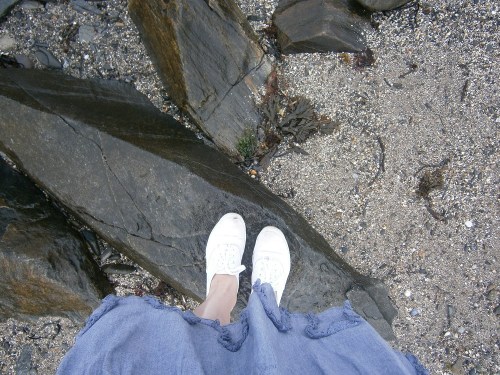
And here is me clambering on the rocks, wearing my beaten-up Keds with a hole in the toe:

OLYMPUS DIGITAL CAMERA

And here are the rocks with the bright yellow seaweed:

OLYMPUS DIGITAL CAMERA

And here are the shells:

OLYMPUS DIGITAL CAMERA

After my ride, I bought myself ice cream in the shop by the ferry landing. I didn’t want to return my bike, although of course I had to, eventually. But for three hours, I had felt so free, so happy. Now, I know that not everyone can go to an island in Maine. And tonight, I’m going home to Boston on the train (which is where I’m writing this blog post, moving through the night, somewhere between Portland and Boston). I suppose you could say that I’m finally returning to ordinary life, but am I? In Boston, I will have a month to finish a novel before the semester starts. So I’ll be finishing the draft of my first novel, which surely isn’t an ordinary thing to do. And I’ll be hunting for summer skirts at my favorite thrift stores, and walking around the city, and visiting the river, and going to the art museum. I’ve been so many places this summer, but I’m not returning to the ordinary, because my life isn’t ordinary — I have imagination, and so anything can be an adventure. I’m the one who brings the adventure to it.

I once wrote, “some people don’t have adventures, some people have adventures, and some people are adventures.” I am the adventure: all of the things I do could be ordinary, but my imagination transforms them. Finding a summer skirt becomes finding a magical garment. Ice cream (with fudge topping!) becomes a fairy feast. (Well, the right kind of ice cream is a fairy feast!) You can do that to anything, even — yes, even housekeeping. Think about how often housekeeping comes up in fairy tales, after all.

I want my life to be a great adventure, but I know that I’m responsible for turning it into one, for being adventurous — because that’s how it works. It’s my responsibility to be the adventure . . .

Posted in Uncategorized | 3 Comments