Being Photogenic

I’m writing this post because several friends of mine who are writers asked me to. I feel a bit awkward about it? In part because I’ll be posting pictures of me, and one is always criticized for that, and in part because I suppose it’s a frivolous topic, although how we appear to the world is usually important to us. And particularly important to writers, who are in a strange position, nowadays: they are photographed a lot, and those photos are used for publicity or posted online. And yet, they’re not performers, not actors or singers who are used to appearing in front of people. They are usually introverts, whose deepest relationships can be with imaginary characters.

Anyway. In the last couple of years, I’ve been getting a compliment that’s new to me, and surprises me: “you’re so photogenic.” Usually I say “thank you,” but if the person giving the compliment is also a writer, I say, “I’m not, actually. I’ve just learned how to be photographed, most of the time.” I suspect that no one is actually photogenic after the age of twelve. Children are photogenic, but adults . . . we’re too self-conscious, too aware of what the photograph might look like. So this is a blog post on being photogenic. I’m sure you’ve heard that “pretty is a set of skills”? Well, so is photogenic. I write this with a caveat: I’m not a photographer or a makeup artist, and I’m sure someone who is could do this much better than I can. The below is simply what I’ve learned as a writer, so that when I look at photos of myself online, I mostly don’t groan. (There are plenty of older photos of me online at which I do groan. Oh well.)

Everything I’ve learned has come from doing a professional photo shoot and being on video of various sorts, including a television show. There’s nothing quite like seeing yourself on early-morning television in Little Rock . . . And I should add that I took the pictures below in the worst possible conditions: mostly in the terrible lighting of my tiny pink bathroom, while recovering from quite a lot of traveling. All right, I think that’s enough with the caveats. On to what I’ve learned.

So, what is involved in being photogenic?

1. Attitude.

You must believe you are beautiful. Don’t laugh: you know what I mean. There you are, having your picture taken. You smile, wait for the click of the camera, and just at the moment it clicks, you think, “But I’m not beautiful. My pictures always turn out terribly, and this one will probably turn out terribly as well.” At that moment, your face takes on an expression of fear, apprehension, doubt. And that’s what makes it into the picture. So, you don’t have to believe you’re beautiful all the time. But at that moment, the moment the picture is taken, you must believe that you are worthy of being photographed.

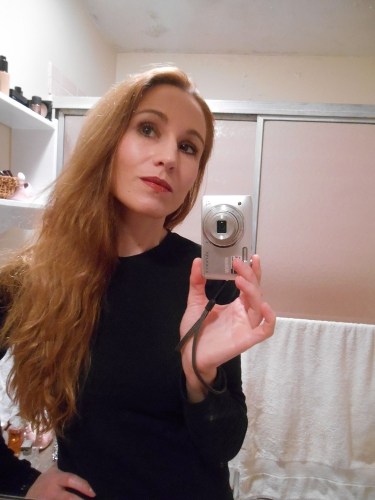
How do you get attitude? Having your picture taken is like everything else: it’s a skill, and you get better at it with practice. So take your own picture. Take it a lot. You probably have a digital camera? Discard the photos you don’t like, keep the ones you do. Think about why you like them, what makes them work for you. Think about how you like to be photographed. This is me, with attitude:

Blog Photo 7

At least, I think it’s attitude. Nothing about this picture says “I don’t think I’m worth photographing.” (Remember what I said about the terrible lighting and my tiny pink bathroom? Yeah, sorry. But if I can produce a picture I feel good about under those conditions, then I can produce a good picture anywhere.)

2. Makeup.

Sorry, this won’t help most male writers, who tend not to wear makeup. (Male actors and many male singers do, of course.) But the standards by which men judge their appearance tend to be looser, more lenient, anyway. They cut themselves more slack. This section is mostly for women, although if you’re male and doing a professional photo shoot, or if you’re on television, you may well use foundation of some sort. Or have it used on you!

So, here’s the thing: the camera isn’t taking a picture of you. The camera doesn’t know you, the wonderful scintillating person you are. The camera is taking a picture of certain planes and angles, in certain lighting. Makeup helps you control how the lighting falls on those planes and angles.

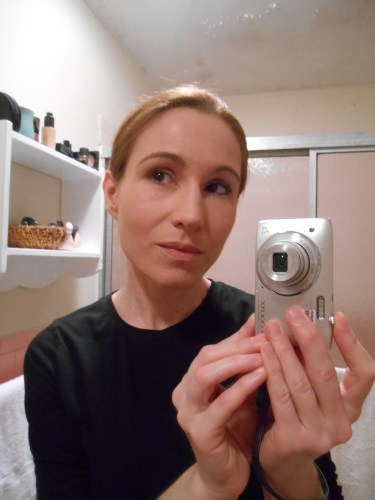
This is me, with nothing on my face except moisturizer. (And by moisturizer, I mean Proactive, because I have what is called “problem skin,” meaning that it breaks out if you say Boo! to it.) I happen to think it’s a perfectly nice face, but like this, it’s difficult to photograph.

Blog Photo 1

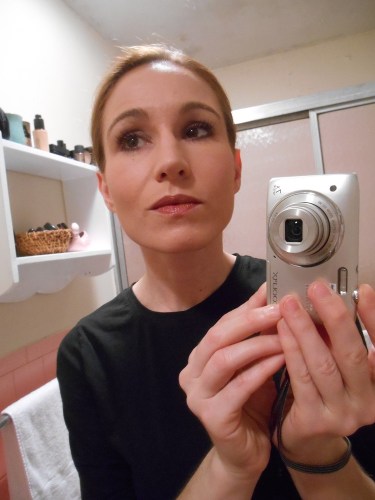
This is my face with the most important step in the makeup process, which is foundation. Here, I’ve started with a thin layer of Garnier BB Cream, then MAC Studio Fix, and then MAC Studio Fix pressed powder. That sounds as though it would be heavy, but it’s not: modern cosmetics are designed to feel light. Foundation gives me a lot more control over how light will fall on the planes and angles that are my face. (Reminder: the camera isn’t taking a picture of you. You may as well be a mountain range, as far as it’s concerned.)

Blog Photo 2

Ironically, skin with foundation on it looks more natural, more like your own skin, on camera than your own skin does. I don’t know why — I’m sure a photographer could tell us?

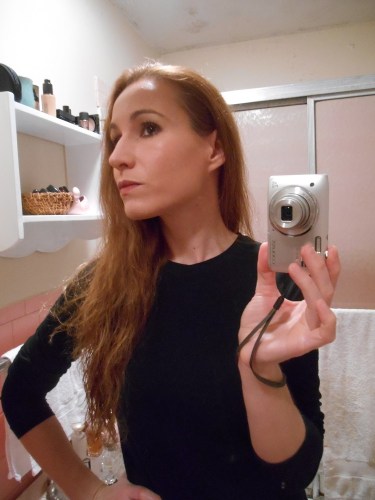
And here is my face with the color added: lipstick, blush, eyeliner, two kinds of eyeshadow (dark under the eyes and on the lids, light on the brow bone), and mascara. These are from MAC and Revlon, but I won’t give you specific names or colors, because you’ll need different ones anyway. We’re all different.

Blog Photo 3

(Oh, and by the way, any male readers who feel like telling me, at this point, that they prefer women without makeup? I don’t wear makeup for you. Both men and women have been wearing makeup since this thing we call civilization started. We wear it because we’re human, and like to play. Not wearing or liking makeup is perfectly fine, but doesn’t get you a moral cookie.)

So, why wear makeup if you’re going to be photographed? Obviously, you don’t have to. But I’ve found that it gives me more control over how a photograph will turn out. It combats the flattening and washing out that is an inevitable part of being photographed.

3. Angles.

Another reason to take photographs of yourself is so you’ll learn the angles of your face. Like all faces, yours will photograph differently depending on the angle from which the picture is taken. There’s a reason that, when I’m photographed by someone I don’t know, I turn my face to the right.

Here’s a shot of the left side of my face:

Blog Photo 4

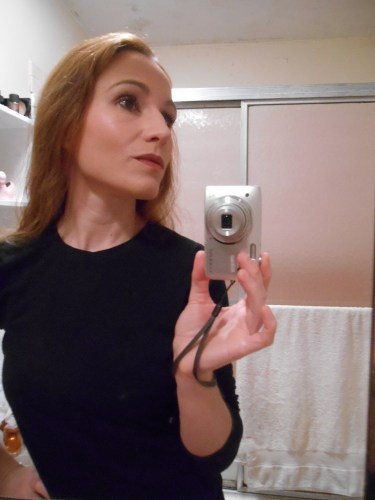
And here’s a shot of the right side (I feel like I’m doing Dovima here, and if you don’t know who she is, Google her):

Photo 9

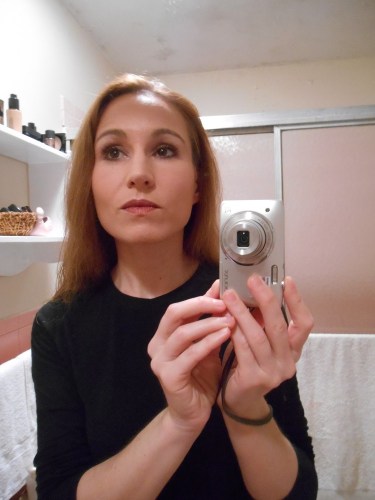
In photos of the left side, I tend to look younger, more vulnerable. Also, strangely enough, more foreign. (Hmmm. Is that a picture of my shadow self? My writer brain starts to work on this concept . . .) The right side looks older, more sophisticated. Photographers talk about your “good side”? Well, it’s my more reliably photogenic side. And here I am head-on (which is a very hard shot to take, by the way, in a bathroom mirror). I almost never take a shot head-on because my features are asymmetrical, and the photo can come out looking strange.

Blog Photo 5

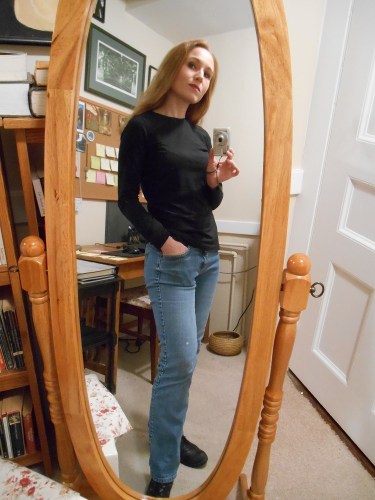
Oh, and by the way, I’ve been focused on faces. But here’s a picture of me in a full-length mirror. In this picture, I am dressed in a terrible outfit for being photographed in: loose black t-shirt, old jeans (you can see a paint splotch on them), Timberland boots for going out into the snow with. Which is actually what I did about five minutes later — go out into the snow. What makes this picture not terrible are the angles of my body. If you look at actresses on the red carpet, they all angle their bodies in a similar way to be photographed. And it’s not just because standing this way makes you look thinner (although it does). It’s because the angles add a sense of movement, and therefore visual interest.

Blog Photo 8

4. Lighting.

Lighting will make or crush and crumple up your picture. Lighting is all. That said, most of the time writers are photographed, it’s in the terrible lighting of a convention hotel. We can’t depend on good lighting.

What you need to do is work with the lighting you have. Figure out where it’s coming from, think about how it will hit your face, and turn so it’s as flattering as possible. Again, that’s something you learn from photographing yourself. That said, some lighting is never going to be pretty. For example, I went out in my Timberland boots and took some photos in the cold gray light of a winter day in Boston. Nothing you take in that light will be “pretty.” It’s just too harsh. So what do you do? If you want pretty but can’t get it, go for cool. Actually, that’s one of my principles: always go for cool. Pretty is boring. Cool has movement and impact. Cool is better.

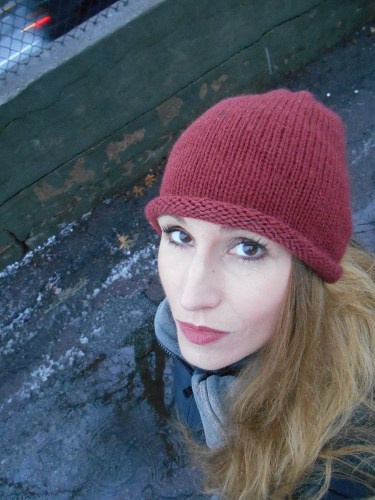
This is the best picture I was able to take in that light, and I kind of love it:

Blog Photo 9

I love the red of that hat and the lipstick, against the cold white of the skin, the gray and black of the background. I don’t think this picture makes me look attractive, but who cares? The picture itself looks interesting.

Nevertheless, there are times when we want to look pretty. That’s when you want a soft, indirect light. My desk lamp is perfect for this. It almost always gives me a good picture, like this one:

Blog Photo 10

And that’s about it! If you’re at a convention and having your photograph taken, think: where’s my lighting, what’s my angle? And at the moment that picture is taken, think, “I’m beautiful.” Because, of course, you are. (The makeup, if you choose to use it, goes on beforehand.) I can’t guarantee the picture will turn out well, but once you’re “photogenic,” you should be able to look at most of the photos of you posted online and not groan.

I’m going to end with one of my favorite photographs, from a party I went to recently in New York City. The guests were mostly writers and editors, and of course there were going to be photos taken. This was taken before the party with my camera by Marco Palmieri, who takes wonderful photos anyway. But I think you can see all the elements I’ve been talking about in it. The writers in the picture are Nancy Hightower, Valya Dudycz Lupescu, Bo Bolander, and me. We are dressed differently, we have different makeup, we are all interacting with the camera in different ways. But each of us is doing what works for us individually, and I think the end result is terrific.

Masque 1

Posted in Uncategorized | 11 Comments

Making Happy

Lately, I’ve been thinking about happiness, because I’ve been happy. Oh, I’ve also been tired, and sometimes frustrated, and sometimes cranky. But underneath, I’ve been happy, and that’s important because as you may remember, I went through a period of depression about two years ago. Serious, going-to-therapy-every-week depression. Of course, it was while I was finishing my PhD dissertation, which made me feel trapped and miserable, so that makes sense. But my point is that I know unhappy. I remember unhappy quite well . . .

There’s a message I see quite often, particularly on blogs and posted on Facebook: it’s that we alone are responsible for our happiness, and that our happiness depends on how we perceive the world. Not on our material circumstances. And I think that is exactly . . . wrong. Anyone who’s had a bug bite that itches and itches, or can’t set the thermostat so it produces the right temperature, and is always either too hot or too cold, knows it’s wrong. There are a lot of things in our lives that depend primarily on our perception, on the way we process our material circumstances. Success comes to mind: whether or not we are successful really does depend, I think, on how we see our circumstances rather than the circumstances themselves. We can define our own success. Perhaps even contentment, that sense of overall comfort, is primarily mental. Perhaps even joy.

But I believe that happiness is different: it’s a day to day, minute by minute thing. Whether I am happy at any give moment can depend quite a lot on whether or not I am eating a cupcake. If I am eating a cupcake, I am happy. (Depending on the cupcake, of course. I mean, I’m picky.) Happiness does in fact depend on things outside ourselves, so to make ourselves happy, we need to change things outside ourselves. (At least, that’s a lot easier than just trying to be happy, which I think is a very hard thing to do. Make yourself be happy, try to produce an internal state of happiness without changing anything external . . . Much easier to buy a cupcake.)

Here are the things I do to make myself happy, and notice what small things they are, how little it takes:

1. Take a bubble bath! This is my #1 go-to making happy thing, and it’s much more cost-effective than therapy.

2. Do the dishes. No, doing dishes does not make me happy. But having done them does! And this goes for all the other cleaning, straightening, organizing things as well. Making beds, vacuuming carpets, even cleaning the bathroom. Among other things, these get rid of that vaguely guilty feeling that comes from not having cleaned. But they also provide a feeling of accomplishment. You may not have finished your PhD dissertation, but hey, the dishes are done!

3. Buying and arranging fresh flowers. I know these are expensive: I’m lucky to have a neighborhood Trader Joe’s, where I can buy flowers each week. Just looking at them, on the table, the dresser, the windowsill, makes me happy.

4. Eating chocolate. Of course, it has to be the right chocolate: brownie cupcakes from Sweet, chocolate orange hazelnut torte from Burdick, even a Toblerone. But chocolate is a happy thing.

5. Painting toenails. Gold, dark burgundy, iridescent purple. Particularly fun when you know you’re going to be taking off your shoes for airport security. It’s a small sign of defiance: you want me to take off my shoes, security person? I have gold toenails!

6. Reading books. I know, I know, this one is obvious. But I also deliberately choose books that will make me happy. There are a lot of books out there that will make me unhappy, not because they’re sad, I’m fine with sad, but because they are boring or badly written. Good books are happy books.

7. Browsing thrift stores. Also antiques stores, when they’re the sorts of antiques stores in which you can actually afford things, old silver plate and transferware. I believe in retail therapy, as long as you’re doing it in a place where you’re not going to be anxious about the prices. If I can buy myself two sweaters in a thrift store for $10? I’m golden.

8. Waking by the river. I love to walk by my river and check on how it’s doing. Are the leaves turning yet? Have they fallen? What are the geese and squirrels doing? Walking in a natural space is necessary for mental health anyway: you need the sunlight, you need the wind in the treetops. But there is something particularly magical about water. If you can, walk near water. It will make you happy.

9. Listening to music. Another obvious one, but sometimes I forget how powerful music can be. And again, I’m picky. Loreena McKennit, I’ve found, is particularly happy-making.

I’m trying to think of a tenth thing I do to make myself happy, and if I think of it, I’ll mention it later. But these are the ones I could think of, off the top of my head. What I’m looking for is something easy, something you can do at a moment’s notice. For example, spending time with friends makes me happy, but that’s something I usually need to plan for. These are things I can do immediately, when I need to, by myself.

And they work even when there is something important making you unhappy, because external circumstances can do that, in a powerful way. If you feel trapped, if you feel as though you can’t do what you want — that, more than anything, will make you unhappy. Even in that circumstance, bubble baths will get you a long way. They got me through a PhD dissertation (well, and therapy).

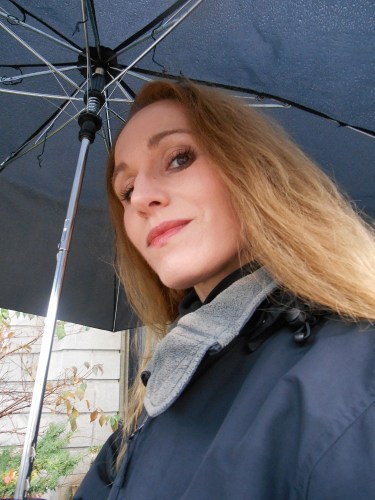
This is me, on a rainy day, walking around the city. Being very happy just to see the city in the rain!

Rainy Day

Posted in Uncategorized | 5 Comments

Having a Purpose

When I walk through the bookstore nowadays (the university Barnes and Noble, where these books are on a front table, by the coffee shop), I see so many books on finding your purpose in life. The other day, I stopped and flipped through them, out of curiosity. I didn’t buy one, because I’ve always had a sense of purpose, as long as I can remember. I don’t need to find one, thanks. But it’s not just in books: there are videos out there, programs on the internet, all on finding a sense of purpose.

I’m not going to write about finding your purpose in life.

The strangest, for me, was a video on living purposefully. If you don’t have a sense of purpose, said the man in the video, you can still live purposefully, mindfully. Which seems like a good idea anyway, but is not at all the same thing. It struck me as strange because living that way was offered as a substitute for having a sense of purpose, as though we all need a sense of purpose. These books and videos and programs all imply that it’s important to have a purpose in life, that without it you’re missing something.

As someone who’s always had a strong sense of purpose, my response is that it’s not, and that having a purpose can actually be — painful, troublesome, disorienting. Keep in mind that this is based on my experience, so someone else who has a strong sense of purpose could describe it quite differently. But here’s what it looks like in my life.

I’ve always known that I was a writer. Not just that I wanted to write, but that I was, at my core, a writer. As a child, I read and told stories. As a teenager, I read and published poetry in the high school literary magazine. As a college student, I read and published poetry in the college literary magazine. I was an English major because I couldn’t imagine studying anything other than literature. As a law school student, I read when I was supposed to be studying for exams, and I wrote a novel. I started publishing poetry in literary journals. As a corporate lawyer, I kept novels in my office desk and read them during lunch. I plotted my escape, when I could return to graduate school to study English literature. In graduate school, I read and read and read, and I went to two summer writing workshops, using my stipend to pay for them. I wrote short stories and started publishing them in magazines and anthologies. After graduate school, I made the decision to teach writing rather than literature, because I was a writer, to my core.

I experience writing not as something I’ve chosen, but as something that has chosen me. I have work I need to do, and that work is writing, and my life is in that work. My purpose in life is that work. If I’m not writing, I start to feel sick, anxious. I start to feel as though I have failed.

I wrote down some of the ways that having a sense of purpose affects one’s life, or at least my life. When you have a purpose,

1. You prioritize that purpose above other activities. Like sleep.

This is not necessarily a good thing, since sleep is important. Eating is important. Having an actual life, other than the fulfillment of your purpose, is important. But all of that can seem unimportant when I haven’t written for a week, and it’s midnight, and I tell myself that instead of going to sleep, I’m just going to look at that story or part of that story, just that one paragraph. I’m not going to revise anything. But as soon as I open the document, I’m gone, into another country — and the next time I look up, it’s three a.m.

2. You make decisions based on your purpose that can make other people wonder what you’re thinking.

Like, for example, giving up a career as a corporate lawyer because I knew I could never be a corporate lawyer and write.

3. You strive for perfection in your art, which is not in fact achievable.

You try to write perfect sentences, perfect stories, even perfect novels. (Trying to write a perfect novel with perfect sentences is a good way to drive yourself mad.) There is no such thing as perfection in prose. There is perfection in poetry, but the only perfect poem was written by John Keats, and you are probably not John Keats, and your poem is probably not “Ode to Autumn,” so you’re probably out of luck. But you’re going to try anyway.

4. You have both overweening confidence in your abilities, and abject self-doubt.

You are smart enough to know your own talent, but also smart enough to feel your limitations and shortcomings. After all, if you have a sense of purpose, you’ve probably been practicing your art in one way or another since you were a child. And you compare yourself to the best that has come before you. So there are days when you say to yourself, I’m not Virginia Woolf, therefore I am a gnat. You are perpetually disappointed in yourself, and yet perpetually working harder to get better at what you do, because you don’t want to be a gnat.

(Are you surprised that writers have breakdowns, after what I’ve written?)

5. Your purpose can, potentially, fill all of your life. All of it, with meaning and striving and fulfillment.

Which is wonderful, except when you realize that there are other things in life as well, like sleep. And eating. And maybe taking a class in Japanese, but not so you can write about Japan in a story. Because it’s so easy to do things only so you can write about them in a story . . . Having a purpose can fill your entire life, which is why I think there are so many books about having a purpose. Because we all want meaning, fulfillment.  But it can also substitute for having a life.  It can also lead to overwork, depression, breakdown.

So I wonder if having a purpose is rather like having an illness or addiction, and people who don’t have one, or aren’t sure they have one, should instead simply live their lives, and enjoy them? I mean, look at the lives of the great writers, the great artists. Do you really want lives like those? Unless you can’t help it . . .

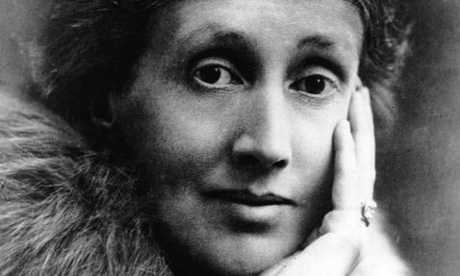
This is Virginia Woolf. Whom, as I may have pointed out, I am not:

Virginia Woolf

Posted in Uncategorized | 4 Comments

What I’ve Learned

I had a birthday recently. And I thought about the things I’ve learned so far in life. There are a great many of them — after all, I have two graduate degrees, so I must have learned something. But I mean those fundamental lessons that you hold on to, that you use every day or week. And since it seems to be the fashion to make lists, I thought I would make a list of some things I’ve learned so far. This is, obviously, in no particular order — except the order in which I wrote them down.

1. You can tell the people who are strong, because they are also kind.

I’ve found this to be generally true, that people who are strong, who are confident and sure of themselves, certain about who they are and where they’re going, are also kind. They have no need to hurt others. The people who have hurt me have inevitably done so out of weakness, because they were uncertain about where they were going, unsure about who they were in the first place. Knowing that makes it easier to forgive people who hurt you. It’s also useful to know that when you are unkind, it’s usually because of some weakness in yourself.

2. It’s possible to live an extraordinary life, but it takes an enormous amount of work.

I know people who live extraordinary lives, who are creating great works of art, traveling all over the world. And they work very, very hard. Their example shows me that I, too, can have an extraordinary life. And to get working . . .

3. Almost all of your clothes can be washed in a machine or by hand. Except ballgowns: always get ballgowns professionally cleaned.

I suppose I should add business suits to that list, but I don’t have any business suits. That was one reason I left the law: I never wanted to wear a business suit again. And almost all of your clothes can be washed in hotel sinks, which is useful to know when you’re traveling all over the world, living that extraordinary life. (But jeans and socks take a very long time to dry.)

4. There will come a day when you realize that you’ve gotten everything you wanted, and then you will need to decide whether you wanted it after all, or were simply fulfilling the dreams that others or society had for you.

The earlier this day comes, the better, because it often involves a course correction. You may well decide that after all, the house in the suburbs and what was supposed to be a secure career make you feel like jumping in a lake. That you feel as though your soul is turning brown like one of your houseplants. It is better to change your life than jumping into a lake — harder, but better.

5. You must take care of your skin.

Cleanse, exfoliate, moisturize, apply sunscreen. As though you belonged to some obscure church of the skin, in which this ritual was considered necessary for the salvation of your immortal soul.

6. Clothing sizes bear absolutely no relation to the size of clothing.

The numbers on clothing bear no relation to anything on the material plane. They are a secret code used to communicate with spiritual beings in other dimensions, and are beyond our primitive understanding. Ignore them.

7. Everything you want to accomplish takes longer than you want it to take.

I’ve found that everything I’ve ever wanted, whether it’s going to graduate school, finishing my PhD, moving into the city, has taken me a year longer than I wanted it to take. When I desperately want to do something, and it isn’t getting done, I think — oh yes, the one year rule.

8. Learn how to be alone, or you will end up staying in relationships long past the time when you should have left.

I’ve seen so many people stay in relationships because they were afraid to be alone. Or get into relationships for that reason. It is much worse to be in a relationship that makes you feel alone than to actually be alone.

9. Your habits create who you are.

I hate to admit this, but it’s so true: what you do every day creates the person who are. At some point, I started exercising every day, and I started looking different. Like a person who exercises every day . . . When I write every day, I feel like a writer, I publish like a writer. When I don’t write every day, I feel lost. The small habits, the sleeping and eating and exercising and working, even what you wear every day, create who you are as a person. We like to think that we are who we are, and our habits come out of that — but we create who we are incrementally, out of all our habits. Day by day by day. (Which means we can also change ourselves, incrementally.)

10. You can buy happiness, but it’s called something else.

You can’t actually buy happiness, but you can in fact buy something that makes you happy. The trick is, that thing has to make you more the person you want to be. That’s what makes you happy, not the thing itself. Some time ago, I bought an adorable pair of pixie boots at Goodwill. They were $10 (the price is still on the bottom of the boot, in silver marker). They would not have made me happy if they had been too expensive, because that would have gone against my idea of myself — as someone who does not spend a great deal of money on clothes, but is nevertheless more chic than many people who do. Every time I wear those boots, I feel as though I’m dancing along the streets, as though I’m some sort of urban princess. They make me happy, because they allow me to be the person I want to be. Another thing that makes me happy? Buying plane tickets. So you can in fact buy happiness, but it’s called “pixie boots” or “plane tickets” or “dark chocolate.” If you’re unhappy, buying a little bit of happiness is not such as bad idea.

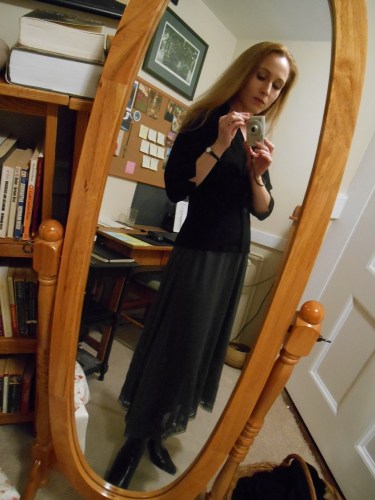
Here, by the way, are those boots, with a gray lace skirt and black jacket I wore to the theater this week. “Theater tickets”: that’s another way to buy happiness.

Jacket 1

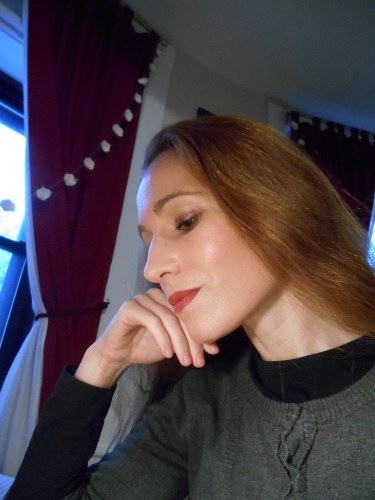
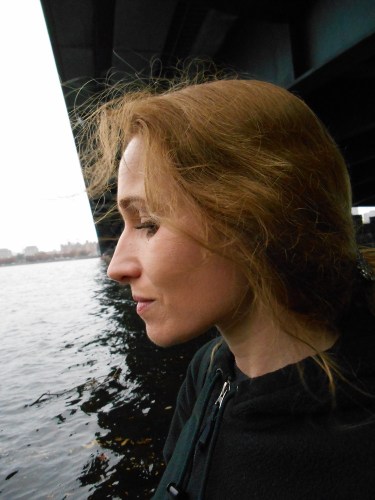
I’m sure there are things I could add to that list? I have, after all, learned more than ten things so far . . . But I’ll have to think about what they are. I thought I would end this blog post with a picture of me by the river, being pensive. And perhaps a little wiser than last year.

River Witch

Posted in Uncategorized | 8 Comments

Alone Time

I’m so tired!

I’ve been meaning to keep up with this blog, to write three times a week, but there’s so much else to keep up with. So much taking energy . . .

It’s not the work, although I have a lot of that. But it’s manageable. What tires me out is the people — don’t get me wrong, I love people. And I have the good fortune to work with absolutely wonderful people — smart, dedicated students and supportive colleagues who are continually innovating in their work. I love everything I do . . .

My problem is that I’m an introvert, and hypersensitive (meaning that I over-respond to stimuli, like bright lights or medicine), and even a bit sensory defensive. So although I love people, I need alone time, when I can sit in a room, with the light dimmed, and do something like listen to soft music. All by myself.

I know I’m not the only one. Since I have so many friends who are writers and artists, many of my friends need alone time as well. They tend to be introverts, people who want to go deeply in life rather than broadly. And deeply often means deeply into themselves, which you can only do when you’re alone. The challenge of being an introvert, of drawing your energy from alone time and expending it during time with other people, is that you can go too much into yourself, spend too much time alone. I have to make sure I get out and socialize, not just see people during work.

(I have sixty students. So almost every day of the week, I’m with people. And I live in a large city, where when I step out the door I see people. Although sometimes being in a large city, where you don’t actually know the people you see on the street, can be refreshing, and not so different from alone time. There’s something lovely about anonymous time as well . . .)

In addition to spending this week with people, I’ve been sick, which always lowers my threshold for sensory stimuli. Some days, all I wanted to do was stay in bed . . .

So the trick is, trying to figure out how to get enough alone time in my days so that I can function well, because if I don’t get that alone time, I find that I’m tired and cranky. And you can’t really be cranky when you’re teaching. One thing that helps is going down to the river, who is a very restful sort of neighbor. (The river is almost out my back door, separated from me by a bridge. When I walk over the bridge, I’m right there, on the riverbank.)

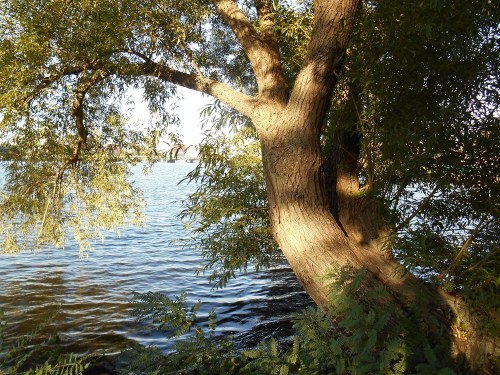
I thought with this post I would include some photos of my favorite willow tree, whom I like to visit when I walk by the river. Here it is!

Willow 1

Willow 6

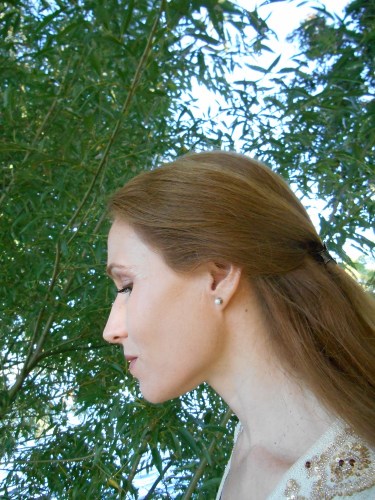
And here is me trying to be a willow spirit. Sometimes I just go and sit by the willow. I look at the river — I think looking at water is a good way to still and refresh the mind. We live metaphorically, although we often don’t realize it. Water is a metaphor for the unconscious, for the depths of the mind itself, and so looking at water can help you get there, to that still, deep part. And it can be cleansing, as water is. This was me after a long day of teaching, down by the willow . . .

Willow 3

(I feel as though I should write about this? Life as metaphor. When I have a little more time . . .)

Posted in Uncategorized | 3 Comments

The Little Things

I would make a terrible Buddhist.

I’m no good at non-attachment, and I’m not sure I would want to be. I get attached to all sorts of things, places and people and even teacups, and I get very sad when I have to leave, or I lose a friendship, or a teacup breaks. I should, of course, be philosophical and tell myself that all things pass away, but I can’t. I would rather feel the pain of loss and disappointment than be safe from it, in my own sensible, philosophical calm.

I’m too in love with the physical world, with the texture and experience of it: city streets, and tree bark, and oatmeal in the mornings with orange juice and a chai latte, and a vase of flowers to greet me, and twilight. Oscar Wilde once gave some very good advice, through the mouth of Lord Henry Wotton I think: “Nothing can cure the soul but the senses, just as nothing can cure the senses but the soul.” I look on this as accurate medical advice, at least for problems of the soul. (I haven’t had problems of the senses — they have all been problems of the soul, soul aches. Some of us are prone to them, I think.) So when I have an ache of the soul, I go on a walk and look at the river, or have a bowl of brownies and ice cream (together), or take a bubble bath. I go to the senses.

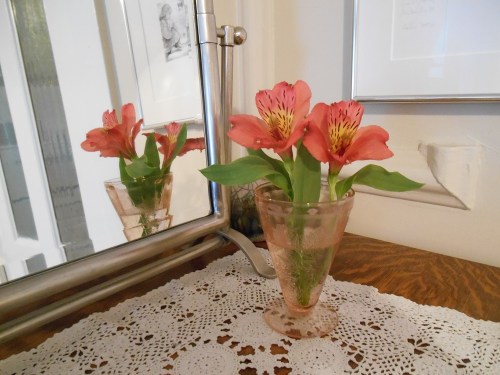
The little things can save you. Flowers in a vase, a doily on a wooden table, a painting on a wall. A book of fairy tales. Walking by a garden, or beneath a tree.

I can’t become unattached from the world, because the world is so splendid, heart-breakingly so. And that means my heart will indeed break, probably over and over again, but the cure for heartbreak, for aching of the soul, is the world itself in all its splendor. Particularly the little things: they tend to heal more than they hurt. A vase of flowers will probably not break your heart, but it will help ease heartbreak. They are the cures for the big things, the heart-breaking things. I don’t think you can have the healing without the heartbreak, the flowers without the hurt. Non-attachment means giving up desire, and therefore also escaping from suffering. But I don’t want to give up desire, even for a skirt that swirls around my ankles as I walk. Even for a soft blanket to curl up in, or a teacup with pink roses on it. Which means that I will suffer when the teacup breaks, or the skirt wears out. All things break, all things wear out eventually. We all die.

But I don’t think you get the splendor without the suffering. And I know that you can’t make art without the suffering. There is no necessary connection between art and suffering — but I think that to make art, you have to accept the ordinary conditions of being human. Saints, who have renounced the world, are the subjects of art rather than artists.

But my main point here isn’t about art or suffering. It’s about the little things, like flowers in a vase. Make sure you pay attention to the little things, for they will save you.

Pink Flower

Posted in Uncategorized | 4 Comments

True Partnership

I’ve been thinking about relationships lately, partly because I have an idea for a book. Not the one I’m currently working on, which doesn’t focus on relationships — it focuses on friendships between women. But I mean romantic relationships, not friendships. We’ve had this idea, for the last hundred years or so, that we’re all supposed to be looking for True Love.

I say the last hundred years, because the idea of falling in love and then spending the rest of your life with the person you fell in love with is a fairly recent one. We trace romance back to the chivalric ideal, the Romances of the medieval period. But that was a very different ideal — there, your True Love was not the person you spent the rest of your life with. Romantic love happened outside the marital bond, and was destructive to it. Tristan and Isolde does not end with the marriage of Tristan and Isolde. It’s not until the eighteenth century, but even more so the nineteenth century, that we get people falling in love, getting married, and presumably living happily ever after — in a sense, the novel takes the plot of the fairy tale and moves it into the domestic sphere.

So we get the fairy tale idea of True Love, which we are all supposed to wish for, to try and find. I’m afraid I’ve gotten cynical about that lately. When you’re a writer, and interested in people, and good at listening, people tell you things — as though you were Hercules Poirot. And sometimes the relationships that look so lovely on the outside aren’t so lovely after all, when you hear about what happens on the inside. The thing is, someone can love you and still treat you horribly. Or at least, that’s what I’ve seen in some relationships. Tristan and Isolde weren’t so good to each other either.

So I have a different ideal than the cultural one, which is True Partnership. I see this too, and not infrequently. I suppose True Partnership includes True Love, but I think of it as a relationship in which love is not simply an emotion that the partners feel for one anther: it is instead a constant basis for action. Love is a verb, not just a noun. The people I know who seem to be True Partners (seem to be because of course we can never get inside a relationship) are each wholly themselves — they each have their own lives. But in addition, they also have a life together. That life allows them to develop as themselves, to keep their own identities. It does not operate as a constraint on who they are, and indeed it helps in their self-development. Each partner becomes more himself or herself in the relationship. Separated, they would each still be whole — but together, they are more than the sum of their parts. True Partnership involves both freedom and togetherness, both independence and trust.

I read an article recently about a couple who had done everything together, all their lives. At the end of their lives, they died within a week of one another. A lot of people though that was sweet — I thought it sounded like a play by Jean Paul Sartre. It would be claustrophobic, not to have one’s own life and identity, to be only a couple. And I’ve met people who hesitated to do what they wanted because the other partner would disapprove. Who quite literally needed to ask permission — whether to attend a social event or pursue their professional goals. I’ve never understood living like that.

The picture I’m going to include at the end of this blog post is of Elizabeth Barrett Browning and Robert Browning. They seem, to me (and again, one can never get inside a relationship), an example of what True Partnership might look like. They weren’t interested in destroying each other, and would make for lousy opera. But they seem to have had a marriage that was truly good for them both.

(I suppose I’ve seen too many relationships in which people love each other, but at some level don’t actually like each other? They would love each other more if the other person could change, just a little . . . could become more of what they want in a mate. That’s a deadly sort of relationship. At least, I think it is, although I see it plenty.)

So, that’s my ideal: a True Partnership. Because I’m not sure that True Love is enough. I love opera, but who wants to end up in one?

Elizabeth Barrett Browning and Robert Browning

Posted in Uncategorized | 12 Comments