Living Our Metaphors

“I haven’t a clue as to how my story will end. But that’s all right. When you set out on a journey and night covers the road, you don’t conclude that the road has vanished. And how else could we discover the stars?” —Nancy Willard

I found this quotation at the top of a terrific blog post by Justine Musk: “the epic feminine: welcome to the epic story of your life (+ how to make it a good one).” It made me think about how we tend to live out our metaphors.

Once, a friend of mine told me that she had started running. She was running a lot, probably too much — eventually, she would train for a marathon. At the same time, she was in a relationship in which she was desperately unhappy (it would later end). I asked her, “What are you running from, or to?” Running was a metaphor: she wanted to get away from the relationship, get to something else. But she couldn’t, at least not at that particular moment. So she started running. When we look at our lives, we often find that we behave in metaphorical ways. If we can read these behaviors, as though they were texts (metaphors in words), we can understand what we truly want, or don’t want.

I’m thinking about this because I’ve been doing a lot of traveling this summer. And the question is, how do I read that action metaphorically? What does it tell me about myself?

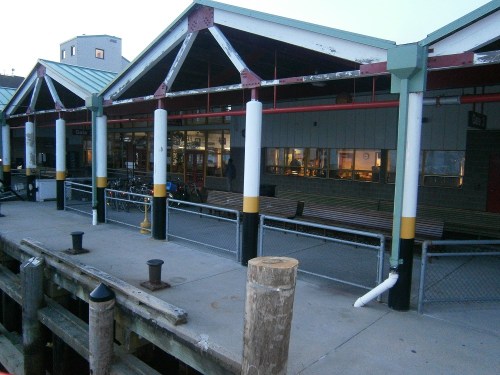
Tonight, I’m writing this in a house on Peaks Island, Maine. I’m staying with the wonderful Catherynne Valente, who lives here (and travels a lot herself). I arrived yesterday, and it was an adventure getting here. I’d been in Brunswick, Maine, teaching at the Stonecoast MFA Program, so the first step was taking the train to Portland. Then I took a taxi to the ferry station, which looks like this (from on board the ferry).

OLYMPUS DIGITAL CAMERA

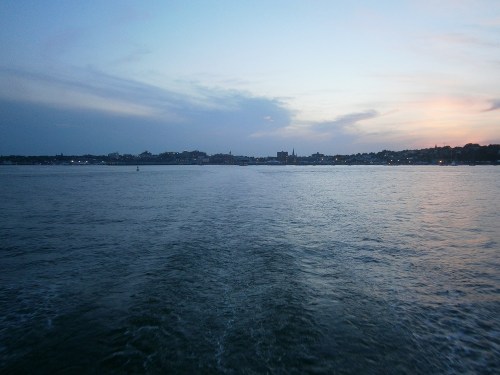
And then we set out across Casco Bay, to the island. Here is Portland, with the sun setting over it, from the back of the ferry.

OLYMPUS DIGITAL CAMERA

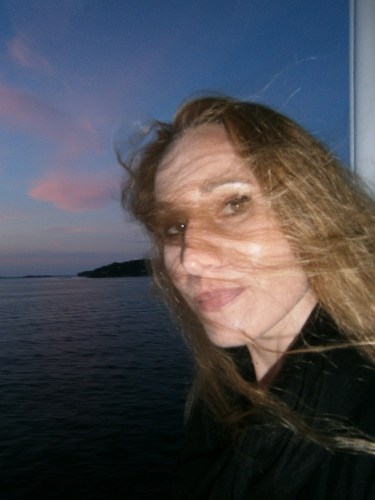
And here is me on the ferry, heading toward the island. Heading into the darkness. It was a windy night, and my hair was everywhere.

OLYMPUS DIGITAL CAMERA

I think I’ve been traveling so much because I don’t know where I’m going. Traveling in space becomes a way of thinking about traveling in time. I’m living out the metaphor. Perhaps by doing so, I’ll come to a better understanding of my life.

I haven’t a clue as to how the story will end. I’m a character in it, not the author of this particular narrative. Which, to be honest, is difficult sometimes — I wish I could skip ahead to a later chapter, make sure our protagonist is still all right. Make sure that, if she hasn’t gotten her happy ending yet, she’s headed there, or has at least learned something worthwhile along the way. And yes, sometimes it’s night and I wonder if the road has vanished, or if there was no road in the first place — if I imagined the road. (But perhaps I’m in a ferry, moving across the water?) However, we can’t know our own stories before they happen.

All we can do is trust them, and try to understand how we are living them. Try to read our own metaphors . . .

Posted in Uncategorized | 3 Comments

The Question

If you follow this blog at all, or follow me on Facebook or Twitter, you know that I have a corkboard over my desk. On it, I have several stickies on which I’ve written quotations that I want to remember. Here are a couple of them:

If you ever find yourself in the wrong story, leave. –Mo Williems

Do what I do: hold tight and pretend it’s a plan. –The Doctor

What would you do if you weren’t afraid?

(I don’t know who said that last one, but I know I read it on Terri Windling’s blog.)

I’m thinking of addinga  sticky to the corkboard, but what I want to write on it is such a self-help cliché that I’m hesitating. Which is silly. What I want to write is a question, and it’s an important question for me to remember, because it’s one I should be asking frequently. Here it is:

Am I loving myself?

Love is both a noun and a verb: it’s both an emotion and an action. To love someone means not just to feel love for them but to act lovingly toward them. The act itself is a manifestation of love. So when I ask, am I loving myself, I’m not just asking how I feel about myself. I’m asking how I’m treating myself, whether it’s with love.

Obviously, the answer is often no . . .

Often, I don’t in fact treat myself particularly well. I get mad at myself and tell myself all the ways in which I’ve failed, or I’m inadequate. I don’t give myself the things I need: time to rest or take long walks, nourishing food. I push myself too hard. I blame myself for not giving other people what they need or want, even when it’s not possible or would involve significant sacrifice.  Or I just make the sacrifice. (Is this a familiar list? I bet you’re nodding.)

What I need to do is treat myself as though I were in a relationship with myself. (In a sense, I am.) I need to take myself out, give myself treats, show myself that I care. Make sure that I’m taken care of. I’m not always so good at this . . .

That may seem selfish in that it’s self-ish, about the self, having to do with the self. But I think if we don’t love ourselves first, we end up not loving other people particularly well either. We start to resent them, because we know that we are missing something. We may expect them to supply that thing, but you should never depend on another person to supply the love that you aren’t giving yourself. That’s your job, not theirs.

So the question is there to remind me: I’m not going to useful, or productive, or loving, unless I love myself. And that’s an action, or rather the action is as important as the emotion. In fact, the emotion doesn’t need to be there for me to take action. Even when I don’t feel love for myself, I can act lovingly toward myself. I can buy myself flowers, take myself on a long walk, give myself time to rest. And then, often, the emotion will come — I will remember that I do love myself, despite how much trouble I can be sometimes.

I thought I would include two photographs in this blog post. The first is of me with the students at the Alpha Science Fiction, Fantasy, and Horror Workshop for Young Writers, where I was teaching last week. I had such a wonderful time at Alpha!

OLYMPUS DIGITAL CAMERA

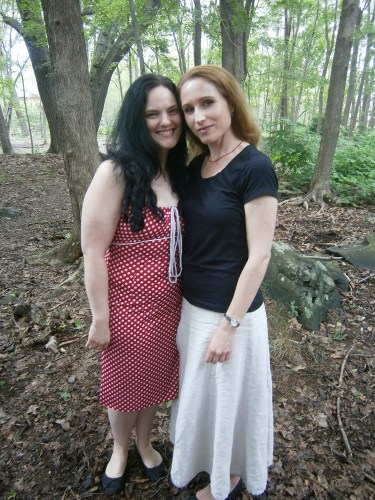
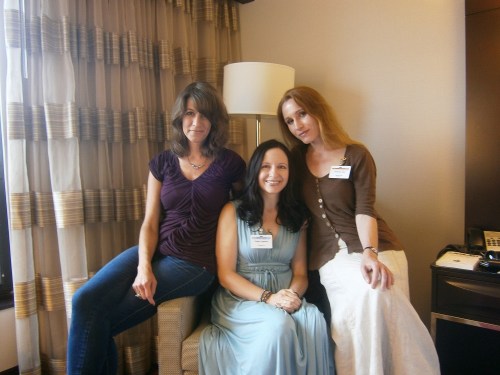
The second photo is of me with two lovely friends of mine, Nancy Hightower and Valya Dudycz Lupescu. This was taken at Readercon, the convention I attended last weekend.

OLYMPUS DIGITAL CAMERA

I’m including them because loving myself also includes doing what I love: teaching wonderful students like those at Alpha, and spending time with my wonderful friends.  Those are gifts I give myself, like buying myself flowers.

Posted in Uncategorized | 6 Comments

Self-Reliance

Yeah, I know. Ralph Waldo Emerson wrote an essay called “Self-Reliance,” and I’m not exactly going to top that, am I? Anyway, I’m not trying to rise to his level eloquence. This for example:

“A man should learn to detect and watch that gleam of light which flashes across his mind from within, more than the lustre of the firmament of bards and sages. Yet he dismisses without notice his thought, because it is his. In every work of genius we recognize our own rejected thoughts: they come back to us with a certain alienated majesty. Great works of art have no more affecting lesson for us than this. They teach us to abide by our spontaneous impression with good-humored inflexibility then most when the whole cry of voices is on the other side. Else, to-morrow a stranger will say with masterly good sense precisely what we have thought and felt all the time, and we shall be forced to take with shame our own opinion from another.”

Yeah, I’m not competing with Ralph . . .

Anyway, this is about a particularly small and local kind of self-reliance: the kind that allows you to visit a museum by yourself, or eat dinner by yourself in a restaurant. I’m writing about it because I know a lot of people who don’t feel comfortable doing those things. Either they don’t feel comfortable being alone or they don’t feel comfortable having other people see that they’re alone. Those are two different things, of course — and I’ve met people who fall into both categories.

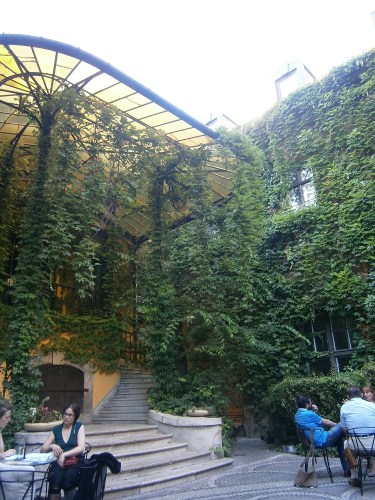
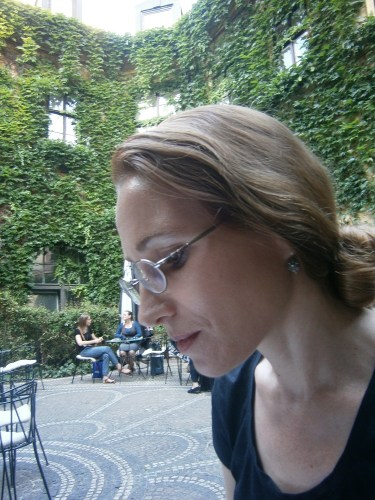
I thought I would include some pictures of me eating dinner on my last evening in Budapest, all by myself at my favorite restaurant. Here is the courtyard of the restaurant:

OLYMPUS DIGITAL CAMERA

I can only speak for myself of course (Ralph would probably agree with that), but I value my solitude. I love spending time with people, but if I don’t get time to spend with myself, by myself — I become quite cranky. It’s part of being an introvert, I suppose. I love to travel by myself, and one benefit of doing so is that I get to see what I want, to think my own thoughts about it rather than having to tell other people what I’m thinking or having them continually tell me what they’re thinking. My favorite hosts and guides are the ones who simply let me do what I want, and I try to be that sort of host or guide myself, when people are visiting.

So, while I love people, I also love spending time alone. I suppose that’s one reason I feel so comfortable going to a museum by myself, or sitting in a restaurant by myself. But also, I always seem to meet people that way . . .

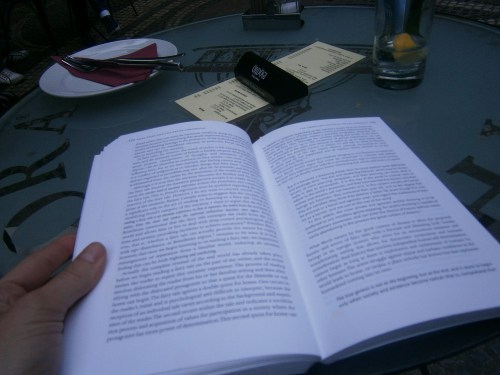
This is the book I was reading in the restaurant: Jack Zipes’ Fairy Tales and the Art of Subversion. So I suppose, really, I wasn’t alone. I had the cantankerous, opinionated Zipes with me, and I had my favorite waiter to talk to, and I was surrounded by people speaking in English and Hungarian. It was lovely to sit and experience all that, without distractions.

OLYMPUS DIGITAL CAMERA

The other reason people feel uncomfortable being alone has nothing to do with missing other people — they would feel perfectly comfortable being alone in their houses, as long as no one could see them. It’s that being alone is accompanied by a sense of shame. It’s as though being alone implies they have no friends, that they couldn’t find anyone to go with them. They are self-conscious. And I understand that — our culture emphasizes extroversion, the importance of being social and having friends. I guess the thing is, when I’m doing something alone, I never feel a sense of shame — I always have a conviction that I’m being fascinating and adventurous. Surely anyone who notices me is thinking, who is that woman sitting by herself? What is she reading? She looks so chic and sophisticated, all by herself . . . At least, that’s my conviction. But, probably more accurately, I suspect that no one notices or cares. That no one is judging me — everyone around me is simply going on with their lives.

It seems silly, to be ashamed of being alone . . .

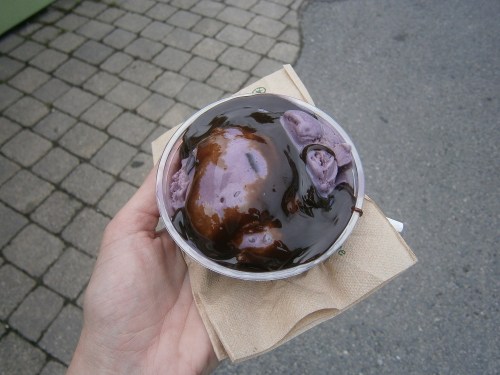
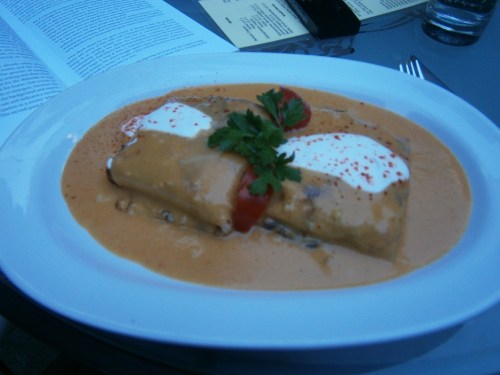
This, by the way, is what I had at that final dinner: Hortobágyi Húsos Palacsinta. It’s one of my favorite dishes in the whole wide world, but you can only really get it in Hungary.

OLYMPUS DIGITAL CAMERA

It’s important, at least for me, to be self-reliant. To be able to travel by myself, go into a foreign city with a map and walk around. To figure out exchange rates, visit the museums. Go to restaurants. Ask for help if I need to, laugh when I mess up.

And to be alone.  I love my friends, who are wonderful.  But I also need my alone time; I also need to wander around a city all by myself, looking into shop windows, browsing the bookstores, thinking my own thoughts . . .

OLYMPUS DIGITAL CAMERA

I’ll send with something Ralph said, because he’s good people, is Ralph:

“Trust thyself: every heart vibrates to that iron string. Accept the place the divine providence has found for you, the society of your contemporaries, the connection of events. Great men have always done so, and confided themselves childlike to the genius of their age, betraying their perception that the absolutely trustworthy was seated at their heart, working through their hands, predominating in all their being. And we are now men, and must accept in the highest mind the same transcendent destiny; and not minors and invalids in a protected corner, not cowards fleeing before a revolution, but guides, redeemers, and benefactors, obeying the Almighty effort, and advancing on Chaos and the Dark.”

Posted in Uncategorized | 5 Comments

An Adventuress

I want to be an adventuress.

But that term has been used in some pejorative ways, so I have to specify what I mean by it. What I mean is a female adventurer. You know, like those Victorian women who went to distant lands, and learned the local languages, and climbed the Himalayas — often in not very practical Victorian clothing. Why then don’t I simply use the term adventurer? I suppose because it doesn’t have the same feel to it, the same sense of breaking boundaries and doing it with a sort of style and grace. I want some of the connotations of the word. But not others, because the term often describes women who use their charms and wiles to live off men — and that’s the opposite of adventure. An adventure requires self-reliance, guts. An adventure involves discovering yourself.

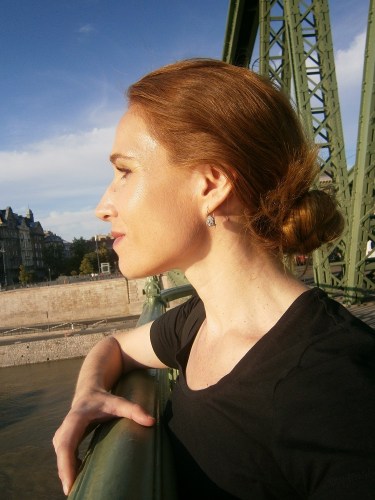
This was the conclusion I came to, that I wanted to be an adventuress, after returning from Europe. Which happened yesterday, actually. Yesterday morning I was in Budapest, and today I am in Boston. This is the last picture of myself that I took in Hungary, leaning against the railing of the Szabadság híd (Liberty Bridge), looking at the Danube. It was almost sunset: Budapest has the most gorgeous light at sunset.

OLYMPUS DIGITAL CAMERA

What I learned, being in Europe for two months, was how easily I moved around, how much I loved the act of traveling. Of looking out a train window. Of getting into an airplane and flying to another country. Of carrying adapters, and trying to figure out new plumbing arrangements, and making my way in another language. Did you know that in England, there are no electrical outlets in bathrooms? It’s illegal, so you have to go into another room to dry your hair. Also, all over Europe, it’s useful to know the term “to take away,” which is equivalent to the American “to go,” because you are charged more for food that you’re going to eat in.

I like going to museums and seeing original paintings for myself: Renaissance art, for example, looks completely different for real than it does reproduced. It’s only when you see it for real, and up close, that you realize its complete brilliance. In Brussels, I saw Landscape with the Fall of Icarus by Pieter Bruegel (at least we think it’s by him, but maybe not say the art scholars). I had the impulse to bow before it, as though I were meeting an important personage . . . I like figuring out maps and metro systems, walking through a strange city and seeing the architecture, coming upon small cafés and bookshops. In Budapest I found an English bookshop and bought too many books. In Brussels I came across an outdoor antiques market and bought some English transferware coffee cups. Ever after, I can look at those things and say, yes, I found that copy of Margaret Atwood’s Alia Grace in Budapest. Or I brought those cups all the way back from Brussels.

There are good and bad things about being an adventuress. It means that I’m not very good at living a quiet life. I need to be doing things, going places, and there’s a sort of restlessness in that: I always feel as though I should find contentment in simply being. But that’s not who I am, and I think it’s better to accept that about myself than fight against it. I want a life of adventures and new experiences — sometimes those are uncomfortable and inconvenient, sometimes they can even be frightening. I don’t like inconveniences any more than the next person, and I try to avoid dangers. But the lure of adventures, of new things, even the smallest — of using different kinds of money, eating different kinds of foods! That is a great and powerful lure.

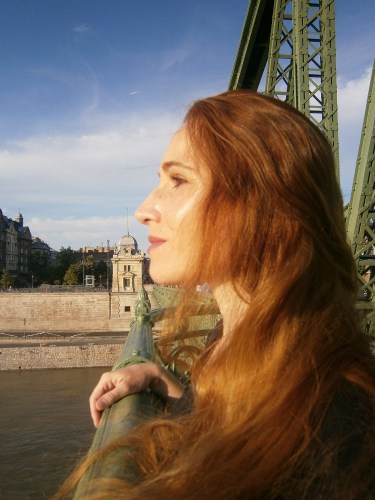
I think I’ll add one more picture, also of myself looking at the Danube that final evening. It was hot and I had put my hair up — I twist and tuck it, and it stays up by itself. But the bridge was windy, and the wind blew my hair down, so I ended up with this. I’m ending with it because I think it makes a fine Portrait of an Adventuress.

OLYMPUS DIGITAL CAMERA

Posted in Uncategorized | 8 Comments

Grand Narratives

When I was in London, I had a long talk with a friend of mine who said something that struck me. He said that in his life, he wanted a “grand narrative.” And he had gotten one: he’s a musician, composer, and rock star. He had decided on things he wanted to do in his life, and he had done them, and they did in fact create a grand narrative — a fascinating story. His biography would be a terrific read.

I think many, perhaps most, people don’t want a grand narrative. I’ve known many that do, but then I spend my time with writers and artists, and they are more likely to want their lives to be fascinating stories. They are more likely to want grand narratives. (Although many of them don’t want grand narratives either — they simply want to do the work, and have the work speak for them.)

It seems almost vain or frivolous to want a grand narrative for one’s life — as though one should be satisfied with the work, and with a measure of security that allows one to do the work. And yet, it’s hard not to want a fascinating biography, a life in which unexpected things happen. At least, I find it hard not to want that, and after all, here I am writing this post at a coffee shop in Budapest. That’s pretty dramatic, isn’t it? And here I am telling stories about my life, on this blog, and Facebook, and even Twitter.

The pictures I’m going to include in this post are from the Hungarian National Gallery, the art museum I visited yesterday. Here is the art museum, which is housed in the castle on Castle Hill.

OLYMPUS DIGITAL CAMERA

Pretty dramatic, isn’t it? I think it’s hard not to want a certain amount of drama and excitement in our lives. And to be honest, what I’ve noticed is that the people who want it, who want the grand narrative, tend to get it. They do in fact tend to have dramatic lives, the sorts of lives that would make good biographies. I suppose that to a certain extent, we all get what we want, what we expect for yourselves, because that’s what we work for.  (Not completely, of course, which is why I qualified that statement.  But our expectations do seem to determine our possibilities, at least in that what we don’t want or believe we can have, we usually don’t try for.)

This is the castle from below, when you’ve climbed down the hill and are ready to cross the Chain Bridge.

OLYMPUS DIGITAL CAMERA

And this is the Chain Bridge, which is also pretty dramatic, with all its lions. I think every bridge needs lions, don’t you? Lots of lions, as many lions as possible and as good taste will allow. We all need lions to add drama to our lives.

OLYMPUS DIGITAL CAMERA

And finally, here is me on the Chain Bridge, in front a beautiful design and some graffiti. That’s so Budpest: the Art Nouveau decoration and the graffiti both.

OLYMPUS DIGITAL CAMERA

Many of my favorite writers and artists did have grand narratives. Isak Dinesen, Virginia Woolf, Georgia O’Keefe . . . They did not necessarily have happy lives, and the problem with grand narratives is that they’re not always happy. I’d like to have the grand narrative and the happiness both. But I understand what my friend meant by wanting a grand narrative. I want one of my own, and I think I’m doing a pretty good job of creating one — well, as much as I can. And then, I also want to do the good work . . .

Posted in Uncategorized | 6 Comments

The Art Museum

I grew up going to art museums. My mother always took me, although we have very different tastes in art: she likes modern art, by which I mean late 20th century. I like art of the 19th and early 20th centuries. When I was old enough, I would go into Washington D.C., where I lived as a teenager, and spend the afternoon at the art museums. Luckily, in D.C. all the museums are free, or I could never have afforded to go . . .

Whichever city I’m in, I always go to the art museums. In Boston, I’m a member of the Museum of Fine Arts, and here in Budapest, I knew that I wanted to go to the large, official art museum, the Hungarian National Gallery, before I left. I hadn’t been in a long time, because when I’m here I’m often with friends, and we go see the more touristy things. Not the art. But yesterday, I finally had time to go, and so I went.

The Hungarian National Gallery is in the castle at the top of Castle Hill. That means it’s an all-day trip, because I have to get up the hill, and then see the art in the museum, and then get back down the hill. That takes several hours. Yesterday was a perfect Saturday for it, except for the heat. But at least it was cool in the museum . . . This art museum is different from most of the large official art museums I visit, because it focuses specifically on Hungarian art. There’s no effort to include a token Picasso or Matisse for example, as you find in so many other art museums, and certainly in the American ones. I like that: it means you get to see all the art movements as they filtered through one particular country. I have a favorite Hungarian artist, and I’ll include three of his paintings here, each of which I saw in the museum yesterday. His name is Pál Szinyei Merse (1845–1920).

This is a painting called The Skylark:

Pal Merse Szinyei The Skylark

I loved seeing the history of art through this particular national lens. It was particularly interesting to see late 18th and 19th century academic art applied to Hungarian subjects: incidents from Hungarian history, village celebrations, famous Hungarian beauties of their day. It was a lovely change from seeing the same techniques applied to English, French, or Italian subjects, which is what I’m used to.

What the museum made clear to me is the richness of the Hungarian artistic tradition, from the middle ages up to World War II. The period of the Hungarian Secession, which was the name given to the Hungarian version of Art Nouveau, was particularly inventive and original. It was a uniquely Hungarian interpretation of an international art movement, and you can see its effects in the architecture of the city, all over Budapest. That was in the late 19th and early 20th centuries — my favorite period, of course. And then, World War II happened.

This painting is called Faun and Nymph:

Pal Merse Szinyei Faun and Nymph

Judging from the art in the museum, World War II was devastating for Hungarian art. To my eye at least, Hungarian art after World War II, at least as represented in the museum, was entirely imitative. I found it interesting that even in the museum’s collection, World War II formed a dividing line in terms of art history: 20th century art to 1945 was displayed separately from 20th century art after 1945. And the art after 1945, to the 1980s — I’m not entirely sure how to describe it, except that although I don’t love the abstract expressionists, I do admire their innovation and power. But I’m used to looking at the spectacular American examples in the Boston Museum of Fine Arts, or in the museums in New York. These paintings were abstract expressionism without its power. And they did not seem particularly Hungarian anymore.

And here is The Balloon:

Pal Merse Szinyei Balloon

I am, of course, open to being told that I’m wrong, that important art was happening in Hungary during that period. That I just didn’t look closely enough, or that it isn’t represented in the museum collection. I would be interested to hear a contrary opinion.

I don’t have any particular words of wisdom to end this blog post, except ones I’ve written before: that it’s so important, for writers particularly, to go to museums, to see art. No matter how small the museum, you always learn something. You always take something away with you, like a gift . . .

Posted in Uncategorized | 4 Comments

Hitting the Target

I’m reading Alias Grace by Margaret Atwood. I’m only at the beginning, a couple of chapters in, but it’s making me think about writing with a sort of precision, so that every word is perfect, every word counts. That’s what Atwood does, and it’s part of the reason she’s such a good writer. Every word she writes hits the target, at the center of the target.

I thought I would give you an example. These are the first three paragraphs of the first chapter:

“I am sitting on the purple velvet settee in the Governor’s parlour, the Governor’s wife’s parlour; it has always been the Governor’s wife’s parlour although it has not always been the same wife, as they change them around according to the politics.  I have my hands folded in my lap the proper way although I have no gloves.  The gloves I would wish to have would be smooth and white, and would fit without a wrinkle.

“I am often in this parlour, clearing away the tea things and dusting the small tables and the long mirror with the frame of grapes and leaves around it, and the pianoforte; and the tall clock that came from Europe, with the orange-gold sun and the silver moon, that go in and out according to the time of day and week of the month.  I like the clock best of anything in the parlour, although it measures time and I have too much of that on my hands already.

“But I have never sat down on the settee before, as it is for the guests.  Mrs. Alderman Parkinson said a lady must never sit in a chair a gentleman has just vacated, though she would not say why; but Mary Whitney said, Because, you silly goose, it’s still warm from his bum; which was a coarse thing to say.  So I cannot sit here without thinking of the ladylike bums that have sat on this very settee, all delicate and white, like wobbly soft-boiled eggs.”

What is it about these paragraphs that I find so perfect? The novel is about Grace Marks, a notorious murderess — who may not be a murderess after all, I don’t know yet and I’m not sure Atwood is going to tell me. Here I’m seeing the world through Grace’s eyes; she’s the one describing her surroundings. And I get such a sense of her as a person. She notices trivialities, she had a clear sense of her position and also her grievances, she is an astute social observer. She also speaks in a way that is poetic, almost stream of consciousness — when Atwood moves into the perspectives of other characters, the language becomes more structured, more typically Victorian. So the language fits the character. And I love the freshness and precision of the images, particularly the bums like wobbly soft-boiled eggs. I can see those women, can’t you?

But finally I think it’s a matter of ear, the fact that the sentences all sound right: there isn’t a wasted word in them. All the words fits into the rhythms of the sentences. Language is like music in that you can hear when it works. You can hear the perfection of a Mozart sonata, and you can hear the perfection of prose that is hitting its target. It’s the satisfaction of an arrow sinking into the center. (The target is your mind, your heart.)

It’s good for me to be reading this novel now, when I’m writing my own. What I’m writing is a first novel, and an adventure story of sorts. It makes no effort to be as sophisticated as Alias Grace. I’m not going to be Margaret Atwood, not on my first try! But it’s useful to have prose of that quality going through my head as I’m trying to write my own.

Alias Grace

Posted in Uncategorized | 4 Comments