Women and Trees

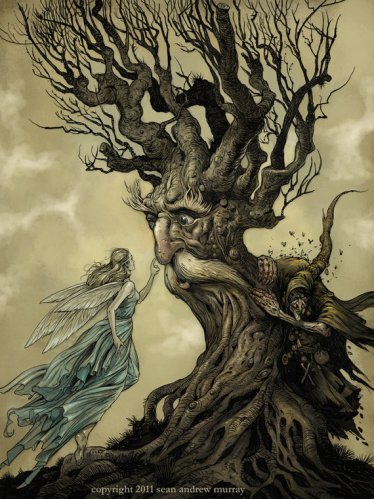
Recently, as I was scrolling down my Facebook newsfeed, I saw this picture:

The Tree Spirit

It’s called “The Tree Spirit,” and it’s by an artist named Sean Andrew Murphy. It’s available as a print in his Etsy shop.

It made me think about women and trees. I’ve always loved trees, I think because they’re so solid. Trees are dependable: they may lose their leaves, but they’re still going to be there. The core of who they are will not change. When you are troubled, you could do much worse than going out and talking to a tree . . .

I’ve written several poems about women who fall in love with trees, and I think that’s because trees have qualities that we want in a partner. That solidity and dependability, the ability to keep growing, despite injuries. To grow around old hurts, to thrive despite them. A kind of perpetual renewal, yet also a permanence.

It makes sense that cultures other than our own have thought of trees as conscious, have painted or sung about men and women stepping out of trees. (When we aren’t looking, of course.) The Greeks had their dryads and hamadryads. When I was a child, I used to wonder what the man or woman of each tree would look like. I would try to imagine them, inspired I suppose by C.S. Lewis’ descriptions of the tree spirits in the Narnia books. For me, the most magical moment in the entire series is when Aslan brings the trees back to life, in Prince Caspian. The land has been asleep, under the rule of the Telmarines (who are early versions of muggles stuck in a land whose magic they disbelieve in on principle and reject out of fear). But when Aslan returns, it wakes up again — the magic is reborn. Looking at the world around me, I thought, we live in a land asleep. That must be why I can’t see the spirits of the trees and waters. That must be why magic doesn’t work. We’ve lost something, but if Aslan came . . .

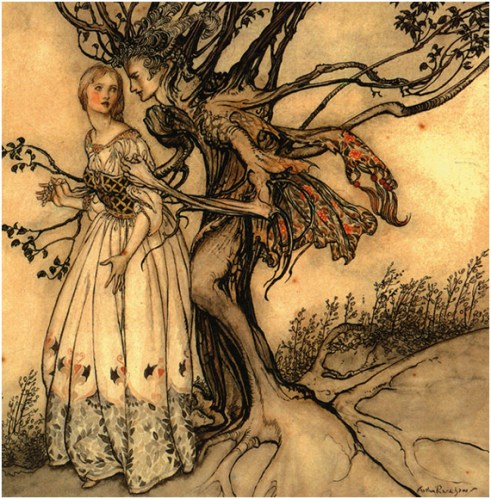
Murphy says that his picture was inspired by Arthur Rackham, and sure enough Rackham has painted a woman and tree as well:

Tree by Arthur Rackham

Now that I’m an adult, I keep reading news stories that reveal the strangeness of the world: elephants communicating at frequencies we don’t understand, trees creating communities underground with their roots. The world we see, the world we experience with our limited senses, is such a small part of the world that actually exists. It’s not as though we’ve lost the magic. It’s as though we willfully ignore it. We are the ones asleep — the rest of the world is still as awake as it ever was. This is where science and magic meet, and we find out that truth is more fantastical than our fantasies. Mother Nature is, after all, the greatest fantasy writer.

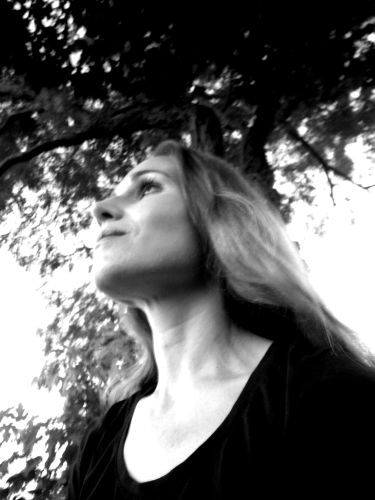
Before I thought of writing this blog post, I took a picture of me and posted it. I joked that I had decided to become a tree spirit.

Tree Spirit 3

It’s a bit of wishful thinking on my part — as though I could become a tree, become part of the natural world in a way I am not. Take on some of the qualities I admire in trees. I would like that . . .

The thing about this world is, Aslan isn’t coming. It’s up to all of us to wake up, and wake each other up.

The pictures by Murphy and Rackham both do that, because while they are literally false, they are figuratively and symbolically true. They express the deep truth of trees . . .

Posted in Uncategorized | 3 Comments

Loving Your Body

It’s a strange morning for me to be writing about loving your body, because I somehow managed to injure my shoulder again, so this morning I’m in pain. I first injured it when I was a lawyer, from too many late nights revising a set of contracts. They were two hundred pages long, and I spent months working on them as the transaction was being renegotiated: I was a junior associate, without the power to say wait, no, this work is injuring me. I ended up with a repetitive motion injury that is re-triggered when I work too hard, carry heavy bags on my shoulder (which I do all the time), spend too much time in front of the computer.

But I wanted to write about it, because it’s something I’ve been thinking about lately, and it seems like an important topic. It took me a ridiculously long time to learn to love my own body. I mean, I’ve been living in it all my life, most of the time not loving it at all. Not even liking it very much. And I suspect that’s where most of us live, feeling uncomfortable in our own skin most of the time. I’m not sure exactly what changed. I think it was a combination of things. I realized that I needed to take better care of it, partly because of old injuries, partly because I wanted to do all sorts of things in my life, and to do them I needed to be healthy. And once I started taking better care of it, my body became healthier, stronger. It began to feel more truly mine. Love is both a noun and a verb: it’s both the feeling of love and the act of loving. When you act in a loving way, you being to feel the emotion as well. So loving your body has a double meaning: both the feeling and the act. As important was the fact that I have a daughter who is growing up, and I want her to love her body. We teach by doing, not saying — if I wanted her to love her body, I had to model it in myself. I would be her primary example of what it meant to be a woman, and so I wanted to do it right, to the extent I could.

Leondardo 1

It’s strange that we generally don’t love our bodies, isn’t it? We’re so disconnected from them. I was thinking about why I ought to have loved my body all along, and I came up with three reasons.

1. It’s healthy. Both of my parents are doctors. I lived with my mother, who is a pediatrician. When I was a child, she worked at the National Institutes of Health. I still remember going with her to visit one of her patients, a girl my age who’d had multiple operations for cancer. She had a long scar down her abdomen. I grew up with the continual knowledge that the body could become ill, that illness was a part of human life. And then, when I was a teenager, my mother had cancer — she was younger than I am now. I have so many friends who are not healthy, who are dealing with medical situations of various sorts. I’m grateful simply for health. I rather hope that if my body weren’t healthy, I would still love it — but it’s ridiculous not to, when I can wake up in the morning, get out of bed, stretch, and know that I’m going to spend all day walking around, doing what I want to do. That, by itself, makes me grateful for the body I have.

2. It’s beautiful. I never realized how beautiful until I spent a week taking care of my grandmother, who was in her nineties at the time. She was bedridden, so she needed to be lifted, cared for the way an infant is. She was thin, frail — and I remember thinking that her body reminded me of a bird’s. For the first time, I was struck by the great beauty of the human body. The bodies we see in magazines, the bodies we are taught to call beautiful, never struck me as particularly beautiful, somehow. But I think I define beauty differently than most people — for me, beauty is complicated and contradictory. It has something in it of death. My grandmother’s body, in its final years, seemed to me worthy of being painted. An artist would have loved it. And in her body, I could see my own. I started to see the beauty in what we would probably call its imperfections.

Leondardo 2

3. It’s mine. It’s the only one I’m going to get, at least in this life. I spent most of my childhood wishing I could look like someone else. But I was never going to, was I? And no one else was going to look like me. So it was up to me to do my best with this particular body. To treat it as well as I could: give it good food, let it rest, make sure it exercises. Not work it too hard (which I tend to do). Because after all, it was me, the only me I would get unless we live more than one life (which I actually believe we do, in some form, in some way, although I don’t know how).

So there you have it. We have such problematic relationships with our own bodies, I’m not sure why. Perhaps because we grow up in a culture that tells us there are right and wrong ways to have bodies, be bodies. Perhaps because unlike other animals, we separate ourselves from our bodies. We often interact with the world as though we were brains being carried around by our bodies, rather than consciousness emanating from a physical structure. But the proper response to our bodies is always love. Even if we don’t like them at a particular moment, because you can’t change what you don’t love. There are things I need to change: I need to deal with this pain in my shoulder, for one. That means more yoga and less carrying heavy bags. But I’m glad that I’ve gotten to this point, where my body actually feels like me. And how strange that it took me so long to get here . . .

Leondardo 3

(I thought about what images to include with this blog post, and decided on some drawings by Leonardo da Vinci, who celebrates the human body so wonderfully, at all ages and in all different conditions.)

Posted in Uncategorized | 1 Comment

Craft and Art

Recently, I’ve been thinking about how grateful I am to be teaching creative writing. It’s different from teaching any other kind of writing. When I teach academic writing, for example, I teach students how to write in a certain way, how to make a persuasive argument in prose. I teach them how to introduce their argument, prove the argument in the paper, and then conclude by discussing the significance of what they have argued. When I teach creative writing, there’s no format, or not in the same way. The writer has to find the form of the story, and every story has a different form. Oh, there are formats I can teach, but they are useful to the writer only to the extent that they make the story more interesting, more compelling. The story, not the format, is of primary importance.

So I’ve been thinking about what I believe with respect to writing. Here are some of the things I believe:

I believe that there is a difference between craft and art. Craft is absolutely essential: to be an artist, you must know the craft of writing. You must understand how words mean, how sentences are put together, how to construct stories. When I teach writing, I teach craft. Art goes beyond craft, and has to do with what a writer, as an individual, brings to writing. Art is in the way Virginia Woolf explores consciousness. In the way George Orwell writes about politics. Both Woolf and Orwell make stylistic choices, write the way they write, because of what they’re focusing on, because of their convictions about reality. I can’t teach a student to write like Virginia Woolf. I can only teach a student why she wrote as she did.

What we think of as crafts can achieve the level of art, and what we think of as arts can be practiced as crafts. A quilt can become a work of art. And writing can be practiced purely as craft. I’ve read romances that are certainly good, as craft. And there’s nothing wrong with good craft. Not all writing has to aspire to art. But I teach my students to aspire, because I do believe that a work of art is a higher, more complex, more difficult thing to create. I can’t teach a student how to be an artist. I can teach good craft, and point the way toward great art. I can indicate what it looks like. (I think J.R.R. Tolkien was practicing a great art. His later imitators are examples of craft.)

I don’t think it’s a coincidence that Stephen King subtitled his book on writing “A Memoir of the Craft” and E.M. Forster called his book The Art of the Novel. (These are two of my favorite books on writing.) King is primarily concerned with craft, as I think he should be. He was trying to teach, and craft is what can be taught. A writer is often better off simply focusing on the craft and letting the art take care of itself, at least for most of the writing process. Forster was concerned with how the novel, as a work of art, actually works.

I believe there is absolutely such a thing as talent, and that if we deny the existence of talent, we are kidding ourselves. I teach over a hundred students each year, and they come into my classes with different levels of ability. Some have a talent for writing, which means they can hear how words and sentences fit together, as a musician hears music. Writing is not necessarily any easier for them, but they approach it differently. However, a talent for writing should really be thought of as talents: in creative writing workshops, where all of my students are there because of their writing talent, I teach students who are good at poetic prose style, students who are good at plotting or creating compelling characters. Different students have different talents. And while talents are to a certain extent natural abilities, like the musician’s ear, all talents need to be developed. Talent is only the beginning, and talent can sometimes lead students astray.  If they believe or rely too much on their natural abilities, they are liable to neglect the craft.

My role as a creative writing teacher is to take an individual with inclination, who has already demonstrated a basic level of talent, and work on the craft of writing. Which itself is a privilege. And then to point the way to art and say, if you wish, that’s where it is, in that general direction . . .

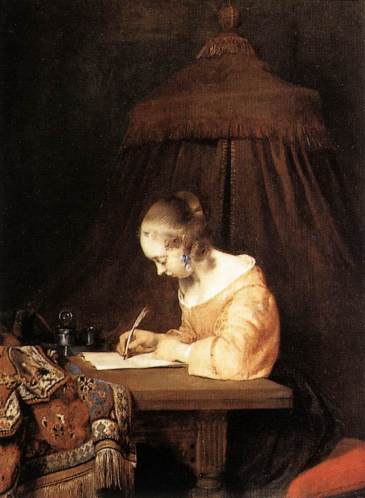
Woman Writing a Letter by Gerard Terborch

Woman Writing a Letter by Gerard Terborch

Posted in Uncategorized | 7 Comments

Fairy Tale Reading

This semester, I’ll be teaching a class on fairy tales. I thought you might like to know what I’m asking my students to read, because if you read this blog, you’re probably interested in fairy tales. Right?

So here’s my reading list:

The central text of the course is Maria Tatar’s The Classic Fairy Tales, from Norton. It contains most of the tales we’ll be reading, as well as important criticism. As we study each tale, the students will read Tatar’s introduction to that tale to provide historical and critical context. We will also be reading Bruno Bettelheim’s The Uses of Enchantment, not because I necessarily agree with his psychoanalytic interpretations (I usually don’t) but because they give students a useful theoretical stance to argue for or against. The semester is arranged by fairy tales, so I’ll give you the stories and poems we’ll be reading by tale, mostly in the order we’ll be reading them.

We’ll start the semester with J.R.R. Tolkien’s “On Fairy Stories,” so we can consider the question “What is a fairy tale?” And then we’ll get into the tales themselves.

Little Red Riding Hood:
“The Story of Grandmother”
Charles Perrault, “Little Red Riding Hood”
Brothers Grimm, “Little Red Cap”
James Thurber, “The Little Girl and the Wolf”
Angela Carter, “In the Company of Wolves”

Snow White:
Brothers Grimm, “Snow White”
Anne Sexton, “Snow White and the Seven Dwarfs”
Neil Gaiman, “Snow, Glass, Apples”

Cinderella:
Charles Perrault, “Donkeyskin”
Brothers Grimm, “Cinderella”
Anne Sexton, “Cinderella”
Aimee Bender, “The Color Master”

Beauty and the Beast:
Madame de Beaumont, “Beauty and the Beast”
Angela Carter, “The Courtship of Mr. Lyon”
Angela Carter, “The Tyger’s Bride”

Bluebeard:
Charles Perrault, “Bluebeard”
Joyce Carol Oates, “Blue-Bearded Lover”
Sylvia Townsend Warner, “Bluebeard’s Daughter”
Angela Carter, “The Bloody Chamber”
Margaret Atwood, “Bluebeard’s Egg”

Sleeping Beauty:
Charles Perrault, “Sleeping Beauty”
Brothers Grimm, “Briar Rose”
Ursula Le Guin, “The Poacher”
Jane Yolen, Briar Rose

We’ll finish the semester with a few classes on Hans Christian Andersen and Oscar Wilde. By Andersen, we’ll be reading “The Little Mermaid,” “The Shadow,” and “The Snow Queen.” By Wilde, we’ll be reading “The Selfish Giant” and “The Fisherman and His Soul.” To go with “The Snow Queen,” we’ll be reading Kelly Link’s “Travels with the Snow Queen.” We will also be reading two essays that touch on these stories: Jane Yolen’s “From Andersen On: Fairy Tales Tell Our Lives” and Ursula Le Guin’s “The Child and the Shadow.”

Throughout the semester, we will be reading critical articles, which I’ll list as well:

Sandra Gilbert and Susan Gubar, “Snow White and Her Wicked Stepmother”
Robert Darnton, “Peasants Tell Tales: The Meaning of Mother Goose”
Karen Rowe, “To Spin a Yarn: The Female Voice in Folklore and Fairy Tale”
Marina Warner, “The Old Wives’ Tale”
Zohar Shavit, “The Concept of Childhood and Children’s Folktales”
Jack Zipes, “Breaking the Disney Spell”
Maria Tatar, “Sex and Violence: The Hard Core of Fairy Tales”

Of course, the students will need to go out and find articles themselves, for their papers. I always find that the most useful for them to start with are those by Terri Windling, and anything linked to on the Sur La Lune website.

So there you go. That’s what we’ll be reading during the semester. I hope you go out and find some of the stories yourself — or even the essays and articles, if you’re interested in fairy tales! (And I think you are . . .)

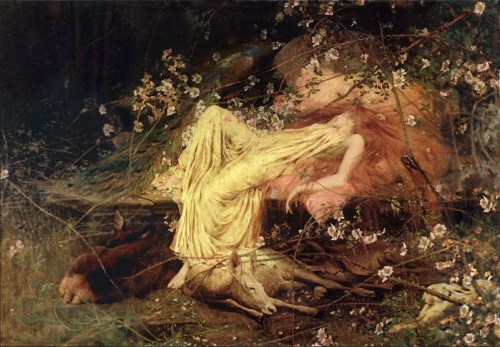
A Fairy Tale by Arthur Wardle

A Fairy Tale
by Arthur Wardle

Posted in Uncategorized | 16 Comments

The Poetry Collection

So, I have this poetry collection coming out?

You can hear the hesitation with which I write that. I trained myself, over many years, to take compliments well. When someone said “You look beautiful,” I learned to say “Thank you.” (I didn’t train myself to believe it, but I did train myself not to say something like, “Oh, but I looked dreadful this morning, you should see me when I first wake up.”) I think I need to train myself to talk about my poetry in the same way, so I can say “I have a poetry collection coming out” as though it were a normal thing, as though I didn’t worry about it terribly.

Why do I worry about it? Because I’ve never in my life had confidence in myself as a poet. No, wait, I did have confidence once, when I was in high school. Back then, I wrote poetry constantly and confidently. I published some of it in the school poetry magazine. It was college that created problems for me, specifically the poetry classes I took at the University of Virginia. UVA has a famous creative writing program, with famous poets teaching in it. And, I’m sure without intending it or perhaps even realizing it, they convinced me that what I wrote was not worth writing.

Here, by the way, is the poetry collection, and I can tell you that I’m very proud of it. It’s forthcoming from the wonderful Papaveria Press.

Songs for Ophelia-Tangerine-lilac.indd

In my literature classes, we studied poetry from all eras. But in creative writing classes, we were expected to read modern poetry, and to appreciate modern poets specifically. A lot of what we were reading, I simply did not like, but I got the distinct sense that I was supposed to write that sort of thing. (I should say, here, that there is a great deal of modern poetry I love, if by modern we mean 20th century. But we were reading the poetry of the 1970s and 80s, and I had a difficult time getting excited about any of it. Contemporary poetry feels more spacious now than it did back then.)

The last poetry class I took was with a famousish poet, the kind of poet who gets into all the anthologies. My first poem was about a woman who has dragons moving into her house — small ones, that get “tangled in her hangers.” I remember those words from the poem. When we critiqued it, my classmates couldn’t understand what I was trying to do — why dragons? They were, of course, a metaphor — but I wasn’t treating them as a metaphor in an obvious way, just writing about what a pain it was to have dragons (small ones) in your house.

That class didn’t stop me from writing poetry. I kept writing and even publishing poetry, all through law school. (I published poetry before I published prose.) But I didn’t talk about it, as though poetry were some sort of disease it was best not to discuss too much. I was surprised when people liked my poems — it’s been a surprise to me, over the last few years, that they’ve been reprinted in Year’s Best anthologies, and that editors like Terri Windling and Ellen Datlow ask me for poems. The greatest surprise was when, with great trepidation, I posted some poems on Facebook and people told me how much they liked them — shared them with friends, commented.

And now I have this poetry collection coming out, so I’m determined to talk about it.

It’s not polite to write about poetry without including some, so here is a poem that should be appropriate for the season:

Autumn, the Fool

The leaves float on the water like patches of motley.
Autumn, the fool, has dropped them into the lake,
where they rival the costume, not of the staid brown duck,
but the splendid drake.

He capers down the lanes in his ragged garments,
a comical figure shedding last year’s leaves,
but as he passes the crickets begin their wailing
and the chipmunk grieves.

The willow bends down to watch herself in the water
and shivers at the sight of her yellow hair.
Autumn the fool has passed her, and soon her branches
will be bare.

By the way, if you’re interested in the collection, it’s meant as a companion to my short story collection In the Forest of Forgetting, which is being reissued by Papaveria Press in a beautiful new edition:

Forest of Forgetting

It’s going to be available in paperback and is already available for the Kindle and in epub and mobi versions.

Posted in Uncategorized | 18 Comments

The Lady Code

In Victorian novels, there is one thing characters always seem to know: whether or not a woman is a lady. And whether or not she’s a lady determines how they talk to her, treat her. It’s as though there’s “lady code” that immediately signals her status. The code has to do with the tangible, such as clothing, but also the intangible, such as attitude.

I was thinking about this recently because I saw a photograph of a college student who had written on her leg, in black marker, what the different skirt lengths meant. A skirt that came to the middle of the thigh meant “flirty.” One just below the knee meant “proper.” One at the bottom of the calf meant “prudish.” And of course one close to the top of the thigh meant “whore.” There were gradations in between.

If we look at this idea historically, it’s the same old lady code. That code always had to do, in part, with sexuality. But it also had to do with social class, and what the photograph can’t represent, being a photograph, is the extent to which the lady code is about economic and educational status.

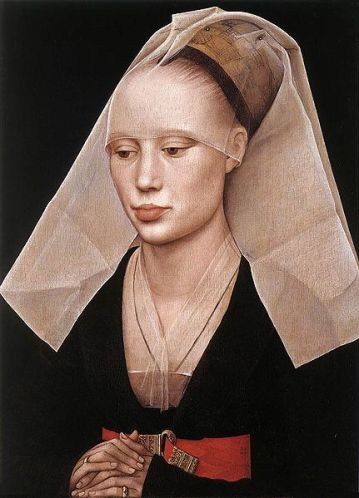
Portrait of a Lady by Rogier van der Weyden

Portrait of a Lady
by Rogier van der Weyden

In American, we are raised with an implicit lady code, because we tend not to talk about social status. But upper-middle class girls are educated into it: they are taught what to wear, usually by their mothers. They are taught which skirts are too short, which shirts too tight. They are taught to signal their social status in coded ways. My family is Eastern European, so the lady code was much more explicit. If I wore something inappropriate, my mother told me that I was not allowed to wear it because I would look like a prostitute. For me, raised as an American child, this was a shocking statement. Here, girls are explicitly taught to wear clothing that is sexually alluring: they are taught this by every magazine and television show. But they are implicitly judged by the lady code.

Portrait of a Lady by John Hoppner

Portrait of a Lady by John Hoppner

So dressing, for a woman, is a complicated affair. When you look into your closet in the morning — and even before that, when you buy your clothes in a store or online — you are making a choice about what you want to communicate. You are speaking in a coded language. If you were raised by an upper-middle-class mother, you know the lady code. You are fluent in that particular language. You know that what you wear should vary depending on the occasion. You will not wear a cocktail dress to the ballet. (I use that as an example because it’s one I see whenever I go to the ballet: women wearing dresses that signal “I don’t go to the ballet often.” The lady code is nuanced: one kind of black dress is fine for the ballet, another kind of black dress is not.) You will not wear a suit that is either flirty or prudish to a job interview: a skirt that is too long is as wrong as a skirt that is too short.

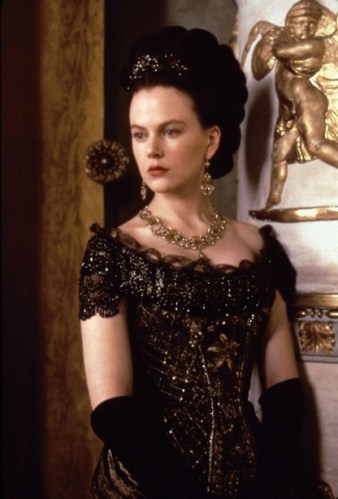
Nicole Kidman in Portrait of a Lady

Nicole Kidman in Portrait of a Lady

Perhaps the place I saw the lady code operating most clearly was at law firms, when I was a lawyer. There was a clear, although implicit and coded, distinction between female lawyers and female secretaries. They wore different clothes, different jewelry, did their hair and makeup differently. We did not have many male secretaries in those days, so male lawyers did not need to signal their difference so clearly. What they wore was relatively simple: a suit. For women, it was not simple at all, and I still remember endless discussions about whether or not a pants suit would be appropriate, and in what circumstances. I don’t think I wore pants once, as a corporate lawyer.

I write this not to make a statement about it, because I don’t know what statement I would make: the lady code has been with us since at least the Middle Ages, and I suspect that reading each others’ clothing as though it were a language goes back to when we first started wearing clothes. Should we abolish the lady code? I doubt we can. Should we be conscious of it? Yes, probably. We have an example of absolute mastery of that code in our First Lady. Michelle Obama’s clothing choices are brilliant: always perfectly appropriate, but also implicitly referring back to one of our great national examples of a lady, Jacqueline Kennedy. Her clothes are a form of political speech that invite us to compare her husband’s administration to Camelot. There is a whole other blog post to be written about the lady code and race, but it should be written by someone who knows the situation from the inside.

What I want to do here is simply notice that the code exists, despite the fact that mothers no longer tell their daughters to be ladylike. Instead, they are taught to be “appropriate,” which means pretty much the same thing. And to notice the ways in which the code is about, and signals, social and educational status.  Which is important, because what a woman signals in that code will determine how she is treated and thought of in our society — just as it did for the Victorians.

Posted in Uncategorized | 15 Comments

Finding the Balance

The thing about being me is, I have things coming at me all the time. I know other people have lives like this too — not everyone, but certainly anyone in the arts. I was having lunch with two friends who are also writers recently, and we talked about how busy we were, all the different things we were doing. We all taught and wrote, so we had teaching deadlines as well as writing deadlines. We were all doing fascinating things — I think I’m doing fascinating things, and I’m so grateful to be able to do them. But we were all also working very hard.

So one thing I need to do, especially now that I’m back from traveling and focused on work, is find the balance. I need to make sure that I’m not burning myself up or out, that I’m doing the ordinary things I need to do, to keep myself balanced and happy. That means eating and sleeping. (Don’t laugh! There are days when eating well, and getting enough sleep, are a challenge. I sometimes need to remind myself that a cereal bar and some chocolate are not lunch.) And I need to make sure that among all the work, I do actually have fun — have a life, as well as a working life.

I’m including pictures from two things I did recently, two small outings that were fun breaks. The first was meeting a friend for chocolate at Burdick, the famous chocolate shop. Here are the interior of Burdick and what I had to eat — my favorite, the Hazelnut Orange Cake.

OLYMPUS DIGITAL CAMERA

OLYMPUS DIGITAL CAMERA

Finding the balance is also crucial to what my last blog post is about: managing darkness. Because it’s so easy for one’s mood to be affected by what one eats, or lack of sleep, or lack of exercise. So I’m trying to make sure that I get all the things I need to be healthy. There are so many stories of writers who were not healthy, who drank to excess for example. But productivity takes a certain measure of sanity and health. So I’m working on those things.

(And I recently discovered a way to deal with insomnia, which has been a problem for me since I was a child. It involves doing at least a half hour of pilates and then listening to a meditation CD that a friend gave me. It’s called Meditation for Busy People, and I was too busy to try it for about six months. But it’s incredibly, wonderfully relaxing.)

My second outing was downtown, where I stopped by a cart selling hats in Faneuil Hall. This is the hat I bought for myself, to keep the sun out of my eyes. Sitting at the cart was a lovely Frenchwoman who told me how to make a hat fit if it’s a little too large: put tissue paper inside the inner band. Frenchwomen know these things. (I did not need tissue paper inside the band, because my head is rather large, as you might expect! I’ve stuffed a lot of things into it.)

The first picture is of me wearing my 1950s-style Audrey Hepburn dress, because I was channeling Audrey that day.  I think that’s how I ended up with a hat.  It was an Audrey sort of hat . . .

OLYMPUS DIGITAL CAMERA

OLYMPUS DIGITAL CAMERA

Finding the balance is always hard for me. I tend to take on too much and push myself too hard, expect too much of myself. But I think I have to focus on it now, because the truth is that I can’t create good art when I’m too tired, or unhappy with the world or myself. And that’s the goal, finally, isn’t it? To create good art . . .

Posted in Uncategorized | 1 Comment