Writing Lesson: Observation

I thought it might be interesting to put down some of the things I’ve learned from teaching writing.  From writing too, of course, but I find that when I teach writing, I tend to make certain points over and over.  Because these are the sorts of things that many writing students need to work on.  So I thought they might be interesting to point out here as well, for those of you who are writers, or who simply want to improve your writing . . .

The first one I want to talk about has to do with observation.  If you want to be a writer, you need to also be an observer . . . someone who is curious about the physical world around you. I don’t know about you, but I find it harder to write about the physical world than about mental states. It’s easy enough to describe what someone is thinking, but try to describe someone walking down stairs. I mean, in a way that makes it interesting.

(Ironically, writing students often think the way to keep a narrative interesting is to include action scenes. But action scenes can get very boring, very quickly. It’s often less interesting to watch a character act than to hear her think. Physical actions are usually interesting to the extent that they illuminate something else: the character herself, the world in which she is acting, etc.)

When describing the physical world, it’s very easy to fall into clichés. And the best way to avoid clichés is to observe closely, to see things as they are instead of as people say they are. To see what actually is.

So here is an exercise for any writers among you: go and observe. I do it sometimes sitting on the metro, where I can see so many faces, all different. I think about what makes them different, what distinguishes them from one another. I try to remind myself to observe, because it’s so easy not to see, isn’t it? To go through our days, particularly when we’re busy, and simply miss what is around us. The colors of leaves on the sidewalk. The different kinds of stone in the buildings. And the world is hard to describe anyway, because it’s so specific, each part of it different from every other part, and yet the words we have are “gray stone” and “autumn trees,” and it’s hard for writing to get at that specificity. But we have to try.

I was thinking about this recently as I read a description of a character in Willa Cather’s The Song of the Lark. The description comes right at the beginning of the book, two paragraphs in:

“Dr. Archie was barely thirty. He was tall, with massive shoulders which he held stiffly, and a large, well-shaped head. He was a distinguished-looking man, for that part of the world, at least. There was something individual in the way in which his reddish-brown hair, parted cleanly at the side, brushed over his high forehead. His nose was straight and thick, and his eyes were intelligent. He wore a curly, reddish mustache and an imperial, cut trimly, which made him look a little like the picture of Napoleon III. His hands were large and well kept, but ruggedly formed, and the backs were shaded with crinkly red hair. He wore a blue suit of wooly, wide-waled serge; the traveling men had known at a glance that it was made by a Denver tailor. The doctor was always well-dressed.”

This, by the way, is what Napoleon III looked like:

Napoleon III

But I can imagine Dr. Archie without that image. He’s stuck in a small town in Colorado, but I know he will be a strong character, simply from the way he’s described. It’s a long description — you probably would not find one as long in a modern novel, since novels now are expected to move at a faster pace. But Cather avoids any clichés. She includes generalizations (“always well-dressed”), but also backs them up with specifics (the Denver tailor). And notice the information she does not give us: we don’t know the color of his eyes. It’s standard in student writing to find a description that focuses primarily on hair and eye color. Here Cather gives us hair color, but not just on Dr. Archie’s head. We also learn about his mustache and the hair on the back of his hands. We do learn that his eyes were intelligent, which is actually what we most need to know about him.

Do you see what she’s doing? She’s describing what we would probably notice if we actually met Dr. Archie. These are the things about him that stand out, that make him different from other people. That are specific to him.

So when you’re observing, you really have to observe two things at once: what is in front of you, and yourself noticing. You have to see how you’re seeing. And not just what is static, but also gestures.  Here Cather gets gesture in a bit with the stiff shoulders; it’s a static description, but we get a sense for how he holds them, for how Dr. Archie moves.  When you’re observing, think about how people move, how they walk down stairs, or put their hand on the railing, or look back up when they reach the landing. How do they turn back their heads? What do their gestures look like?

It occurred to me, writing this post, that writing handbooks often tell you how to write, focusing on the craft of writing itself. But they don’t often tell you how to be a writer: how to prepare yourself to write. How to go through the world as a writer, finding and absorbing the material you will need. Because writing doesn’t come out of your head. Oh, if only it were so easy! No, writing comes out of other writing, and out of your lived experiences. If it comes only out of other writing, it’s merely imitative. If it comes only out of lived experiences, it’s often unformed, uninformed. Like a long diary entry, uninteresting to read. Good writing happens when you’ve absorbed a great many things, both from books and from life, and they’ve mixed pretty thoroughly in you, as though you were a cocktail shaker. And then you pour it out, into whatever form you’ve chosen or it’s chosen for itself (whether a poem, or short story, or novel).

So if you want to be a writer, give yourself homework: go out and observe.

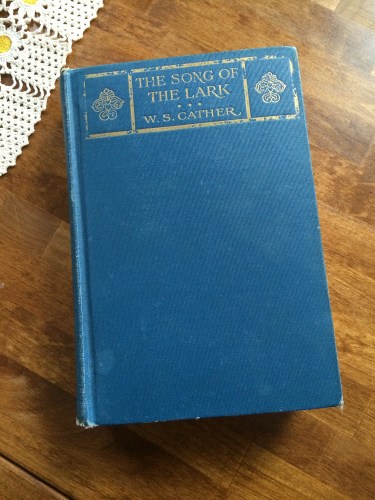
Song of the Lark

This, by the way, is my copy of The Song of the Lark, from 1924.

Posted in Uncategorized | 10 Comments

Small Details

Details matter.

Once upon a time, a long time ago (specifically, while I was in college), I took a poetry class. It was my introduction to the fact that taking a class with a Famous Poet doesn’t mean it’s going to be any good (it wasn’t). And that’s where I first heard the phrase “God is in the details.” I’m not sure where I heard “The Devil is in the details,” which I suppose is a sort of companion phrase. They both essentially mean the same thing, which is that details matter. (In my poetry class, the professor meant that the poem is in the details, which is both true and not true. He was referring to the small descriptive details that are at the heart of modern free verse. But the poem is also in the details of rhythm and rhyme.)

I was thinking of this last night, because it was the first night in about two weeks when I haven’t been working (frantically trying to finish the tasks of the semester). And instead of going straight to sleep, which is of course what I should have done, I stayed up to sew cherry red bobbles on my lampshade. Because decorating is also in the details — if the details aren’t there, aren’t right, you haven’t decorated at all. You’re just arranged furniture.

There is a sort of rule that I’ve been hearing about, mostly from business people: since 20% of your effort goes into achieving 80% of a task, and the remaining 80% goes into achieving the final 20%, you should focus on achieving that first 80%. As for the rest, “the perfect is the enemy of the good,” right? I suppose there’s nothing wrong with thinking that way, or acting on it, in certain industries. But there are places where the difference between 80% and 100%, or even 90% if you can’t get all the way there, is huge. Is everything.

One of those places is the arts. The difference between an artist giving 80% and 100% is the work of art itself. You can tell a painting, a novel, that isn’t at 100%. Where the artist or writer said, “that’s good enough.” What makes an artist great is knowing where 100% is, and doing his or her best to get there. Maybe not achieving it — probably not achieving it, because who are we kidding, art is hard. But trying anyway.

When I’m decorating, I add the bobbles. (Which I love in part because they’re slightly ridiculous, as though my lampshades belonged at a circus. This morning, I added bobbles to the other lampshade. Now I have two lampshades with red bobbles, like circus clowns.) When I’m writing, I sweat over the commas and semicolons. The novel I’m writing — I’ve read the entire manuscript out loud to myself, to hear what the sentences sound like. Over the next few days, I need to go over it one more time before sending it to Important People. Just to make sure there aren’t any stupid mistakes.

As I said, I suppose there are places where 80% is enough, and you can let the other 20% go. But not the spaces I work in: not in teaching, not in writing. And it’s not a way that I particularly want to live, because I care about the details, about getting to 100%. And there’s another saying that I’ve always remembered: “The way you do one thing is the way you do everything.” I think that’s often true: people who are conscientious in one area tend to be conscientious in other areas as well. I know it’s true for me: the better I get at one thing, the better I get at others. It’s as though each thing I do is a learning process. Putting red bobbles on my lampshades provides a lesson about writing, about teaching. About living.

Because in the end it’s about how we live, isn’t it? In the end, everything is. And everything can provide lessons. Even time spent sewing on red bobbles . . .

Details 1

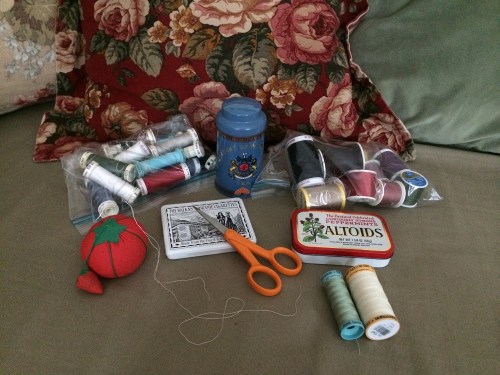
The photo above is from this morning: some of my sewing supplies scattered on the daybed in the living room, where I was working. The cigarette tin holds needles, the tea tin holds buttons, and the old Altoids tin holds my pins. The photo below is one of my lampshades, the one next to the Christmas tree, with red bobbles.

Details 2

Posted in Uncategorized | 2 Comments

Tidying Up

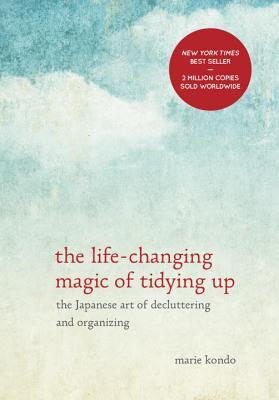
I read the most charming book, recently. It’s called The Life-Changing Magic of Tidying Up: The Japanese Art of Decluttering and Organizing, by Marie Kondo. The author is a television star in Japan, where she has a show in which she . . . you guessed it, goes to people’s houses and helps them organize their possessions. Helps them tidy up. After reading the book, I watched clips from several episodes on YouTube, in Japanese of course. A lot of what she does is talk to people, and I’m guessing that she’s asking them what they love, which of their possessions are truly important to them. Because Kondo has a different approach to tidying up, one I found interesting and valuable.

The book is charming in part because Kondo is so obsessive, much more than I could ever be. But I’m going to describe what I found valuable in her book, the ideas that stood out to me. Because I need order to work well — I need my environment to be tidy.

I know there have been articles on writers and how messy they can be. Some of them need mess, need disorder — they say within that disorder, they know where everything is. They get angry if anyone tries to tidy up. I’m not like that: I need my environment to be organized. I think it has to do with the way I think. My mind is itself a tidy place, or wants to be. It doesn’t like to be untidy, with important things tucked into the wrong places and forgotten. I do so much, have so many projects at once, that it’s really the only way I can operate. And one of the best ways to tidy my mind is to keep my physical environment clean, clearly organized. I don’t like inner or outer mess.

There are two other reasons I don’t like mess. One is that I need to live efficiently. I have so much to do that it’s frustrating when I have to spend time searching for a set of notes I knew I put somewhere. Or keys. Or change. If I’m working on a research project, I need to know which books I have relevant to that project, and where to find them. And second, I want to live in a beautiful space. Mess can be beautiful, but have you noticed that a beautiful mess is almost always intentional and intensely curated? Edward Gorey’s house was a beautiful mess, but he was an artist. It’s actually much more difficult to create a beautiful mess than simple neatness. So I try to keep things neat.

But I do fall into messiness sometimes, particularly when I don’t have time to clean. When I’m simply too busy.

So here are the central concepts from Kondo’s book that are particularly important to me:

1. You should only have things that bring you joy. This was a revelation, actually. What Kondo does, and I did not do this, is have people bring out all their possessions and put them on the floor. Then, she tells them to hold each one in their hands and decide whether that item brings them joy. If it doesn’t, it goes.

I thought I was being very practical by keeping things I had not worn for a long time, because I might need them again someday. But Kondo would say, while those things were useful to you once, they have outlived their usefulness. They are now ready to go away, wherever they’re supposed to go next. In a way, by keeping them, you’re impeding the flow of both your and their lives. Someone else could potentially use that coat. And then there are things that have outlived their usefulness entirely, and simply need to be thrown away. Old receipts don’t necessarily want to stay with you, to clutter up your drawers. They know when it’s time for them to move on, and so should you.

Did I mention that Kondo talks a fair amount about Shinto? It’s very clear that she believes all your things have spirit. If they’re no longer giving you joy, not only should they move on, they actually want to move on.

This prompted me to go through my closets and bookshelves. I try not to keep things I don’t love, but even I found things I was keeping that didn’t give me joy: some books I had bought because I felt as though I should read them, some clothes that were such a bargain at the time. I took several large bags to Goodwill.

2. Once you have discarded everything that doesn’t give you joy, make sure everything you’re keeping has its proper place. You should have a designated place for everything.

3. And you should make a habit of putting everything in its place. Now, this is difficult for me at the moment. Although I moved into this apartment six months ago, I’m still decorating. So there are paint cans on the kitchen counter, which is clearly not a place to store paint cans. (I just painted three lamps, and next come the shelves in what I glamorously call the walk-in closet, because you can walk into it, but is really a tiny room under the stairs, with a rod and drawers.) But I do try to make sure that whenever I take anything out of its place, I put it back. I notice that if it’s sitting out of place after I used it, I start to feel uncomfortable. This is partly Kondo’s fault: she makes me feel as though everything I own is sentient! As though my socks have feelings. (And how do I know they don’t?) Things like to be in their proper places, she says. And I know mine do.

There is a final concept in her book that I really like. She says that every day, when you enter your home, you should bow to it and thank it, and all the things in it, for taking care of you. For sheltering you, supporting you. Because after all, that’s what your things do, from socks to frying pans. I don’t actually bow down to my apartment (or at least not often!), but I like the idea of gratitude toward your things. That’s where the impulse to keep them neat, to take care of them back, ultimately comes from.

Marie Kondo

Posted in Uncategorized | 8 Comments

Daily Rituals

This morning, I read a blog post by the author Steven Barnes, who was a teacher of mine at Clarion, many years ago. Steve is also a personal coach, spiritual teacher, and martial artist: the sort of person who is always working on becoming a better version of himself, and teaching others how to become better as well. Here’s the post: “Your Life Is Not a ‘Lemon.'” And here’s the part of it that really struck me:

“You need to have a daily ritual of thought, movement, and emotion. Tell me your daily rituals, and I’ll tell you your life. Exercise daily and keep a food journal? That’s one body. No exercise and food unconsciousness? Another. Daily meditation and journaling? One psyche. Allowing the cess-river of daily news, political debate, human negativity and existential angst to flow over you unchallenged? That’s another. Daily checking your Mint.com account to see your finances and net worth? That’s one financial path. Inability to balance your check book? That’s another. Re-writing your goals daily and being crystal clear on what a perfect ‘today’ would be to implement them? That’s one life. Vague or no goals, and hoping for ‘luck’ to bring your dreams to you? That’s another. Daily focus on goals, actions, faith and gratitude? That’s one life. Rooting in the trough of our unfulfilled dreams, betrayals, failures, fears, guilt, blame and shame? That’s another.

“It isn’t fair that we have to take control. It isn’t un-fair. It just ‘is.’ Stand on the beach and scream at the waves that it is ‘unfair’ your shoes are getting wet. Or . . . back away. Or . . . take off your shoes and wiggle your toes in the wet sand.”

Basically, what Steve is getting at is that we can largely determine what our lives are like. Our lives are our daily lives: our experience of them is determined by the daily choices we make. And so we can make our lives good ones, healthy and happy and productive. Or we can make bad choices, and end up with unhealthy, unhappy, unproductive lives. It all depends on the small choices we make on a daily basis. Whether to exercise or not. Whether to eat the whole wheat turkey sandwich or the doughnut. Oh, not every choice has to be perfect! Not every choice can be. But our lives are better if most of our choices are good ones. And that happens if good choices are ingrained, and actually chosen automatically. If they are habits or rituals.

Steve talks about this as a way to deal with problems like depression, and I can speak to that, because I’ve been there. As readers of this blog know, I went through a period of serious depression when I was trying to finish my PhD dissertation. It was very difficult, but I eventually got out of it, with therapy and by building good habits. Now I try to maintain those habits, because I know that without them, I won’t be as healthy, either physically or mentally.

So what are my daily rituals? I have a healthy breakfast. Every day, I do twenty minutes of pilates, plus I walk a lot. Healthy lunch (cheese sandwich on whole wheat bread, apple), healthy snack (nuts, fruit, dark chocolate), healthy dinner (whole wheat pasta or brown rice with vegetables). Every day, time to rest and relax. All right, that last one I’m not as good at as I should be, and I definitely haven’t had enough sleep lately! I need to work on that. Also meditation. But the point is, the way you live on a daily basis affects the larger aspects of your life. The daily rituals are what keep me healthy. They are what allow me to be productive.

Some people say that when you’re depressed, you can’t do those things. That’s what depression is all about. But as someone who’s been there, I say that you can try, and you can start, and they will make you feel better. And for people who aren’t depressed, this is the way to have a good life: develop good daily rituals. These are the things that help me in particular:

1. Eat healthily.
2. Exercise daily.
3. At least once a day, do something that clears my head, that allows me to relax.
4. Keep my space neat and organized. Make my bed, do the dishes; if there is a mess, organize it.
5. Write, so the ideas don’t start clamoring around in my head.
6. Put a list of the larger things I want to accomplish up where I can see it. You know, the life things. Make sure that every day, I work on that list. That I’m accomplishing the larger things as well as the smaller ones.
7. Get some sleep. All right, no, I’m not as good at this one as I should be! But I’m working on it . . .

What are your daily rituals? It seems to me that most people don’t have good daily rituals; they live haphazardly. But you who read this blog — I bet you have them . . .

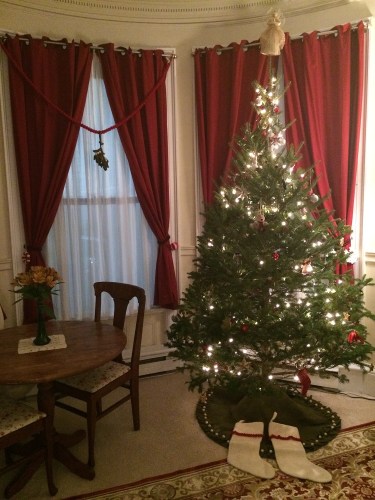
Tree 1

This is a picture of my Christmas tree. Just because it’s so pretty! It’s a yearly rather than a daily ritual, of course. But it ties me to the year, to time. I think our daily rituals do the same thing, actually. They make life more real for us . . .

Posted in Uncategorized | 9 Comments

Doing It All

I miss blogging.

I used to blog every day. And then I went to several times a week, and then recently I’ve barely blogged at all. It’s because I’ve been so busy. The problem with getting to do all the things you want to, is that you’re doing all the things. And there are still things I want to do that I don’t have time for.

So what am I doing? I have two wonderful academic positions, both of which I love: teaching writing to undergraduates at Boston University and in the Stonecoast MFA Program. This year, I finished a novel, so I am writing, even though it’s been a while since I’ve had a short story come out. I have almost enough short stories for the next short story collection; I mean, I have enough, but I want to write one more. And then I want to write the second novel, the sequel to the one I just finished.

I’m already into describing what I want to do, aren’t I? Instead of focusing on what I’m doing. The problem is that there doesn’t seem to be enough time. In these last few weeks in particular, finishing the academic semester, I’ve been exhausted, not sleeping enough and not eating very well. (I mean, I eat very healthily, or I wouldn’t be able to do what I do. But when I’m up past midnight, I get hungry again, and then I’m eating five meals a day. Like a Hobbit . . .)

So what is the problem exactly? I think it’s the sense that I’m doing so much for other people, and not doing all that much for myself. Not getting enough time to write, but also not getting to connect in the way I want to. In a way that blogging allows me to.

A friend of mine who is a writer once asked me why I do it, because it seemed to her as though it was taking time that I could be doing other work, like writing short stories. But blogging is easy for me, in a way writing short stories isn’t. It doesn’t take as much energy. And it allows me to get ideas out there, talk to people directly. I think I need that. I spend so much time talking as an authority on things. You know, I walk into a classroom and I’m the Professor. Or I’m advising a student on how to revise a story, a novel. Blogging is really the only place where I get to say, Here’s what confuses me. Here’s what my day is like. Here’s what I’m afraid of. (Failure and irrelevance, at the moment. Those are my particular fears.)

It’s the place where I get to speak without an editor.

I don’t know how much I can get back to it. There’s so much else I need to do. But I think that if I don’t get my ideas out, they get stuck in my head, and then it’s as though they’re all backed up, and they get snarled. I think I need a place to speak, and I think it needs to be public, because that’s who I am. It’s not enough for me to talk to friends. I’m a storyteller. Blogging is my way of telling the story of myself, and it allows me to get myself out of the way, so I can tell other stories as well.

Conclusion: I need a way to make sure that I’m writing. Otherwise, I get sick. I start to feel all wrong . . . And it’s important for me to write fiction, but when I can’t, blogging can fill that gap. It can keep me writing regularly, so I don’t feel as though I’ve somehow lost it . . . or lost myself. I need it the way I need to work out in the morning, or take a hot bath at the end of the day — because it keeps me healthy. I suppose the lesson here is that if you want to do it all, people will eventually let you. And then you will be doing it all, and you will go, all right, but I still need time for myself. Even if it’s writing a silly blog post!

Snowy Day

This is me, on my way to class, on the last week of classes. With the first snowflakes of the season on my hat . . .

Posted in Uncategorized | 13 Comments

Making Clafoutis

I posted a picture of my Peach Clafoutis on Facebook, and people asked me to share the recipe, so here it is! I’m interrupting my series of blog posts on fairy tale heroines and their journeys to bring you a little snack . . .

First you should know that I don’t use white flour or sugar, because I’m trying to eat more healthily, even when eating desserts! If you want a standard clafoutis recipe, there are many available on the internet. This is a slightly healthier version. I’ve found that you can use whole wheat pastry flour to substitute for white flour, but it is more absorbent, so you typically need less of it. I also use the brownish sugar that is usually labeled “organic sugar” and is a little less processed than the white variety. It can be used just like white sugar, but it has a flavor of its own, a bit more caramely than white sugar. So the flavor of whatever you make will be a bit stronger.

This is a good time to preheat the oven to 350 degrees.

Clafoutis, the way I make it, is basically a thickened custard over fruit. I’ve seen some recipes in which American cooks describe it as a baked pancake, but I think that means they’re using way too much four. It should taste like a custard.

Here are my ingredients for the clafoutis:

1/3 cut flour
3 tbsp. sugar
2 eggs
1 cup milk (I use 2%)
1/2 tsp. vanilla

For the fruit, cherries are traditional. I like peaches. You can also use strawberries, blackberries, and probably raspberries, although I’ve never tried the raspberries myself. In winter especially, when fruit are so expensive, I use frozen fruit, thawed and drained. (The juice will change the consistency of the clafoutis, so drain as much as possible.) When I’m using frozen fruit, I add a tablespoon of sugar to the fruit, because otherwise it tends not to be sweet enough.

Clafoutis 1

Take a baking dish, preferably a pretty one (like the glass pie dish I used here) because you may serve the clafoutis in it. Butter it and then put the fruit on the bottom, arranged however you wish, but in a thin layer.

Assembling the clafoutis is incredibly easy. Just mix all the ingredients except the fruit, starting with the solids and then adding liquids while mixing so it’s not lumpy. I use a hand-held electric mixer.

Clafoutis 2

Then you just pour the clafoutis mixture over the fruit.

Clafoutis 3

Bake in a 350 degree oven until it’s done, which depends on your oven, so I won’t try to give you an exact time. If you’re used to baking, you know there’s a moment when it smells so good, and that’s just before it’s time to take the clafoutis out. Then there’s a moment when you think, I can’t smell it anymore, and that’s it, that’s usually the time. The clafoutis is done when the top is golden brown.

Clafoutis 4

It’s best to let it cool a little bit, but warm clatoutis is a wonderful treat, and it’s just as good cold the next day. Some people sprinkle powdered sugar on top, but I think it’s quite sweet enough as is, so I would only do that if serving it at a party. And here you go, a bowl of Peach Clafoutis!

Clafoutis 5

Posted in Uncategorized | 4 Comments

The Heroine’s Journey II

Almost a month ago now, I wrote a blog post called “The Heroine’s Journey,” in which I started mapping the journey I saw heroines going on, in the fairy tales I was teaching. Since then, I’ve gone through three fairy tales, “Snow White,” “Sleeping Beauty,” and “The Goose-Girl,” to see where my theory was right, and where it was wrong — or incomplete. I think that’s important, because I want my theory to use useful, to reflect what is actually there in the tales I’m talking about.

You see, I really care about good scholarship. And so much of what is written about the hero’s or heroine’s journey is not good scholarship.

So what am I actually claiming? That there is a certain set of fairy tales that have heroines, and a subset in which the heroine goes on a journey. And those journeys take a particular shape: they are metaphors for women’s lives. Not necessarily for women’s lives in general, at all times and everywhere. But at least in the societies in which the tales I’m looking at were told, which were generally European, from the 16th through the 19th centuries. So the Fairytale Heroine’s Journey is like a meta-tale type. (If you don’t know, the concept of a tale type was created by the Finnish folklorist Antti Aarne. Folktales are assigned to tale types by their narrative elements: for example, “Snow White” belongs to tale type 709, along with other tales that have similar plots, even if many of their details are different. The tale type is like the trunk of the tale, the details like its branches and leaves. Cinderella can have shoes of gold, or silver, or glass, but the important element will be the shoe that only fits one woman.) There are a number of different tale types that fit into this meta-type, The Fairytale Heroine’s Journey.

I also want to make another claim, one that isn’t meant to be scholarly: that this journey can teach us things about our own journeys, because our society isn’t as different as we sometimes think from the societies in which fairy tales were told or  written. And women’s lives aren’t as different, either. The Fairytale Heroine’s Journey is not inherently conservative or liberating. It can be either, depending on how it’s handled: the Grimms give us a more liberating “Cinderella” than does Perrault, I think. And the women writers of the salons, like Madame d’Aulnoy, use this structure over and over again, in part for social critique. The Fairytale Heroine’s Journey is, however, always illuminating: it teaches us things about women’s lives, how they were lived and perceived. And it can teach us something about our own lives . . .

Here’s what I’m not claiming. That this particular Heroine’s Journey is a timeless mythic structure. I don’t think it is — I think it’s very much a product of particular cultures and time periods. (As I think Joseph Campbell’s Hero’s Journey is as well. I adore and respect Campbell, but those sorts of claims ignore the extent to which stories are products of their particular societies. They focus on similarities and ignore differences. And the differences are very, very important.) I also don’t claim that what I’m describing is a psychological structure, embedded deep in the human mind. For one thing, I have no evidence for such a claim, and for another, I’m not particularly interested in it. What I do claim is that the Fairytale Heroine’s Journey is a narrative structure we return to over and over again, that we seem to find particularly useful or satisfying. It would be interesting, actually, to see where else I could find it — is there a way, for example, in which heroines in literary fiction go through a fairytale heroine’s journey? Does Tess of the d’Urbervilles? But that is so far beyond what I’m trying to do right now. Now, I’m just trying to understand it. And this post is about consolidating what I’ve learned from looking at three tales. (I told you, I’m trying to do careful scholarship, and that takes time. My goal is to go through twelve tales — and then, hopefully, I’ll have learned something.)

So, based on the stories I’ve read so far, and my general knowledge of fairy tales, here are the steps in the Fairytale Heroine’s Journey. Notice that I’ve refined this list from the one I started with, in my original post.

1. The heroine receives gifts. Sleeping Beauty receives gifts from the fairies. Donkeyskin receives three dresses from her father and a ring from her mother. Cinderella receives three dresses and magical shoes from the hazel tree.

2. The heroine leaves or loses her home. Donkeyskin leaves home to escape her father. The Goose-girl leaves home to be married. Cinderella loses her home when she is forced to live in the kitchen and sleep on the hearth.

3. The heroine enters the dark forest. Snow White runs away from the huntsman, though the dark forest. The dark forest grows up around Sleeping Beauty.

4. The heroine finds a temporary home. Snow White lives with the dwarves. Donkeyskin lives in the castle kitchen. Vasilisa lives in Baba Yaga’s hut.

5. The heroine finds friends and helpers. Snow White’s dwarves, Cinderella’s doves. The head of a dead horse, three old women by the roadside, the winds themselves — all sorts of people and things can be friends and helpers.

6. The heroine learns to work. Donkeyskin cooks, Snow White and Cinderella keep house. The Goose-girl tends geese. Vasilisa works for Baba Yaga.

7. The heroine endures temptations and trials. Snow White is tempted with lace, a comb, and an apple. Sleeping Beauty is tempted by the spinning wheel. The heroine of “East o’ the Sun and West o’ the Moon” must travel far to find her husband.  In some stories, the trials involve climbing glass mountains or wearing through iron shoes.

8. The heroine dies or loses herself. Snow White dies, Sleeping Beauty falls into a death-like sleep. The Goose-girl is not recognized as a princess. Cinderella is not recognizes as herself (despite having danced with the prince for hours).

9. The heroine finds her true partner. Sometimes this is an entire subplot, in which the heroine must first lose and then find her true partner. I’m still working on this one, but in some stories the finding just happens (“Snow White,” “Sleeping Beauty”), while in others it involves losing and a long search (“East o’ the Sun” being one example).

10. The heroine is revived or recognized. Dead heroines are revived (Snow White, Sleeping Beauty), lost heroines are recognized (Donkeyskin, Cinderella).

11. The heroine enters her true home. Usually, the true home is a castle.

12. The heroine’s tormentor is punished. She is made to dance in red-hot iron shoes, or her eyes are pecked out. Or she is turned into a living statue. Or rolled down the hill in a barrel filled with nails.  The punishment is usually, actually or metaphorically, created by the tormentor herself.

That’s what it looks like right now, but I’m going to keep working through stories, trying to figure this out. It’s like a tale type: there are all sorts of variations, and yet you can see — or at least I can see — an underlying pattern in these tales. And that pattern is of a woman’s life.

Rackham

The illustration is by Arthur Rackham.

Posted in Uncategorized | 3 Comments