Doing It All

I miss blogging.

I used to blog every day. And then I went to several times a week, and then recently I’ve barely blogged at all. It’s because I’ve been so busy. The problem with getting to do all the things you want to, is that you’re doing all the things. And there are still things I want to do that I don’t have time for.

So what am I doing? I have two wonderful academic positions, both of which I love: teaching writing to undergraduates at Boston University and in the Stonecoast MFA Program. This year, I finished a novel, so I am writing, even though it’s been a while since I’ve had a short story come out. I have almost enough short stories for the next short story collection; I mean, I have enough, but I want to write one more. And then I want to write the second novel, the sequel to the one I just finished.

I’m already into describing what I want to do, aren’t I? Instead of focusing on what I’m doing. The problem is that there doesn’t seem to be enough time. In these last few weeks in particular, finishing the academic semester, I’ve been exhausted, not sleeping enough and not eating very well. (I mean, I eat very healthily, or I wouldn’t be able to do what I do. But when I’m up past midnight, I get hungry again, and then I’m eating five meals a day. Like a Hobbit . . .)

So what is the problem exactly? I think it’s the sense that I’m doing so much for other people, and not doing all that much for myself. Not getting enough time to write, but also not getting to connect in the way I want to. In a way that blogging allows me to.

A friend of mine who is a writer once asked me why I do it, because it seemed to her as though it was taking time that I could be doing other work, like writing short stories. But blogging is easy for me, in a way writing short stories isn’t. It doesn’t take as much energy. And it allows me to get ideas out there, talk to people directly. I think I need that. I spend so much time talking as an authority on things. You know, I walk into a classroom and I’m the Professor. Or I’m advising a student on how to revise a story, a novel. Blogging is really the only place where I get to say, Here’s what confuses me. Here’s what my day is like. Here’s what I’m afraid of. (Failure and irrelevance, at the moment. Those are my particular fears.)

It’s the place where I get to speak without an editor.

I don’t know how much I can get back to it. There’s so much else I need to do. But I think that if I don’t get my ideas out, they get stuck in my head, and then it’s as though they’re all backed up, and they get snarled. I think I need a place to speak, and I think it needs to be public, because that’s who I am. It’s not enough for me to talk to friends. I’m a storyteller. Blogging is my way of telling the story of myself, and it allows me to get myself out of the way, so I can tell other stories as well.

Conclusion: I need a way to make sure that I’m writing. Otherwise, I get sick. I start to feel all wrong . . . And it’s important for me to write fiction, but when I can’t, blogging can fill that gap. It can keep me writing regularly, so I don’t feel as though I’ve somehow lost it . . . or lost myself. I need it the way I need to work out in the morning, or take a hot bath at the end of the day — because it keeps me healthy. I suppose the lesson here is that if you want to do it all, people will eventually let you. And then you will be doing it all, and you will go, all right, but I still need time for myself. Even if it’s writing a silly blog post!

Snowy Day

This is me, on my way to class, on the last week of classes. With the first snowflakes of the season on my hat . . .

Posted in Uncategorized | 13 Comments

Making Clafoutis

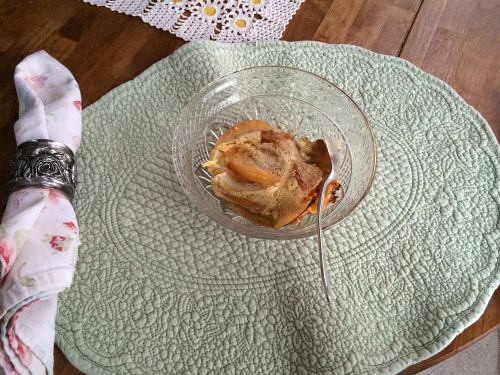
I posted a picture of my Peach Clafoutis on Facebook, and people asked me to share the recipe, so here it is! I’m interrupting my series of blog posts on fairy tale heroines and their journeys to bring you a little snack . . .

First you should know that I don’t use white flour or sugar, because I’m trying to eat more healthily, even when eating desserts! If you want a standard clafoutis recipe, there are many available on the internet. This is a slightly healthier version. I’ve found that you can use whole wheat pastry flour to substitute for white flour, but it is more absorbent, so you typically need less of it. I also use the brownish sugar that is usually labeled “organic sugar” and is a little less processed than the white variety. It can be used just like white sugar, but it has a flavor of its own, a bit more caramely than white sugar. So the flavor of whatever you make will be a bit stronger.

This is a good time to preheat the oven to 350 degrees.

Clafoutis, the way I make it, is basically a thickened custard over fruit. I’ve seen some recipes in which American cooks describe it as a baked pancake, but I think that means they’re using way too much four. It should taste like a custard.

Here are my ingredients for the clafoutis:

1/3 cut flour
3 tbsp. sugar
2 eggs
1 cup milk (I use 2%)
1/2 tsp. vanilla

For the fruit, cherries are traditional. I like peaches. You can also use strawberries, blackberries, and probably raspberries, although I’ve never tried the raspberries myself. In winter especially, when fruit are so expensive, I use frozen fruit, thawed and drained. (The juice will change the consistency of the clafoutis, so drain as much as possible.) When I’m using frozen fruit, I add a tablespoon of sugar to the fruit, because otherwise it tends not to be sweet enough.

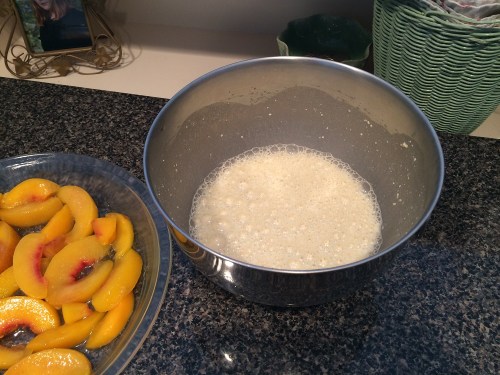
Clafoutis 1

Take a baking dish, preferably a pretty one (like the glass pie dish I used here) because you may serve the clafoutis in it. Butter it and then put the fruit on the bottom, arranged however you wish, but in a thin layer.

Assembling the clafoutis is incredibly easy. Just mix all the ingredients except the fruit, starting with the solids and then adding liquids while mixing so it’s not lumpy. I use a hand-held electric mixer.

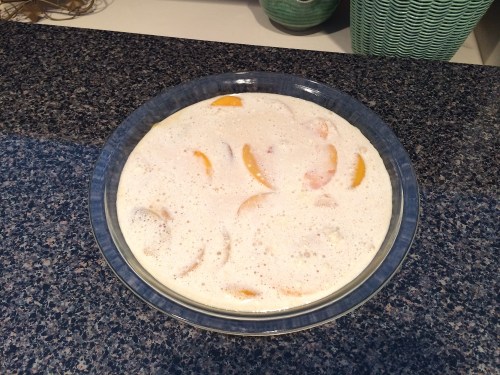
Clafoutis 2

Then you just pour the clafoutis mixture over the fruit.

Clafoutis 3

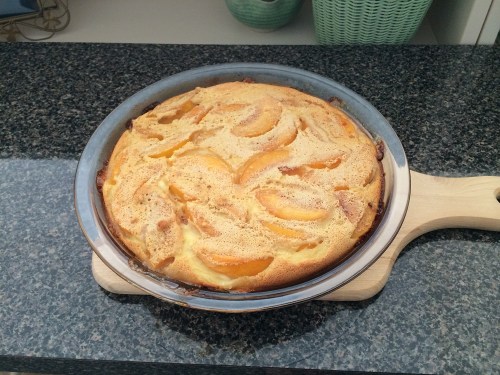
Bake in a 350 degree oven until it’s done, which depends on your oven, so I won’t try to give you an exact time. If you’re used to baking, you know there’s a moment when it smells so good, and that’s just before it’s time to take the clafoutis out. Then there’s a moment when you think, I can’t smell it anymore, and that’s it, that’s usually the time. The clafoutis is done when the top is golden brown.

Clafoutis 4

It’s best to let it cool a little bit, but warm clatoutis is a wonderful treat, and it’s just as good cold the next day. Some people sprinkle powdered sugar on top, but I think it’s quite sweet enough as is, so I would only do that if serving it at a party. And here you go, a bowl of Peach Clafoutis!

Clafoutis 5

Posted in Uncategorized | 4 Comments

The Heroine’s Journey II

Almost a month ago now, I wrote a blog post called “The Heroine’s Journey,” in which I started mapping the journey I saw heroines going on, in the fairy tales I was teaching. Since then, I’ve gone through three fairy tales, “Snow White,” “Sleeping Beauty,” and “The Goose-Girl,” to see where my theory was right, and where it was wrong — or incomplete. I think that’s important, because I want my theory to use useful, to reflect what is actually there in the tales I’m talking about.

You see, I really care about good scholarship. And so much of what is written about the hero’s or heroine’s journey is not good scholarship.

So what am I actually claiming? That there is a certain set of fairy tales that have heroines, and a subset in which the heroine goes on a journey. And those journeys take a particular shape: they are metaphors for women’s lives. Not necessarily for women’s lives in general, at all times and everywhere. But at least in the societies in which the tales I’m looking at were told, which were generally European, from the 16th through the 19th centuries. So the Fairytale Heroine’s Journey is like a meta-tale type. (If you don’t know, the concept of a tale type was created by the Finnish folklorist Antti Aarne. Folktales are assigned to tale types by their narrative elements: for example, “Snow White” belongs to tale type 709, along with other tales that have similar plots, even if many of their details are different. The tale type is like the trunk of the tale, the details like its branches and leaves. Cinderella can have shoes of gold, or silver, or glass, but the important element will be the shoe that only fits one woman.) There are a number of different tale types that fit into this meta-type, The Fairytale Heroine’s Journey.

I also want to make another claim, one that isn’t meant to be scholarly: that this journey can teach us things about our own journeys, because our society isn’t as different as we sometimes think from the societies in which fairy tales were told or  written. And women’s lives aren’t as different, either. The Fairytale Heroine’s Journey is not inherently conservative or liberating. It can be either, depending on how it’s handled: the Grimms give us a more liberating “Cinderella” than does Perrault, I think. And the women writers of the salons, like Madame d’Aulnoy, use this structure over and over again, in part for social critique. The Fairytale Heroine’s Journey is, however, always illuminating: it teaches us things about women’s lives, how they were lived and perceived. And it can teach us something about our own lives . . .

Here’s what I’m not claiming. That this particular Heroine’s Journey is a timeless mythic structure. I don’t think it is — I think it’s very much a product of particular cultures and time periods. (As I think Joseph Campbell’s Hero’s Journey is as well. I adore and respect Campbell, but those sorts of claims ignore the extent to which stories are products of their particular societies. They focus on similarities and ignore differences. And the differences are very, very important.) I also don’t claim that what I’m describing is a psychological structure, embedded deep in the human mind. For one thing, I have no evidence for such a claim, and for another, I’m not particularly interested in it. What I do claim is that the Fairytale Heroine’s Journey is a narrative structure we return to over and over again, that we seem to find particularly useful or satisfying. It would be interesting, actually, to see where else I could find it — is there a way, for example, in which heroines in literary fiction go through a fairytale heroine’s journey? Does Tess of the d’Urbervilles? But that is so far beyond what I’m trying to do right now. Now, I’m just trying to understand it. And this post is about consolidating what I’ve learned from looking at three tales. (I told you, I’m trying to do careful scholarship, and that takes time. My goal is to go through twelve tales — and then, hopefully, I’ll have learned something.)

So, based on the stories I’ve read so far, and my general knowledge of fairy tales, here are the steps in the Fairytale Heroine’s Journey. Notice that I’ve refined this list from the one I started with, in my original post.

1. The heroine receives gifts. Sleeping Beauty receives gifts from the fairies. Donkeyskin receives three dresses from her father and a ring from her mother. Cinderella receives three dresses and magical shoes from the hazel tree.

2. The heroine leaves or loses her home. Donkeyskin leaves home to escape her father. The Goose-girl leaves home to be married. Cinderella loses her home when she is forced to live in the kitchen and sleep on the hearth.

3. The heroine enters the dark forest. Snow White runs away from the huntsman, though the dark forest. The dark forest grows up around Sleeping Beauty.

4. The heroine finds a temporary home. Snow White lives with the dwarves. Donkeyskin lives in the castle kitchen. Vasilisa lives in Baba Yaga’s hut.

5. The heroine finds friends and helpers. Snow White’s dwarves, Cinderella’s doves. The head of a dead horse, three old women by the roadside, the winds themselves — all sorts of people and things can be friends and helpers.

6. The heroine learns to work. Donkeyskin cooks, Snow White and Cinderella keep house. The Goose-girl tends geese. Vasilisa works for Baba Yaga.

7. The heroine endures temptations and trials. Snow White is tempted with lace, a comb, and an apple. Sleeping Beauty is tempted by the spinning wheel. The heroine of “East o’ the Sun and West o’ the Moon” must travel far to find her husband.  In some stories, the trials involve climbing glass mountains or wearing through iron shoes.

8. The heroine dies or loses herself. Snow White dies, Sleeping Beauty falls into a death-like sleep. The Goose-girl is not recognized as a princess. Cinderella is not recognizes as herself (despite having danced with the prince for hours).

9. The heroine finds her true partner. Sometimes this is an entire subplot, in which the heroine must first lose and then find her true partner. I’m still working on this one, but in some stories the finding just happens (“Snow White,” “Sleeping Beauty”), while in others it involves losing and a long search (“East o’ the Sun” being one example).

10. The heroine is revived or recognized. Dead heroines are revived (Snow White, Sleeping Beauty), lost heroines are recognized (Donkeyskin, Cinderella).

11. The heroine enters her true home. Usually, the true home is a castle.

12. The heroine’s tormentor is punished. She is made to dance in red-hot iron shoes, or her eyes are pecked out. Or she is turned into a living statue. Or rolled down the hill in a barrel filled with nails.  The punishment is usually, actually or metaphorically, created by the tormentor herself.

That’s what it looks like right now, but I’m going to keep working through stories, trying to figure this out. It’s like a tale type: there are all sorts of variations, and yet you can see — or at least I can see — an underlying pattern in these tales. And that pattern is of a woman’s life.

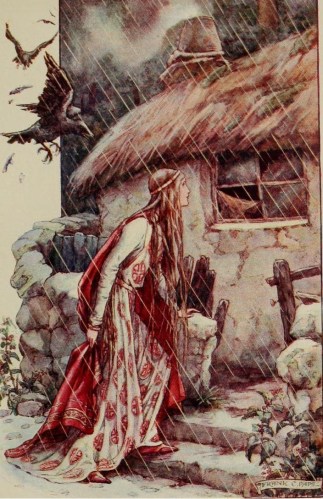
Rackham

The illustration is by Arthur Rackham.

Posted in Uncategorized | 3 Comments

The Heroine’s Journey

This post is prompted by two things:

First, I heard Elizabeth Gilbert say, in an interview, that according to Joseph Campbell there was no such thing as a heroine’s journey, because the heroine did not need to go on a journey: she was the home to which the hero returned. I can imagine Campbell making such a statement, but the evidence in his own book, The Hero With a Thousand Faces, contradicts it: he repeatedly describes heroines on journeys, including Ishtar descending into the underworld. Some heroines have gone on journeys; therefore, the heroine’s journey must exist.

Second, I tried to do some research on the heroine’s journey, and what I found seemed too complicated: it didn’t match up with the journeys I was seeing in the fairy tales I teach.

So I decided to write out a heroine’s journey based on the fairy tales I’m most familiar with. Here’s what I came up with. I describe each step, but sometimes the steps occur in a different order, so the chronology may differ from tale to tale. And not every tale has every step. And not every tale is a journey tale! But when the heroine is on a journey of some sort, this is basically what it looks like:

1. The heroine lives in the initial home. This can be Snow White’s Castle, Cinderella’s house, or the poor cottage where we first encounter the lassie in “East o’the Sun and West o’the Moon.” It’s a place of stability, where the heroine is happy and safe. Usually, it’s the place she spends her childhood.

2. The heroine receives gifts. Sleeping Beauty receives gifts from the fairies, Cinderella from her fairy godmother or alternatively the spirit of her dead mother in a hazel tree. Donkeyskin receives dresses from her father. Sometimes receiving gifts comes before she leaves the initial home, and sometimes after.  The lassie receives the golden apple, comb, and spinning wheel after she has lost the temporary home and been left in the dark forest, so rather late in the tale.  These gifts will later help the heroine.

3. The heroine leaves her initial home. Sometimes she has to leave because she is fleeing her father, as in Donkeyskin. Sometimes she is given away, like Rapunzel. Sometimes she chooses to leave, like Beauty, to save her father and family. If the heroine stays in her home, the home itself is somehow destroyed: Cinderella’s sense of home disappears when her stepmother arrives and she is made to work as a servant.

4. The heroine enters the dark forest. Snow White and Donkeyskin go directly from their initial homes into the dark forest. The lassie enters the dark forest after losing her temporary home: when her bear husband disappears, she is left alone among the trees. In “Sleeping Beauty,” the dark forest actually grows up around the sleeping princess. Rapunzel enters the dark forest after being expelled from her tower.

5. The heroine finds a temporary home. This can be Snow White’s home with the dwarves, or Psyche’s home with Eros in the old, mythic precursor to “Beauty and the Beast.” It can even be the Beast’s castle. In Donkeyskin, it’s the castle where the heroine serves as kitchenmaid, and in Rapunzel it’s the tower. The important thing is that it’s temporary: the heroine may think she can stay there, but she will eventually have to leave again. Sometimes, in the temporary home, she finds her true partner, but not in the right form or at the right time. Rapunzel meets her prince in the temporary home, but loses him again.

6. The heroine finds friends and helpers. These are dwarves, birds, snakes . . . The heroine finds them and enlists their aid by being kind to them, giving them what they need. And they will help her later on, when she is forced to leave the temporary home and set out on her journey once again.

7. The heroine is tested. Snow White is tempted with the ribbons, comb, and apple. Sleeping Beauty’s test is brief: can she resist touching the spindle? But some heroines go through long, agonizing periods of testing. The princess in “Six Swans” can’t speak for years, and must sew shirts for her swan-brothers. Tests can involve climbing glass mountains, wearing iron shoes, and dealing with ogres.  Even Cinderella must get home by midnight.

8. The heroine dies. The tests and trials that the heroine endures include a journey into death. This is perhaps clearest in Psyche’s descent into Hades, but Snow White in her glass coffin, Sleeping Beauty in her hundred years’ sleep, are all versions of the dead heroine.

9. The heroine finds her true partner. This time, he is in his right form: the bear has been transformed into a prince, the Beast is now a man. He recognizes her, just as she recognizes him. It may not seem like much of a love story (the prince dances with her three times, and that’s it), but that’s because fairy tales are told in a kind of shorthand. It’s a convention of the fairy tale that recognition of the true partner is immediate, if he is in his true form. If he is in his false or temporary form, the heroine must learn to see him correctly first.  And sometimes he must learn to see her correctly, because she may be in disguise as well.

10. The heroine finds her true home. She had to leave her initial home and find her true partner before she could enter her true home. Now Cinderella can live in the castle, Beauty can live with her Beast, and it’s time for happily ever after.

If you’re uncomfortable with the idea of the heroine finding her true partner (does she really need a man to be her partner?), you can think of it as a metaphor. The true partner is also the other side of herself, so the story shows us the integration of the feminine and masculine, human and animal, sides of the personality. I don’t know, really: I just know that the partner is usually there, that the heroine is eventually united to a prince. Perhaps it means that a union with the right other is one of the highest things we can achieve in this life, perhaps it’s about unity within the self. Either way, it seems to be part of the story.

I do think, looking over this list, that it’s an interesting model for looking at a woman’s life. I know that I’ve been into the dark forest, and through times of trial. I’ve found friends and helpers, as well as temporary homes. But I’ll have to think some more about whether and how this model is useful . . .

Snow White

This image from the 1920s shows Snow White entering her temporary home (the dwarves’ cottage).

Posted in Uncategorized | 31 Comments

Tried and True

Life is uncertain, we know that. We know that we’re on a small blue globe spinning through the darkness of space. We’ve seen maps of galaxies with the little arrow pointing: “You are here.” We know that in a moment, life can change, or end. Our planet can be hit by an asteroid. We can be hit by a bus. We know all that: the uncertainty, instability, unreliability of it all.

Which is why I like finding things that are tried and true. Things I know I can rely on. They’re always small things, because the larger things you can’t rely on: home, love, peace. Those things change and slip away. Come back and slip away again. So I hold on to small things, even silly things, the way a child clutches a favorite blanket or toy. But the small things matter in life: raindrops, fireflies, minutes all matter. If you experience it in the right way, a minute can last an eternity. In the same way, small things can keep you grounded, safely on this spinning globe. They can fill you with happiness.

So I’m going to list some of the things I rely on, and I think you should make a list of your own. What is your tried and true, no matter how small or silly? What do you know will not let you down?

1. Revlon lipstick. The cosmetics company Revlon has been around since 1932, and they’ve figured out how to make lipstick by now. The colors are rich and varied, the lipsticks are moisturizing. And they are cheap. When I wear my favorite color (Fig Jam), I feel adventurous and as though I could conquer the world. Happiness in a tube of lipstick: that’s like a small miracle, really.

2. My rice cooker. I put in dry rice and water, and an hour later I have cooked rice. How perfectly brilliant! Would that other things in life were so reliable.

3. Cotton cardigans. Is there anything better for fall in New England than a cotton cardigan? (I can’t wear wool because it’s too itchy.) You can put it on, button it or not, take it off, depending on the temperature — which, in fall in New England, is unpredictable. The cotton cardigan: an ingenious device that allows you to regular and respond to unpredictability. And it comes in pretty colors . . .

4. Alstroemeria lilies. I know, they’re not the most beautiful flowers. But the most beautiful flowers are delicate — if I bring them home and put them in a vase, they last a day or two. Alstroemeria lilies last, reliably, for a week. And over that week, I can see them open up, pink or yellow or crimson, with green veins. They bring something living and beautiful into my apartment.

5. Cetaphil face wash. If you have sensitive skin, your skin itself, the thing you live in, can be unpredictable. Will we break out into a red rash today? We never know . . . This is the gentlest and most reliable way to clean my face, the face I present the the world and that tells people what I’m thinking or feeling. Considering how much work my face does, I think it deserves to be well taken care of!

6. Agatha Christie mysteries. When I can’t read anything else, when I’m exhausted or despairing, I can always read her mysteries: the gruesome death, the labyrinthine case, the logical deductions. I think it’s because they tell me that in an uncertain world, there’s always an underlying logic, if we can just see it.

7. The sea. All right, this isn’t a small one. But the sea . . . it moves, it has moods, it gets angry sometimes. Sometimes it breaks things. You could say that it’s the principle of uncertainty itself. And that’s why it’s so reassuring. The sea is always different, yet always there. Whatever changes on the surface, underneath the sea is the same. Until our planet itself dries up, it will be with us, in constant motion. By the time the sea goes away, we will be long gone.

8. Ballet flats. You can squash them flat and pack them into a suitcase, and when you arrive in London, they’ll be ready for you. They’ll carry you through cities and down country roads. Sure, there are places where ballet flats are impractical, but I wouldn’t travel without them. With a pair of ballet flats and a pair of Keds, I can go almost anywhere . . .

9. The English language. All right, this is another big one. But it’s like the sea: it’s so uncertain, such a mishmash of other languages, always changing, and yet always the same underneath. It’s reliably unreliable. Cough? Dough? Plough? I mean, really, it’s crazy . . . And yet I love it. (Hungarian, which I also love, is also crazy, in a completely different way.)

10. Timex watches. Time slips away, but a Timex watch will at least tell you what time it is, reliably. Mine don’t even need to be wound. I have two, in case I lose one or the battery stops working and I need another watch to wear while I get it replaced. They are comparatively cheap, and they do what they’re supposed to — tell the time — perfectly. How many things in life can do that?

All things fall, all things change. Which is why we hold on to what we can, whether it’s a favorite shade of lipstick, or a dogeared book, or a walk by the seashore . . .

Fall

(This is a photo I took recently, in the park by the Boston Common. That’s the swan lake . . .)

Posted in Uncategorized | 3 Comments

Making Mistakes

I’ve been decorating, so I’ve been making lots of mistakes.

The latest is the Mistake of the Bedroom Curtains. Yes, they have names, like Sherlock Holmes cases. The mistake was that I bought the wrong curtains, but it actually all started with the bed.

When I first started decorating the bedroom, I put the bed in a perfectly logical place, close to the window. I added the bedside tables and hung pictures above them. I thought, that’s it: one corner of the bedroom done. And then I realized that late at night, through the wall, I could hear the low buzz of conversation from the building next door. Not words, but the buzz that lets you know a conversation is taking place, like bees in the walls. I don’t know how, since the buildings are a hundred years old and the walls are a foot thick. But then, I have very good hearing. So I had to turn the bed around, which actually ended up being a much better place for it. And the bedside tables had to move. And the bookshelves. So now I had a window with a bookshelf beneath it, which meant rehanging the paintings. I will have to find spackle and paint to cover the initial holes — to hide my mistakes.

But what about the curtains? The first set of curtains I put on the window were dark red cotton, to match the curtains in the living room. But the window in the bedroom is tall and narrow: those curtains blocked out too much light. The second set of curtains were cream, with flowers on them (one of my favorite patterns, Waverly’s Norfolk Rose). They were perfect, but always meant to be temporary because they will eventually be the bed curtains (by which I mean the ones that go over the bed — a bed doesn’t feel finished to me, without curtains). So I bought a third set of curtains, with dark red and cream stripes. I thought, that will match everything else in the room, right? And they did. They matched perfectly, and would have worked, except . . . the room was too dark again. And then I thought, why not get plain cream cotton curtains, just like the dark red curtains I started with — except, you know, not dark or red. By now you’re thinking, I never ever want to decorate with this woman . . . Because yes, I had gone through three different sets of curtains for the bedroom, although the only one I couldn’t reuse elsewhere was the striped set. But I had actually learned something from the experience. Not that I’m incredibly picky when decorating my living space — that I knew. But that the most important thing, for me, was light.

You see, the bedroom is where I have my writing desk, and sometimes I write during the day, although right now I do most of my writing at night. It’s important to me that the room get as much light as possible during the day, although at night I need to close the curtains. The mistake — buying the wrong curtains — led to the realization. So now I have plain cream cotton curtains. If I could, I would have a pattern, because I like patterns. But the most important thing is the light. Without buying the wrong curtains, I would not have realized what I actually valued the most.

And that’s why I’m writing a blog post about curtains: because they led to a revelation. I blame myself for mistakes, beat myself up mentally for them.  But the mistakes are actually part of the learning process. They aren’t wrong turns, but how I get to the right place. We’re told to forgive ourselves for our mistakes, but what I’m saying goes deeper than that: our mistakes are necessary. We could not succeed without them. Often, it’s just after doing something wrong that I suddenly realize how to do it right. If you’re not making mistakes, it’s probably because you’re not trying to do anything particularly complicated. Anything at all complicated (in which I include hanging curtains) takes time, and finding the right way to do it — and that usually involves starting with wrong ways.

So what I’m saying is, don’t blame yourself for mistakes. Don’t forgive yourself for them. Thank yourself for them . . . maybe even, if you can, celebrate them. Because without them, you can’t get wherever you’re going.

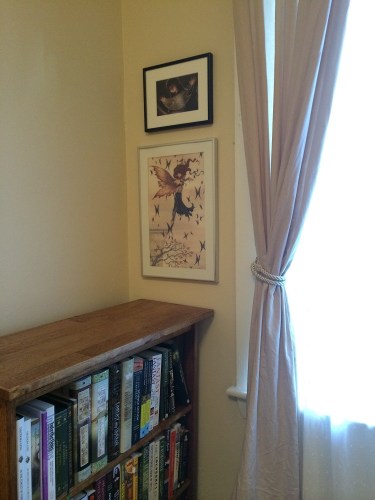
Curtains

This is the window, and the shelf, and the pictures rehung. And the curtains . . .

Posted in Uncategorized | 10 Comments

Pacing Yourself

You can’t do everything.

You can do a lot of things, but you have to pace yourself.

These are the lessons I’ve been learning this month. I’m the sort of person who wants to do everything: Teach. Write novels and stories and essays and poems. Spend time with my daughter, of course. But also learn Hungarian, and go to the ballet, and read books. Travel when I can. Decorate my apartment. There’s time for all of that, but I have to figure out when and how to do each thing so I’m doing it well, and not exhausting myself. That takes pacing.

So for example, I’m decorating my apartment. My impulse is to do everything at once: to buy the bookshelves, put them together, stain and finish them. Buy the pillows, the fabric to cover the pillows. Sew the pillow covers. But I don’t have time to do everything at once, because I’m also teaching and writing. So instead I do a little each day, and I find that as long as I’m doing something each day, eventually it gets done. The shelves go up, the pillows are covered and put on the daybed.

It takes having patience, and being able to divide work into discreet tasks so you can do it a bit at a time. So for example, today I’m going to stain the shelves, then let them dry overnight, turn them over, and stain the other sides tomorrow. They should be completely stained by this weekend, when I can put the whole bookshelf together and finish it with oil. Soon, and by soon I mean at the end of the week, I’ll have a bookshelf, and the books that have been sitting on the floor will have a home. I do hate books sitting on the floor, so not having a place to put them has been an exercise in patience. But I know that as long as I work on the shelves every day, a little at a time, I will eventually have a floor without books on it.

The same goes for writing, and of course you know I’m more concerned about writing than shelves, although my home is important to me. In writing, I have to pace myself too. Right now, I’m working on revising the entire novel. This will be my second full revision, and this week I’ve been doing the hardest part: rewriting the first chapter. I work during the day, so I write at night, from around nine p.m. to midnight. I find that I can only write for about three hours before I lose focus, before the words won’t come as easily or fit together as well. It’s like the shelves: as long as I do a little each day, I know it will eventually be done.

There is another sense in which I try to pace myself: not just breaking up tasks over time, but making sure that in any given day, I’m doing different sorts of things. I know that if I teach and then meet with students, I need to do something that doesn’t involve people. If I sit and write for a long time, I need to go something physical. If my mind has been taken up all day with work, I need to go read a book. Whatever I’ve done, I need to do the opposite for a while. Otherwise, I’ll exhaust myself with one task, or type of task.

Pacing yourself is about getting to do all the things you want to do, not necessarily when you want to do them, but so you can do them most efficiently, and with the most energy. It takes three things:

1. Prioritizing. Know what you actually want to do, and get rid of the things you don’t want to, to the extent you can.

2. Dividing tasks over time. Figure out how to divide what you need or want to do, and do part of it each day until it’s done. But almost anything you do, even the things you love to do, you will tire of, if you keep doing them long enough.

3. Dividing your time into tasks. What do you want to do when? What are the things you most need or want to get done today, and how are you going to arrange them? Can you fit in the things you need to do, the things you want to do, and the things that will give you a break from everything else? Remember to take a walk, read a book . . .

I’m not always very good at pacing myself, but I have so many things I want to do . . . and I think that’s the only way to do them.

Tree

Last weekend, I saw this little tree in the town of Harvard, Massachusetts. Can you see that it’s trying to be all the colors at once? I admire this little tree, and yet I thought: pace yourself! You have plenty of growing to do, and there’s plenty of autumn to come. You will be all the colors, little tree, in time . . .

Posted in Uncategorized | 8 Comments