How to Revise

Here’s the problem. I’m writing this story about four girls at a school for witchcraft. And one day, when I’m too tired to do anything else, I describe that school for witchcraft. And I look at that description and think, that’s boring.

And I look at the plot so far, and I think, what happened to all the magical stuff? Because the magical stuff happened in the earlier posts, when I was just randomly describing the Other Country, where Thea was encountering Mother Night, and The Gentleman, and Morgan, and Merlin (those green eyes . . .), and the obnoxious cat Cordelia. That was the interesting part. When I was writing in fragments, my writing was better, more interesting, more poetic. As soon as I started to write a connected plot, my writing became less descriptive. It became – I’m just being honest here – sort of blah.

If I were writing a book, I would get the plot down first, and then I would go back through each scene and make it more interesting. I would revise everything. I can’t do that here.

But there are some things I need to rethink.

Here are the principles on which I want to rethink them:

1. I need cool stuff. What did I do with all the cool stuff? Well, the problem was that all the cool stuff, the house made with dragon bones, the white-haired librarians noiselessly walking its corridors, the automata tending the gardens, were all in the Other Country. Everything magical happened there. That’s stupid.

2. I need pretty prose. I need to write the way I write, the Theodora Goss way. Well, all right, a Theodora Goss way, because there are different ways I write. But I need some poetry in that story. It’s there in the shorter, experimental segments. Not in anything I’ve written recently.

So what to do? Well, I have a couple of ideas. First, I could move Miss Lavender’s into the Other Country. Just move the whole school, playing fields and all. You would still open the wrought-iron gate and walk down Hecate Lane, but you would emerge in a field, with the school and its gardens in front of you. So I could make the school less ordinary. It would be stone, and shaped like a castle with peaked turrets, and I could add in some dragon bones. And then it would actually make sense that Miss Gray hid Mouse at Miss Lavender’s, because Samael Sitgreaves was banished from the Other Country. I could also create a brother school, a boys’ school called Paracelsus Academy. It would be up in the mountains. One of Emma’s brothers, the older one, could go there.

Then, I would need to differentiate between the girls, get a better sense of who they are. Emma is a Gaunt, but a sort of anti-Gaunt, not at all like her family. Kind and considerate, in an automatic sort of way simply because that’s who she is, a romantic, plump and the prettiest of the girls, with long blond hair. Mouse is thin, pale, with white hair because her mother is one of the Wild Women of the Forest, who wear white dresses and shoes of bark. She is timid, diffident, smart. But she can be fiercely proud. Matilda and Thea. There’s the problem: I wasn’t originally going to have Thea. But I started writing about the Shadowlands, which was really about depression (since I was dealing with it at the time), and then Mrs. Moth and Miss Gray came into it, and then it was obvious that Thea had gone to school with the other girls. Matilda was originally my mouthy, athletic narrator. A brunette, short hair. So who is Thea? I think she has to be a sort of me, I don’t think I can avoid that. Red hair, bookish, sensible. (Of course, they’re really all me. They have to be, otherwise I couldn’t write them.)

They’re teenagers, so I need romantic complications. Everyone has a crush on The Gentleman, that raven-haired trickster. But he’s not available, he’s the companion of Mother Night. He has been since before the dawn of time. Of course there’s Merlin, and he’s part of Thea’s story. I already have some lovely complications there, because if you remember, he gave his heart to Mother Night for safekeeping after having it broken by a certain medieval princess. The question is, where has she put it? And what can he do without it? I think he’s just going to be trouble for Thea, at least until the end of the story. And she’s going to spend a lot of time thinking she dislikes him, and he’s going to spend a lot of time teasing her, while the other girls look on exasperated. (“Why do you like him?” said Matilda. “I don’t,” said Thea. Matilda snorted. “Yeah, right.”) Someone has to have a crush on Emma’s older brother, and I think that will be Mouse. But he will flirt with Matilda or Thea for most of the story. I think I might have to do something fairly traditional, like have him be wounded and have Mouse rescue him, for him to finally notice her.

Matilda will need someone really quite extraordinary. Really as obnoxious as she is. What I need is some version of Loki, I think. Lucas? Emma’s brother’s friend, who turns out to be – you know, I don’t know what yet. Lucas Grimm. I do like the names, I have to say. Gaunt, Tillinghast, Mandragora. Proper witch names.

And what about Emma, the romantic? I was sitting here thinking, finishing my Brown Rice Teriyaki (see yesterday’s post about never having the time for a proper meal), and it occurred to me that her love interest should be dead. A ghost? Or something like that, because I don’t think death means the same thing in Mother Night’s world as it does in ours. Death is certainly not an end, merely a transformation. And the thing about witches is, they make that transformation knowingly, voluntarily.

Some of the loves should be hopeless: I think Emma’s will be. Some of the loves should be a very bad idea: Matilda’s, since I think that after all, Lucas isn’t really Lucas Grimm but Lucas Grimsby, Leonora’s nephew. And one thing we need to find out is that the weak, whining Leonora is stronger and sneakier than she seems. (I know, I’m giving away the plot here. Or maybe not. I mean, I haven’t written it yet.) Some of the loves should be true and sweet and strong: Mouse and Whatsisname Gaunt. Alasdair, named after his grandfather, I think. And some of them should seem impossible, but be possible after all: Thea’s, because nothing is ever impossible, with magic. Although sometimes you have to accept that the love of your life will go off before breakfast to fix the timestream.

So what to do next? Well, next, the girls have to go to the studio of Tollie Mandragora. Which is going to be all steampunked out. Where shall I set that, in Boston or the Other Country? I don’t know, I’m still trying to figure all these locations out. But I know that I have to make the whole thing weirder. Because blah is not an option, you know?

Posted in Uncategorized | 12 Comments

Take Care of Yourself

I haven’t been very good at taking care of myself, lately.

It’s because I have so much to do, and I’m so stressed about it all. This month is the worst. March should be a little better, and April should be better still. And then the summer should be all right.

The thing is, I’m trying to change my life, and that’s a difficult thing to do. But three months from now, my life should be significantly different, and six months from now, it should be even more so. It should be better, and more filled with possibilities.

In the meantime, I have to remember to take care of myself. I think this is something writers have to remind themselves to do. I’m not sure why writers aren’t very good at taking care of themselves, but they’re not. I started thinking about this issue because Tobias Buckell wrote a blog post called “How I lost 30 pounds while eating a donut every day,” and Elizabeth Bear wrote a blog post called “you might be surprised at how far she’d get with her feet on the ground.” They were both about diet and exercise, and I want to talk about more than that, but those issues are important as well. They are two-thirds of the equation. You know I like breaking ideas into threes, so I’m going to talk about staying healthy in three ways: eating, moving, resting.

Eating

We all know how to eat well, I think. Whole grains, low-fat proteins, fruits and vegetables. Small portions. Plenty of water. My problem is that I don’t have the time to eat regularly. For breakfast, I grabbed two pieces of whole-wheat toast and two low-fat Baby Bell cheeses and ate them in the car on the way to the university. I had meetings all morning. For lunch, I bought a small ham sub with veggies on whole wheat and a bag of Sun Chips. I managed to eat the Sun Chips, then had to teach. Then meetings. Then finally, at around 4:00 p.m., I had time to eat the sub. For the trip home, I bought a Kashi cereal bar. Dinner was a small vegan pizza on a whole-wheat crust and Manhattan clam chowder, eaten – well, honestly, I’m eating it now. Dessert will be a coconut milk ice cream, which has no actual dairy in it. The flavor is pomegranate chip. So, whole wheat, low-fat protein, veggies. No fruits, unless you count the pomegranate, and you shouldn’t. Too much sugar in the cereal bar and ice cream, but otherwise not terrible. I just wish I had time to sit down and eat a proper meal.

What about calories? I stay between 1600 and 1800 a day, which keeps me at 120-125 pounds. I write that because both of the other posts discussed calories, and like Toby and Bear, I count calories every day. It’s the only way to make sure not only that I’m not eating too much, which always makes me feel ill, but also that I’m eating regularly throughout the day. Otherwise, I will eat too much without thinking about it, or eat too little (less frequently, but a distinct possibility on busy days). I’m used to writing down calories before meals, so it’s not a bother. And it means that I never feel guilty about treats, because they’re simply calculated into the daily total. One day a week, I don’t bother and simply eat whatever I want, which is also like Toby and Bear. I’m comfortable with my weight, although I prefer to be on the 120 end rather than the 125, which feels too heavy. If that seems low to you, remember that I’m only 5’4″, and I have a very small frame. A weight that would be perfectly normal on someone taller and larger than I am is too much on me. And I believe we all have to find the weight that feels most comfortable on us.

I think that’s really all there is to eating. Healthy food, in the right amount. And hopefully eaten in a more relaxed way than I’ve been able to eat lately.

Moving

We all need exercise.

Having written that, can I confess that I absolutely hate anything we usually consider exercise? Anything that involves repetitive, monotonous motion? Anything one might do in a gym? I think there are three types of exercise I need to do, to stay healthy: move, strengthen, and stretch. I find that I move quite a lot, actually. Most writers sit and write for hours at a time. I’m fortunate in that in addition to the writing, I also have a teaching schedule that keeps me active for most of the day. My office is up five flights of stairs, one of my classes is also up five flights of stairs. I’m on my feet all day long, walking around campus. So I don’t bother with aerobic exercise. I figure that as long as I can run up five flights of stairs, I’m fine. To strengthen, I do pilades. To stretch, I do yoga. I do wish I could do more – I would love to take a dance class again.

The issue right now is that the International Conference on the Fantastic in the Arts is in March, and it’s in Orlando, and there’s a pool. And I’ve bought a swimsuit. So I’m going to try to get in shape. That means more pilades, basically. I don’t think anything is as good for getting toned.

There’s a special problem that writers have, and I’m starting to get it too: muscle pain from typing. I’m not sure what to do about that, except stretch and massage. So more yoga and pilades. That’s the agenda for the next month.

Resting

Oh, I’m terrible at this one. I’ve been getting 5-6 hours of sleep a night, which I know perfectly well is nowhere near enough. The problem is stress. I can’t seem to sleep well at all. I’m not sure what to do about this, except finish the work I need to finish, which will get rid of the stress.

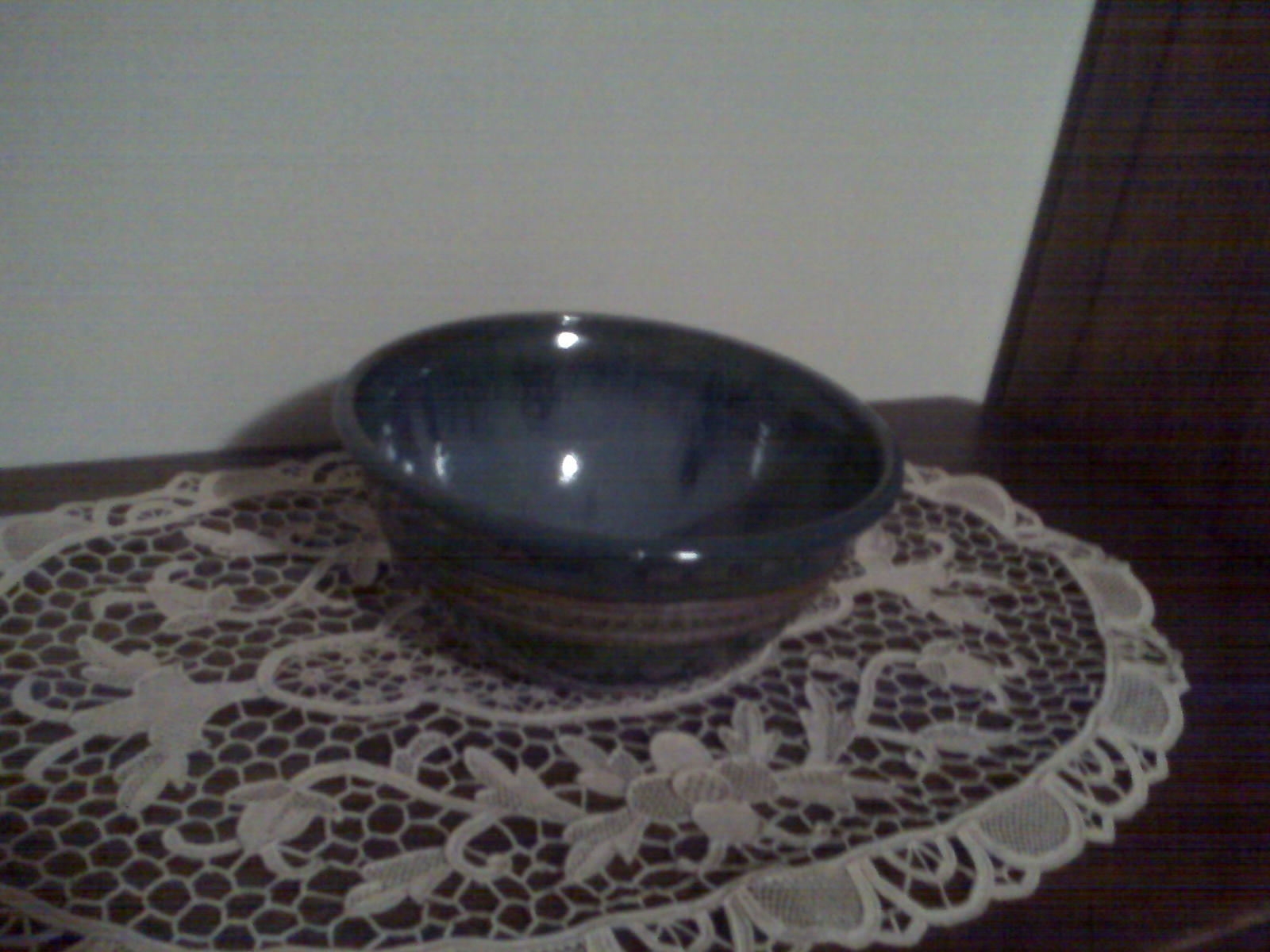
I do try to make sure I’m doing things other than working, when I can. For example, today I had about half an hour, so I went into one of my favorite thrift stores. I came out with an adorable table and pottery bowl. Here they are while I’m standing in line to pay ($10.68):

And here they are in my room, cleaned up (sorry, the lighting is low):

And here is one of the table legs (I thought the legs had such an interesting shape):

And here is the bowl on top of the table:

There’s something relaxing about taking a half hour off, once in a while. Just to go look at things, or buy something small. I should take more time off just to rest, to read stories for instance. But there doesn’t seem to be enough time.  And I don’t seem to have the concentration I need.

Most of the time, I have to admit, I’m very, very tired.

So what to do with all this? I meant to write a post about taking care of yourself, but it’s ended up being about how I don’t take very good care of myself. But I’m trying, and I suppose what I’m saying here is that you should try too. Taking care of yourself is a part of valuing yourself. We all need to figure out how to take care of ourselves in our own ways, figure out what will make us feel best, most productive, and of course most cared for.

In my former apartment, one way I cared for myself was taking a bubble bath every night, in Whole Foods lavender body wash, in the claw-foot tub. It was enormous and held a great deal of very hot water, and very bubbly bubbles. In this house, there is no claw-foot tub. I can’t take bubble baths.

Which brings me back to what I said at the beginning. Six months. I’m going to change my life. As much as I possibly can. Just wait and see.

Posted in Uncategorized | 5 Comments

On Blogging

I wanted to write a post called “Take Care of Yourself,” because that’s exactly what I haven’t been doing lately. But Terri Windling wrote a wonderful post called “Reflections on Blogging,” which was a response to an interview conducted with Rima Staines on the John Barleycorn website. You can look at the interview with Rima here: “Around the table with . . . Rima Staines.” I’ve been blogging for a long time now, in various forms, but I’ve only been doing it consistently since the middle of November. (Consistently, for me, means every day. Someone else will surely have a different definition.)

And so I thought I would write about blogging, about why I do it and what it means to me.

It was the middle of November, after several weeks during which all I had wanted to do was lie on the bed and stare up at the ceiling. There I was, staring up at the ceiling, and part of me said, what now? And another part of me answered, now you remake your life.

And I got up. I spent most of that night and the next day designing this website. That’s when I started blogging consistently. I think that, at its simplest, it was a way of saying several things: I am a writer. I am still here. I’m going to be fine. (Even when I wasn’t sure myself that I was going to be.) It was a way of reaching out, not to anyone I knew, but to all the people I didn’t know.

Since then, I’ve insisted on posting very day. When I miss a day, I post twice the next day. There are several reasons. First, it’s a way of writing consistently. It means that every day, I sit down and write. And I get the instant gratification of seeing that my writing is read. If you want to believe you’re a writer, you have to write. You have to convince yourself by actually writing. Otherwise, you begin to doubt yourself. You begin to think, I haven’t written since – whenever you last wrote. And you begin to think, perhaps I’m not a writer after all. At least, that’s the way I respond. This is one way to convince myself I’m a writer. And with that conviction, I will be. (The difficulty, of course, is that with the schedule I have right now, I don’t have the time or energy to work on stories every day. I get stories written, but they happen in bursts, when I can focus on them completely. So I certainly am writing fiction as well, but it’s happening differently. If I could work on fiction every day, I would. Also, when I write stories, I often don’t know when they will be published or how many people will read them. Here, I know.)

Also, and this is a separate reason, it seems to keep me from falling into sadness or darkness, I think because I feel as though I’m connecting. And I feel as though I’m being brave, because there is something brave about writing so directly, without the intermediary of an editor, a publisher. I write it, you read it. And when I write something, it leaves me – so I write the sadness, the darkness, and then it’s gone, it’s out there rather than here with me.

Do you want the statistics? Now remember, I am not John Scalzi, nor was meant to be. But since I created this website in the middle of November, I’ve written over 100 posts and received over 300 comments. Sometime tomorrow, it will have received over 20,000 hits. I think that’s pretty good, for three months!

This is a particularly personal post, and I was thinking about that: writing so personally. At Boskone, as I was walking through the dealers’ area, I met a writer I always love talking to but rarely get to see, and she mentioned how difficult it could be, writing through depression. For a moment I wondered why, and then I remembered that I had written a number of posts about Depression, Anxiety, and Insomnia. It reminded me of what Hawthorne had said about autobiographical writing at the beginning of “The Custom-House”:

“The truth seems to be, however, that when he casts his leaves forth upon the wind, the author addresses, not the many who will fling aside his volume, or never take it up, but the few who will understand him better than most of his schoolmates or lifemates. Some authors, indeed, do far more than this, and indulge themselves in such confidential depths of revelation as could fittingly be addressed only and exclusively to the one heart and mind of perfect sympathy; as if the printed book, thrown at large on the wide world, were certain to find out the divided segment of the writer’s own nature, and complete his circle of existence by bringing him into communion with it. It is scarcely decorous, however, to speak all, even where we speak impersonally. But, as thoughts are frozen and utterance benumbed, unless the speaker stand in some true relation with his audience, it may be pardonable to imagine that a friend, a kind and apprehensive, though not the closest friend, is listening to our talk; and then, a native reserve being thawed by this genial consciousness, we may prate of the circumstances that lie around us, and even of ourself, but still keep the inmost Me behind its veil.”

I don’t think I’m indulging in “such confidential depths of revelation as could fittingly be addressed only and exclusively to the one heart and mind of perfect sympathy.” I don’t quite go that far! (Although it is a lovely idea, isn’t it? The one heart and mind, the perfect sympathy.) Rather, I address what I write here to what I assume are hearts and minds of partial sympathy. I assume that you will read and understand, that we are in some way deeply and fundamentally alike, because otherwise why would you come here? I assume that we have something in common, although you may well disagree with any specific thing I say. (After all, that’s what comments are for.) So I think, and hope, that we do stand in some true relation to one another, that there is something authentic about this, me writing, you reading and perhaps commenting. That this blogging, which can seem like a strange activity, has a purpose and a reward.

That is why I prate of the circumstances that lie around me, and even of myself, although I do keep the inmost Me behind a veil, not because I intend to, but because that Me is behind a veil to me too. There are parts of myself I do not understand, and I suspect that I reveal them as much in my writing as anywhere.

I have now written over 1000 words, so I’m going to stop.

But you know what I think? I think that if Hawthorne were alive now, he would be blogging. He would want that connection too.

Posted in Uncategorized | 14 Comments

Being a Snail

Would you believe me if I said that I was an introvert? Well, I am.

The truth is that most writers are, however much we go to conventions and live public lives, by which I mean lives that are, in significant part, lived online. I mean, if you were following my tweets, you knew what I was doing today, which was going to panels and giving a reading at Boskone. Even if you weren’t following my tweets, you could see all that information on my public Twitter page.

And yet, I’m an intensely private person, and I still have to mentally prepare myself for public events. Especially ones I’m doing alone, like readings. To be perfectly honest, I’m always worried that no one will come. (After all, why would they want to come and listen to me? Aren’t there so many more interesting people to listen to? So runs the mental script.)

I’m naturally a snail, and there is a process of mental bracing whenever I have to come out of my shell.

I do have one principle that helps, which I will call the Miniskirt Principle. If you have to do something frightening, do something else that frightens you at the same time. I have no idea why that helps, but it does. That is why, today, I decided to wear a miniskirt. There was something comforting about the dress I wore to Boskone on Saturday. I was Pre-Raphaelite Girl, and it floated around me, and there was nothing about it that worried me or made me self-conscious at all. But when I wear a miniskirt (and I rarely do), I’m always conscious of how I’m moving. And sitting, of course. Partly because it’s just, you know, short. But partly because, like every woman, I have a least favorite part of my body, and that least favorite part is my legs. I naturally have the sort of body that makes someone a good gymnast or dancer, and I did actually take both gymnastics and dance as a child. Which means that my center of gravity is low, and I have proportionally short, muscular legs. They’re perfectly functional legs that routinely take me up five flights of stairs, for which I’m grateful. It’s just that, if I’m self-conscious about anything, it’s them.

It’s as though, by choosing to wear a miniskirt, I announce to myself and the world that I am FIERCE. And then I stride along fiercely, and I go to my panels fiercely, and do my reading fiercely.  So there you are, the Miniskirt Principle: if you’re frightened of doing something, do something else that frightens you at the same time.

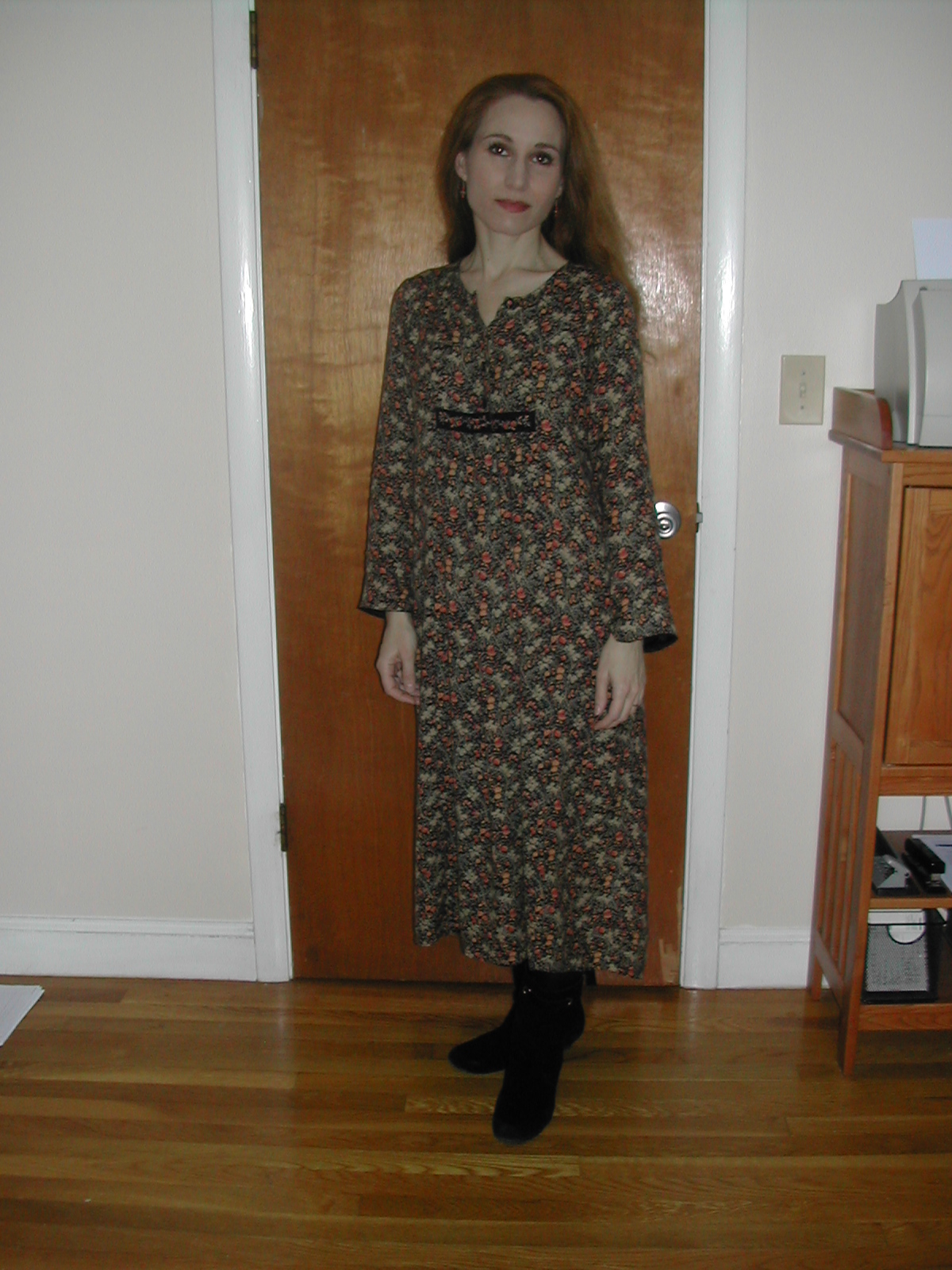
Here is a photograph of me in a miniskirt, ready to go to the convention. (But notice that I’m artfully standing so as to minimize my legs. I’m FIERCE, but I’ve learned how to pose for photographs . . .)

So how did the reading go? I think it went very well. I was worried that no one would come, so this morning I tweeted that the first five people who came would get free copies of my short story collection. I had the largest crowd I’ve ever had for Boskone, although I don’t know if that was why. And I had a chance to catch up with Brett Cox and Alex Irvine, who both came. I read part of “Pug,” which is coming out in Asimov’s this summer.

I also had two panels today.

First panel: Mythpunk

Debra Doyle
Gregory Feeley
Greer Gilman
Theodora Goss
Michael Swanwick

Wikipedia says, “Described as a subgenre of mythic fiction, Catherynne M. Valente uses the term “mythpunk” to define a brand of speculative fiction which starts in folklore and myth and adds elements of postmodern fantastic techniques: urban fantasy, confessional poetry, nonlinear storytelling, linguistic calisthenics, worldbuilding, and academic fantasy. Writers whose works would fall under the mythpunk label are Valente, Ekaterina Sedia, Theodora Goss, and Sonya Taaffe.” And what do WE say?

This is a difficult panel to describe. So many things were said, and some of them were “The Wasteland” and “Cyberpunk,” so you can get a sense of the territory that was covered. I particularly liked two lines of Michael Swanwick’s: “I’m Michael Swanwick and I’m one of the most interesting fantasists writing today,” and “I sit here vindicated.”

He also, in the nicest and most supportive possible way, called the Mythpunks “Young Madwomen,” which I think is a wonderful designation that should immediately be adopted. We should have a sort of Young Madwomen’s Club.

We also talked about modernism and postmodernism. Greer said, “The impulse of modernism is to make cathedrals,” and Greg added that postmodernism capers in the ruins of those cathedrals. Which I thought was an excellent description.

Perhaps the most interesting thing about this panel was telling Greer how incredibly influential she had been among the female fantasy writers of my generation, and having her look completely surprised. So this is for you, Greer Gilman and Carol Emshwiller and Kelly Link: you influenced an entire generation of women fantasy writers. (Although Kelly is actually part of our generation. But she started earlier than most of us.) You showed us what we could do, how we could write, and we found it incredibly liberating. Now you know!

Second panel: A Child’s Garden of Dystopias – the Boom in Nasty Worlds for Children

Bruce Coville
Theodora Goss
Jack M. Haringa (M)
Kelly Link

Why do dystopias and YA literature seem to go together? Are YA dystopias more common now than previously? Are there differences between YA and adult dystopias – perhaps a different ratio of cynicism to hope? How does “if this goes on” fit in?

By the time I got to my last panel, I was very, very tired. Also, I knew less about this subject than any of the other subjects I had talked about. I thought it was a very good panel, and I particularly liked Kelly’s image of dystopic YA novels as scratchboards: they look black, but once you scratch the surface, all the colors are underneath. And I think Bruce Coville had an important point about the fact that teens today are going through a sort of spiritual crisis, trying to figure out where meaning is going to come from in their lives while living in a culture that defines them as consumers. I think that’s very true.

I had some time after the final panel to make my rounds and say goodbye. Here are Brett Cox and Kelly Link, in the general area of the Small Beer Press table:

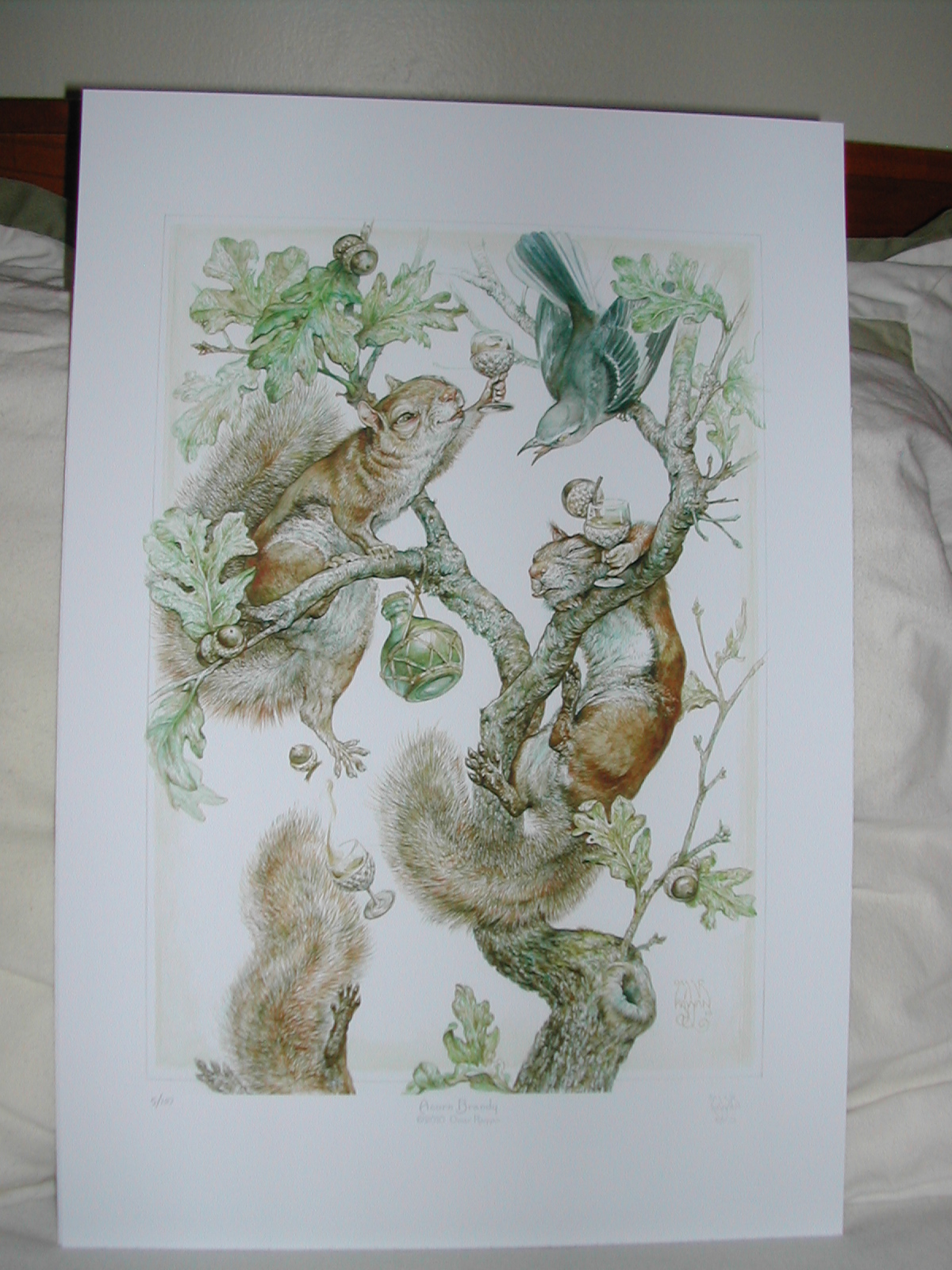
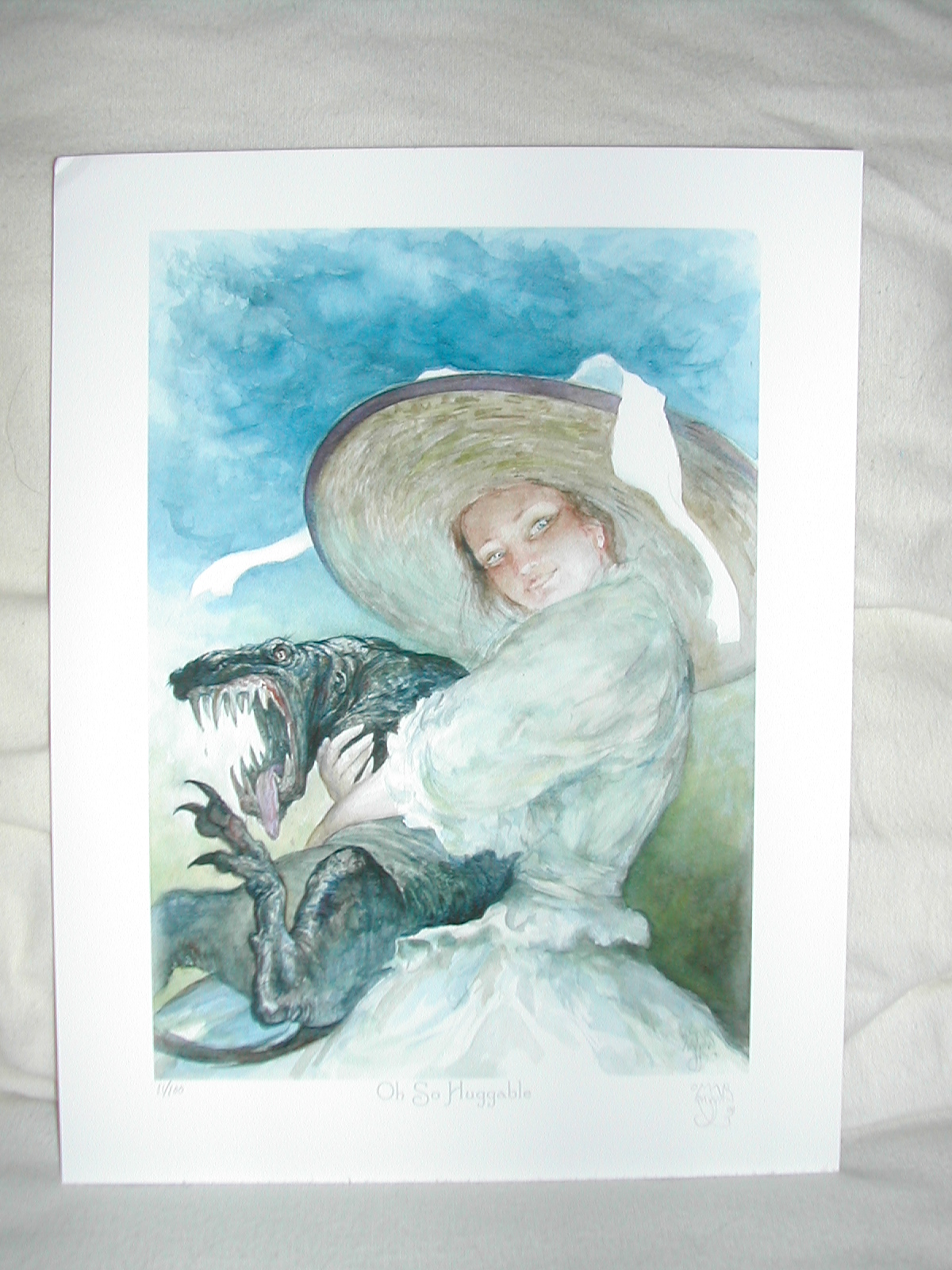
I also had a chance to catch up with Steve Pasechnik, who helped me pick up my art. I always buy some art at Boskone, because it has one of the best art shows. I bought two limited edition prints by Omar Rayyan, “Acorn Brandy” and “Oh So Huggable.”

I also had a chance to look at the pile of original paintings and drawings on his table. They were stunning, as always. But I’m grateful that he has prints available, because those are what I can afford. There is something so democratic about prints. They’re different from originals, of course – there’s a different feel to them. But they do allow me to surround myself with beautiful things. Like drunken squirrels!

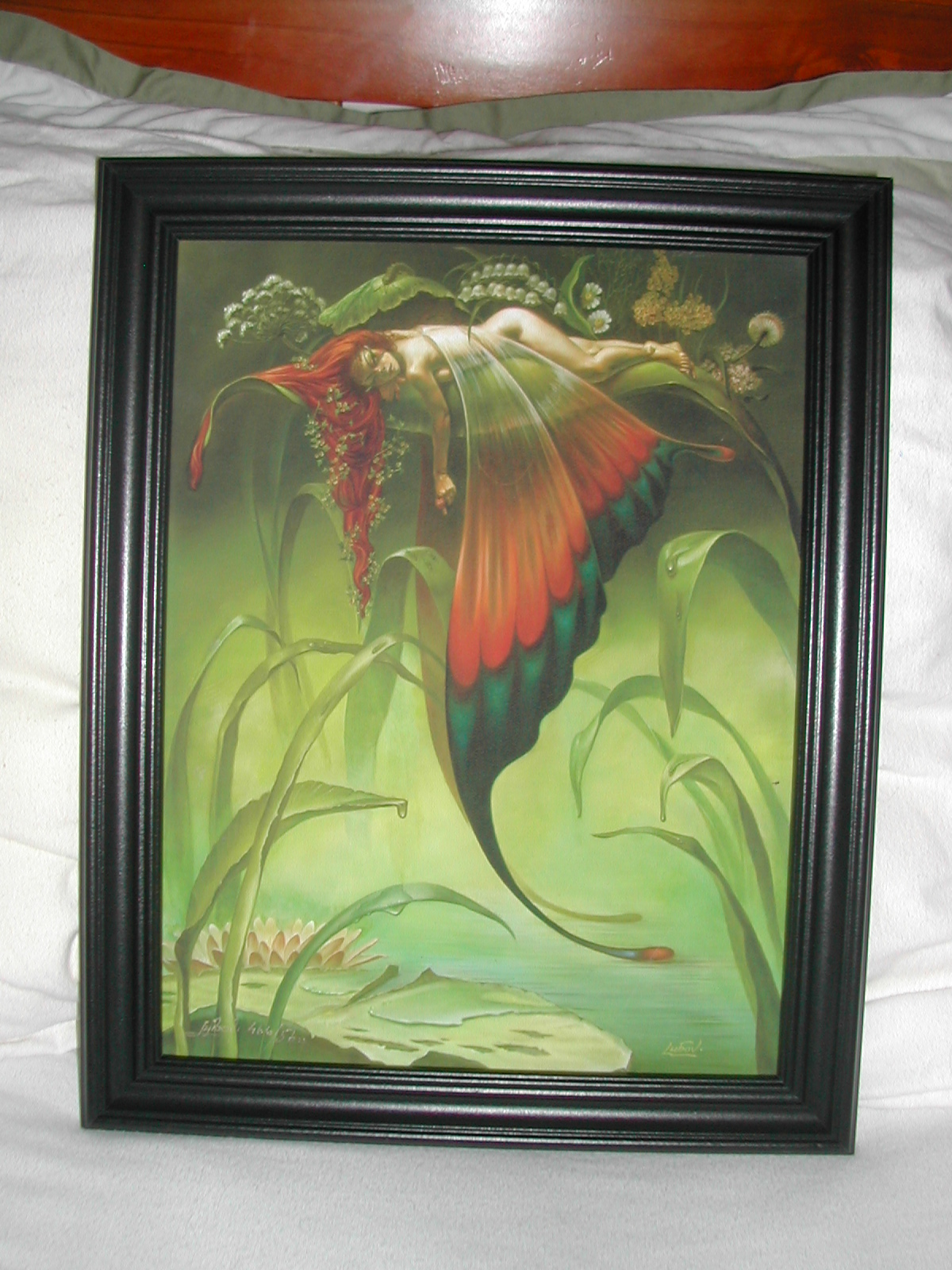
I also bought another limited edition print by bidding on it in the art show. It’s called “By the Pond” and it’s by an artist named Lubov. This isn’t the sort of art I usually buy, but I loved the colors, and the precision of the flowers and leaves.

To photograph these paintings, I just propped them up against a pillow. If you want to see better images, look here: “Acorn Brandy,” “By the Pond.” (I haven’t found an image of “Oh So Huggable.”)

(Note to the artists: my understanding is that, because I’ve purchased these items, I can photograph them and post the photographs on this website. But if you would prefer that I take them down, I will of course do so.)

The convention is over, and it’s time for me to go back to work. I’m so glad I went, and also very tired. Time for the snail to crawl back into her shell for a while. (Even though at this point, it’s a rather public shell.)

Posted in Uncategorized | 8 Comments

Boskone Pictures

All right, here are my Boskone pictures from Saturday. There are quite a lot of them, so I’ve put them together in pairs to save space.

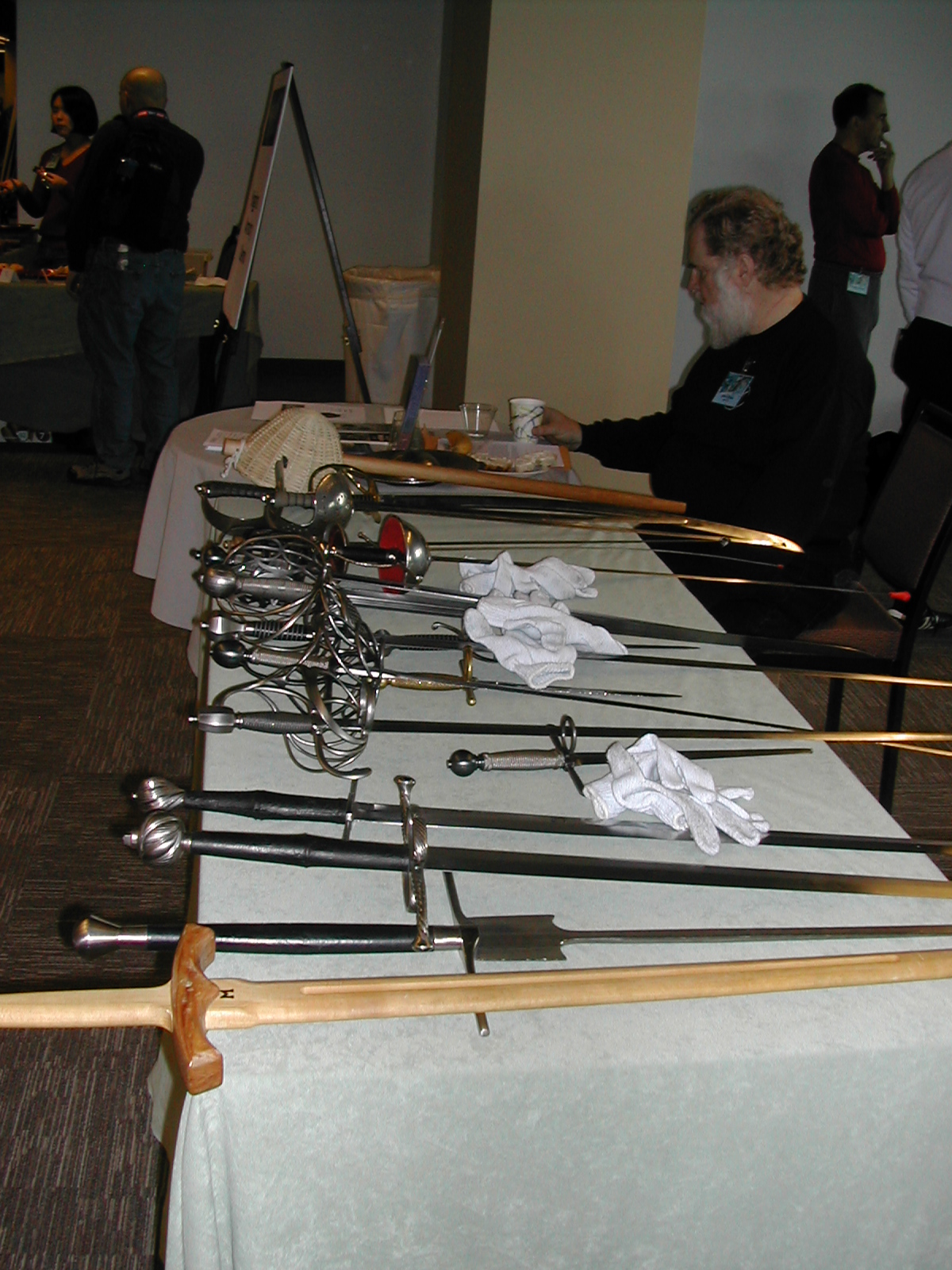
The first two are of me dressed for the convention and a display of weapons by the Higgins Armory Museum.  Someone complimented me on this dress, and I said that I had bought it at the thrift shop where all the Pre-Raphaelite models bought their clothes.

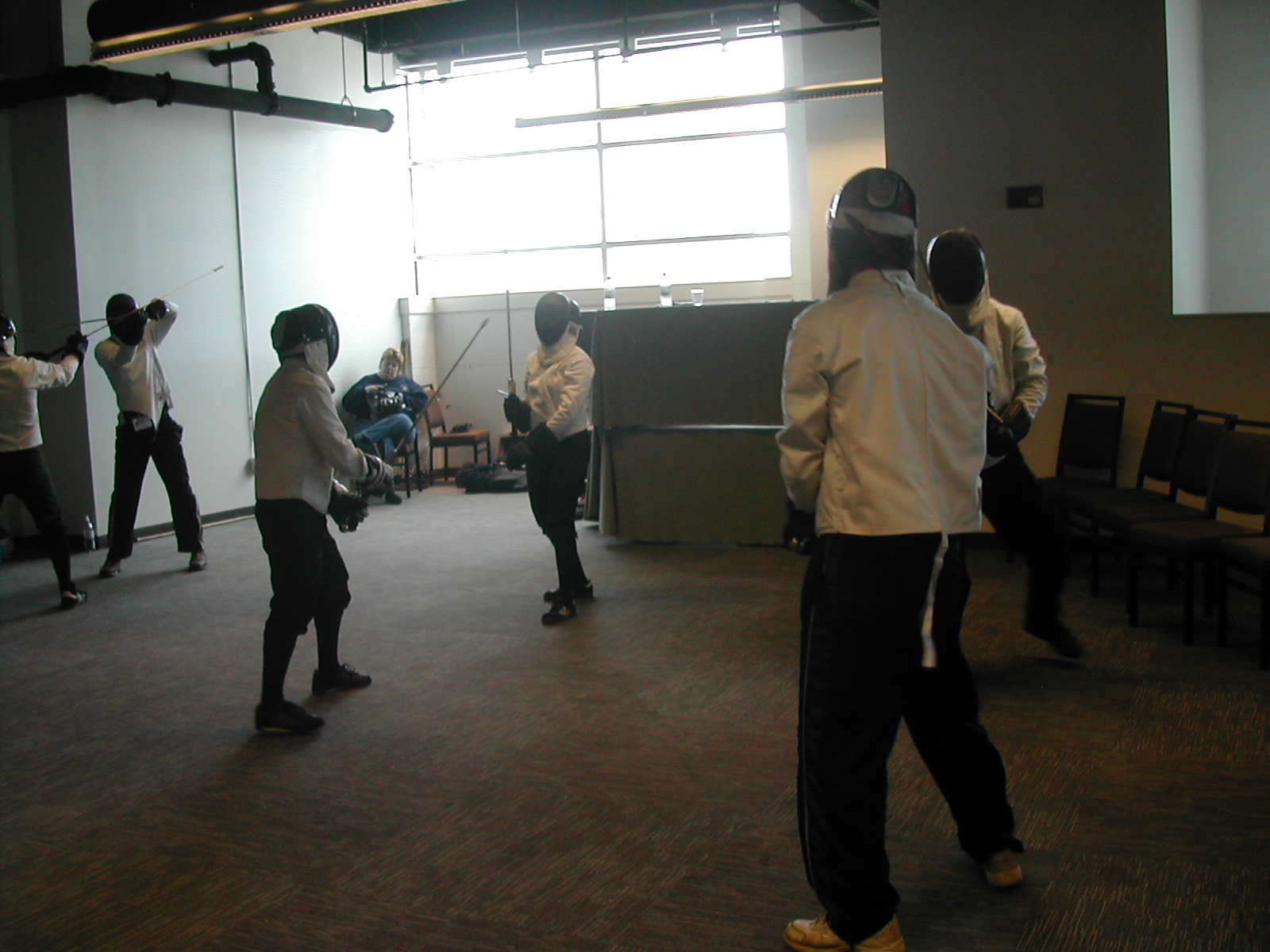
Here is one of the demonstrations put on by the Higgins Armory Museum, as well as a general shot of the room where all sorts of events took place. There were tables where people could sit and snacks of various sorts.

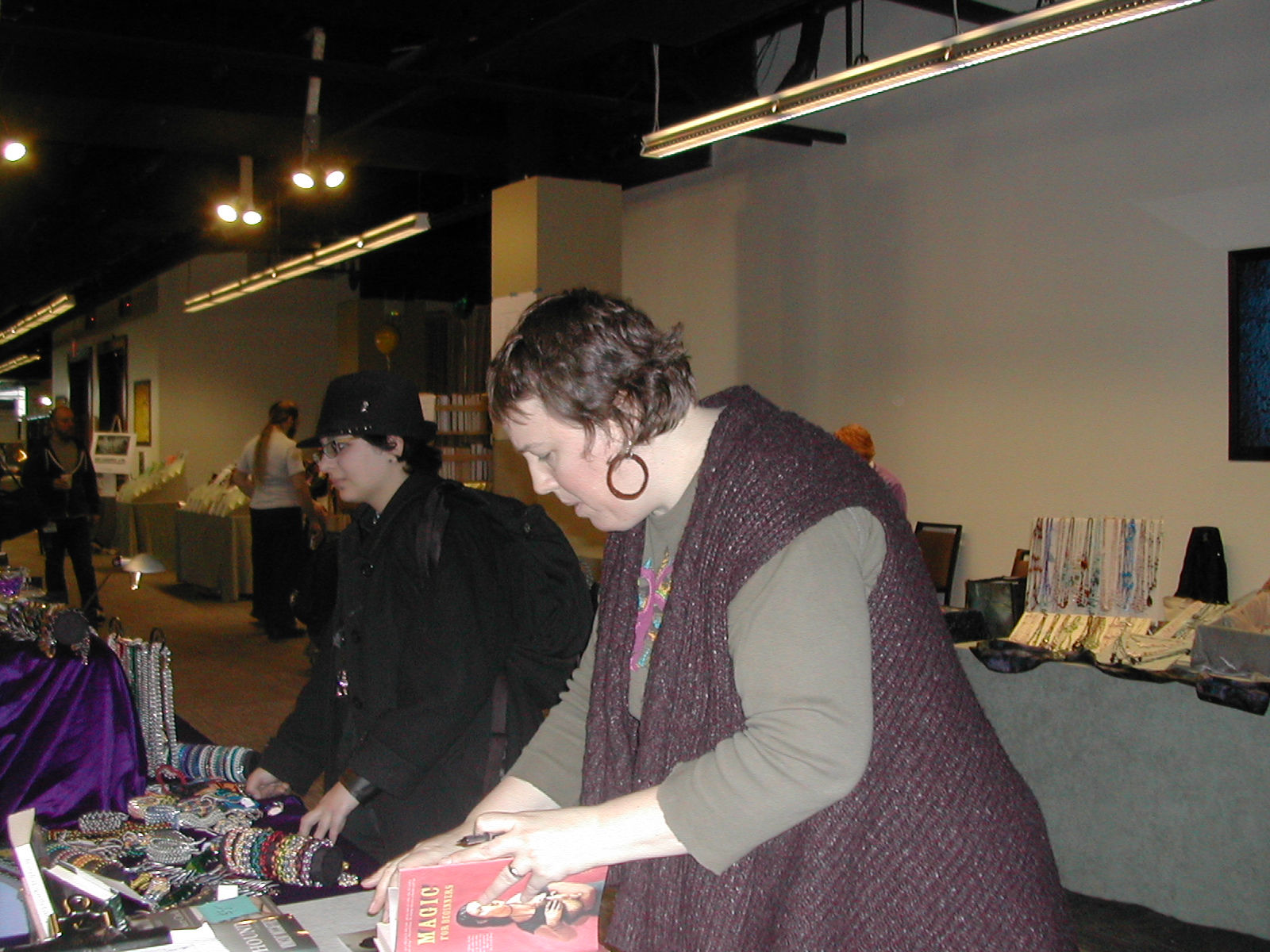
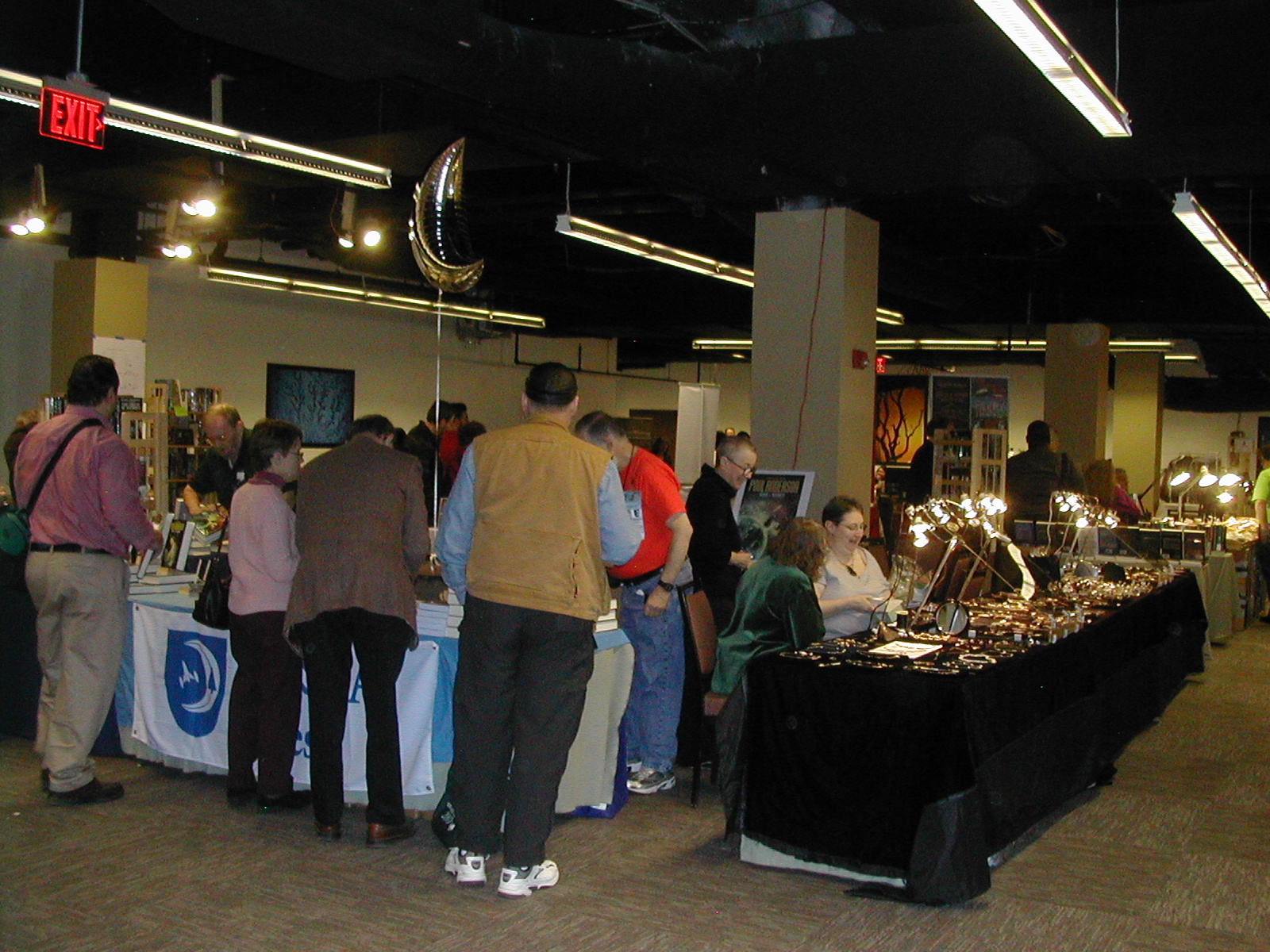
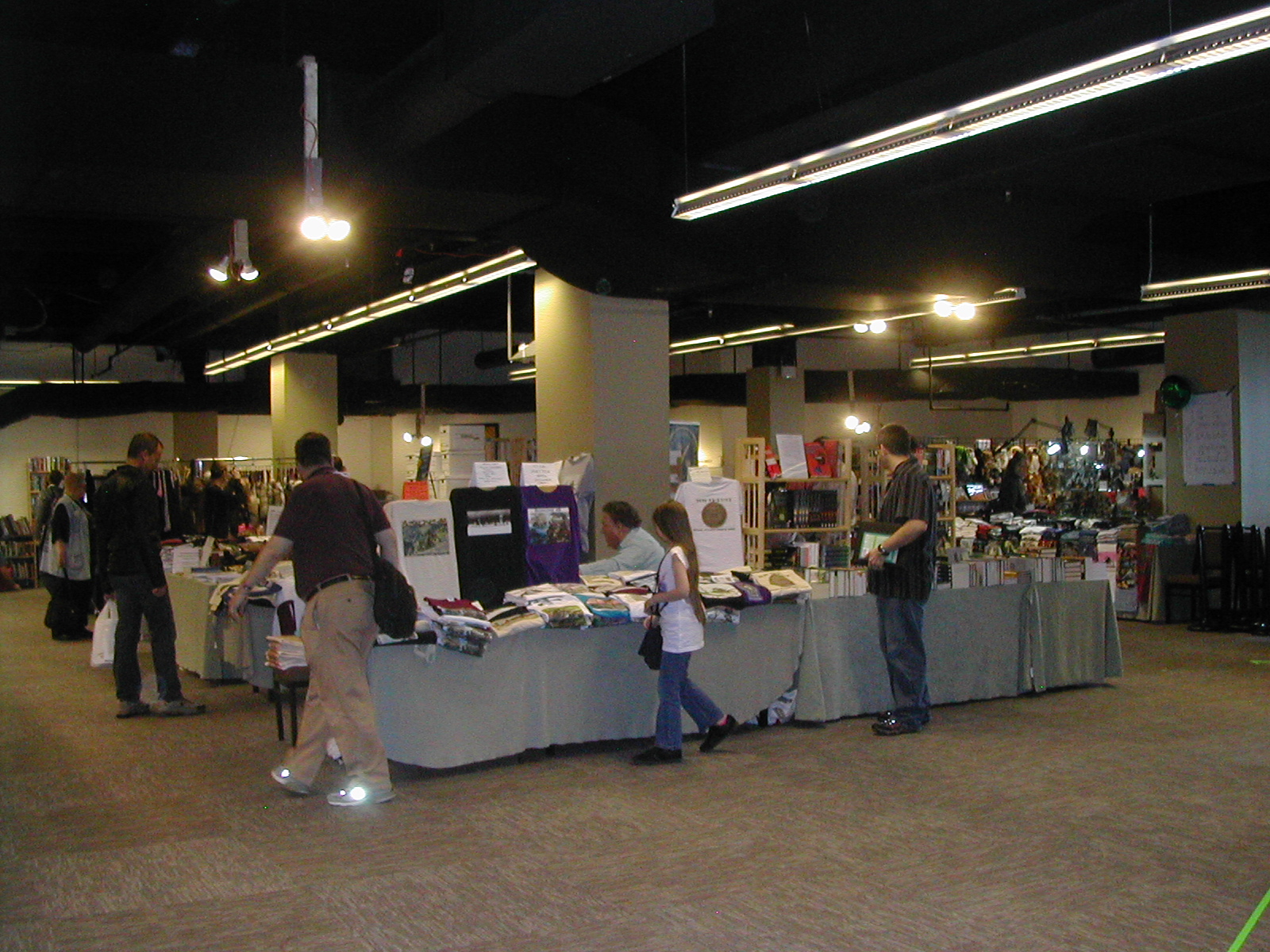
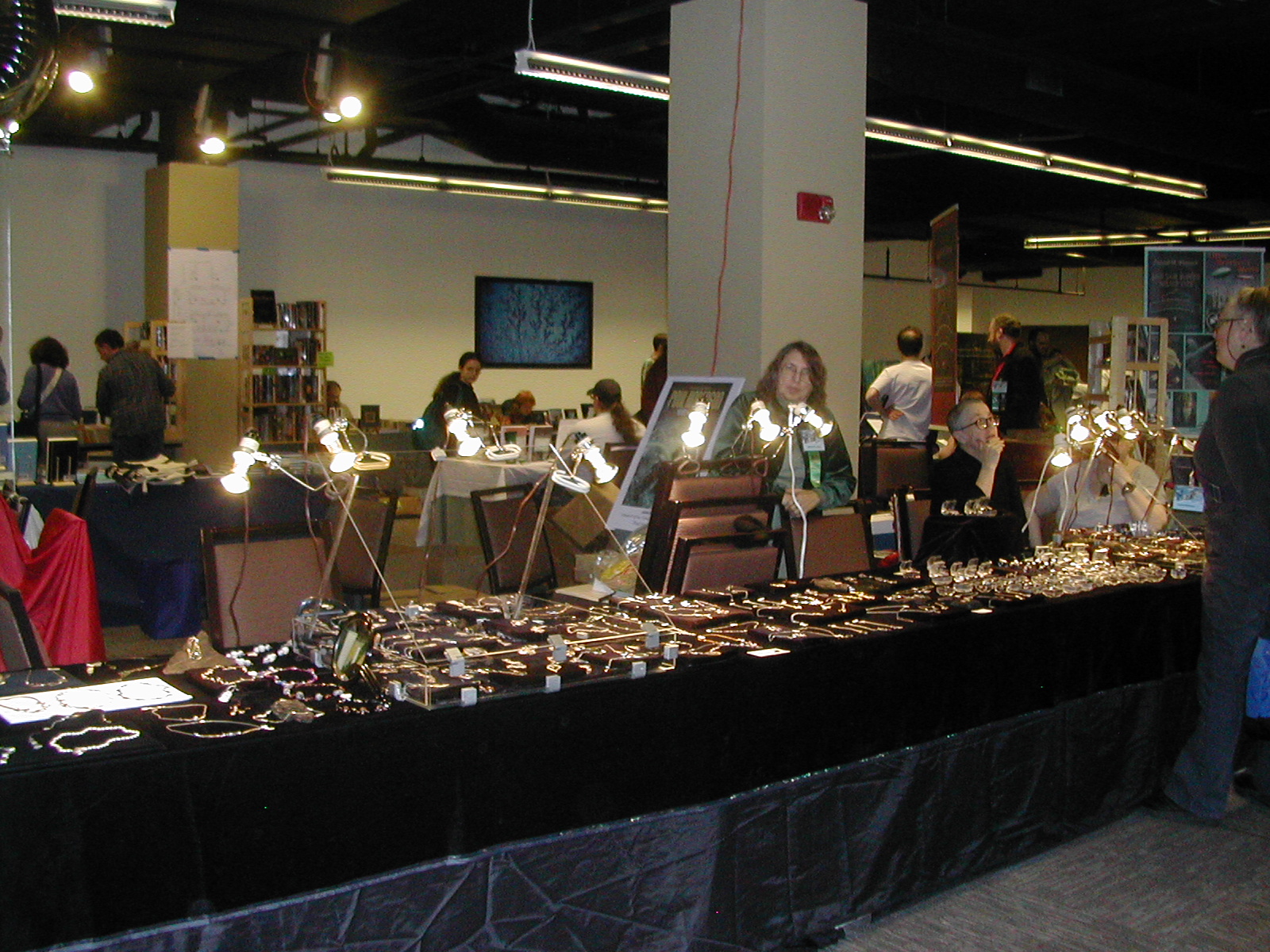
This was the dealer’s area. There are not as many booksellers at Boskone as I’m used to from Wiscon or Readercon, but there are all sorts of other things, jewelry and scarves and of course art. (The actual art gallery was in a separate area that I did not photograph because of copyright issue. I don’t want to reproduce the work of any artist without permission.)

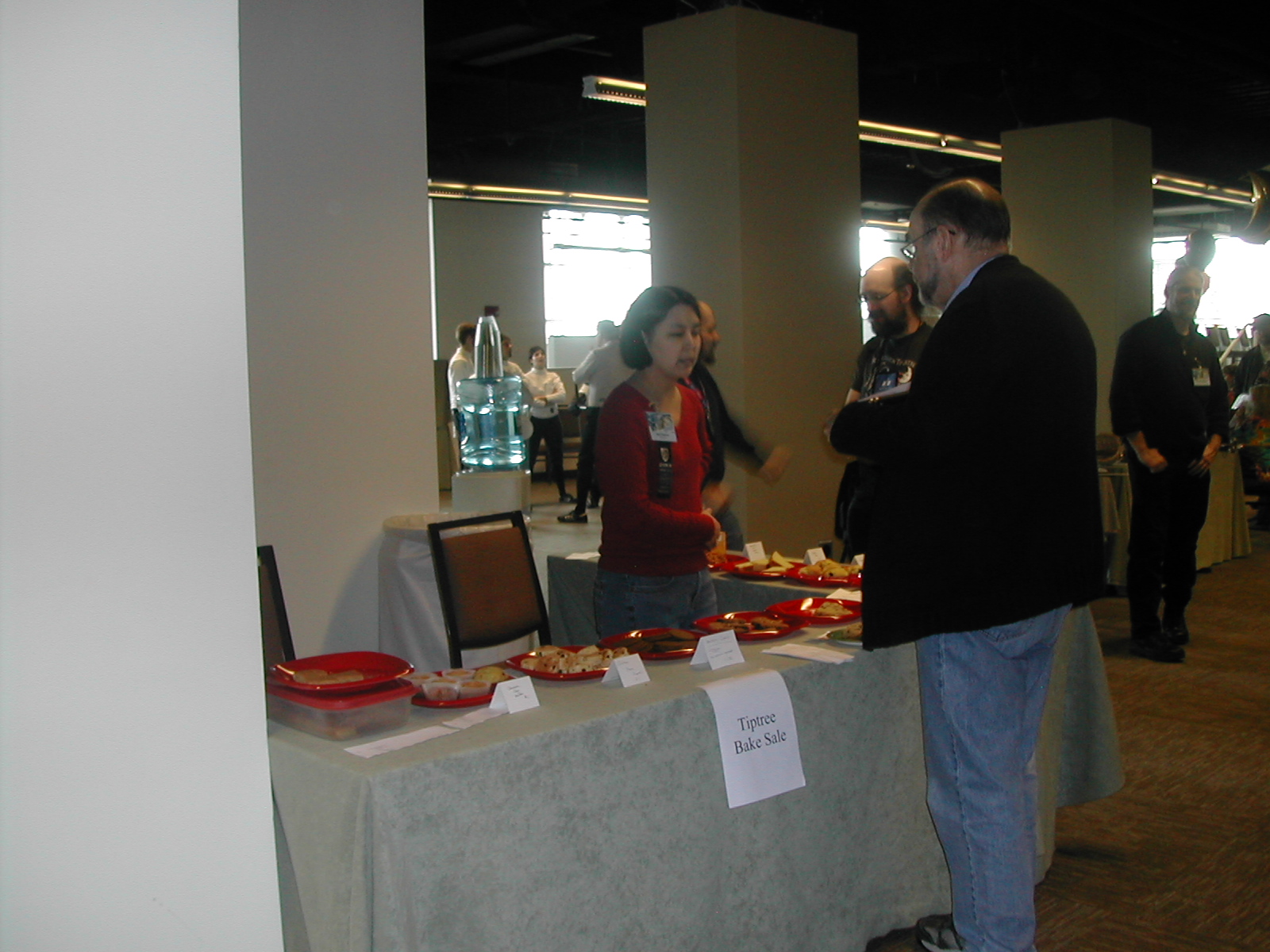
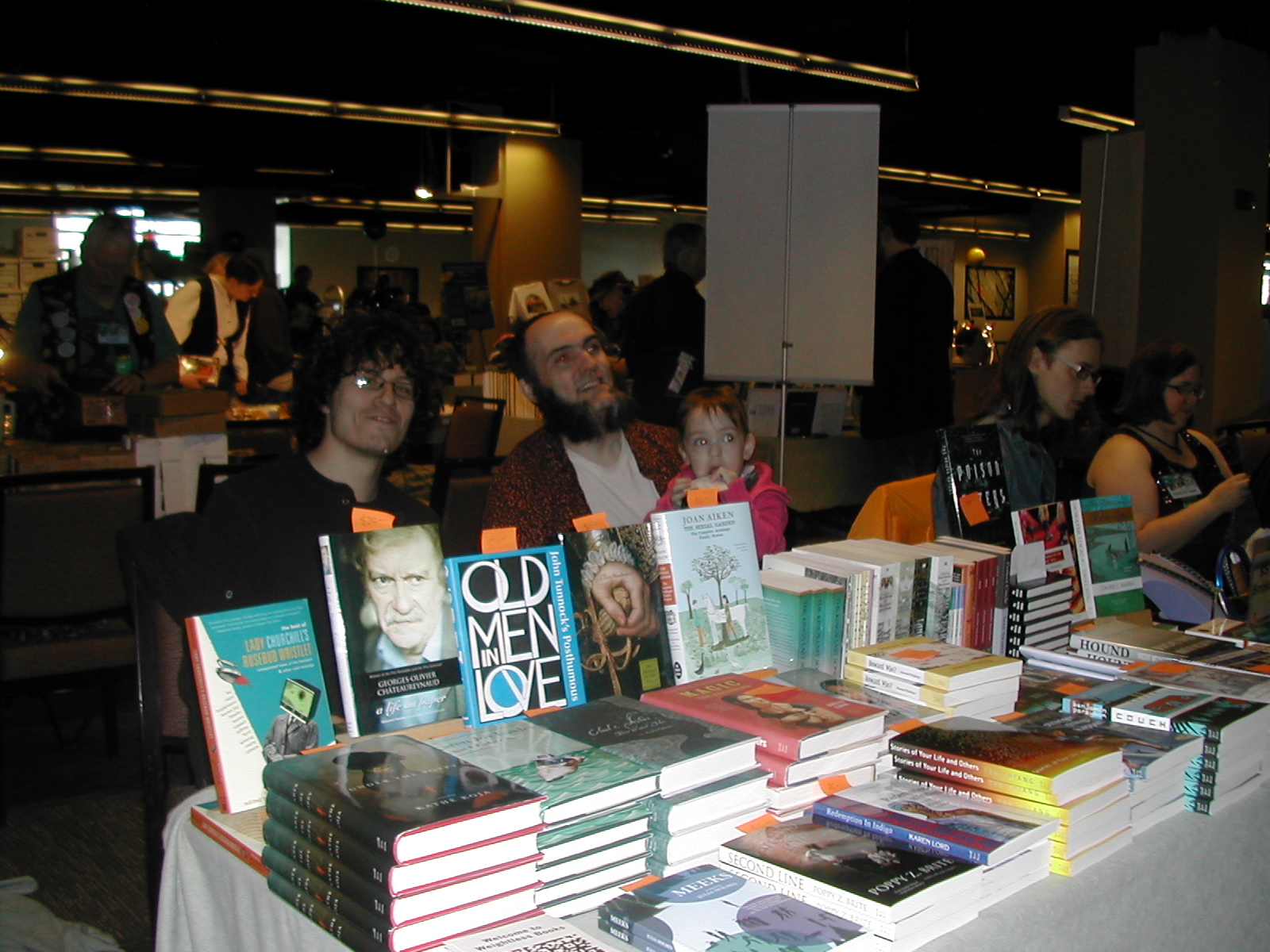
I bought an oat cake at the Tiptree Bake Sale and then went over to the Small Beer Press table. Here you see Gavin Grant, his daughter Ursula, and Michael DeLuca.

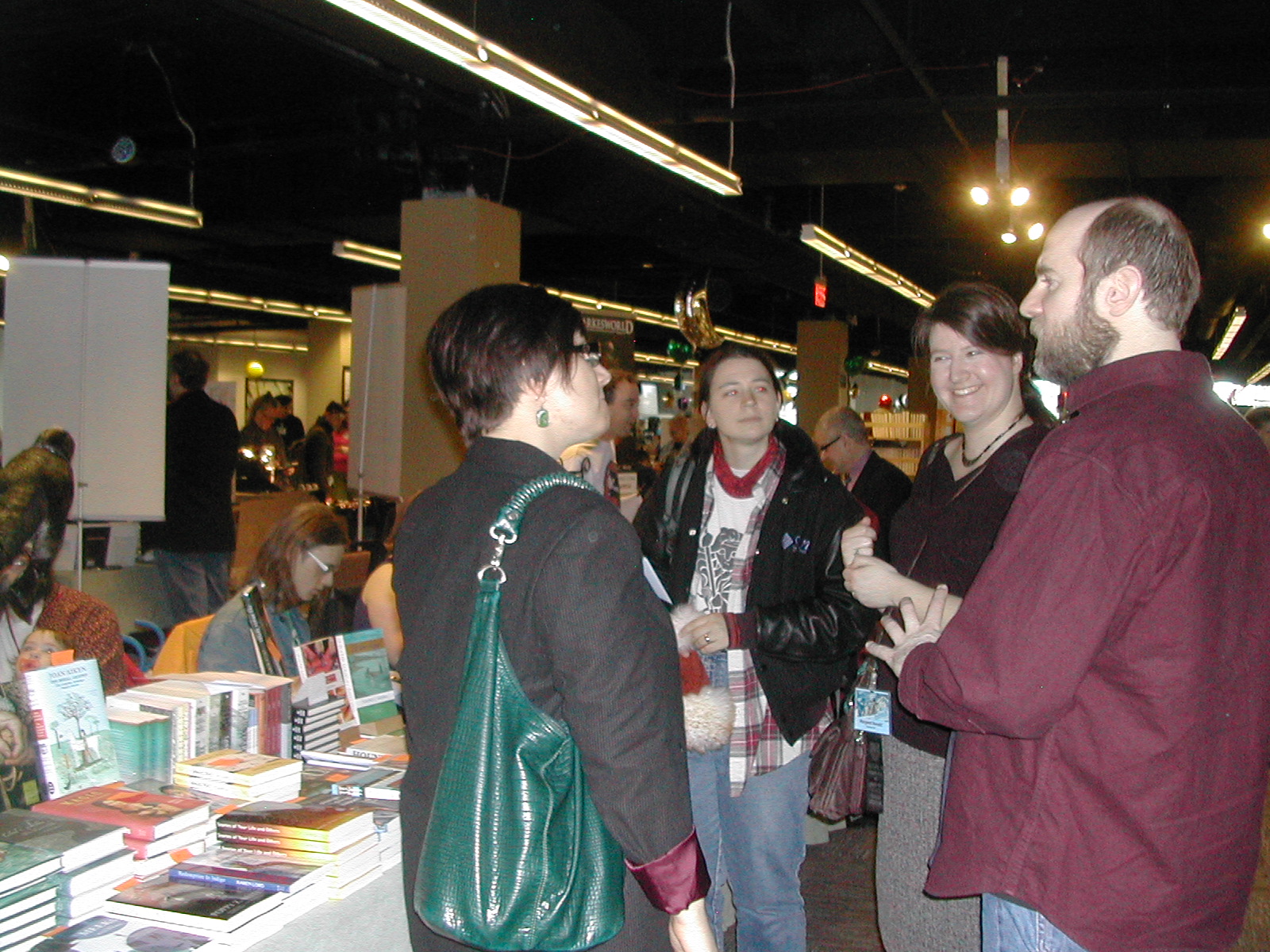
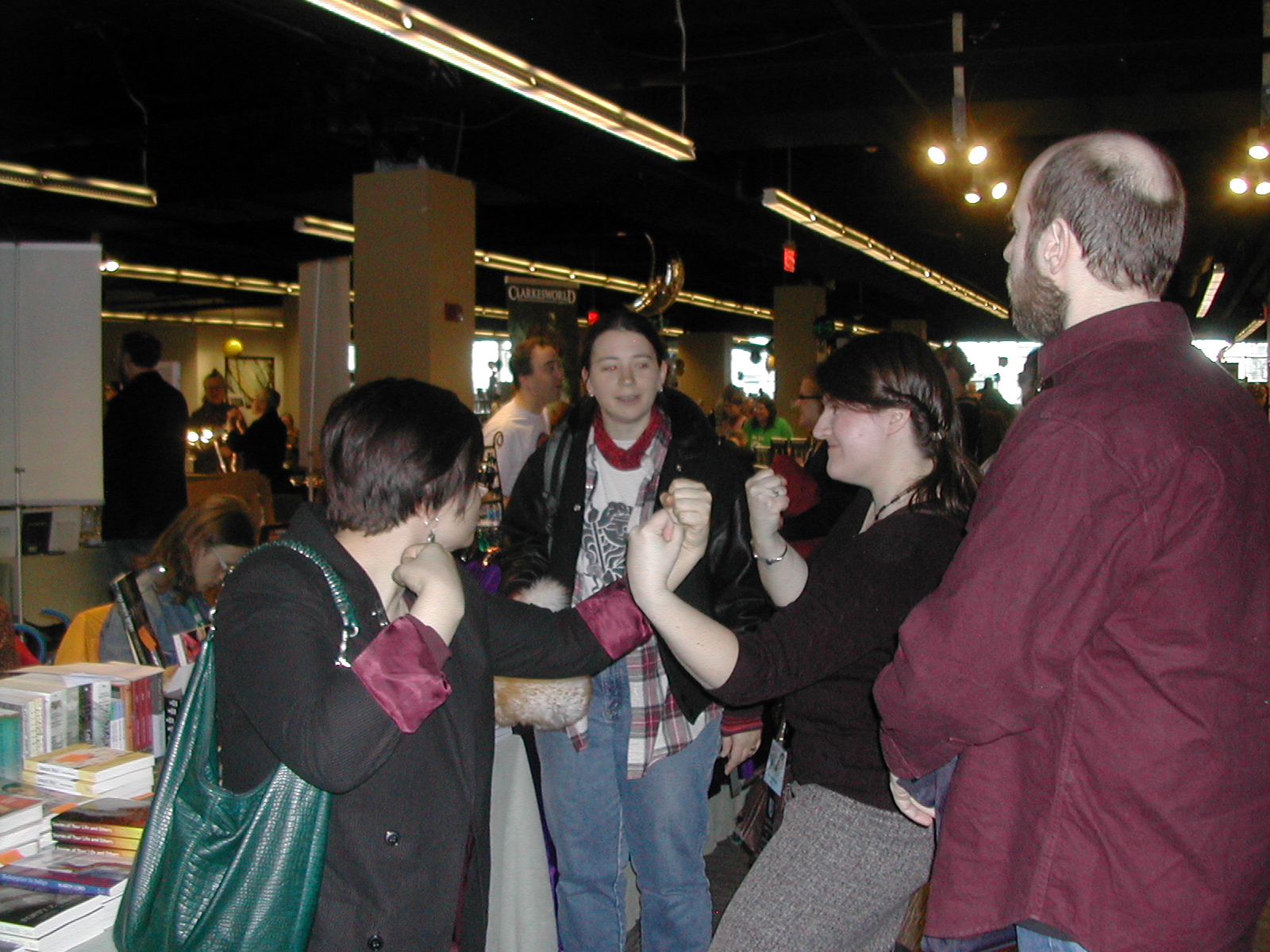
Genevieve Valentine was talking to some friends in front of the Small Beer Press table. Unfortunately, a fight broke out.

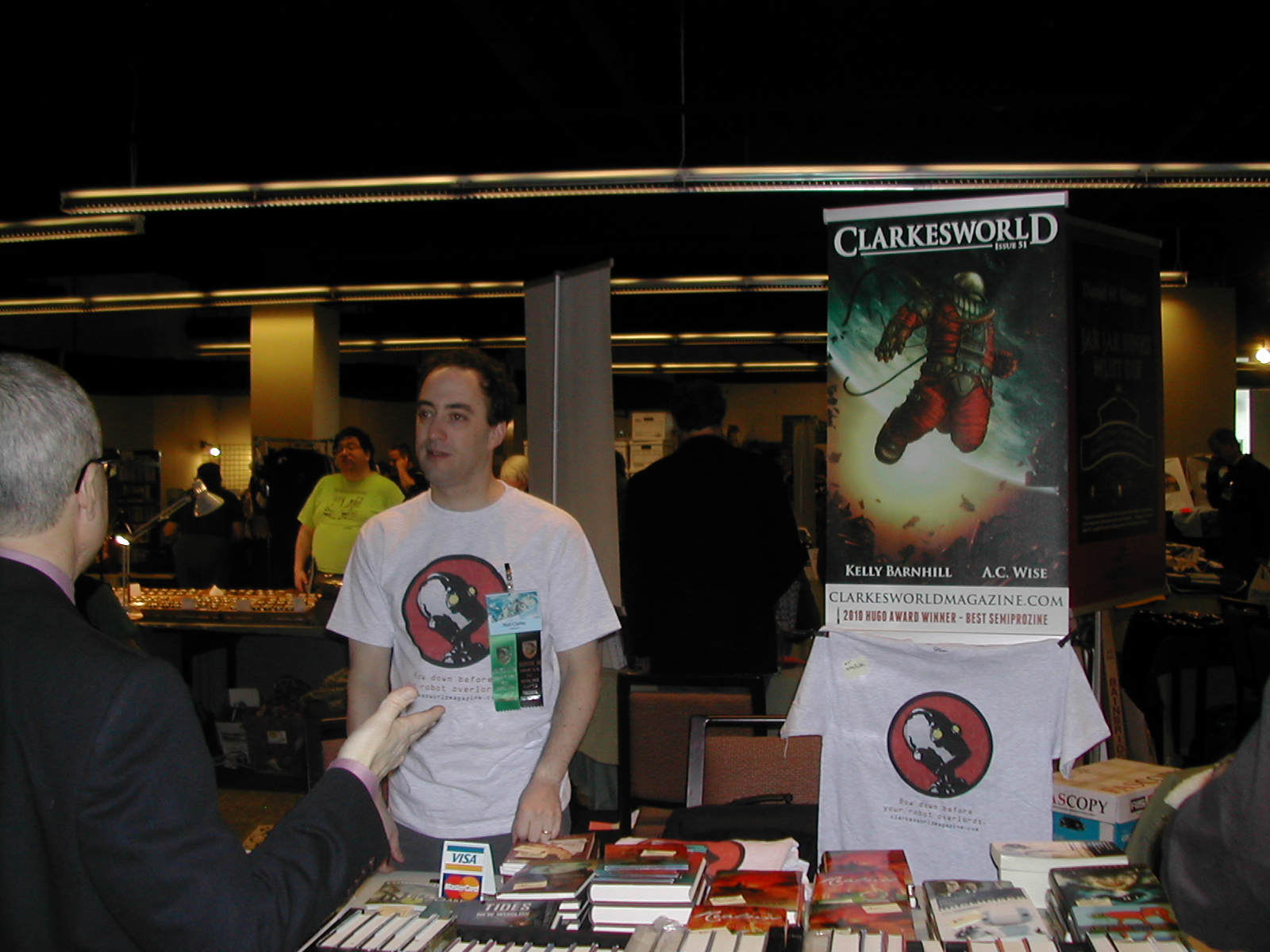
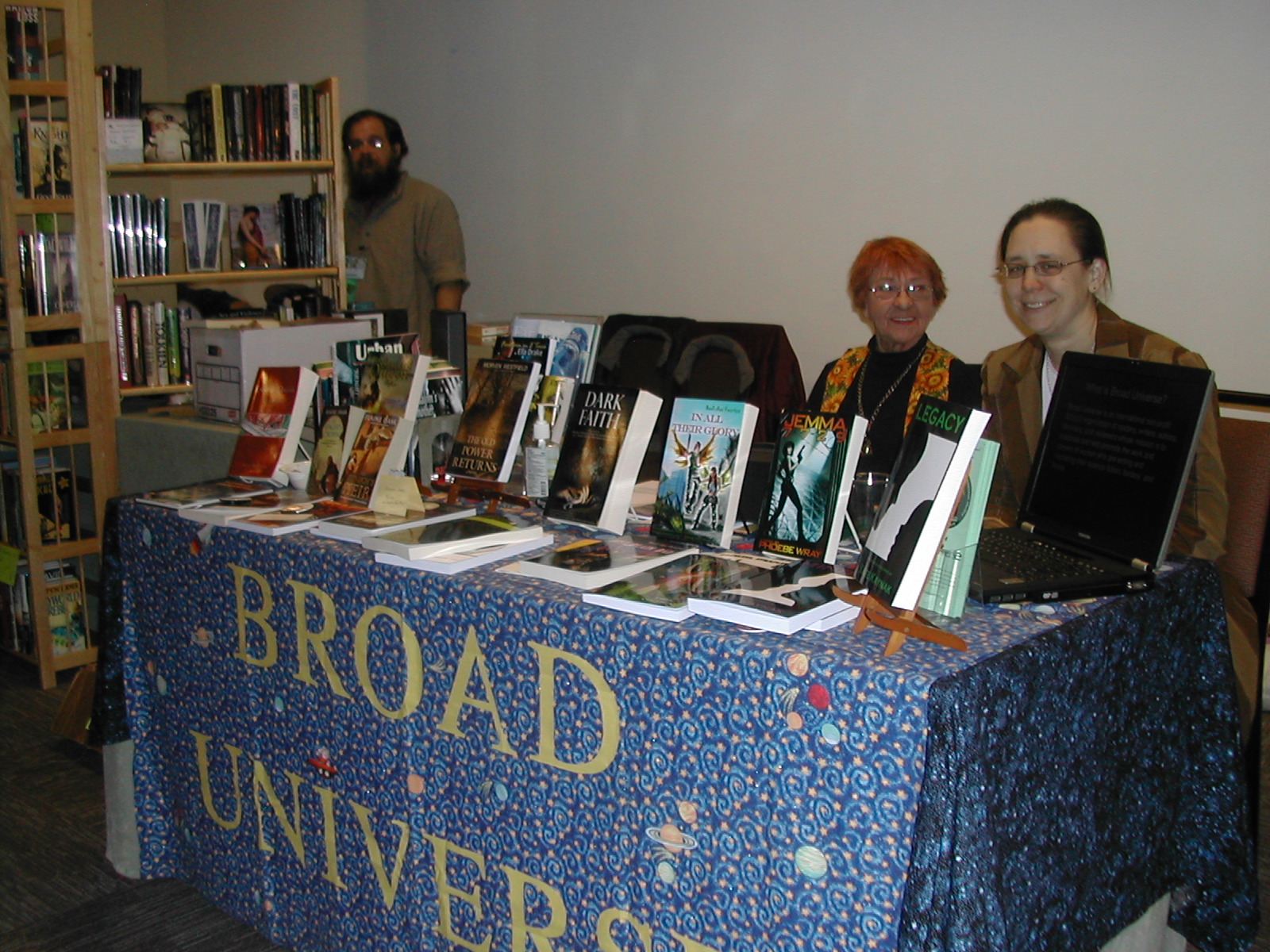
Here are the Clarkesworld table with Neil Clarke and the Broad Universe table with Elaine Isaak. (Elaine is a fellow Odyssey graduate, although she attended a few years before I did.)

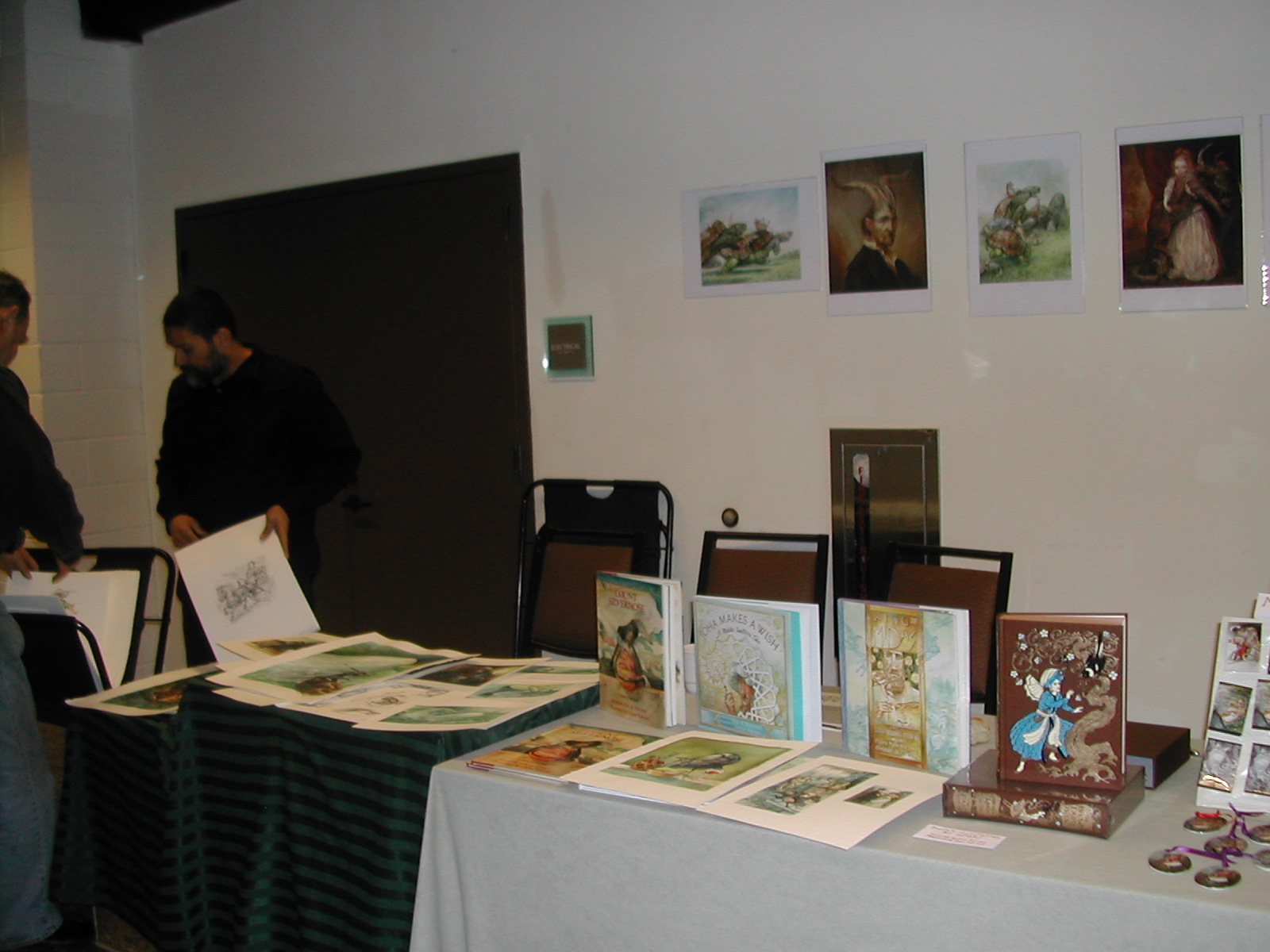
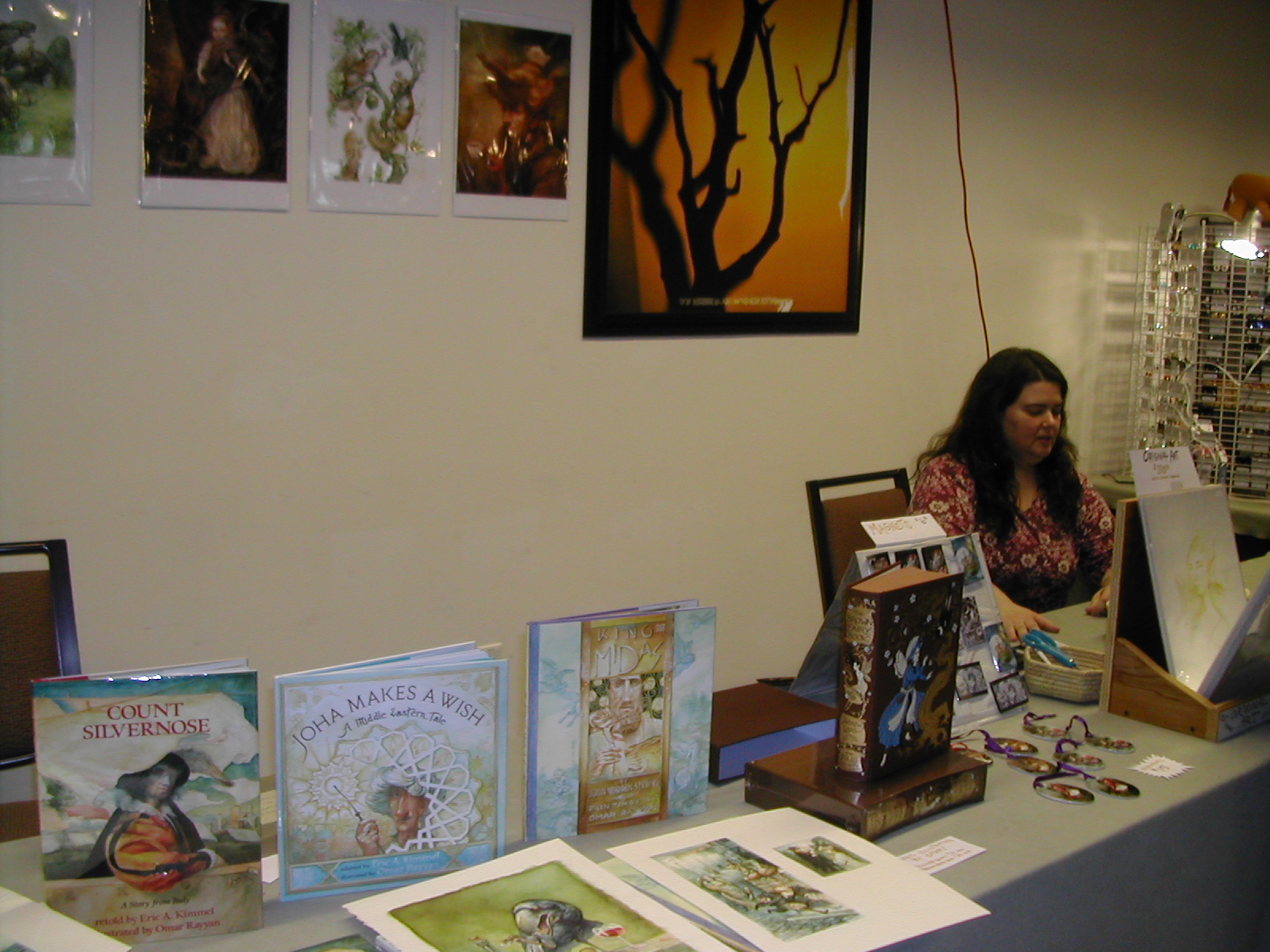
One of my favorite tables is always Omar and Sheila Rayyan’s. Their art is stunningly beautiful. I have several of their prints, and even an original drawing that I bought last year.  (It was a serious splurge.)  Sheila kindly gave me permission to photograph.

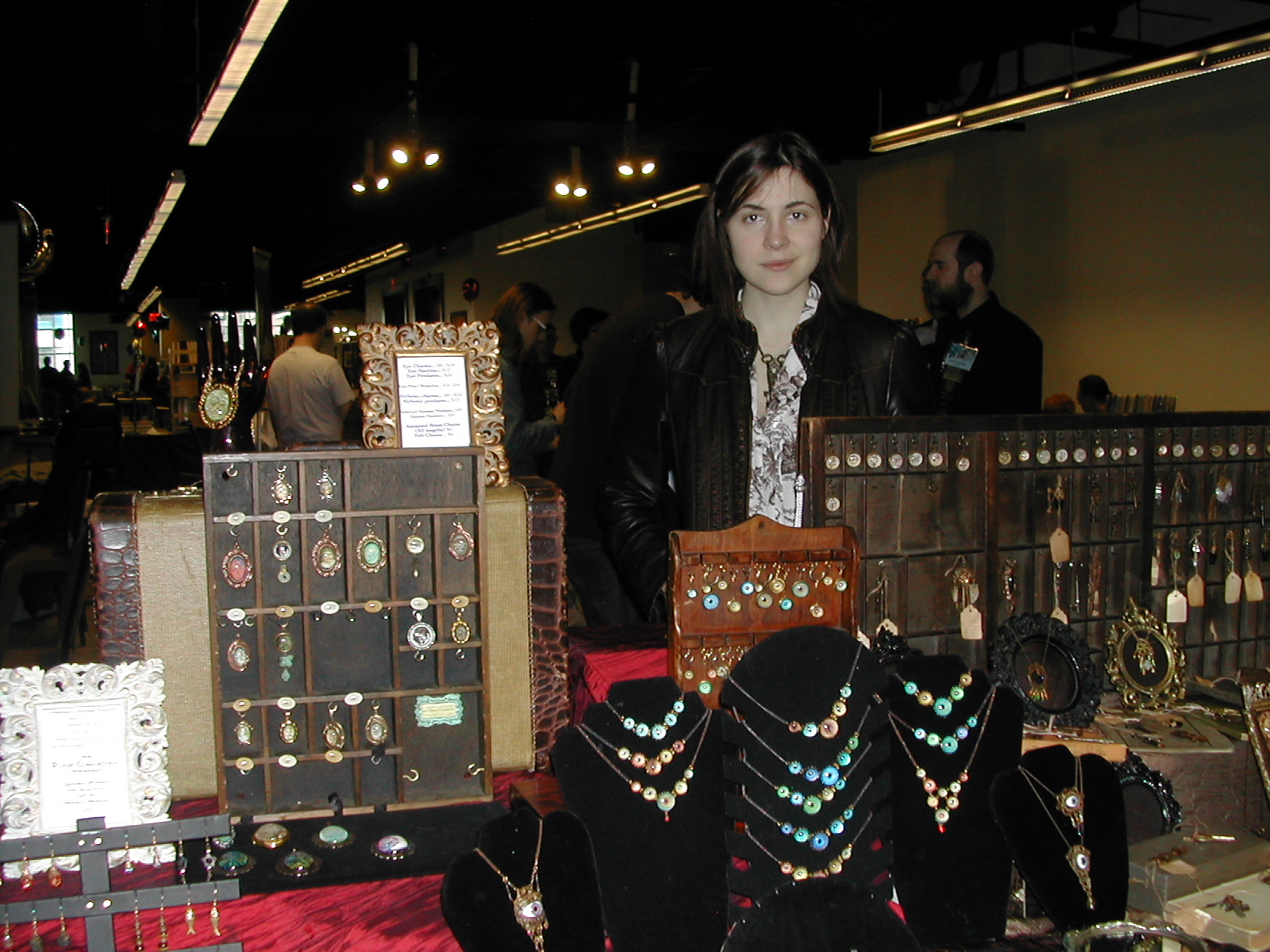
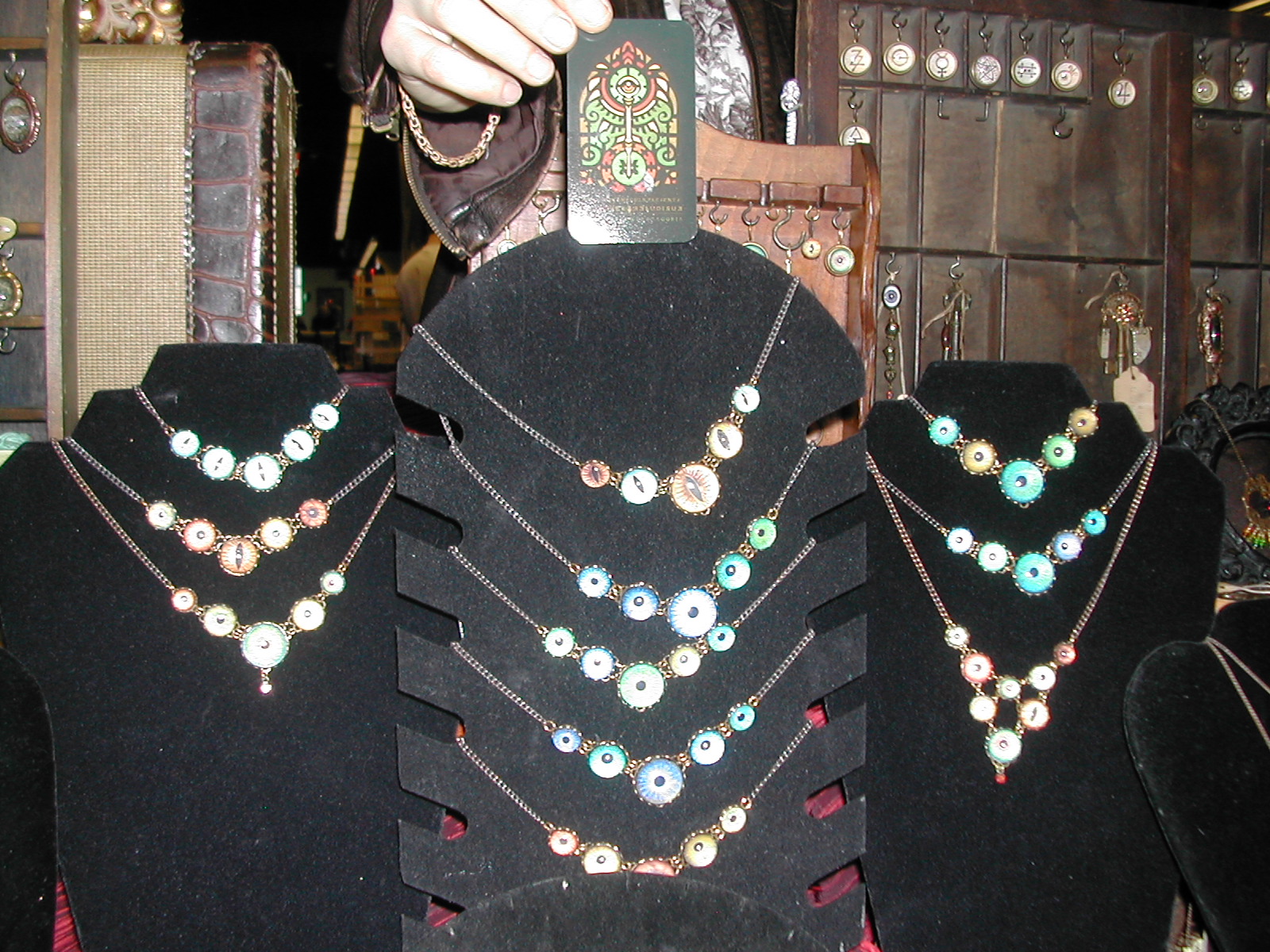
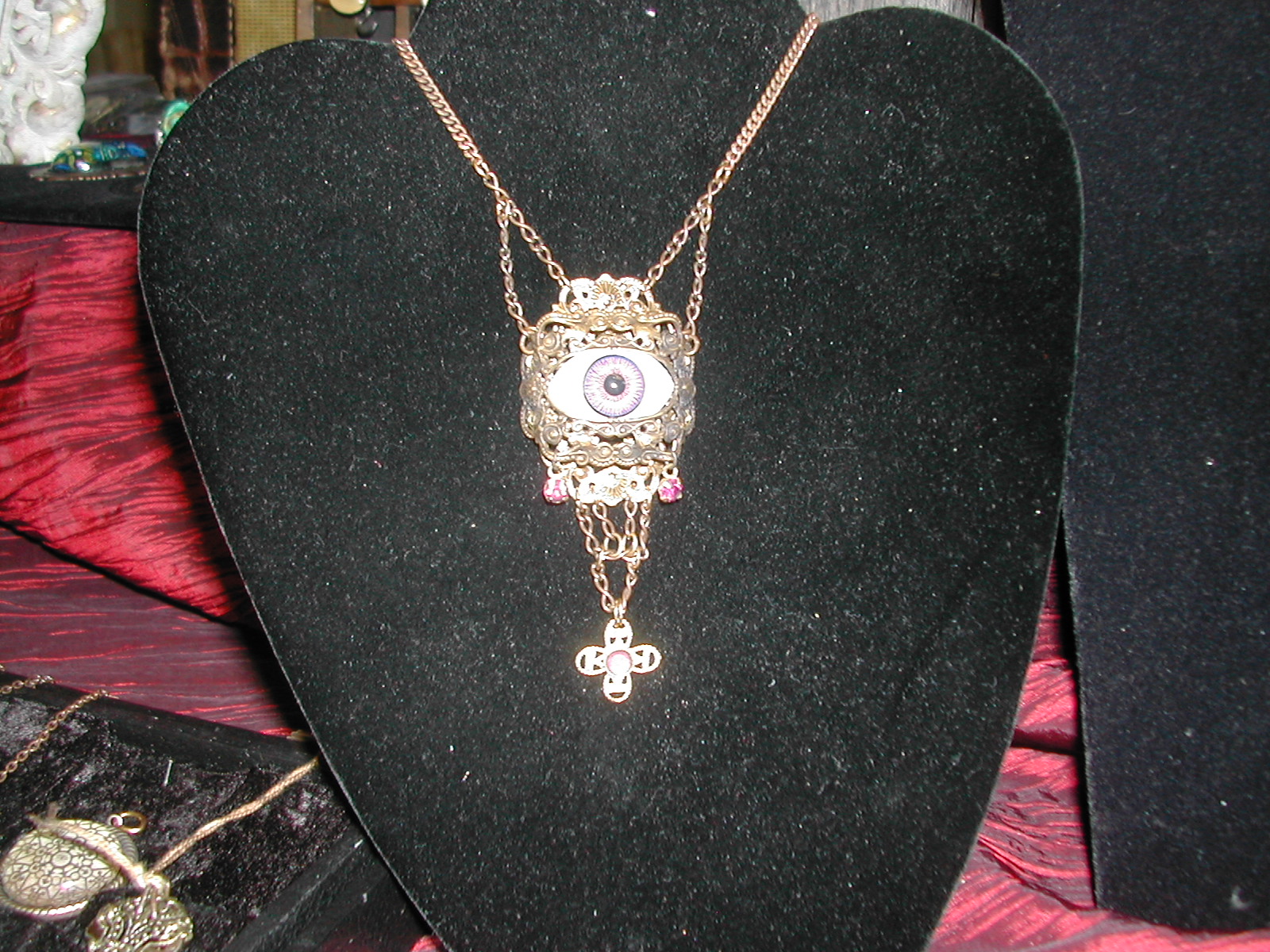
A new artist this year was Kelly M. Kotulak, who makes jewelry that has a recurring theme of eyes and keys. I found it fascinating. I asked for her card, and she gave me one for Studio Hibernacula. Visit her site: it really is gorgeous.

The necklace on the left is one of Kelly Kotulak’s. The table on the right is Laurie Edison’s. If you’ve been to any of the major conventions, you’ve seen Laurie’s stunningly beautiful jewelry, based on natural forms.

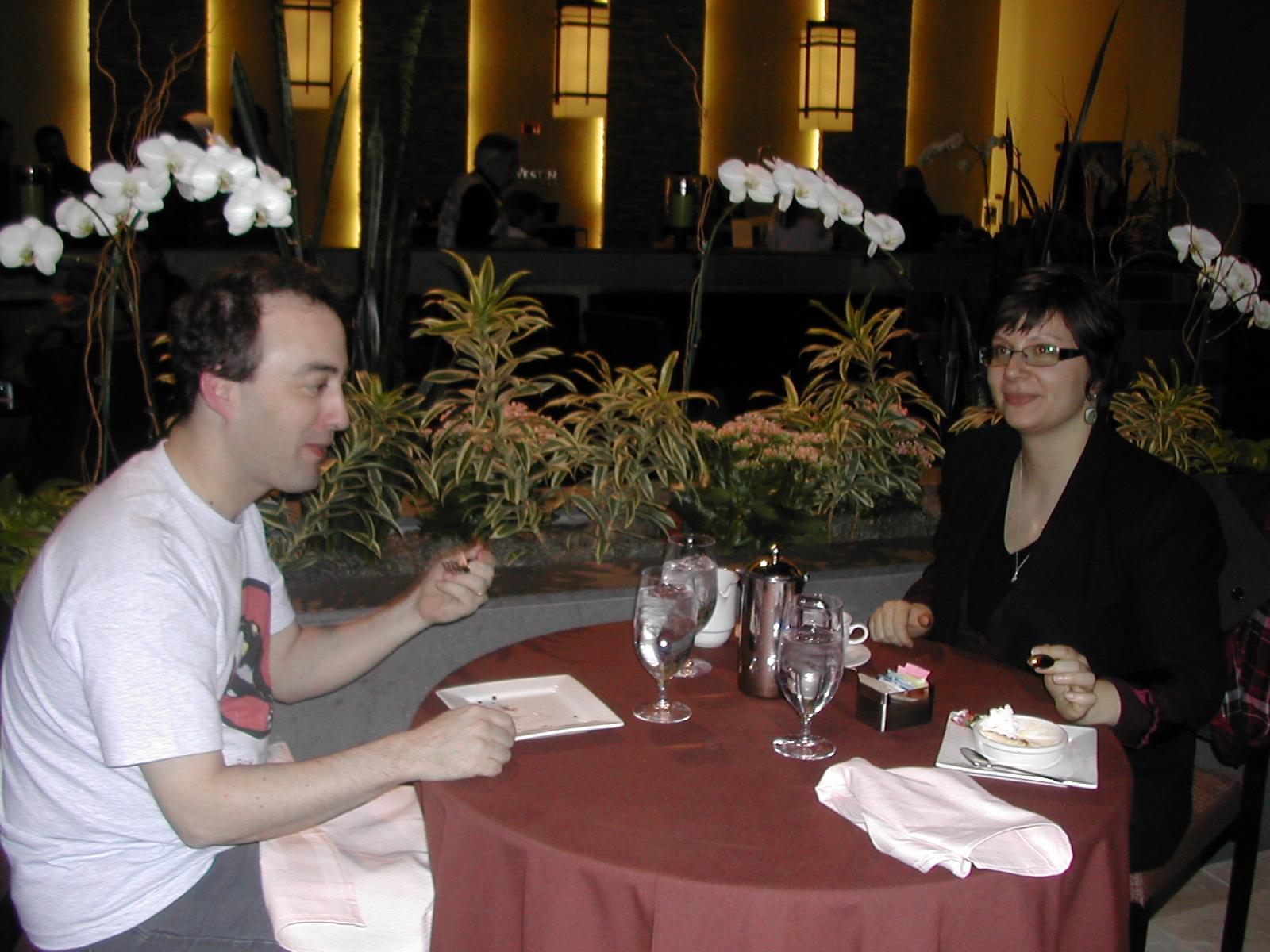
I went to a joint reading by John Langan and Genevieve Valentine, and later in the day I went to dinner with them and a group of friends. We went to a Mexican restaurant that had opened recently, and was located reasonably close to the convention hotel. After dinner, Genevieve, Neil Clarke, and I went back to the hotel for coffee and dessert.  Genevieve and I shared a crème brûlée. And then it was time for me to go home. The only problem with living so close to a convention is that I can’t justify the expense of staying at the convention hotel, so I have to go home every night, missing the parties. But that’s all right. There will be plenty of parties at ICFA, Wiscon, and Readercon.

And finally, I think these t-shirts prove exactly what I said in the H.P. Lovecraft panel. Cthulhu is everywhere. We’ve domesticated him. Just wait until he wakes up and finds out that people are knitting him and putting him on t-shirts. He’s going to be seriously upset.

Posted in Uncategorized | 3 Comments

Boskone Panels

Do you want to hear about the panels first, or look at pictures first? Why don’t I give you a few brief comments on the panels, and then the pictures? That makes sense.

First Panel: The Writer’s Child

Katherine Crighton
Theodora Goss
Jo Walton (M)
Jane Yolen

What’s it like for a writer to raise a kid? Our panel includes both writers and people who were (and are) writers’ children. Are the writer’s child-rearing methods, biases, or hopes different from those of other parents? How is a writer’s child different from a reader’s child? Stories will be told.

I didn’t know how this would go, but it was actually fascinating. Jane Yolen and Katherine Crighton both came from families where the parents were writers, and their experiences growing up were so different from mine! I said that my parents were anti-writers, both doctors who assumed that one naturally went into a profession like medicine, law, or business. This led to one of my favorite lines from this panel, which actually came from me. (I’m never the one with the good lines. This one was an exception.) I said they told me I could always do writing on the side – like salad dressing.

Jo Walton pointed out that the panel was all women, which was of course true. I wonder why? I’m sure it wasn’t intentional on the part of the programming planners. But still, it’s interesting that a panel about children would have all female panelists.

I was particularly fascinated by Jane’s account of writing with her children. She had to separate out the mother and the writer, and they in turn had to become used to challenging her, to being effective editors. Jo also said that she got ideas from her son. I wonder if Ophelia and I will ever work on anything together? Of course, she’s already writing her own stories, putting together her own books.

Second Panel: Writer vs. Copyeditor – Lovefest or Deathmatch?

Theodora Goss
Teresa Nielsen Hayden (M)
Jo Walton

Let’s discuss process and roles, how copyeditors can help, when they can go too far, points of contention, and more. Red pens may be flourished, but let’s hope not blood-red . . .

Another panelist had been added to this panel, but I’m afraid I don’t remember her name. I should have written it down. This was incredibly useful. Theresa Nielsen Hayden provided so much information on the editor’s perspective, and told a number of stories about when copyediting had gone well or badly. I particularly liked the one about the copyeditor for a collection of modern classics who “corrected” Faulkner’s punctuation.

She also talked about copyeditors having a superpower, which I think is true. The audience quickly decided to call it hypereulexia.

Third Panel: Fairy Tales into Fantasy

Greer Gilman
Theodora Goss (M)
Jack M. Haringa
Jane Yolen

A whole branch of fantasy literature is based on re-examining the assumptions of well-known fairy tales. Panelists discuss some of the best examples.

I moderated this panel. Just so you know, if you have Jane Yolen, Greer Gilman, and Jack Haringa on a panel, don’t worry about preparing. They’re all brilliant and they all just talk. Brilliantly. This panel was such a pleasure, because the topic itself has come up so often before in convention panels, but I think Jane, Greer, and Jack made it fresh and interesting.

(Fangirl moment: I was on two panels with Jane Yolen! There was a time when I would barely have dared talk to her! I mean, I grew up on Jane Yolen . . .)

My favorite lines in this panel both came from Greer, who always seems to come up with the most wonderful zingers. Here they are:

Greer saying that fantasy needs to have its roots in the folklore tradition, which serves as a sort of soil, giving it the necessary nutrients: “I for one do not believe in hydroponic literature.”

Greer on Hans Christian Andersen’s”The Little Mermaid”: “It’s Titus Andronicus with fish.”

All right, now to the pictures. But I’m going to have to post them separately, because there are a number of them. So, on to the next post.

Posted in Uncategorized | 3 Comments

Conventions

On Fridays I usually try to write part of my story, but I spent this evening at Boskone, so I’m going to write about that.

This morning I woke up at seven, got dressed, and went to the university to meet with students. I met with students all morning, then taught for three hours, then met with more students. Then I took the T, green line to red line to silver line, across the city to Boskone. I was on one panel and talked to many people, and now it’s midnight and I’m tired, so I’ll do my best to make this post coherent.

Why do I go to conventions? I suppose the most practical reason is that when I go to conventions, people get to know who I am. And then they look at my blog, and perhaps they read my books, so going to conventions is simply part of what I do as a writer. Today I was on a panel on H.P. Lovecraft with Charles Stross, John Langan, and Jack Haringa. I thought it went well . John was an excellent moderator, I thought Charles and Jack and I all made interesting points, and there were very interesting points from the audience as well. Charles brought several Cthulthuesque visual aids.

Before the panel I had wandered around the dealer’s room. Omar Rayyan was there, and I know I’ll have to at least buy an Omar Rayyan print at some point during the convention. I talked to Gavin Grant, who was at the Small Beer Press table. Gavin was kind enough to give me a copy of Joan Aiken: The Serial Garden, and I bought a copy of Holly Black’s The Poison Eaters. I saw some other wonderful things that I’ll try to write about tomorrow. I’ll try to post some pictures too. A less practical reason for going to conventions is seeing all the things that people are creating. Beautiful books, beautiful art. The art show this year is particularly good.

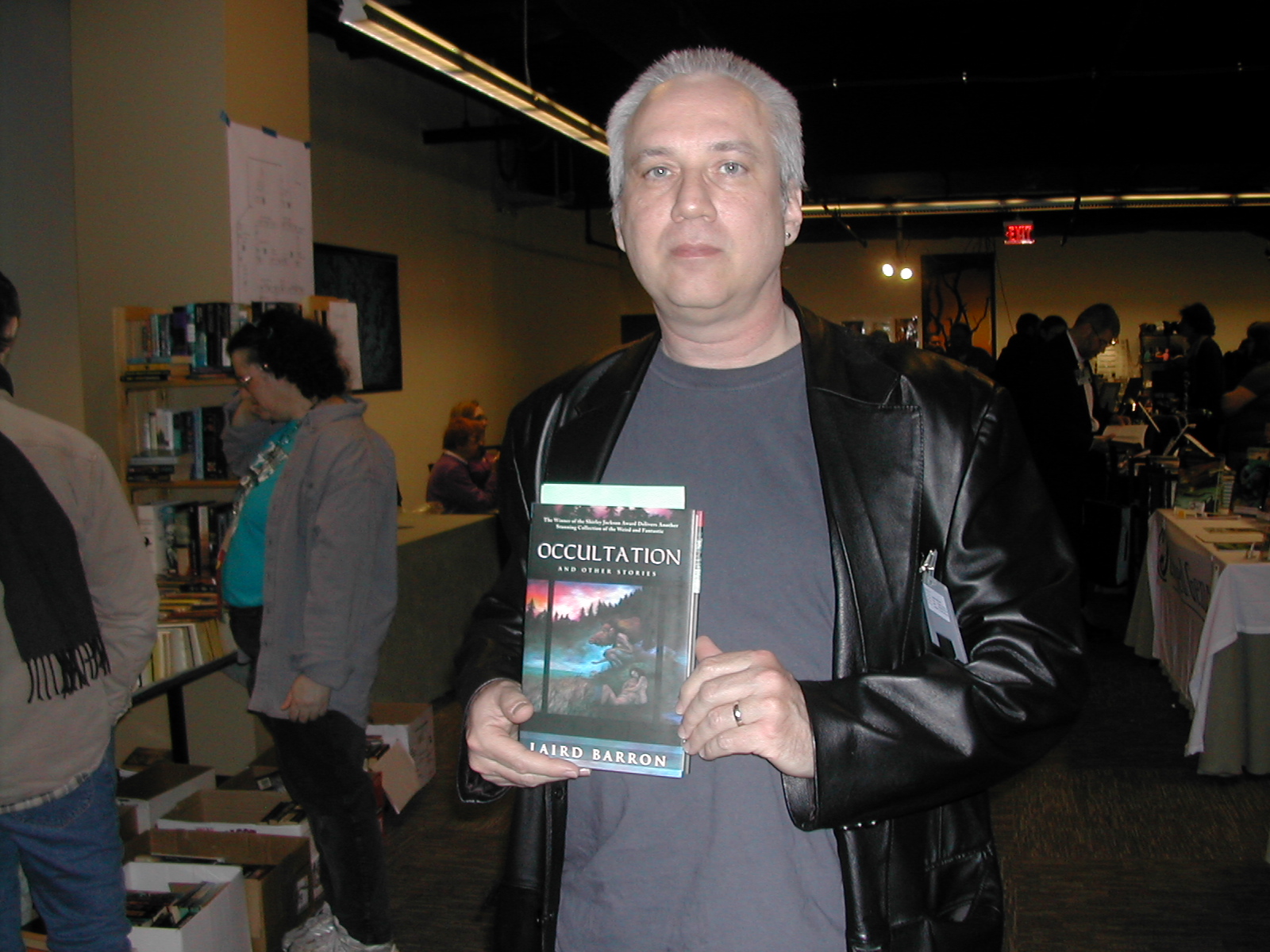
I ran into or had short conversations with several people I knew or had at least met before: Sarah Langan and her husband J.T. Petty, Laird Barron, Paul Tremblay. And I have a long talk with Genevieve Valentine, with whom I shared some dinner and a dessert. (We did the girl thing: shared food. If you share food, you don’t have to feel guilty about what you’re eating. Although honestly, the dessert was such a large slice of chocolate cake, and so much of that cake was frosting, dense and chocolaty and flavored with Guiness, that we only ate about half of it. Even with sharing.)

A third reason for going to conventions is meeting friends. We all live in different places, all over the country, and conventions give us the opportunity to see each other again, to catch up.

A fourth reason is the shop. Every profession talks shop. Writers do too: writer shop is about who’s working on what, who has a book coming out, what sorts of projects are floating around. Who’s good to work with, how books were sold, what problems are coming up. I get so much information simply from talking shop with other writers. We all develop a sort of knowledge, a general sense for how things are working, what the industry is doing. And that’s absolutely crucial in an industry like this one, where there’s no central source of information (except perhaps Locus Magazine). You have to talk to people to, basically, know what’s going on. To keep up.

If you don’t do that, don’t keep up with the industry, you’re going to run into problems. You’re going to sign with a publisher who hasn’t been paying writers, or not understand how to promote your own writing, or miss opportunities. And if you want to be a professional writer, to do this at the most serious level, you can’t afford to do that, any more than a businessman can afford not to keep up with the stock market, or a lawyer can afford to ignore the latest cases.

What do conventions give me? Information, connection, pleasure. That’s why I go to conventions.

I’ll be at Boskone on Saturday and Sunday as well. Hopefully on those days I won’t be quite so tired, and will be able to put together more coherent posts. But what I really want to say is, as I rode the T toward the convention hotel, I felt a sense of freedom and joy, that I was going to be spending time with my crowd. That I was going to see friends again, and be with people who cared about books and art. People who made things. Who are my favorite sorts of people.

Posted in Uncategorized | Leave a comment