Selkie Women

I had a sort of incomplete revelation the other day about selkies.

An incomplete revelation is where I realize something, but I’m not entirely sure what I’ve realized, how it works. But I generally know what it has to do with. In this case, it has to do with the otherness of the magical animal women in folk and fairy tales. It has to do with another way of looking at them.

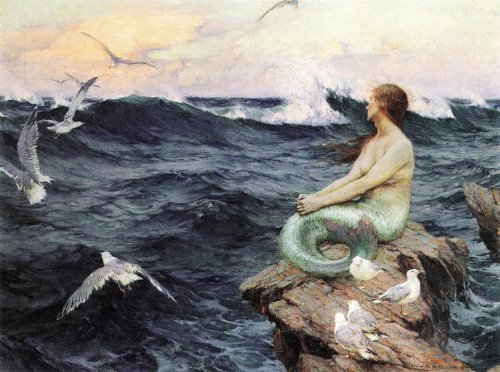
It occurred to me that there have always been selkie women: women who did not seem to belong to this world, because they did not fit into prevailing notions of what women were supposed to be. And if you did not fit into those notions, in some sense you weren’t a woman. Weren’t even quite human. The magical animal woman is, or can be, a metaphor for those sorts of women. Perhaps my thinking on this issue was influenced by having just read John Fowles’ The French Lieutenant’s Woman, because Sarah Woodruff is one of those women. She is presented as not quite human, which could be seen as a problem with Fowles’ characterization. Or it could be seen as something else, the fact that certain women are perceived as otherworldly, are not understood, precisely because they cannot be understood according to prevailing codes.

I had gotten an idea, too, for a book about those sorts of women, like George Sand: the women who never quite fit into their societies. Perhaps Sand isn’t the best example, because she does not strike me as particularly magical. And I’m talking about women who are seen as incomprehensible, magical, fay.

Selkie women are the women you don’t understand. They are the women who know they belong to another tribe, in another element. And so they seem as though they don’t belong in yours — and they don’t. They are the women who live by other rules and values, because their rules and values are different from those of this world. They are the women who sometimes seem to be listening to other voices, or music you can’t hear, or the call of distant bells. There is a faraway look in their eyes.

Selkie women are the ones who look as though they came out of fairy tales, because they did. The ones who look at the sea longingly, who look at the sky as their home. They do not fear death. They only fear imprisonment.

Selkie women are the ones you can’t keep.

It is a very bad idea to hide their sealskins. They will always find them again, and then they will leave, specifically because you hid it the first time.

Selkie women are the ones who create things, but those things look as though they came from another world. Men fall in love with selkie women because they see them as conduits to something richer, stranger, more authentic. This is dangerous: wherever they came from, selkie women can’t get you there. You have to get there on your own.

There’s a story in all this, of course. I have so many other stories to write that it won’t get written for a while, and it’s still developing in my head. But now that it’s there, the idea will develop. Tonight, I need to write a rather ugly scene in my current story. That’s one reason I like writing this, about selkie women.
Posted in Uncategorized | 25 Comments

The British Library

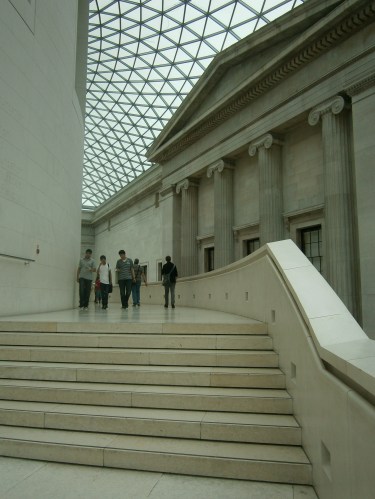
Today I’m going to combine two things, the British Museum and the British Library, because I don’t have pictures from the latter. But I want to talk about what I saw there, because it was one of the most important parts of my trip to London. Here is the picture I took going up to the second floor of the British Museum.

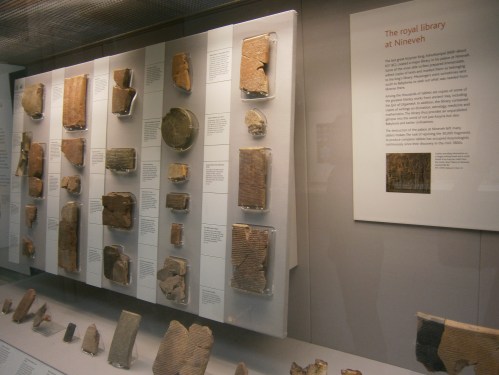
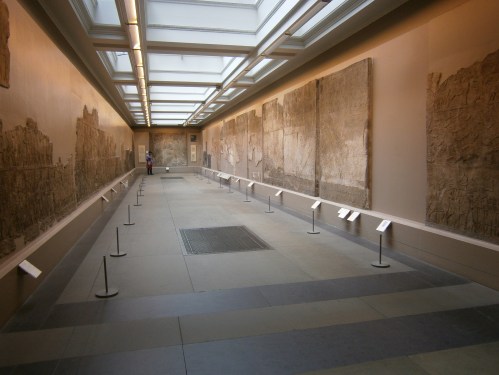
And here’s an example of the sort of thing I found there. Once again, the collection was so incredibly rich. These were documents from the Royal Library of Nineveh.

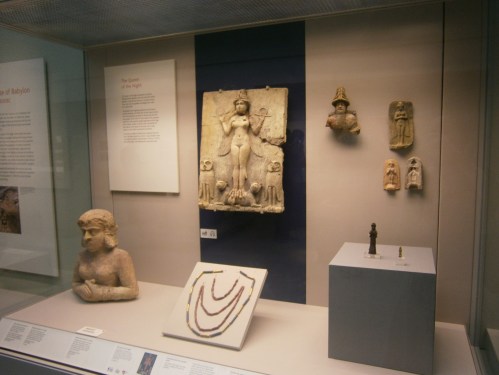
One of my favorite items was this relief of either Inanna or Ereshkigal. I’d seen pictures of it before, but of course it was quite different to see the real thing.  It was smaller, but also more powerful, than I had expected.

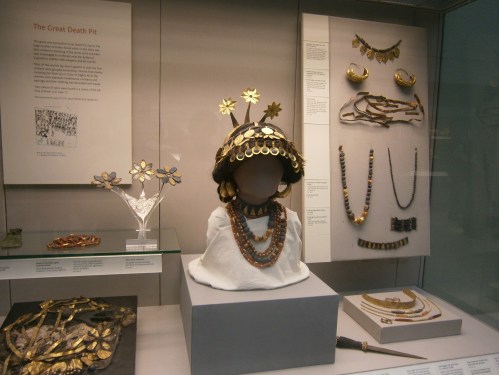
This is the last picture I’ll include from the museum, but you can imagine what a treasure-house it was. I must have walked through the rooms of that upper floor for two or three hours.

Later that week, I went to the British Library, specifically to see an exhibit called Writing Britain: Wastelands to Wonderlands. The only way I can give you a sense for what the exhibit included is to list some of the items I saw there:

1. The oldest copy of Sir Gawain and the Green Knight in existence.
2. Marked proofs of Thomas Hardy’s Far from the Madding Crowd.
3. Oscar Wilde’s manuscript version of The Importance of Being Earnest.
4. An audio of an interview with Stella Gibbons about why she wrote Cold Comfort Farm. (Which I listened to rather than saw, of course.)
5. A copy of A.E. Houseman’s diary from 1891 recording the temperature and what was blooming. (It snowed on May 14th, even though the cherries were in bloom.)
6. A watercolor painting by J.R.R. Tolkien of The Hill and Hobbiton-across-the-Water.
7. George Eliot’s manuscript version of Middlemarch.
8. A copy of Household Words containing the serialized first chapter of Elizabeth Gaskell’s North and South.
9. George Orwell’s hand-drawn map of his trip while researching The Road to Wigan Pier.
10. A letter by William Wordsworth describing how he had composed Tintern Abbey.
11. Dorothy Wordsworth’s Grasmere Journal.
12. A letter John Keats wrote to his brother while on a walking tour of Scotland.
13. Emily Brontë’s Gondal Poems in manuscript.
14. Charlotte Brontë’s manuscript version of Jane Eyre, open to the page where Jane first meets Rochester.
15. William Blake’s notebook with a draft of “The Tyger.”
16. Robert Louis Stevenson’s manuscript version of Strange Case of Dr. Jekyll and Mr. Hyde.
17. J.K. Rowling’s manuscript version of Harry Potter and the Philosopher’s Stone.
18. Angela Carter’s manuscript version of Wise Children. It was open to the first page, which begins, “Why is London like Budapest? Because it is two cities divided by a river.”
19. Jane Austen’s manuscript version of Persuasion.
20. A newspaper produced by Virginia Woolf and her siblings when they were children. (They reported on going to a lighthouse.)
21. Lewis Carroll’s manuscript verison of Alice in Wonderland, the one presented to Alice Liddell, with a drawing of the Red Queen and Alice.
22. Kenneth Graham’s manuscript version of The Wind in the Willows.

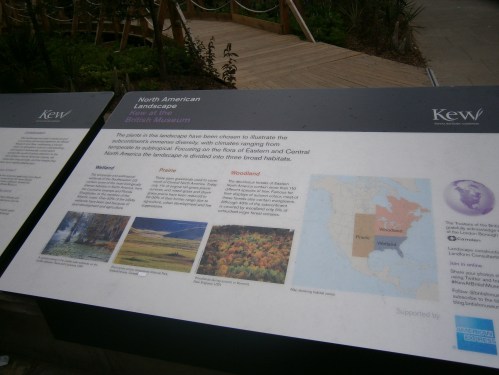
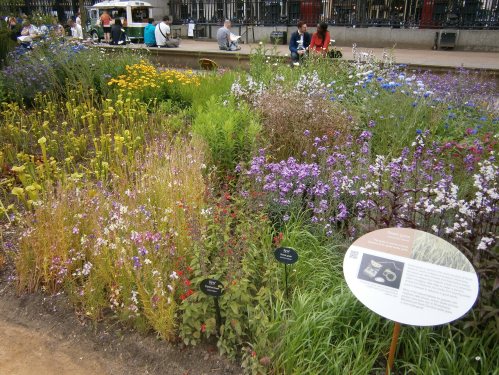
And that is a very partial list. You can imagine how slowly I walked around that room, how in places that exhibit almost brought me to tears. I’m going to end this blog post with two pictures of something I saw at the British Museum that amused me very much. It was an exhibit just outside the museum, in the garden area.  It was called North American Landscape, and it included all sorts of native North American plants.

Except that they were planted very much as they would have been in an English garden. I can’t imagine any collection of native North American plants looking less like an actual North American landscape than this:

But my trips to the British Museum and Library were both wonderful beyond words. They were experiences that I will remember for the rest of my life.

Posted in Uncategorized | Leave a comment

The Elgin Marbles

This may be a short post, because I’m not sure how many minutes I have left on my free wifi.

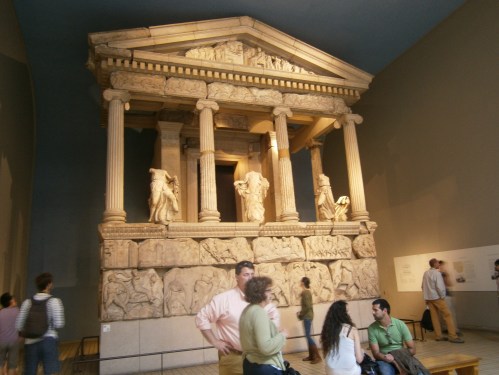
First, I thought you might like to see the Elgin Marbles in the British Museum. I know the political controversy that surrounds them and their purchase by Lord Elgin, but I was glad to be able to see them in a museum, at eye level. I believe a museum is where they belong. But then, I think art is more important than nation-states. Walking through the British museum reinforced that notion: all the nations that have passed, that no longer exist! Except in their art. The art is important. Borders and national ownership are temporary.

My favorite sculpture, as you might expect, was this head of a horse. So wonderfully modeled and so expressive!

One of the most interesting parts of the museum in terms of my research was the long room in which items are displayed as they would have been in the nineteenth century: in a series of evolutionary sequences. So for example, pots were displayed to show the development of pots, evolutionarily. There is a beautiful and false logic to that sort of display and the thinking it represents. That was the subject of my doctoral dissertation, and it’s finding its way into my novel as well. About which more anon.

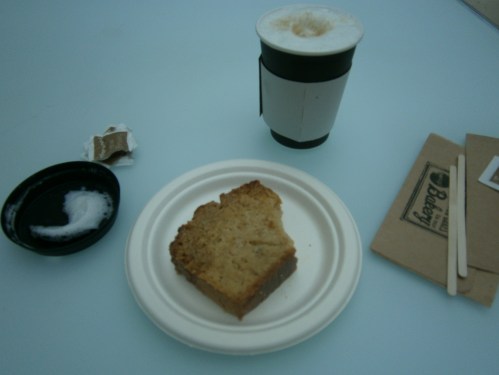
This was another of the really wonderful meals I had in England: just a slice of oat honey loaf and a cappuccino. The best places I found to have coffee in England were, strangely enough, the British Museum and Victorian and Albert Museum cafés. And both of them sold this delicious loaf.

I think I’ll end my post here today, because I have to run to Tesco to pick up some more food before picking up Catherynne Valente at the airport. If you’ve been following my blog, you’ll know that the two of us are here on a writing retreat. We’ll be working hard, writing and editing. But we’ll also be seeing the city.

Oh, and about the novel. I think I finally figured out how to write it. Last night, I intensively revised part of the first chapter. It’s going to be quite different than I thought it would be, more like the original novella than I expected. And I have no idea if, in this form, anyone will want to publish it. But I’ve decided that the only thing worth thinking about, when I write a story, is whether I like it, whether I want to write it, whether it excites me. The time to think about all those other considerations is afterward . . .

Posted in Uncategorized | Leave a comment

The British Museum

Last night, I couldn’t get to sleep. I think it was the excitement and nervousness of being in a new place, for the third time in three weeks. Or maybe it was the coffee I had yesterday. Hungarian coffee is strong!

This morning, I woke up and walked around a bit. It’s Sunday, so the city is very quiet. It feels almost empty. I ended up at the Danube, looking across the river toward the Gellert baths. Then I walked back toward the apartment and found a Tesco, so later I will be doing some marketing.

But what I feel more than anything this morning is a strange sense of sadness. I think it has to do with what I’ve been writing about: this effort to figure out who exactly I am. Because when I was in London, I felt as though I was saying hello to a city I was seeing for the first time. A far too brief hello. But here in Budapest, I feel as though I’m saying goodbye. I’m here for another two weeks, so perhaps that feeling will change. But I’ve felt this before: the sense that even though I’m in a particular place, I’m already gone.

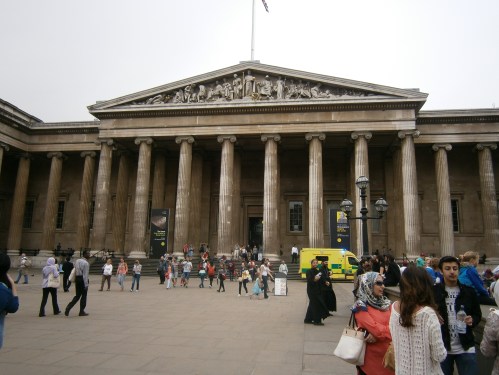
Today, I’m going to be including some pictures I took of the British Museum, where I went on my second full day in London.

I suppose that sense comes in part from knowing, deep down, that if I’m serious about having the writing career I want, this is probably the last summer I’ll be able to do something like this: just take off and go to Europe for a month and a half, even though I am doing research while I’m here. My friends who are writers, and who have the sort of career I want, mostly travel on business. They go to conventions, or to signings, or to meet with publishers.

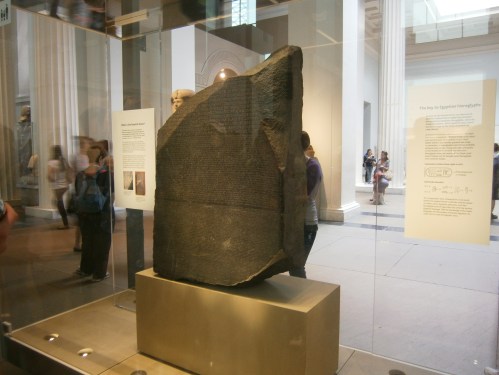
I will always love Budapest, but it feels as though it belongs to my past. Perhaps that sense will change this week? Look, the Rosetta Stone! It really is incredibly impressive, when you see the real thing up close.

And perhaps it’s a sense, too, that there are so many places in the world I want to see. If I could go anywhere next, it would be the English countryside. And then Ireland. And then Scotland. And then, perhaps, Greece.

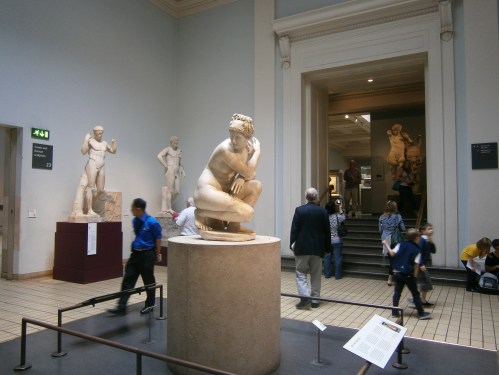
I walked for hours through the British Museum. It’s the sort of museum that you can tackle systematically, unlike the Victorian and Albert, which I visited later that week. But I sort of ambled, looking closely only at the things I particularly loved. It’s the perfect museum to amble through.

Of course, I was in London to research the late nineteenth century, and it doesn’t seem as though these monuments would have anything to do with that period, does it? But somehow, all week, I kept ending up in places where I could learn about my era. Even in these halls, because the items in them had been collected in the nineteenth century, during the era of empire.

The English were such collectors. Of everything, really. After ambling through the British Museum, I started wondering if there were any of those red and black jars left in Greece!

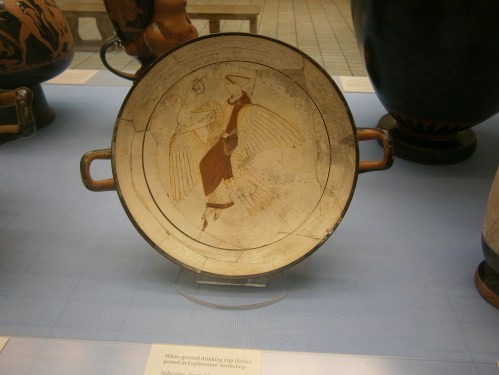
One of my favorite items in the museum was this small plate, with a picture of Aphrodite riding a goose. It’s such a domestic image, somehow.

So that’s me this morning, sitting in the California Coffee Company on Múzeum Utca, in the middle of an identity crisis. But that’s not necessarily a bad thing, is it? It’s out of those moments of crisis that we learn about ourselves, even though they’re uncomfortable at the time. The thing is, I feel as though my life is shifting in deep and fundamental ways. And I hope that I can keep my balance. Or if I fall, I hope that I can get up again.

Tomorrow, more pictures of the British Museum, including the Elgin Marbles.

Posted in Uncategorized | 2 Comments

Kensington Gardens

On this trip, I have a secret mission. It’s to figure out who I am, now that the dissertation is done. Who I am and what I want to do, because now that the dissertation is done, I have the time to become that person, to do those things. But of course, you can’t simply decide who you are. It’s a process of discovery.

The pictures I’m going to post today are from Kensington Gardens, where I went on my first full day in London after visiting Hyde Park. The picture below is the Peter Pan statue.

If you look at it right, every experience can teach you about yourself, about who you are at the core. Because you will respond to those experiences, and you can examine your own responses. This sounds like a bit of an arduous process, I know. But I think that many people are actually mistaken about who they are. They think they are one thing and are actually another. You can live like that, but you can’t write like that. I would venture to say that all of the arts, even music and dance, require self-knowledge. And honestly, I feel as though I lost myself for a while there. It’s only been in the last two years that I’ve started finding myself again, figuring out who I am at the core. Because I think the core doesn’t change: what I am, I was at twelve, and will likely be at eighty-two.

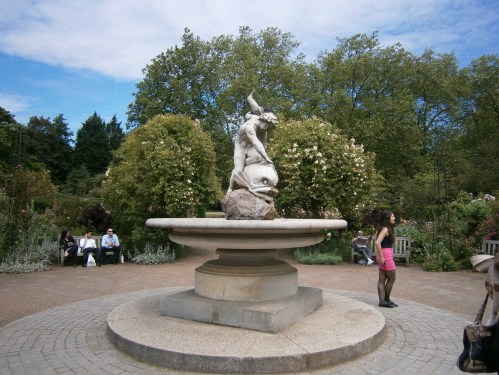
Kensington Gardens is quite different from Hyde Park. It’s larger, more open: there are more areas of just grass and trees. I entered it by the Peter Pan statue, which is next to the Long Water, which is basically a continuation of the Serpentine. It’s a long lake with ducks, geese, all sorts of waterfowl. And then I walked along the lake until I came to one of the most beautiful parts of the park, the Italian Garden.

After walking around the Italian Garden, I left the park for just a moment and took a picture of the street. This is a picture of a London street, but quite a posh street, since it’s next to the park. Think of New York next to Central Park: that’s what it reminded me of.

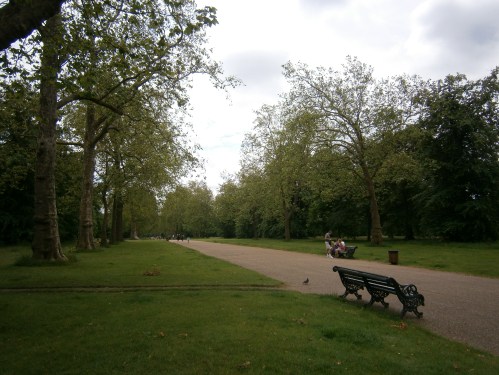
But then I turned and walked through the leafy avenues of Kensington Park. It was cool and lovely under the long alleys of linden trees.

Finally, I visited Kensington Palace. I paid to go in, and at first I thought I had wasted my money (it was £15!), because the palace itself is in the process of being refurbished, and so many of the items that are usually there weren’t. But I was in luck, because instead there was a exhibit focused on the reign of Queen Victoria, who had grown up there. And I saw many things that I don’t think I would have seen otherwise: two pairs of her stockings (one for her wedding, one from when she was in mourning), her personal jewelry, a piece of Honiton lace she had worn as part of her wedding veil. So now I know what Honiton lace looks like and why it was considered so precious. It really is the most beautiful lace that I think I’ve ever seen. Here is the statue of Queen Victoria in front of Kensington Palace.

And I gained new respect for Prince Albert, seeing how much time he spent working on the Great Exhibition, how much thought he put into it. He did not have to be so enterprising; he would simply have done nothing for the rest of his life. But instead, he did a great deal for Britain and the public good. He’s become a figure of fun because the monument to him in Kensington Gardens is so extravagant, and I have to admit that it does look like a bit of Las Vegas that has landed in an English park. But I like Prince Albert.

In the café in Kensington Palace, I had what was one of the best meals I had in London, although it was so simple: a cheese sandwich with a sort of sweet relish, and a ginger beer. (Ginger beer, by the way, is nothing at all like American ginger ale.

Since I started writing this blog post, a storm has sprung up in Debrecen. I may lose my internet connection, so I’m going to post what I have now. More on finding myself in the next blog post.

Posted in Uncategorized | Leave a comment

Being in London

I didn’t post at all while I was in London. In his preface to Lyrical Ballads, Wordsworth says, “poetry is the spontaneous overflow of powerful feelings: it takes its origin from emotion recollected in tranquility.” I think that’s true of all sorts of writing, even perhaps of blog posts. I know that while I was in London, I couldn’t write about it. I was experiencing too much every day. It’s only afterward that I can write about intense experiences, and London was an intense experience.

I’m going to write about it over the next week or so, and even post pictures, but my posts will likely be broken, fragmentary. I’m still thinking about London, still trying to put the pieces of it together. One thing being there made me realize is that my true country is the English language. That country is made up of all the books that were ever written in English, so I have Hobbiton and Wuthering Heights and the Hundred Acre Wood all in my country. And of course London.

There was so much to see there, and I knew of course that I could never see it all, so I focused on the time period in which my novel is set. I was primarily there for research, after all. I wanted to find the London of 1860-1900, and I found it everywhere. I’m going to include some pictures in these posts. The first set of pictures I will include are from Hyde Park and Kensington Gardens, where I went the first day.

The first thing I noticed about London was how easy it is to get around. I went almost everywhere by tube or on foot, although I did take the bus twice. The city felt easy, familiar, and I think that’s more than language. I think it’s because London is the city that the cities I’m most familiar with (Boston and New York) were modeled after.

I was very lucky. While I was in London, it was sunny almost every day, so I got to see the parks, which are my favorite parts of the city. I honestly don’t think anyone gardens like the English. And of course the English climate is perfect for all those flowers I would like to plant myself, such as roses and foxgloves.

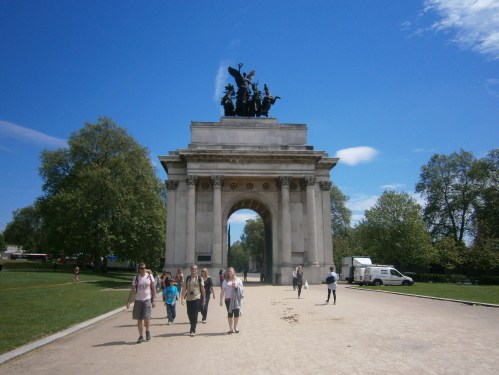
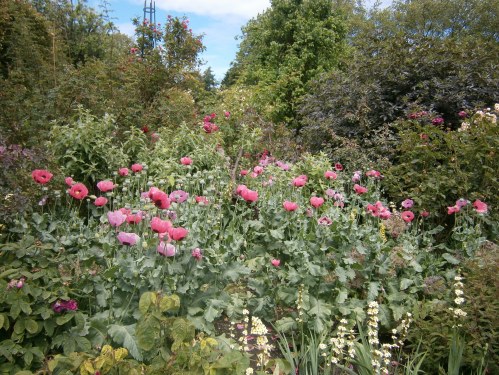
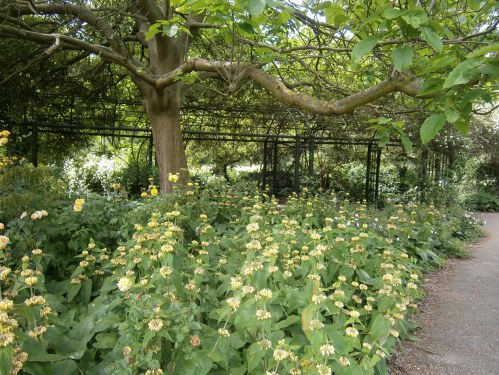
I took many pictures simply of the flowers, because they were so beautiful. I will only include a few here. On my first day there, I got off the tube at Piccadilly Circus and walked down Piccadilly to Hyde Park.  (You can see Hyde Park Corner in the first picture above, and then two pictures of the garden that is located right there, by the corner.) I basically just walked through Hyde Park, along the Serpentine and to Kensington Gardens.

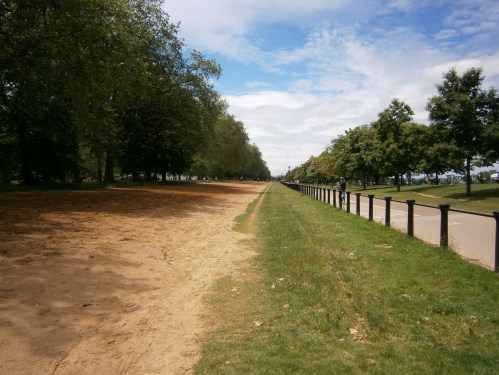
In this post, I’ll just include pictures from Hyde Park. I’ll save Kensington Gardens for tomorrow. Of course, you know that Hyde Park is where the ladies and gentlemen would walk and ride. As I was walking along the park, I took a picture of Rotten Row (whose name is evidently a corruption of Route de Roi, the king’s way). At one point, I saw three girls, very properly equipped and on lovely Thoroughbreds, riding along that dirt track. (You can see that dirt track below, by the way. I think Dorian may have been seen riding there in The Picture of Dorian Gray? But I’d have to check.)

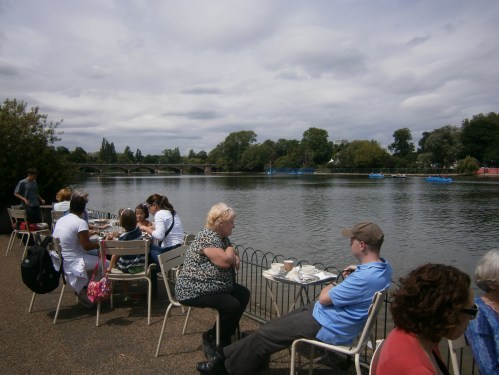
This is a non sequitur, but as I was walking along Piccadilly, I came upon Fortnum & Mason. Of course I had to go in. The strange thing was, as I was standing there looking around, I had one of those moments I sometimes have in which I realize that I’ve already dreamed what I am doing. I had dreamed of being in Fortnum & Mason several years before. It had looked very much the same. I don’t know, was that my brain playing tricks on me? I tend to think that time is a much stranger thing than we think it is, and that sometimes we get echoes and indications from the future. But anyway, that was the odd moment I had. Below is a picture of the Serpentine. It’s a sort of long pond, with geese and duck and swans, and if you follow it, you will end up in Kensington Gardens. Where Peter Pan used to play.

One of the realizations I had in London is that once this trip is over, I will need to retreat into myself, to close myself off from external influences to a certain extent. In order to contemplate, to gather myself together, to write. I think you can live or write, and if you’re living as intensely as I did last week, wandering everywhere, it’s very difficult to write. So that’s what I’m going to be doing over the next year. This is my summer of living intensely, a summer that’s teaching me so much. And then, I will withdraw into myself and see what I can create.

Posted in Uncategorized | 7 Comments

The Wedding and the Zoo

I’m sitting in the guest bedroom of a beautiful house in the north of London, looking out the window into the back garden. I think I’ll need my umbrella today. The house belongs to my friends Farah Mendlesohn and Edward James. I arrived here on Monday, and yesterday I spent the day walking around Hyde Park and Kensington Gardens. But before I get into describing what I’m doing in England, I should finish describing what I did in Debrecen.

I mentioned that Ophelia and I went to a traditional Hungarian wedding. Really, it was more a modern Hungarian wedding incorporating traditional elements. It was very long, about twelve hours from start to finish. It included a lunch, a religious wedding ceremony in a church, a civil ceremony at a sort of hotel/spa in a forest, and a dinner at that hotel. I’ll post just a few pictures from the wedding.

Of course I hadn’t come prepared to go to a wedding, so I was scrambling for an acceptable outfit. I ended up wearing a long silk skirt that my father’s wife had given me and a black silk blouse that I had bought long ago at Goodwill. I thought the outfit had a sort of boho vibe, and at any rate it was cool and comfortable. (This picture was taken by Ophelia.)

At the lunch before the wedding, the groom came and ceremonially asked for the hand of the bride. He was offered two other girls first, before he got the the one he wanted. The whole event was presided over by a man who would announce what was happening next and tell everyone where to go. He was the only one dressed in a version of traditional Hungarian garb.

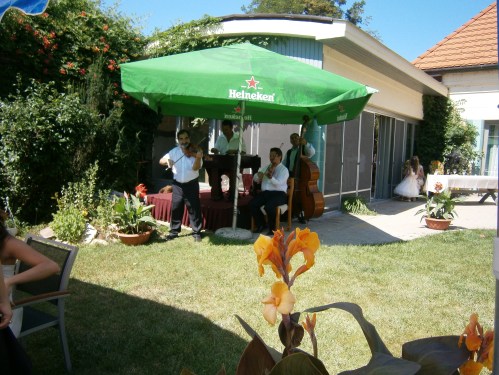
Everyone else was dressed the way guests dress at the American equivalent, which would be a rural summer wedding in the south, perhaps in a city like Richmond. If you imagine how a variety of guests, about two hundred of them, of all ages, would dress at a southern wedding — well, that was how this wedding looked as well. At the lunch, there was a gypsy band.

My favorite part, I have to admit, were the deserts. They were the most traditionally Hungarian parts of the menu (the rest of the menu was rather like banquet food at every wedding I’ve been to). I didn’t get a picture of the dessert table before it was ravaged by hungry hordes, but here’s what was left.

That was just the lunch. Ophelia and I were too tired to make the religious ceremony, so we slept for a while, then rejoined everyone for dinner in the forest. What it made me realize, interestingly enough, is that weddings are the same the world over. The bride in white, a large dinner to celebrate, dancing afterward with a disco ball danging overhead, and a Hungarian band singing “Hopelessly Devoted to You” (yes, the Olivia Newton-John song from Greece). I wonder what Marcel Mauss would think of that?

The next day, my father took me and Ophelia to the Debrecen zoo. It was interesting to see what was still very much an old-fashioned zoo, mostly unaffected by the more modern concern with conservation of species. It was very much what zoos were like in the nineteenth century. There was a tiger, but also a cage of fancy pigeons particularly associated with Debrecen. The focus was still on the display of animals, and there were certain animals you could feed. Ophelia fed the llamas and ostriches.

The strangest sight for me was seeing three Canadian Geese. They have such plaintive honks, and they honked at me as though trying to make the point that they should be in the skies above Boston, not in a zoo in Debrecen. And I have to say, I rather agree with them.

The next morning, my father drove me to the Debrecen airport, which has been open only two months. It’s a converted Russian airforce base, and rather looks like it. Only one airline flies out of it (Wizzair), and going through it took me back about twenty years, to when the Budapest airport was much less international. Back then, people would look at you curiously if you were traveling with an American passport, and I got those looks that morning, although I never get them anymore in Budapest. The plane was filled with Hungarians going to London, mostly to jobs there. A man started talking to me and turned out to be a doctor, a former student of my father’s who was now an oncologist in London. It paid so much better than work in Hungary, he told me.

That concludes my stay in Debrecen, at least for now. I landed at Luton to the north of London, then took the train to St. Pancras station. And since then I’ve been here. But more on that soon.

Posted in Uncategorized | Leave a comment