Stonecoast: The Hobbit

I want to write a couple more posts about my experience at the Stonecoast residency this winter. As you know if you read my last post, Stonecoast is a low-residency MFA Program in which I teach, which means that I go up to Maine for residencies in the winter and summer, and then mentor students during the spring and fall semesters. This past residency, I led an elective workshop on writing fantasy. Most of the workshop was spent critiquing the stories students had submitted. But we also talked about the particular challenges of writing fantasy. The first day we talked about setting, then characters, then plot, then style. I thought I would talk for a bit here about creating setting in fantasy fiction, because it presents problems that realistic writers don’t have to deal with.

Basically, when you’re writing fantasy, you may be setting your story in a world that doesn’t exist. It can be much easier for a realistic writer, because he or she will have points of reference for the reader. “I walked through Central Park” immediately conveys an image to most readers (who have been in Central Park, or more likely seen it in movies or on television). “I walked through the gardens of the temple of Ashera” tells the reader exactly nothing. It conveys absolutely no visual image, except perhaps a green horizontal thing beside a gray vertical thing. So as a fantasy writer, you often have to work harder.

The day we talked about setting, I brought in a quotation for us to discuss. You’ll recognize it at once:

“In a hole in the ground there lived a hobbit. Not a nasty, dirty, wet hole, filled with the ends of worms and an oozy smell, nor yet a dry, bare, sandy hole with nothing in it to sit down on or to eat: it was a hobbit-hole, and that meant comfort.

“It had a perfectly round door like a porthole, painted green, with a shiny yellow brass knob in the exact middle. The door opened on to a tube-shaped hall like a tunnel: a very comfortable tunnel without smoke, with paneled walls, and floors tiled and carpeted, provided with polished chairs, and lots and lots of pegs for hats and coats–the hobbit was fond of visitors. The tunnel wound on and on, going fairly but not quite straight into the side of the hill — The Hill, as all the people for many miles round called it — and many little round doors opened out of it, first on one side and then on another. No going upstairs for the hobbit: bedrooms, bathrooms, cellars, pantries (lots of these), wardrobes (he had a whole room devoted to clothes), kitchens, dining-rooms, all were on the same floor, and indeed on the same passage. The best rooms of all were all on the left-hand side (going in), for these were the only ones to have windows, deep-set round windows, looking over his garden, and meadows beyond, sloping down to the river.

“This hobbit was a very well-to-do hobbit, and his name was Baggins. The Bagginses have lived in the neighborhood of The Hill for time out of mind, and people considered them very respectable, not only because most of them were rich, but also because they never had any adventures or did anything unexpected: you could tell what a Baggins would say on any question without the bother of asking him. This is a story of how one Baggins had an adventure, and found himself doing and saying things altogether unexpected. He may have lost the neighbors’ respect, but he gained — well, you will see whether he gained anything in the end.” — J.R.R. Tokien, The Hobbit

That’s Tolkien at his most brilliant, getting you right into the story by describing where we are, by giving us setting. But notice how cleverly he’s doing it, and what risks he takes. In a hole in the ground lived . . . what? A hobbit. We have no idea what a hobbit is, so he has to tell us, not by telling us, but by describing that hole in the ground. He’s not actually going to tell us what a hobbit is until later. The reference to a hobbit can make us feel displaced, so he’s going to place us: we’re in a hole. He starts by doing something I was taught not to do in writing workshops: telling us what isn’t there, what that hole is not like. It’s not dirty or wet or dry or sandy. No, it’s comfortable. And then he describes it.

One thing I’ve come to understand from teaching writing is that to work, writing needs tension: you need to feel things pulling against each other. Tolkien starts that pulling right at the beginning: the tension between our assumptions and the truth. We think a hobbit hole might be nasty, but it’s not. Look . . .

And then Tolkien takes us on a tour. One continual problem with how writers describe setting is that they stop, and then they describe. We are still. Tolkien describes the hobbit hole, but notice that we are on the move: we enter through the door, move down the hall, hang up our hats. (Just as the dwarves will, later in the chapter. We are the hobbit’s guest before they are. We are the storyteller’s guest, and only at the end do we realize that in a sense, the storyteller was the hobbit all along.) Then we keep moving down the hall as it follows the curve of the hill. We look out the window, over the garden and down to the river. Then we are finally introduced to our host.

And do you notice where the novel begins? At the end of the third paragraph! There it is, bam: this is the story of how one hobbit had an adventure. So we have another source of tension: a hobbit went on an adventure. He found himself doing and saying things, and he lost . . . something. Found and lost, lost and gained: can you see the wonderful balance of the passage? We’re at the beginning, and we’re already talking about the end.

Tension comes from the juxtaposition of opposites, which we have plenty of in this passage. Suspense comes from things we don’t understand: we start by not knowing what a hobbit is, and we end by not knowing what the adventure is. And so we begin our story.

This is one of the most brilliant openings in English literature. By the end of the chapter, a great deal will have happened, and in the second chapter Bilbo will be off . . . no dawdling for the hobbit or Tolkien either. And from that second chapter on, he will always be in trouble. The narrator will be throwing rocks and rings and wargs at him.

These are the sorts of things we discussed in our workshop. In my next post on Stonecoast, I’ll talk about character . . .


Hobbit

Posted in Uncategorized | 5 Comments

A Still Place

I haven’t posted for a while, and it’s partly because I’ve been so busy. Mostly because I’ve been so busy. But there’s something else . . .

I feel as though I’m in a still place, a place of stasis. That’s not necessarily bad. Stillness is also peaceful, and I’ve been feeling less frantic than I have in a long time. It’s a good place: I love everything I’m doing. I love teaching undergraduate writing at Boston University, I love teaching my graduate creative writing students at Stonecoast. I have enough money to cover my living expenses and some luxuries, which certainly hasn’t always been the case. (Graduate school — ugh.) I live in a beautiful apartment, in a beautiful city. I just happen to have the best daughter in the world.

But it’s a strange place, too, because I’m not used to standing still. I’m used to things happening, to continually moving toward. Or, you know, away from . . . I’m used to a sense of motion, rather than stillness. It’s strange, for me, to think that I could stay here for the rest of my life, and it would be a perfectly good life. If nothing changed, I would be fine. Of course, that never happens. Things always change: if nothing else, I will get older. Nevertheless, if I stayed here, where I am, for a long time — it would be perfectly fine. And sometimes that fills me with a sense of panic.

Winter Storm 1

I think it’s because I’ve spent my entire life moving from place to place, adjusting to new circumstances. Hungary to Belgium to the United States. Philadelphia to Washington D.C. to Boston. To Richmond to New York to Boston again. University of Virginia to Harvard to Boston University. And now here I am, having lived in Boston for a long time, having been at Boston University for more than ten years, as a student and then teacher. A great deal has happened in that time — and it’s really only in the last few months, since I settled into this apartment, that I feel as though I’ve arrived someplace. That I’m not just transitioning from one place to another. There’s something lovely about feeling settled. But I’m not used to it.

I suppose what I should be thinking is, I’ve come to a place that I can build on. Here, where I feel both strangely at peace and agitated from that strangeness, I can finally start to build what I want to, which is books — I want to build out of words. My first full-length novel is already with my lovely agent. I just sent him a synopsis of the second novel. And I do have so many ideas, for novels and stories and essays . . .

So I suppose my advice to myself should be: settle in and work.

Winter Storm 3

The other thing I need to remember, to remind myself of, is that nothing ever stays the same. Stasis is, in the end, an illusion. The world may feel still, but it’s spinning. Everything we do, every choice we make, can change what happens. Who knows what will happen with this novel, or the one after it, or the one after that. The more we do, the more opportunities we are given to do things. And that sometimes means we are overwhelmed with work (ahem). But it also means we get to do amazing things . . .

I have already gotten to do a lot of amazing things. And I intend to do more.

So I need to take this stillness as the gift it is — a time when nothing seems to be happening, and I can maybe catch up, take a breath. Get ready for whatever is to come.

Winter Storm 4

(These pictures are from our snowstorm last week. Today we are having another snowstorm, and once again university classes are cancelled. I don’t remember them being cancelled twice in one semester . . . ever. Not since I arrived here more than ten years ago. This is a particularly heavy winter, just right for being contemplative.)

Posted in Uncategorized | 6 Comments

Calling in Sick

Yesterday, I called in sick.

Since it’s Winter Break, there was no one to actually call in sick to . . . so I had to call in sick to myself. In the ten years I’ve been teaching, I’ve only called in sick to cancel a class once, on a day when I could barely crawl to the phone to make the call. (This was back when I still had a landline.) Usually when I get sick, but not very sick, I have a conversation that goes something like this:

Body: I’m sick.
Mind: No, you’re not sick. I have a lot of work to do, so you can’t be sick.
Body: I’ll put off being sick until the weekend. But then I’ll really collapse.
Mind: Deal.

I’m very good at not being sick for a couple of days. And then I really get sick when I have time to. It’s something I learned back when I was in college, taking exams. I would study study study, take my exams, do well on them. And then I would go to bed for a week, sick from exhaustion. Nowadays I don’t have exams anymore, but the ends of semesters are just as intense, and I tend to overwork myself just as much. What’s changed is that I cut myself less slack. I assume that I should be able to (a) grade papers and submit final grades for almost sixty students, (2) make sure my graduating MFA students get in their final theses, (3) send a finished novel to my agent, and (4) prepare for Christmas, including the shopping and cooking and decorating, without getting tired or feeling ill. Gracefully, like some sort of academic Martha Stewart.

Instead, of course, I wake up one morning and decide that showering and making breakfast both sound like way too much work . . .

The problem with being a doctor’s daughter (and I’m the daughter of two doctors) is that one was never allowed to be just a little ill. When I told my mother that I felt sick that day, she would come take my temperature. And if I didn’t have a temperature that said “fever” to her, I had to go to school. After all, she dealt with children who were genuinely ill, who were being treated for diseases like cancer. What I was doing fell under the category of malingering. Now when I feel ill, the first thing I do is check my temperature. If it’s normal, I immediately say to myself, “I’m not sick.” The problem is, I never have a fever. The useful thing about being a doctor’s daughter is that when you call a parent and say that you have a pain in your side and it’s probably nothing, that parent can say “Go to the emergency room.” Several hours later, you are being prepped for an appendectomy. At first, the doctors didn’t think it was appendicitis, because . . . I didn’t have a fever. (Not having a fever when you have appendicitis is apparently some sort of bizarre medical anomaly. So I can say with some confidence, seriously I never have a fever. If I ever did, I would probably be convinced that I was dying.)

But if you feel ill, you are ill. The feeling itself is a symptom. If you’re so tired that you don’t want to do anything but lie in bed and watch British crime dramas, you’re ill. If you think a piece of toast and a boiled egg sound like a perfect dinner, you’re ill. If showering sounds like way too much trouble . . . Well, it’s time to call in sick. Also if you’re coughing and blowing your nose, but I tend never to trust physical symptoms.

Mind: You’re just coughing and blowing your nose to fool me into thinking you’re sick.
Body: Go. To. Bed.

Basically, I’ve exhausted myself. My body is completely out of whack, and I need to get it back in again. (Is there such a think as in whack?) And that means giving it what it needs, which is a lot of sleep, and rest, and time completely alone. So I’m letting it sleep whenever it wants to, as much as it wants. And I’m still doing the work that needs to get done before next week, but more slowly. I’m not bothering with going out, or seeing people, until I want to again. (I’m an introvert, so this is very much what I need.) Luckily, I have several pairs of pajamas. I have at least a couple of days until I run out of food. I will probably take a shower today . . . I have books and Netflix on my computer, so basically, I’m set.

I think every once in a while we just have to call in sick to ourselves. We just have to say, “I’m going to be sick. I’m going to be sick until I’m well again.” And then we have to sleep and sleep, and binge-watch British crime dramas, and drink herbal tea. I’ll know when I feel well again because I’ll decide that I’m just so bored, and I’ll want to see what the outside world is doing. I don’t think it will take long.

But until then, I’m going to be well and truly sick.

The Library by Elizabeth Shippen Green

This painting is The Library by Elizabeth Shippen Green. I am nowhere near this elegant when I am sick. But let’s just pretend I am . . .

Posted in Uncategorized | 8 Comments

Why I Write

Last night, I stayed up late finishing the final edits to my novel manuscript before sending it to my agent for the second time. The first time I sent it to him, it was in the “well, I finished the novel but I’m still working on it because it’s not quite right, but here you can see that it’s finished” stage. This time it was in the “I hope you like it because honestly I can’t stand to look at it anymore” stage.

If you’re a writer and you’re sending manuscripts out, you know the stage I mean. It’s where you read through the manuscript on screen and decided to take out “that,” and then you read it on paper and decided to put “that” back in. And as you’re putting “that” back in, you stare at the screen, trying to read it both ways: with and without the word “that,” which really is only one of approximately 108,700 words in your manuscript. But there you are, agonizing over the one word. (“That” is one of my particular, personal problems. I did not realize this until an editor pointed it out and I did a word search on the short story she was editing. Sure enough, there were an awful lot of “that”s, about half of them unnecessary.)

These are the sorts of questions you ask yourself when you’re at that stage:

1. Should she have “dark brown” or “darker brown” hair?
2. Have I used the word “monkey” too often? (Word search for “monkey.”)
3. Do I need to mention that she left her umbrella at home? It wasn’t raining that morning.
4. How many characters are snoring? Is that too many characters? Do I need to cut some of the snoring?
5. Wait, where is her revolver? Is she holding it all this time?

I did, in fact, cut some of the snoring.

I sent the manuscript out around midnight, as an emailed document file, about 370 pages long (double-spaced). And then I celebrated by eating chocolate and watching two episodes of Miss Fisher’s Murder Mysteries, which took me to the end of Season 2. Now I have to wait until they film Season 3, which is entirely too long . . . If you haven’t heard of it, Miss Fisher’s Murder Mysteries is an Australian television series based on the books by Kerry Greenwood. If your taste in stories and television shows is anything like mine, you will love them. I adore Phryne (pronounced Fry-oh-nee), her 1930s Lady Detective, and I have to admit that I’m in love with Detective Inspector Jack Robinson. But that’s based just on the television series, since I haven’t read the books . . . yet.

So there I was, sitting in bed, in pajamas, eating dark chocolate with sea salted almonds in it, watching Miss Fisher on my computer (I don’t have a television). Thoroughly enjoying myself. And I thought: this is why I write. Because someday, someone might need something to entertain them, or cheer them up, or even just pass the time. And maybe my book will do that.

I think that’s worth all the agonizing over “that.”

It’s fair to say this novel took me two years to write: the first few chapters were written earlier, but I had to rewrite them after I finished my PhD and moved into my previous apartment. I had been thinking about the novel in the wrong way, and it took the mental freedom of having finished my degree to get it right. That apartment was where I really wrote the novel, finishing it last summer in Budapest and then adding the final chapters when I moved into this apartment, in August. Since then, I’ve been revising. And of course there has been a lot of revising along the way . . . Sometimes I think it’s pretty good, sometimes I worry that it’s awful and I just can’t see its awfulness. But I figure, it’s only the first full-length novel I’ve written, so if I mess up the first time, I’ll get it right the second time. Or the third. Or fourth. I’ll just keep writing . . . Someday, there will be a woman in pajamas, with chocolate, and she will stay up late to read something I wrote. Or maybe even watch something based on it, on her television screen!

So thank you, Kerry Greenwood, for doing that for me. You don’t know me from Eve, and you’re all the way on the other side of the world, in a country I’ve never visited, but you gave me two lovely hours. Oh yes, a television show is always separate from the book, although based on it. But it would not have existed without you, sitting in a room, probably in front of a computer, agonizing over that final draft. Just like me.

Miss Fisher

Phryne Fisher

These images are from the Miss Fisher’s Murder Mysteries television show and the first book in the series, which I now want to read . . .

Posted in Uncategorized | 7 Comments

Writing Lesson: Observation

I thought it might be interesting to put down some of the things I’ve learned from teaching writing.  From writing too, of course, but I find that when I teach writing, I tend to make certain points over and over.  Because these are the sorts of things that many writing students need to work on.  So I thought they might be interesting to point out here as well, for those of you who are writers, or who simply want to improve your writing . . .

The first one I want to talk about has to do with observation.  If you want to be a writer, you need to also be an observer . . . someone who is curious about the physical world around you. I don’t know about you, but I find it harder to write about the physical world than about mental states. It’s easy enough to describe what someone is thinking, but try to describe someone walking down stairs. I mean, in a way that makes it interesting.

(Ironically, writing students often think the way to keep a narrative interesting is to include action scenes. But action scenes can get very boring, very quickly. It’s often less interesting to watch a character act than to hear her think. Physical actions are usually interesting to the extent that they illuminate something else: the character herself, the world in which she is acting, etc.)

When describing the physical world, it’s very easy to fall into clichés. And the best way to avoid clichés is to observe closely, to see things as they are instead of as people say they are. To see what actually is.

So here is an exercise for any writers among you: go and observe. I do it sometimes sitting on the metro, where I can see so many faces, all different. I think about what makes them different, what distinguishes them from one another. I try to remind myself to observe, because it’s so easy not to see, isn’t it? To go through our days, particularly when we’re busy, and simply miss what is around us. The colors of leaves on the sidewalk. The different kinds of stone in the buildings. And the world is hard to describe anyway, because it’s so specific, each part of it different from every other part, and yet the words we have are “gray stone” and “autumn trees,” and it’s hard for writing to get at that specificity. But we have to try.

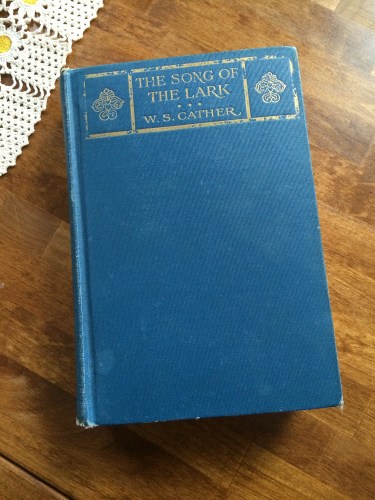
I was thinking about this recently as I read a description of a character in Willa Cather’s The Song of the Lark. The description comes right at the beginning of the book, two paragraphs in:

“Dr. Archie was barely thirty. He was tall, with massive shoulders which he held stiffly, and a large, well-shaped head. He was a distinguished-looking man, for that part of the world, at least. There was something individual in the way in which his reddish-brown hair, parted cleanly at the side, brushed over his high forehead. His nose was straight and thick, and his eyes were intelligent. He wore a curly, reddish mustache and an imperial, cut trimly, which made him look a little like the picture of Napoleon III. His hands were large and well kept, but ruggedly formed, and the backs were shaded with crinkly red hair. He wore a blue suit of wooly, wide-waled serge; the traveling men had known at a glance that it was made by a Denver tailor. The doctor was always well-dressed.”

This, by the way, is what Napoleon III looked like:

Napoleon III

But I can imagine Dr. Archie without that image. He’s stuck in a small town in Colorado, but I know he will be a strong character, simply from the way he’s described. It’s a long description — you probably would not find one as long in a modern novel, since novels now are expected to move at a faster pace. But Cather avoids any clichés. She includes generalizations (“always well-dressed”), but also backs them up with specifics (the Denver tailor). And notice the information she does not give us: we don’t know the color of his eyes. It’s standard in student writing to find a description that focuses primarily on hair and eye color. Here Cather gives us hair color, but not just on Dr. Archie’s head. We also learn about his mustache and the hair on the back of his hands. We do learn that his eyes were intelligent, which is actually what we most need to know about him.

Do you see what she’s doing? She’s describing what we would probably notice if we actually met Dr. Archie. These are the things about him that stand out, that make him different from other people. That are specific to him.

So when you’re observing, you really have to observe two things at once: what is in front of you, and yourself noticing. You have to see how you’re seeing. And not just what is static, but also gestures.  Here Cather gets gesture in a bit with the stiff shoulders; it’s a static description, but we get a sense for how he holds them, for how Dr. Archie moves.  When you’re observing, think about how people move, how they walk down stairs, or put their hand on the railing, or look back up when they reach the landing. How do they turn back their heads? What do their gestures look like?

It occurred to me, writing this post, that writing handbooks often tell you how to write, focusing on the craft of writing itself. But they don’t often tell you how to be a writer: how to prepare yourself to write. How to go through the world as a writer, finding and absorbing the material you will need. Because writing doesn’t come out of your head. Oh, if only it were so easy! No, writing comes out of other writing, and out of your lived experiences. If it comes only out of other writing, it’s merely imitative. If it comes only out of lived experiences, it’s often unformed, uninformed. Like a long diary entry, uninteresting to read. Good writing happens when you’ve absorbed a great many things, both from books and from life, and they’ve mixed pretty thoroughly in you, as though you were a cocktail shaker. And then you pour it out, into whatever form you’ve chosen or it’s chosen for itself (whether a poem, or short story, or novel).

So if you want to be a writer, give yourself homework: go out and observe.

Song of the Lark

This, by the way, is my copy of The Song of the Lark, from 1924.

Posted in Uncategorized | 10 Comments

Small Details

Details matter.

Once upon a time, a long time ago (specifically, while I was in college), I took a poetry class. It was my introduction to the fact that taking a class with a Famous Poet doesn’t mean it’s going to be any good (it wasn’t). And that’s where I first heard the phrase “God is in the details.” I’m not sure where I heard “The Devil is in the details,” which I suppose is a sort of companion phrase. They both essentially mean the same thing, which is that details matter. (In my poetry class, the professor meant that the poem is in the details, which is both true and not true. He was referring to the small descriptive details that are at the heart of modern free verse. But the poem is also in the details of rhythm and rhyme.)

I was thinking of this last night, because it was the first night in about two weeks when I haven’t been working (frantically trying to finish the tasks of the semester). And instead of going straight to sleep, which is of course what I should have done, I stayed up to sew cherry red bobbles on my lampshade. Because decorating is also in the details — if the details aren’t there, aren’t right, you haven’t decorated at all. You’re just arranged furniture.

There is a sort of rule that I’ve been hearing about, mostly from business people: since 20% of your effort goes into achieving 80% of a task, and the remaining 80% goes into achieving the final 20%, you should focus on achieving that first 80%. As for the rest, “the perfect is the enemy of the good,” right? I suppose there’s nothing wrong with thinking that way, or acting on it, in certain industries. But there are places where the difference between 80% and 100%, or even 90% if you can’t get all the way there, is huge. Is everything.

One of those places is the arts. The difference between an artist giving 80% and 100% is the work of art itself. You can tell a painting, a novel, that isn’t at 100%. Where the artist or writer said, “that’s good enough.” What makes an artist great is knowing where 100% is, and doing his or her best to get there. Maybe not achieving it — probably not achieving it, because who are we kidding, art is hard. But trying anyway.

When I’m decorating, I add the bobbles. (Which I love in part because they’re slightly ridiculous, as though my lampshades belonged at a circus. This morning, I added bobbles to the other lampshade. Now I have two lampshades with red bobbles, like circus clowns.) When I’m writing, I sweat over the commas and semicolons. The novel I’m writing — I’ve read the entire manuscript out loud to myself, to hear what the sentences sound like. Over the next few days, I need to go over it one more time before sending it to Important People. Just to make sure there aren’t any stupid mistakes.

As I said, I suppose there are places where 80% is enough, and you can let the other 20% go. But not the spaces I work in: not in teaching, not in writing. And it’s not a way that I particularly want to live, because I care about the details, about getting to 100%. And there’s another saying that I’ve always remembered: “The way you do one thing is the way you do everything.” I think that’s often true: people who are conscientious in one area tend to be conscientious in other areas as well. I know it’s true for me: the better I get at one thing, the better I get at others. It’s as though each thing I do is a learning process. Putting red bobbles on my lampshades provides a lesson about writing, about teaching. About living.

Because in the end it’s about how we live, isn’t it? In the end, everything is. And everything can provide lessons. Even time spent sewing on red bobbles . . .

Details 1

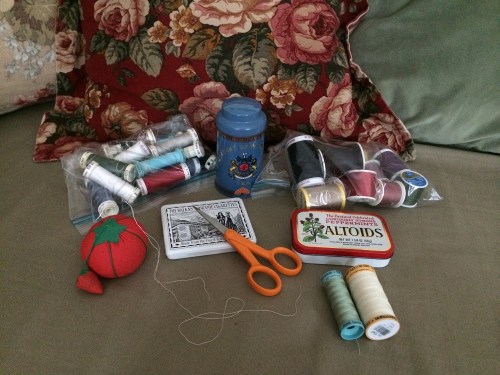
The photo above is from this morning: some of my sewing supplies scattered on the daybed in the living room, where I was working. The cigarette tin holds needles, the tea tin holds buttons, and the old Altoids tin holds my pins. The photo below is one of my lampshades, the one next to the Christmas tree, with red bobbles.

Details 2

Posted in Uncategorized | 2 Comments

Tidying Up

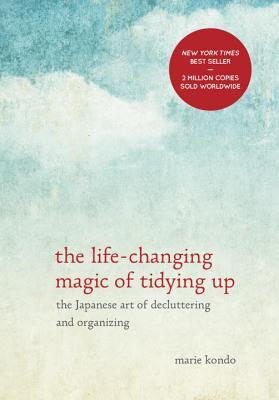
I read the most charming book, recently. It’s called The Life-Changing Magic of Tidying Up: The Japanese Art of Decluttering and Organizing, by Marie Kondo. The author is a television star in Japan, where she has a show in which she . . . you guessed it, goes to people’s houses and helps them organize their possessions. Helps them tidy up. After reading the book, I watched clips from several episodes on YouTube, in Japanese of course. A lot of what she does is talk to people, and I’m guessing that she’s asking them what they love, which of their possessions are truly important to them. Because Kondo has a different approach to tidying up, one I found interesting and valuable.

The book is charming in part because Kondo is so obsessive, much more than I could ever be. But I’m going to describe what I found valuable in her book, the ideas that stood out to me. Because I need order to work well — I need my environment to be tidy.

I know there have been articles on writers and how messy they can be. Some of them need mess, need disorder — they say within that disorder, they know where everything is. They get angry if anyone tries to tidy up. I’m not like that: I need my environment to be organized. I think it has to do with the way I think. My mind is itself a tidy place, or wants to be. It doesn’t like to be untidy, with important things tucked into the wrong places and forgotten. I do so much, have so many projects at once, that it’s really the only way I can operate. And one of the best ways to tidy my mind is to keep my physical environment clean, clearly organized. I don’t like inner or outer mess.

There are two other reasons I don’t like mess. One is that I need to live efficiently. I have so much to do that it’s frustrating when I have to spend time searching for a set of notes I knew I put somewhere. Or keys. Or change. If I’m working on a research project, I need to know which books I have relevant to that project, and where to find them. And second, I want to live in a beautiful space. Mess can be beautiful, but have you noticed that a beautiful mess is almost always intentional and intensely curated? Edward Gorey’s house was a beautiful mess, but he was an artist. It’s actually much more difficult to create a beautiful mess than simple neatness. So I try to keep things neat.

But I do fall into messiness sometimes, particularly when I don’t have time to clean. When I’m simply too busy.

So here are the central concepts from Kondo’s book that are particularly important to me:

1. You should only have things that bring you joy. This was a revelation, actually. What Kondo does, and I did not do this, is have people bring out all their possessions and put them on the floor. Then, she tells them to hold each one in their hands and decide whether that item brings them joy. If it doesn’t, it goes.

I thought I was being very practical by keeping things I had not worn for a long time, because I might need them again someday. But Kondo would say, while those things were useful to you once, they have outlived their usefulness. They are now ready to go away, wherever they’re supposed to go next. In a way, by keeping them, you’re impeding the flow of both your and their lives. Someone else could potentially use that coat. And then there are things that have outlived their usefulness entirely, and simply need to be thrown away. Old receipts don’t necessarily want to stay with you, to clutter up your drawers. They know when it’s time for them to move on, and so should you.

Did I mention that Kondo talks a fair amount about Shinto? It’s very clear that she believes all your things have spirit. If they’re no longer giving you joy, not only should they move on, they actually want to move on.

This prompted me to go through my closets and bookshelves. I try not to keep things I don’t love, but even I found things I was keeping that didn’t give me joy: some books I had bought because I felt as though I should read them, some clothes that were such a bargain at the time. I took several large bags to Goodwill.

2. Once you have discarded everything that doesn’t give you joy, make sure everything you’re keeping has its proper place. You should have a designated place for everything.

3. And you should make a habit of putting everything in its place. Now, this is difficult for me at the moment. Although I moved into this apartment six months ago, I’m still decorating. So there are paint cans on the kitchen counter, which is clearly not a place to store paint cans. (I just painted three lamps, and next come the shelves in what I glamorously call the walk-in closet, because you can walk into it, but is really a tiny room under the stairs, with a rod and drawers.) But I do try to make sure that whenever I take anything out of its place, I put it back. I notice that if it’s sitting out of place after I used it, I start to feel uncomfortable. This is partly Kondo’s fault: she makes me feel as though everything I own is sentient! As though my socks have feelings. (And how do I know they don’t?) Things like to be in their proper places, she says. And I know mine do.

There is a final concept in her book that I really like. She says that every day, when you enter your home, you should bow to it and thank it, and all the things in it, for taking care of you. For sheltering you, supporting you. Because after all, that’s what your things do, from socks to frying pans. I don’t actually bow down to my apartment (or at least not often!), but I like the idea of gratitude toward your things. That’s where the impulse to keep them neat, to take care of them back, ultimately comes from.

Marie Kondo

Posted in Uncategorized | 8 Comments