More Than Writing

Recently, I read an article in The New York Times called “How Writers Build the Brand.” It begins,

“As every author knows, writing a book is the easy part these days. It’s when the publication date looms that we have to roll up our sleeves and tackle the real literary labor: rabid self-promotion.”

My friends who are writers seem to fall into two categories when it comes to self-promotion. Some of them enjoy it and do it almost instinctively. Some of them, the majority, seem to dislike it. I was talking to a friend recently and said to him, “If you’re serious about a writing career, you need to actually work on it. How do you think you might do that?” He said, “I don’t know, write more?” I think many writers believe that: if they simply write more, submit more, the writing career will come. But the friends of mine who actually have writing careers don’t do that – or not just that. They do in fact write more, but they are also the ones who publicize themselves and their work.

The article goes on to say,

“In this era when most writers are expected to do everything but run the printing presses, self-promotion is so accepted that we hardly give it a second thought. And yet, whenever I have a new book about to come out, I have to shake the unpleasant sensation that there is something unseemly about my own clamor for attention. Peddling my work like a Viagra salesman still feels at odds with the high calling of literature.”

I think many writers dislike publicizing themselves for two reasons. The first is that they are genuinely introverts, and publicizing yourself takes different skills than just writing. Skills that don’t necessarily come easily to introverts. When you publish a book or story, you put your work out there. It’s in the public sphere, but any response you get will be to the work, and it will be indirect. Your work will be reviewed, commented on, but you will not necessarily see those responses unless you seek them out. And they will not be about you. When you publicize yourself, the response will be direct and it will be to you. If you do a reading, people will come or not, laugh or not, applaud or not. When you join facebook or twitter, people will decide whether or not to friend or follow you. When you write a blog, they will decide whether or not to read what you have to say, and they will comment. When you write a book or story, the response cycle will take six months to a year. When you write a blog post, the response cycle will take a day.

For someone who’s an introvert (which, by the way, I am), it’s difficult to make yourself and your life so public. Perhaps it’s less difficult for me, because a long time ago I decided that when something scared me, I was going to do it, on principle. That gives me practice.

The second reason is that we’re taught there is something unseemly about publicizing yourself. This comes from the days when writers were ladies and gentlemen – indeed, writing was one of the few ways a lady could make serious money while remaining respectable. We like to think of writing as a high calling. Which is why it’s good to read an article like this one, in which the author tells us,

“In such moments of doubt, I look to history for reassurance. It’s always comforting to be reminded that literary whoring — I mean, self-marketing — has been practiced by the greats.”

You see, the great writers have always publicized themselves. As the article tells us,

“Hemingway set the modern gold standard for inventive self-branding, burnishing his image with photo ops from safaris, fishing trips and war zones. But he also posed for beer ads. In 1951, Hem endorsed Ballantine Ale in a double-page spread in Life magazine, complete with a shot of him looking manly in his Havana abode. As recounted in ‘Hemingway and the Mechanism of Fame,’ edited by Matthew J. Bruccoli and Judith S. Baughman, he proudly appeared in ads for Pan Am and Parker pens, selling his name with the abandon permitted to Jennifer Lopez or LeBron James today. Other American writers were evidently inspired. In 1953, John Steinbeck also began shilling for Ballantine, recommending a chilled brew after a hard day’s labor in the fields. Even Vladimir Nabokov had an eye for self-marketing, subtly suggesting to photo editors that they feature him as a lepidopterist prancing about the forests in cap, shorts and long socks. (‘Some fascinating photos might be also taken of me, a burly but agile man, stalking a rarity or sweeping it into my net from a flowerhead,’ he enthused.) Across the pond, the Bloomsbury set regularly posed for fashion shoots in British Vogue in the 1920s. The frumpy Virginia Woolf even went on a ‘Pretty Woman’-style shopping expedition at French couture houses in London with the magazine’s fashion editor in 1925.”

I want to find that fashion shoot! According to the article,

“But the tradition of self-promotion predates the camera by millenniums. In 440 B.C. or so, a first-time Greek author named Herodotus paid for his own book tour around the Aegean. His big break came during the Olympic Games, when he stood up in the temple of Zeus and declaimed his ‘Histories’ to the wealthy, influential crowd. In the 12th century, the clergyman Gerald of Wales organized his own book party in Oxford, hoping to appeal to college audiences. According to ‘The Oxford Book of Oxford,’ edited by Jan Morris, he invited scholars to his lodgings, where he plied them with good food and ale for three days, along with long recitations of his golden prose. But they got off easy compared with those invited to the ‘Funeral Supper’ of the 18th-century French bon vivant Grimod de la Reynière, held to promote his opus ‘Reflections on Pleasure.’ The guests’ curiosity turned to horror when they found themselves locked in a candlelit hall with a catafalque for a dining table, and were served an endless meal by black-robed waiters while Grimod insulted them as an audience watched from the balcony. When the diners were finally released at 7 a.m., they spread word that Grimod was mad – and his book quickly went through three ­printings.”

Did you think we had invented publicity? A hundred years before Anne Rice went to signings in a coffin, the actress Sarah Bernhardt was sleeping and being photographed in one.

Why do writers do such mad, bad things, all to publicize their work? Because writers, and I mean great, dedicated, innovative writers (like the above), don’t care about being safe or genteel. If they did, they wouldn’t write the way they do. They care about their work, about making it the best it can be and getting it before an audience. The popular counter-example is of course J.D. Salinger. Who, intentionally or not, came up with the best publicity stunt of all by refusing to publish and becoming a hermit for thirty years. That sort of stunt works best when you have already been on the cover of Time Magazine.

Ultimately, if you’re a writer, how much to publicize yourself is your decision. But I will be blunt: the friends of mine who have writing careers, actual careers rather than simply writing, publicize themselves and their work continually, almost without thinking about it, as though the publicity were simply part of the job. As, nowadays, it is.

(I consulted the magic of the internet, but found only a photograph of Virginia Woolf that had supposedly appeared in Vanity Fair:

For the record, if Vanity Fair ever wants to photograph me, even in this unflattering sort of get-up, I’m available.)

Posted in Uncategorized | 7 Comments

Thinking About Chanel

I was thinking about the quotations I posted two days ago, and thought I would choose a few to write about. So here are my thoughts on what Chanel said, mostly in the context of writing.

“In order to be irreplaceable one must always be different.”

That’s certainly true for writers. We remember the writers who are different: the Kelly Links, China Miévilles, Catherynne Valentes. They have their unique styles, and that is why we can’t do without them.

“A women who doesn’t wear perfume has no future.”

There are many women who do not wear perfume, and they certainly have a future. Indeed, the future may belong to them. But I included this quotation just for me, because I wear perfume every day, and it’s part of who I am and how I think of myself. Sometimes I even wear Chanel.

“Don’t spend time beating on a wall, hoping to transform it into a door.”

Which is good advice, generally. But sometimes you need to break through the wall and turn it into a door, and sometimes that is indeed possible. So just keep the possibility in mind.

“Fashion fades, only style remains the same.”

I think this is absolutely true in writing. One day, there will no longer be shelves of young adult vampire novels, or angel novels, or whatever it is we’re into at this point. But the books that speak to us, the books that we remember afterward and that affect our lives, will always be there. And I think this quotation applies specifically to writing style as well. Just as you need to find your own personal style to be elegant, you need to find your own writing style to become a truly memorable writer. You need to find and speak with your own voice.

“Great loves too must be endured.”

Which includes the love of writing, doesn’t it? Sometimes, that kind of love can drive us crazy as well.

“Hard times arouse an instinctive desire for authenticity.”

Yes, I think this is absolutely true. And we’re going through hard times now, so readers are looking for authentic voices. I’m trying to find that myself, my authentic voice. The way I speak, which comes out of who I am, both as a writer and a person.

“I invented my life by taking for granted that everything I did not like would have an opposite, which I would like.”

I think this quotation is really about optimism, about realizing that what you do not like, what is difficult, what distresses you may actually be what teaches you. And what may ultimately help you get where you need to go. It’s about the realization that what you do not like has an opposite, and you need to move away from what you do not like toward what you do.  And that you can do that.

“Look for the woman in the dress. If there is no woman, there is no dress.”

I would say, look for the writer in the book. If there is no writer, there is no book. What I look for in a book is the writer, his or her distinctive voice and way of understanding the world. If I can’t see the writer thinking, hear him or her speaking, there isn’t much point for me.

But I do like how this quotation applies to clothing as well. If the woman isn’t wearing the dress, if the dress is wearing the woman, what’s the point? Style is an expression of your personality. I like to see that personality in a dress, a house, a story.

“Luxury must be comfortable, otherwise it is not luxury.”

Yes, why would anyone want to be uncomfortable?

“Some people think luxury is the opposite of poverty. It is not. It is the opposite of vulgarity.”

Luxury is having beauty all around you. And that doesn’t necessarily cost a lot of money. But it takes creating something beautiful, putting in the time to select what makes you feel comfortable, elegant – and in a certain sense free, because I believe beauty is freeing. Having it around you allows you to focus, to become what you want to be. At least, it always gives me that sense.

“Success is often achieved by those who don’t know that failure is inevitable.”

I would say, success is often achieved by those who know that failure is inevitable and don’t care. Those who look at failure and say, that was a great learning experience.

“The most courageous act is still to think for yourself. Aloud.”

It’s also the scariest act, because as soon as we think for ourselves aloud, we will be criticized. And we have to learn to take the criticism.

“There is no time for cut-and-dried monotony. There is time for work. And time for love. That leaves no other time!”

This quotation is about priorities. What are your priorities? Because I will tell you that if you’re focused on your work, particularly if that work is writing and you’re serious about it, it will take all your time. You will have to make time for love, which is something none of us can live without. (Passionate love, love of family, whatever other kind of love you can think of.) You will have to make time to eat. But the sort of work I’m doing, that you also might want to do (but you have to decide for yourself), will take your life.  Your whole life, if you let it.

“How many cares one loses when one decides not to be something but to be someone.”

How do I say this? I feel as though at some point, I decided that I was not a mother, a teacher, a writer, but Theodora Goss being all those things. And then I had to decide how Theodora Goss (strange to speak of myself in the third person) did those things, which might be different from how other people did them. But it was liberating as well, because I was no longer trying to meet a series of societal expectations. Instead, I was trying to be myself. I’m still trying, and you know, I think I’ll be working on that for a while.

Posted in Uncategorized | 3 Comments

What Chanel Said

In the few minutes I’ve had between obligations and responsibilities this week, I’ve been stealing glances at a book about Coco Chanel. I want to write about her, but I don’t have time tonight, so instead I’m going to give you some quotations from Chanel that I like very much. Here they are:

“In order to be irreplaceable one must always be different.”

“A women who doesn’t wear perfume has no future.”

“Don’t spend time beating on a wall, hoping to transform it into a door.”

“Elegance is not the prerogative of those who have just escaped from adolescence, but of those who have already taken possession of their future.”

“Fashion fades, only style remains the same.”

“Gentleness doesn’t get work done unless you happen to be a hen laying eggs.”

“Great loves too must be endured.”

“Hard times arouse an instinctive desire for authenticity.”

“I invented my life by taking for granted that everything I did not like would have an opposite, which I would like.”

“It is always better to be slightly underdressed.”

“Look for the woman in the dress. If there is no woman, there is no dress.”

“Luxury must be comfortable, otherwise it is not luxury.”

“Nature gives you the face you have at twenty; it is up to you to merit the face you have at fifty.”

“Since everything is in our heads, we had better not lose them.”

“Some people think luxury is the opposite of poverty. It is not. It is the opposite of vulgarity.”

“Success is often achieved by those who don’t know that failure is inevitable.”

“The most courageous act is still to think for yourself. Aloud.”

“There is no time for cut-and-dried monotony. There is time for work. And time for love. That leaves no other time!”

“How many cares one loses when one decides not to be something but to be someone.”

There you go, thoughts for a Monday night. And here is the paragon of style herself, Coco:

I have a great deal of admiration for her, and hope to write about her later this week. As soon as I can get out from under all these deadlines.

Posted in Uncategorized | 1 Comment

I’ve Got Nothing

Today, I’ve got nothing for you.

I didn’t even try to write a blog post yesterday. Did you notice? Today I have to write one, because I can’t miss two days in a row. It’s not good for me.

But I’ve spend the entire day either grading papers or working on my Folkroots column, which is due tomorrow. At the moment I have 2500 words, so if I write about another 1000, I’ll be done. I’m already written an introduction, and a section on monsters in myth and legend. Now I’m working on another section, monsters in the age of science. I need to describe the most important literary monsters of the nineteenth and twentieth centuries. Then, I’ll write a final theoretical section on why we’re so interested in monsters, what they mean to us.

That’s what I’m working on.

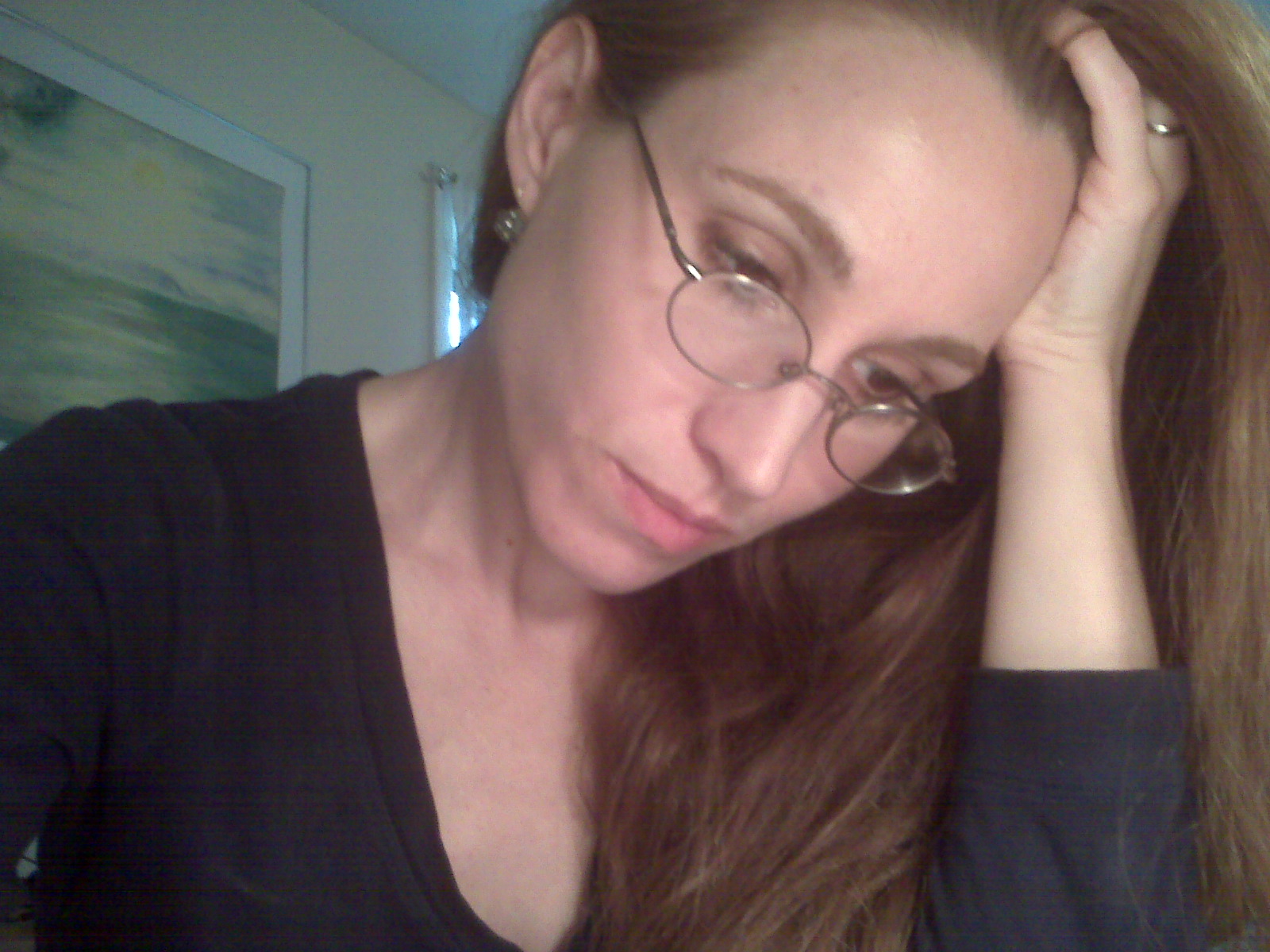
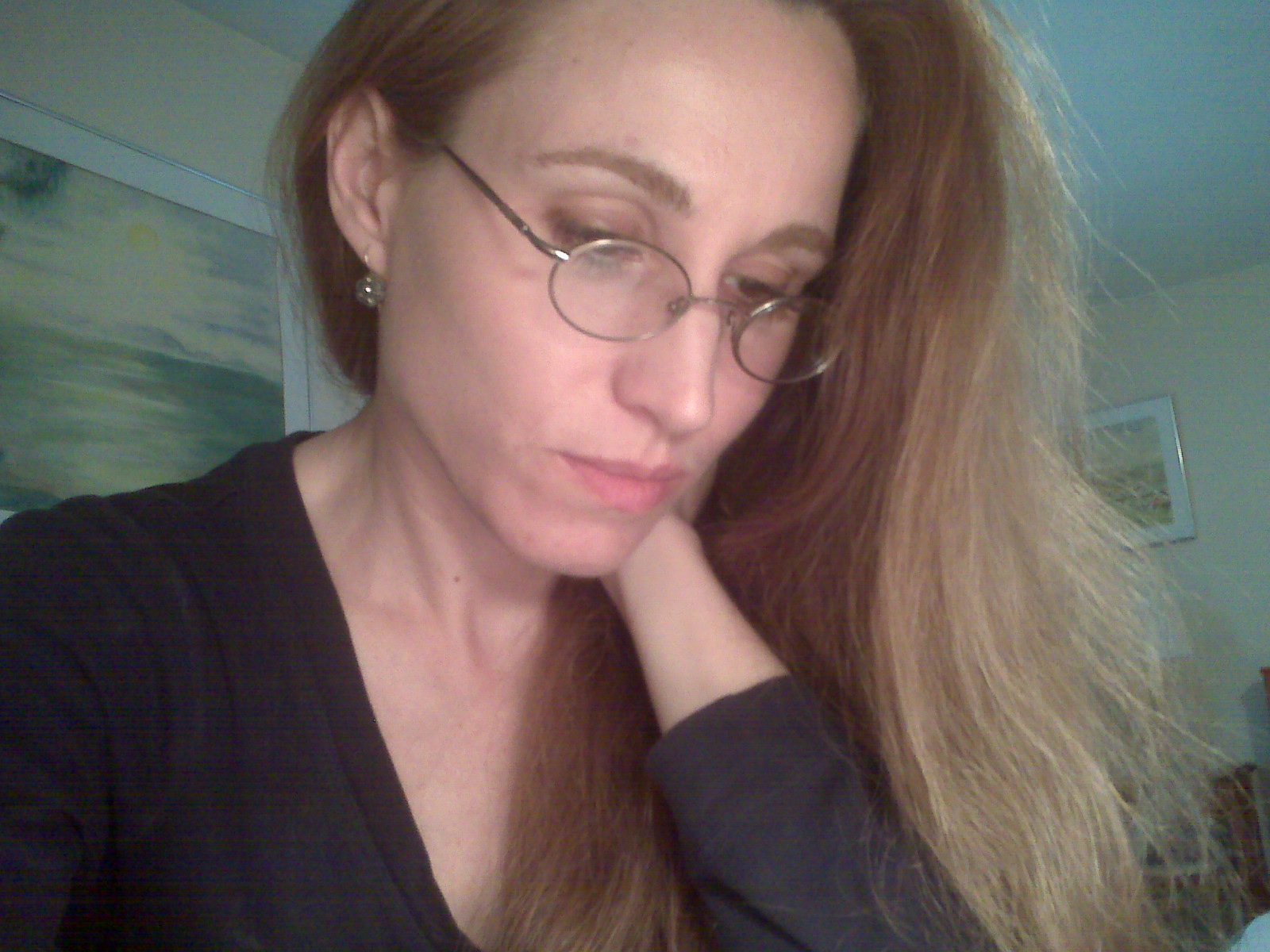
But because I have nothing, you’re going to get two pictures of me, doing what I did today. Here you go:

That’s what I looked like for most of the day, although at the moment I’m sitting in front of my computer, typing this post. (You can see, in closeups like this, why I wrote an entire essay for the Weird Tales “Uncanny Beauty” issue on what a strange face I have.)

Is it all right for me to post something so inconsequential? I mean, it’s my blog and I can post what I want to, but you know me. I want to entertain, to inform, to enlighten. I don’t think this post does any of those things.

Except in this way: I’m a writer, and if you’re an aspiring writer, there is a lesson here. This is what some days will look like. You will be working on whatever it is you do to earn a living, and then you will turn to writing, and that means you will be working all day long. Looking rather the way I look here – pale, tired. The opposite of glamorous. But if you are a writer, a true dyed-in-the-wool writer, you will think it’s worthwhile.

Posted in Uncategorized | 7 Comments

Writing Monsters

I had no idea how much fun writing the Folkroots column for Realms of Fantasy would be.

I’ve been working on my next column, which will be called “A Brief History of Monsters.” By next, I mean the one after the column that’s coming out in June, which is called “Fairies and Fairylands.” So you won’t see what I’m working on until August, sorry! But I’ll tell you a little about it.

First, a confession: I’m so busy right now that I’m terribly behind at anything that doesn’t have a hard deadline. So if I owe you something, I’m so sorry. (By hard deadline, I mean a publication deadline. Something that absolutely has to be published a particular month. For example, the column has a hard deadline because the magazine has to come out.)

The fact that I’m so busy this month meant that I needed to write a column on something I already knew quite a lot about. I couldn’t just head to the library and research anything that interested me, and that I thought might interest you. Part of my doctoral dissertation focuses on monsters in the nineteenth century, so I’d already done quite a lot of research on monsters, and I knew there was a wonderful new book, Stephen Asma’s On Monsters, that contained a lot of the information I wanted. So, monsters it was.

I knew what I wanted to write, and actually wrote about half of the column based simply on what I already knew. Then I went through Asma. It’s sitting beside me as I type this, with stickies marking important passages. In fact, I’ll take a photograph of it right now and include it at the end of this post. And then, to make sure I was considering all the monsters out there, I enlisted the help of my Facebook friends and asked them to name important monsters to make sure I hadn’t missed any. (Thank you, Facebook friends! You are all awesome!  And you know, I hadn’t even though of the hulda as a monster.  But a cow-tailed woman certainly qualifies.)

Earlier today, I went to the library to pick up some books: a general theoretical work on monsters, a book on Greek and Roman monsters, two books on monsters in the Middle Ages, and Jorge Luis Borges’ The Book of Imaginary Beings. I don’t know how much information I’m going to take from them. After all, I have a 4500 word limit, and I already have about half of that written. But they will help me check and double-check the information I’m including.

Yes, it’s stressful – all the work I need to do at the end of the semester. And yes, writing a column is added stress. But it’s also what I do when I take a break, when I need to do something fun for a while. Because it really, truly is fun to read about monsters and then write about them in a way I think Realms of Fantasy readers will find accessible, scholarly, and interesting.

I love this work!

Posted in Uncategorized | 2 Comments

Incorporating Failure

Today, I taught a class of students who were preparing portfolios of the work they had done over the course of the semester. We spent the class going over the portfolios, discussing how they could better organized the documents they were going to incorporate, that sort of thing. I found that many of them were leaving out documents they thought did not represent their best work.

And so I gave a sort of impromptu lecture on the importance of incorporating failure.

I mentioned the importance of failure in the blog post “Thoughts on Writing,” which I posted earlier this week. But I want to emphasize it again because I believe it’s particularly important for writers. Here’s what I believe about failure:

You’re going to fail.

You’re going to fail a lot.

And that’s good, because no one ever succeeded at anything worthwhile without failing at it. Every time you write a story, you will have discovered ways not to write that story. Those ways will be your drafts, and in a sense they will be failures. They will never be published, unless you are T.S. Eliot and someone publishes your original draft of The Waste Land (which, by the way, is just embarrassing) before Ezra Pound came along and fixed it for you.

Some years ago, there was an exhibit of Pablo Picasso’s paintings at the Museum of Fine Arts. It was an enormous exhibit. The most fascinating paintings were the early ones, in which Picasso systematically went through the styles of both ancient and contemporary painters, imitating each one. I think he was learning what he could from them, incorporating their lessons and then passing on. In the process, he was also learning how not to be Picasso so that he could, eventually, be Picasso. In a sense, those paintings are failures. They are certainly not the paintings any museum would want to hang up as a Picasso. But they are fascinating for us as artists. (Let us go then, you and I. We artists. Having mentioned Eliot, I now have scraps of his poetry floating around in my head.)

So, assuming that I’m right and you’re going to fail (a lot, remember), you need to figure out how to accept failure. How to fit it into the narrative of your self and your art (since we all create narratives, and narratives are how we understand the world). What story will you tell yourself about failure? (Anthony Robins would be so proud of me here. I’m speaking like a motivational speaker. But also like a writer who knows that the world is a story we’re telling ourselves.)

Will you try to hide your failures? Or will you hold them up proudly, tell everyone: Hey, look, this is where I failed! In the larger effort of creating the art I wanted to create. This was my moment of failure, from which I learned – whatever it is you learned. How not to create a lightbulb, as Thomas Edison discovered (many times).

In which case you’re redefining failure. Because anything you learn from isn’t really a failure, is it? It’s simply another moment when you learned how to do whatever it is you wanted. I don’t think you learn more from failure than success. I think you can learn a great deal from success. But you can learn as much from failure. I know that I do.

(They say April is the cruelest month. All right, Eliot says so. There isn’t all that much of April left, and I’m glad. My work is going well, I’m going to meet my deadlines, but I’m very, very tired. I think May is going to be so much better.)

Posted in Uncategorized | 7 Comments

Every Day

Kendrick told me this story. Once, the motivational speaker Anthony Robins was on a talk show. A caller called in, told him about a project he was considering, and asked what he could do to make it succeed. Robins told him, “Hang up and start working on it tonight. And then work on it tomorrow.” The message was, if you want to succeed at something, start now and work on it every day.

That’s what I’m trying to do with my writing. It’s difficult right now because this is the end of the semester, and I have so many other responsibilities. Sixty-four students, for example. But I find that if I don’t work on it every day, I get anxious.

I went to the doctor’s office today, for my annual physical. Evidently, I am ridiculously healthy, blood pressure 104/70, everything else as it should be. The only real problem I have is stress. A friend told me to take time off, take things easy. But I think that would actually make life more stressful for me. It would give me the sense that I wasn’t working for what I wanted, that I wasn’t moving in the right direction. I want to feel that I am, every single day.

Which reminds me of something Dan Blank wrote on his blog:

“To build a successful business, we often look for balance.

“We look for safety, we look for the expected, we look for certainty. We try to find a process that works, that can be replicated. And we try to find ways success can fit into the hours of 9am-6pm on weekdays.

“But few things of great importance are done in a balanced way. Instead, they require vision, sacrifice, and boldness.”

Writing, at least the way I want to do it, is a business. I want to do it that way because I want to prioritize it, and if I think of writing as an art, as something I do when I’m inspired, I find that I don’t do it. I don’t prioritize it. When I think, this is my career and I’m building it, one story, one essay, one novel at a time, then I think of it in the right way. And the art comes out anyway, because I want to create something of high quality. I don’t want to let my readers down.

But I find that I can’t look for balance. I’m not all that into balance anyway, as a person. When I wanted to learn to write, I went to both Odyssey and Clarion. That’s not exactly balance, is it? It’s closer to obsession.

Dan goes on,

“But one’s success is often driven by two things: goals and purpose. And when dealing with the question of ‘how can I fit this into my busy life,’ the honest answer is: if you don’t make the time, no one will make it for you. No one will make it easy for you to succeed. In fact, there are lots of people who will try to stop you, in their well-meaning ways: encouraging you to find balance; to not spend another weekend in the basement writing; that you are already doing enough; that maybe you aren’t a writer after all. These discouragements come in tiny ways in regular conversations. Writers often know them well.

“Every success story of a creative individual is one of a long journey; of countless thankless hours of work when no one believed in you; of doing the impossible, which is often the most unsexy thing of all: jugging laundry, a family, a job, dinner, AND building your writing career.

“And I think that is true of all business, and most endeavors that we hope desperately to succeed in. You have to put in the hours. You have to prioritize and give up any sense of a balanced life.”

Which reminds me that I need to do laundry. I will say that after a while, the discouragement stops. It stops when you sound like a professional writer, meaning someone who makes money from writing. At that point, people will stop trying to discourage you (with the best of intentions). After all, no one says to a lawyer, do you really need to work those long hours to succeed? Why don’t you cut back and aim for balance? (You’d think they would, but they don’t. Believe me, I’ve been there.)

This is a rambling post, isn’t it? It’s because I’m tired, and I’m writing this eating dinner (an organic chicken hot dog on a whole wheat bun, with a plate full of steamed vegetables, which is probably why my blood pressure is so low). It would be a lot more balanced to sit down, eat a relaxed meal. But after I type this, I have papers to grade and a column to work on.

Yes, it’s an unbalanced life. Yes, it will get better, but I will continue to obsess about my writing – the quality of it, the business of it. In the meantime, I continue to work on it every day, because I have a vision of the life I want. And this is the way to get there.

In the meantime, spring has come to New England. I know it happens every year, but this year it seems particularly meaningful. Most of the bulbs I planted have been nibbled by whatever lives in our yard (squirrels mostly, but also chipmunks). However, I will leave you with a picture of two hyacinths that have actually bloomed:

Posted in Uncategorized | 6 Comments