Bad Books by Good Writers

“The orchard was very silent and dreamy in the thick, deeply tinted sunshine of the September afternoon, a sunshine which seemed to possess the power of extracting the very essence of all the odours which summer has stored up in wood and field. There were few flowers now; most of the lilies, which had queened it so bravely along the central path a few days before, were withered. The grass had become ragged and sere and unkempt. But in the corners the torches of the goldenrod were kindling and a few misty purple asters nodded here and there. The orchard kept its own strange attractiveness, as some women with youth long passed still preserve an atmosphere of remembered beauty and innate, indestructible charm.”
–L.M. Montgomery, Kilmeny of the Orchard

It feels a bit strange to write that I had not read Lucy Maude Montgomery’s Anne of Green Gables until just recently. I had read a number of her other books, including other Anne books and some Emily books (about the adventures of Emily of New Moon), and several collections of her short stories. I loved her as a writer, but in some obscure way I was afraid to read Anne of Green Gables, her most famous book. I was afraid it would not live up to my expectations. I had watched the Canadian movie version, in which Anne was played by Megan Follows, and I loved it so much that I was worried the book itself might let me down.

I should not have worried. Anne of Green Gables is a wonderful book, both touching and very very funny.

Just before reading Anne of Green Gables, I read Kilmeny of the Orchard, and it’s . . . not. As in, neither funny nor particularly touching. It’s the story of a young man, a privileged young man, who goes to teach on Prince Edward Island and meets a beautiful, really stunningly beautiful, really incredibly impossible beautiful, young woman with one mysterious defect (his words, not mine) . . . she can’t speak. They fall in love, because he is basically the first young man she has ever seen, and she is just so beautiful that it doesn’t matter that she has no money, no knowledge of the world outside the farm she has grown up on, basically nothing to bring to a relationship except her beauty and untouched purity, and oh yes, she plays the violin. Plus she can’t talk back, although she and the young man seem to get along well enough because she can write on a slate.

This is a typically icky Victorian plot. You could find buckets of such books in the Victorian and Edwardian eras, and as I’m sure you expected, in the end Kilmeny’s muteness turns out to be psychological. It’s cured by her love for Eric, the young man, which is a good thing because she feels as though she could not possibly marry him with such a defect (her words, not mine). As the novel progresses, all obstacles to their union fall away rather easily, like the fall of a silk robe from the shoulders of Gibson girl. Eric’s rich father could object, but he doesn’t because Kilmeny is just so stunningly beautiful that she would make an appropriate wife for anyone, plus she reminds him of his beloved dead wife, Eric’s mother. Yes, I know, icky.

So there we have it. What kept me reading Kilmeny of the Orchard, other than its very short length (134 pages)? Well, there is my love for turn-of-the-century literature. But there is also no denying that the book is beautifully written. Lucy Maude Montgomery is a cracking good writer, whether she’s writing great books or bad ones. As you can see in the passage I excerpted above. Her descriptions of the orchard, and of Prince Edward Island in general, make up for the weaknesses in characterization and plot. Their loveliness comes not just from the imagery she describes so well that I can see the orchard on that September afternoon, but from the sentences themselves. It’s in the way she puts them together.

“There were few flowers now; most of the lilies, which had queened it so bravely along the central path a few days before, where withered. The grass had become ragged and sere and unkempt.”

What beautiful rhythm. It would not be at all the same if she wrote, as a modern editor might suggest, “The grass had become ragged, sere, and unkempt.” That would not capture the lilting, unhurried pace of a sunny September afternoon. The lilies queened it, as they do. The torches of the goldenrod — yes, I can see that, because goldenrod does exactly that, it stands up and blazes. Purple asters are misty because there are so many little flowers on a stem that from any distance they look like a purple mist. So her images are both evocative and precise.

And this: “The orchard kept its own strange attractiveness, as some women with youth long passed still preserve an atmosphere of remembered beauty and innate, indestructible charm.”

Ok, yes, it’s thoroughly of its era, when old age for a woman was approximately thirty . . . But it’s beautifully written and I love the image it evokes, of the orchard aging in this way. You can see that the spring glory of its flowers has passed, it has borne its fruit, which may have already fallen, but there is something innate and indestructible — imagine the trunks of fruit trees that will stand like strong brown limbs through the winter snows, and blossom again in spring. In a sense, the novel is a love story between an author and the orchard she created.

Honestly, if I were Kilmeny, I would write on my slate, “Thanks, Eric, but this is a really nice orchard, I mean I really like this orchard, so have fun in the big city but I think I’ll be fine here. I have a violin, after all.”

The thing is, Kilmeny of the Orchard was published the year after Anne of Green Gables, and Anne of Green Gables is a really good, I mean really really good, book. It’s got all the beautiful language, but it also has perceptive characterization, excellent pacing and plot (will Anne be allowed to go to the church picnic with Diana and the other girls? I had to know. I could not put it down and stayed up until 2 a.m. to find out), and the one thing Kilmeny of the Orchard does not have at all, not even a little — it’s very very funny.

I had to find out how the author of Anne of Green Gables could have written Kilmeny of the Orchard, and the answer is that Kilmeny’s story was written earlier, as a magazine serial. After the success of the red-haired orphan who breaks slates over people’s heads, Montgomery’s publisher said “I want another novel and I want to publish it a year later,” and this was the only thing Montgomery could give him — a patched-up serial, while she wrote her next Anne book. I suspect that publishers have been responsible for bad books in exactly this way since they invented themselves . . .

While trying to figure out how Kilmeny of the Orchard came into being, I came across a review on Goodreads that I found particularly illuminating. The reviewer said something like, “Kilmeny is the romantic heroine Anne imagines herself to be, but can never become.” And I thought, yes! That makes perfect sense! Kilmeny has long black hair and is impossibly beautiful. Anne has red hair, as she often laments, and the most endearing thing about her is that she simply never shuts up. Anne of Green Gables is filled with long paragraphs that are simply Anne going on and on while Marilla says, “The muffins in the oven are burning.” And the muffins burn, and then we listen to Anne lamenting the burned muffins and her red hair, and spinning a new romantic adventure for herself, for another couple of pages.

I don’t have any great wisdom to offer here. Just a few observations: First, good writers are going to write bad books, sometimes. That’s just how it is. Both readers and writers should expect it. Second, if I really love a writer’s style, I will read a bad book by that writer, regardless. I will read L.M. Montgomery’s bad books with pleasure, ignoring Eric and even Kilmeny, pretending that it’s really a book about an orchard, and the happy ending is that those annoying protagonists finally leave the wonderful, magical orchard alone to dream in the September sunshine.
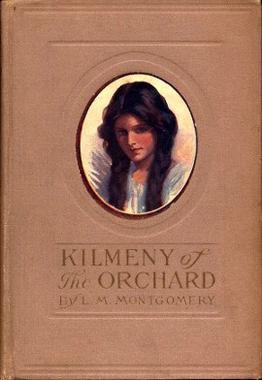
(The image is the first edition of Kilmeny of the Orchard, published in 1910.)

Posted in Uncategorized | 7 Comments

Turning Fifty-Five

The strangest thing about turning fifty-five is that it doesn’t feel any different from turning forty-five, or even thirty-five. I suppose thirty-five was different because I was pregnant with my daughter, but I don’t remember feeling any particular age. And I don’t feel any particular age now. Twenty-five was different because I was working as a lawyer and trying not to be completely miserable in the world of corporate law. It was actually more different than fifteen, when I was still in high school and still myself, more or less. Still the self I am now, rather than trying to be someone else. I was writing poetry and reading literature, which is more or less what I’m doing now.

It feels as though the years between fifteen and fifty-five have been a return to who I am — a long, hard road that has taken me back to myself.

I mean to write this post last year, around my birthday, but I was in Budapest and so busy that there was no time. I suppose this post is really about time, about what a strange thing it is. I didn’t think much about time until I became a lawyer. Of course as I was growing up, there was time to wake up, time to get to school, the schedule of the school day signaled by a bell I hated the way a cat might hate the bell around its neck. In the regional dialect I grew up with, in Virginia, it could be “high time” for something, meaning it should happen now, and maybe should have happened some time ago. In college there were syllabi telling me when to turn in assignments, when exams where scheduled. There was a rhythm to the semester. The first time I remember really being conscious of the passage of time was in my early twenties, when it became “high time” for the girls I graduated with to get married. I remember feeling as though, if I was not married in my early twenties, I would have somehow missed a crucial step in the dance my girlfriends and I we were all dancing — as though life were one of those balls in a Jane Austen novel.

Later, I realized this was once again regional. The female law school students I met in Massachusetts were definitely not getting married in their early twenties — there was a ten-year difference between what was considered normal in Virginia and normal in Massachusetts. Instead, they were thinking about how long it would take to make partner in their law firms, and planning their lives around that particular track. In the law firm, I had my first experience of time and mortality. All of my work had to be accounted for in fifteen-minute increments so the law firm could bill by the hour. We lived under the tyranny of the billable hour, just as I had once lived under the tyranny of the school bell. One day, I remember trying to calculate how many billable hours there would be until I died. That was the beginning of the end of my legal career.

The next time I remember feeling the pressure of time was in my early thirties, when I thought, if I don’t have a child now, I may not be able to. I was in graduate school, my then-husband was in graduate school, and it was not an easy time to have a child, but then everyone said there was no easy time, really. And I was thrilled when my daughter was born. That was the beginning of a different relationship with time, because when you have a child, you live with a small being whom you fervently hope will outlive you, will have a long and happy life after you are gone. You are presented every day with the fact that life is a cycle, and you are part of that cycle. You live with physical evidence of your own mortality. Of course, most of the time you’re too tired to actually think about this, but it’s there, like existentialism for John Paul Sartre.

And what is time now? My daughter will be turning twenty this year and as she had gotten older, I’ve lost that sense of time as so physical, so urgent. I feel, once again, somewhat immortal. I have to remind myself that my time on this earth is limited, and that I have things to do. Sometimes I wonder how much time I have left. But it’s more as motivation than existential crisis, because the other thing I’ve learned over the years is that there are two kinds of time. The first is the time of the bell and the billable hour, which passes and passes and passes, inexorably. But at the same time, there is yes, another kind of time — the time of subjective experience, in which a moment can last forever or a day can pass all too quickly. We can lose time, as when we scroll on our phones and realize, hours later, that time has passed and we have barely experienced the world. And we can have moments of exquisite being when we are fully alive, and it seems as though the experience will never end, that it’s etched in eternity. I have so many of those potential moments left that I’m pretty sure I’m going to live forever. More practically, my grandmother died at ninety-six, and all the women in my family live a long time. So there is that.

Mostly what happens as you get older, I think, is that you return to the essential self you had when you were young. Somehow society covers it up, like layers of varnish on an old painting, and then time cleans it again until you are back to the original layer, like a Vermeer after a museum restoration. At least, that’s my theory today, and it could be wrong, or only apply to me. But I feel closer to my fifteen-year-old self than my twenty-five-year-old or thirty-five-year-old selves. And when I think about all the things I still want to do in my life, I think, there’s plenty of time — but I’d better get started.

(A photo I took of myself on my birthday, already thinking I would write this post. No makeup, no filters, but excellent lighting by the city of Budapest.)

Posted in Uncategorized | 9 Comments

Listening to Ben Okri

One of the nice thing about working for a university is that there are always speakers and events, which are often free or not very expensive for students and faculty members. Last week, I was able to attend a reading and Q&A session with the Nigerian writer Ben Okri, and I wrote down a few thoughts that I wanted to share here.

First, it’s always fascinating to hear good writers talk about their process. I’ve only read a little of Okri’s work so far, but what I read was an essay on writing that was very smart, so I wanted to hear what he had to say. And I found that his perspective on being a writer from Nigeria was similar to what I’ve heard from at least some Central European writers. His view on writing felt right for Hungary as well — at least for the way I write about Hungary.

Okri lived through the Nigerian Civil War of the late 1960, which resulted in mass casualties from both the war itself and the resulting poverty and starvation. The war followed a long period of British colonial rule, so the people of Nigeria suffered the double trauma of colonization and civil strife. It was a very different environment than the one we were experiencing at that reading, sitting in conference room chairs arranged in neat rows, in a large room with floor-to-ceiling windows that showed the Charles River at night, with the lights of Cambridge across the river and Boston to the right of us, as the river bends. If you looked carefully, you could have seen the gold dome of the Statehouse. It was the serenely privileged light of a city that had not been in a war for two hundred years, and as I sat there, I remembered the spring of 2022, when I was in Budapest and the war started just one country over, in Ukraine.

First there was an introduction by the novelist Ha Jin, then a conversation, then a reading, then a Q&A. Here is what Okri said that struck me enough that I wrote it down, and I scribbled for some of the conversation and most of the Q&A. The Q&A always ends up being the most interesting part of these sorts of presentations, and it is always left for last, so it’s usually done in a rush — which is unfortunate.

Nigeria, Okri said, according to my notes, is a palimpsest of realities — like Hungary, I would add. In that sort of situation, Western conventions of storytelling don’t work. When you have sedimented realities — that was the word I wrote down, and I think it came directly from him — you can’t tell a story in a linear way, so your choice of structure is already poetic and fantastical. Which means (I think, if I’m transcribing and explaining correctly), that sort of reality can only be represented, realistically represented, in a non-Western, non-linear fashion. He mentioned disliking the term magical realism, and I’ve noticed that everyone described as writing magical realism dislikes the word — it’s only people who themselves claim to write magical realism, usually from a solidly European tradition, who seem to like it. And he said that he started with his mother’s stories. That was his original experience of narrative.

I wrote down a series of statements about story. This is a sort of paraphrase:

Stories are the oldest human technology. They organize the chaos of existence. They create a clarity within that chaos, allowing us to see the world. They simplify, and in doing so, they give us a path forward. Stories are also a storage mechanism for cultural wisdom. They function as coded realities. They hold time — he paused, then said, “They hold the essence of time” (this is a direct quotation, I believe). I think I understand this in several ways. Stories hold the time of the story itself — they contain something that happens, a particular narrative, like a cup. They capture time, but they also take time. A story is not a painting: to experience it, you need to spend the time to read it. I feel as though this is somehow very important, but I’m not yet sure why. It has to do, I suppose, with the distinctive form of the story — it is not even a poem, which happens all at once. A story is the closest artistic event to a human life, which also takes time. Then he said, “I’m fascinated by stories that are impossible to tell,” and, “The deepest things are impossible to find a narrative for.”

When he was asked about what we face right now, the overwhelming problem of climate change, he said, and I’ve written this down on a card so I can remember it:

“We either transform or we perish.”

Write that down, because you’ll find that you need it in your own life, but we also need it as a civilization. Either we transform as a global society, or we perish, taking a lot of other species with us. We’ll find out which it is in the next few generations.

The most important idea for me, in terms of writing, came during the conversation, and then I asked about it in the Q&A. It was the idea of an aesthetic code. The aesthetic code of a story, said Okri, is the code by which the story can best be understood. For example, he wrote a story and later realized that it could best be understood as a series of gaps. This reminded me of what Henry James wrote about his novel The Golden Bowl: that when he started writing is, he envisioned it as a movement. Everything would revolve around Milly Theale without touching her. She would be the delicate center of the novel, but the action would move around and around her. When I first read this, I was fascinated by the idea of starting a novel with a movement. But I think many stories can be envisioned in this ways — they can be visualized. They have a particular shape, like sculpture or dance. In the Q&A, I asked him if he was aware of the story’s aesthetic code while he was writing it, and he said that sometimes, not always — that understanding it was like grace, but a grace that is earned through hard work. Which I think is a wonderful thought.

The other most important idea is something I’ve thought about before: it’s of the story as fractal. Okri did not actually call it that — he just said that the story should contain everything, just as reality contains everything. In reality, you look at one small thing (say, the way someone walks), and it contains so much — the whole history of that person, the things that have happened to them. Actors know this. When a really good actor develops a character, she thinks about how that character moves, and the way a character walks down a street can project the essence of the character. The small part contains the whole. Okri implied that stories functioned like this — although they show only a small part of reality, they somehow contain all of it, and the story itself is a fractal in that a small part of it also contains the entire story, so that a sentence can express the essence of that particular narrative (just as a character’s walk can express the character). I’m not sure I’m explaining this well, and I’m also not sure this is what Okri meant, because so much of my own thinking is wrapped up in it. But I remember reading, once, that a Jackson Pollock painting from his mature period had that fractal structure, whereas one from his earlier, less mature period did not, and it affected how I think about writing.

He also said, and here I’m paraphrasing again, that a novel walks in a constant dialog of oppositions. This reminded me of how I used to talk about writing when I was teaching in an MFA program. I used to say, what are you putting in tension in this scene? What things are pulling against each other? It doesn’t matter how much action you include, if nothing is in tension. Without that tension, your reader won’t feel anything, won’t be interested in anything. Things need to be in opposition to each other, whether it’s the galactic forces of good and evil or two friends having a disagreement.

Finally, he talked about dreams as a parallel reality, and described writing as making dreams real for people. I think this is important. Our minds can’t deal with the world all the time. We are created to shut down for part of every day, so that our minds can go do something else. They can go elsewhere. I have found that my dreams are often ways of processing my daytime anxieties, which is probably why I so often dream of being lost in either large cities or their equally large transit systems. Or more recently, in enormous airports. Stories can function in the same way. They are waking dreams that help us organize and deal with the anxieties of our existence. They create meaning for us.

And my final note from the reading had to do with The Odyssey. I didn’t write down the specific context for this statement, but toward the end of his talk, Okri said that it encapsulated a basic human narrative: “We’re all just trying to get home.”

I think that’s true, but I think we’re also all just trying to create home, to find our families, belong and find meaning for our lives. And that is what stories help us do.

The Famished Road is the book for which Okri received a Booker Prize.

Posted in Uncategorized | Leave a comment

Emotional Energy

I’m too tired to write this blog post.

Last week I tried to do all the things — all the administrative things I need to do at the beginning of a university semester. I still have a lot to get through. There are receipts to file, meetings to attend, emails to send or answer.

And I tried to write as well. I’m most of the way through writing a story I thought of several years ago, and that I started months ago but that was interrupted by teaching in London during the summer. Hopefully it will be done in the next few weeks.

And I had family obligations to deal with, which are not purely obligations — for example, it’s a pleasure to spend time with my daughter. Nevertheless, the start of the academic year is always stressful, for students and parents alike.

And now it’s Sunday morning, and I’m trying to write a post I’ve been thinking about for a while, on why we sometimes get so tired — and I’m too tired to write it. But I’ll try, nevertheless . . .

This post comes from a realization I had recently — or perhaps it’s less of a realization than a hypothesis. I remember that I was in Budapest, and it was afternoon, and I thought, What’s wrong with me? Why do I get so tired sometimes?

There are ways in which my life can be physically tiring. I had just come back from London, where we were taking the students on excursions every week, and on most days I was walking at least two hours, to and from classes, to Sainsbury’s and Marks & Spencer for food, on street tours of London or in various museums. But I realized that I did not mean physical tiredness, that physical tiredness by itself did not give me that sense of exhaustion I sometimes felt, an exhaustion so deep that all I wanted to do was lie down for a while, someplace light and airy, or escape into the pages of a really good book.

What produced that kind of exhaustion? Sometimes, teaching three classes and holding office hours — after a long day, I would need to lie down for a while. Usually I would not lie down, but would go on working, because teaching would also give me ideas, would inspire me as well, so I would have all sorts of things I wanted to research, to prepare for the next lecture . . . But I would feel that same sense of exhaustion after a morning of answering emails, and to be honest, after a morning of writing. I would feel it after spending a day at a conference or convention, even if I had a wonderful time with other academics or writers. And after spending time with family.

Of course it wasn’t always exhaustion. Sometimes I would be just a little tired, but if I pushed myself, I would get more and more tired, until yes, there I was, completely exhausted. Why?

My hypothetical answer is that some things take emotional energy. Teaching of course, because at the same time as you’re explaining the history of rhetoric or how to use MLA citation format, you’re intensely aware of the students in the classroom. You know who is paying attention, who is looking at emails on their laptop, who has a question they are too embarrassed to ask. It’s a kind of teacherly intuition. Answering emails takes emotional energy, because you’re projecting yourself into the recipient, trying to see the email from their perspective, editing to make sure that recipient will understand what you’re writing. Similarly, with creative writing, the writing I love — that takes energy too. I’m projecting myself into the story, into the minds of the characters. I’m living in them for a while. And at the same time, often, I’m also projecting myself into the minds of potential readers, trying to see the story both from my perspective as a writer and from their perspective. Will they need a paragraph break here?

Being a parent always takes emotional energy. It’s intensely rewarding, and there are wonderful things you get back for the emotional energy you expend, but I have to be honest, and I think other parents would say the same — it can be tiring. Friendship, I find, doesn’t take the same emotional energy. Sitting and talking with a friend is closer to an exchange — you get energy at the same time as you give it, and after meetings with close friends, I find myself refreshed. It’s like reading a good book. Reading, if it really is a good book, also gives me energy. Faculty meetings take energy. They’re like teaching, in that I usually come away from them with ideas, things I want to try. But it takes energy to listen, interact, to be completely present. It’s the same for a conference or convention.

When I say that something takes emotional energy, that it tires me, I don’t necessarily mean that in a negative way. Teaching, writing — these are all things I want to do. I’m happy to expend energy on them, just as I’m happy to expend physical energy on going on to parks or museums. What I was trying to understand is how they tired me, what sort of energy they required. And I think it’s emotional energy — the energy that flows out from you when you’re interacting with another human being, even hypothetically. Of course you can get energy from another human being as well — which is why, I suppose, I receive emotional energy from meeting with friends or reading a good book.

I suppose the important thing is, if you’re tired, to understand what kind of tired you are. Are you physically tired? Emotionally tired? Spiritually tired? Because there are different ways to deal with each kind of tiredness. For physical tiredness, you need to rest and sleep. For emotional tiredness, sleep is important as well, but so are taking walks in the park, reading books, meeting with friends. For spiritual tiredness, which is a category of its own, the remedy (I think) is something like spending time with trees and looking at the sky. You need to somehow drink in the essence of existence.

At least, the above is true for me. But I know that people are different, and fall in different places on the spectrum of introversion to extroversion. It may be that you, if you are an extrovert, get your emotional energy in large crowds, all shouting for a sports team. Or from being on a stage in of an audience, channeling their emotions. I am on the introverted arm of that spectrum, and my energy comes from small, quiet things, plus chocolate.

Today I’m so tired because last night I made a mistake. After a day of writing and dealing with administrative issues, which included talking to a chatbot and three different customer service representatives because two airline websites were both malfunctioning (Swiss and Lufthansa, I’m looking at you), plus trying to deal with UPS, I was so tired that I did not have the energy to get ready for bed. So I stayed up too late watching silly video clips on YouTube. Even thought watching films and videos involves absolutely no physical energy, I always find that it takes quite a lot of emotional energy, in a way that reading does not. I’m more tired after a movie than before. I did not get to sleep until much too late, so today I am both physically and emotionally tired. Maybe even a little spiritually.

I have a lot of work to do. But sometime today, I’ll take a walk in the park and do some reading — not for work, purely for pleasure.

And you know what? Now that I’ve written this, I feel better, more energetic. Writing may take emotional energy, but it also gives me something powerful, which is that I’m talking to you, whoever you are, and that’s a bit like communicating with a good friend.

(The image is Fresh Flowers by Lee Lufkin Kaula.)

Posted in Uncategorized | 5 Comments

An Elegant Woman

I saw her on the airplane from Budapest to London. I saw her first from the back, and I thought she must be a girl, around fifteen or sixteen, because she was so small and slender. She walked like a teenager. Then I noticed her bun of gray hair. And when she turned, I realized she was closer to eighty-five than fifteen. She had a small, elegant head with high cheekbones and tan, wrinkled skin, an aquiline nose. And her hair, quite a lot of it, all different shades of gray, was pulled back in the high bun I had seen.

What had deceived me, in part, about her age was that she did not move like an eighty-five year old woman. She stood straight and she moved easily, naturally. Of course I know I’m dealing with stereotypes here — not all women move the same way at any age. But I remember how my grandmother moved at that age, and this woman moved like a yoga instructor, or maybe a former ballet dancer, the kind that becomes a teacher and stands at the front of the ballet class in character shoes, more poised than any of her students. She reminded me of my grandmother, actually. My grandmother had those same high cheekbones, and similarly her cheeks had been hollowed by age, a look that young actresses try to achieve by having the fat sucked from beneath their cheekbones. Be patient, I would tell them. Age will etch your cheeks. Age will make you elegant. My grandmother also had a full head of gray hair, although hers was short all her life.

Like my grandmother, this woman was Hungarian — I know because I heard her talking to a man who might have been a son or son-in-law, and a little girl who was certainly a grandchild, who hung on her hand. She was wearing what I thought was a knit dress until I later saw it in the window of the High Street Kensington Zara and realized it was a sweater-skirt combination, in various shades of gray that matched her hair. Very elegant, and probably expensive. Her shoes had the sort of heels that are more comfortable than flats — medium sized, thick without being chunky, very walkable. And again, elegant.

I noticed all this in the relatively short time I watched her walk onto the plane, then wait in the line to disembark, and then disembark — both times I was behind her. I noticed so much partly because I notice women’s clothes. As they pass on the sidewalk, or as I see them sitting or standing on public transportation, I notice and say to myself, Oh, I like that! What if I tied my scarf the way she’s tying hers? Ok, I see wide legs are in now, and they look good with a long sweater. But could I wear that, at my height (or rather shortness)? Oh, no, not those shoes. She’s going to trip over them any minute . . . It’s not really a way of judging the wearer (although sometimes, to be honest, it’s a way of questioning her judgment). It’s more a way of figuring out what might suit me, who I want to be. At least in the matter of clothes. And of getting new ideas, because I’m not really very creative when it comes to clothes. I mostly know what suits me now, because of all the mistakes I made in the past — years and years of mistakes. We won’t talk about my unfortunate Laura Ashley phase, when I tried very hard to be that romantic boho girl. Or the phase, in graduate school, when I decided to wear only black, day after day. I don’t remember why, but I had just gone back to school after four years as a corporate lawyer, and I think I was in rebellion against all things corporate, against hierarchy and patriarchy (embodied in the very real, non-theoretical hierarchy of partners that I had to work with, some of them gleefully nasty to new associates, both male and female). It was as close as I came to punk, in a Victorian mourning, gothic sort of way.

Anyway, my point is that I noticed this particular woman, not just because she was elegant, but because she was old, as I discovered when she turned around. I could call her elderly, but the point I’m trying to make is that she was eighty-five or so and elegant, and I thought, I’m going to be eighty-five too someday. I’m going to be old, and people are going to call me elderly, and I might say, No, I’m just old, my dear. But there’s no guarantee that I’ll be elegant. But . . . she was. So if she was, I could be too? If, at that age, she could be on a plane from Budapest to London, wearing the latest Zara, I could be too?

I’m not afraid of getting old, but I am afraid of getting old the way my grandmother did, slowly losing her ability to travel, to work at her painting and embroidery. No longer tending her own garden, cooking the recipes in the handwritten recipe book I’ve inherited. The elegant woman, speaking Hungarian to her granddaughter, was a slender beacon of hope.

I still have a while before I’m old, or elderly, or whatever you want to call it. But I’m planning ahead, because I know I’ll get there eventually. (Assuming the politicians with the nuclear buttons don’t blow us all up first, which is always possible.) I suspect the most important element of her elegance was yoga or ballet or pilates, one of those disciplines — whatever it was that allowed her to move so freely. And the second most important element was the absolute comfort of the clothes she was wearing, of her sensible but stylish shoes. It took me a very long time to realize that the pinnacle of elegance is being comfortable in your clothes, your skin — of knowing and being yourself.

I’m not there yet, but in the meantime, I’ll keep admiring elegance, wherever I see it. I was not elegant when I was young, as my high school photos (in which I always looked uncomfortable) amply prove. Now that I’m sort of in the middle, I’m doing my best — no longer quite as awkward, intermittently confident. But really, the goal is to be elegant by the time I’m old, like the woman I saw in the airplane from Budapest to London. Here’s hoping that, by the time I’m eighty-five, I’ll get there.

(The image is Portrait of the Princess de Beaumont by John Singer Sargent.)

Posted in Uncategorized | 4 Comments

Making a Home in London

Seven weeks is a long time to spend somewhere. It’s not a vacation, and anyway I wasn’t vacationing in London. I was there to work.

Specifically, I was there to teach in the Boston University College of General Studies summer semester, which takes place in London and is one of the most adventurous teaching experiences I’ve had. We don’t just teach in the classroom — London becomes our classroom, and we go everywhere. The British Museum, the Victoria and Albert, the Imperial War Museum, Kew Gardens, Brighton . . .

And my daughter was with me, taking classes on reading Egyptian hieroglyphs. Last summer, when I taught in London, I was mostly by myself, and in that situation I can lead a fairly monastic existence. I suppose the female equivalent of monastic is conventual — when I looked up the female equivalent of a monastery, I was given the word convent, and told that historically a convent was actually a house of friars, now knows as a friary. The point of this etymological rabbit hole is that when I’m by myself, I can live on oatmeal for breakfast, sandwiches for lunch, and soup for dinner, day after day. I don’t need entertainment, other than some books (all right, an increasing quantity of books). And I mostly focus on work. But that’s not enough for a teenager.

So anyway, I was working and living in London for seven weeks, with a teenager. I had to make a home somehow, even in a short-term rental flat.

There is a sort of art to making a home. How do you make a space both functional and cozy? Particularly when you’ll only be there a short time, and you’ll need to leave it as clean and spare as you found it. What are the components of home? I suppose they’re different for everyone, and what you need depends on the place you’re living in. Ours was furnished and outfitted with the basic necessities. But we did find ourselves buying things that would make our lives there more comfortable.

Since I had taught in London the summer before, and we are given some storage space, I had a few items waiting for me: a yoga mat, two blankets, office supplies. I don’t know if office supplies make you feel at home, but they have that effect on me. When I have my scissors and stapler and hole puncher, I just feel much more comfortable, as though I’m in a known and familiar world. And having a yoga mat means stability. It means that on this spinning globe of ours, I have a place to stand on, and a routine for my mornings. It’s like a little bit of my own ground in the larger country of Albion — not quite a garden, but a rectangle of concentration in a strange landscape.

Because London is, indeed, a strange landscape — stranger than Budapest, not only because Budapest is also my home, but because when you travel from the United States to Budapest, you expect Budapest to be different. Whereas if you travel to London, you expect it to be somehow the same — at any rate, you expect people to be speaking English, but there is no such thing as English. There are only Englishes, many of them, with different dialects and accents. Even within London, many Englishes are spoken, and some of them were quite difficult for me to understand, so I was conscious, always, of being in a foreign country, with its own customs that are not those of Boston.

There are of course the obvious differences, people driving on the other side of the street and the car, so that I was always trying to get in the wrong side, and always in danger of being run over. The food is different, the water from the tap tastes different, even the air is different, both from the soft air of Budapest and the sharp air of Boston. The air of London hangs around you like a curtain, often of chilly rain, sometimes of a damp warmth that is different from the dry, bright warmth of Budapest.

In this strange place, how did we make a home? Partly it was by buying stuff, the basic stuff you need for everyday life. Placemats and napkins with daisies embroidered on them. Cheerful bowls and mugs for our breakfast and tea. I made a rule: what we bought had to either be good enough that we would bring it back to Budapest with us, or cheap enough that we could bring it to a nearby charity shop afterward, and donate it so others could potentially use it. Thinking that we could pass it on to others made the purchases seem less extravagant, although we did not buy anything expensive — our primary source of items to pass on was Flying Tiger, and the things we wanted to keep, we found in Marks and Spencer. My favorite purchases were three mugs with animals on them: an owl, a rabbit, and a badger. There is a fourth mug, with a fox on it, but the only one available in the store on High Street Kensington had a chipped rim, and although I went back several times, no fox mugs were added to the inventory. Next summer, I’m going back to London to see if there is a fox mug. (I mean, I’m going back to teach. But the fox mug is an added incentive.)

We also bought a lot of books, too many of course. So many that we had a buy an extra backpack to bring them back to Budapest, and I thought we would be charged for it, but the ticket agent who checked us in said no worries, it’s small enough that I don’t charge you. And he told me about his daughter was also a teacher, but is now a school principal. I think books are like bricks that you use to build the walls of home, and actually in Boston and Budapest, all my rooms are lined with bookshelves. Being surrounded by books is like being surrounded by friends — I know that at any point, I can go have a conversation with Jane Eyre or Ozma of Oz.

So I suppose we build our homes out of little things. Books and mugs and blankets. In Budapest and Boston, I have furniture that I picked out, and rugs underfoot, but the things that make a home are smaller. They’re the pens in the wire mesh cup. The paper flowers in the vases. The pillows scattered around. The things that make life softer and more interesting.

When our time in London was done, we packed up almost everything, gave away what we needed to, and left the keys on the table. We had made a home for a little while, and even for that little while, it was worth it to have bought the mugs with the owl and rabbit and badger (which anyway are now with us in Budapest). I’ll be back for the fox.

This is part of the Boston University London campus near Kensington.

And these were some cakes we bought in a cafe that looked delicious but proved disappointing. We were not in Budapest anymore . . . (I may be biased, but I think Budapest has the best cakes in the world.)

Living in Chelsea . . .

Posted in Uncategorized | 6 Comments

How to Feel Rich

I discovered the secret to feeling rich during the pandemic.

Do you remember the Great Toilet-Paper Shortage? When the supply lines failed, and suddenly there was not enough toilet paper, and we were all going to different stores on heroic quests for those magical scrolls of pillowy, or if necessary not so pillowy, positively scratchy, but at that point anything would do, toilet paper? One day, I was almost out of toilet paper and I went into a store — I don’t remember which store exactly. Drug store, grocery store? That day, it was a magical store, because it had toilet paper! I bought a pack plus an extra pack, a big one, and I kept that extra pack in one of the lower kitchen cabinets throughout the pandemic, using a roll as I needed it, replacing it as I could. It was my toilet paper stash, like having money saved in the bank for emergencies.

And I realized that it made me feel rich.

I was not rich — I am not, at this particular moment, by any definition of the word, rich. As a teacher, I am modestly middle class, struggling to pay rent in one of the most expensive rental markets in the world. Growing up, I was even less rich — the daughter of a single mother raising two children by herself. I remember going to college and seeing all the clothes my friends brought with them. So many! How did they get so many? I don’t remember whether we did not have a lot of money to buy clothes, or whether my mother insisted on quality over quantity — I suspect both. My allowance certainly did not stretch to many outfits, and as for quality — well, I’m not sure it makes sense to focus on quality in clothes for teenagers. I still remember the holes I used to wear in my jeans, from sitting on the ground with my friends, falling from a bike or while roller skating . . .

In graduate school, I discovered thrift shopping, because I did not have money to shop in regular stores. And somehow, over years and years, I filled my closet with the very pretty things that other people had discarded — swingy linen skirts, cosy cotton sweaters, even silk blouses with patterns of flowers. And now, I am rich in clothes! And I feel it — that’s the point I’m trying to make. I feel a sense of abundance, of affluence, because I am rich in this one thing.

How to feel rich: have all you need of one thing, plus a little more.

All it really takes is a little more — you don’t need endless toilet paper or clothes. At this point I only buy clothes if I fall in love with something and it seems to fill a space in my wardrobe — if it’s beautiful and I think I could really use it.

But the point I’m trying to make is that feeling rich and being rich are really two different things. It seems to me that the people who are rich, the billionaires of the world, don’t actually feel rich. For one thing, they never look happy in photographs. And for another, they keep acquiring things, as though they were endlessly hungry, endlessly needy. For yachts, mansions, corporations, money money money. I’ve been thinking about why these things don’t make you feel rich.

Let’s take money. For years I had no money at all, or very little — I lived graduate school stipend to stipend. Now I have emergency savings, and that gives me a sense of comfort and security, but money above that is essentially an abstraction. Seeing bigger numbers on the bank balance on my phone doesn’t make me feel rich. It’s all too diffuse and distant — it feels as though it could disappear tomorrow. And the thing about yachts and mansions is, no matter how many you have, it’s hard to have enough and a little more, which is my formula. I mean, I can get up in the morning and say, which of my clothes will I wear today? And then I will get to choose among a beige linen dress, a pair of loose black trousers with a cream-colored sweater, a pink cotton skirt and white t-shirt . . . What do I want to wear today, who do I want to be today, what textures will I feel, how will I move around the world? My closet gives me an wealth of possibilities.

Granted, toilet paper is not quite so romantic. Still, there is something about toilet paper — in one sense, the lowliest form that paper can take. After all, it’s not being used to print great works of literature! Yet there is something so deeply comforting about have the basic needs of our body cared for, and the things that care for them. Like soap — there is something deeply comforting about soap, pillow cases, a pair of sneakers. One of my favorite objects here in Budapest is a really perfect garlic crusher.

But a yacht — and I have to grant here that, never having owned a yacht, I’m imagining how it would feel. But I don’t think I would get up in the morning and ask myself, “Which of my yachts will I use today?” Same with mansions. I’m not sure if it’s the nature of these things — it’s hard to feel anything at all about one of those luxurious yachts I see in pictures, except what Prince Caspian said to Eustace in The Voyage of the Dawn Treader, something about if a boat is so big that you can’t feel you’re on the ocean, what’s the point? And if I had enough money for a mansion, I would buy and refurbish an old castle with a tower and a secret staircase, because come on! Of course I would, and wouldn’t you?

But I think there’s also something else — the formula is, enough and a bit more. And you can’t have enough yachts plus a bit more — a second yacht is already too many yachts. A second mansion is already way more space that you could ever use, and to have more than you will ever need does not make you feel rich, I think. It gives you a sense of surfeit rather than fulfillment, like when you eat way too much birthday cake. Which leaves you feeling empty again rather quickly. And then, of course, you need to fill that emptiness–I suppose by getting another yacht.

I don’t know for sure, of course, since I don’t own more companies than I will ever need, like certain billionaires who seem intent on ruining all of them, as well as our planet . . .

What I am fairly sure of is the formula for feeling rich: what you need, plus a little more.

Based on this formula, I am rich in: toilet paper, summer skirts, marcasite jewelry, Keds sneakers, notebook paper, notebooks in general, pens, pillow cases and towels, jars of jam (at the moment), soft blankets for wrapping around yourself, toothpaste, teacups, and very pretty napkins. I am currently not rich enough in chocolate, so I will need to acquire more chocolate pronto. I don’t count books, since I never have enough of those — my need to acquire books seems insatiable, which I suppose is how I am similar to those billionaires who need to take over more and more companies to put on their shelves (that’s where you keep them, right?).

Anyway, there you have it: my philosophy on how to feel rich. What are you rich in?

(The image is Autumn (Méry Laurent) by Édouard Manet. Born the daughter of a laundress, Méry Laurent became a courtesan, the muse and model of contemporary artists, the center of a fashionable salon, and a wealthy woman. She is buried in Père Lachaise Cemetery. I chose this image because she seems quite content . . .)

Posted in Uncategorized | 8 Comments