How to Feel Rich

I discovered the secret to feeling rich during the pandemic.

Do you remember the Great Toilet-Paper Shortage? When the supply lines failed, and suddenly there was not enough toilet paper, and we were all going to different stores on heroic quests for those magical scrolls of pillowy, or if necessary not so pillowy, positively scratchy, but at that point anything would do, toilet paper? One day, I was almost out of toilet paper and I went into a store — I don’t remember which store exactly. Drug store, grocery store? That day, it was a magical store, because it had toilet paper! I bought a pack plus an extra pack, a big one, and I kept that extra pack in one of the lower kitchen cabinets throughout the pandemic, using a roll as I needed it, replacing it as I could. It was my toilet paper stash, like having money saved in the bank for emergencies.

And I realized that it made me feel rich.

I was not rich — I am not, at this particular moment, by any definition of the word, rich. As a teacher, I am modestly middle class, struggling to pay rent in one of the most expensive rental markets in the world. Growing up, I was even less rich — the daughter of a single mother raising two children by herself. I remember going to college and seeing all the clothes my friends brought with them. So many! How did they get so many? I don’t remember whether we did not have a lot of money to buy clothes, or whether my mother insisted on quality over quantity — I suspect both. My allowance certainly did not stretch to many outfits, and as for quality — well, I’m not sure it makes sense to focus on quality in clothes for teenagers. I still remember the holes I used to wear in my jeans, from sitting on the ground with my friends, falling from a bike or while roller skating . . .

In graduate school, I discovered thrift shopping, because I did not have money to shop in regular stores. And somehow, over years and years, I filled my closet with the very pretty things that other people had discarded — swingy linen skirts, cosy cotton sweaters, even silk blouses with patterns of flowers. And now, I am rich in clothes! And I feel it — that’s the point I’m trying to make. I feel a sense of abundance, of affluence, because I am rich in this one thing.

How to feel rich: have all you need of one thing, plus a little more.

All it really takes is a little more — you don’t need endless toilet paper or clothes. At this point I only buy clothes if I fall in love with something and it seems to fill a space in my wardrobe — if it’s beautiful and I think I could really use it.

But the point I’m trying to make is that feeling rich and being rich are really two different things. It seems to me that the people who are rich, the billionaires of the world, don’t actually feel rich. For one thing, they never look happy in photographs. And for another, they keep acquiring things, as though they were endlessly hungry, endlessly needy. For yachts, mansions, corporations, money money money. I’ve been thinking about why these things don’t make you feel rich.

Let’s take money. For years I had no money at all, or very little — I lived graduate school stipend to stipend. Now I have emergency savings, and that gives me a sense of comfort and security, but money above that is essentially an abstraction. Seeing bigger numbers on the bank balance on my phone doesn’t make me feel rich. It’s all too diffuse and distant — it feels as though it could disappear tomorrow. And the thing about yachts and mansions is, no matter how many you have, it’s hard to have enough and a little more, which is my formula. I mean, I can get up in the morning and say, which of my clothes will I wear today? And then I will get to choose among a beige linen dress, a pair of loose black trousers with a cream-colored sweater, a pink cotton skirt and white t-shirt . . . What do I want to wear today, who do I want to be today, what textures will I feel, how will I move around the world? My closet gives me an wealth of possibilities.

Granted, toilet paper is not quite so romantic. Still, there is something about toilet paper — in one sense, the lowliest form that paper can take. After all, it’s not being used to print great works of literature! Yet there is something so deeply comforting about have the basic needs of our body cared for, and the things that care for them. Like soap — there is something deeply comforting about soap, pillow cases, a pair of sneakers. One of my favorite objects here in Budapest is a really perfect garlic crusher.

But a yacht — and I have to grant here that, never having owned a yacht, I’m imagining how it would feel. But I don’t think I would get up in the morning and ask myself, “Which of my yachts will I use today?” Same with mansions. I’m not sure if it’s the nature of these things — it’s hard to feel anything at all about one of those luxurious yachts I see in pictures, except what Prince Caspian said to Eustace in The Voyage of the Dawn Treader, something about if a boat is so big that you can’t feel you’re on the ocean, what’s the point? And if I had enough money for a mansion, I would buy and refurbish an old castle with a tower and a secret staircase, because come on! Of course I would, and wouldn’t you?

But I think there’s also something else — the formula is, enough and a bit more. And you can’t have enough yachts plus a bit more — a second yacht is already too many yachts. A second mansion is already way more space that you could ever use, and to have more than you will ever need does not make you feel rich, I think. It gives you a sense of surfeit rather than fulfillment, like when you eat way too much birthday cake. Which leaves you feeling empty again rather quickly. And then, of course, you need to fill that emptiness–I suppose by getting another yacht.

I don’t know for sure, of course, since I don’t own more companies than I will ever need, like certain billionaires who seem intent on ruining all of them, as well as our planet . . .

What I am fairly sure of is the formula for feeling rich: what you need, plus a little more.

Based on this formula, I am rich in: toilet paper, summer skirts, marcasite jewelry, Keds sneakers, notebook paper, notebooks in general, pens, pillow cases and towels, jars of jam (at the moment), soft blankets for wrapping around yourself, toothpaste, teacups, and very pretty napkins. I am currently not rich enough in chocolate, so I will need to acquire more chocolate pronto. I don’t count books, since I never have enough of those — my need to acquire books seems insatiable, which I suppose is how I am similar to those billionaires who need to take over more and more companies to put on their shelves (that’s where you keep them, right?).

Anyway, there you have it: my philosophy on how to feel rich. What are you rich in?

(The image is Autumn (Méry Laurent) by Édouard Manet. Born the daughter of a laundress, Méry Laurent became a courtesan, the muse and model of contemporary artists, the center of a fashionable salon, and a wealthy woman. She is buried in Père Lachaise Cemetery. I chose this image because she seems quite content . . .)

Posted in Uncategorized | 8 Comments

Living Two Lives

“What’s wrong with you?”

That’s the question I’ve been asking myself for a while now. I’ve been tired, really deeply tired. I’ve done the work I’ve needed to, but almost none of my own work — it’s been ages since I’ve written even a poem, and the short story I’m working on is waiting on my laptop, half-written. As is a novel manuscript.

So, what’s wrong with me?

I think it began after my third novel came out. I was so exhausted from publishing three novels in three years, while teaching more than full time, that I needed time to rest and recharge. I was just getting started again, working on the next project, when the pandemic came. I’m sure this is true for most of us, but that was one of the most difficult and exhausting times of my life. I taught on Zoom, and then in a hybrid format, and after dealing with the challenges of daily living (finding toilet paper!) and teaching during the pandemic (lecturing through a mask!), I did not have the mental and physical energy to do anything else. Just as the pandemic was ending, I was lucky enough get a semester off from teaching to work on a special project for the university, and then for the next semester, I got a Fulbright to teach in Hungary. We started that semester remote, then went to in-person classes . . . just as the war started in Ukraine. I ended up both teaching my university classes and teaching English to Ukrainian refugees. That semester, I was asked to teach an extra summer semester in London, which I did, and in the fall I started preparing to teach in a new program, where I taught this spring.

Yes, it was as complicated as it sounds, and on the one hand, I’m delighted to have had so many opportunities — I loved the Fulbright, love the program I’m teaching in now, am excited to be teaching in London again this summer. On the other hand, just writing all this makes me tired.

The problem, I think, is that I’m trying to live two lives at once. I’m trying to be a teacher, and also a writer. At the same time, I have one life in the United States, and one in Europe. I don’t know, maybe that’s actually four lives, if we think of it as two times two? And of course, I have a daughter who just started college this year . . . That’s a whole other life in the midst of these two (or four).

No wonder there are times when I feel overwhelmed.

This is where I had gotten to in writing my blog post when I had to stop, because there were too many other things to do . . . I had to take my daughter to kendo practice, yes in Budapest (taught in Hungarian and Japanese), and by the time we got back it was too late to finish. The next morning I had to get her off to Hungarian class, and since it’s the beginning of the month, I had financial things to figure out — money to transfer, bills to pay. There are all sorts of things I’m late on (not bills, administrative things). And of course, soon I have to focus on preparing for the summer semester in London.

So what’s wrong with me? Maybe it’s simply that life has been overwhelming for a while. I’m hoping that it will calm down, and I will be able to focus on writing again. After all, I’m writing here, now, right? That’s something.

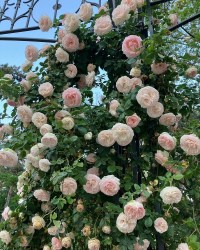
I started this blog post with “it’s been ages since I’ve written even a poem,” but between the time I started and the time I’m writing this — now, this minute — I wrote a poem. I wrote it while waiting for my daughter to finish her kendo class, sitting in the rose garden at the Millennium Háza in the Városliget, which means the City Park. It’s a large central park in Budapest, very beautiful, with tall old trees and winding trails, with museums and botanical plantings, a café and a hill for dogs to run on, a closed garden of textures and scents specifically for those who are blind or have disabilities related to sight. Right now, in June, the rose garden is filled with blooming roses. They inspired me the way they always do — that is, I think roses are very strange flowers, wise and secretive, hiding whatever they know within their ruffled petals. They are stronger than they look, and of course they have thorns — we know they do, and yet we forget about the thorns, or at least I always do. I reach for the beautifully scented blossoms and get pricked.

The poem I wrote can be found on my poetry site, so if you’re interested, you can find it there. It’s called “Portrait of a Lady.” I’m not sure where it came from. Like many of my poems, it just happened. I wrote the first stanza:

She sits on a stone bench
in the city park, under a bush
of pink roses, probably
something like Maiden’s Blush,
because they have so many
petals — you know the kind
I mean, that blossom in June
and release, if you lean in closely,
the most delicious perfume.

The poem is not about me, of course. But I was imagining another woman sitting where I was sitting, reading a book (I had brought several — I’m always afraid of running out of books). And I wondered what her story might be, and then I thought — whoever is watching her, writing a poem about her, doesn’t know and can’t know. But the roses know, because they know everything. There is a reason we say that whatever is secret is told “sub rosa.” (I don’t mean the technical reason, having to do with roses on ceilings. I mean a mystical reason. Roses just know. Remember that Antoine de Saint-Exupéry made the two great loves of his Little Prince a fox and a rose.)

Why did I write a poem, there and then? After all, I had books with me, three of them (just in case I ran out of books). I could have read one of them. Instead, I imagined something and wrote it down.

And that, in the end, is what is wrong with me. I have a mind that does that — that makes things up and writes them down, that sees secrets in the roses. And also a mind that gets overwhelmed by the demands of the world, and then gets angry and desperate because it can’t do what it does naturally, which is hold conversations with foxes and roses, and scribble silly rhymes.

Where have I gotten with all this? I have no idea. Except that I’m really thoroughly tired of not writing about roses or Budapest or whatever else. And I don’t have a solution, exactly — I still have half a short story, not to mention half a novel, on my laptop. But even writing about the problem is clarifying.

(The writer in the rose garden, after having written a poem.)

Posted in Uncategorized | 9 Comments

Finding the Paths

There is a story I remember, although I don’t remember where I read it. It’s about the president of a small New England college, in New Hampshire or Maine or Vermont, one of those northern states. He wanted to renovate the central lawn of his campus. Between two academic semesters, a beautiful green lawn was laid down — a rectangle right in the middle of campus, between all the old college buildings. When the grass had grown into a rectangular green carpet, the head groundskeeper said to him, “But there are no paths.” The college president said, “Just wait. In a few weeks, there will be.” When the college students returned, they started walking across the grass, and where they walked the most, they wore it down into dirt. The college president said to the head groundskeeper, “There are your paths. Put the bricks down there.”

I remember this story partly because I’ve lived and worked on college campuses, and you always see the auxiliary paths. There are the official paths, the ones in brick or concrete or asphalt, where students are supposed to walk. And then there are the auxiliary paths where they often actually walk, when the official paths are inconvenient — when they are not the quickest way between two buildings, for example. A long time ago, I used to ride horses, and you would see these sorts of paths across the field as well, made by the horses when they walk in single file. They would create their own preferred paths, then use them over and over again. Human beings are, in some ways, not that different from horses. They decide where they want to go, and the paths remain as evidence of their decision-making process. The official paths are an ideal, a vision of the planner or architect for how the field should look, where the people should walk. The auxiliary paths are the reality of how people move and interact.

I was thinking about this recently because I’m trying to redecorate my apartment. It was very pretty before, filled with furniture I had picked up here and there, some of it from antiques stores, some of it from thrift shops, none of it very expensive but all meaningful because they came from the days when I was a graduate student and had very little money. But I realized that there were spaces in the apartment I was simply not using, furniture that was serving merely a decorative purpose. And an armchair should be more than just decorative . . . Also, my life had changed — my daughter had become a college student, and my apartment had to work for her as well as for me. It needed, for example, not a pretty antique armchair, suitable for a tea party, but a big comfortable one to flop down in, to curl up in and read a book.

So I became that college president watching students walk across the grass, although I was the president as well as the students. My apartment was the grass. I observed the way I used it: Where did I spend time? What did parts of it did I use, and how? What did I really need to make my life in it productive and comfortable? Because that apartment also had to work for me — it was my office as well as my living space. It was where I worked and wrote and often researched, because all my books are in it, ranged around the walls in shelves. There is a sense in which I live in a library that is also an art gallery, which just happens to have some furniture in it.

I ended up changing quite a lot, turning the apartment around so the former office became a bedroom and vice versa. And I’m not done yet–I still need a big, comfortable sofa to flop down in, to curl up on and watch episodes of Hercules Poirot on BritBox. But it’s an interesting exercise, to observe yourself and try to figure out who you are, as opposed to some ideal, some vision of yourself that you created in your head. Because at least some of the old furniture came from who I thought I was supposed to be, or thought I might become. But I never actually turned into the person who would have tea parties with guests sitting upright and elegant. When I have guests, they want to flop down on comfortable sofas as well, drinking from big mugs of herbal tea.

There’s still work to do on the apartment, but I wanted to write about this idea, that you have to find your paths, figure out what you actually do, who you actually are, even for something as seemingly simple as buying an armchair.

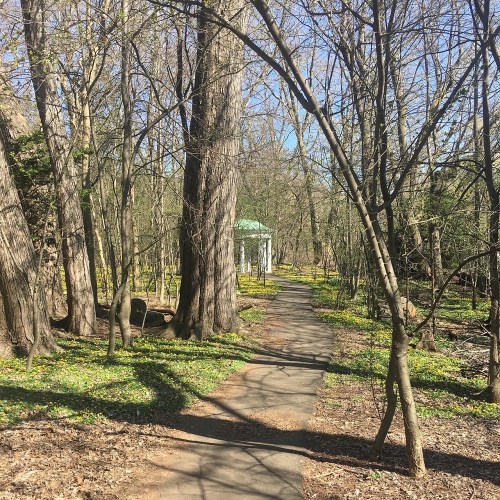
(This is a path in the Halls Pond Sanctuary, where I took my students on a field trip after we had studied the essays of Emerson and Thoreau. I wanted to them to experience a bit of nature themselves, to pause and breathe in the middle of a very busy semester.)

Posted in Uncategorized | 3 Comments

Work in Progress

I should warn you in advance: this blog post will be a little depressing. Its title comes from a Facebook post I saw a few months ago, in which a Facebook friend, although someone I don’t know personally, posted about a friend of hers, an author, who had recently died much too young, in her forties, after the publication of her first novel. The post made me so sad — so young, and just after her first novel had been published! I followed a link to the author’s website, and there it was: “This website is a work in progress.”

It felt like a punch in the chest. Here was a woman, younger than me, who was trying to build a writing career. She had just accomplished what is often the first big step, the publication of a novel. She was in the middle of creating her website. And then . . .

It was, inevitably, a moment of confronting my own eventual mortality, of wondering how many years I had left to write in and how much I could accomplish during that time. And I thought, “I’d better update my website.” But in the middle of that existential panic, I also had another thought: that no matter how long my life lasts, it will probably always be a work in progress. There will probably never be a moment when I say, “That’s it, I’m done, I finished what I came here to do.”

I remember reading that in an interview, Jorge Luis Borges, then in his 90s, told the interviewer, “Someday I hope to write the novel that will justify me.” There he was, famous and accomplished, but he wasn’t finished yet. And then I thought, when that moment comes for me, I hope not to be finished yet. I hope I’m working on a new project, thinking, “This one is going to be really good.”

At that point, the words “work in progress” became a promise rather than a sign of failure. I thought, I want to be a work in progress, up to the very end.

Who knows how many years any of us has left. Who knows what, among all the things we create, will last. All I can hope is that among all the things I create, for however long I can keep working, there will be something — a novel, a story, a poem — that will justify me. That will mean I have done whatever the bits of ancient stars that went into creating me were meant to accomplish.

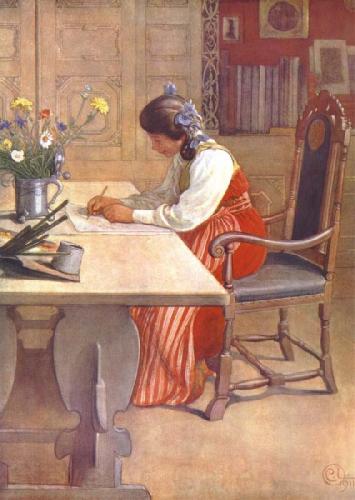
(The image is Hilda by Carl Larsson.)

Posted in Uncategorized | 6 Comments

Little Green Pockets

When I was a child, I sometimes had trouble falling asleep at night. So I would lie in bed for a while with my eyes closed, just imagining things, stories of sorts, or scenarios. One of them went like this. I would imagine all of the streets around our house turning into rivers, the parking lots into lakes. The houses would turn into hills, and the people in them into animals of various sorts. I would imagine what sorts of animals they would turn into, based on their personalities. All around me would be a natural landscape. I would be the only human being left in the wide world, able to wander around this reconstituted garden of Eden. I don’t think I ever thought about the practicalities — what I would eat, for instance. By that time I was already asleep.

We lived in a standard American subdivision that might have come out of a teen movie from the 1980s or 90s. It was arranged around a long, circular road, with smaller streets running off it. On those smaller streets were detached houses in the middle of green lawns, except for one small area of attached houses and even apartments. We lived in one of the attached houses, without a lawn but with a small garden in the back. It was one of the newest subdivision spreading out from Washington, D.C., and there was still a lot of green space that has since disappeared. Back then, the subdivision was surrounded by forest, and the kids could still go play in the forest, as kids did at the end of the last century. We were perpetually on our bikes, riding around the streets, or walking to one another’s houses. There were two schools in the subdivision, an elementary school and a middle school — we were bussed to the high school, which was in the middle of farmland. Beyond the subdivision spread more farmland — we were at the edge of suburban America, back then. Still, I longed for more green space.

Since then, I have lived in many places, many of them quite urban. But I’ve always tried to live somewhere I could see trees out the window, or hear birdsong. I’ve always tried to have a little pocket of nature nearby, for my mental health. It means a lot to me that my Boston apartment is on a quiet street with ancient linden trees that drop their yellow leaves all over the road in autumn, and that I have a little garden, just a strip along the side of the house but I’ve put so many plants into it and over the seasons I can watch them grow, bloom, die back and sleep under the snow. And in my Budapest apartment, I see the trees in the park of the Nemzeti Múzeum. I love that view, and I think I need it as well.

I think most of us need much more nature than we get.

I love teaching, but when I go to teach in the morning, I pass one of my least favorite views in the world. First I walk through the tree-lined streets of Brookline, where the sidewalks are built the old-fashioned way: between strips of green, usually on one side a little garden by the house or apartment building, and on the other side the strip of green between the sidewalk and the road, with grass and tall trees. It’s like a sidewalk sandwich: green, concrete, green. The trees tower above me, and I can hear birds, see a glimpse of the blue sky. Then I emerge onto Commonwealth Avenue, and the view changes. Either way I look, it’s concrete concrete concrete. The long river of concrete that is the avenue, with a tram line going down the middle, broad sidewalks on either side, and very little green. Commonwealth Avenue has gotten better in the last few years — it had to, since it had a reputation as one of the most dangerous streets in Boston, the site of numerous accidents. In places, trees were planted. Right now they look like sticks sticking (stickily) up from small square patches of brown dirt. And there is a protected bike path. But either way I look, I see so much concrete, and in the distance a mountain range of office buildings, glass glass glass, glittering in the sun.

Why are trees put in those little square spaces? Why are the squares either left as dirt or covered with metal grates, as though the trees might escape — or, I’ve seen more recently, a sort of spongy asphalt that I assume is a new technology, the latest in street tree design, because it must let the rain through or the tree would die. But it looks so strange to see trees growing out of what looks like playground plastic asphalt. I feel sorry for the trees — they look lonely, all by themselves, with no birds to sit on their branches (birds stay where there are more trees, more cover), no squirrels to climb up them, not even grass to talk to. I wonder where their roots go, under the streets? Is there room for them to stretch and grow? There are places on Commonwealth Avenue where the trees have better accommodations. They are in long raised planters, fancily edged in stone, with other plants. Those appear in front of important buildings like the business school and the gym, but ordinary classroom buildings get sticks in grates.

We know this isn’t good for either trees or people. We need nature — our souls need it, our lungs need it. Concrete and asphalt lead to flooding when it rains, overheating when the sun shines on the streets in summer. But everywhere I go, on those city streets, I see places where we could put little pockets of green — places where no one walks, empty useless concrete corners that could be something else. There could be plants, there could be green to rest and refresh our eyes, to cool the air and do all the other good things plants do. We could, if we wanted to, have little parks everywhere. What I’m saying here is that we should have those little parks, that our cities could be very different than they are now, that they could be gardens as well as cities — and they should. This would of course be more expensive, because people would need to create and take care of those little gardens. We could think of a word for that — I don’t know, something like “jobs.” It would create more jobs.

I dream of a world where cities have little green pockets everywhere we can put them, like a great dress with little pockets sewn all over it, holding plants. I dream of a city with birds and insects, a city that is slower, more human. I can imagine a hundred arguments against this, all having to do with economics, with practicality, and I will say: human ingenuity has done a lot more than this. Putting little parks in cities is one of the easier things we have done. Look at those glittering skyscrapers — you’re going to tell me my plan is harder than that?

I want little green pockets everywhere, to carry our hopes and dreams.

(The image is Avenue of Schloss Kammer Park by Gustav Klimt.)

Posted in Uncategorized | 4 Comments

Organizing My Closet

I got back from Budapest and immediately started to prepare for teaching at Boston University this semester. I’m teaching a class I really enjoy — a class on rhetoric to freshmen, not classical rhetoric as defined by Aristotle and the ancient Greek rhetoricians, but a broader, more modern rhetoric, focused on oral, written, and visual communication. We get to talk about traditional oral storytelling, the development of the reflective essay, modern modes of communication such as photography and film . . . It’s going to be a lot of fun, certainly for me and I hope for the students.

But the last few weeks have been too much transition, in too short a time. Last week I found myself feeling as though I did not know where I was, or even who I was exactly. I’ve traveled in the past without this sense of instability, but that was travel — I was going somewhere, with my life temporarily packed into a suitcase, and then I would come back. There was a here, a there, a me at home and a me traveling. This time there was a me at home in Budapest, then a me at home here in Boston. I was teaching in a new program, my daughter was moving back into the dormitory for her second semester of college. Nothing was fundamentally changing (I was still teaching at the university, still in the same apartment in Boston), and yet everything felt different. It felt as though the ground was shifting under me.

So I did the logical thing. I organized my closet.

I had all my Boston clothes in two closets and a chest of drawers in two different rooms, which meant I was always walking back and forth, trying to remember what fit with what else, what matched with what. The shirts and skirts were in one room, the sweaters were in another, so I would find myself standing in front of one closet thinking, What sweater goes with this skirt? and then maybe taking the skirt over to the other room, to check. I could not trust my memory, partly because I was jetlagged, partly because I might be remembering a sweater that was in another closet altogether, in Budapest. Anyway, I don’t carry my sweaters around in my head — that’s what the closet is for.

The first step was putting away all the summer and spring clothes. There’s snow on the ground, but when I pulled out one drawer, I would see short-sleeved shirts, and part of one closet was half filled with floral summer dresses. In my jetlagged state, I would spend a minute staring at them before thinking, No, winter dresses. What is the temperature again? Cold, rainy or snowy — that’s January in Boston. So I bought some storage boxes at the local hardware store and put away the clothes for warmer weather. My closets are not deep, but my ceiling is high, and there is a quite lot of space to go up — space that is usually wasted, but perfect for stacked storage boxes.

Then I organized the clothes that were left, the fall and winter clothes I will actually be wearing until spring comes again, which around here could be April, who knows. I put everything I actually use in two places, the larger closet and the chest of drawers. The other closet will be for my daughter, when she is here rather than in the dormitory. I used hanging shelves for the sweaters, so now they are right next to the skirts, and I can see immediately what goes with what else. Shoes are below, except the heeled shoes, which are on a rack above, and winter boots, which are in the coat closet below the coats.

I know, I know, that’s a lot of detail you didn’t necessarily need to hear about. But the process of putting my closet together was also a process of creating the place I live in, which was also a process of recreating myself. We don’t simply exist. We exist in relation to places and people — we interexist, so that my existence in Budapest is defined in part by the table where I do my Hungarian homework, the convenience store around the corner where I buy rétes. I am a person who eats rétes, a person who does studies Hungarian. Here in Boston, I was jetlagged and feeling a sense of vertiginous displacement, so I tried to define where I was in relation to something — the season, at a minimum. It’s winter, I will put away the summer clothes.

To be honest, I got a bit obsessive about it. I spent a day going through all my clothes, checking to see what I had, making sure it still fit and sparked joy (yes, that is a Mari Kondo reference), unfolding and refolding, going to the hardware store for more storage boxes, scrolling through the Ikea website for drawer dividers. At certain points, I felt pretty silly. But at the end, as I grew reflective, I thought the following:

Home is something we make, not just someplace we are. For most of the year, my home had been in Budapest. I had made that home, with a lot of help from a lot of wonderful people (especially during the renovations the year before). Over time, it had become a warm, welcoming, comfortable place. And it was mine, my very own apartment with a view of the Nemzeti Múzeum. Now I was back in Boston, in a rented apartment. I had to make it home again, at least for a while.

I started with a closet — probably, I’m not sure but it seems likely — because clothes define who we are. They demarcate different aspects of our lives, different roles we fill in relation to others. There are outdoor clothes and indoor clothes. In my case, there are teacher clothes — after a semester of not teaching, I had to think of skirts and sweaters that matched, of dresses that looked professional but did not prevent me from writing on a chalkboard. I had to become Dr. Goss again, and that meant dressing the part.

I’m so busy this semester — I have so much to do, mostly for other people (my colleagues, my students, my daughter) — that I wanted to make my own life as easy and intuitive as possible. I wanted to be able to move through my own apartment with a sense of fluidity and grace. I wanted, at a minimum, to be able to find the clothes I could wear (for a Boston winter) in one closet, one chest of drawers. So I could devote the time I had to other things — creating lesson plans, writing stories, watching Netflix with my favorite college student when she has a free night.

And finally, that I, at least, need a sense of order and routine in my life. Not just to function well, but in an existential sense. Because part of me knows, always and every moment, that we are on a small planet hurtling through space, so the solidity of the ground under our feet is always an illusion, and we are here for such a short time, like flames that spark up and then flicker out. Every moment of this precious life, every breath we take, is an improbable gift. We are always, every moment, in transition. But if I thought like that on average, ordinary days, I would probably go mad, like the heroine of an Edgar Allen Poe short story. So the existential anxiety has to stay below the surface. On the surface, I have to live my life, with intention and meaning — I have to create intention and meaning, a sense of solidity and continuity.

I think we all do this, every day. We create the solidity and continuity of our lives through our thoughts and beliefs, our actions. Anyway, that’s why I organized my closet.

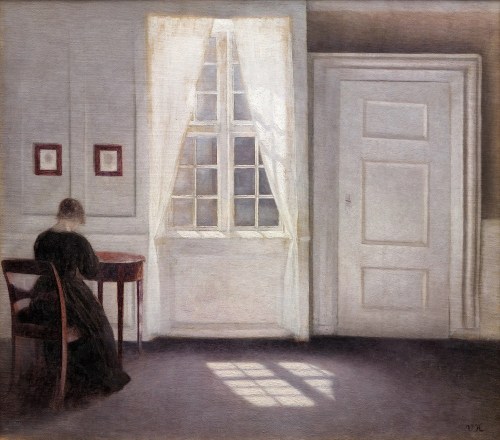
(The image is Interior in Strandgade, Sunlight on the Floor by Vilhelm Hammershoi. This is a woman who has organized her closet.)

Posted in Uncategorized | 2 Comments

Budapest at 3 a.m.

Every time I travel from Boston to Budapest, I have terrible jetlag. It’s only Boston to Budapest — traveling the other way around, with the sun, I may be a bit tired and dehydrated from the long journey, but I don’t have the same symptoms.

The first symptom is a sense of absolute exhaustion. I can sleep twelve hours a day and still be tired. It’s not just that my sense of time has been disrupted and I need to catch up. My tiredness is unpredictable, and I am off schedule not only in Budapest but also in Boston. It’s as though my time sense has shifted to someplace other than where I was, where I am — I don’t know, some alien planet? I often wake up at 3 a.m., no matter what time I went to sleep, even though 3 a.m. is not a time to wake up, either in Budapest or Boston. It’s not that I’m lagging — it’s that I’m spinning wildly out of control, like a carousel in space.

The second is a sense that gravity has increased by 100%, so that I have become incredibly heavy. It takes so much more energy simply to move. Walking up stairs is a chore. Even getting out of bed is a chore. It feels as though I have turned into a metal statue of myself.

The third is disorientation. What day is it? Monday? Oh, you say it’s Wednesday? Wait, you said Saturday? All right, if you insist. As I was saying, since this is Saturday . . . But no, I don’t remember. I had a thought, but it’s gone, whirling away behind me as I turn on this interplanetary carousel. When I’m jetlagged, I can’t think properly. There is also, sometimes, a sense of nausea and general unease, as though my body knows something is wrong, that it’s in the wrong place at the wrong time. Which, in a sense, it is.

The flight from Boston to Budapest takes about ten hours in two airplanes. That’s the quickest flight through Zurich, with only an hour between flights — it’s the easiest and most comfortable, and the Swissair flight attendants give you chocolate (one per flight, so I end up with two chocolate bars, which is not a minor consideration). In those ten hours, I cross six time zones: 3 a.m. in Budapest is 10 p.m. in Boston. For most of those ten hours, I am in a particularly dry environment, doing something profoundly unnatural: sitting, or sleeping almost upright in an airplane, or watching a movie on the tiny screen in front of me (only at the start of the flight — then I always try to sleep), eating something or other out of an aluminum box. Last time it was couscous and vegetables. These are things I would never do under any other circumstance. I don’t mind them — they are part of the ritual of flying. But all those things, and the pressure in the cabin, take their toll. Predictably, not the day I arrive but usually the day after, the jetlag starts.

I’m not writing this asking for remedies. I do what I can, drinking water throughout the flight, getting sunlight and fresh air once I arrive, trying to adjust. I haven’t tried melatonin or other medications because despite the misery of jetlag, my body adjusts naturally, exactly as the medical websites describe: one day per time zone traveled. My body does what it’s supposed to, and I’m grateful to it for being as healthy and accommodating as it is. Considering what I put it through, it’s remarkably kind to me.

Because, and this is my point, flying against the sun like that is profoundly unnatural. It’s time travel, really — it’s something science fictional, as though I traveled somewhere by spaceship. Jetlag is a reminder that we are profoundly affected by our place on this earth, that we are earthly, earthy, creatures of the ground from which we came. The experience of jetlag is the experience of being ungrounded. I have, for ten hours, lost my connection to the planet, and I need to reconnect. Jetlag is a tiny warning that this planet is, after all, our parent — a great green and blue mother floating in space, turning like a carousel, the most wonderful you can imagine, with the best animals — and that we are bound to her cycles, her rhythms. Her movements from light to dark, her temperatures and tides. When we get too far away from her, we lose something. Perhaps that is the true lesson of Icarus. As a species, we are not particularly meant to fly — we are the wrong shape, the wrong size. When we do, it’s glorious: we slip the surly bonds of earth, as the television used to say when the daily broadcast ended, back in the days when there were only four channels, fading to black and white static around two in the morning. Right around the jetlag hour.

It is the same, it seems to me, with many of our unnatural endeavors as a species. They take us away from our natural selves, in the direction of cities, papyrus scrolls and then libraries filled with books and then the Internet, cultivated grain and then restaurants and finally little aluminum boxes of pre-cooked couscous and vegetables. From leather wrappings to linen tunics to ripped jeans and a t-shirt. They give us magnificent art, soaring architecture, and of course pollution. We create wonderful things but we also lose connection. We are all Icarus, soaring and falling, not just once but all the time. Trying to be birds, brought down to earth.

Perhaps another effect of jetlag is middle of the night speculation on the meaning of existence and the fate of humanity? Or maybe we all think about these things in the late anthropocene. In the 3 a.m. of our human timeline.

I have no solutions. Melatonin is not going to get us out of this mess. My one thought is that even relatively unimportant things, like the discomfort of jetlag, which after all passes (soon, I hope — it’s been five days), can be significant, can mean something, teach us something. In this case, that we are children of a wonderful mother, this beautiful planet of ours. We are more closely attuned to her than we often realize. We are not simply on her, walking around on her surface, restrained by her gravity so we don’t float up into the sky — she is inside us, regulating our sense of time, our sleeping and waking. We need to pay more attention, both to her and to our relationship with her. It is only by understanding that relationship, by working with her, that we will remain healthy, individually and as a species.

Such are the insights of jetlag at 3 a.m. in Budapest.

(The image is The Lament for Icarus by Herbert James Draper. This is a pretty accurate representation of what jetlag feels like . . . I hope the nymphs are bringing him water and saltines.)

Posted in Uncategorized | 3 Comments