Finding the Magic

So first of all, about me.

My life is crazy right now. I’ve almost been afraid to write a to-do list, because it would have, not so many things on it, but such large things: Write story due by the end of the month. Find criticism I will be teaching this fall. And sometimes, that makes me feel as though I can’t breathe. So I haven’t been very good at posting on this blog, and my website is out of date, and altogether I’m just terribly behind. I think the problem is that being a writer is a full-time job, and being a teacher is a full-time job, so I have two full-time jobs. And I need to try to do both of them well.

Have patience with me. I will get through this, and things will be easier, although I’m honestly not sure when yet.

But there was something I really wanted to write about today, which is a quotation that I saw on a friend’s Facebook page:

“Because there is no cosmic point to the life that each of us perceives on this distant bit of dust at galaxy’s edge, all the more reason for us to maintain in proper balance what we have here. Because there is nothing else. No thing. This is it. And quite enough, all in all.” — Gore Vidal

It was posted after the death of Gore Vidal of course, and I “liked” it, as one does on Facebook, because I think it’s beautifully written. But I don’t think it’s true.

I think that thinking of our material universe, the one we perceive with our sense, as the only thing is not only foolish, it is arrogant. As well as, if I may add, in contradiction to theoretical physics. I believe — I have always believed — that there is meaning and purpose to life, although we may not understand that meaning and purpose. I think we catch glimpses of it here and there, and I honestly think that the universe communicates it to us, if we can listen for it — if our perceptions are finely enough tuned. All my life, I’ve had a strong sense of purpose, of being here for a reason that I might not at that moment understand, but that something, somewhere, understood. The times I’ve been unhappy in my life are when I’ve gone off the path, when I’ve realized that I made a choice taking me away from the way I was supposed to go. I remember what it was like to go to law school and to feel, so deeply that it went to my core, as though I was in the wrong place, as though I had stepped off the path. The path itself feels narrow and rocky, sometimes. Sometimes it feels as though I’m walking along a gulley, or a high cliff with winds. But it feels like a path, as though I’m going somewhere.

I don’t know how to talk about this except by saying that we have instincts, and our instincts tell us these things, and we have to trust them.

I think part of my purpose in this life is to talk about magic, and to make it. Because we’ve lost the idea of magic — we feel like Vidal, in a wholly material universe that has no meaning, and that is a terrifying place to be. But we are like children terrifying ourselves with stories that aren’t true, or even very interesting. The problem with finding the magic is that I think you have to believe it’s there to find it.

That’s a bit of a rant for tonight, so I’ll leave you with an image:
Posted in Uncategorized | 10 Comments

Magical Decorating

As I may have mentioned, I’m in the middle of decorating an apartment. It’s going to take a while, because I want the end result to be magical. And I mean that in a very specific sense: I want it to look as though it could appear on Grace Nuth’s blog Domythic Bliss, which is one of my design influences. It’s a particular challenge in this space, because it’s a faculty apartment and can’t be painted. It’s also quite small. But I do have several things in my favor: it’s in a nineteenth-century building, so the layout is eccentric, and it has plenty of nooks and crannies. It also has plenty of light. Those are good things. I don’t understand people who like wide open spaces in their houses. How do you arrange furniture in a wide open space? It feels, to me, like being in a sort of blank. I like walls and corner and closets.

I’m going to include a few pictures of how it’s going so far, and I’ll post more as the decorating progresses. It’s going to take a while.

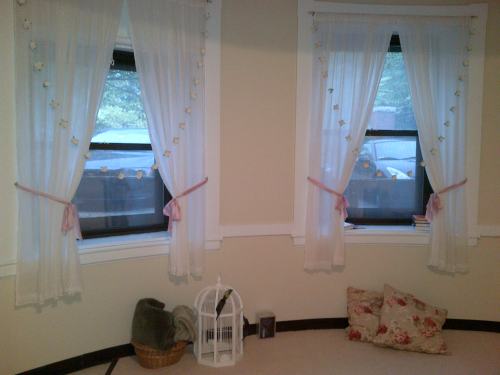
The apartment has two large windows. I’ve put up curtains, and over the curtains I’ve strung garlands of paper flowers that I found at Ten Thousand Villages, which is one of my favorite stores. The tie-backs are lengths of pink silk ribbon that I bought at Paper Source. Each one is about two yards. Yes, I’m still waiting for some furniture. And yes, that is a birdcage. It’s eventually going to hang from a bracket on one of the window frames.

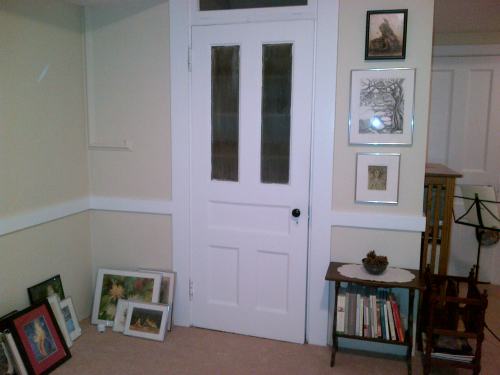
I’ve started putting up paintings, but you can see a stack of them against the wall. I bought the little table and the bowl that’s sitting on top of it at Goodwill, then put pinecones I had collected into the bowl. I think it looks quite nice there. The key to magical decorating seems to be creating a series of vignettes, and this is one.

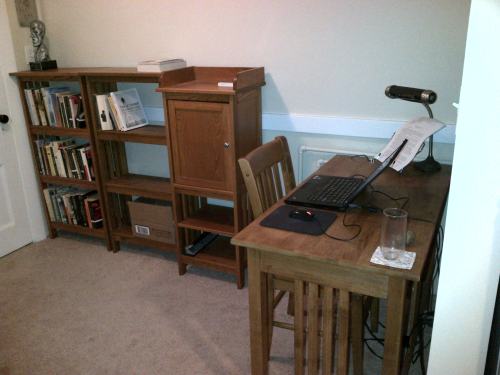
The apartment has a small alcove in which I have put my writing desk and some bookshelves. I need to finish filling and organizing the shelves, and of course there will eventually be pictures on these walls as well. The printer stand is awaiting its printer.

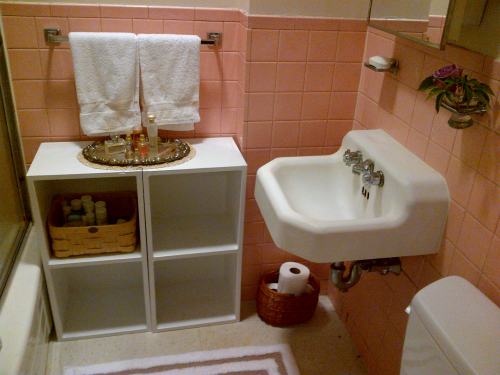
And finally, one can’t forget the bathroom. This one happens to be pink, which I think is rather nice. I’ve put low white shelves into it, and I checked today to make sure that the type of basket I want to put into them fits. It does, so now I need three more baskets, and I need to paint them white to match the shelves. But I’ve already put a silver tray on top for perfume. Every bathroom should have a silver perfume tray, don’t you think?

Notice, by the way, that the toothbrush holder is instead holding what Crate and Barrel tells me is a cocktail glass, in which is a rose. I will use that glass for flowers. After all, what else is one to do with a toothbrush holder, nowadays?

As you can tell, there’s a lot more to be done. But I want to continue in this somewhat whimsical vein. I think that once I’m done, the apartment will be a lovely space. At least, I hope so.

Posted in Uncategorized | 4 Comments

Writers and Families

Writers have families.

On the one hand, this is good because it gives the writer something to write about. On the other hand, it’s bad because it means the writer is under scrutiny. Families read the writing, and they inevitably evaluate it relative to themselves. Is a story really “about” the family? Does it put forth a position with which the family disagrees? Does it represent members of the family in a negative way?

This reminds me of a former boyfriend whom I once called Raven, and who therefore imagines that every raven in every story or poem is always him. (Even the unflattering representations.)

Families are like that. And it’s probably worse when the writer is writing non-fiction, giving interviews or describing his or her life in a blog post. Everything is taken to reflect on the family.

My family has a strange attitude toward my writing, which I think is almost always the case unless the writer comes from a family of professional creators. (By professional, I mean people who actually make a portion of their incomes from a creative endeavor — writing, art, dance, etc.) When I met my cousins in Debrecen, they told me they’d heard I’d become a famous writer, of fantasy like J.R.R. Tolkien. Of course, I’m not at all a famous writer, and what I write is nothing like Tolkien. They’d never read my writing themselves — that was simply the general family impression.

My parents’ generation was raised under communism, and still retains the assumption that literature is important to the extent that it adheres to literary realism. I remember being given Earnest Hemingway’s The Old Man and the Sea when I was a child and being told that it was great literature. Now, I like Hemingway very much, but I loathe that particular book, partly because it’s boring, and partly because I was given it as an implicit model for what writing should be like. I think becoming a writer always involves a rebellion against what and how one was told to write. My rebellion is in part against the dreariness and tedium of what I was taught as great literature.

So it’s a problem, really. Writing professionally means writing for an audience, and that means one’s writing is out there, to be judged — including by one’s family members. Who, in some way, are the group of people it is least for. Writers treat their experiences ruthlessly — witness my making fun of the way Hungarians do laundry, which got me into trouble, but surely if I can make fun of anything, it is my own country, my own people. We are not merciful, we writers. We take things apart, we put them back together.

I’m not sure what to tell writers’ families about all this. I suppose this, at least, might be reassuring: if your name is Judith and the writer creates a character named Judith, that character is not you. Not even if Judith majored in the same thing you did in college. The writer is using you to create something completely different. Of course, no one likes to be used. But at least it’s better than actually being written about. The writer transforms everything, but in doing so he or she uses the material that is at hand. This implies no particularly insight into you, the actual Judith — either good or bad.

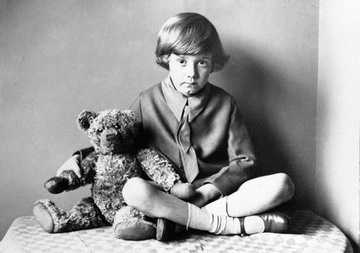
I write this because it’s something I discussed with Catherynne Valente, while we were both in Budapest — and also because I’ve had family members reading my writing lately, and it’s frustrating to be misunderstood. But then, it’s probably frustrating to be in a writer’s family as well. After all, if the writer becomes famous (there is always that miniscule chance), the family will be remembered only relative to the writing — as Hemingway’s is. It’s rather a horrible thought, that one might be a line in someone else’s Wikipedia entry, as writer’s parents, spouses, and even children often are. I’ve always felt sorry for Christopher Milne — although he has his own entry, mostly because he wrote about being Christopher Robin.

So basically, it kind of sucks having a writer in your family. But it’s difficult for a writer as well, because people who aren’t writers or editors or publishers have a hard time understanding exactly what it is we do, how we transmute life. How even in a blog post what we present is a story, intended to be read by an audience. How even we become our own characters. (What I write here is not about the ordinary, everyday Dora, but about Theodora Goss, who has a series of adventures and insights. She is real, and she is me, but she does not represent my every thought or moment.  Perhaps it might be more accurate to say that she is realish.)

It’s difficult, isn’t it? And in the face of it, what the writer has to do is go on being ruthless. Because if you don’t mine the material, if you hold back and censor yourself, which is so easy to do when you know your writing is being read, you betray your allegiance to the story. And that is where your allegiance lies. Milne may have been a bad father, Hemingway was certainly a bad husband — but they were excellent writers.

Christopher Robin Milne, with bear:

Posted in Uncategorized | 9 Comments

Finding Your Balance

This is going to be a short post: today is my last day in Budapest, and I have packing to do. But I was thinking about the issue of balance. When I take a ballet class, we do each exercise on both sides, right then left. After the right side, the teacher always tells us to find our balance. There we are, en pointe, letting go of the barre and finding the center of our bodies, where we can balance: figuring out how we can stay en pointe, on two legs or sometimes just one. If you don’t find your balance, you can’t turn. You can’t do a pirouette.

We have to find our balance in life as well, of course. It’s from that balanced place that we can turn and move. We each find and maintain our balance differently, I think — just as we all have different bodies, different minds and spirits. For some people, it means living in the peace and quiet of the country, having a garden, keeping chickens. For some, it means living in the liveliness and bustle of the city. For almost everyone, I think, it means finding the work you feel as though you were meant to do.

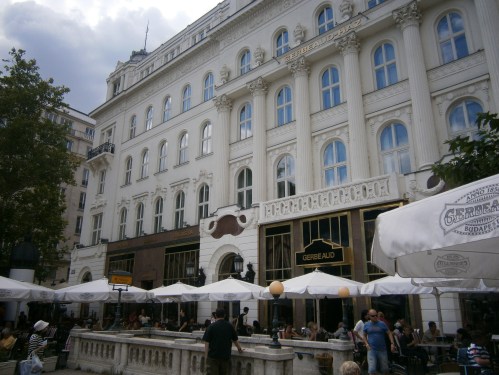
I was thinking of this particularly because yesterday I was feeling a bit off balance. My friends Cavin and Sunshine were visiting, and we spent the day walking around the city. For lunch, we stopped at Gerbaud.

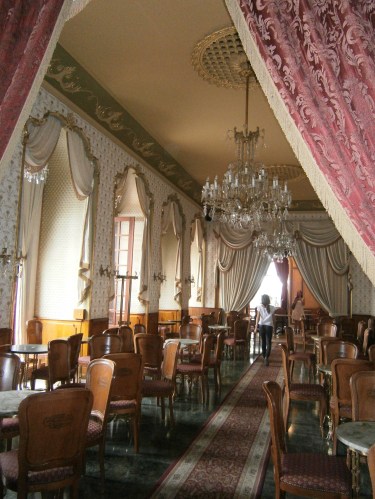
If you were wondering what Gerbaud looks like from the inside, here it is. The nineteenth century did coffee houses right, didn’t it?

At Gerbaud I had an enormous, sophisticated ice cream sundae, the Gerbaud Sundae. (This is how it’s described on the website: two scoops Gerbeaud “Valrhona” cake, three scoops chocolate ice-cream, apricot purée flavoured with apricot palinka and dried apricot, whipped cream, apricot foam, chocolate sauce, Gerbeaud bonbon.) It was absolutely delicious, but of course it was too much to eat. Still, I figured, it was the last day I would be walking around Budapest, and I could do something extravagant.

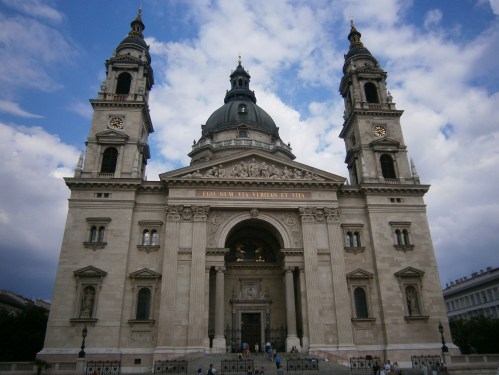
And then we went to St. Stephen’s Basilica.

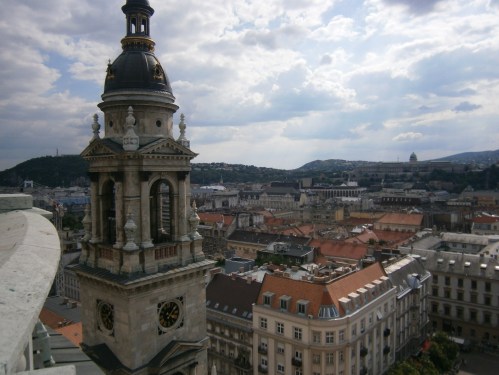
Before going inside, we decided to climb up to the dome and look down on the city. Now, I’m not afraid of heights, exactly. But I am afraid of falling from them. The sign at the bottom said it was 302 steps up. When we got to the top, I stayed close to the wall. I think that may be a matter of balance as well: I always feel as though I’m going to plunge to the city below, despite the stone parapet that has surrounded the dome for more than a century. But I did take some pictures.

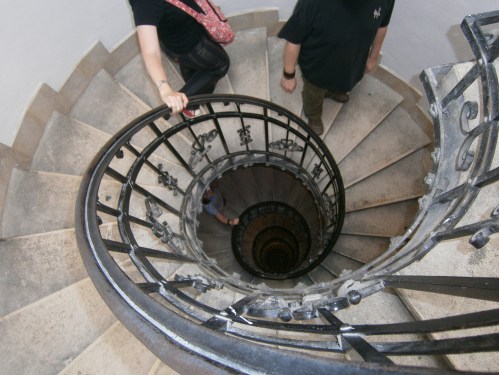
This is a picture of the stairs going down, with bits of Sunshine, Cavin, and Ophelia (who was much braver than I was, and held my hand walking around the entire dome). The lower stairs were stone. The upper stairs were cast iron, so you got a much clearer sense of how far you had climbed.

This is my last day in Budapest, and I feel very sad to be leaving. But I think that throughout this trip, I have gotten a much better sense of my balance. It’s often by being slightly off balance that you feel where your center of balance is. You have to test and feel your limits. I hope that knowledge will help me in the next year. It will be a year of transformations — among other things, the year in which I’m trying to finish the novel. I hope I’ll be able to find my balance, to maintain the place from which I move and turn.

Posted in Uncategorized | Leave a comment

Missing Budapest

I wanted to write a blog post today, because I didn’t write one yesterday, but I’ve spent all my internet time responding to emails and doing my banking. (What did people do before online banking? How did they go on long vacations? I just don’t know.) So here I am, with ten minutes of wifi left, and I don’t know what to write.

I think I’ll write about what I’m thinking and feeling right now, which is how much I don’t want to leave Budapest. When I first arrived, I wasn’t all that enthusiastic about being here. I had loved London so much, and returning to Debrecen was depressing. So the first day in Budapest, all I wanted to do was go back to London. But in the next few days, I started getting used to the city, knowing where things were, realizing that I could get literally everywhere from the apartment. That I could take the metro or walk all over this city. Also, that I could function well even without a great deal of Hungarian.

This is a picture of my favorite restaurant, the Épitész Pince Étterem, which is just around the corner form the apartment. It has stood in the same spot for at least the last hundred years, I think. This is a picture of the courtyard, where Cat, Ophelia, and I usually sit when we go there.

So I’m already nostalgic: I already miss Budapest, even though I still have almost a week here. But that’s not enough. I will miss the flavors of the food, the fact that even the tomatoes from Tesco taste like actual tomatoes. It’s different to describe how food in Hungary is different, but perhaps it will make sense if I say that everything has at least one more layer than it would have in the United States. The flavors of the food are more complex. And everything tastes fresher. I will miss having a little bakery across the square, and a large market down the road. I will miss the fact that the food is smaller: the yogurt here is in smaller packaging, for example. I will miss the variety. I will especially miss the plums and sour cherries everywhere.

This is another picture of my favorite restaurant.

I’m also having a wonderful time seeing friends here. On Tuesday, the writer and editor Csilla Kleinheintz took Cat, Ophelia, and I to the Ethnographic Museum, and on Friday two friends of mine arrive from Sarajevo. We’re going to have fun showing them around the city.

I will miss being able to go all over the city by metro, but almost as soon as I get back, I move into Boston, so I will have that experience next year. I will be able to do my marketing several times a week, rather than in one large grocery shopping trip, and I will be able to get on the metro and go to the museums. I’m looking forward to being a city girl again.

Today, we have a museum visit, the dinner with Hungarian writers and editors, and then Cat’s reading. It’s been a wonderful visit. I just don’t yet want it to end.

Posted in Uncategorized | 6 Comments

Fearless Women

Sometimes I write bits of stories before I actually have stories for them to go into. There is something I wrote a while back in one of the notebooks I brought with me. It goes like this:

“I felt that I was the most beautiful I had ever been in my life, and the smartest and bravest. I felt as though I deserved to feel alive, as though I deserved life and love and to do the work I was meant for. And that if I was brave enough to strive for those things, the universe would help me.”

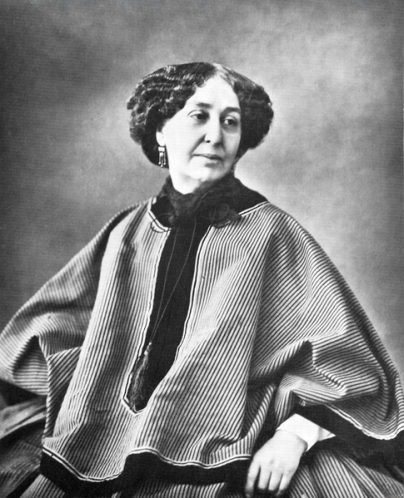
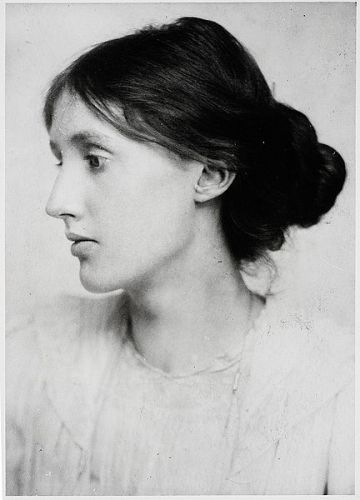
When I wrote this, I had no idea what story it would go into, but I think now I know. While I was in London, I got an idea for, not a story, but a whole novel, to be called The Malcontents. It would be about a woman, an academic, who was researching women who had not been content with the lives they were supposed to live, and so they lived other lives: women like George Sand, Virginia Woolf. They decided to live in ways they were not necessarily supposed to. And it would be about her own life, the academic’s: about how she herself became one of the malcontents. I have no idea when I’ll have time to write this novel, but I like the idea a lot.

Here is George Sand:

I think there is a certain age, for women, when you become fearless. It may be a different age for every woman, I don’t know. It’s not that you stop fearing things: I’m still afraid of heights, for example. Or rather, of falling — heights aren’t the problem. But you stop fearing life itself. It’s when you become fearless in that way that you decide to live.

Perhaps it’s when you come to the realization that the point of life isn’t to be rich, or secure, or even to be loved — to be any of the things that people usually think is the point. The point of life is to live as deeply as possible, to experience fully. And that can be done in so many ways.

This is of course a personal post, because I feel as though, although I’m certainly not fearless, I have become more so in the last few years. You become fearless in part from experiencing things, from going through difficulties and setbacks. The more you do that, the more you discover that you can get through them, that you’re stronger than you thought. And suddenly, things that used to scare you aren’t so scary anymore. So I will claim for myself that I’m more fearless than I used to be.

Here is Virginia Woolf:

My internet time is about to run out. But I like this idea for a novel. I like it a lot.

Posted in Uncategorized | 19 Comments

The Keats House

Today I thought I would upload two pictures. Here they are:

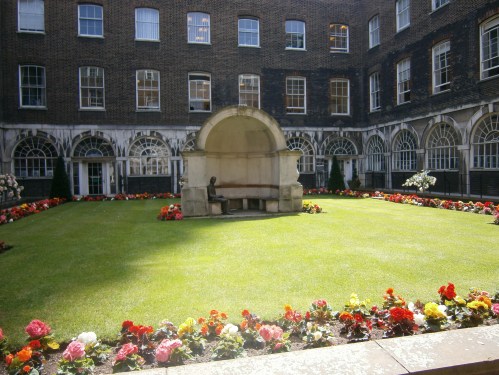
On one of the days I was in London, I wandered around the southern and eastern parts with Lavie Tidhar. Quite by accident, as I was walking to meet him, I came upon the house that John Keats had lived in while he was studying medicine at Guy’s Hospital. The hospital is still there, and I walked around it a bit. I saw the monument to Keats (that’s the second picture). It’s a strange monument, isn’t it? Keats is sitting there alone, although you can sit on the bench next to him. I wonder how alone he was in his life? I always think of him as essentially lonely, although perhaps I’m wrong. Perhaps my impression comes from knowing that his poetry was not well-received, at first. And he died so young that there wasn’t much more than “at first,” for him.

I was thinking about this today because Ophelia and I went to visit a childhood friend of mine, who lives in the suburbs of Budapest. She followed a path that is similar to mine: she has a law degree and is doing a PhD. She’s not a writer, but the similarities made me think about my own life. What would it have been like if I had grown up in Hungary?

The suburb she lived in was lovely, with houses painted in shades of yellow, orange, and green lining streets shadowed by poplar and linden trees. It was peaceful, quiet, about a half-hour outside of Budapest but on the subway line. It had parks where children could play. And I wondered if I would be living in a Budapest suburb, or perhaps still in the city itself. What would I have studied? Would I be a writer, and if so, would I write in Hungarian? (Surely I would write in Hungarian.) Would I, when the borders opened, have left for England or another European country?

I just don’t know.

And I thought (this was the conclusion I came to) that for all its turbulence, I would not change my life. I would not choose to be anyone else, or in any other place. Everything I’ve gone through had brought me to where I am now, writing my stories. I would not trade those for anyone else’s stories.

After all, out of all of Keats’ turbulence, came this:

Bright star, would I were stedfast as thou art —
Not in lone splendour hung aloft the night
And watching, with eternal lids apart,
Like nature’s patient, sleepless Eremite,
The moving waters at their priestlike task
Of pure ablution round earth’s human shores,
Or gazing on the new soft-fallen mask
Of snow upon the mountains and the moors —
No–yet still stedfast, still unchangeable,
Pillow’d upon my fair love’s ripening breast,
To feel for ever its soft fall and swell,
Awake for ever in a sweet unrest,
Still, still to hear her tender-taken breath,
And so live ever — or else swoon to death.

Posted in Uncategorized | 2 Comments