Making Adjustments

This is going to be a fairly quick post, because I want to attend a concert tonight:

I couldn’t have done that — attended a concert at night — last year. It would have meant staying in the city late, trying to find dinner before the concert, and then afterward driving another hour out to the suburbs. But this year it’s a short walk away. I’m eating dinner as I’m writing this: cream of zucchini soup that I just made on the ancient stove. I’m doing well with that stove. Whenever you move into a new place and start learning a new stove, it takes a while. So much of cooking is instinct, and I’m developing an instinct as to how long I can leave something to brown before it burns — that sort of thing. Last night, I used the oven for the first time.

This fall, I’m adjusting to living in the city again, and you know, so far it’s been rather wonderful. Oh, there are all the problems one has living in the city. It can be harder to find things than it was in the suburbs. But there are also so many advantages. For one thing, I can walk just about everywhere. And if I can’t, I take the subway. That has created one problem: I’m walking so much more now that I’m hungry all the time! I have to figure out a way to eat more, healthily. I’m working on recipes: tonight, I’m hoping to make the perfect apple crisp. (The one I made last night was almost but not quite right.)

But the biggest adjustment I need to make has to do with my work habits. I tend to be a bit of a workaholic. I couldn’t be, last year. I had a long commute each day, and I was very tired at the end of it, so I couldn’t work the way I can here, where I’m around a computer most of the time. I need to make sure that I don’t overwork myself. I also need to make sure that I leave plenty of time for writing, that I don’t spend all my time on teaching. That’s difficult, because I love teaching and it’s so demanding anyway that it’s easy to spend all my time simply doing that. But I have a novel to work on. I want to make sure that I block out at least two hours each weekday to work on it. That’s not a lot, but then, I have to much to do that I don’t know how I could find more.

I feel very strongly that this is an interim period, that this is the time during which I create the work that will take me through the rest of my life. In which I create the professional and personal life that is to be. I’m looking forward to it. I just need to make sure that I get enough food and sleep! And of course take advantage of all the wonderful opportunities in the city.

Posted in Uncategorized | Leave a comment

Your Secret Story

Do you have a secret story?

A secret story is a story you tell about yourself, as you’re going through your daily life. We probably all had secret stories when we were children. I know I did. I was in disguise as an ordinary student, but I had actually come from fairyland, or the future, or somewhere else, and I was just observing the people around me. I would eventually have to report back to my superiors, or turn all the people I had been observing into the animals they most resembled, or I would simply go back to where I came from — which was of course much more magical than where I was. Having a secret story made life more interesting.

I know, I know, you’re thinking of Walter Mitty. I hated that story. If he was able to tell secret stories about himself, couldn’t they have been interesting? Why did they have to be as horribly clichéd as his actual life? For me, the lesson of “The Secret Life of Walter Mitty” was that if you have a lame imagination, your life is going to be lame as well. But then, for me, James Thurber is particularly of his time. I’ve found him amusing, but not very satisfying.

A secret story should be yours alone: about who you are, who you want to be. Who you believe yourself to be, under all the social conventions and expectations. Are you secretly a sorceress? A priestess? A charmer of animals or teller of fortunes? Are the trees your friends? There is something wonderful about having a secret identity, something that no one knows about you. (When I was a child, I had a secret name. No, I won’t tell you what it is.)

Sometimes, if you’re lucky, your secret story can come true, in certain ways. You can become the person you wanted to be, have the life you wanted. It took me a while to realize that being a writer was like being a sorceress — that writing was a type of spell, an enchantment, and that I was learning to cast it. So I get to be a sorceress of sorts in my daily life. We’ll see if the other parts of my secret story come true. (I’ve met the fairy queen. I’ve made friends with trees.  I’m still looking for Avalon.)

What is your secret story? I bet you have one. You don’t have to tell me; you just have to tell yourself.

Posted in Uncategorized | 7 Comments

Julia in France

As you may be able to tell from this blog, I’m a bit of a workaholic. The important difference for me is not between work and leisure, but between work I want to do and work I don’t particularly want to do. If I have free time, I write . . . Which is my work, of course. (If you’re paid for it, it’s work.)

But I’ve created a rule for myself, which is that I’m not allowed to work in the bath. Go ahead, laugh, but I have a tendency to take books that I have to read, because they’re research or I’m teaching the contents, into the bath. (Where, yes, they sometimes get bubbles on them. Of course one needs bubbles in a bath, or what’s the point?) But I am no longer allowed to take work into the bath, so I have to find other reading material. Lately, I’ve been reading Julia Child’s My Life in France.

The book is ridiculously entertaining, I think partly because you can hear Julia’s voice all through it, and she had a sense that life was fun and an adventure. So everything becomes an adventure — even plumbing problems. I thought I would include a few quotations here, just to show you what she sounds like.

“My father was pained by his daughters’ liberal leanings. He had assumed I would marry a republican banker and settle in Pasadena to live a conventional life. But if I’d done that I’d probably have turned into an alcoholic, as a number of my friends had. Instead, I had married Paul Child, a painter, photographer, poet, and mid-level diplomat who had taken me to live in dirty, dreaded France. I couldn’t have been happier!”

One of the most wonderful things about the book is reading about the relationship she had with her husband. It was a true partnership: he always encouraged her and supported her career, and they went off on adventures together, across Europe. You can tell how much affection they had for each other in every line she writes. The other most wonderful thing about the book is watching a woman find her passion — food and cooking, in this case. She’s ambitious, she perseveres, she triumphs — it’s lovely to see.

And they spent time with all sorts of people in Paris, even meeting Alice B. Toklas. Julia describes one Thanksgiving dinner when they “went to a cocktail party at Paul and Hadley Mowrer’s apartment”:

“He wrote a column for the New York Post and did broadcasts for the Voice of America. She was a former Mrs. Ernest Hemingway, whom Paul had first met in Paris in the 1920s. Hadley was extremely warm, not very intellectual, and the mother of Jack Hemingway, who had been in the OSS during the war and was called Bumby.”

It’s funny that she talks about Hadley Mowrer being a former Mrs. Hemingway as though it were a job. I suppose in some sense it must have been! From the book, I get the sense (perhaps false) that life was both more difficult (plumbing! strikes that would mean you had no power for days! Paris after the war!) and more vivid. Julia and Paul seem to have so much fun, and to eat so much wonderful food. I find myself a bit envious.

The last quotation I’ll include is her description of Simone Beck, who was one of her co-authoresses.

“For Simca and Jean, the subject of food was a precious and meaningful thing. During the war, they have faced terrible deprivations: Jean had been captured by the Nazis, and Simca sent him messages sewn inside prunes that were delivered to his prison camp.”

Messages inside prunes! I consider myself a good writer, but I don’t think I could have made that one up.

Posted in Uncategorized | 1 Comment

The Other Side of Fear

I’m still trying to figure out how to fit everything into my ridiculously busy life, so please forgive my falling behind on things like blogging and responding to comments. I’m going to try to keep up, but I have a feeling that this is going to be an exceptionally busy year for me. There’s just so much to do!

Tonight’s blog post was inspired by a couple of things. The first was a quotation posted by the wonderful writer Jonathan Carroll:

“Everything that you want is on the other side of fear.”

The second was an exchange on Facebook: one of my Facebook friends said that surely, with my accomplishments, I no longer had fears. I told him that I had plenty! And the third was a conversation I had this week with a friend who is thinking about whether or not to go to graduate school. She’s in the middle of dealing with her own fears.

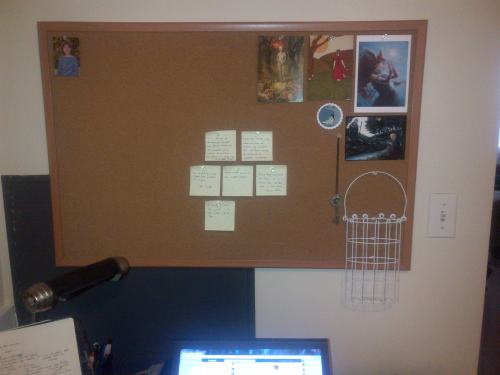
I actually posted the quotation over my desk, on my cork board. It’s written on a sticky.

It’s right under the stickies that say “What would you do if you weren’t afraid?”, which I originally read on Terri Windling‘s blog, and “Do what I do: hold tight and pretend it’s a plan.” That one I attribute to the Doctor. (If you don’t know who that is, you may not be sufficiently nerdy to read this blog!) I think it goes very well with both of them. Terri’s asks you to think about what you would do if you weren’t afraid of what might happen: it asks you to imagine. The Doctor’s tells you how to get there: hold tight, pretend it’s a plan, and go! And the one I just pinned up says, what you want is on the other side. It’s a promise.

I have done many things in my life, and they have taken a certain amount of courage. Even writing this blog takes a certain amount of courage, because what if people disagree, what if they take offense? After all, I wrote yesterday that J.K. Rowling was not a writer. She is an instinctive storyteller, and I have a great deal of respect for her, and for her intellect: I read her graduation speech at Harvard, and she is a smart, wonderful woman. But I have not seen her wrestling with the act of writing itself, the way I see Le Guin doing it. The way people who are writers to their core wrestle with their craft. She might become one: we’ll see what her adult novel is like. Who knows.

But I think I’ve created a life for myself that involves constantly overcoming fear. After all, three days a week I stand up in front of college students and try to both inform and entertain them. I send my work out there, to be either accepted or rejected. I am constantly out in the world doing things, despite the fact that I’m a fairly intense introvert. I’m perfectly happy sitting in a room by myself and reading for most of a day. And I am, like many writers, thin-skinned. I hate conflict and criticism.

The secret is that I also need the fear. I know that if I’m not doing something that scares me, at least a little, I’m not really living. What I told my friend was, you and I are the sorts of people who need to stare into the abyss. We’re not happy unless we’re pushing ourselves, unless we’re testing our own limits. I certainly do that in my writing.

So I like the quotation: what I want is on the other side. Life is not about overcoming fear, but about being afraid and doing what you want anyway. About using the fear to let you know that what you’re doing is worthwhile. After all, anything worth doing is difficult.

Posted in Uncategorized | 4 Comments

Boy Wizards

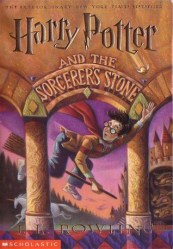
I’ve been thinking a lot about why books like Harry Potter, Twilight, and yes, even Fifty Shades of Gray, are so popular. (I’ve read all the Harry Potter books, I made it through the first Twilight book, and I’m not going to read Fifty Shades of Gray for the same reason I don’t eat McDonald’s hamburgers. Which is that I’ve had real hamburgers, and I see no reason to try fake ones that are inevitably going to taste bad and leave me feeling sick. Meaning, just in case you didn’t get that metaphor, that I’ve read real books, and I have no desire to read fake ones.)

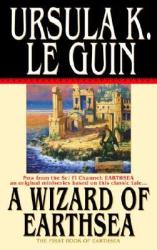
I was thinking about this specifically because in an interview, some time ago, Ursula Le Guin compared her Earthsea books to Harry Potter. I grew up on A Wizard of Earthsea, and the Earthsea books were among those that created my perception of fantasy, and of the world I lived in. I have enough invested in them that I was really, genuinely angry at Le Guin for writing Tehanu, which felt like a betrayal.

But the question I’m most interested in right now is, why are the Harry Potter books so much more popular? Le Guin is by far the better writer. She is a writer: for me, J.K. Rowling is someone who happens to have written a popular series, but someone who is not, at heart, a writer. I know that’s a controversial statement, and I don’t mean it in a negative way. But I would say the same about Stephenie Meyer. Le Guin has written novels, short stories, poems. She has written essays on writing, on her own writing practice and on genre. She is, in a deep and complete way, a professional writer.  I have no desire to read Rowling’s adult novel, which is supposed to come out soon.  Whereas I will seek out most of what Le Guin writes.

So what does Harry Potter have that her books don’t? What makes them so popular?

Honestly, I think it’s that they come directly from our deepest desires. We all want to be Harry: the boy selected for greatness, the boy who comes into his own without having to wonder whether or not he will ever be great. The boy who is immediately recognized for what he is. Ged is not Harry Potter. He is also a wizard by instinct, he also gets into a wizarding school, but his time there is so much more difficult. He has to earn his later fame through a series of trials, in which he realizes that his own worst enemy is himself. His own talent and ambition hold him back. He is tempted, as we are all tempted but as Harry is not truly tempted. Harry never wants to be Voldemort. The fact that they are doubles is always implicit, but Harry does not want to go over to the dark side. Ged discovers that the darkness is in himself.

The Earthsea books are so much more complex, so much less comfortable to read. In a sense, they are less entertaining. They are more work. They are about us.  (I would add that Ged’s suffering is internal, whereas Harry’s suffering is largely external.  He has to fight an external enemy, not his own impulses.)

I suppose I draw two lessons from this, which may not be what you expect. The first comes from having studied Victorian literature and knowing that what is popular, even wildly popular, in one era is often forgotten in the next. Who now reads Dickens’ The Old Curiosity Shop? So we should write what we are drawn to write, knowing that popularity at any given time means very little. But the second is that books like Harry Potter have something to teach us: they give us pleasure because they give us part of what we want. They fulfill our dreams and desires. And that can be an important technique for a writer: making a book entertaining is itself a technique we can use. Even if we want to do the more difficult stuff.

(I should add that the Earthsea books are of course entertaining, although in a different way. They give us wizards and dragons and Le Guin’s beautiful language. I read them for that, but I did rebel when the later books became less like that, and more about her philosophical message. Still, I have to read Tales from Earthsea, which I saw in the bookstore recently.)

Posted in Uncategorized | 22 Comments

Visiting the Dead

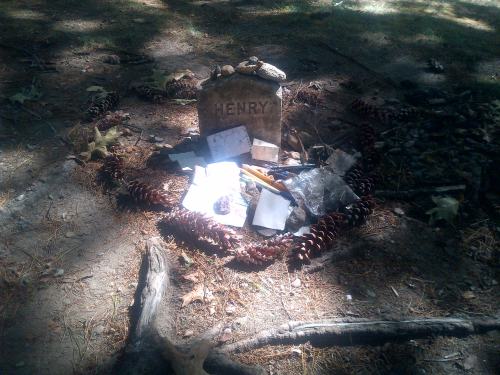
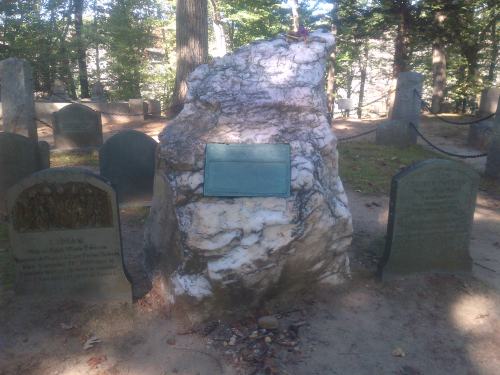
Last weekend, I went to the cemetery in Concord where prominent families used to be buried, back in the 1700s and 1800s. There’s a narrow path there called Writer’s Row. It goes up a hill, and as you walk along it, this is what you pass:

The grave of Henry David Thoreau.

Can you see the things people have left? Including letters about how much his writing has meant to them. (Of course I didn’t read his private correspondence. But some of the letters had been left open, and you could see what people had written him.)

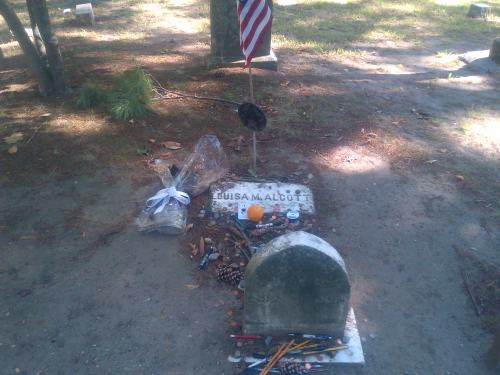
The grave of Louisa May Alcott.

Among the things left for her were an orange, a kazoo, and a lifesaver. (Yes, the small candy. I wonder if it was meant to be a metaphor? It was still in its plastic wrapper, as though someone had wanted it to be preserved.)

The grave of Ralph Waldo Emerson.

This one was the grandest, but not my favorite. I liked the smaller gravestones better, and there were more things left at them. I think it’s easy to respect Emerson, but easier perhaps to love Thoreau, Alcott, and Hawthorne.

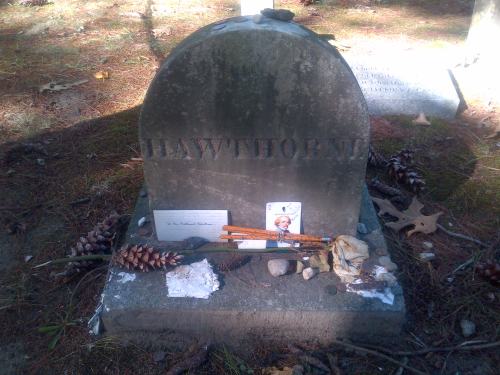
The grave of Nathaniel Hawthorne.

I mention this one last although it was not the last in sequence, because this was the one I went back to. I sat by the grave, tore a sheet of paper out of my Moleskine notebook, and wrote him a letter. (I always travel with pen and paper, of course. Doesn’t every writer?) I tried to make it relatively formal, so he wouldn’t be shocked by my modern tone. I called him “Dear Mr. Hawthorne.” I thanked him for creating Beatrice Rappaccini, told him that I had written a story about her and that she was a character in my novel, and said that I hoped he wouldn’t mind. I hope he doesn’t . . .

We’re always in conversation with other writers, aren’t we? And some of them, perhaps most of them, are dead. It’s nice, sometimes, to write them a letter. (In case you were wondering, my letter is the one on the left.)

Posted in Uncategorized | 6 Comments

Contentment and Joy

I’ve been reading a lot recently about happiness — not because I’m researching the topic, but because a lot of people seem to be writing about it, and I run across the articles. For example, the Mayo Clinic has a page called How to be Happy, subtitled “Tips for Cultivating Contentment.” There are books being written about happiness, TED talks being given about it.

These articles bother me, I suppose in part because they seem to confuse what I think are two distinct feelings: contentment and joy. The Mayo Clinic article uses the terms interchangeably. But I think they really are quite different, and happiness is a sort of general category that can encompass both.

Contentment is the feeling of being peaceful, satisfied with your circumstances. I feel content when I lie in bed on a Saturday morning and look out my window at the sky, knowing that I have a whole weekend ahead of me. It’s the feeling of not wanting things to change, because the present moment is enough. It’s the feeling of living in the present, which is what Buddhism teaches us to do. Of not desiring anything else. Contentment is essentially static.

I was wondering what pictures to include with this blog post, and I decided to take photographs of the two front corners of my apartment. This is the left corner. You can see a drawing of a tree in a field, by my grandmother. Above it is a fantasy print. And hanging from a bracket is my birdcage, with two birds (not real, of course, although they have real feathers) on the outside. I don’t put birds in cages — not even artificial ones!

In the right front corner you can see the prints I’ve put up recently — one matches the print on the left, and I just remembered that they are by Amy Brown. The watercolors are by my grandmother, and I bought the print of the green girl at Wiscon. It’s by Samantha Haney. If you want a copy of it yourself, you can find it right here: “Green Girl.” The artist’s contact information is on her website. You can also see the bed curtain I created, which I’m very happy with! (Every bed should have curtains, no matter how rudimentary.)

Living in spaces like this makes me content. Creating spaces like this gives me joy.

Joy is not contentment. It’s caused by action, change. Joy can be the result of dissatisfaction: indeed, perhaps it requires dissatisfaction. I am dissatisfied, I change something, I create — and then I feel a sense of joy. Unlike contentment, joy does not stay. It is fleeting, but it can come back. Contentment feels like swimming in a warm lake. Joy feels like standing on top of a high mountain, breathing clear, cold air. Joy is exhilarating, like a sweet, strong wine — like a Tokay. It makes you feel sharper, more aware. It can be almost painful.

If I had to choose between contentment and joy, I would take joy. But of course I want both. All the articles I’ve read on happiness seem to focus on contentment. I think it’s time they started talking about joy as well.

Posted in Uncategorized | 2 Comments