Our Inner Dialog

Since moving into the city, I’ve spent more time alone than I have for many years — in part because I’m just so busy and don’t have time to meet friends. But it’s created an interesting situation: I can hear my own inner dialog more clearly, and more often, than I’ve been able to in the past.

You probably know what I mean. I was wondering whether to call it an internal monologue, but I think there are two voices. One is the internalized voice of society, by which I mean everyone outside yourself. The voices of your parents figure in it prominently, but there are also the voices of friends, teachers and others in authority, and of course the media. That voice speaks as one, but it’s made up of all those different voices: it exists where they intersect. So if your mother told you that you are overweight, and that’s the message you received from your friends, and the images in magazines imply the same thing, guess what that voice is going to tell you? That you’re overweight, of course.

I’ll call it the Critical Voice, because what we internalize most often is criticism. The voice speaking in response is the Responsive Voice. It’s our inner self responding to that voice. It usually responds, rather than speaking on its own initiative, although I’m beginning to think it should.

I’ll tell you about a conversation I once had with my mother, which will indicate what sort of Critical Voice I have. The conversation took place about three years ago, in a train from Budapest to the town of Szántód, by Lake Balaton. It was a rickety old train, moving along old tracks through farmland. My mother was sitting on one side of the compartment, and I was sitting on the other. Ophelia was asleep, I think on my lap. My mother looked at her and said, “Ophelia looks like me.” She paused a minute and then added, “She’s a pretty girl. Sometimes these things skip a generation.”

I laughed and said to her, “Do you realize you just implied that I’m not pretty?” I laughed because that was of course the message I’d gotten most of my childhood. It was a deliberate message: my mother made clear to me, years later, that she had wanted to make sure I did not think being pretty was important, that I learned to rely on my brains and education. She did not believe in telling girls that they were pretty. It was bad for them. This, by the way, is something I find very Eastern European. There is a belief, among Eastern European parents, that praising children is bad for them. Notice that my mother only remarked on Ophelia’s prettiness while she was asleep.

Sitting in the train, she replied, “You’re pretty in a different way. You look like your father.” Which again made my laugh, since at that point she had not spoken to my father in twenty years. I took after that side of the family.

The things we hear, particularly from parents but also from society as a whole, forms the Critical Voice. Even when we don’t hear it, it’s there, telling us what it thinks of us, our plans, our ambitions. I can hear it more clearly now, and you know what? It’s wrong.

I think what I need to do is turn my Responsive Voice into something stronger. I need to let it speak first, let it indicate what my inner self needs and desires. Then the Critical Voice can respond, but the Responsive Voice (which I should perhaps call the Desiring Voice) can dismiss its criticism. It can say, you’re too late. I’ve already decided what I want to do. (Maybe it can become a Decisive Voice. Whatever I call it, I want it to speak — not just respond.)

Being able to hear that Critical Voice has made me so much more conscious of how much it’s there, and how much it says about what I am not and what I should not do. I want to start talking about what I am and what I should do instead. (Maybe I should call that inner voice the Affirming Voice.) It will continue to be a dialog: both voice will always be there. It’s just a matter of which one I listen to, which one I take more seriously.

Posted in Uncategorized | 5 Comments

Managing Depression

If you’ve been reading this blog for a while, you know that I went through a period of depression that lasted for about two years, although I wasn’t depressed the whole time. It came and went. It was no surprise: those two years were the years I was writing my PhD dissertation, and although I doubt much research has been done on this, I think working in such an intense way, for such high stakes, can and certainly does lead to depression — many of my friends who have done PhDs report similar experiences. Of course, I was also teaching full-time and I had a child. Those made finishing the PhD even more difficult.

The depression ended some time after I received my diploma, and it hasn’t come back since. But now that I’ve had it, I’m aware of it: sometimes I can see the shadow of its black wings. I can feel when they come near me. They never would have when I was younger, but this is what I believe: those of us who do difficult creative work can’t do it without making ourselves more vulnerable to things like depression. To do any creative work well, you have to open yourself up — to the world, to other people, to whatever is out there. And you have to make the barriers in yourself, the barriers that keep out your own fears and desires, thinner. Because in order to write well, you have to feel things, understand things, and that means the membranes between yourself and yourself, and yourself and others, have to be permeable. You become more vulnerable to all sorts of things. If you’re going to be sensitive, and you have to be as a writer, you can’t have a thick skin.

So I find myself managing my moods, living in a way that leaves me feeling balanced and healthy. Well, as much as I can. At least, I have a much better idea of how to do it now than I did when the depression first hit. (I did the right things, by the way: started going to a therapist, started working on recovering from what is not a mood, but an illness.) I’m going to write what I learned down, in case it helps anyone else. Here are the things I pay attention to now:

1. Sleep. You must get enough sleep, and not only sleep but also rest. I don’t get as much sleep as I should, but if I don’t, I know that I’m going to teeter on the edge of sadness, and I will feel as though there is something wrong with me, or with life, but no: it’s just a lack of sleep. It’s purely physiological, and I know that I will feel better once I get some rest. So I don’t push myself as hard as I used to. I know my health depends on it.

2. Food. When I told my therapist how I manage my food, she initially though it was strange, that there might be something compulsive about it. But I told her that I did it to manage how I felt throughout the day, so that my mood was always stable. I think everyone’s body is different, and everyone has to learn how to do this for themselves, based on how different foods make them feel. But I feel best when I eat whole grains, lean proteins, fruits and veggies, and healthy treats. Four meals a day, about 400 calories for the first three, about 600 for dinner. Each meal has to have whole grains, lean proteins, and fruit or veggies. Except the treats. So a typical day will be oatmeal with milk, orange juice, and a chai latte for breakfast; a cheese sandwich and an apple for lunch; something sweet for a snack (like the brownies I make); and beef stew with vegetables for dinner. I try never to get either full or hungry. I try to make sure that any grains I eat have whole grains in them, and while I eat plenty of sugar, I buy the organic kind — those brown crystals — because I’ve noticed that it doesn’t seem to affect my energy level as much. It’s pretty simple, really. I drink water, tea (herbal except for the chai in the morning), and sometimes juice. And I eat low-fat but not non-fat (cheese, mostly). I think non-fat foods just make you hungrier.

3. Exercise. I hate gyms. So I don’t go to gyms. It’s pretty easy getting plenty of exercise in the life I’m living now. Since I’ve moved into the city, I haven’t had a car, so I either walk everywhere or take the T. I can easily cover five miles just running errands. I walk every day, and when I have a chance to, I choose to walk rather than taking the T. But I find that yoga and pilates, morning and night, help me stay balanced and feel healthy. I haven’t been very good at doing them recently, but I feel so much better when I do! It’s something I definitely need to get back to. And I want to set a good example for my daughter: I want her to see that her mother is healthy, and cares about her health. But mostly, I want the feeling of calm that it gives me. If I can stretch and do yoga for half an hour in the morning, I know that I’ve done something good for myself that day.

4. Pleasure. I think you have to deliberately do things that give you pleasure. Every day. It may sound silly to say this, but being able to take a hot bubble bath at the end of the day changes my perspective significantly. Playing music. Walking by the river, which is so beautiful in autumn. Going to the art museum or a concert. Making sure that each day, you do something that pleases you, that if possible brings you joy. Even, for me, walking through a bookstore . . . You have to treat yourself as though you were someone you loved.

I have some more thoughts on this topic, but I have other work to do tonight — perhaps I’ll write more about this some other time. I’ll end this post with a picture of me by the beautiful river:

Posted in Uncategorized | 13 Comments

Miss Mary Mack

I’ve been teaching Ophelia “Miss Mary Mack.” Do you remember the rhyme? If you’re a woman about my age, and you grew up in an English-speaking country, I’m sure you do. It goes like this:

Miss Mary Mack, Mack, Mack,
All dressed in black, black, black,
Had silver buttons, buttons, buttons,
All down her back, back, back.

She asked her mother, mother, mother,
For fifteen cents, cents, cents,
To watch the elephants, elephants, elephants,
Jump over the fence, fence, fence.

They jumped so high, high, high,
They reached the sky, sky, sky,
And they never came back, back, back,
Till the fourth of July, July, July!

There are variations: the version in Wikipedia (yes, there’s a whole entry for this rhyme) is a little different. Wikipedia says it’s the most common clapping game in the English-speaking world, and I’m sure that’s true. When I started teaching Ophelia clapping games, it was the first one I remembered, although “Miss Lucy Had a Baby” also came back to me pretty quickly. I started teaching her clapping games because she would get bored on the subway, and I didn’t want her playing games on my cell phone. I needed a way to keep her amused, and clapping games required only hands.

Once I started teaching her, I was surprised by the realization that she didn’t already know them. After all, she’s eight. Didn’t I already know clapping games by the time I was eight? Perhaps it’s because she plays primarily with boys, but I think it’s more than that. I think that the culture of childhood is disappearing.

If you’re my age, you probably remember having your parents tell you to get out of the house, particularly during summer vacation. We would get out of the house and just go — a group of kids, usually all the kids from the neighborhood. We would go down to the creek, wherever that was (there always seemed to be one), and play all sorts of games. Older kids taught younger kids games like Cat’s Cradle, and Slap Jack, and all sorts of jump rope rhymes. Songs like “Jingle bells, Batman smells, Robin laid an egg . . .” (I bet you remember the rest.) Ophelia goes to one of the best schools in Lexington, which is one of the best school districts in the state, probably the country. Kids from the high school go on to Ivy League universities. The parents come from all over the world to work in Boston, primarily in medical and technological fields, and they live in Lexington for the schools. After school, their children go to chess club and robotics team and violin lessons, to karate and riding. They play together only at school or on playdates. And on those playdates, they play Pokémon or on their Wiis. Even Ophelia has an iTouch, given to her by her grandmother, so she can play Angry Birds and whatever else is on there. They don’t play clapping games.

Think about what we’re losing. Our children will be ready for a technological world, but we’ll have lost games and rhymes that have been handed down, child to child, sometimes for centuries. I think that’s terribly sad.

(On the other hand, I just realized that Miss Mary Mack would be an excellent Halloween costume. All you need is a black dress, silver buttons to sew down the back, fifteen cents (unless you’re doing the more expensive fifty-cent version — evidently, ticket prices have gone up) and a stuffed elephant. I think that would be a brilliant costume!

Posted in Uncategorized | 13 Comments

Meaning in Fairy Tales

Elmore Leonard famously said about his writing, “I try to leave out the parts that people skip.”

Fairy tales do that, of course. They leave out all the boring parts. Because they started as oral tales, they are almost pure plot. That’s one reason they are so much fun to read, although when we read them, there are also things we miss: character development, descriptions of setting. For those, we go to other kinds of stories.

I was thinking about this today as I was walking to the grocery store. I thought, what does it really mean to live life as though it were a fairy tale? Do you try to leave out all the boring parts? Well, of course in life we can’t do that. There are always going to be boring parts. And in fact, those boring parts are represented in fairy tales as well: Cinderella has to spend a long time cleaning the kitchen. Fairy tales can mention those parts briefly, but the fairy tale characters, if we imagine them to be real, have to live through sweeping the hearth, and being a goose girl, and climbing the glass mountain. They have to deal with wearing a catskin day after day.

But what fairy tale characters get, in compensation, is meaning. All those things have a greater meaning that will become clear by the end of the tale. They are the ordeals the fairy tale characters have to go through to prove that they are worthy of the happy ending.

So I thought, perhaps living life as though it were a fairy tale doesn’t mean never being bored. Perhaps it means finding meaning even in things that seem meaningless.

Now that I’ve returned from the grocery store, and I’m sitting here eating soup and consolidating my thoughts, this is what I’ve come up with. If you want to live a fairy tale life, you need to start with the following.

1. Minimize the boring parts as much as you can: either get rid of them or, if you can’t, try to make them more interesting. I find doing dishes boring, and I can’t not do dishes, because I wouldn’t have anything to eat on. But I’ve bought myself very pretty dishes, so I like to see them emerging all clean from the soapy water. That turns doing dishes into a kind of sensual pleasure. And finding dishes that go together, usually at Goodwill, is an adventure — each dish has its own story.

2. Fill the remaining boring parts with meaning. Find the meaning in them. I’m very lucky to be doing work I love, but there are certainly boring parts, as there are in every job. I remind myself that my work supports my writing, and that I’m climbing the glass hill because on the other side is the ogre’s castle, and I need to get to the castle to find and free what I love. (This is an elaborate metaphor of some sort, although I’m not entirely sure how it’s working. What is the ogre? The publishing industry? Have I mentioned that it’s Friday and I’m very tired?)

That’s what fairy tales offer us: meaning. And if we want to have fairy tale lives, we have to find or create the meaning of them.

These, by the way, are some of my dishes:

Posted in Uncategorized | 2 Comments

The Value of Reading

Here I am, trying to write a blog post! Even though I’m tired and I have a lot of reading to do tonight for the classes I’m teaching tomorrow. But it’s so easy for me to focus on everything that needs doing, and neglect the things I want to do. (Although, I have to tell you, I’m working on the novel! I’m very happy about that.)

Tonight, I thought I would write about a quotation I found on Facebook. It was posted by Jonathan Carroll, who is always a wonderful source of quotations. It goes like this:

“We are, if not exactly ‘saved’ by reading, at least partially ‘repaired’ by it: made the better morally and existentially. To those who find that idea fanciful I would put the question: when were you last mugged on the Underground by someone carrying Middlemarch in his pocket? We read to extend our sympathies, to see ourselves in others and others in ourselves, to educate our imaginations, to find liberation from the prison of the self, to be made whole where we are broken, to be reconciled to the absurdity of existence, in short to be redeemed from flesh, the ego and despair.” –Howard Jacobson

Doesn’t that sound wonderful? The problem is, I don’t agree with it. We try so hard to justify reading, in a society in which many people simply don’t read, that we assign it some sort of moral value. We say that reading will make us moral. It will save us from becoming the sorts of people who mug others on the subway. And I think that’s absurd. The sorts of people who carry around Middlemarch in their pockets have generally received an expensive enough education that they don’t want to jeopardize it by having a criminal record. But also, perhaps they haven’t read Middlemarch carefully enough. Because if you read it, really read it, you might become the sort of person who mugs people on the subway in sheer despair. You might realize that you live in a society that limits your choices, in which love and authenticity are difficult to achieve. You might identify with Dr. Lydgate.

Don’t tell me that reading The Stranger or The Metamorphosis or 1984 is going to keep you from mugging people! Or even The Hobbit.

Reading is just as likely to wound you, to make you hate other people or the society you live in. To long for something else, to reject the absurdity of at least contemporary existence. The people who ban books are wrong about banning books, but right about why one would ban them: because they are a bad influence. They make us discontented with our lives. They are subversive. They do not reconcile us; they encourage us to rebel. Writers understand that: Flaubert warned us in Madame Bovary.

Books are not spinach. They are brownies. (Coincidentally, I just ate brownies. They were desert, after a dinner of a ham omelet with buttered toast.) If they were spinach, do you think we would want to read them?

The justification for reading, the importance of reading, is that it damns us, wounds us, makes us thought criminals who reject the status quo. But in the process, it opens us up to new possibilities, which include the possibility of changing the world we live in. Or rejecting it.

I am sorely tempted to write a short story about a man who mugs people on the subway specifically because he has read Middlemarch. Because I can see exactly why he would.

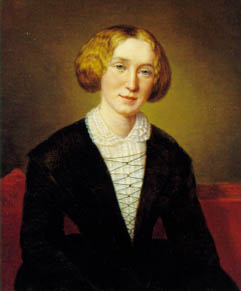
George Eliot by Alexandre Louis François d’Albert Durade

Posted in Uncategorized | 4 Comments

The Fairy Tale Life

I know that I’ve been terrible about updating. I’m going to try to do better. The reason I’ve been terrible is that it’s been an incredibly busy month, and in the middle of that business, I’ve become introspective. I’ve turned inward rather than outward. I take walks, I look at the river. I think a lot.

Do you remember that about a year ago, I kept posting about caterpillars? In their chrysalis — is there a plural for chrysalis? — waiting to emerge. That’s how I felt at the time, like a caterpillar in its chrysalis, not entirely sure what was going to happen to me. Now I feel like the butterfly that has emerged and is waiting for its wings to dry. I’m trying to figure out where to fly next, where my wings will carry me. I’m not sure, and so I’m waiting for some sort of sign from the universe, something to tell me, yes, there.

In the meantime, I work and write and make apple crisp (which is what I’m doing right now).

This blog post is about living the fairy tale life, by which I probably mean something different than you think. It was originally inspired by part of an interview that a student of mine posted in the Facebook group for my class on Fairy Tales and Literature. The interview was with Christian Louboutin (yes, the shoe designer). He said that his life was a fairy tale and added, “But it’s because I choose to make it one. It’s very simple: You make up your mind about what kind of life you want to live. I choose to live in a fairy tale.” When I read that, I wondered if it really was that simple. Do we get to choose the kind of life we live? If we live AS IF we are in a fairy tale, will it work?

And then I started wondering what it would mean to live in a fairy tale anyway. Because the truth is, fairy tales can be fairly unpleasant places — like the real world, actually. But I thought of two things fairy tales give us that the real world doesn’t: magic and meaning.

In the real world, things don’t happen by magic. Or most people believe they don’t, but I have often felt magic in my own life. It has felt as though a good fairy is looking out for me, helping me. Living in a fairy tale is often difficult — there are ogres — but there is also help, there are also speaking animals that will tell you the way, good fairies that will show you what to do. And in fairy tales, your actions have meaning. Sharing your food with an old woman will eventually save you. To be honest, I believe that’s true in our world as well. Perhaps what really happens is that in our world, which is not a fairy tale world, we act as though there is no magic, and no meaning, and so they disappear. After all, our perceptions shape, if not reality (and I believe they do, to a certain extent), then our experience of it.

I’m going to write about this more in the coming days, but for the moment, I will leave you with a graphic that I asked a friend to design for me. It’s about living in a fairy tale, and it says that living a fairy tale life is not easy, or for the faint of heart. But I think what you get at the end is magic, meaning, and maybe even happily ever after.

Posted in Uncategorized | 8 Comments

Making Adjustments

This is going to be a fairly quick post, because I want to attend a concert tonight:

I couldn’t have done that — attended a concert at night — last year. It would have meant staying in the city late, trying to find dinner before the concert, and then afterward driving another hour out to the suburbs. But this year it’s a short walk away. I’m eating dinner as I’m writing this: cream of zucchini soup that I just made on the ancient stove. I’m doing well with that stove. Whenever you move into a new place and start learning a new stove, it takes a while. So much of cooking is instinct, and I’m developing an instinct as to how long I can leave something to brown before it burns — that sort of thing. Last night, I used the oven for the first time.

This fall, I’m adjusting to living in the city again, and you know, so far it’s been rather wonderful. Oh, there are all the problems one has living in the city. It can be harder to find things than it was in the suburbs. But there are also so many advantages. For one thing, I can walk just about everywhere. And if I can’t, I take the subway. That has created one problem: I’m walking so much more now that I’m hungry all the time! I have to figure out a way to eat more, healthily. I’m working on recipes: tonight, I’m hoping to make the perfect apple crisp. (The one I made last night was almost but not quite right.)

But the biggest adjustment I need to make has to do with my work habits. I tend to be a bit of a workaholic. I couldn’t be, last year. I had a long commute each day, and I was very tired at the end of it, so I couldn’t work the way I can here, where I’m around a computer most of the time. I need to make sure that I don’t overwork myself. I also need to make sure that I leave plenty of time for writing, that I don’t spend all my time on teaching. That’s difficult, because I love teaching and it’s so demanding anyway that it’s easy to spend all my time simply doing that. But I have a novel to work on. I want to make sure that I block out at least two hours each weekday to work on it. That’s not a lot, but then, I have to much to do that I don’t know how I could find more.

I feel very strongly that this is an interim period, that this is the time during which I create the work that will take me through the rest of my life. In which I create the professional and personal life that is to be. I’m looking forward to it. I just need to make sure that I get enough food and sleep! And of course take advantage of all the wonderful opportunities in the city.

Posted in Uncategorized | Leave a comment