Our Need for Romance

When I was a graduate student, I had money for necessities, but not luxuries. (Necessities were things like rent and heat. Luxuries were often things like clothes. That was when I got into the habit of shopping in thrift stores.) At some point, I mentioned to a friend that I missed being able to buy perfume. She sent me a whole bottle of Chanel No. 5. I used to wear it every day, and some days, I used to put just a little bit on before I went to bed, so I could smell it even in my sleep. I still have some left.

I don’t know if we all have a need for romance, but I think at least some of us do. I know I do . . .

I define romance broadly: in its modern meaning, it usually refers to romantic love, but in an older sense, it refers to the medieval romances, which were tales in the native vernacular (French, Italian, Spanish) rather than in Latin. They often involved knights, ogres and giants, ladies who lived beneath lakes or could turn into animals. They were tales of adventure and magic. I think we all need tales of adventure and magic in our lives.

I feel my own need for romance the most when I’ve been working very hard (as I have been recently). It feels as though I’m not truly living, merely existing. That’s when I want something interesting to happen. Something that tells me there is an underlying magic to the world, that life can be an adventure. Of course, as you can tell by this blog post, I’ve been feeling that way lately. It’s November, so the work is constant and it’s never done. But I hope there is some sort of magic and adventure in the near future, waiting for me. Sometimes I think that rather than making the future, we are pulled toward it, that there are certain nodes that draw us onward. It’s as though life is a matter half of fate and half of intention, both what we make it and what the universe wants of us. Sometimes I think of it as a dance: we are dancing with the universe, toward our futures, our fates.

I’ve gotten esoteric, I know. But what I meant to say was, I think many of us have a need for something other than ordinary life. We need it as a reminder that ordinary life is not all there is, that there is more. (And there is. I believe that.) There is courage, there is passion, there is beauty in the world. We can’t always see it, but it’s there. Those are all large things, and often we don’t have time for such large things, not in our daily lives. We only have time for smaller things, for small indicia of them. So we buy perfume; or wear long, elegant coats; or hang pictures of landscapes that remind us of our dreams. It is the most we can do, and some days that is enough. But it also reminds us that there is more to life, that the larger things exist.

I’m going to include one of my favorite pictures, which I may have posted before. It is John William Waterhouse’s My Sweet Rose, and it reminds me of our need for romance: our need to smell the roses on the wall, before winter takes them.

Posted in Uncategorized | 4 Comments

Finding the Time

I’m so tired! It’s the middle of the semester, and I’ve spent all week meeting with my students about their papers. I have 48 students, and it takes at least half an hour to go through a paper and meet with a student (about fifteen minutes each). So I spend about 24 hours meeting with students, in addition to teaching and holding office hours. And then there are all the administrative meetings, which have been particularly numerous this week. Both of the classes I’m teaching this semester are new, and I’m trying to make them interesting and innovative, so there’s quite a bit of preparation involved. Because of all that, I’ve been feeling overwhelmed with work, and very tired.

So the question is, what happens to the writing? Well, the answer at the moment is that I haven’t written in several days. No, that’s not true: I wrote a couple of paragraphs yesterday, but not of the novel. I was waiting to vote, and I wrote several paragraphs of a short story while standing in line. (Voting took about an hour and a half, and it was the end of a long day of meeting with students.) If I had brought a book, I would have read — it would have been Jane Eyre, which I am currently teaching, so my reading would actually have been preparation for class. But I didn’t have a book, so I took out the Moleskine notebook I always have with me, and one of my Pilot pens, and started the story I want to write.

But I haven’t been working on the novel, and that really bothers me. The problem is that working on the novel takes a certain amount of energy: I can’t be exhausted. And I’ve been exhausted most of this week.

How does one find the time to write?

I wanted to find an icon for this blog post, and I found what I think is an appropriate one: a picture of a woman writing from a mural in Pompei.

I wonder if she had the same problems I do? It seems as though all of my time is needed simply to do the work that supports me. The advantage of teaching at the university level is that it does allow me to have a flexibility that many people don’t, and I do genuinely love it. And it gives me ideas that I would never have gotten otherwise: for example, I was reading the fairy tales that the students in my Fairy Tales and Literature class had written, and I thought, what I really want to do is write a series of stories about Sylvania, my imaginary Eastern European country. (My stories “Fair Ladies” and “Princess Lucinda and the Hound of the Moon” both take place there.) I want those stories to tell the history of Sylvania, and somehow I want to include the Sylvanian versions of the fairy tales we all know. I wonder what those versions would be like?

But the problem with teaching is that it takes the same kind of creative mental energy as writing. So by the end of the day, my brain is already tired, and of course that’s when I write. I know some people write in the morning, but I can’t do that. I can’t write knowing that I will need to stop in order to get dressed, or eat breakfast, or go off to teach. I have to sit down at my computer knowing that I have as much time as I need, that if I need to stay up later to finish something, I can. And writing is tiring: I can’t go and teach afterward.

So there’s my dilemma. Next semester may be a bit easier, I don’t know. And then I’ll have more time over the summer, although I’ll be teaching part of the summer as well. I envy people who have some sort of financial support, because for me, it’s all me. I have to support myself and do what I love to do in the time that’s left. On the other hand, I know people who have a lot more support than I do, a lot more time, and who talk about writing without necessarily writing. I suppose what you have to have, in the end, is determination. You have to find what time you have, and write then. I don’t know if I can tonight: I’m honestly worn out. But I have to find a way to plan better, take care of myself better, so I can do it. I’ll find a way. I always do.

Posted in Uncategorized | 6 Comments

Talent and Discipline

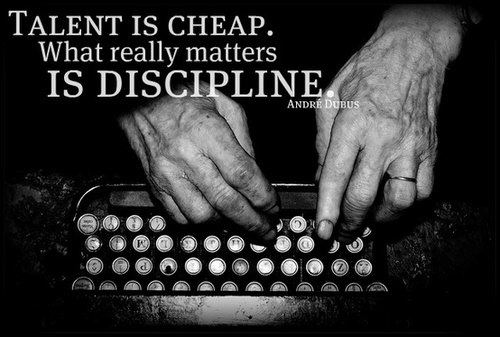
There’s a graphic that has been making its way around Facebook. It looks like this:

I’ve been thinking about it, even looking up the man who is credited with saying that talent is cheap: Andre Dubus. (His name doesn’t seem to be spelled with an accent anywhere but in the graphic, although that’s the French spelling. Having read that he’s a former marine who received an MFA from the Iowa Writers’ Workshop and passed up lucrative novel deals because he wanted to devote himself to the short story, and that he was a friend of Vonnegut and Updike, I rather doubt that he used an accent. He doesn’t seem the type.)

And I’ve been wondering if it’s right. I’m not so sure it is. I’m not so sure talent really is cheap. If it were, we could all be anything we wanted to. I could, with enough discipline, become a talented gymnast or musician, for example. But that’s not the way it works. If you’ve raised a child, you know that children are good at some things and not good at others. Intellectually, my daughter is ahead of her peers, particularly in terms of her verbal ability. She’s also physically uncoordinated, the way I was at her age. Neither of us is particularly good at sports. No, let me be more specific: there are certain sports I could be good at. I’m good at sports that require grace: downhill skiing, anything involving dance. I’m not good at sports that require spatial skills, anything involving a ball. Even gymnastics. I could get better at them, I’m sure. But do I have talent? No, I don’t.

Talent is what, initially, allows us to do things untaught or self-taught. Later, it allows us to make the most of the training we receive, to move more quickly and benefit more from a training regimen. I’ve seen people with talent. I’ve seen them sit down at a piano and play something after having heard it once. Or sit down at a table and draw something, knowing before they set pen to paper where each line is going to go. Talent is something we envy, because it makes the difficult seem easy. And talent is something that has gotten a bad rap lately, I think because it seems undemocratic. The idea that talent is cheap, and that discipline is what’s important, seems more American somehow. We want to believe that we could all become great at whatever we chose, if we dedicated ourselves sufficiently. But I don’t think that’s true.

I do think that we all have different talents. Perhaps that is my own egalitarianism: I think we all have something we are called to do. Some people answer the call, some don’t. I’ve seen people with significant musical talent go into the business world, where that talent went undeveloped and was used only to entertain during family gatherings. Is there anything wrong with that? Well, to be honest, I actually think there is. But whether or not we develop our talents is our individual choice. That is where discipline comes in. It takes a great deal of discipline to become truly good at anything. But I think in the end, to be truly good (much less to be great), you need the interplay of talent and discipline.

I wish I had a good definition of talent. I’m trying to think of what it is exactly, because I do think I have one (remember, so does everyone else: a talent or talents). Perhaps it’s a capacity to get inside something, to see it from the inside rather than the outside. For a musician, it’s an instinctive sense of how music works. For a writer, it’s an instinctive sense of how words fit together, how they make sense and the different kinds of sense they can make. It’s the way my eight-year-old daughter, told that a painting is Op Art, immediately asks if the word comes from “optics.” It’s the way I can feel dance moves in my body, as I can’t feel the moves in basketball — but I know there are people who can.

Don’t get me wrong: discipline is at least half the battle. But talent is not cheap. If only it were!

Posted in Uncategorized | 11 Comments

Becoming the Writer

I have a theory: anything that we do on the outside has to have happened first on the inside. Before I could go to graduate school, I had to become the sort of person who could go to graduate school. I’ve always found that the internal change precedes the external one. When I tried to go to graduate school before I was ready, it didn’t work.

I think the same thing happens with a novel: in order to write a particular novel, you have to become the sort of person who can write that novel. And of course the process of writing the novel changes you as well. But you have to become the writer. The novel comes out of the writer that you are, and if you’re not ready, the novel won’t work.

I’ve had such a ridiculously busy week, and I’m so ridiculously tired, that I don’t know if I’ll be able to express this in the way I want to. But first you have to become the writer who can write a novel — any novel. I’ve seen friends of mine try to write novels and fail, in part because they didn’t believe in their own capacity to do it. You have to believe in your ability to complete a significant process. You can’t psych yourself out. There’s a certain level of confidence you need to write anything of that length. I think what convinced me I could do it, more than anything else, was completing the doctoral dissertation. If I can do that, I’m pretty sure I can write a novel.

And then you have to become the person who can write that particular novel. For the novel I’m writing, that means in part being a person who has done her research, who knows that particular time period. I got that from my PhD: I studied late nineteenth-century England. I know what people were wearing, what they were discussing. But the process of research is ongoing. There is so much I need to know, in order to move my characters around in that world convincingly. And then, I need to become a person who can write about young women who are social outsiders, who have family problems, who have problems with self-image and self-esteem. There’s no way to research that. It’s all knowledge I have from growing up in a certain way, in a certain family. From having been the person I am. But also from having become the writer I am, which is a writer who is aware of those things, who has thought about them, who can translate them into characters.

Writing takes a strange combination of arrogance and humility. I’ve seen writes so humble that they don’t believe in their own abilities. Some of them are very good writers who have difficulty completing longer projects. I’ve also seen writers so arrogant that they are not able to see outside themselves, to truly understand other people. Some of them are very good at completing projects, but not actually very good writers. Both arrogance and humility can be learned, and I think becoming a writer means learning whichever one you’re missing. I know that, in order to write this novel, I need both.

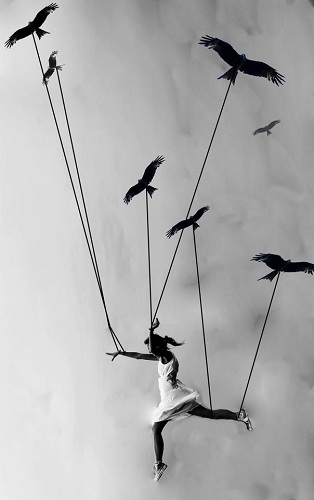
I recently saw and reposted this photograph:

I think it’s an excellent image for what it feels like to write a novel. You have to trust that the birds will hold you up, even though there’s no ground under your feet.

Posted in Uncategorized | 12 Comments

Writing a Novel

Did you know that I’m writing a novel? Well, I am. I’m about 30,000 words into it, which is longer than anything else I’ve ever written. Even The Thorn and the Blossom, which was a book, was only a novella: it ended up being about 20,000 words long. So it’s as though I’ve swum further out than I’ve ever swum before, and there are some things I’m learning about writing a novel that I couldn’t have learned in any other way.

The first thing I’ve learned is that it’s hard! Much harder than writing novellas. As you probably know, if you’ve spend any time on this website, I write different sorts of things: novellas and short stories and articles and poetry. Each sort of thing I write has its own rhythm, its own way it wants to be written. Strangely enough, writing a novel resembles writing my doctoral dissertation more than anything else. Constructing a plot is like putting together a very long argument: things have to happen in the proper places. If they don’t, you need to reorganize. You can’t get by, as you can in a short story, on the poetry of the language.

One of my greatest difficulties, and I don’t know if other writers have a problem with this, is simply moving my characters through space. How does Mary get out of a carriage? How does she walk across a room? I have to see, precisely in my mind’s eye, how she’s moving. And I’m dealing with more characters than in a typical short story, so I have to keep them all in mind. I can’t forget that one is in a scene, I can’t let the scene go on too long without that character doing something. I have to say, wait, this important message is being communicated, but in the meantime, Diana would be bored. Where has she wandered off to?

Part of the difficulty is that my characters are moving around London in the 1890s, and so I have to understand how they’re traveling. I’m so glad I went to London last summer! I honestly don’t think I would be able to write this novel if I had not seen the buildings, the parks, for myself. And this is where sometimes I have to pause while writing, so I can click over to Google Maps or Wikipedia. Or both. Monday, for example, I had to figure out how to get my characters from Baker Street to Purfleet, which is (or at least was) on the outskirts of London. It took a ride in a hackney cab and then a train. Here is how Wikipedia helped:

This is Oxford Street in 1875, and it’s the street my characters would have driven down about twenty years later. But at least it gave me a sense of what they would be driving through. It allowed me to imagine the rest. That’s why writing a novel is more like writing my doctoral dissertation: it’s a matter of fitting puzzle pieces together, and it involves a lot of research.

Of course, it’s a lot more fun than the doctoral dissertation, and that’s another difficulty: that I want to work on it all the time. Of course I can’t: I have a job to do. But when I do work on it, which is at least every other day, it’s hard to come back out. For a little while, I’m living so intensely inside my head, and when I come out, sometimes I forget what day it is, what I was supposed to do. I just want to be back in London with my girl monsters . . .

Posted in Uncategorized | 4 Comments

Living Intensely

There’s a storm coming. I’ve seen it mentioned on social media, and there have been stories about it on the news. The university has written to tell me that I can cancel classes if I need to, and even the electricity company is telling me what to do in case of downed power lines.

I live in the city, and all the power lines are underground. Perhaps that’s part of the reason I haven’t really been paying attention. The other part is that this is Boston, and we’re told that we’re getting a storm of the century every autumn. I have a flashlight, I’ll probably go out later today to get extra water and food. And I’ll charge up the electronics. But I’m half a block away from my office, in a brand new building in one of the largest universities in the country, which has backup systems. And I live in a building that has been standing for the last hundred years.

So yeah, maybe I’m not taking it as seriously as I should . . .

I was thinking about the storm today because it seems to mirror something inside me. I’ve been asking myself why I haven’t been better about updating this blog. Even while I was writing my dissertation, I was quite good at updating on a regular basis. I think it’s because since I’ve moved into the city, into this apartment which seems so peaceful, so quiet, I’ve been living intensely.

You can’t see it on the outside. On the outside, I have a very normal life. But on the inside, so much has been happening. I’m not even sure I can describe what. It’s as though tectonic plates are shifting. I always think that you have to be prepared on the inside before something can happen on the outside. So what in the world am I preparing for? I have no idea. I sometimes think my body understands things better than I do. I also think that if you try to do things before the time is right, they don’t work out. I remember trying to apply to graduate school before I was mentally ready, even before my law school loans were paid off. It didn’t work. The next year, when the loans were paid off and I was ready, it worked so well that I had full support and a stipend. And I ended up at Boston University, which was the last place I thought I would go. I was sure I’d end up at one of the smaller Ivies, and I had that opportunity. But in the end, I chose to come here, and it turned out to be the perfect place, the place that allowed me to start becoming a writer.

Living intensely is actually quite difficult. I end up becoming impatient with ordinary life. I end up doing things that have a certain intensity to them: taking long walks by the river, writing. Those bring a kind of relief. And I think of adventures to have, even when they’re small ones.

I don’t know what this period is about, exactly. But I feel as though I need to go through it, because there’s something on the other side. When I figure out what it is, I’ll let you know!

Meanwhile, here’s what I’ve been listening to while waiting for the storm:

Posted in Uncategorized | 4 Comments

Being Alive

I’m so tired! It’s been an incredibly busy week, and in addition to all the busyness, I’m sick. Yesterday, I had no voice left.

I’ve been thinking about exactly what to do with this blog, because I don’t want to stop updating. But I’ve been so tired lately! I’m going to try to update very other day, and answer comments on the days I’m not blogging. That may or may not work, I’m not sure.

And this is a strange day to be writing the particular blog post I want to write, because I am so incredibly tired. But it’s on being fully alive.

It’s inspired by a blog post written by Marjorie Liu, who is another lawyer turned writer. Marjorie links to a blog post by a friend of hers, written I just realized exactly a year ago today. (What a strange coincidence! I didn’t realize, until I started writing this post, that it’s her post’s anniversary. That’s one of those Jungian synchronicity things, isn’t it?)

Her friend writes about dedicating the next year of her life to becoming unstuck. She says,

“I start this year of becoming unstuck with the premise that the sole purpose of my life is to be alive. Everything else is just a dance.

“Whether I work from a laptop in a café in Paris or from my home office, whether I could lose 30 pounds or whether I’m a size 6 . . . I am going to show up to life anyway. And while I’m here, I might as well do the best I can, for no other reason than it just feels better.

“Where I used to get overwhelmed by all that needed to happen in order to ‘get where I wanted to go,’ not even knowing where to start (so why not just put that off until tomorrow?), I am just showing up to my life. Not the one from my dreams, but the one I have. And turns out I like it far more than I ever realized. There can always be dreams of ‘more,’ but not at the expense of enjoying today. Over it.”

I spent the last year of my life becoming unstuck: from the PhD program, primarily. I changed so many things about my life, and I feel as though I’m in a place from which I can move forward. It’s a scary place, sometimes. It feels both free and sometimes as though I’m not entirely sure what I’m standing on. Maybe I’m not standing on anything, just sort of floating in space. Maybe I’m flying, I don’t know.

But I like what she says about being alive, about showing up to the life you have. Sometimes, when I’m anxious about the future, I try to just stop and be in that moment — see that it’s a beautiful day, with white clouds in the sky, the leaves lying red and yellow on the pavement.

She continues,

“Showing up for life is a different strategy than I’ve had for a very long time, and the results so far have been incredible. Funny thing is? By letting go of my dreams a little, and becoming more awake to life in this moment, I have begun the process of becoming ‘unstuck’ and I’m moving toward those dreams. They are now something I feel entirely confident I will achieve and I don’t put off the things I need to do to achieve them until tomorrow, I do what I can today. And if they don’t come true that’s okay too, because I’m still alive and that’s all I need to be.

“Who knows where I will be a year from now, maybe updating this blog from my macbook in a café in Paris, or maybe still right here in this chair — doesn’t really matter. Life will throw me curve balls and it will twist and turn and there will be suffering and unexpected joy along the way, but that’s part of life too and I’m going to show up for it either way. That way, I won’t ever become stuck again.

I only have to be alive, the rest is just a dance.”

I checked her blog recently (remember that this was written a year ago), and she is indeed currently living in Paris. What a wonderful example of someone who came unstuck! So this year, since I’m unstuck already (and maybe floating or maybe flying), I’m going to focus on the being alive part. And maybe, just maybe, my life will take me in unexpected directions too. I hope so!

Posted in Uncategorized | 5 Comments