Sleeping Beauty

Since I’ve been teaching a class on fairy tales, I’ve been asked, by students and by people who are simply interested in the subject, what fairy tales “mean.” And I have to say that in my personal opinion, they don’t “mean” anything. Bruno Bettelheim thought they did: he thought he could use Freudian analysis to explain their psychological significance, which would be timeless and universal, since human beings were always the same everywhere. Except they’re not. They differ because of the times or cultures in which they live, because of race or gender or age. They differ even as individuals. Fairy tales have lasted so long precisely because different versions have meant different things to different people at different times.

So I think it makes as much sense for me to talk about what a fairy tale means to me personally as to try to find some sort of universal meaning. To me, fairy tales are about the journey of the soul, and the one I’ve been thinking about lately, because I’ve been teaching it, is “Sleeping Beauty.” So what does “Sleeping Beauty” mean to me?

The fairy tale falls into three parts: the gifts of the fairies, the hundred-year sleep, the awakening.

I. The Gifts of the Fairies

We are all given gifts by the fairies, and I think it’s useful to be honest about what they are. After all, they are gifts — we did nothing to deserve them, we can only be grateful for them. Seven good fairies came to my christening. (But be careful: it’s difficult to tell a good fairy from a bad fairy. Gifts come with a price, and what may seem like a curse can turn out to be a gift in disguise.)

The first fairy said, “I give her intelligence. She will always do well on standardized tests, and so she will be able to get into some of the best schools in the country. However, she will also be smart enough to see that the value systems she is is expected to live by are meaningless. This will make her try to live a different kind of life, which will cause her difficulty and heartache.” I told you, didn’t I? Gifts come with a price. Nevertheless, they are gifts, and we have to be grateful for them.

The second fairy said, “I give her strength. She will not always feel strong, but she will always be able to do what she needs to. She will always get through.” I’m grateful to that fairy.

The third fairy said, “I give her grace. She will be physically graceful, and will love to dance. But more than that, she will be able to accept defeat, and when it comes, she will be able to say, oh well, what next? She will have to do this more often than she would like.”

The fourth fairy said, “I give her empathy. She will feel what others are feeling, without wishing or trying to. She will not be able to stop doing so, and sometimes she will have to hide in a small room, or in a corner of her mind, simply to get away from other people.”

The fifth fairy said, “I give her beauty. However, she will never be able to see it herself, or believe in it, not when she looks into the mirror. She will, on the other hand, be able to see the beauty in the world, and in others.”

The sixth fairy said, “I give her poetry: the ability to hear the rhythms of language, and to write in language as though words were her natural element. This will be the most important gift she receives, and what will save her.”
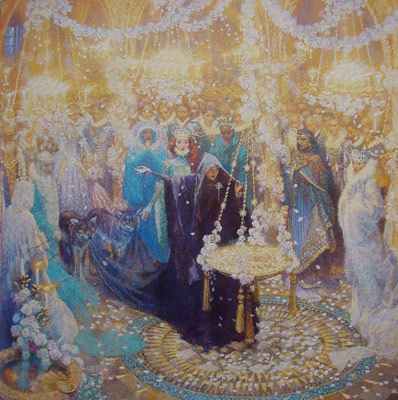
Sleeping Beauty 1

That was, of course, when the bad fairy stepped in and said, “I curse the child. While she is still a child, she will lose her home: her country, her family. And she will never again find a place where she belongs.”

Of course, the seventh good fairy was hiding out (I think they’d been through this routine before). She stepped forward and said, “I can’t change the curse, but I can give her a gift that will help her bear it. She will always be a good traveler, able to pack efficiently and create temporary homes for herself wherever she goes.” I think that fairy was supposed to give me either humility or self-confidence, either of which would have been useful gifts. But she had to mitigate the bad fairy’s curse, you see.

We are all given gifts, we are all cursed in our own ways. That is the first way in which we are like the Sleeping Beauty.

II. The Hundred-Year Sleep

The sleep doesn’t always last for a hundred years, and it doesn’t necessarily happen once. It’s the state in which we fall asleep metaphorically, in which we forget who we are. I think I fell asleep for a while in my own life, during the years I was trying to finish the PhD. There’s one thing I can tell you about that experience. Awakening? Is so. Incredibly. Painful.
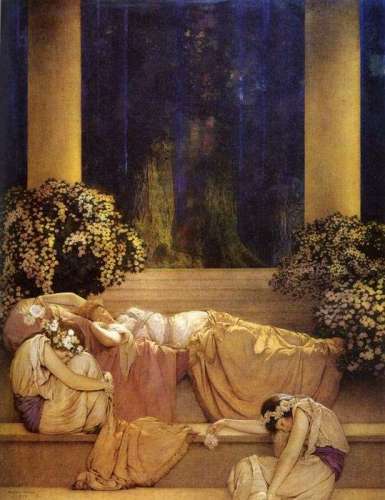
Sleeping Beauty 2

III. The Awakening

In different versions of “Sleeping Beauty,” the princess awakens in a variety of ways. Awakening to the prince’s kiss is actually a fairly modern development. In some of the earliest versions, the princess sleeps right through two pregnancies.

The thing about fairy tales is, we can always rewrite them. There are always new versions to be written. In my version, at some point the princess realizes she’s asleep, and she tries to wake up. She tries several times, each time thinking she is awake, but eventually she succeeds. She sits up in bed, and instead of a prince, sees a sign on the wall. I’m pretty sure it was left by the bad fairy. (I mentioned, didn’t I, that you can’t actually tell whether fairies are good or bad? They are both, and neither, and either at different times.) The sign says,

YOU MUST SAVE YOURSELF

Which, I’m pretty sure, is the beginning of a new fairy tale.
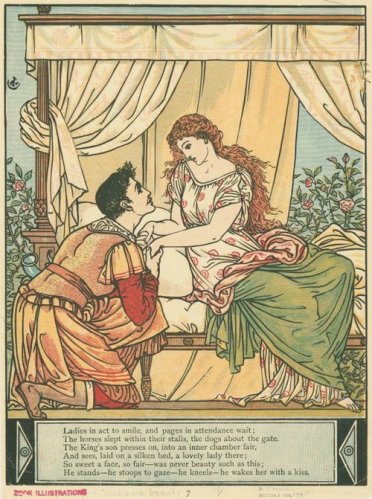
Sleeping Beauty 3

Posted in Uncategorized | 16 Comments

Magical Women

I realized, this morning, that there are certain people whose Facebook posts I always look forward to reading. Most, although not all, of them are women. I look forward to reading them because even their Facebook posts reflect a quality they have, an inner brightness. They are bright spirits, which doesn’t mean that they are always cheerful or optimistic. No, it means that they are always honest, direct, clear. There is something fundamentally true about them. They shine brightly, like lights that illuminate parts of the world. They show you things.

The ones I am thinking of as I write this are Jane Yolen and Terri Windling, and if you don’t read their writing, you should. And then there is a group of artists, like Iris Compiet and Jackie Morris, Ali English and Bryony Whistlecraft. (Terri is also an artist, of course.) And there are bloggers like Grace Nuth. I love the images they post, the parts of their lives they share with the world.

I think of them as magical women. They make the world more magical, show me the parts of it that are magical, in case I’ve forgotten. But they also write about work. They are all doing wonderful, important work: this week, I’m teaching Jane Yolen’s young adult novel Briar Rose, which was edited by Terri Windling, in my fairy tale class. I think that’s partly where they get their magic and power, that dedication to the work that is truly worthwhile. To the arts in some form, specifically to the mythic in arts, and to arts that change the world. I think it takes a great deal of courage to be one of the people who tries to change the world in some way — I’ve heard too many people say that they’re not trying to change the world, that they’re just trying to entertain (particularly in their writing). But that’s the point of that? If you’re not trying to change the world, what are you doing, and why? I mean, doesn’t the world need changing?

I still remember when I was a corporate lawyer, doing work that other people thought was important. In Manhattan, working with major corporations, flying around the country. I certainly looked and sounded important, and yet I knew the work I was doing was not, ultimately, worthwhile. That it changed nothing, except by making corporations, and their wealthy shareholders, richer. I could feel the hollowness of it. That was why I left.

The life I have now can be exhausting — it’s been particularly exhausting this year. But I know the work I do, whether it’s teaching or mentoring or writing, is all worthwhile. It’s all work that changes the world, even if only in the most minor ways, by changing one person’s perception. I wonder if that is, after all, the definition of magic?

There are all sorts of things I wish for right now in my life, but one consistent wish is to become one of those bright spirits, who speak honestly, directly, clearly. And with courage.

While I was thinking about this blog post, I ran across two videos that I want to include here. The first is an interview with the artist Evelyn Williams, who died late last year. Her art has such intensity. It is sometimes almost too much to take, but how interesting it is — as she was.

The other is a song from Noe Venable called “Sparrow I Will Fly,” which somehow seemed appropriate just now. The song goes, in part,

I’m still waiting
in the cyclone’s eye
for the day when like
the sparrow I will fly

Two videos by two magical women . . .

Posted in Uncategorized | 13 Comments

Being Seen

I read a poem this morning, the first of the poems that will be published on Tor.com as part of Poetry Month. It’s by Neil Gaiman, and it’s called “House.” It starts like this:

“Sometimes I think it’s like I live in a big giant head on a hilltop
made of papier mache, a big giant head of my own head.”

The poem describes how the man lives in a house shaped like his own giant head, cleaning the windows (which are the eyes), mowing the grass around it. And people drive past, waving not to him, but to the giant head, because “they think the house is me.” It isn’t, of course.

What it is, is a metaphor. I suppose a giant house shaped like a head would have to be!

The most important lines of the poem, to me anyway, are these:

“I’ll be sleeping there, or polishing the eyes, or weeding the lawn,
but no-one will see me, no-one would look.”

There’s a sense in which this is a poem about being someone like Neil Gaiman, someone so famous that he is no longer seen as a person. People no longer see him. They see the giant Neil Gaiman head. But it’s also a metaphor for how we experience other people in general: we so often don’t see them, and they so often don’t feel seen. Instead, we see who we think they are, the giant heads of themselves. The houses they inhabit, not the selves that are the inhabitants.

Strangely enough, some of the most authentic people I’ve met have been people who are famous. It’s as though they insist on authenticity — they insist on being themselves, specifically because they feel as though they are being made artificial. They know that people don’t see them, and so whenever they can, they insist on being seen as they are, even if that image is not particularly flattering. They take actions or express opinions that may be controversial, that may cause debate, but reflect what they think and feel. They want, so much, to be seen not as constructs, but as people.

It’s uncomfortable, not being seen as a person.

But we all get that to a certain extent: the giant heads we live in are constructed partially by us, but also partially by others, by who they think we are. And if we are writers or artists, there’s an assumption that we are our writing, our art.

There’s something I’ve learned about writing these posts, which is that when they become hard to write, when the sentences feel like snakes twisting around in my hands, it’s because the subject it too personal. It hits too close to the giant head that is my home. And this subject is personal, I think. Because we all get this, and I get it too: the sense of living in an artificial construct that is perceived as my self, that is addressed instead of me. The value of friends is that they see you, the real you: they automatically look through the windows and know you’re in there. One of the saddest thing, I think, is meeting someone you would like to be a friend who doesn’t do that, who can’t seem to see the person in the construct.

There is a particular pain in not being seen. In not being perceived as a person.

A friend of mine and I were talking about this last summer, sitting in my grandmother’s apartment in Budapest: two women who write fantasy, discussing how easy it seems for people to confuse the writer with the work, or even simply with an image online.

A Woman's Head by Fernand Khnopff

As my illustration for this post, I’ve chosen A Woman’s Head by Fernand Khnopff. She’s beautiful, isn’t she? Iconic, almost. But she must have been a real woman who modeled for the artist. I wonder who she was, and what she was like as a person . . .

Posted in Uncategorized | 12 Comments

On Loneliness

I’ve been thinking about loneliness lately, because friends of mine have been feeling it to various degrees, and of course I’ve felt it at various times in my life. It seems an important topic to address, and one we don’t address very often. It’s one we don’t want to address, I think because it’s an emotion we’re ashamed of feeling, as though we should somehow be sufficient onto ourselves. As though if we were stronger, strong enough, we would not feel it.

And yet we’re human beings, made to connect with one another. We evolved as social animals, and without that connection, we feel a little lost, a little aimless. We don’t quite know what to do. It’s as though we are all, after all, incomplete, and are completed only by each other. Not one of us is sufficient onto ourselves.

And so I thought, what is it, exactly? What is loneliness?

There was a quotation I put on my tumblr a while back: “Loneliness does not come from having no people around you, but from being unable to communicate the things that seem important to you.” –Carl Jung

I think that starts to get at what loneliness is. It’s not being alone, and people often say they can be lonelier in a crowd than by themselves. That’s because in a crowd, the lack of connection becomes more obvious to them — they feel it more. I think Jung is right to stress that loneliness comes from a lack of communication, of genuine interaction. But I want to offer a different definition:

Loneliness comes from being treated as a means rather than an end.

We all want to be seen, and to mean, as ends: as the people we are, as complete wholes. And yet so often we exist for other people as means, as the parent who will raise them, the spouse who will support them, the teacher who will help them. That’s unavoidable: we will always to a certain extent be seen as means. But we also need to be seen as ends, and when we’re not — that’s when we get lonely. When we are in a crowd and feel as though we’re not seen. I suppose that’s why fame also creates a kind of loneliness — you become a means for other people, who read you or watch you. You become a part of their internal landscape, but it is not after all you. It it whoever they imagine you are.

We all need at least one person in the world to see us as we are, and to accept that. To love that, because the opposite of loneliness is being loved, and loving is seeing and accepting.

And you know what? It is very difficult to find. I’m not sure why. Perhaps because at heart, we are all impatient and afraid, and truly knowing and valuing another person takes time and vulnerability. We all want to be loved, without necessarily doing the work of loving. But it doesn’t really work that way, does it? You have to do both. One way out of loneliness is loving, but you need it back, eventually. It can’t simply go one way, which is why taking care of a child can be a lonely endeavor — a child, no matter how affectionate, can’t yet see you as you are, and won’t for years.

I feel as though I should have some sort of grand pronouncement here at the end, but all I have is this: try to find people who love you, and love them back. I think it’s as simple and as difficult as that.

Dreams II by Heinrich Vogeler

This image is Dreams II by Heinrich Vogeler.

Posted in Uncategorized | 9 Comments

Being Strong

I had a strange realization, recently.

It was after meeting a friend for chocolate. There is a famous chocolate shop in Boston called Burdick’s. That’s where we met, and when I say for chocolate, I mean to drink chocolate, or eat any one of the chocolate items that Burdick’s carries. In my case, it’s a chocolate orange hazelnut cake that is one of my favorite foods in the world. My friend is one of those delicate, graceful women who look as though they wandered out of a fairy tale. She told me about the things that had happened recently in her life, which included death threats because of some things she had written. She had handled them as she seems to handle everything: gracefully, with strength and resilience. And I thought, wait, there’s a pattern here.

The strongest people I know are delicate, graceful women who look as though they wandered out of a fairy tale. (Yes, I know a number of these. I suppose it’s being a fantasy writer, because they are all writers and artists of the fantastic.) They post about finding pink taffeta dresses in second-hand clothing stores, and have overcome incredibly difficult childhoods. They have become famous writers, scholars with international reputations. They have created magnificent lives for themselves, despite opposition, sometimes illness.

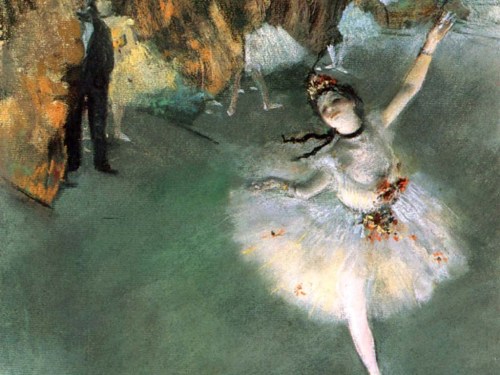
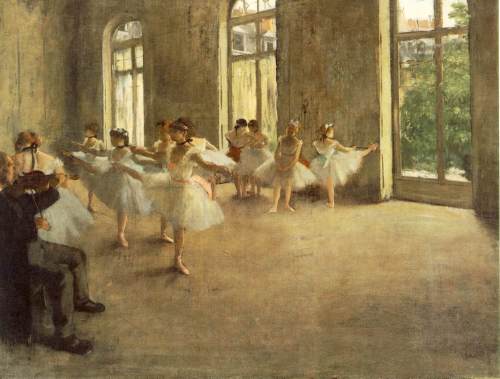
They remind me of ballerinas, who look so delicate and graceful. And yet, when you get close to them, you realize they are all muscle. They are a combination of will and art. So the pictures I’ve chosen for today are Degas ballerinas.

Ballerina 1

We live in a world where physical strength is and will always be useful. Yet it seems to me that these women are stronger, in their own way, than the six-foot tall, two-hundred-pound men I know, and I know a few of those, too. (Sorry, guys.) Their strength is in not knowing when to give up. Giving up never seems to occur to them. Setbacks and adversity are seen as a part of life, a matter of course. Things to learn from, to grow from. And when these women get down and discouraged, as we all so, they talk to their friends. (It’s important to have friends.)

They support each other.

Ballerina 2

I’m not sure why this struck me so hard, recently. But it was a good realization to have: that strength means going on, doing the things you want and need to do. It means resilience. It even means stubbornness, as in not knowing when to give up, to take no for an answer. Doing what everyone tells you can’t be done, not because you believe in yourself, but because you may as well try as not. Thinking, “I’m not sure I can do this” every step of the way, but doing it. It means flexibility: thinking all right, that didn’t work, what other way can I try to do it? The women I’m thinking of aren’t tough: they get hurt, they cry. They don’t try to be tough. They remain open to the world, to the wonder and the pain of life. They remain vulnerable. They fail and fall, then they pick themselves back up, try to understand what went wrong, what they can change in themselves that will produce a different outcome the next time. And, like beautiful, unstoppable forces, they just keep on going . . .

Posted in Uncategorized | 9 Comments

Being at ICFA

I’ve been terrible about updating this blog, haven’t I? I’ve just been so unbelievably busy, last month and this month. But I have to post something. I feel as though I can’t let a month go by with no posts at all.

I was able to step out of the busyess for at least a little while last weekend, at ICFA (the International Conference on the Fantastic in the Arts). It’s my favorite of all the conferences, either academic or industry. I like it so much because it’s small, and I know all the writers and many of the scholars there, and so it’s like meeting a group of your best friends again, many of whom you haven’t seen for an entire year. There are things to do: I gave two readings, one of “England under the White Witch” and one of my story “Estella Saves the Village,” which is in Queen Victoria’s Book of Spells. But most of my time was spent catching up with people, hearing what they had been up to, what they were planning on doing. And such people! The very best writers in the business. Writers like Kij Johnson and Andy Duncan and Jeffery Ford. And I got to meet Neil Gaiman, which was of course a pleasure.

I’m going to include two photographs here. The first one was taken at the banquet, which occurs on the last night, by Ellen Datlow.

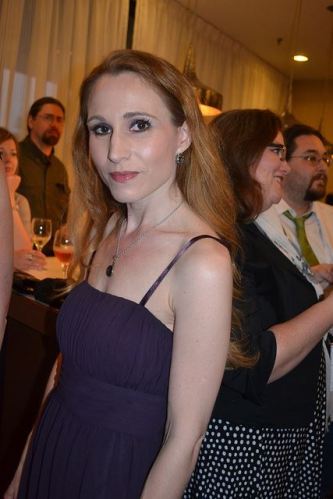
ICFA Photo

I’m rather proud of this dress because I found it at Goodwill for $10. I bought it specifically for the banquet, but by the time ICFA came around, I had lost some weight and it no longer fit as well. Which isn’t usually a problem, but this was a strapless dress. There were loops for straps, so it had once come with them, but no straps with the dress. So I hunted all around town until I found some ribbon of the right color and matching thread (at two different stores). And I made straps!

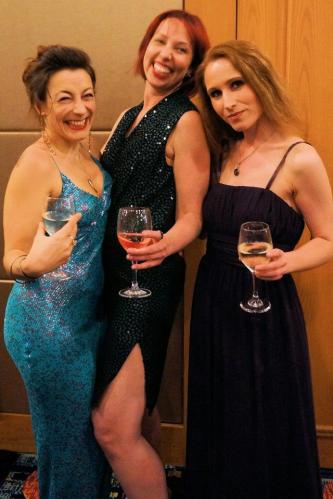
The second photograph was taken by Jim Kelly, and it’s of me with fabulous writer friends Maria Dahvana Headley and Kat Howard. I thought we looked pretty smashing!

ICFA Photo 2

What I value most about ICFA is the sense of camaraderie, that we’re all in this together. That those of us writing and studying the fantastic are part of a community — we care about and take care of each other. Now that I’m back in Boston, I miss my community, but I know that I’ll see them all again, while I’m in Europe this summer, when I teach at Alpha and Stonecoast, and of course at Readercon, where one of the guests of honor will be Patricia McKillip, who influenced me so much when I was a teenager. And of course I’m in constant contact with them, and with the larger community all over the world, online.

Writing is such a solitary activity! I think it’s important that we come together, we writers. We need to hear what others are doing, tell them what we are doing — check in with each other and with other parts of the industry. Which I suppose is why we have this yearly round of conferences and conventions. It’s expensive, and there are many conventions I wish I could go to but can’t afford. Still, whenever I do manage to go, it’s so worth it.

Also, it gives my evening dresses something to do . . .

Posted in Uncategorized | 4 Comments

In Transition

Today was a Very Snowy Day.

Yesterday, the snow came down all day, and today my street looked like this:

Snow 1

I live on a street with both apartment houses and university buildings, and you can see the mix in this picture. The snow was at least two feet deep everywhere I walked, except of course where the streets and sidewalks had been plowed. (That’s one nice thing about living in the city: all the plowing is done for you.) As I walked around the neighborhood, I stopped to take a picture of myself reflected in the post office window:

Snow 2

That’s me dressed for winter in a Land’s End jacket and Timberland boots. When you live in Boston, you have to be ready for winter weather. I walked around a bit, watching the students enjoying the snow. We have so many students here from other parts of the country, and from all over the world; some of them have never seen snow until they arrive in Boston. Today, I saw students building forts, having snowball fights, and taking pictures of themselves having the New England university experience. By Monday, the city will be moving again, and they will all be in classes.

I walked back to my building, which looked very much as it probably had on a winter day a hundred years ago:

Snow 3

It was nice to have a quiet weekend, because usually I’m so busy. This is a transitional period for me: I’m still doing all the things I was doing, and I’ve started doing all the things I’m going to be doing, and those are going on at the same time, which is exhausting. That will be my life for the next few weeks, although after that it will get easier. Transitional times are hard . . . But they’re necessary, because otherwise you can’t actually get anywhere. You have to go through the transitions.

There’s something I do to help me through them, a sort of mental game I play. I pretend to be the person who has already gone through the transition. I’ll give you an example. In the next month or so, I need to lose five pounds. (Don’t even start: I know that I’m perfectly healthy at my current weight. But I dance, and when I go to events I get photographed, and I know the weight I prefer to be, which is five pounds less than my current weight. Any less than that, and I start to look underweight.) So I think, what sort of person would weight five pounds less than I do now? Let’s call her Theo. Well, Theo would not be in the bad habit of staying up late at night, which would leave her tired and hungry and in need of a midnight snack. She would take care of her health, which means getting enough sleep and exercise. So the mental game is pretending to be Theo. I think, what would Theo do? And even more importantly, how would Theo think? And then I try to do and think that.

It just occurred to me, as I was writing this, that I actually have a picture of Theo. Here she is, just after her ballet class:

Theo

Doesn’t she look responsible, as though she’s sleeping and eating right? I wish I could be her all the time . . . But for now at least I can pretend, and that actually helps me through the transition, whether it’s a transition to being healthier, or having the career and life I want. Transitions are hard, and in some sense we’re in transition all the time, because life never stays still. But the major transitions, those times in our lives when we’re changing rapidly, and it feels as though the earth is shifting beneath our feet — those are when it can help to visualize who you will be after the transition is over, and pretend to already be her.

Posted in Uncategorized | 2 Comments