Your Fairy Tale Name

As you may know, I teach a class on fairy tales. In my class recently, we were talking about names in fairy tales. Very few characters in fairy tales have ordinary names: they are almost never Ann or Michael. Their names mean something: Snow White is as white as snow, Cinderella has to sleep among the cinders. Blue Beard is frightening because of his blue beard, which is as unnatural as his propensity to kill his wives. Puss in Boots is distinguished by his footwear. Their names are attributes. Or their names can be nonsense words that are also codes, that don’t mean anything but also mean your freedom: Rumplestiltskin, for example. Many fairy tale characters don’t even have names: they are the Prince or the Miller’s Daughter.

If I were just a professor, I would go on about the meaning and function of fairy tale names. But I’m also a writer, so I’ve created a way for you (yes, you) to find your own fairy tale name. What would you be named if you were in a fairy tale? Take this short quiz to find out:

Cinderella by Margaret Evans Price

(Illustration for “Cinderella” by Margaret Evans Price.)

1. Are you a man, a woman, or an animal? If you are a man, go to question 2. If you are a woman, go to question 8. If you are an animal, go to question 15.

2. If you are a man, are you good, evil, or morally ambiguous? If you are good, go to question 3. If you are evil, go to question 4. If you are morally ambiguous, go to question 7.

3. If you are a good man, your name is “Prince” + [your best character trait]. Ex. Prince Organized.

4. If you are an evil man, do you have magical powers? If you do, go to question 5. If you don’t, go to question 6.

5. If you are an evil, magical man, your name is “The Wizard of” [where you live]. Ex. The Wizard of Portland.

6. If you are an evil man but not magical, your name is [your name] + “the Ogre” or “the Troll” (your choice). Ex. Sidney the Ogre.

7. If you are a morally ambiguous man, take your name and scramble the letters to form a nonsense word. Ex. Nathajon. (Try not to steal any children. It never pays.)

8. Are you a good, evil, or morally ambiguous woman? If you are good, go to question 9. If you are evil, go to question 13. If you are morally ambiguous, go to question 14. If you are descended from fairies, go directly to question 22.

9. If you are a good woman, do you define yourself by your best character trait, your best physical feature, or the challenges you have overcome? If by your best character trait, go to question 10. If by your best physical feature, go to question 11. If by your challenges, go to question 12.

10. If you are a good woman and define yourself by your best character trait, your name is [that character trait]. Ex. Patience. (Be prepared to demonstrate that character trait throughout the tale.)

11. If you are a good woman and define yourself by your best physical attribute, your name is [the best thing about that attribute] + [that attribute]. Ex. Sparkling Eyes.

12. If you are a good woman and define yourself by the challenges you have overcome, your name is [your most difficult challenge] – any final vowel + “ella.” Ex. Insomniella. Alternatively, if you have a distinctive article of clothing, you may choose to identify yourself by that article. Ex. Blue Wool Coat.

13. If you are an evil woman, your name is “The Wicked” + [your job]. Ex. The Wicked Accountant. (Watch out for red hot iron shoes.)

14. If you are a morally ambiguous woman, your name is [your favorite natural phenomenon] + [the color of that phenomenon]. Ex. Sleet Gray.

15. If you are an animal, are you really an animal, or are you enchanted? If you are really an animal, go to question 16. If you’re actually enchanted, go to question 19.

16. If you are really an animal, are you good or morally ambiguous? If you are good, go to question 17. If you are morally ambiguous, go to question 18.

17. If you are a good animal, your name is “Good” + [your name]. Ex. Good Jennifer. (You will probably have your head chopped off by the end of the story, but everyone else will live happily ever after.)

18. If you are a morally ambiguous animal, your name is [your favorite animal] + “in” + [your favorite article of clothing]. Ex. Kangaroo in Pajamas.

19. If you are enchanted, are you an enchanted man or woman? If you are an enchanted man, go to question 20. If you are an enchanted woman, go to question 21.

20. If you are an enchanted man, your name is [your name] + “my” + [you favorite animal]. Ex. Andrew my Aardvark. (You will spend the tale trying to find a woman to disenchant you.) Alternatively, you could choose to be called “The” + [your favorite animal] + “Prince.” Ex. The Llama Prince.

21. If you are an enchanted woman, your name is [your name] – any final vowels + “ette” (if good) or “ile” (if evil). Ex. Amandette, Amandile. (By the end of the tale, you will have caused the Prince’s death. These things happen . . .)

22. If you are descended from fairies, your name is [color of your favorite flower] + [name of that flower]. Ex. White Lily.

Now that you have your fairy tale name, you’re ready to take your part in a fairy tale. Good luck! I hope you survive . . .

The Frog Prince by Mabel Lucie Attwell

(Illustration for “The Frog Prince” by Mabel Lucie Attwell.)

Posted in Uncategorized | 17 Comments

Becoming That Woman

When I was growing up, when I was a teenager and then in my twenties, I had an image in my mind, of a woman. She was a woman I could never become, because she was so much more sophisticated than I was. She was the sort of woman who walked around European cities, with a scarf wrapped around her neck. She negotiated her way in English and probably French and who knew what other languages. She was beautiful and accomplished: she had done things and she knew it, and out of that came her confidence, her ability to walk through strange cities with a mysterious smile on her face. Looking as though she belonged, wherever she was in the world.

Yeah, you hate her too, right?

Hate is the wrong word. I never hated her: what I did was envy her. I would have wanted to become her, except that it seemed so impossible. She was so different than I was. Because I was . . . well, awkward, and unsure of my place in the world, and often scared. I felt as though I had no idea what I was doing, as though I was an alien or an imposter pretending all the time. You probably know what I’m talking about, because we’ve all been there. But I kept on doing what I was doing, kept on working and writing. Because this is life, and what else are we supposed to do? I finished things, as one does: poems, stories, degrees. So I published, and put my diplomas on the walls, and even won some awards. Oh, and I bought some smashing clothes, mostly in thrift stores because that was where I could afford to shop. And I taught classes.

One day, a student of mine asked to interview me for a sociology project. She was supposed to interview someone who was doing creative work of some sort. And one of her questions was, “Where did you get your style?” I stared at her and asked, “My what?” I think it was that day I started realizing something that has startled me ever since, that startles me all the time: somehow, I’m not entirely sure how, I had become That Woman.

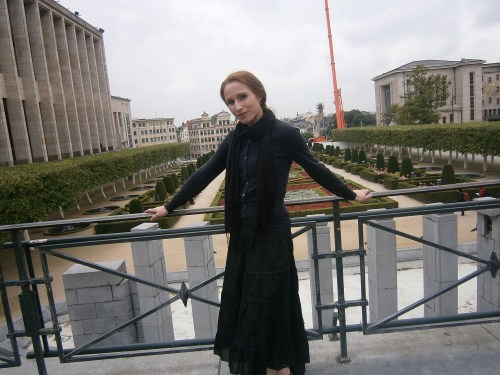
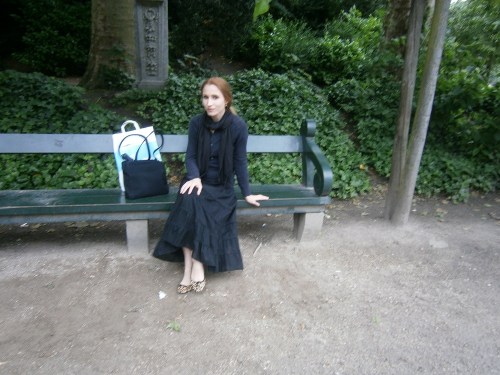
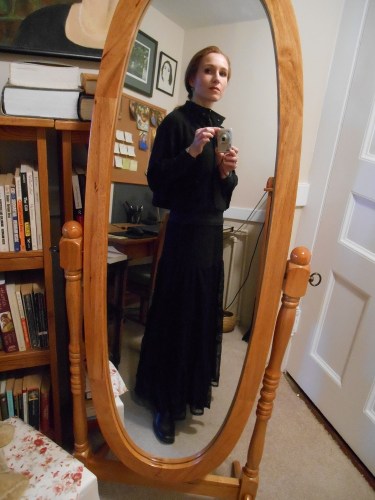
This is a picture of me from last summer, in Brussels. Very consciously being That Woman! Because there I was, realizing that I was in Brussels, speaking (broken) French, buying sandwiches on baguettes, walking around the city and going to museums. And thinking, Yeah! I’m her . . .

OLYMPUS DIGITAL CAMERA

(I bought the scarf at a small store in London, the skirt at a thrift shop in Budapest.)

I think those of us who are women all have a “That Woman,” the woman we don’t think we can become. And I guess what I want to say is, says who? You, that’s who. You say you can’t become her. And so you envy her, whenever you see her walking around a city or along a beach, or climbing a mountain, or whatever your That Woman does, because all of ours are different. (I don’t know if men have a That Man? It would be interesting to find out.) But, of course, you can.

I don’t think you become her by setting out to. You don’t say to yourself, I’m going to become That Woman, and go out to buy the right clothes. For one thing, you’ll get it wrong, because you probably don’t understand her yet. Your That Woman is a projection of what is deeply, truly inside you, the woman you could become (which is why you envy her, for being what you so want to be). So the way to get to her is to find what is deeply, truly in you, and keep doing it. While you feel awkward and inadequate, while you’re afraid. If it’s writing, go sit at your desk or in a coffee shop and write. If you want to go back to school, do that. Buy the clothes you really love (I still recommend thrift stores, which is where I get most of mine). Do the things you genuinely love to do. When you do that, over and over, you slowly start to become her.  And it is in the process of becoming her that you understand who she is.

The hardest thing about this process is overcoming your own negative emotions: your fears and feelings of inadequacy. The thing to remember about emotions is that they’re only emotions. You can feel them without acting on them. So be afraid, but do what you want to anyway. Separate out your feelings and actions. Feel your feelings, but pay attention to your actions.

OLYMPUS DIGITAL CAMERA

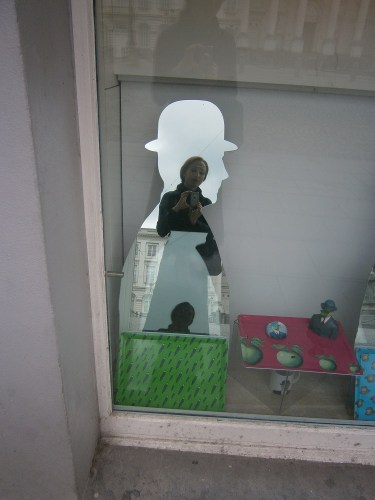
(This is me reflected in a mirror in front of the Magritte Museum, which is my favorite museum in Brussels. I was so glad to have gone to Brussels, simply to see this museum.)

I have two stickies over my desk about fear. They are on my cork board, where I can see them every day.

What would you do if you weren’t afraid?
Everything you want is on the other side of fear.

They work together, don’t they? Perhaps because I’m a writer, I think it’s useful to write things like this out. When I do, I find it’s easier for me to remember them, to live them. They become my inner voice, the voice that speaks when I need it to, that guides me. That inner voice speaks to all of us, and it often seems as though it speaks from outside, as though it’s the voice of another. But of course it’s not: the inner voice is your own voice, although it often repeats what others have told you. That you can’t, that you’re not good enough. But you can take control of that inner voice, you can change what it says. You do that not directly, because you can’t argue with the subconscious, but slantwise. Like by putting stickies over your desk.

Now that I am That Woman, there are some things I know about her. I’ll let you in on those secrets:

1. Before she became That Woman, she was not That Woman. She thought she could never become That Woman, until she did. She spent a long time being scared, feeling awkward and inadequate. And then one day, she found herself walking through Brussels in a swingy skirt and leopard print flats, with a scarf tossed carelessly around her neck. On that day, or another, she realized that she had become That Woman.

2. Some days, when she wakes up in the morning, she groans and crawls back under the blankets. You might think, Aha, she’s not That Woman all the time! But you’re wrong: groaning and crawling back under the blankets are part of being That Woman. It’s all part of the package. Later that day, she will walk to a cafe and work on a poem, or go to a museum, or just dreamily watch the snow come down outside her window. She will be That Woman, whatever she’s doing.

3. What defines her as That Woman is that she knows she is. She knows she’s the woman she wanted to be, or is well on her way to getting there. She looks at herself in the mirror and says “Yes.” She looks at her life and says, “This is what I wanted to do, and I’m doing it.” Her fundamental attitude toward herself and her own life will be love. Oh, some days she will be tired, and frustrated, and overworked! But underneath, there will be gratitude and joy.

Last picture: me on a park bench in Brussels, that same day.  See?  I wasn’t kidding about the leopard print flats . . .

OLYMPUS DIGITAL CAMERA

Posted in Uncategorized | 181 Comments

After Depression

If you’ve been reading this blog or following my work for a while, you know that about two years ago, I went through a period of depression. It lasted a long time, or what is a long time for me — about a year. It happened while I was finishing my PhD dissertation, and was very much linked to that, I think. A PhD dissertation is one of the most difficult things you can do, sort of like climbing an intellectual Mount Everest with a committee both coaching you along the way and judging your form as you do it.

At the time, I dealt with it by going into therapy, meeting with a therapist once a week. That was a good way to handle the depression, I think. I never took anything for it, which may have been a mistake. Perhaps it would have gone away more quickly, or not hit as hard, if I had been on the right medication. I don’t know. As I finished my dissertation, and particularly after I defended, it slowly went away. I could feel it going away. While you’re depressed, you can’t really feel the depression — it’s your normal. You just feel as though you’re in the darkness, all the time. I used to call it the Shadowlands, and visualize it as an underground place where everything was dark and flat, as though the world were made up of silhouettes. I wrote about it, mostly on this blog, because writing is one of the ways I deal with things. And of course because one of my jobs as a writer is to talk about what I’m experiencing, on the chance that it may help someone else experiencing the same thing. It probably will — we are all human, we experience mostly the same things.

It was only when I started getting better, getting through and over it, that I could feel it — as a sort of dark cloud that hovered over me, and then near me, and then went away. I would tell my therapist, “It’s about three feet away now.” Recently, I realized that the cloud was nowhere near me, and hadn’t been for a year. So this is a post on what happens after depression. On where you find yourself once you’ve gotten over it, and what you do there.

Honestly, this isn’t the best morning for me to be writing a post like this one, because I was up very late last night. I had to buy an airplane ticket to a conference, and spent an hour trying to figure out the cheapest option, and even then it was very expensive, which is always stressful for me. And then I stayed up even later revising a couple of paragraphs in the novel. That felt good — the paragraphs are better now. But as I was doing it, I knew that I would be tired the next day. And tiredness isn’t good for me. You see, once you’ve been through depression, there are some things you know about yourself: (a) you could get it again, and (b) to avoid it, you have to take care of yourself.

So this is really a post about self-care. Before I talk about that, let me add a third thing you know about yourself: (c) you’re stronger now, stronger than you were before, but also more vulnerable. You’re like a reed that can bend with the wind. You weren’t destroyed by it, and you know that you’re not going to be destroyed.  But you also know the wind can return.

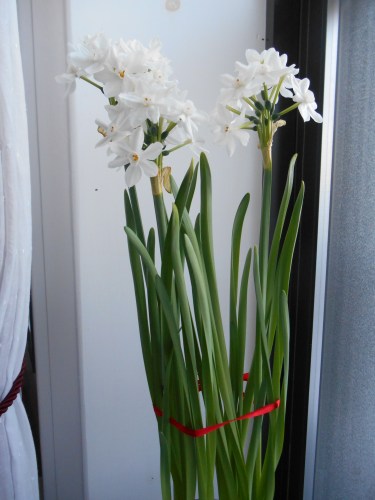
Paperwhites

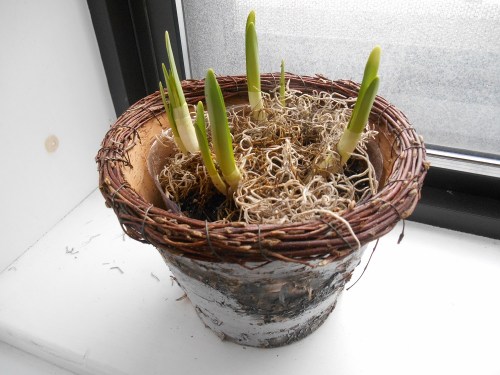
(Paperwhites growing on my windowsill.)

So, what happens after depression? Well, the first thing is that after a while, you start to experience joy. I use that word deliberately. It’s not happiness, although you can be happy too — but happiness is a fleeting thing, something you can feel for a little while. Joy is deeper. It’s an inner peace and contentment and delight, based on nothing at all but life itself — the experience of being alive. You feel joy because your oatmeal tastes good, with milk and raisins and brown sugar, and because it’s cold outside and the sky is a clear gray, and because you have a warm blanket to wrap yourself in and a book to read. Joy is based on such little things, on breathing itself. The second thing is that you realize how important it is to take care of yourself. Here are the things I do, after depression:

1. I’m careful about what and when I eat. I eat whole grains, and lean proteins, and lots of vegetables and fruit. I give myself regular treats, usually chocolate. I make sure that I’m eating regularly throughout the day, small meals so I can keep up my energy. I never let myself become hungry and drained. And I make sure that my food is delicious, because if it isn’t, why eat it?

2. I exercise. Mostly, I get out and walk, long walks, even when it’s cold. Not just to walk, because that would bore me. (I’m rather easily bored.) I walk to buy groceries, or to the bookstore, or to my favorite thrift store to look at clothes. Walking around with a camera also gives me something to do. I can take pictures and post them later. I also do yoga and pilates, because moving makes me feel good, and being flexible makes me feel good.

3. I get more sleep. Not enough, I’m afraid, but what I’ve noticed is that getting too little sleep is one of the worst things I can do for myself. It starts a cycle, in which I eat too much and the wrong things, because I have to get energy from somewhere and if it’s not from sleep then it’s from food, and I’m too tired to exercise. Getting more sleep is at the top of my to-do list.

Fairy Mouse Print

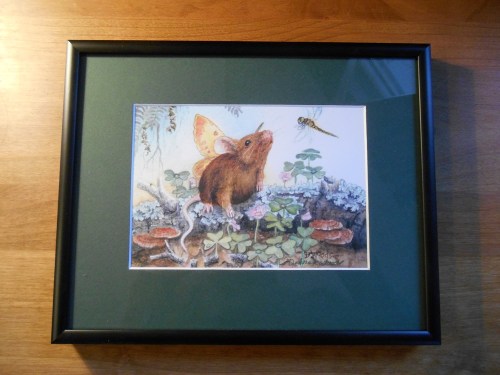
(A print I matted and framed myself.)

4. I prioritize my own work. This is difficult, because I have so much work to do: work I have to do, because it’s what I’m actually paid for, and then work people ask me to do, like write papers. And I simply can’t do it all. So I make sure that I do my own work, which means my writing — I make sure I’m writing every day. Which, of course, is why I was up too late last night. But if I don’t do that, I feel terrible for neglecting what is most important to me. It is, in a very real sense, like neglecting myself.

5. I give myself a regular diet of treats. Bubble baths, good books, cupcakes. You need to treat yourself well. You can’t control what goes on out in the world, how other people treat you. (People treat me very well, by the way. But most people want things from me, because after all I am a provider of things — help with papers, recommendations, advice. They want me to give talks and chair panels, both of which I will be doing next week. Write poems — I will need to finish a poem this weekend.) I have a sticky over my desk on which I’ve written, “Are you loving yourself?” When I’m not treating myself very well, I remind myself of this — that I must love myself, and love is a verb as well as a noun. It’s an action. And then I go buy myself lipstick or watch an episode of Dracula.

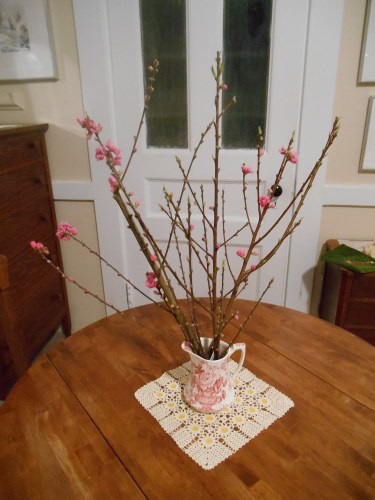
Thrift Store Vase

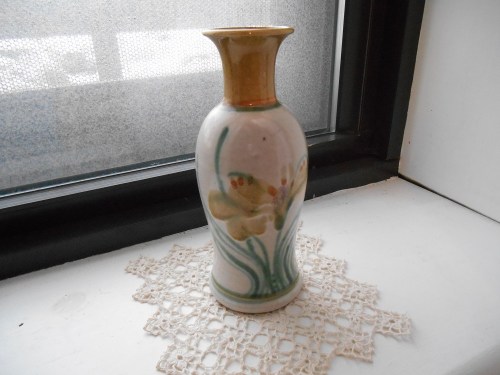
(A vase I bought at a thrift store.)

6. I go for beauty. I try to make my space as beautiful as I can, which also means that it should be neat and clean. I don’t always get to neat . . . But right now I have a vase filled with daffodils and yellow tulips on my dining table, and I’ve been framing some of the art I have so there’s more art on the walls. And as often as I can, I go to the museums or to hear a concert. I’m going to a concert today, actually. Beauty is therapeutic. Oscar Wilde once wrote, “Nothing can cure the soul but the senses, just as nothing can cure the senses but the soul.” I treat this as excellent medical advice, and listen to Dr. Wilde. To cure my soul, I engage the senses.

7. I reach out. It’s so easy, when you’re depressed, to curl in on yourself, and you may need to do that in the midst of depression. I certainly needed to — if I were a turtle, I would have crawled inside my shell. Perhaps a better image is the caterpillar inside its chrysalis. I needed some sort of covering, so I could change and emerge. Sometimes I just crawled under my blanket . . . But now I need to reach out, see people. Of course, I see people all the time, because I teach — I’m in constant contact. But the difficulty for me is to be in contact in a way that doesn’t involve responsibility, that is purely social. So I try to keep in touch with friends, make a point of traveling to new places even when it’s expensive. Yesterday, I bought a new suitcase! And I make a point of being on social media, because that’s a way of keeping in touch too.

8. Finally, and this is the last thing I’ll list although I’m sure there are also others, I let go. There are things I just can’t do — I can’t say yes to every request, lately I haven’t even been able to answer every email, and I have such a backlog of Facebook messages! This makes me feel guilty, but I can’t do anything about it. There simply isn’t enough time. I have to do what I can and let the rest go, feel guilty about it if I need to, but if I tried to do it all, I would be there again, in the space where there is no joy and no light.

And my life, right now, is filled with joy and light. It surprised me, really — that I should feel those things, and perhaps more powerfully than I ever have. How lovely it is, how lucky I feel simply to be me, to be able to do the things I do, have the things I have. To inhabit my own brain, which is a constant source of stories.

So there you have it: (a) eat right, (b) exercise, (c) sleep, (d) do YOUR work, (e) treat yourself, (f) go for beauty, (g) reach out, (h) let go. And find joy.

Lace Skirt

(Dressed for a concert.)

Posted in Uncategorized | 13 Comments

Being an Artist

I’ve been reading Mihaly Csikszentmihalyi’s book Creativity: The Psychology of Discovery and Invention. It’s a good book, not particularly scientific if we start to take it apart, but suggestive and interesting. And I care more about suggestive and interesting than I do about scientifically accurate, particularly when we’re talking about something as difficult to understand as creativity — and the creative impulse. The books I find most useful are those that offer an interpretation of the world that allows me to see parts of it in a new way. And this book does.

I’m only about a third of the way through, but I was struck by Csikszentmihalyi’s description of the three steps needed for creativity — I would say they are needed for creating good art in general. They are the three things every artist must do.

1. Internalize the system.

“A person who wants to make a creative contribution not only must work within a creative system but must also reproduce that system within his or her mind.”

In other words, as a writer, I work within a “system” that is literature. To work well, I need to know literature, know it thoroughly and deeply. I need to have read a lot of books, studied them, thought about them. If I don’t know the field I’m working in, it’s very difficult to be creative within it — to even create good art within in. I think this is why, when I decided to go back to school, I instinctively chose a PhD over an MFA. I wanted a thorough grounding in English literature, and I’d had bad experiences with poetry workshops. They had given me no grounding in poetry itself, the history of poetry or even poetic technique. (Now I teach in an MFA program, and I can tell you that we give students plenty of grounding, both in history and technique. But this was what I thought at the time.)

To create art in a field, you need to both learn it and then internalize it, to have it within you. Know it so deeply that it becomes part of your makeup. When I have trouble writing a sentence, I reach for Jane Austen or Virginia Woolf or Isaak Dinesen, as though they were tools in my internal cabinet. When I see waves, white and black, I hear Prufrock (which may be some sort of mental disease, actually).

2. Be motivated to work within the system.

That’s an accurate title, but really what I mean, and what Csikszentmihalyi means, is that you must be the sort of person who likes to play within the field you’ve chosen: who will write poetry even if no one reads it, who will write novels whether or not they’re published. You have to generate ideas and work for their own sake. In other words, your motivation must be internal, and out of it you must produce, and produce.

I see this with my friends who are artists and writers — they are constantly writing, constantly making art. They never stop. I’m not sure they could. I am sitting here on a Saturday morning writing a blog post, after staying up until 2 a.m. last night revising a chapter of my novel, because this is what I love to do. I love words the way Cleopatra loved jewels. A life of dealing with words, of teaching writing and of writing myself — I can’t think of any way I would rather spend my time.

Why is this important? Well, because it’s only out of that motivation, that enjoyment and sense of play, that you actually produce enough to (a) get better and (b) throw away what isn’t good enough.

3. Apply the critical apparatus of the system to discard inferior work.

Some art isn’t good, or isn’t good enough. You must know enough about what is and isn’t good to discard what, in your own work, is inferior. In other words, you must develop taste.

This can be a bit of a problem, because criteria of taste change over time, and you must have enough taste, be bold and innovative enough, to see what is good even before other people, often respected people within the system, recognize it. You must be able to say, “Yes, that Monet, he’s got something.” But I think the basic idea is sound: you need to be your own editor. What has helped me with this, more than anything else, is editing the work of other people — in other words, teaching writing. I can see when writing is trite, flat. I can diagnose what’s wrong with it, how it needs to change. And hopefully, I can see when those things are true of my own work, although I often cringe as I tell myself that what I’ve written isn’t good enough. It takes courage to be your own editor, but if you want to be good, you have to be. It’s a fundamental requirement.

Those are the three steps, and I think I’ve gotten better at each of them with time. That’s something else Csikszentmihalyi talks about, which is that it takes a lot of time. There are shortcuts in life, but not in art. There are efficiencies, meaning that if you study writing in a good program, it will teach you a lot about writing that you won’t get, or will get more slowly, by just writing on your own. But there are no shortcuts: you still need to put in the work. “Butt in Chair” is still the motto of all writers.

If I think of how long it’s taken me, simply to get where I am? I was writing regularly in high school — my first publication was in the high school literary magazine. So I’ve been writing for at least two decades. And there are days when I feel as though I’m just starting to get it . . . (But then, in an interview he did at ninety, Jorge Luis Borges said that some day he hoped to write the work that would justify him. I don’t think artists are ever satisfied.)

I think these three steps are important, or at least important to me personally, because I see people who are missing one or two of them, and they aren’t working the way I want to. Outsider artists don’t necessarily internalize the system, and they produce genuinely interesting work — being outside the system can be freeing. But it is often limiting because the artist remains outside the conversation going on within the system, in which works of art speak to each other, or  lacks the craft, the technique, to be flexible, to produce a body of work that changes over time rather than replicating ideas and forms. Picasso immersed himself in the system before he did his own creative work — that man imitated everyone. Lacking critical faculty can be a real problem, because our culture does not necessarily reward good writing. You write a best-seller, and you think you’ve done good work because a lot of people are reading it. But the book will be gone within ten years because it doesn’t have the depth and complexity of great literature. I could go on, but won’t, because this post is already long enough and I have other things to do. After all, someday I hope to write the work that may justify me . . .

Creativity

Posted in Uncategorized | 6 Comments

Being Photogenic

I’m writing this post because several friends of mine who are writers asked me to. I feel a bit awkward about it? In part because I’ll be posting pictures of me, and one is always criticized for that, and in part because I suppose it’s a frivolous topic, although how we appear to the world is usually important to us. And particularly important to writers, who are in a strange position, nowadays: they are photographed a lot, and those photos are used for publicity or posted online. And yet, they’re not performers, not actors or singers who are used to appearing in front of people. They are usually introverts, whose deepest relationships can be with imaginary characters.

Anyway. In the last couple of years, I’ve been getting a compliment that’s new to me, and surprises me: “you’re so photogenic.” Usually I say “thank you,” but if the person giving the compliment is also a writer, I say, “I’m not, actually. I’ve just learned how to be photographed, most of the time.” I suspect that no one is actually photogenic after the age of twelve. Children are photogenic, but adults . . . we’re too self-conscious, too aware of what the photograph might look like. So this is a blog post on being photogenic. I’m sure you’ve heard that “pretty is a set of skills”? Well, so is photogenic. I write this with a caveat: I’m not a photographer or a makeup artist, and I’m sure someone who is could do this much better than I can. The below is simply what I’ve learned as a writer, so that when I look at photos of myself online, I mostly don’t groan. (There are plenty of older photos of me online at which I do groan. Oh well.)

Everything I’ve learned has come from doing a professional photo shoot and being on video of various sorts, including a television show. There’s nothing quite like seeing yourself on early-morning television in Little Rock . . . And I should add that I took the pictures below in the worst possible conditions: mostly in the terrible lighting of my tiny pink bathroom, while recovering from quite a lot of traveling. All right, I think that’s enough with the caveats. On to what I’ve learned.

So, what is involved in being photogenic?

1. Attitude.

You must believe you are beautiful. Don’t laugh: you know what I mean. There you are, having your picture taken. You smile, wait for the click of the camera, and just at the moment it clicks, you think, “But I’m not beautiful. My pictures always turn out terribly, and this one will probably turn out terribly as well.” At that moment, your face takes on an expression of fear, apprehension, doubt. And that’s what makes it into the picture. So, you don’t have to believe you’re beautiful all the time. But at that moment, the moment the picture is taken, you must believe that you are worthy of being photographed.

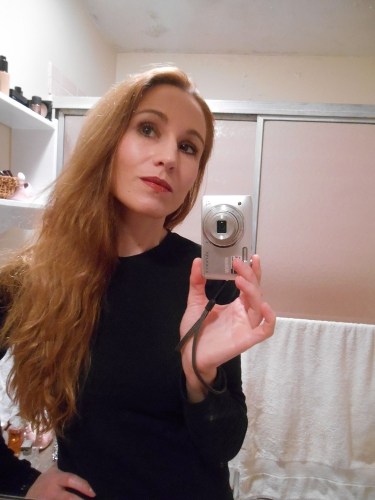
How do you get attitude? Having your picture taken is like everything else: it’s a skill, and you get better at it with practice. So take your own picture. Take it a lot. You probably have a digital camera? Discard the photos you don’t like, keep the ones you do. Think about why you like them, what makes them work for you. Think about how you like to be photographed. This is me, with attitude:

Blog Photo 7

At least, I think it’s attitude. Nothing about this picture says “I don’t think I’m worth photographing.” (Remember what I said about the terrible lighting and my tiny pink bathroom? Yeah, sorry. But if I can produce a picture I feel good about under those conditions, then I can produce a good picture anywhere.)

2. Makeup.

Sorry, this won’t help most male writers, who tend not to wear makeup. (Male actors and many male singers do, of course.) But the standards by which men judge their appearance tend to be looser, more lenient, anyway. They cut themselves more slack. This section is mostly for women, although if you’re male and doing a professional photo shoot, or if you’re on television, you may well use foundation of some sort. Or have it used on you!

So, here’s the thing: the camera isn’t taking a picture of you. The camera doesn’t know you, the wonderful scintillating person you are. The camera is taking a picture of certain planes and angles, in certain lighting. Makeup helps you control how the lighting falls on those planes and angles.

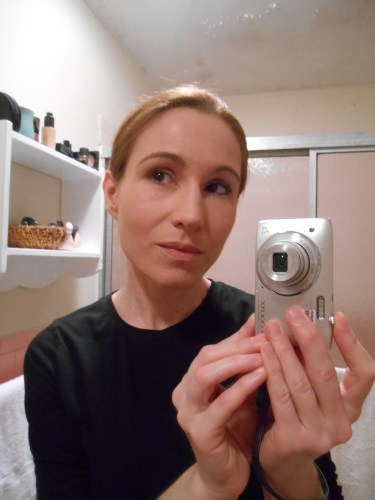
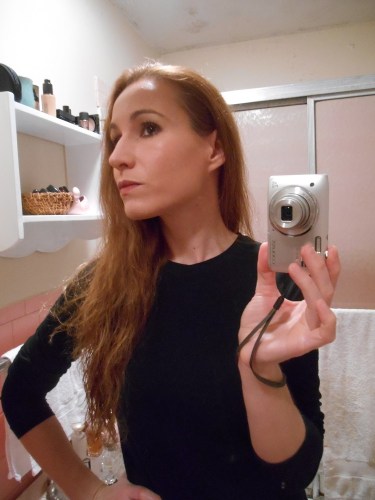
This is me, with nothing on my face except moisturizer. (And by moisturizer, I mean Proactive, because I have what is called “problem skin,” meaning that it breaks out if you say Boo! to it.) I happen to think it’s a perfectly nice face, but like this, it’s difficult to photograph.

Blog Photo 1

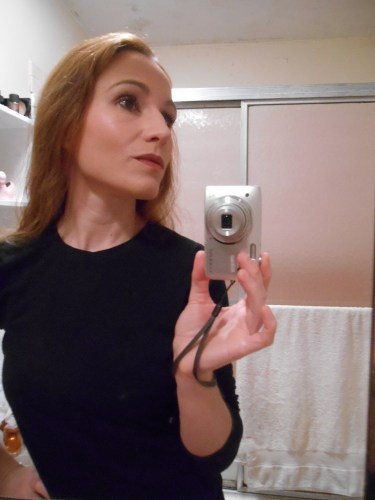
This is my face with the most important step in the makeup process, which is foundation. Here, I’ve started with a thin layer of Garnier BB Cream, then MAC Studio Fix, and then MAC Studio Fix pressed powder. That sounds as though it would be heavy, but it’s not: modern cosmetics are designed to feel light. Foundation gives me a lot more control over how light will fall on the planes and angles that are my face. (Reminder: the camera isn’t taking a picture of you. You may as well be a mountain range, as far as it’s concerned.)

Blog Photo 2

Ironically, skin with foundation on it looks more natural, more like your own skin, on camera than your own skin does. I don’t know why — I’m sure a photographer could tell us?

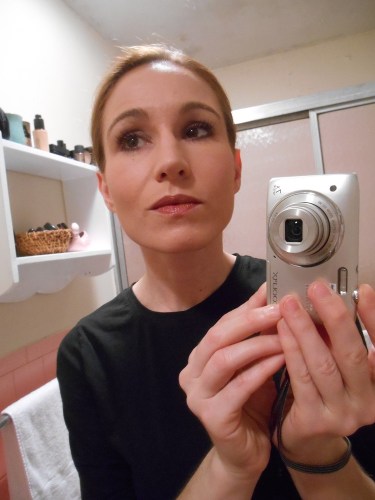
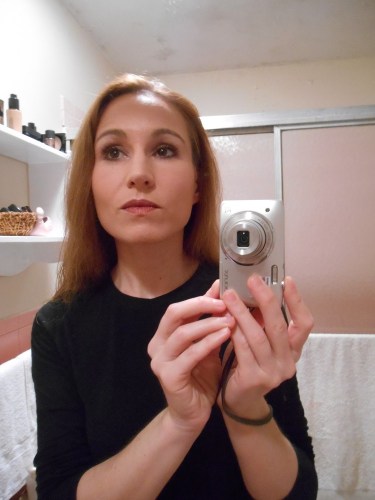
And here is my face with the color added: lipstick, blush, eyeliner, two kinds of eyeshadow (dark under the eyes and on the lids, light on the brow bone), and mascara. These are from MAC and Revlon, but I won’t give you specific names or colors, because you’ll need different ones anyway. We’re all different.

Blog Photo 3

(Oh, and by the way, any male readers who feel like telling me, at this point, that they prefer women without makeup? I don’t wear makeup for you. Both men and women have been wearing makeup since this thing we call civilization started. We wear it because we’re human, and like to play. Not wearing or liking makeup is perfectly fine, but doesn’t get you a moral cookie.)

So, why wear makeup if you’re going to be photographed? Obviously, you don’t have to. But I’ve found that it gives me more control over how a photograph will turn out. It combats the flattening and washing out that is an inevitable part of being photographed.

3. Angles.

Another reason to take photographs of yourself is so you’ll learn the angles of your face. Like all faces, yours will photograph differently depending on the angle from which the picture is taken. There’s a reason that, when I’m photographed by someone I don’t know, I turn my face to the right.

Here’s a shot of the left side of my face:

Blog Photo 4

And here’s a shot of the right side (I feel like I’m doing Dovima here, and if you don’t know who she is, Google her):

Photo 9

In photos of the left side, I tend to look younger, more vulnerable. Also, strangely enough, more foreign. (Hmmm. Is that a picture of my shadow self? My writer brain starts to work on this concept . . .) The right side looks older, more sophisticated. Photographers talk about your “good side”? Well, it’s my more reliably photogenic side. And here I am head-on (which is a very hard shot to take, by the way, in a bathroom mirror). I almost never take a shot head-on because my features are asymmetrical, and the photo can come out looking strange.

Blog Photo 5

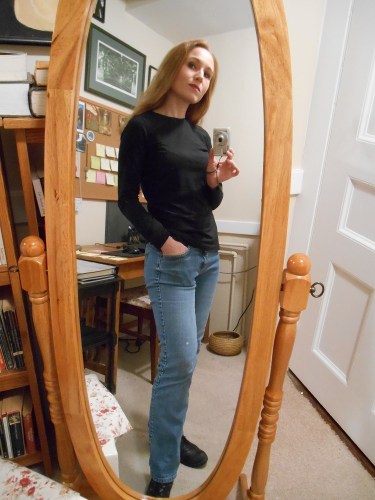
Oh, and by the way, I’ve been focused on faces. But here’s a picture of me in a full-length mirror. In this picture, I am dressed in a terrible outfit for being photographed in: loose black t-shirt, old jeans (you can see a paint splotch on them), Timberland boots for going out into the snow with. Which is actually what I did about five minutes later — go out into the snow. What makes this picture not terrible are the angles of my body. If you look at actresses on the red carpet, they all angle their bodies in a similar way to be photographed. And it’s not just because standing this way makes you look thinner (although it does). It’s because the angles add a sense of movement, and therefore visual interest.

Blog Photo 8

4. Lighting.

Lighting will make or crush and crumple up your picture. Lighting is all. That said, most of the time writers are photographed, it’s in the terrible lighting of a convention hotel. We can’t depend on good lighting.

What you need to do is work with the lighting you have. Figure out where it’s coming from, think about how it will hit your face, and turn so it’s as flattering as possible. Again, that’s something you learn from photographing yourself. That said, some lighting is never going to be pretty. For example, I went out in my Timberland boots and took some photos in the cold gray light of a winter day in Boston. Nothing you take in that light will be “pretty.” It’s just too harsh. So what do you do? If you want pretty but can’t get it, go for cool. Actually, that’s one of my principles: always go for cool. Pretty is boring. Cool has movement and impact. Cool is better.

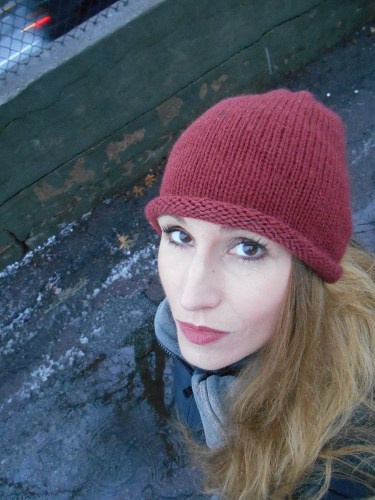
This is the best picture I was able to take in that light, and I kind of love it:

Blog Photo 9

I love the red of that hat and the lipstick, against the cold white of the skin, the gray and black of the background. I don’t think this picture makes me look attractive, but who cares? The picture itself looks interesting.

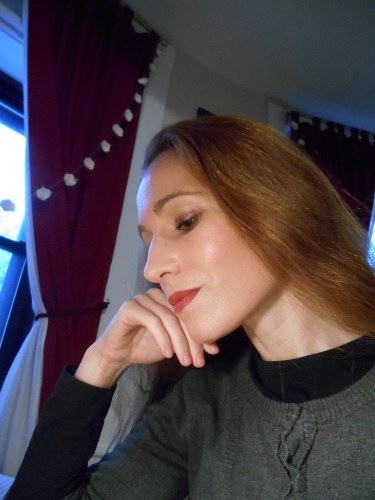
Nevertheless, there are times when we want to look pretty. That’s when you want a soft, indirect light. My desk lamp is perfect for this. It almost always gives me a good picture, like this one:

Blog Photo 10

And that’s about it! If you’re at a convention and having your photograph taken, think: where’s my lighting, what’s my angle? And at the moment that picture is taken, think, “I’m beautiful.” Because, of course, you are. (The makeup, if you choose to use it, goes on beforehand.) I can’t guarantee the picture will turn out well, but once you’re “photogenic,” you should be able to look at most of the photos of you posted online and not groan.

I’m going to end with one of my favorite photographs, from a party I went to recently in New York City. The guests were mostly writers and editors, and of course there were going to be photos taken. This was taken before the party with my camera by Marco Palmieri, who takes wonderful photos anyway. But I think you can see all the elements I’ve been talking about in it. The writers in the picture are Nancy Hightower, Valya Dudycz Lupescu, Bo Bolander, and me. We are dressed differently, we have different makeup, we are all interacting with the camera in different ways. But each of us is doing what works for us individually, and I think the end result is terrific.

Masque 1

Posted in Uncategorized | 11 Comments

Making Happy

Lately, I’ve been thinking about happiness, because I’ve been happy. Oh, I’ve also been tired, and sometimes frustrated, and sometimes cranky. But underneath, I’ve been happy, and that’s important because as you may remember, I went through a period of depression about two years ago. Serious, going-to-therapy-every-week depression. Of course, it was while I was finishing my PhD dissertation, which made me feel trapped and miserable, so that makes sense. But my point is that I know unhappy. I remember unhappy quite well . . .

There’s a message I see quite often, particularly on blogs and posted on Facebook: it’s that we alone are responsible for our happiness, and that our happiness depends on how we perceive the world. Not on our material circumstances. And I think that is exactly . . . wrong. Anyone who’s had a bug bite that itches and itches, or can’t set the thermostat so it produces the right temperature, and is always either too hot or too cold, knows it’s wrong. There are a lot of things in our lives that depend primarily on our perception, on the way we process our material circumstances. Success comes to mind: whether or not we are successful really does depend, I think, on how we see our circumstances rather than the circumstances themselves. We can define our own success. Perhaps even contentment, that sense of overall comfort, is primarily mental. Perhaps even joy.

But I believe that happiness is different: it’s a day to day, minute by minute thing. Whether I am happy at any give moment can depend quite a lot on whether or not I am eating a cupcake. If I am eating a cupcake, I am happy. (Depending on the cupcake, of course. I mean, I’m picky.) Happiness does in fact depend on things outside ourselves, so to make ourselves happy, we need to change things outside ourselves. (At least, that’s a lot easier than just trying to be happy, which I think is a very hard thing to do. Make yourself be happy, try to produce an internal state of happiness without changing anything external . . . Much easier to buy a cupcake.)

Here are the things I do to make myself happy, and notice what small things they are, how little it takes:

1. Take a bubble bath! This is my #1 go-to making happy thing, and it’s much more cost-effective than therapy.

2. Do the dishes. No, doing dishes does not make me happy. But having done them does! And this goes for all the other cleaning, straightening, organizing things as well. Making beds, vacuuming carpets, even cleaning the bathroom. Among other things, these get rid of that vaguely guilty feeling that comes from not having cleaned. But they also provide a feeling of accomplishment. You may not have finished your PhD dissertation, but hey, the dishes are done!

3. Buying and arranging fresh flowers. I know these are expensive: I’m lucky to have a neighborhood Trader Joe’s, where I can buy flowers each week. Just looking at them, on the table, the dresser, the windowsill, makes me happy.

4. Eating chocolate. Of course, it has to be the right chocolate: brownie cupcakes from Sweet, chocolate orange hazelnut torte from Burdick, even a Toblerone. But chocolate is a happy thing.

5. Painting toenails. Gold, dark burgundy, iridescent purple. Particularly fun when you know you’re going to be taking off your shoes for airport security. It’s a small sign of defiance: you want me to take off my shoes, security person? I have gold toenails!

6. Reading books. I know, I know, this one is obvious. But I also deliberately choose books that will make me happy. There are a lot of books out there that will make me unhappy, not because they’re sad, I’m fine with sad, but because they are boring or badly written. Good books are happy books.

7. Browsing thrift stores. Also antiques stores, when they’re the sorts of antiques stores in which you can actually afford things, old silver plate and transferware. I believe in retail therapy, as long as you’re doing it in a place where you’re not going to be anxious about the prices. If I can buy myself two sweaters in a thrift store for $10? I’m golden.

8. Waking by the river. I love to walk by my river and check on how it’s doing. Are the leaves turning yet? Have they fallen? What are the geese and squirrels doing? Walking in a natural space is necessary for mental health anyway: you need the sunlight, you need the wind in the treetops. But there is something particularly magical about water. If you can, walk near water. It will make you happy.

9. Listening to music. Another obvious one, but sometimes I forget how powerful music can be. And again, I’m picky. Loreena McKennit, I’ve found, is particularly happy-making.

I’m trying to think of a tenth thing I do to make myself happy, and if I think of it, I’ll mention it later. But these are the ones I could think of, off the top of my head. What I’m looking for is something easy, something you can do at a moment’s notice. For example, spending time with friends makes me happy, but that’s something I usually need to plan for. These are things I can do immediately, when I need to, by myself.

And they work even when there is something important making you unhappy, because external circumstances can do that, in a powerful way. If you feel trapped, if you feel as though you can’t do what you want — that, more than anything, will make you unhappy. Even in that circumstance, bubble baths will get you a long way. They got me through a PhD dissertation (well, and therapy).

This is me, on a rainy day, walking around the city. Being very happy just to see the city in the rain!

Rainy Day

Posted in Uncategorized | 5 Comments

Having a Purpose

When I walk through the bookstore nowadays (the university Barnes and Noble, where these books are on a front table, by the coffee shop), I see so many books on finding your purpose in life. The other day, I stopped and flipped through them, out of curiosity. I didn’t buy one, because I’ve always had a sense of purpose, as long as I can remember. I don’t need to find one, thanks. But it’s not just in books: there are videos out there, programs on the internet, all on finding a sense of purpose.

I’m not going to write about finding your purpose in life.

The strangest, for me, was a video on living purposefully. If you don’t have a sense of purpose, said the man in the video, you can still live purposefully, mindfully. Which seems like a good idea anyway, but is not at all the same thing. It struck me as strange because living that way was offered as a substitute for having a sense of purpose, as though we all need a sense of purpose. These books and videos and programs all imply that it’s important to have a purpose in life, that without it you’re missing something.

As someone who’s always had a strong sense of purpose, my response is that it’s not, and that having a purpose can actually be — painful, troublesome, disorienting. Keep in mind that this is based on my experience, so someone else who has a strong sense of purpose could describe it quite differently. But here’s what it looks like in my life.

I’ve always known that I was a writer. Not just that I wanted to write, but that I was, at my core, a writer. As a child, I read and told stories. As a teenager, I read and published poetry in the high school literary magazine. As a college student, I read and published poetry in the college literary magazine. I was an English major because I couldn’t imagine studying anything other than literature. As a law school student, I read when I was supposed to be studying for exams, and I wrote a novel. I started publishing poetry in literary journals. As a corporate lawyer, I kept novels in my office desk and read them during lunch. I plotted my escape, when I could return to graduate school to study English literature. In graduate school, I read and read and read, and I went to two summer writing workshops, using my stipend to pay for them. I wrote short stories and started publishing them in magazines and anthologies. After graduate school, I made the decision to teach writing rather than literature, because I was a writer, to my core.

I experience writing not as something I’ve chosen, but as something that has chosen me. I have work I need to do, and that work is writing, and my life is in that work. My purpose in life is that work. If I’m not writing, I start to feel sick, anxious. I start to feel as though I have failed.

I wrote down some of the ways that having a sense of purpose affects one’s life, or at least my life. When you have a purpose,

1. You prioritize that purpose above other activities. Like sleep.

This is not necessarily a good thing, since sleep is important. Eating is important. Having an actual life, other than the fulfillment of your purpose, is important. But all of that can seem unimportant when I haven’t written for a week, and it’s midnight, and I tell myself that instead of going to sleep, I’m just going to look at that story or part of that story, just that one paragraph. I’m not going to revise anything. But as soon as I open the document, I’m gone, into another country — and the next time I look up, it’s three a.m.

2. You make decisions based on your purpose that can make other people wonder what you’re thinking.

Like, for example, giving up a career as a corporate lawyer because I knew I could never be a corporate lawyer and write.

3. You strive for perfection in your art, which is not in fact achievable.

You try to write perfect sentences, perfect stories, even perfect novels. (Trying to write a perfect novel with perfect sentences is a good way to drive yourself mad.) There is no such thing as perfection in prose. There is perfection in poetry, but the only perfect poem was written by John Keats, and you are probably not John Keats, and your poem is probably not “Ode to Autumn,” so you’re probably out of luck. But you’re going to try anyway.

4. You have both overweening confidence in your abilities, and abject self-doubt.

You are smart enough to know your own talent, but also smart enough to feel your limitations and shortcomings. After all, if you have a sense of purpose, you’ve probably been practicing your art in one way or another since you were a child. And you compare yourself to the best that has come before you. So there are days when you say to yourself, I’m not Virginia Woolf, therefore I am a gnat. You are perpetually disappointed in yourself, and yet perpetually working harder to get better at what you do, because you don’t want to be a gnat.

(Are you surprised that writers have breakdowns, after what I’ve written?)

5. Your purpose can, potentially, fill all of your life. All of it, with meaning and striving and fulfillment.

Which is wonderful, except when you realize that there are other things in life as well, like sleep. And eating. And maybe taking a class in Japanese, but not so you can write about Japan in a story. Because it’s so easy to do things only so you can write about them in a story . . . Having a purpose can fill your entire life, which is why I think there are so many books about having a purpose. Because we all want meaning, fulfillment.  But it can also substitute for having a life.  It can also lead to overwork, depression, breakdown.

So I wonder if having a purpose is rather like having an illness or addiction, and people who don’t have one, or aren’t sure they have one, should instead simply live their lives, and enjoy them? I mean, look at the lives of the great writers, the great artists. Do you really want lives like those? Unless you can’t help it . . .

This is Virginia Woolf. Whom, as I may have pointed out, I am not:

Virginia Woolf

Posted in Uncategorized | 4 Comments