The Joy of Poetry

I’ve been writing poetry for as long as I can remember.

The earliest poems of mine that I still have are from high school. That’s when I started writing seriously, on scraps of paper, whatever I had on hand, and then recopying my poems into a large green notebook. That’s also when I started submitting poems for publication in the school literary journal. I think it was junior year that I won my first poetry prize, for a poem on Icarus. It was published in the literary journal and illustrated by another student. I was so proud . . .

Why does a child start writing poetry? I think it’s natural for us to love poetry: after all, the first literature we’re introduced to is poetry, in the form of nursery rhymes. We clap our hands to poetry, jump rope to poetry. The difference between “Mary, Mary, quite contrary, how does your garden grow?” and John Keats’ “Ode to Autumn” is a difference in level of complexity, not fundamentally in kind. We love poetry naturally, and then we are taught out of that love, usually in school. I’m not sure how it happens. I think it starts with having to analyze poetry, to pick it apart for meaning and structure rather than letting it sing in our heads. It also comes from being taught, at the school level, only poetry that is somehow socially relevant: we are taught poetry with a political message because it’s easier to teach. The teacher doesn’t have to deal with the poetry-ness of it at all: it can be taught as social commentary that just happens to rhyme or have an underlying rhythm. Those of us who continue with poetry often belong to a particular sub-category of the high-school nerd, the literary magazine nerd — closely related to the theater nerd, and often found at the same parties.

I belonged to that category in high school. I was in theater, I wrote poetry. You could tell the literary magazine nerds because they tended to do things like read incredibly difficult books, books with intellectual cachet, prominently. They read Franz Kafka. They carried around James Joyce’s Ulysses. If they were female, they often swore allegiance to Sylvia Plath. The danger of belonging to this particular category is a kind of intellectual snobbery, but considering all the dangers of high school, intellectual snobbery is a fairly minor one, on the level of getting burnt by a toaster.

In college, I continued to write poetry. I continued to submit to the school (now university) literary journal, and at one point I was even on the literary journal’s editorial board. I continued to be published. But in college something changed. I started taking classes in writing poetry, and by the time I graduated from college, I was not sure if I wanted to write poetry anymore. I had been taking classes with famous poets (there were a several of them at the University of Virginia, where I went as an undergraduate), and they not only undermined my confidence in my own ability to write, but also made me question whether poetry was worthwhile. I think there were two reasons for this. First, the classes were intellectually lazy: they took place once a week, for several hours, and during those hours all we did was sit around and critique other students’ poetry. There was no rigor to the classes, no actual teaching. The teacher would lean back and let us do most of the work. Second, the teachers all emphasized the poetry that was then in fashion. This was the late 1980s, so confessional poetry still seemed fresh and innovative. That was the poetry we were supposed to be writing. It was all free verse of course, but not free verse in the way earlier 20th century poets had used it, with underlying rhythms and playful patterns. It felt loose, like one of the beanbag pillows that were popular then. And it felt insular, almost parochial (we never studied foreign poetry — it was always the American, sometimes English, poetry of the 1970s and 80s.) I could not make myself interested in it.  If that was the direction poetry was heading in, I wanted out.

If I were to teach an undergraduate class in poetry, I would not start with workshopping at all. No, I would say, first we’re going to start by doing exercises. You’re going to write poetry in different forms: ballads, sonnets, villanelles. Because when Picasso was your age, he was imitating Velasquez. That’s how he eventually became Picasso. And it’s going to be bad, because you’re all going to be terrible at writing formal poetry — most people are. But it’s going to make you better poets, whether you’re writing in forms or in free verse. And we’re going to study the history of poetry, particularly in English but also in translation because you need to look beyond your own literary tradition. In this class you’re going to work . . . That’s the class I wish I’d had, a class that would have taught me about poetry in a deep way. That’s the sort of class I think would have inspired me.

I should rephrase my earlier statement: I still wanted to write poetry, but I no longer wanted to be a poet. Being a poet seemed incredibly pretentious, artificial — an extension of the intellectual snobbery that had seemed so cool in high school. By this point I was in law school, and I was still writing poems, on scraps of paper as I had when I was a teenager, then typing them into my computer and printing them out on a dot-matrix printer. I started sending them to small literary magazines, very small because I had no confidence in my own writing anymore. And my poems were accepted, as they had been when I was in high school and college. So I was still writing and publishing: what had changed was something inside me. I wrote though law school, then through being a lawyer — I have poems I still remember writing in my 42nd floor office in downtown Manhattan. Honestly, they were not particularly good poems. A few of them were good enough that I included them in my poetry collection, but most of them will remain hidden in my notebooks . . . The percentage of good to not-publishable was pretty low.  Still, when I look at my own poems, even as far back as high school, I see something in them I like, a way of using words, an inventiveness. Writing all those poems made me the writer, including the prose writer, I am.

After several years of working as a lawyer, I went back to graduate school for a PhD in English literature. I continued to avoid poetry — all my graduate work was in prose fiction. But I wrote poetry in secret. I didn’t submit much, because it didn’t seem worthwhile. By this time I was attending fiction-writing workshops (Odyssey, and then Clarion), and I was starting to sell short stories. Unlike poetry, those paid — and editors reprinted them, so they continued to circulate, to get attention. Since my first fiction sale, I’ve been writing short stories regularly. Some of them have been finalist for or won awards, and of course I’ve been paid for them, sometimes well, but always something. My first novel will be coming out in 2017. Until a few weeks ago, I’d mostly given up on poetry. I realized, from looking at my notebooks, that I rarely wrote it anymore. At one time, I would write approximately a poem a week. Recently, there have been years when I wrote one or two . . . for the entire year, and then only because I was asked by an editor who wanted a poem for a specific purpose.

So what changed in the last few weeks?  Nowadays I’m a teacher, teaching writing of all sorts, to both undergraduates and graduate students. Since November, I’ve been so busy with end of the semester work that I haven’t had time to write, and that’s not good. When I don’t write, I don’t feel quite myself . . . So I’ve been writing poetry, because that’s something I can do over breakfast, or in between teaching classes. I can finish a poem in a day and feel a sense of accomplishment. But I had to think about what to do with those poems. I didn’t want them to languish in notebooks. Trying to publish them in literary magazines no longer seemed worthwhile. When I sent poems to magazines, they were usually accepted. But it could take weeks to months before I heard back, and longer than that for the poem to actually be published.  And I certainly didn’t write poetry for the money — the average payment for a poem is between a copy of the magazine and $20.  Once the poems were published, few people read them — few people read literary magazines anyway, and poems get the least attention of all.

And yet . . . the few times I had shared poems online, people had liked them.  They had reshared them, commented on them.  That surprised me . . . I thought, why don’t I just continue to do that?  So I started sharing poems on my blog.  That had a magical and unexpected effect: I started writing more poetry. I think when you’re a creative person, you need to get whatever it is you’re creating out, so you can create more. If you keep it in, it starts getting blocked up, and then what you’re left with is stagnant water, like the pool behind a beaver’s dam. You want the creativity to flow like a stream. Once I started putting the poems out there, publishing them online, I started writing a lot more. And that felt good . . .

But I started running out of room on my blog.  So I created a new blog, dedicated specifically to poetry.  It’s called, quite simply, Theodora Goss: Poems.  You can go take a look . . .

The poetry I write is rooted in myth and legend and fairy tale, not as a conscious choice but because those are the things that inhabit my head. They assume the world is deeply alive because that is how I approach the world. In a way, they are the clearest statements of what I believe in and care about — even more than my prose. They are deeply influence by the poets I have loved, some of them poets who are fashionable (W.B. Yeats, Anne Sexton), some of them poets who fell out of fashion long ago, or never were fashionable in the first place (Mary Coleridge, Robert Graves). I am particularly influenced by the history of women writing fantastical poetry, such as Christina Rossetti and Sylvia Townsend Warner. In their poetry I find a subtle subversiveness, and a fine feeling for the underlying magic of human existence. And that, fundamentally, is what I write about.

The blog is an experiment — we’ll see if it works. But my goal is simply to write more poetry and share it. If it does that, it will have fulfilled its purpose.

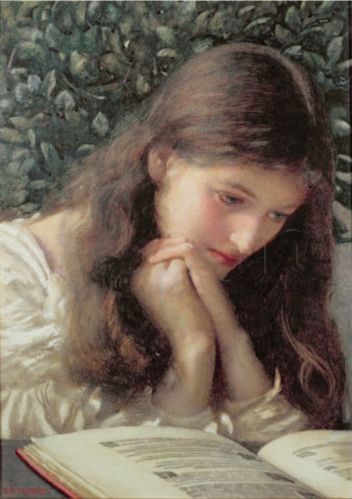
Painting by Edward Robert Hughes

(The painting is by Edward Robert Hughes.)

Posted in Uncategorized | 7 Comments

Writers and Money

This year, my writing income will exceed my expenses. Last year, it was the other way around.

That’s how it is with writing when you’re trying to build a career. I should explain what I mean by a career, because I have a job that gives me a regular income, in addition to which I have writing income (sometimes). It’s not a “day job,” which usually refers to a job unconnected with writing that you intend to do only until the writing works out . . . until writing itself can become a career. For one thing, I don’t just do it during the day. I teach, which means that I’m often up late at night, grading papers or preparing for classes. But I chose it specifically because it was about writing; it immersed me in writing and thinking about writing. My job is to teach writing: both academic writing at the undergraduate level, and creative writing at the graduate level to MFA students. I’m very, very lucky: I get to work on and think about what I love, every day. Oh, sometimes it’s tedious grading student papers. But grading papers, even at the most elementary level of marking the missing commas, makes me think about writing. It makes me consider what good writing is, why certain voices are lively and engaging. And of course it provides me with an income.

Because the thing I’ve learned about writing, over the years, is that it’s very, very difficult to make a living at it. Oh, people certainly do, but it’s a very small percentage of the people who actually write. Most of the people I know who make a living at writing have certain characteristics in common: (1) It took them a long time to get where they are, making a living at writing. Usually, you need several successful books in print before you can make anywhere near enough money from them to live on. (2) In the meantime, they had to rely on regular jobs, or on spouses who could support them. If they did not have those things, they went through a period of terrible struggle, and by terrible I mean not knowing where rent or food was coming from. (3) They write a lot, and they write fiction that is popular, that sells. As writers, they are both popular and prolific. (4) They are generally out there, at conferences or on social media, marketing their books. It’s certainly possible to be a wildly successful reclusive writer, but it’s rare. (5) They continue to supplement their income, with part-time teaching or freelancing or writing tie-ins.

If you want to be a writer, it’s best to confront the realities of writing income. First, you’ll have to write novels. The average short story sale will make you several hundred dollars, which is very useful when you’re trying to buy groceries or pay rent, but won’t sustain you over the long term. And poetry only pays for coffee. So you’ll have to write novels, and you’ll have to write them fairly consistently. The second reality is that writing income is itself inconsistent. I recently received half of the advance for my first and second novels. It was more money than I have ever put into my bank account at one time — I’m pretty sure my bank now thinks I’m money-laundering. But it was also the most money I’ll receive for these novels at once, unless they do every well indeed. I’ll receive more money when each of the final manuscripts are delivered, but it will be a smaller amount. And then of course when the film deal is made . . . Ah, but we’re just dreaming at this point. That happens, but not often, so what I have to count on right now is my advance. For which I am very grateful, but whether I’ll get this much money again from these books is up to the publishing gods. The only thing I can do about it is make these books the absolute best they can be, and then go on to write the next book.

The third reality is that publishing advances sound a lot more impressive than they actually are. For example, think of a writer who gets a quarter million dollar advance for a five-book series. A quarter million dollars! That’s an enormous sum of money. Until you break it down: that’s $50,000 per book. If each of those books takes about six months of work total, to write and revise, then revise again when the edit letter comes, then revise in response to the copyedits, the writer is making about $100,000 per year. That’s still a lot of money! But out of that, the writer is paying all the things that are invisible to regular employees. For example, I cost my employer, the university, about twice what I actually make. Among other things, the university pays for part of my medical insurance and matches any retirement fund contributions. The self-employed writer must pay for medical insurance and fund her own retirement, plus there’s a small thing called self-employment tax. I have to pay it on the writing portion of my income. So that advance isn’t the same as making $100,000 per year at a job. It’s like making $100,000 a year from a business, and then having it reduced by business expenses. If you’re a writer, you’re a business. So sayeth the IRS.  And think about all the marketing for those books.  It takes time to publicize a book, and even if the publisher pays travel expenses for readings and signings, that’s time the writer could be making more money by writing.  It’s unpaid time, or time paid for by the advance.  Finally, it can take considerably longer than six months to write a book.  If it takes a year total, that income goes down to $50,000 per year, minus business expenses.  And that’s on the high end of a novel advance . . . (The average novel advance is well under $20,000 per book.)

When I finished my PhD and started working full-time, I had to confront all this myself. I had to ask myself, are you going to treat writing as a hobby, or are you going to make it your career? Of course the answer was, a career. That’s what I’ve always wanted, to be a professional writer. That doesn’t mean I want to write full-time: I love teaching. It does mean I want to write every day, and produce on a regular schedule. I want to have novels and short stories and poems coming out regularly. I want to be known as a writer. So how, I had to ask myself, was I going to think about money? I had already spent a lot of money on my writing career: I had gone to Odyssey and then Clarion, I had been to any number of conventions. And those were all worth it, because they gave me the training and the contacts I needed. But now, I really wanted to think about my expenses as investments. Was a particular convention worthwhile? Would I learn from it, would I meet people I wanted to meet — writers I admired, editors I would love to work with? It’s wasn’t enough that I would have fun, because let’s face it, conventions are expensive. Did I want to spend $1000 on an industry convention where I wouldn’t necessarily meet readers, or should I put that money toward a research trip to Europe for the second novel? (That was an actual decision I had to make recently.) I haven’t been to as many conventions recently, because of such calculations. I’ll be going to more next year, because I’ll have a novel coming out in 2017 . . . So the investment will make sense.

I also had to do one more thing: I had to confront my own issues with money. My issues come partly out of the fact that I grew up in a household where money was always uncertain. We always had just enough money to get by, although sometimes the bills were paid late. But there was no concept of savings. My mother had grown up in communist Hungary, where if you had anything extra, it was taken away from you. My grandparents could not buy the apartment they had lived in since World War II until after the fall of communism. I was used to money coming and going, but never staying . . . that was my normal. I hated it — it made me feel uncertain, as though I were always standing on ground that could be shaken by an earthquake. But it was still how I, unconsciously, thought about and dealt with money. (It did not help that for years I had been a graduate student living on fellowships.) I had to consciously reevaluate my unconscious attitude toward finances, to make having savings a goal. To tell myself that money in the bank was normal, not an aberration. That it was not all right for me, who was lucky enough to have a stable job (when so many don’t), to get to the end of the month and worry about whether I was going to make it. I had to consciously build better habits. I’m still working on that.

If you want to be a writer, what I would advise is something like the following: (1) Be realistic about what it will mean financially. You may write a best-seller and never have to worry about money again for the rest of your life. That’s very, very unlikely. Even people who write best-sellers have to keep working, keep producing. I know, I’ve met them. They’re sitting with their butts in chairs, just like the writers who are starting out. (2) Deal with your money issues, because in a field as uncertain as writing, they will undo you. If you’re not used to saving and budgeting, start practicing now. (3) Make a plan, revise your plan. How are you going to support yourself? What will your sources of income be, while you write? How will you create a good life for yourself, a life you want to live, that also supports your writing? You don’t have to have a writing career . . . no one does. Writing can be a wonderful, fulfilling hobby. But if you want it to be a career, you need to treat is like a business (you know the IRS will!), even if you’re only making coffee money for right now.

(I should say here that I don’t budget, not formally, although I did while I was in graduate school. What I do now is know, at the beginning of each month, that I will have a number of recurring expenses, such as my electricity bill. On top of that, I will have necessary expenses, like groceries. I don’t worry about those. A certain number of small treats go in with those necessary expenses, like buying cupcakes for myself and my daughter — it’s a weekly ritual.  I know what those recurring and necessary expenses will be, and I know that I can afford them — for those, I don’t need to budget.  Beyond that, I have to think about how much I’m spending and why I’m spending it. I have to justify the expense.  But perhaps that’s a subject for another blog post?  And my taxes have gotten complicated enough that I would not tackle them without an accountant, which is another expense of doing business . . .)

Coming to terms with money, getting to the point where I could handle money with only a moderate amount of trepidation and anxiety, has been an important part of my adult life. But I’ve had to, because if you want to be a writer, and at the same time you want to eat and have a roof over your head, you have to address the money issue. Hopefully this post will help, a little . . .

Writer Dora

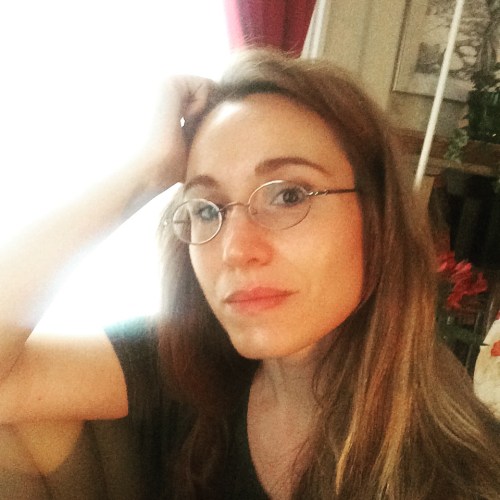
This was me recently, in my novel-writing uniform. Sweat pants and fuzzy slippers. The fuzzy slippers are particularly important . . .

Posted in Uncategorized | 6 Comments

Writing Your Stories

One of the hardest things about being a writer is that you can only tell your own stories.

I don’t mean that you can only write about yourself, or only about people like you. Of course you can write about different people, different places, different cultures. But the stories have to come from inside you. What you find outside needs to correlate to what you have inside. One of my central stories, for example, is losing a country. Or a family. It’s a story I find myself telling over and over again, almost as though I’m still trying to understand it. I could tell that story in a number of different ways, but the important thing is that it comes from inside and it wants to be written.

I’ve tried, before, to write the way I thought I should write. It never worked — the writing came out stiff, artificial. I see my students do it sometimes. They tell themselves, I’m writing a YA novel and this is the rule for writing a YA novel. They follow the rule, and the writing comes out sounding almost as though it were written by rote. It’s not alive . . .

“You can only tell your own stories” sounds almost inspirational, as though impelling you to tell your stories — it sounds as though it’s saying “you must tell your stories because no one else can tell them.” Which may be true, but it’s a different sentiment. “You can only tell your own stories” is actually a warning and a lament. Why a lament? Because what if your stories are not the ones culturally valued at that particular moment? What if you write poetry like Emily Dickinson or horror like H.P. Lovecraft? It’s going to be a hundred years before you are lauded as the most important poet of your generation, or people crochet Cthulhu hats. What if the stories in you aren’t New Yorker stories, or the sorts of stories that get you teaching positions in creative writing programs? I’m not talking about bad writing. I’m taking about good writing that isn’t what the culture wants or recognizes as innovative at a particular time. Or maybe ever . . .

I’m not sure, here, to what extent I’m talking about my own writing. After all, I’m writing in a genre that’s slowly being recognized as culturally important. I have many opportunities to publish my work. But even I feel, sometimes, as though my work is out of step, as though I am out of step with a mainstream. Or even, sometimes, where my own genre is going. But all I can do is write out of myself, dig deeper into myself, plumb my own depths to find the stories living down there. They are down in the mines of the self . . . And then find the things outside myself that correlate with those stories.

I was thinking, earlier today, of what is mine, what I know to be mine. What has become a part of myself. And I made a list:

1. Lists. Linear thinking, understanding through categorization. I learned it in law school, but it was always in myself. I have a logical mind that wants the world to be orderly. (Hint: it often isn’t.) I love order and structure and the intellect. I love the precision of a ballet class.

2. Flowers, and gardens more generally, and specifically roses. I love their names: Cardinal de Richelieu, Madame Hardy, Cuisse de Nymphe. I know them by name, I know their histories. Tall trees, running water, still pools. The calm of ordered nature.

3. But also wilderness: the beauty of mountains, rushing streams, storms. Mountain slopes covered with forests, like the ones where I grew up. Their blue, one behind the other as though a giant had filed them, fading into the distance.

4. Europe, especially Eastern Europe, which calls itself Central Europe. And Hungary, my own little corner of Europe. Even though I lost it, it’s still mine. I still claim it, and I hope it somehow claims me.

5. The perspective of the immigrant, the emigrant. The one who wonders where she belongs, who thinks in two languages. Who is perpetually an outsider, belonging to both cultures but never entirely to either. Who feels perpetually inadequate, not enough in either place.

6. Fairy tales, especially the dark Eastern European ones I read as a child.

7. Poetry, especially poetry that sings, as it has sung all my life through my head.

8. The nineteenth century, because I studied it as a graduate student. I am professionally trained it in, and have in a sense made it my own. And there is something temperamental that calls me back to the literature and art of that era. The end of the century, which I know best, was a time of transition, of becoming. And I seem to have always been in that process. No wonder I like vases with dragonflies on them . . .

9. Monsters, doubles, the Gothic and all its paraphernalia. Perhaps because I was born in Hungary, perhaps because I am an immigrant, perhaps simply because of who I am. I have always sympathized with those created by mad scientists or infected with vampirism. I have always felt myself to be double, like William Wilson . . .

10. Handicrafts: sewing, knitting, lacemaking. And art, which does not seem so different, I suppose because my grandmother did all these things and they were all expressions of herself, her own creativity. I have always assumed that women make art, because in my family they all do.

So I guess that gives me immigrant monsters who sew and grow rose gardens, somewhere in the forest at the foot of the mountains? And make lists . . . Or maybe the story is in the form of a list? Which, yeah, is actually the sort of thing I write! I’m pretty sure it will never make it into the New Yorker. I think there is an 11:

11. Sincerity, belief in a deeper meaning, a deeper pattern. A pretty complete absence of sarcasm and snark, although I’m all right at irony, I think. A lack of interest in things that are contemporary simply for their own sakes, in brands for example, in things that are culturally “cool” but I feel are pretentious. A belief in the importance of beauty. For its own sake, and for ours. And also,

12. A horror of violence, so that I will never write a story in which random people randomly die, and it doesn’t matter, or it’s done to make a point. Every single character matters, to herself if no one else.

So that’s a bunch of it, at least: the bundle of things that make up what I write, where it comes from. I guess I can only keep discovering my stories by writing them. But they will come from me, from the woman who loves roses and monsters and lace, and hates violence. And if at some point the culture decides they are worthwhile, that will have nothing to do with me. I will have written what is in me, which is really all I can do, and all I aim for.

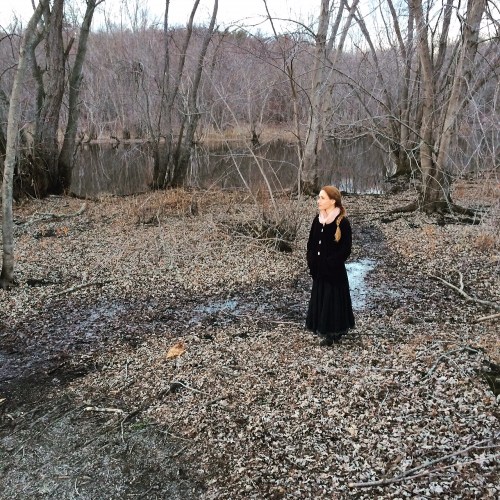
This is me (the me that all the stories come out of):

Dora in the Park

Posted in Uncategorized | 6 Comments

Looking Within

The more I study myself and other people, the most I realize that if you don’t find the things you need inside yourself, you won’t find them on the outside. You can’t find the things you need outside yourself.

I’m talking about the things you really need: love, success, affirmation of your fundamental worth. Our physical needs can be met externally. We can find food, shelter. But our emotional needs, our inner needs, can’t. Not really. Or not, at any rate, after childhood. Hopefully when we are children, we feel loved by our parents. We feel as though we are the most important thing in their world, that our successes and failures, our hurts and triumphs, matter deeply to them. This is not narcissistic: it is what a child needs to be healthy. The child then internalizes that love, and it becomes the self-love that he or she will need as an adult. Not having that sort of love as a child is a psychic wound that later needs to be healed. I’ve seen many of my friends with that sort of wound, in the process of healing. It’s not easy.

Once, when my daughter was young, I was sitting in a park playing with her. Another mother was there, also with a young daughter, and a grandmother with her grandson. The grandmother had been watching that other girl (mine was just a toddler at the time) playing in the sandbox. I’m not sure what prompted the comment, but she leaned over to that mother and said, casually, “She’s a little spoiled, isn’t she?” I recognized her accent at once: it was Eastern European. And I thought, I know the culture you come from. I know it so well, because it’s my own. And I know the generation you come from too, because my grandparents came from it. It’s the generation that lived through World War II, and to them, all the younger generations were a little spoiled, their lives a little too easy. You can understand that perspective: they had lived in the worst of times, under the Germans and then under the Russians, through no food and then bread lines. They wanted to prepare children for the reality of the world. Would children who were spoiled, who were too loved, be ready for privation? Starvation, even?

But I think that’s the wrong way to look at it. Children can’t love themselves: they can scarcely love other people, at that stage. They are being bombarded all the time by a strange world, a world too large for them, a world beyond their understanding. Their emotions are in a turmoil. At that stage, they need external love, and hopefully there is someone around — if not a parent, then a grandparent, another relative, a friend — to give it to them. Later, that love will form a sort of rock in their consciousness, a place to stand. They will have the knowledge that they were well and truly loved.

But what happens later? That’s what I’m really concerned with here. Now that we are all online, we get constant glimpses into other people’s lives, and I see so many people mourning their lack of certain things . . . emotional support, a partner to love and care about them, success in their chosen fields. They want those things so badly, and they want those things to come to them from the outside. And those things may, but when they do . . . they won’t be enough. That’s the ironic thing, isn’t it? By the time you’re an adult, if you haven’t built that rock to stand on inside you, nothing that comes from the outside will ever been enough. When love comes, it won’t be enough, and you will doubt it. Surely you’re not worthy of it? Surely it’s not real? When success comes, you will want more success, greater success. You will realize that any success can go away, and the knowledge will be like sawdust in your mouth.

When you’re an adult, in order to recognize the things outside yourself, to benefit from them, you must already have them inside you. This operates on a physical level as well: if you are hungry on the inside, no amount of food will make you feel full. You will continue to hunger. (Then you will need to figure out what you’re hungering for.) It’s a strange image I’ve created here, building a rock. You can’t build a rock, not physically. But maybe you can psychologically, the way nature and time build rocks? I thought of using the word “platform” instead, but that’s not strong enough to express what I mean. It’s a rock to stand on, something solid. And it needs to be inside you, because all the things outside you are ephemeral. They can go away. The people who love you can stop loving you. The success you wanted so badly can end in failure. All the external signs of your worth can disappear, with a turn of the wheel of fortune that medieval scholars thought governed our lives. Then what are you left with? What you have inside, that’s all.

So you have to work on what’s inside. That’s not easy, is it? Particularly if after childhood you were left not with a solid rock but with an emptiness, a sort of windy darkness — if what you are standing on is empty space. But either way, the project is the same: you have to build and maintain a rock on which to stand, your own rock. You have to love yourself, and find love within yourself. You have to feel successful, even when your work has been rejected. How do you do that? Little by little, bit by bit, stone by stone. Everyone does it differently, and it’s hard, and it takes a long time. But learning to find what you need inside yourself is the process of becoming an adult. I wondered if I had any wisdom to offer on how to do this, how to build your rock. And I thought, this is all I know:

1. Treat yourself as though you were someone you loved.
2. If you have failed, reward yourself: you are one of the brave ones who tried.
3. Remember Vincent Van Gogh. He failed all his life, and created some of the greatest beauty of which human beings are capable.

For me, finding what I need inside myself has been a very long process, one that has taken all my life. Am I there yet, at perfect self-sufficiency? Of course not, and I don’t think I ever will be. I don’t think anyone is, except perhaps Buddhist monks. I am not a Buddhist monk. But I can say that I’m better at it now . . .

I do know that the process of finding what you need inside yourself, finding love, courage, peace, is one of the most important processes we go through as human beings . . . and as artists, for those of us in the arts. That rock inside yourself is a platform, from which you can jump. And maybe fly.

Path Through the Woods

(I thought this would be the right image for this post. I took it yesterday, while walking through the woods, visiting my friend Autumn.)

Posted in Uncategorized | 6 Comments

Crafting a Life

I had a sort of epiphany recently, which makes it sound much more grandiose than it actually was.

When I moved into the apartment where I live now, I had the sense that I was going to live here for a while. And I’ve done a pretty thorough job of decorating, although it’s not done yet. There are still pictures to put up on the walls, and I just bought a new bookshelf, the last bookshelf I need to complete the apartment. It will have to be painted. Still, when I moved in, I had a sense of stability. And honestly, it scared me. I’m not used to stability . . . I’m used to always being on the way somewhere else. In law school, I was on my way to a legal career. In my legal career, I was trying as hard as I could to get out, to go back to graduate school. In graduate school, I had to actually finish and graduate. And then I did: I had my degree and a job I love, teaching writing. But things were still changing: I started teaching at Stonecoast as well as at Boston University, I moved from my smaller apartment into this larger one. I was still in transit. And now . . . I feel as though I’m here, stable, standing still. It’s a strange feeling. I’m not used to it, and I was worried that if I wasn’t moving forward, I was somehow getting stuck, going nowhere.

The epiphany was that I or a divine force (I like to think it was the both of us working together) had gotten me to the perfect place, the place I need to be right now. I have two jobs I love, teaching both undergraduates and graduate students. I love where I live. Oh yes, city living has its annoyances. But from here, I can go anywhere: the museums, the libraries, the train stations, the airport. It’s as though I live at the center of everything, and that center is a tree-lined street with old brownstones that, if you walk along it and then turn right, leads to a bookstore. Or if you turn farther on, a cupcake shop. Perfect, right? My apartment isn’t large, but it has ten-foot ceilings and sunlight streaming in through the windows. It’s the perfect size for what I need it to be, which is a refuge and a place to write. I have a home, an income, and then . . . I have the writing. And that’s at the heart of it all, really. Because what we’re trying to do, if we’re artists, is craft a life that lets us do the art. That’s the whole point.

And it’s not easy, is it? I was thinking about what it entails, and because I am a list-making animal, I came up with a list. Here are the things you need, in order to craft a life for yourself as an artist.

1. Meeting your physical needs.

This is the most basic step, the bottom of the pyramid. You need to meet your physical needs — food, shelter, safety. I know, there’s the cliché of the starving artist. I’ve known plenty of artists who were starving, or at least in situations of serious instability: writers, musicians, cartoonists. Guess what? It’s harder to create art when you’re scrambling to afford groceries, to find an apartment. To afford heating in Maine. (Yes, these examples are based on friends of mine.)

The reality is that it’s incredibly difficult to support yourself solely through art. If you see a writer who doesn’t have a job, the likelihood is that either he or she has an alternative source of income (family money or income from a spouse), or the writer earns most of his or her money through freelancing. Writing technical manuals, tie-in novels, video games: words that are commissioned, that do not belong to the writer because he or she is doing work-for-hire and the copyright is in the company. Very few writers earn enough simply from their creative writing to live on — or raise a family on. Those who do have usually had to work years to get there, to become famous enough, to build up enough of a backlist, to earn significant money from writing.

So if you want a creative life, find a way to meet your physical needs, whether it’s teaching or working at Starbucks. And be proud of yourself for having done so — you’re not selling out. You’re building the bottom of the pyramid that will allow you to become an artist.

2. Meeting your spiritual needs.

I think we have spiritual needs as well as physical ones. By spiritual, I mean a need to connect with sources of creativity. We need libraries, parks, museums. We need to read, to walk by the river, to look at paintings. We need beauty as well as bread. That’s the second level of the pyramid, and for an artist I think it’s as important as the first, although perhaps less immediately crucial. First pay your rent, then stare at a Monet . . .

But remember that if you’re going to create, you will need to feed your soul as well as your body. It’s the spiritual food that will inspire and inform your art. And the physical and spiritual can come together: in your apartment (rent paid for), you can create a beautiful space, filled with music and books. You can hang paintings on the walls. You can create a home for not just your body, but your soul.

3. Learning the craft.

I went back and forth on whether to break this out as a separate step: I was originally going to put it under “creating the art,” below. But I do, after all, think it’s different: this is the process of learning how to create your art, and you need to make a place for it as well. When I first started writing professionally, it was after having gone to writing workshops, but now I learn in other ways: by teaching, for one. Teaching undergraduates and graduate students means that I’m constantly learning.

This is the hard discipline of the ballet dancer who is constantly going to classes, constantly doing his or her exercises . . . The best artists I know, the Charles Vesses or P.J. Lynches of the world, seem to paint or draw every day. They are continually learning.

4. Creating the art.

This is the top of the pyramid, the place we wanted to get to, right? All the other levels of the pyramid lead to here. It’s much easier creating art if you’ve met your physical and spiritual needs, if you’ve learned and are learning about your craft. That’s usually where art happens. It comes not out of starving in a garret, not out of panic and anguish, but out of a small, stable place where you can do the work that is uniquely yours.

My epiphany was that I am in that place: what I need to do now, rather than panic about the fact that I’m not going anywhere, is sit down and write. I have at least five books lined up that I want to write, and guess what? Books don’t write themselves. You need to sit, move the hand across the paper, move the fingers over the keyboard. And that’s what I need to do. (That, and work on meeting my physical need for sleep. I’m much better at meeting my physical need for chocolate!) Write the book, write the next book. Teach fascinating classes, grade smart although grammatically problematic papers, go for walks along the river, remember to use my museum membership, read books. Eat cupcakes. And write . . .

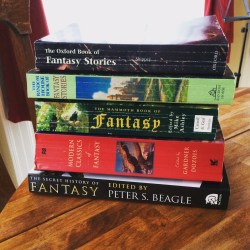
Meeting physical needs: books for a class I’m planning on teaching next fall.

Fantasy Books

Meeting spiritual needs: flowers on my table.

Flowers on the Table

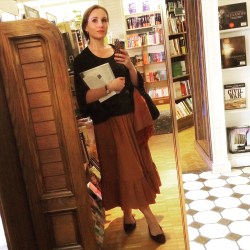
And the writer herself, in the neighborhood bookstore.

Dora in Bookstore

Posted in Uncategorized | 5 Comments

My Writing Life III

I love books on writing by actual writers. They tend to be less writing advice and more about being a writer, being the sort of person who makes things up in your head and then writes them down. They tend to be idiosyncratic, individual, and of course beautifully written.

Recently I bought four:

Writing Life 1 x 1000

Those are The Writing Life by Annie Dillard (from which this blog post takes its name — I was going to call it simply “My Writing Life,” but realized this is the third blog post I’ve written on that topic), Negotiating with the Dead: A Writer on Writing by Margaret Atwood, Reading Like a Writer by Francine Prose, and Steering the Craft by Ursula Le Guin. The Writing Life looks a little wrinkled because I had already read it when I took that picture, and honestly, the only time I have to read for pleasure right now is at the end of the day, in the bubble bath I take each evening. The bubble bath is a necessity: it helps with the back problems I’ve had ever since, as an associate at a law firm, I was told to revise the same contract over and over again, twelve hours a day, for a week.

I really enjoyed The Writing Life — Dillard’s writing is beautiful, and I loved hearing about how another writer does it . . . But what struck me most was the fundamental difference between her writing life and mine. She described writing as a kind of special agony — there were days of not being able to get anything down, nights of writing in a frenzy fueled by coffee and cigarettes. Writing was described as something special, elusive, sort of like a spirit that is sometimes there, sometimes not. And it was done in writing cabins on remote islands, or empty offices on university campuses — places that were not at home, that were remote, set apart. It sounded rather wonderful, and also rather awful, in both senses of the term. At least it filled with me awe, and also a sort of dread. Yes, some of it sounded . . . dreadful.

And also completely different from my writing life. So I thought I would write a post about my writing life, because all writers are different: the things Dillard needs, the things that fuel her creativity, are different from what I need and what fuel mine.

Here’s what my writing life looks like. Take an average Wednesday. I wake up, eat breakfast, exercise, shower, get dressed. Then I prepare to teach my classes. I teach a class, eat lunch, and teach two more classes. Then I come home and do the other work required for my teaching: grade papers, respond to student emails. But in addition to my undergraduate teaching, I also teach MFA students, so I have manuscripts to comment on, maybe a conference call. Most of my day is taken up with teaching. Somewhere along the way I usually get the ordinary tasks of living, such as grocery shopping and laundry, done. Days when I’m not teaching classes, I’m catching up on grading, commenting, emailing. Or holding office hours. When do I actually write? At night, after dinner, when all the other work is done. Sometimes I have so many other things to do that the writing doesn’t start until after midnight, which is bad — because I usually need to perform the next day, to make sense in front of a classroom of undergraduates, so I really do need to sleep.

Here are the things I can’t afford, financially and otherwise. I can’t afford to fly to small cabins on remote islands, because I have a job. I can’t afford procrastination or writer’s block, because if I don’t get writing done in the time I have, it doesn’t get done. There’s no other time for it. I can’t afford to wait until the spirit comes: it needs to come when I sit down to write. I can’t afford for writing to be agony, and it’s not: writing is usually the best part of my day. I think, now at last I get to sit down and write!

I think my life has trained me to write the way journalists are trained to write: I need to produce on time, by a deadline. And for me, that’s been good. At least I think it’s been good. It may be that to write as well as Dillard, you have to go through her kind of agony and isolation. You may need to write on a remote island, chopping your own wood for fuel. I don’t know. I may never write as well as she does, for that reason or another. All I can do is write my own material, create a writing life that enables me to write what I’m capable of writing.

I recently read an essay by Daniel José Older called “Writing Begins With Forgiveness: Why One of the Most Common Pieces of Writing Advice Is Wrong” that I liked very much. In it, he argues that we do not, in fact, need to write every day. What most often stops us from writing is a sense of shame, and the dictum to write every day can produce a sense of shame that actually stops us from writing. I think he’s absolutely right that shame stops us from writing, and he’s probably right that for a lot of people, the shame of not writing every day can derail writing at all.

After reading his article, I looked back on my own writing advice, because I had once said, and am still quoted as saying, “Write all the time. I believe in writing every day, at least a thousand words a day. We have a strange idea about writing: that it can be done, and done well, without a great deal of effort. Dancers practice every day, musicians practice every day, even when they are at the peak of their careers — especially then. Somehow, we don’t take writing as seriously. But writing — writing wonderfully — takes just as much dedication.” I mean, it’s up on Goodreads under “quotations from Theodora Goss”! While I do not mean to add to the load of shame any writer has to bear — there is already so much shame around — I do actually believe that for me, this is both true and necessary. (A caveat: in that thousand words, I count ALL writing. Including the writing I do while grading papers. I believe all writing teaches you to do all the other kinds of writing — it all counts as practice. So today, by writing this blog post, I’ve already done my 1000 words.)

Reject any writing advice that doesn’t work for you. I’ve rejected plenty. But for me it doesn’t work to treat my writing as a special spirit with which I am infused, nor does it work to forgive myself when I don’t do it. It works best when I think of writing as both my pleasure and my job. It’s something I get to do at the end of the day, but it’s also something I need to do, the way I need to exercise. Why do I think of it that way? Well, to be perfectly honest, because I want to be a good writer, and I also want to be a working writing. The only way for me to get better as a writer is to write, to keep thinking and learning about my writing. To practice deliberately. And the only way for me to be a working writer is to produce, usually on deadline. When you don’t produce, when you don’t have writing coming out, people tend to forget about you . . . It’s so easy to fall into the “whatever happened to” category. I know, I’ve been there — after I had finished my doctoral dissertation (which was still writing! just not published writing), a friend of mine told me, “I was wondering where you had gone.”

Now I have two novels coming out, in 2017 and 2018, one of which I still need to write. That wouldn’t have happened without a lot of butt in chair. The chair is drawn up to my writing desk, which is in a corner of my apartment. No island, no isolation. I write after a full day of doing other work. I write because I want to, but also because I’m a working writer, and that’s what working writers do. I would not skip a day, any more than I would skip a day of exercise. Both have become habits. Because I know that’s the only way my writing will actually get done . . .

Writing Life 2

And this is me, grading papers.  Seriously, grading papers is excellent training for being a writer!  There is no better training for writing clearly and succinctly than writing paper comments that students will hopefully understand . . .

Posted in Uncategorized | 4 Comments

Magic and Realism

At the last Stonecoast residency, I gave a seminar called Magical Realism: Theory and Practice. At the next residency, I’ll be leading a workshop on writing magical realism, or the intersection between magic and realism where we usually place that literary mode. It occurred to me, looking at the stories I’ve published so far in my writing career, that all the stories I write are at that intersection. I’ve never written anything in a wholly magical world, even though I like reading secondary world fantasies — at least, if they’re set in Narnia, or Middle Earth, or Earthsea. But all of those secondary worlds, while complete in themselves as imaginative constructs, also function as metaphors for our world — they are created by extraordinary writers, and I think those sorts of writers can’t help speaking metaphorically. Narnia, Middle Earth, and Earthsea tend to point back to us, make us think about our own issues and problems.

My stories tend to happen in or be related to our world: they inhabit an interstitial space. Why?

Here’s what I said in my seminar. I started by talking about different literary modes. First, realism. Realism has been with us since at least the time of the Romans. You can see the shift from idealization to realism by walking from the Ancient Greeks room in the museum to the Ancient Romans room — there you think, wow, the Romans weren’t anywhere near as good-looking as the Greeks! But of course it’s not that: the mode of representation had changed. The Romans are showing us what people actually looked like, pock-marks and all.

Realistic representation has been important every since, although in different ways at different times. It was particularly important during the eighteenth century, when artists assumed that the representation of reality, even if an idealized or allegorized version, was the primary aim of art. It is the default mode of the modern novel. Here is the image I used as an example of realism, Leonardo Da Vinci’s Mona Lisa:

Mona Lisa by Leondaro Da Vinci

Here is a real woman, depicted much as she would be in real life: not exactly of course, but Leonardo was aiming, among other things, for faithful representation. I told my students to think of realism and fantasy as on a continuum: fantasy at one end, realism on the other. We never really get to either end. Complete fantasy would be a dream, incomprehensible; complete realism would no longer be literature at all. Literature takes place somewhere along that spectrum: The Lord of the Rings somewhere on the fantastical side, Middlemarch somewhere on the realistic side of it. Here is the image I used to exemplify fantasy, The Birth of Venus by Sandro Botticelli:

The Birth of Venus by Sandro Botticelli

Here we see the birth of the goddess, and no one is batting an eyelid. No one is saying, Wait, are there actually goddesses in our world? Of course in Botticelli’s world there weren’t. While Botticelli probably had a model, the woman he painted is not realistic: she is a fantastical representation of the goddess of love. The realest thing about her might be . . . her toes? Fantasy is our oldest literary mode: long before we were writing novels, we were telling myths, legends, fairy tales, and fables. It predates the seemingly clear separation of fantasy and reality on which our modern understanding of the world is founded. The rise of realism as the dominant mode accompanied the rise of the real itself as a separate category from the fantastical, imaginary, and false.

So here we are with our continuum:

Fantasy _________________________ Realism

Along that continuum are ranged all the literary works we know. Both modes, fantasy and realism, are necessary to literature: if a work is entirely realistic, it’s no longer literature: it’s reportage. It lacks the element of imagination, of the imaginative selection and ordering that turns history into story. All literary works include fantasy and realism, in unique mixtures.

And then I started talking about the middle space, somewhere between Lord of the Rings and Middlemarch. Here is the image I used to exemplify surrealism, The Great War by René Magritte:

The Great War by Rene Magritte

Notice that I chose images of women as examples. I did so for two reasons: first, because women are one of the great and recurring themes in Western art history, and second, because I wanted to compare images on the same theme. Here we have an image that is realistic: the dress and handbag are contemporary, and we can imagine a real woman wearing them. But her face is hidden by violets, which is obviously not realistic . . . it’s fantastical, both beautiful and unsettling. Surrealism happens somewhere around the center of the continuum, where fantasy and realism meet. It turns inward, to the psychological — to the extent that this painting has meaning, it’s meant to be understood by the unconscious. In the early twentieth century, surrealism was an attempt to unseat reigning Realism from her throne. Its manifesto was that realism has limits, that it allows us to see only the surface of things, and there is so much more under the surface.

And then I started talking about magical realism. Here is the image I used, Frida Kahlo’s Self-Portrait with Thorn Necklace and Hummingbird:

Self-Portrait with Thorn Necklace and Hummingbird by Frida Kahlo

Magical Realism, in the mid-twentieth century, also challenged the dominant literary mode, but this time in a way that was more historically grounded: in an awareness of colonialism and the ways in which realistic representation left out alternative modes of perception as well as storytelling. Magical realism said, wait, you’re telling a story one way, but there are others, and we’re going to try them. It also said, the way you are perceiving the world may not be the correct one. It was a more political challenge, and I believe a stronger one.

Why do I write it? When I look at the Mona Lisa, I find it comforting. When I look at The Birth of Venus, I feel the same . . . a sense of stability and comfort. Although they fall on opposite sides of the spectrum, in both of them we know where we are. Either goddesses exist and rise out of the ocean, or they don’t. But in the Magritte, and even more powerfully for me in the Kahlo, we aren’t quite sure. Do goddesses exist? They could . . . What are the fundamental rules of our world? We don’t know. That is the liminal space, the interstitial, slipstream, magical realist. It is a space of uncertainty, and for me that is a space of becoming. It’s generative.

Anyway, I have lived in that space all my life — by personal history (losing my country at a young age) and probably by temperament. I believe in a real reality, underneath our perception of it. If I fall out of a window, I will end up in the hospital. Under current gravitational conditions, I can’t fly. But I also believe that what I perceive of the world is only a very small part of it, that real reality is so much greater than I think or can understand. It’s a stance of humility toward the world, and of skepticism toward our construction of it. I feel more comfortable in uncertainty than certainty . . .

And that is why I write what could be called magical realism, or slipstream, or interstitial fiction. The important thing, I suppose, is how it informs my work and its philosophical underpinnings. Last residency, I ended my presentation with a quotation from Frida Kahlo: “I never paint dreams or nightmares. I paint my own reality.” Yeah, what she said.

Posted in Uncategorized | 4 Comments