Research for Writers

I’m back from Budapest! This month will be very busy: first I’ll be attending Readercon, where I’m an author guest. I’ll have a reading, a kaffeeklatsch, and a whole bunch of panels. Then I’ll be teaching at the Stonecoast MFA Program summer residency. While I’m there, I’ll be on a panel about research for writers, which makes perfect sense considering that I just got back from five weeks of doing research in Europe. Well, not all of it was doing research — some of it was sleeping and eating. But otherwise? Yes, pretty much all research.

First I flew to Budapest, where I spent one day in my grandmother’s apartment before heading by train to Vienna. In Vienna, I stayed with wonderful and very generous friends who live within walking distance of the Ringstrasse, which semi-circles the center of the city. Every day I was there, I would set out in the morning and just walk, as long as my legs would carry me. I ended up so tired! But I did all the research I needed to, in order to write the central chapters of the book I’m working on now. Honestly, I don’t think I could have written this book without going to Vienna — I hadn’t been in so long, and Vienna has a completely different character than Budapest, although they are related. It’s like the relationship between the sensible older sister who became an investment banker and the rebellious younger sister who ended up a performing artist — she has a lot less money, but she makes up for it in style and individuality. That’s how I think of Budapest. I really needed to see Vienna, smell Vienna, taste Vienna. I needed to get a sense of her, to internalize her just a little, so I could capture her in my novel.

One of the things I want to say at Stonecoast is that research for writing is completely different from the sort of academic research most of us are taught. I was taught more academic research than most: my PhD dissertation was on late nineteenth-century gothic literature, and as you can imagine, it required a lot of research. Around two years’ worth. When I started to write my first novel, I thought, easy peasy. I’ve done the research for this. Ha! The first time my characters wanted to buy anything and I had to figure out how many shillings were in a pound, I realized my previous research had been a bare beginning. You can write a PhD dissertation about the late nineteenth century not knowing very much about the sewage system, or contagious diseases, or how an oven works. But not a novel! For a novel, you need to know all sorts of things so you can imagine even more, so your characters can walk around in a world that has the texture of reality. You need to know about mourning customs, and when indoor plumbing was introduced, and what your characters would have heard walking down the streets. What were the costermongers crying? How did carriage wheels sound on cobble stones? When your characters climbed onto an omnibus, how did they do that?

There are different places you can do that research: of course you can find some information online and in modern books about the time period. But in order to write the first book, I also read all the books I could from that time period, including every single Sherlock Holmes story, paying particular attention to things like when characters drew on their gloves, where they looked when they needed to consult the train timetables. I also used primary sources, such as nineteenth-century maps. That became particularly important while I was researching the second book, because in that one my characters travel, and I wanted to make sure I had the exact same Baedeker they would have used (although mine is a PDF). But nothing quite substitutes for actually going there. I realized that one day while I was researching the first book, two years ago. I was in London, standing in an alley behind a row of houses facing Lincoln’s Inn Fields. My characters needed to stand in that alley, and one of them needed to climb up to a window on the second floor of one of the houses. How was that to be accomplished? And then I saw it: the drain pipe. My character would climb up that drain pipe! Judging by its look, it had been there in the late nineteenth century. Even if it hadn’t, it could have been — an external drain pipe would have been entirely possible in 1897. It’s fair to say that the most important thing I saw on that trip to London was the drainpipe.

One of the most important things I saw on this trip to Vienna was the Freud Museum, and I’m including some pictures here so you can see what sorts of photographs I take when I’m doing research. I needed photographs of the museum because it’s actually where Freud’s apartment and consulting office were located. My characters go to that office, and I wanted to describe it accurately.

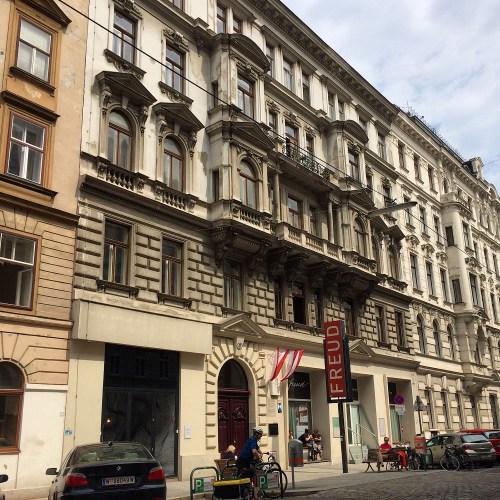
This first photo is the Freud Museum itself. You can see that it’s simply on an ordinary back street. I almost got lost going there. (It’s very easy to get turned around in Vienna, unlike in Budapest, where you can always orient yourself by the river.)
Freud 1 1000

You walk up two flights of stairs and there you are, at Freud’s apartment. If you walk to the right, you come to his waiting room, which is still furnished the way it would have been when he was seeing patients in Vienna.
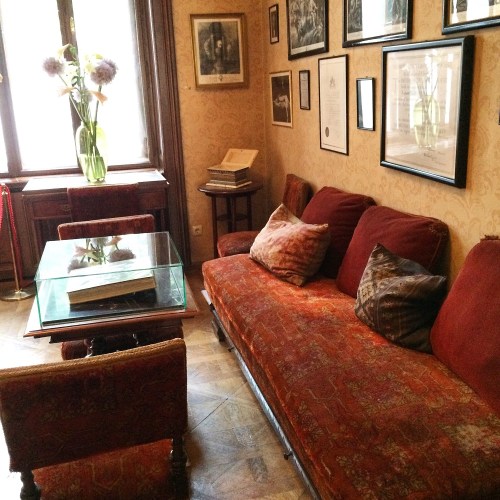
Freud 6 1000

Here is a second photograph of his waiting room. I have several others: I wanted to make sure I captured it completely. I bet that settee was actually not very comfortable, for those waiting to see him . . .
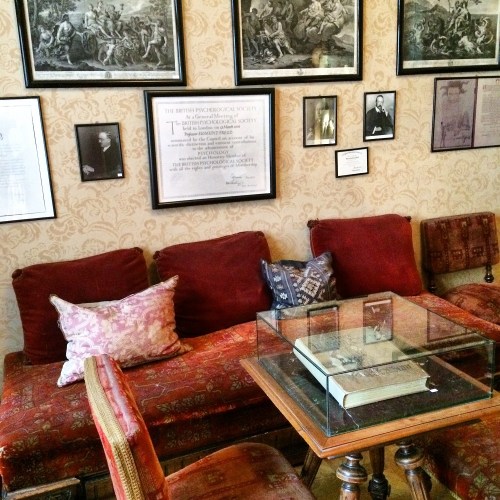
Freud 7 1000

The rooms that used to be his office are now a museum, so they aren’t furnished the way they used to be, but you can still see photographs of them on the walls.  The surfaces were covered with ancient pottery and statues, since he was interested in archaeology.  The shelves were filled with books.  The famous couch stood in the center of the room.  Below is his custom-made reading chair.
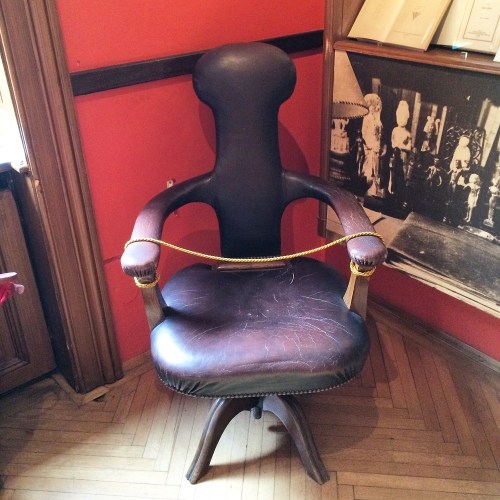
Freud 18 1000

And below you can see the trunk he kept packed, not at the time of my novel but later.  It was packed in case he and his family had to flee the Nazis, and of course they did finally have to.  This was the trunk they fled with.
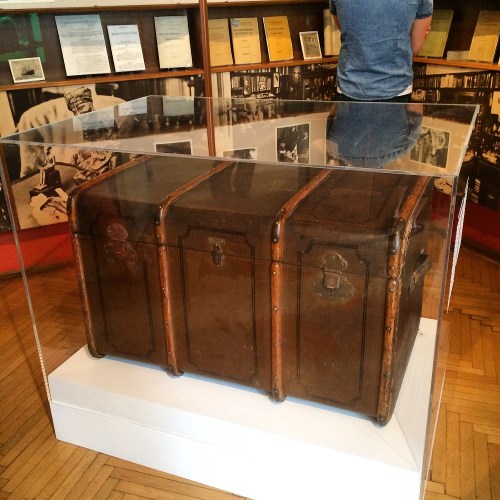
Freud 16 1000

He used to look at himself in this mirror.  You see, he had oral cancer from smoking, and several surgeries for that cancer.  In this mirror he could see how they affected his face.  It felt uncanny taking my own photograph in it — which is exactly why I did it, of course.
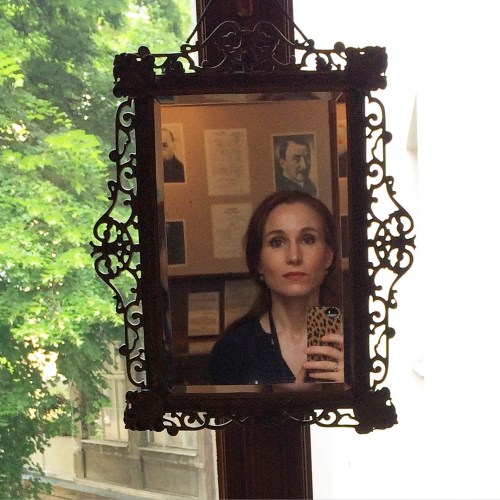
Freud 17 1000

And finally, here is an example of the sort of thing you just have to see for yourself: a late nineteenth-century intrauterine device, used for birth control.  I wonder how effective it was!
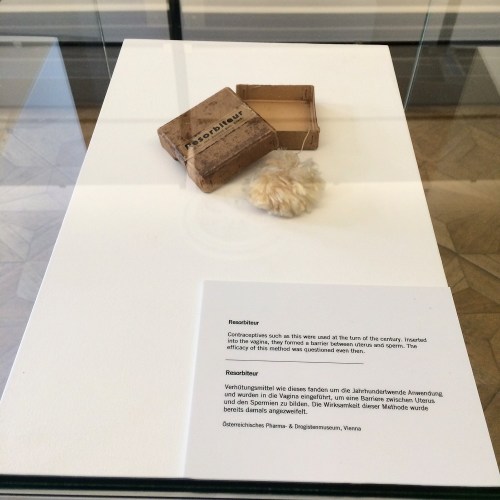
Freud 23 1000

Research for writers is always in the aid of imagination. What writers do is take bits and pieces of reality and build a credible world out of it, whether that world is New York or Middle Earth. What you’re doing when you research is, at its simplest, paying attention. What does it actually feel like to climb up into a carriage? To wear a wool walking suit? To fire a revolver? What does the city smell like? What vegetables would have been sold in the markets? And then, you put your characters there, and imagine . . .

Posted in Uncategorized | 7 Comments

The Caretakers

The year I was finishing my PhD, I would go to a therapist once a week. I was trying to manage depression, which honestly I think is pretty normal when you’re finishing a PhD. That sort of intensive work, for that long, can be so difficult — you spend your days staring at a screen, trying to make the words and ideas fit together, and then you try to manage the rest of your life at the same time. It was one of the most difficult periods of my life.

Anyway, we talked about my childhood, and one thing she told me was that I was a “caretaker.” I think she said that partly because when I was about twelve years old, I became responsible for taking care not only of myself, but also my little brother. Then later I started babysitting, taking care of other children. Even later, I worked at summer camps. Almost all the jobs I had before going to law school involved taking care of people, in one way or another. But it started with taking care of my little brother.

There is another way of being a caretaker. Somewhere along the way, I was taught to do what we now call emotional work: that is, taking care of the emotional needs of other people. Being not only responsible, but also responsive. This is something a lot of women are taught, of course. I think I learned it because I was raised in a Hungarian family, where you were not only supposed to do the appropriate thing, you were also supposed to feel the appropriate thing. To respond in a way the family thought was appropriate. If you didn’t, you were called an ungrateful American child. Or spoiled. I’ve been called spoiled many times in my life. It’s an interesting word, with an implication of rottenness — if you don’t behave or feel the way you should, you are somehow rotten. I think a lot of people were raised this way, although it was starting to change when I was a child — there was already a sense that children should develop their own sense of self, should learn to stand up for themselves, to create their own boundaries. But that was not part of my upbringing.

So I became a caretaker, and for the most part I remained one. As I lawyer, I took care of clients. Later, as a teacher, I took care of students, and of course I still do. In some ways, it’s like taking care of your little brother. It doesn’t mean giving him everything he wants — it means making sure he heats a healthy dinner, does his homework, goes to bed at the right time. Taking care of students means sometimes giving them things they don’t want, like grades they will be unhappy about — because hopefully they’ll learn from getting a “bad” grade, and do better. It means doing what you believe is best for someone else.  It also means listening, intuiting what is not said, caring.

There are good things about being a caretaker: if you’re doing it well, it’s helpful to other people. It makes conversations and interactions better, smoother, easier. This would be a difficult world without nurses and teachers, the types of people who are tasked most directly with caring for someone else. I don’t just mean helping — a surgeon can help you without exchanging a word with you. But nurses do both the emotional and physical work of caring, and that’s really what I’m talking about.

The danger of being a caretaker is that it can consume you. Taking care of other people is one of the most exhausting things you can do, as anyone with small children knows — in that situation, you are responsible for all their needs, physical and emotional. When my daughter started daycare and I went back to work,  I was surprised by how much of a relief it was to do that sort of caretaking instead.  I loved being with my daughter, but taking care of undergraduates, even sixty of them, was so much easier than taking care of a single two-year-old! That was of course because two-year-old children have no boundaries at all, physical or emotional, whereas teaching creates boundaries as well as connections — the emotional work of interacting with students was much easier.

Most women will know what I’m taking about when I say that caretaking requires emotional work, different amounts depending on the situation. Women are usually taught to do that work as they grow up — they are taught to be caretakers, to make others feel comfortable. They are taught to agree, to be agreeable. To defer when they are told they are wrong, to respond when a response is asked for. They are taught to take care of homes, men, children — and anyone they are in conversation with. If you’re a woman reading this, you probably have an instinct, in conversation, to make sure the person you’re talking to feels comfortable. It’s like putting a pillow under someone’s head. Smoothing a coverlet.

There are good things about that kind of work — another word for it is politeness, and back in the nineteenth century, gentlemen, as well as ladies, were praised for their ability to do it. Somewhere along the way we stopped asking men to do that sort of emotional work, and in male discourse we began to value authenticity. Speaking your mind became a masculine trait, although in women we still valued the ability to soothe, to make comfortable, to take care. That’s changing, although we’re at the point where women are being given the advice to speak up and ask for what they want, then penalized for doing so. It’s a confusing time. The bad thing about it is that, once again, it’s exhausting. Have you ever been in a conversation with someone you disagree with, but that person is also someone you need to treat with respect and politeness — maybe an older relative? Nodding, smiling, saying the soothing thing? Not getting into an argument? And ended up with a splitting headache afterward? Yeah.

What I want to say here is that being a caretaker can be a good thing, but you can’t do it all the time. You lose too much — to much energy, too much of yourself. There are times when you have to draw boundaries, when you have to retreat behind your own walls. You have to take care of yourself. That’s a cliché, but it’s true. There are times when you have to prioritize your own work, your own needs and desires, or you will burn out from trying to provide heat and light to other people. And caretaking can become a place to hide.  A substitute for finding your own way, doing your personal work. It’s so easy to say “Everyone else needs me” and ignore yourself. It’s so easy to find emotional fulfillment in meeting everyone else’s needs, at least for a while. Parents sometimes realize that as their children grow older and they think, wait, what was I going to do with my life again?

Caretaking is not enough. Taking care of other people’s needs isn’t enough. Even saving the world isn’t enough if you lose yourself in the process. Although saving the world is a very good thing to do, of course. Society needs caretakers, and honestly we could probably use more of them. Some of the people who are supposed to be caretakers aren’t doing a very good job (politicians especially — anyone remember that they’re supposed to advance the common good?). But don’t let yourself be trapped in being a caretaker. That’s not good for you, or ultimately anyone else.

Take care of yourself too. It’s not new advice, but I think it’s good to be reminded of it every once in a while.

Image by Jessie Wilcox Smith

(The painting is by Jessie Wilcox Smith.)

Posted in Uncategorized | 6 Comments

The Mythic Arts

When you write a lot for a long time, eventually you learn a very important thing: why you’re writing.

I was thinking about just this issue recently: why do I write? Of course I write because I love writing, the way a dancer loves dancing — it’s a continual dance of the mind, and on days when I don’t write, I feel almost disoriented, not at all myself. I get angry with the world, on days I don’t write. And I write because I want to be read. I want to talk to people, tell them something. I want to communicate.

What I want to tell them is that the world is enchanted, and enchanting. I want them to see what I see: the beauty, the tragedy, the grandeur of this world of ours. Of our lives, even in their smallest moments. I want to show them enchantment. I want them to see the magic. Which is, I suppose, why I write and work in the mythic arts.

I first encountered this word in the work of Terri Windling, who was editing the Journal of Mythic Arts at the time. Unfortunately, the journal itself is no longer being updated regularly, but you can read its wonderful Archives online. What are mythic arts? To explain that, I have to go back a bit.

There are various ways that human beings tell stories. Some of these ways are myths, legends, fairy tales, and history. Myths are stories of the gods. Legends are stories of heroes who have almost-godlike powers. Fairy tales are stories of ordinary people who encounter magic, who venture into or are impacted by fairyland. We separate out history from these categories because it is supposed to be “true,” but as J.R.R. Tolkien points out in “On Fairy-Stories,” history is often more truthy than actually true, and the farther back we go, the more it includes material that comes from myths, legends, and even fairy tales. Modern realistic fiction is fantasy (because all fiction is fantasy — Emma Bovary did not actually exist) that partakes of the truthy quality of history. Realistic fiction is another way we tell stories — a very modern way. The European novel as we know it (novel meaning new, not that old mythic, legendary stuff) dates only to the seventeenth century, although it dates back much farther in Japan.

Something important happened in the nineteenth century: realism and fantasy split off from one another. That split had started at least a century earlier — in Maria Edgeworth’s The Parent’s Assistant, a book for children old enough that Jane Austen would have been familiar with it, she prides herself on not including any fairy stories, which are bad for children in the way sweets are bad for them. It’s already clear from Edgeworth’s introduction that there is reality, and there is fantasy, and never the twain should meet. At least not in the imaginations of children, because they might become confused — they might expect castles and ogres and princes, whereas such things do not exist. So says Maria Edgeworth.

This movement to separate fantasy and reality, but also realism and fairy tale, continued into the nineteenth century, and by the end of the century it was very clear that there were the respectable novel and short story, and the considerably less respectable forms of fairy tale, myth, romance (in the old sense of an adventure story), ghost story, etc. By the twentieth century, they occupied different publishing niches, different shelves in the bookstore. As they still do.

The problem of course is that realism isn’t truth — it’s truthy. And myth and legend and fairy tale also contain truth, in a different way — not by pretending to be true, but by embodying deeper widsom about the world and ourselves. They allow us to tell different kinds of stories that are not accessible to us through realism. For example, The Wind in the Willows contains the very deep, very true, truth that animals have lives apart from our own, consciousnesses we don’t necessarily understand. It’s taken science until — well, now, to understand that truth. We are still exploring it scientifically, but it was there all along in myths and fairy tales. We just stopped listening, and in the meantime, a lot of animals got treated very badly.

Here’s the thing: talking about conservation will not save the badgers of England. If anything will save them, it will be the way people feel about Mr. Badger. We are human beings, and we make decisions based not on logic or rationality, however much we may think we do (deluded as we are about ourselves), but on emotion. And what creates emotion? Story.

If we are to be good, decent human beings, who do not destroy each other or this beautiful world of ours, we must learn that animals can teach us, that trees have wisdom, that kindness and generosity can make you a princess. We must also learn that there are ogres out there, and weapons to fight them. We must learn this in childhood, and we must learn it again (because we are forgetful and must continually be reminded) in adulthood. The mythic arts teach us the deeper truths we must learn, about the world and each other.

And that is the reason I write what I write. I sometimes say that I want to re-enchant the world, but by re-enchant I mean not make enchanted but reveal the enchantment that is already there. I feel as though I see a deeper truth: the world as it is, and as it could be for us if we, in our human folly, did not separate ourselves from the deeply real, did not pave over it with concrete (and the concreteness of our realism).

I’ve been told that what I write is too fantastical, too romantic. But I write about the reality I see. Maybe I just see reality a little differently? What I see is that so much of what we make is truthy, not true. Realism, not reality. We need to reach deeper, go down to the deep wells of story. That is the well I want to draw from.

Down there, the water is cool and dark, and it is the only thing that, ultimately, will quench your thirst. That is why I write.

Forest 2 1000

Forest 1 1000

(I was walking through the forest when I found what I think is an old church baptismal font. There, under the trees, it seemed to symbolize a different sort of baptism . . .)

Posted in Uncategorized | 7 Comments

Studying Adaptations

Writing is a craft and an art, as I’ve said many times and in many places.

To learn the craft, you need to study writing. To learn the art, you need to study life. Study it, experience it, live it . . .

But what I want to write about is an aspect of craft. I’m not sure when I started studying adaptations, but I distinctly remember reading The Hunger Games, one week when I had the flu, and then watching the movie almost directly after, specifically to find out how it had been adapted. Someone said (or maybe no one, because it’s one of those internet memes), being a writer means having homework for the rest of your life. That’s essentially true, and writers also set themselves homework. I read books specifically to study what makes them popular, what makes them work . . . or not. Often I learn as much from what I don’t like as from what I do. That week, being too sick to do anything else, I decided to read The Hunger Games. It wasn’t the sort of book I generally love, although I might have when I was younger, but I was impressed by its sheer compulsive power. Despite the fact that I could see how it was being done, how the narrative was put together, I could not put it down. I kept wanting to know what happened next. That in itself is a kind of writerly feat.

Then, still with the flu, I watched the movie version.  I was fascinated by the changes that had been made to adapt the novel to a movie. For the most part, they were very effective changes: The Hunger Games and the Harry Potter series both belong to that rare tribe of books that are good in themselves, and are adapted well. Nowadays, I watch adaptations deliberately, trying to learn from them. I find that I can learn a great deal from the choices made by different writers. For example, lately I’ve been watching Grantchester, the BBC mystery series based on the novels by James Runcie. That’s an instance in which I prefer the television adaptation, which is quite different from at least the first novel. And it’s going in a different direction . . . It’s darker and grittier, with more psychological depth. The mysteries are more like puzzles: they fit together in intriguing ways. My brain has always liked puzzle mysteries.

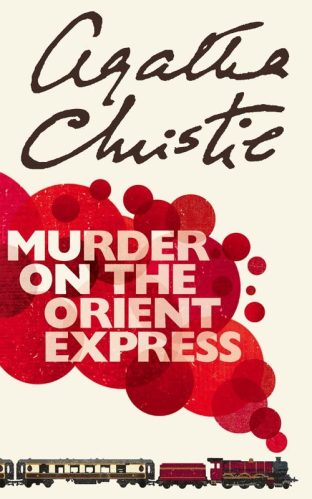
On the other hand, I’ve been dissatisfied with every adaptation I’ve seen of an Agatha Christie mystery. I think the adaptations have gotten her novels completely wrong: they have been convinced that she writes cozies, and that Miss Marple and Hercules Poirot are fundamentally comical figures. But they’re not. In my mind, Poirot resembles Alfred Hitchcock much more than David Suchet, who played him on the BBC series. What we forget about Poirot is that he was a policeman. If you’ve ever met a policeman in real life, you’ll know they have a certain something that people get when they’ve been in positions of power over others, positions from which they wield judgement.  Particularly over life and death.  When Poirot reveals who he really is, the audience (as well as the criminal) should feel a sense of danger. Christie didn’t write cozies — she wrote perfect, poisonous little poems on death, deconstructions of the British social class system. There is something in her the adaptations, so far, have fundamentally missed.

Recently, I watched another sort of adaptation: the pilot and first season of Buffy the Vampire Slayer. Here the pilot could be considered the original, and the first episode of that first season an adaptation of sorts. It was fascinating to see the different choices the director made in the first episode. The biggest change was the actress who played Willow. Looking at the pilot, I could see why the original actress did not work in that part — I’m sure she was very talented, but she seemed to be in a different show from the other characters. I suppose shooting a pilot is like drafting a chapter — once you look back at it, you can see what sticks out, what isn’t going to fit into the novel. You can see what sort of novel it’s going to be.

Murder on the Orient Express

Give yourself this exercise: Watch a movie or television adaptation of a novel. Notice the following:

1. How has the plot changed, and why? Are those changes effective? Which version do you prefer or find more satisfying?
2. How are the actors bringing the characters to life? What has changed in the characters or how they’re being interpreted?
3. How has the screen version brought the setting to life? What sorts of details have the set designers chosen? How do they inform the story?
4. This isn’t part of the set or part of the characterization — perhaps it’s part of both? But notice how the characters are styled, what they are wearing. What sorts of decisions have been made about costume, and why?
5. Notice the camera. In a screen version, the camera substitutes for what you, as a writer, think of as point of view. What is the camera showing? What is is not showing?
6. What has been cut out? What did the screenwriters and director consider unnecessary?
7. Particularly in a modern version of an older book, how has it been updated? For example, something there only as subtext in the 1940s (a character’s homosexuality, perhaps) will likely be shown in the modern adaptation.

You can learn quite a lot from studying adaptations. It’s yet another tool in your toolkit as a writer, yet another thing you can study as you learn your craft.

And it’s an excellent way to distract yourself when you have the flu . . .

Sidney Chambers and the Shadow of Death

Posted in Uncategorized | 5 Comments

Writing with Density

Recently, I picked up a writing book in a used bookstore. I like to read books about writing, particularly those that focus on writing as a craft, because I find that I always learn something from them. Sometimes I learn what I don’t agree with, when the book doesn’t make sense to me — in which case I give it away again. But sometimes I find a book that is truly valuable to me, and then it becomes a part of my permanent library. That is the case with William Sloane’s The Craft of Writing. I was pretty sure I would like it when I saw that John Ciardi had written the cover blurb — I like Ciardi a great deal, not as a poet necessarily but as a critic and theorist. I like how he approaches writing, looking for a sort of modernist lyrical clarity, which is what I aim for in my own prose.

The Craft of Writing turns out to be an incredibly useful little book — so clear, so sensible. And it contains the best (and honesty, the only) description I have read of something that is central to writing, which is density. Here’s what it says:

“A vital aspect of the fiction-writing process, and most surely of all creative writing processes, is the matter of density. By density I mean richness, substance. It is the core of knowing your materials.

“Density is one of the most difficult aspects of fiction to discuss because it is not a separate element like plot or even characterization. Rather it is a part of everything else. Real density is achieved when the optimum number of things is going on at once, some of them overtly, others by implication.

“Writing is not a matter of a single, simple progression, with each sentence making only one point. Every paragraph, every sentence is related to the entire rest of the book, and if it is not so related it is superfluous. By ‘the entire rest of the book’ I mean what is to come as well as what has gone before. The part of the book already read is stored in the reader’s memory bank, and each new word is added to that storehouse. But in many ways what is being read is an invisible prophesy of what is to come. This is one part of the ingredient of density. There are many others.

“A good piece of fiction is something like the Scot’s definition of the haggis: ‘A deal o’ fine confoosed feeding.’ All parts of each scene are working: characterization of the people portrayed, creation of the physical world of the story, narrative motion, whetting of anticipation, resolution of the mystery, characterization of the author — style inevitable does this — all the dimensions and all at once.”

That’s density, the best description of it I’ve ever read. What I tell students is that every sentence in your story should be doing at least two things, three is better. If it’s only doing one thing (conveying information, for example), it’s insufficiently dense. If a story is written in such single-purpose  sentences, it will feel flat, one-dimensional. What you’re aiming for really (Sloane would not have had this vocabulary, I think) is a story that is also a fractal. Each part of the story also contains the pattern of the entire story. But that’s high-order writing, J.S. Salinger’s “For Esmé — with Love and Squalor” level writing. What I’m talking about right now is simply density.

Density is how you establish a feeling of reality in your story. The real world we live in is dense, absolutely filled with stuff, near and far. We are constantly thinking about the past, the future. Just as I sit here writing these lines, I have around me the teddy bear I was given when I was a year old, all the books I have published on a shelf across the room from a shelf of the books I was given as a child, my watch reminding me that I will be going to see the lilacs later this afternoon, a to-do list telling me that I need to finish critiquing two manuscripts this weekend, a rock with the word Believe on it that I bought while I was finishing my doctoral dissertation, and a photograph of my daughter from two years ago as well as a poem she wrote last year. My world is absolutely full, layered. That’s the feeling you want to convey in prose.

The most common difference between the prose of an inexperienced and an experienced writer is density. The experienced writer’s prose will be much more dense. Therefore, it will feel more complex and satisfying.

I tried to think of an example of density in prose — Virginia Woolf immediately came to mind. But perhaps I’ll go with the beginning of “For Esmé — with Love and Squalor,” which is an almost perfect short story. Here’s how it starts:

“Just recently, by air mail, I received an invitation to a wedding that will take place in England on April 18th. It happens to be a wedding I’d give a lot to be able to get to, and when the invitation first arrived, I thought it might just be possible for me to make the trip abroad, by plane, expenses be hanged. However, I’ve since discussed the matter rather extensively with my wife, a breathtakingly levelheaded girl, and we’ve decided against it — for one thing, I’d completely forgotten that my mother-in-law is looking forward to spending the last two weeks in April with us. I really don’t get to see Mother Grencher terribly often, and she’s not getting any younger. She’s fifty-eight. (As she’d be the first to admit.)”

Notice how much is going on in this paragraph, which on the surface is so simple. We know the narrator is male, married, and that he takes a particular attitude toward his wife, who is “breathtakingly levelheaded” — a critical although affectionate appraisal. He’s not in England (America, probably), and he doesn’t have much money. He would very much like to go to this wedding, but expenses are what they are, and anyway his mother-in-law is coming. He likes his mother-in-law well enough, although again we get a sort of amused, sardonic tone (as well as the words “terribly often”–what does that “terribly” imply?). We know at once that this is a man who’s distant emotionally, or has distanced himself. He looks on the world amused, and somewhat passive. What sort of man does that imply? One who has been through trauma. He has discussed the matter rather extensively with his wife — we get the sense that she had a lot to say (breathtakingly — did she have to take a breath in the middle of the discussion? That’s rather the implication, isn’t it?  That she did most of the talking, with scarcely a pause to breathe.) And the narrator is not level-headed. Expenses be hanged, he would very much have liked to go to this wedding. Why? Well, in the next paragraph he says,

“All the same, though, wherever I happen to be I don’t think I’m the type that doesn’t even lift a finger to prevent a wedding from flatting. Accordingly, I’ve gone ahead and jotted down a few revealing notes on the bride as I knew her almost six years ago. If my notes should cause the groom, whom I haven’t met, an uneasy moment or two, so much the better. Nobody’s aiming to please, here. More, really, to edify, to instruct.”

He knew the bride. It was six years ago — he is not an old man, his mother-in-law is only fifty-eight. What was his relationship to her? Why will his notes cause the groom an uneasy moment or two? We don’t know — already we are in suspense, because we are put and kept in suspense by things we don’t know. A compelling narrative is simply a continuation of things we don’t know and want to find out.

Do you see how densely Salinger is writing? Really, it takes my breath away. We have place, time, characters, relationships, style, all going at once. Let’s look at one more paragraph:

“In April of 1944, I was among some sixty American enlisted men who took a rather specialized pre-Invasion training course, directed by British Intelligence, in Devon, England. And as I look back, it seems to me that we were fairly unique, the sixty of us, in that there wasn’t one good mixer in the bunch. We were all essentially letter-writing types, and when we spoke to each other out of the line of duty, it was usually to ask somebody if he had any ink he wasn’t using. When we weren’t writing letters or attending classes, each of us went pretty much his own way. Mine usually led me, on clear days, in scenic circles around the countryside. Rainy days, I generally sat in a dry place and read a book, often just an axe length away from a ping-pong table.”

Ok, and now we know where and when we are. We also know that we are being set up for something important, because six years ago our narrator was in a pre-Invasion training course in World War II. You know how Anton Chekhov famously talks about putting the gun on the mantelpiece? Well, in these first three paragraphs Salinger has put two things on a mantelpiece: World War II (that’s a pretty big mantelpiece!), and a woman he still remembers six years later, who is now getting married. In three paragraphs. Bow to the master . . .

What you want to do, if you’re a writer, is practice creating density, because density is one of those craft things: the things you learn, and that you need to practice. It’s like an artist creating perspective (three dimensions on a one-dimensional canvas). It’s like a dancer conveying emotions when all she has is gesture, the movements of her body. It’s an illusion, but fundamental to the art. (In art, the illusion is also true.) One of the best things you can do is read writers who are masters of density and figure out how they do it. The very best of them do it with absolute clarity. Notice that Salinger’s three paragraphs are very simple on the surface — there is not a wasted or confusing word. But they are deep and dense. Read the first few paragraphs of any Virginia Woolf novel and you will see the same thing.

Density is something I work on, something I aspire to. It is the fractal quality that makes black letters on a page come startlingly and vividly to life.

The Craft of Writing 1000

(Here is the book: The Craft of Writing by William Sloane. I recommend it most highly.)

Posted in Uncategorized | 8 Comments

Being a Changeling

I’ve always been fascinated by the idea of a changeling.

You know what that is, I’m sure. Although come to think of it, when I ask my students what a changeling is, most of them don’t know. They ask, is it something that changes? And I say, no, the “change” in changeling comes from the same root that gave us “exchange.” A changeling is really an exchangeling.

My friend the Oxford English Dictionary says that the word “change” goes back to the late Latin “cambium,” meaning “exchange.” Among its meanings, it specifies that change is the “substitution of one thing for another; succession of one thing in place of another.” It’s also a round in dancing, “passing from life; death,” and “a place where merchants meet for the transaction of business, an exchange.”

So what is a changeling? “A person or thing (surreptitiously) put in exchange for another,” or more specifically, “A child secretly substituted for another in infancy; esp. a child (usually stupid or ugly) supposed to have been left by fairies in exchange for one stolen.”

A changeling is a child who actually belongs elsewhere, left here in our world. That’s what I felt like, as a child. I wondered what I was doing here, when I obviously belonged somewhere else. I didn’t know where, but somewhere. I could not understand why the other children at my elementary school read books that were not about magic. I mean, how boring, right? I could not understand how the other teenagers in my high school could be so interested in popular culture — the latest movies, the latest music. Although by then I had learned to disguise my own lack of interest. I looked like everyone else, I spoke like everyone else. But I didn’t feel the way I imagined they felt. I was in love with Robin Hood, not Scott Baio. (I bet a lot of people reading this post won’t even remember that ’80s teen heartthrob. But most of you know who Robin Hood is.)

What I’m trying to describe is that sense I had, when I was young (and, confession, still have) of being permanently outside things. Not just that: of belonging someplace else. Part of it, of course, was being an immigrant. I did in fact belong someplace else, another culture. I had lived in that culture long enough to learn its language, to be Hungarian. And then I was taken away, and I had to become something, someone, else. I had to become American. At that time, the land I had come from was hidden behind an Iron Curtain, so it might as well have been fairyland. That’s part of it, I’m sure.

But I’ve met lots of people who feel this way, who are convinced they somehow belong elsewhere, and are still nostalgic for their home country. C.S. Lewis described this feeling, although it converted him to Christianity. I honestly don’t think it has anything to do with religion in particular. What is it then? I think perhaps it’s really the condition of being an artist. Or perhaps of being the sort of person who has an artistic approach to life. You know there is a fairyland, a magical country. You feel it when you create, and see it when you observe. You catch glimpses of it just beyond the reality other people insist is the only one. (I have also met people who don’t feel this way, and who did not at all understand what I was talking about. Sometimes I envy their comfort, how easily they move in this world. It seems to me that being a changeling is a state of continual discomfort.)

What I’m trying to say, I think, is that there are people out there (perhaps you’re one of them) who identify with the story of the changeling, the fairy child left to live in this world. The child who is convinced it belongs elsewhere, but does the best it can here, because that’s what it has, right now. The child who often feels (going back to the definition) stupid or ugly, because it doesn’t quite fit. It thinks, well, perhaps what I have would count as wit and beauty elsewhere? Under a different system of values?

The compensation, for me, of feeling as though I’m a changeling, a sort of perpetual outsider, is art. It feels as though what I do, the stories I tell, the poems I write, all come from someplace else, the place (wherever it is) that is my home. It feels as though I have access to a fairyland, a place where words come from and magic is made. And I see it, too, in little bits and pieces. Fairyland is there: in pools of water, curled up in flowers, as though it were one of those other dimensions described by quantum physicists. It’s as though I can see it interspersed in this world, intersecting it, or behind it but visible as though through a film or veil. Fairyland haunts this world like a ghost. It is always there: what we need are the right eyes.

Recently, I read a book called Writing Wild by Tina Welling. She says something about writers that struck me, although I would apply it to artists in general:

“As writers, we pretend to be among the normal people, all the while living in a way that no one, not even we ourselves, believes is normal at all. What we yearn for is to be acknowledged for who we really are. It may be the reason behind writing in the first place.”

“As writers, we choose a particular way of life. It is our business to see what others may miss; we see life as an exciting wilderness of connections, and we make it our work to discover these connections, mark the path through them, and pass the information on to others. We have noticed that we are after a larger experience of life than most. It doesn’t make us better than others, but it does demand that we be more alert to life. And so it makes us different. We know that, and we like our differentness. Yet it is uncomfortable at times.”

There are things I question about this quotation: for one thing, I don’t think anyone is actually “normal,” or that there is a normal to define ourselves against. There are simply different ways of being abnormal, defined against an imaginary normal that we have somehow made up. But artists may be particularly bad at fitting that imaginary template. They may be particularly incapable of appearing normal. And I do agree with what she says after that: it is our business to see what others may miss, to acknowledge it and represent it. It is our task to understand the connections, to experience and describe life as larger than most people imagine. Not all artists do that, but the ones who do are the ones I most admire, the ones whose work most resonates with me. They are the ones who seem to be looking into another dimension, who see fairyland curled into the trumpet of a flower.

If there is a good thing about being a changeling, it’s that you can see the magic, wherever it hides. And you can write about it, draw it, paint it. Dance it, even. (Change is a dance move, remember?) You can work to re-enchant the world. The world is already enchanted: re-enchanting it means helping other people see the enchantment that is there, and that we often seem to pave over, I think because it makes us uncomfortable. Because it reminds us that what we have, here, now, is only temporary. (Remember that a change is also the passage to death, and fairyland, in old stories, is the land of the dead.) It reminds us that we are ephemeral. But I think we need to be reminded.

Being a changeling means you feel as though you came from somewhere else, and will go somewhere else. It means acknowledging that you are here temporarily. It means seeing the magic in the world, and if you can, representing it for others, so perhaps they will see it as well. And it means being uncomfortable, feeling lost, sometimes feeling alone, because you see things differently than other people seem to see them — unless you can find other changelings to hang out with. But I don’t think I would exchange the way I perceive the world for comfort. It lets me see too much, it makes the world so much more vivid for me. And it allows me to create, which in the end is what I think the fairies left me here to do . . .

Posted in Uncategorized | 23 Comments

Shabby and Chic

I’m infinitely grateful to Rachel Ashwell.

Unless you’re interested in decorating, you probably don’t know who she is. She’s the decorator and designer who, in the 1990s, introduced the idea of Shabby Chic. It was very influential at the time, I suppose because everyone was so used to perfectly decorated houses being the standard to which we should all aspire. That was the ideal sold by the decorating magazines, and it mostly still is.

Shabby Chic was the idea that the things you had could be shabby — old, worn, cracked. But if they were beautiful, you could still decorate with them and create something chic — in fact, more chic than you could create with an entire roomful of perfectly-matched furniture.  It was based on English country house style, as well as the continental style found in old apartments in Paris, old castles in Tuscany. It was the style of people who had inherited things and didn’t throw them away. The appeal was that this fundamentally aristocratic style could be used by anyone. You didn’t need to inherit things — you could buy them in a thrift store or antique store. If they were a little broken, so much the better.

Dishes didn’t have to match, linens could be crumpled, with maybe a few holes in them. That was perfectly all right. The style was about the beauty of age, use, decay. It promised authenticity. Like the Velveteen Rabbit, things were more real if they had been used and loved.

It appealed to me at once because it was the style I had first known, in my grandmother’s apartment in Budapest. If you wanted to, you could call it Genteel Poverty, but that doesn’t quite have the same ring, does it? My grandmother had it down: the antique linens (because women in her family had embroidered them), the mismatched plates and glasses (because some in the set had broken), the furniture that was a little damaged (because repairing it would have cost too much). Shabby Chic is, of course, a romanticized version of that. But as you know, I’m not against romanticizing things. A human life without romance, without illusion, would not be much fun. Anyway, chic is an illusion. Just ask that consumate sorceress, Coco Chanel.

Ashwell lives in California, although she’s originally from England — her color palette was all wrong for me. But the underlying idea was just right. And it came just when I needed it, when I had very little money to spend on the basic necessities, much less decorating. But I love living in elegant spaces. It makes me feel happier and more human. So here was a decorating style that matched my history, my budget, my basic philosophy of life.

Since then, I’ve applied her philosophy to all sorts of things: the way I buy clothes and books, the way I cook food. I would paraphrase it this way: “I may be thrifty, but I’m determined to be elegant.” I try my best to be both . . .

I thought it would make sense, in this post, to include a few pictures of what my apartment looks like now. It’s in Boston, so I have New England light, which has an undertone of gray. You have to combat that with rich colors.

Shabby Chic 12

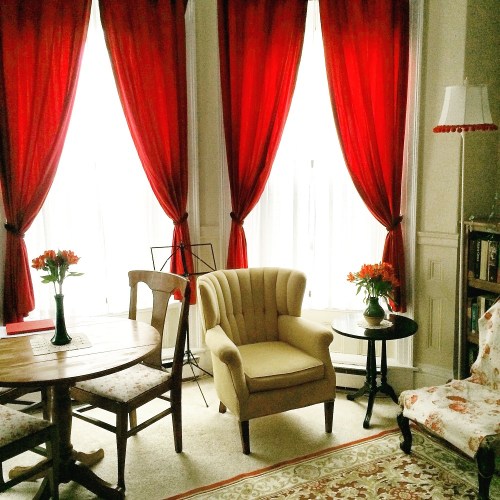
Let’s start with my living room widows. That table, I bought unfinished and refinished myself. The chairs are from an antique store, although I recovered the seats. The yellow armchair is from Goodwill, the Victorian slipper chair is from an antique store that was selling it cheaply because the fabric is so damaged. Until I have time to have it properly reupholstered, it’s covered with a piece of Waverly fabric in my favorite pattern. The lamp I bought in a hardward store and repainted, then added the shade. I sewed the bobble fringe on myself.  And the small black table, I carried a mile from Goodwill to my apartment.  It’s a little damaged, but works just fine, as you can see.

Shabby Chic 10

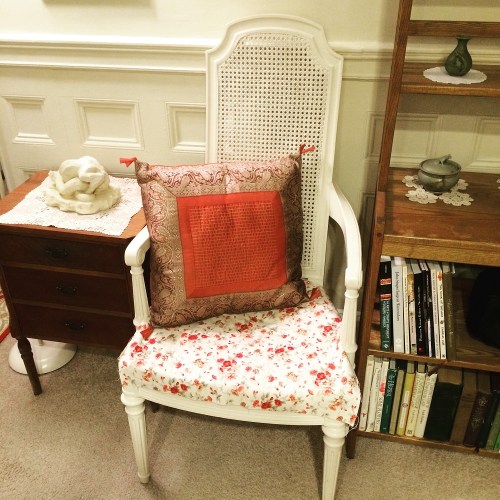
This chair in my hall was originally from Goodwill, and it was brown. I painted it, put a piece of fabric over the cushion (that’s another thing that needs to be reupholstered), and added a pillow, also from Goodwill. The small sewing chest contains jewelry, the shelf holds green Indonesian potter collected over many years, on doilies crocheted by my grandmother.

Shabby Chic 11

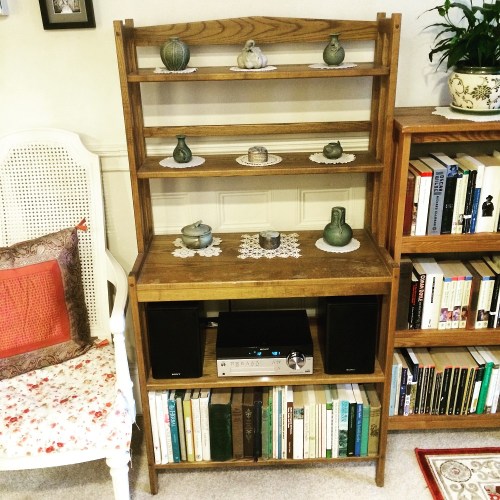
And here is the shelf with the pottery, taken after I had bought my one indulgence, a CD player.  I’ve had the shelf for more than ten years, and it’s a little water-damaged.  Someday, hopefully, I’ll have a chance to refinish it.

Shabby Chic 14

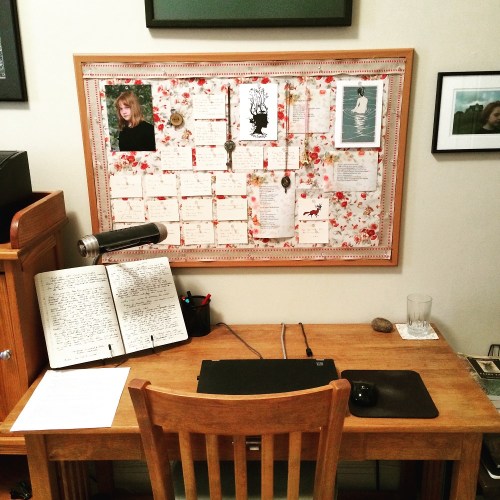
This is my writing desk.  Both the desk and chair were bought unfinished, and I refinished them.  Everything else came from various places: hardware stores, Staples, art stores where they sell picture frames.  The bulletin board came from Staples, but I covered it in fabric and pinned ribbon around the edges.

Shabby Chic 3

Across from it is the chest of drawers, found in an antique store.  The things on it are from various places, mostly antique and thrift stores, although that lovely mottled vase comes from Etsy.  The silver mirror needs to be polished . . .  To the left is a bookshelf that holds my murder mysteries.  Because there are days when nothing is as satisfying as a good murder.  And the painting is by my grandmother.

Shabby Chic 8

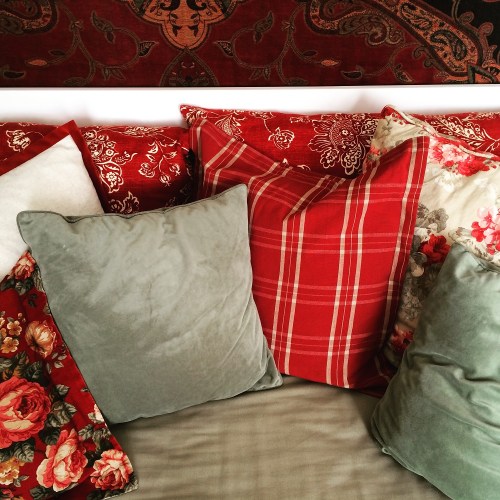
This is just a collection of cushions on the daybed, which serves as a sofa and a place for guests to sleep.  The ones in the back are actually long pillows — I sewed the covers myself.  All the other cushions come from discount stores, except the one with the flowers, which is from Goodwill.  The scarf behind the daybed is also from Goodwill.

Dani

And this is probably the shabbiest but also chic-est thing I own: my bear Dani, who is almost my age.  I painted that chair, and the shelf behind him still needs to be repainted — it’s supposed to be cream, not blue.  But that will happen this summer, when I have some time.

Honestly, I think the reason I adopted this particular style, aside from its practicality (my dishes are cracked? that’s because they’re chic!) is that everything looks a little worn, which also means well-loved. It’s about having a life that is really, genuinely lived in. Which is of course what I try to do with my life — live in it as thoroughly as I can.

Posted in Uncategorized | 5 Comments