Miss Fisher and the Female Gaze

I’ve been re-watching Miss Fisher’s Murder Mysteries, which I like very much — it’s the perfect show to curl up with when you’re thoroughly tired of the modern world we’re living in. You get to go back to another world, equally complicated but in a different way. The show is clever, with twists and turns in every mystery, and has wonderful characters that are deftly developed over time. They have strong, solid, sometimes conflicted relationships. Overall, there’s a lot to like, and I put Miss Fisher in my pantheon of really fun, interesting detectives, up there with Miss Marple, Lord Peter Wimsey, and their ilk. But something particularly struck me, watching the series again. It’s that Miss Fisher is filmed for a female gaze.

I realized this while watching an episode called “Dead Man’s Chest,” in Season 2. The murder weapon, a knife, has been thrown from a pier, so of course someone must search in the water around that pier. We see Miss Fisher and her companion Dot standing on the beach. They are beautifully attired, with flowing dresses and summer hats, and both hold what look like delicious cones of vanilla ice cream in their hands. They are looking at the water, where Detective Inspector Jack Robinson and Constable Hugh Collins are bobbing up and down, rather like dolphins, looking for the murder weapon. Miss Fisher smiles and lowers her sunglasses, presumably to see better. Collins finds the knife, then both men walk out of the water, like in that famous James Bond bathing suit scene with Ursula Andress but in reverse. They are attired in the fetching two-piece men’s bathing suits of the 1920s, which are clinging to their bodies because they are, of course, wet. The camera focuses in a particularly appreciative way on Collins’ chest and arms, and because the top of his bathing suit is white, it becomes translucent when wet. (Don’t even tell me the costume designer didn’t do that on purpose.) Dot towels him off — she is the innocent young woman, not yet aware of what has happened, but Miss Fisher knows. You can tell by her smile, which is, well, knowing. She is perfectly aware of the sexual subtext of the scene, which she has in a sense set up — in the last scene, she asked, with a pointedly innocent look on her face, whether Collins brought his bathing suit. Jack Robinson is also sexualized, but not to the same extent: his bathing suit is dark, his body leaner, more spare. Collins is rather like the ice cream of the scene, in addition to the actual ice cream — he is a delicious dessert, and you realized that Dot has lucked out in a way she doesn’t yet appreciate. But Miss Fisher knows . . . Once out of the water, Collins hands the knife not to Robinson, but to Miss Fisher, who immediately starts analyzing it in the context of the case. End scene.

The perspective of this scene is that of Miss Fisher herself, the heterosexual woman appreciating male bodies. And I find that so interesting, because as I think is clear from years of aesthetic criticism, the heterosexual male gaze has been primary in our culture for a very long time. I’m not interested in abolishing gazes — there is no such thing as no gaze, or a neutral gaze. In art, in film, even in literature where what is seen is entirely imaginary, there is always someone gazing. What I am interested in, though, is the multiplication of gazes. That allows us to see things in different ways, and one reason for Miss Fisher‘s allure, especially among women, is that it allows them to participate in a female gaze (not the only female gaze, but one type).

This is a pattern in the series. In an earlier episode in Season 2, “Death Comes Knocking,” Miss Fisher is in bed with the handsome male assistant of a famous psychic. He is bare-chested — on his chest is a pattern of shrapnel wounds. Miss Fisher is dressed in a beautiful silk gown. The texture of her gown is as sensual, as attractive, as his bare chest. Again we are looking at the scene as though we were Miss Fisher herself — the show turns us all into Miss Fishers, figuring out mysteries, presented with attractive male romantic possibilities. Critics who have written about the show usually focus on its feminist implications, with its liberated female detective who is mature, smart, sexual. The show fairly consistently focuses on issues of women’s equality in the 1920s: driving, work, contraception. But its feminism is deeper than the issues it explores or Miss Fisher herself. It’s woven into every camera shot.

I have to admit, I find it refreshing to watch from the perspective of a female gaze. In the broad tradition of Western art and film, I’m usually watching from a heterosexual male gaze, and I’m used to that — but it does always involve a slight dislocation, as though before truly seeing a painting (of Botticelli’s Birth of Venus, for example), I have to hop to the left. That dislocation can be good — Robert Mappelthorpe’s photographs of male nudes are controversial in part, I think, because they ask us to see from the perspective of a homosexual male gaze, in which the male body is desired in the way female bodies are desired in most of Western art. Western culture is not used to seeing from that perspective. It’s not used to seeing from Miss Fisher’s perspective either. Multiple gazes, as many gazes are we have identifies, which are multitudinous. Let us all learn to see in different ways.

But right now, I’m appreciating Miss Fisher’s gaze. And thinking about what a very clever show this is, to allow me to see in that way.

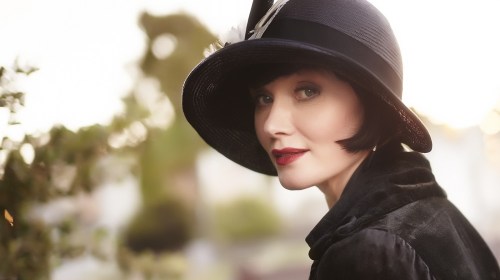
Essie Davis plays Phryne Fisher, a beautifully attired detective in 1920s Melbourne.

(The image comes from this interview on NPR, and is credited to Ben King/Acorn.TV.)

Posted in Uncategorized | 12 Comments

Learning to Hide

Yesterday, I wrote a poem. I called it “Thumbelina.” It starts like this:

Sometimes I would like to be very small
so I could curl into a snail’s shell,
or a seashell: abalone, nautilus,
even an oyster shell. I would let the oyster
cover me with layer on layer of nacre,
come out shining.

This is something I’ve fantasized about since . . . probably since reading The Borrowers as a child. I’ve wondered what it would be like to be very small, to see the world on a completely different scale. I’ve never wondered about what it would be like to be larger than I am, to see things as tiny — no, I wanted to see them as gigantic. I think part of the impulse came from the realization that there’s nowhere to hide anymore, nowhere one can go to disappear. That’s not entirely true — I could probably buy a small cabin in a remote location and more or less disappear if I wanted to, live simply, disengage from modern life. It could be done. But there would still be satellites overhead. The world is a different place than it used to be.

When I first thought about writing this blog post, it wasn’t about becoming small, but about learning to hide. I was inspired by a sentence from a novel I read as a child. My mother read thrillers, and I think the sentence was in one of her books: Shibumi by Rodney William Whitaker, writing under the pseudonym Trevanian. To be honest, I barely remember the book. The internet tells me that it’s about an assassin, and I do remember that — the main character could kill people with a comb. I don’t remember whether he actually did. I do remember that it details his long training, and that a teacher told him to keep his skills, his very existence, a secret. “Hide, Niko,” was the sentence I remembered. Somehow, in my head, it got mixed up with The Borrowers, the way things do get mixed up. It seemed to me that one could not hide in this world unless one was, perhaps, the size of a mouse.

Later I realized that there was a way to hide: inside oneself. Imagine, your own body is a sort of shell, like a snail’s shell, a seashell: inside it is your mind, and inside your mind could be anything, anything at all, entire worlds of anything, and no one would ever know. This realization was intensely reassuring to me as a teenager. My outside could be monitored, controlled, but inside I could be thinking anything — I could write entire novels that no one would ever know about. We are all worlds, inside ourselves. A death is the death of a world, a universe.

We do not value this sort of interiority very much, nowadays. We are all supposed to be open, vulnerable. We are all supposed to share. But I think there is something valuable and reassuring about it. There is a freedom inside oneself, the freedom to be oneself in at least one place. And there is a freedom to choose: do I share this aspect of myself or not? I think that’s particularly important for artists. The art one sees is in a sense the detritus, the flotsam, of the art that happens inside. That is perhaps why we are fascinated by artist’s biographies — we want to know, what in the world was happening inside to create those paintings, those books? What world was happening inside that left those particular marks on our shared reality?

I think learning to hide is a sort of skill, and one we probably need in our modern world, where so much is open and shared, where we photograph our breakfasts and say look, here is my dog, here is my vacation, here is my life. I know it’s a skill I need, because for me at least, creativity happens in the small spaces, safe spaces, in the dark. It is when I am most alone, most myself, that I can write. (And how ironic, and modern, that I am sharing that information with you! Yet here I am, alone at my work desk, in the morning before anything has happened, before I have had to see anyone. Writing.) Artists in particular often need to lead a sort of double life: there is the public self, which goes to work, pays the bills. And there is the private self, which goes down deep into the recesses of the self, the soul, and creates something — like an oyster layering nacre over an irritant. (Isn’t that what we do when we write? Find something that itches, that we cannot seem to get rid of, and layer it over, make it aesthetically pleasing or at least not so annoying to us? Hope it turns out a pearl?)

Robert Louis Stevenson wrote about this double life when describing how he conceived of The Strange Case of Dr. Jekyll and Mr Hyde. He described himself as a house, with a brownie in the attic (you know, those one of small Scottish fairies). He said that he paid the bills, and all the while the brownie was working, working. All his best ideas came from that supernatural helper. But sometimes I don’t want to have a brownie–I want to be the brownie, the borrower, living in the attic or behind the walls or under the floorboards, just doing my own work (and maybe stealing buttons).

I guess my advice for any artist would be, learn to hide. And then you can decide what to reveal. I know the more I do, the more I am out there in the world, the more my work is public, the more of an impulse I have to carve out a private space for myself. Who knows, perhaps someday I’ll find that cabin in the wilderness, although to be honest I think one can hide just as well in a busy city, where no one much cares who you are or what you’re doing, and the faces you pass are almost always anonymous. But I need my snail’s shell or seashell, a small nest, a room from which the rest of the world is shut out. (When I was a teenager, I had a small room, a sort of closet under the stairs, where usually brooms would be kept). Or even the inside of my brain, which so far despite our technologies is relatively inviolate. Make a space for yourself, or at least your brownie, where the creativity, the magic, can happen . . .

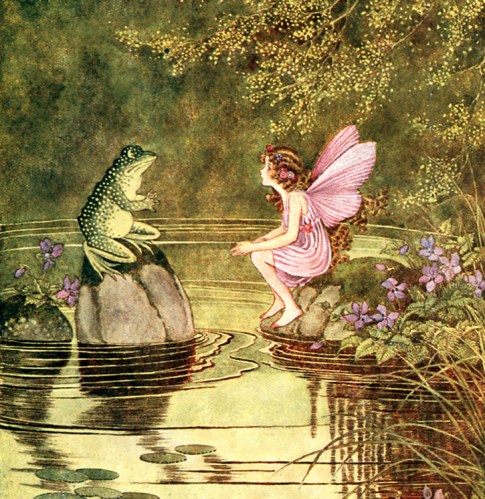
image-by-ida-rentoul-outhwaite

(The illustration is by Ida Rentoul Outhwaite.)

Posted in Uncategorized | 7 Comments

The Three of Me

I read Oprah Magazine, because I’m a sucker for self-improvement, even when it’s the self-improvement lite I often find there. But among the women’s magazines on the bookstore shelf, what else is there for someone like me? Nothing, really . . . Anyway, the author Elizabeth Gilbert has a column in Oprah now, and I think she’s a smart cookie. Even when I disagree with her, I like reading what she has to say. Several months ago, she wrote a column about the three selves she has inside her, and I thought, I could do that too: break myself up into three fairly distinct selves. I’ll call them Thea, Dora, and Theodora.

Theodora is my public self. It’s the one that teaches at a university, that answers interview questions or sits on convention panels, that gets dressed in the morning in something appropriate for work and puts on lipstick. Theodora is the me that most people encounter, even when I tell them to call me Dora. She’s polite, knowledgeable, hard-working.

Dora is my private self, my ordinary daily self when I’m alone or with family and close friends. Dora cleans the bathroom, does dishes, mends clothes. She is the one who binge-watches Poldark. She’s the one who eats half a pint of mint chip frozen yogurt and worries about calories. She’s the one who wears sweatpants and tries to get a tangle out of her hair in the morning. She is as ordinary and necessary as bread.

Thea is my very private self, that even family doesn’t see. She’s a sort of paradox, because on the one hand I am Thea mostly when I’m alone, so no one sees her. On the other, she’s probably the most visible to the extent that she’s all over my writing, because she’s the one who does it, or most of it. She’s there in the stories, in the poems. Thea is the one who is in touch with something completely different, something that isn’t ordinary life at all. She’s the one who knows the way to the Other Country. (That’s from a story of mine published recently called “The Other Thea.” And yes, it’s about having different parts of oneself, as well as other things like magic.) Thea is the one who, asked what she would do with her one wild and precious life, would tell you she’s doing it.

But Thea can’t exist by herself. She needs Dora, because otherwise who would clean the bathroom? Who would sew the buttons back on her sweaters? Who would cook? And who would read Oprah Magazine? Because I can tell you that Thea doesn’t. She reads poetry — she just bought a book by Carol Ann Duffy. And Theodora wouldn’t. She’s reading the books she will need to teach next semester. Dora is the one who reads books on decorating. So if my taste in books seems eclectic sometimes, it’s because there are three of me, and we have different tastes in reading material, as we probably have different (although overlapping) tastes in a lot of things. I mean, I’m pretty sure we all like flowers. But we probably all like them for different reasons, and Dora is the one who buys them, cuts their stems, makes sure they have enough water. Thea just writes poetry about them.

I think we can, potentially, understand ourselves better if we see our selves — the multiple selves we have inside us. It even helps to name them. The thing is, they sometimes want different things, and that leads to conflict. For example, when I’m at a convention, Theodora wants to socialize, because after all that’s what she’s there for. Dora wants to get to sleep not too late, because she knows otherwise they’re both going to be tired in the morning. Thea — well, when I’m at a convention, when I’m teaching, when I’m doing what I think of as work, she’s not there. She’s been left at home. She doesn’t like to go to such things. She just wants to walk in gardens and nature preserves. She just wants to read Willa Cather or write novels, stories, poems. She has very little interest in practical life.

I don’t think there’s any need to unify them. They’re like three sisters, living happily together in one house. This morning, Dora made breakfast, and now Thea is writing this. She’s the one who writes these sorts of things. Theodora is getting a much-deserved rest. She taught all semester, and she really, really needs some time off.

Who are the selves that live inside you? I bet there are at least three of them. The key to a successful life, I think, is getting them to live in harmony, like siblings who love each other even though they quarrel sometimes. And knowing which one to be at any particular time, because Dora can’t do what Theodora does, and Theodora can’t write the way Thea can, and so on. The key is being able to move smoothly among your selves, and to accept them each and all as part of who you are — they are all you, even though they are different.

The key is being able, and willing, to accept your own multiplicity and contradictions. Which I, I think, good training for life itself.

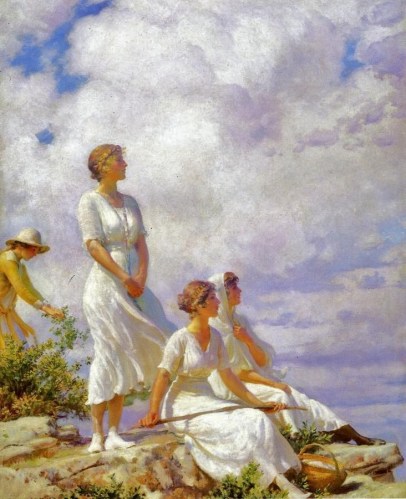
summer-clouds-by-charles-courtney-curran

The image is Summer Clouds by Charles Courtney Curran. I thought it fit the theme of this post very well . . .

Posted in Uncategorized | 6 Comments

How We Live Now

I’ve been anxious and stressed for several weeks now. One reason, of course, is the election. Another is that I simply have so much work to do this semester — it’s been overwhelming. The world seems darker than it did, and life in it seems more difficult, less certain. It feels as though life is one never-ending cycle of work and worry — as though this is all there is, and all there ever will be until, well, death I suppose. Last night I could not get to sleep for hours. When I finally did get to sleep, I dreamed that I was on an island, looking for a house, and first I could not find it, second I did not have the key, and then I went for a swim in the ocean and worried about drowning. I don’t think we need Freud to interpret that one! In terms of the political situation, I have not felt this particular sensation since before the Berlin Wall fell — I still remember what that was like, when I was a teenager. Suddenly, the world felt more free. Now, suddenly, I’m worried that it will become less so.

When I’m not sure what to do, how to live, I give myself principles to live by. I find they help because, no matter what happens in the world outside me, at least I know what I should do in response. At least I can control the world inside myself, to some extent. I thought about how we live now, how we should live now. Really, this is no different than what I would have written a month ago, a year ago. But now, I think, it may be particularly helpful. Here, then, are some principles for living in our difficult, complicated world:

1. Don’t be evil. Don’t condone or collaborate with evil.

This isn’t really that complicated. Don’t hurt people. Don’t exploit them. Don’t treat them as though they were less important, less worthy of respect. Don’t lie to them. This may seem overly simplistic, but if people refrained from being evil, from participating in or condoning evil — from abusing each other, exploiting each other for profit — I mean, that would be a very different world, wouldn’t it?

We may disagree in some cases about what constitutes evil, but I think in most instances, most people will agree: Allowing children to drink water tainted with lead is evil. Stealing employees’ wages is evil. Making a racist joke is evil. (Yes, words can be evil, and they can create the conditions for evil acts.)

All this requires is negative action — don’t do it.

2. Do the most good you can, to the best of your ability.

This requires positive action — figure out what you can do, and do that. Help to the best of your ability, whatever that is. Is it donating money to an organization that fights for social justice or helps the needy? Is it doing something directly yourself to help another person? Is it doing your job well and honestly? Is it taking care of one child, one animal? Well, do that.

Figure out what you can do, make a plan, and do it. And then keep doing it.

3. Take care of yourself, because you matter.

You’re not going to do anyone any good if you don’t take care of yourself. You know this, right? Do the best you can to make sure that you’re staying healthy, and that your bills are paid. By extension, take care of your family and your home. You’re not going to be effective in the world if you’re stressed, tired, overwhelmed. (These are words I try to remember, when I myself am stressed, tired, overwhelmed — as I am now.)

Taking care of yourself is not selfish or a cop-out. It’s a necessary precondition for (1) doing good and (2) not being evil. It’s much easier to do, and not do, those things when you yourself are well.

And by the way, accept that you will sometimes fail at the things I’ve listed above, as you will fail at anything you do. Pick yourself up and try again.

4. Live as though the world you wanted to live in already existed.

Imagine the world you want to live in. For me, it’s a world where we are all more environmentally conscious, where we support the arts and cultural institutions, where everyone is valued. So, you know, I try. I take public transportation, I buy organic produce, I try to recycle. I buy yearly memberships to the art museum. I splurge on the ballet, because I want to live in a city with a ballet. I subscribe to newspapers I want to make sure survive. I try to be a good, effective teacher — fair to my students, kind but also challenging them to write better, think more deeply.

I want to live in a world with less consumerism, where repairing items is valued over buying new ones, so I mend my clothes. I take my boots to the cobbler to be re-soled. I want to live in a world where literature matters, so I buy books. I support small businesses and environmental causes.

These things also make me feel better: they make me feel as though at least I’m doing something, not simply accepting things as they are. Because, and this is the last thing I’ll say, no one person will save the world. Trust me on this: no one is coming out of the sky to make this world better. We all have to do it ourselves, one small gesture at a time. But those small gestures add up to something much larger, which is the whole point.

You are not responsible for saving the world. But we are all responsible for doing our part.

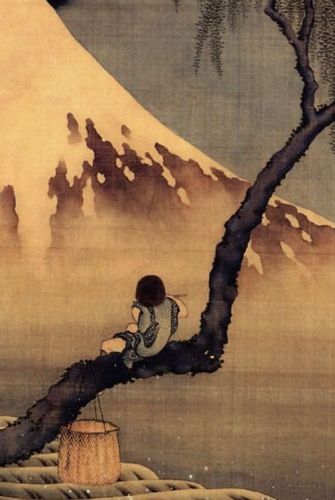
print-by-hokusai

(The print is by Hokusai. I thought it captured the feel of what I was trying to say here . . .)

Posted in Uncategorized | 9 Comments

Writing Is/as Work

Confession: last night I was up until 3:30 a.m. working on a novel. Was that good for me? Well no, probably not. But it was good for the novel, because I wrote a scene that I really like. Today I’m tired, but I have that scene on my typing stand. Tonight I’ll revise and add to it, although I can’t stay up that late again because tomorrow I have to teach. Why do I push myself in this way? Because writing is part of my job. I have deadlines to meet, novels to write and get out there into the world. I’m a writer . . . so I write.

Recently, there was an article published, somewhere or other, making the argument that writing is not a job. Well, I guess that depends on how you define a job. I mean, if you define it as something that provides you with steady income, health benefits, and a retirement plan, then no, writing isn’t a job. But then, a lot of other freelance work doesn’t qualify either.

I like the idea of writing as a job, because that’s what it feels like when I’m actually doing it. When I started thinking about this subject, I remembered two quotations that have always bothered me. Here’s the first one:

“There’s nothing to writing. All you do is sit down at a typewriter and open a vein.” –Ernest Hemingway

I don’t know if Hemingway actually said this — it’s simply one of the things attributed to him on the internet. And it sounds good, doesn’t it? It’s pithy, and truthy . . . it feels true. We often think of writing as self-expression, so it feels true to say that writing is like bleeding. Why don’t I like the quotation? Because I’ve written before, and I’ve bled before, and bleeding is a lot easier. More painful, but easier in that you’re not sitting there bleeding for hours at a time, mentally engaged in bleeding, trying to bleed well, bleed so the reader can follow along, so she doesn’t put the book down and say, “What boring blood. I think I’ll go see what’s on Netflix.”

Of course the quotation isn’t talking about actually bleeding, but what it implies is that writing involves sitting down at your typewriter/keyboard and letting your emotions pour forth, as though you were bleeding. That attitude is expressed in the second quotation I dislike:

“No tears in the writer, no tears in the reader. No surprise in the writer, no surprise in the reader.” — Robert Frost

Maybe Frost really did say that? What I dislike about it is that it assumes the writer is a sort of emotional conduit. He or she must feel something, so the reader can later feel it. If you want your reader to cry, you must first cry . . . But that’s not true. Writing is an art, but it’s also a craft, and I can make a reader cry without, while I am writing, feeling anything in particular myself. All I have to do is describe something likely to make a reader cry, and then hopefully the reader will respond.  But the reading experience exists independently of the writing experience. The reader and writer are not in a symbiotic relationship. The reader may well decide that the scene I wrote so emotionally myself is really quite funny. If I’m a good writer, I should be able to make most readers cry, depending on my knowledge of what makes most people cry. Hemingway supposedly wrote a devastating six-word story: “For sale: baby shoes, never worn.” I read that, and it makes me tear up. He supposedly wrote it on a restaurant napkin in response to a bet. I don’t think he was tearing up as he wrote it.  If he did write it, I think he did so feeling rather smug that he could pull it off.

My point here is that writing takes craft and skill, and the writer is like any other artist: a painter, a composer. A Monet may well make you cry, but I don’t think Monet was crying as he painted it — he was painting. Yes, he may well have drawn on moments he had cried in the past, and writers do that — sometimes, when I’m stuck on an emotional scene, I’ll think about how I felt at an analogous moment and remember that. I’ll try to reproduce the emotion inside myself, based on memories.  But it’s in the service of description, and I know that if I don’t describe whatever it is I’m describing well, it’s not going to raise any sort of emotional response in the reader. That depends on my craft and skill.

Writing is a job, and it feels like a job — there are deadlines, there is work to be done. Sometimes I love doing it, sometimes I don’t, but I do it anyway because it’s my job to finish that particular story, that novel.  And honestly, I find the idea of writing as a job reassuring. If I woke up in the morning thinking, “I need to be an artist today,” I would probably go hide under the covers again. But if I think, “I need to get out of bed and write a chapter,” I will go do my job, using everything I have learned, all my intellect, whatever techniques I have. Because that’s how it’s done.

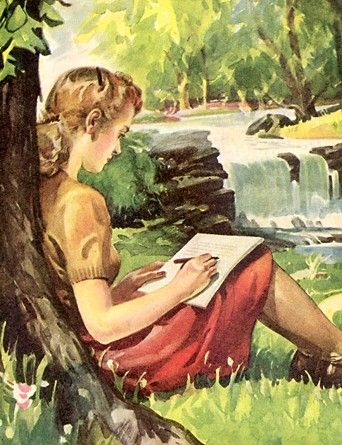
girl-writing

(I don’t know where this image is from, but I love that it’s of a girl writing.)

Posted in Uncategorized | 4 Comments

Me and Edna and May

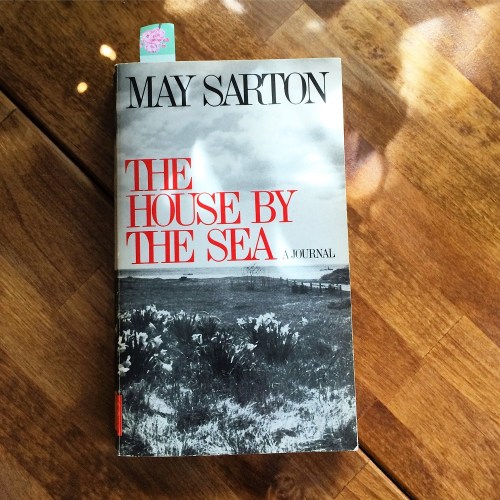
On my last day in Brunswick, Maine, I walked into a second-hand bookstore and bought several books. One of them was The House by the Sea by May Sarton. I started to read it — she has such a beautifully lucid style. That’s what I look for when I read — lucidity, a sense of light shining through the words. That and wisdom.

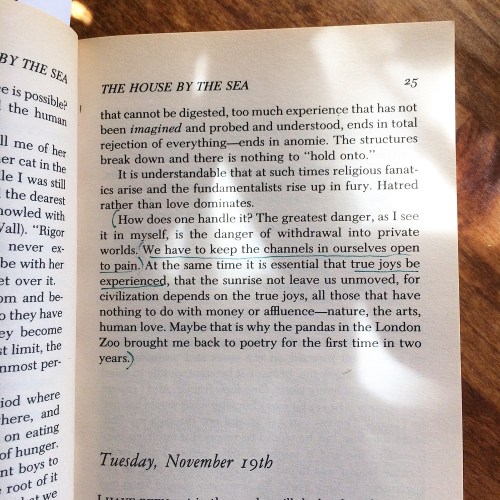
As I flipped through it, on one page I noticed a passage marked with green pen, placed in parentheses and part of it underlined. You can see it in the photograph below. But here is the passage, in case it’s difficult to read in the photograph:

“How does one handle it? The greatest danger, as I see it in myself, is the danger of withdrawal into private worlds. We have to keep the channels in ourselves open to pain. At the same time it is essential that true joys be experienced, that the sunrise not leave us unmoved, for civilization depends on the true joys, all those that have nothing to do with money or affluence — nature, the arts, human love. Maybe that is why the pandas in the London Zoo brought me back to poetry for the first time in two years.”

What an interesting passage this is! It’s about leaving yourself open to the pain of the world, because that is the only way in which you can also experience its joys. It starts with a question: “How does one handle it?” How indeed? There is so much wrong, and painful, and to be wounded by. And yet Sarton says that withdrawal is dangerous, because it’s necessary to experience pain — probably because that’s the only way we can sympathize with it. But at the same time she warns us that we have to experience the joys also, or we are only partially living. Civilization, both our own (being “civilized”) and civilization as a whole, depend on the things that money can’t purchase: nature, the arts, love. If we can’t experience those things, we are poor indeed.

And then she mentions the pandas. I have no idea what that means. I haven’t gotten to that part yet. I’m looking forward to finding out what pandas have to do with poetry.

But there is another mystery here. The entire passage is in parentheses, but a particular sentence is both placed in additional parentheses and underlined: We have to keep the channels in ourselves open to pain. Whoever underlined that sentence did so for a reason: it meant something to her. If I were to play detective, I would speculate that she underlined it because she was in pain, and it was a reminder to herself that the pain was necessary, not to close the channels. Another part of a sentence is underlined, but not placed in parentheses: true joys be experienced. I think that was a reminder to herself too, that you don’t get the joys without the pain. And she was reminding herself that the joys were there, even if she might not be noticing them at that particular moment.

It’s funny, what a little underlining in green pen can tell you. The underlining is light: she did not want to mark up the book, and indeed, there are very few marks in it. This is the first, and the only one in pen — after this, she marked in pencil. The passage was important to her, so important that she marked it. I think she did not want to lose it.

Why do I say she? Partly because the delicacy of the lines makes me think of a woman. But also partly because on the inside back cover, there is a name and address. The first name is Edna. I won’t tell you her last name or where she lives, because who knows, she may be out there, somewhere. Throughout the book, there are a few other passages underlined:

. . . “at some point one has to make choices, one has to shut out the critical self and take the leap.”

“We are lonely when there is perfect communion. In solitude one can achieve a good relationship with oneself.”

“I am simply too isolated and starved.”

“For one person who would focus this beautiful world for me” . . .

. . . “loneliness like starvation” . . .

. . . “a rainstorm to blow off in time” . . .

Under the handwritten (in cursive) word “gardens” (and again this looks to me like a woman’s writing):

“Do I spend too much time at this ephemeral task? In spring, summer, and autumn I work harder at it than at waiting, and I expect that looks crazy, but what it does is balance all the anxieties and tensions and keep me sane. Sanity (plus flowers) does make sense.”

. . . “create the space necessary for achievement, little by little” . . .

What you can see here is a mind moving, selecting, the particular things that feel pertinent. You can see an intellect, you can see thought and even growth. The later passages are more hopeful than the earlier ones, although I don’t know if that has to do with the reader or Sarton. As I read this book, I am not only reading Sarton, I am also reading the previous reader’s reading of it. May is filtered for me through Edna.

And what I want to say about that is, I like you, May. And I like you, Edna. We are a chain of three women, writing and reading and annotating. Living and feeling and thinking. It’s as though we form a small community, right here in the pages of this book. That is the sort of joy, the sort of art, the sort of love that will save the world. Slowly, eventually . . .

May Sarton 1 1000

May Sarton 2 1000

Posted in Uncategorized | 5 Comments

Sabotaging Yourself

I was thinking about this recently: ways you can sabotage yourself as a writer. I’ve done some of these myself, and I’ve also seen other writers doing them. I thought I would make a list of ways to sabotage yourself, as much for me as for anyone else. So here goes. (I’m sure this applies to the other arts as well, so adjust the wording as necessary.) Instructions for how to sabotage yourself:

1. Stop writing.

A lot of people just stop writing. I know this sounds so simple, so elementary, almost insultingly so. But if you want to be a writer, someone who writes and hopefully eventually gets published, you have to actually write stuff. You have to write a lot of stuff, because especially at first, a lot of it isn’t going to be very good, so it’s not going to get published.

Writing means writing. It doesn’t mean creating a website or social media presence. It doesn’t mean thinking about writing. It means butt in chair, hands on a pen or the keyboard. It means the actual hard work of making stuff up and putting that stuff down in words.

Recently, I talked to the Clarion Writing Workshop students, and I told them something that could sound depressing, but that I actually find heartening. Of the people I went to Clarion with, the ones who kept writing now have writing careers. There weren’t many. Most people don’t actually want to spend the next fifteen years of their lives butt in chair, writing. It’s fun to put stories down on paper, not so much fun to do it day after day after day, and then submit, and then maybe revise, and then certainly copyedit. And then do it again from scratch. But if you want to be a writer, that’s what it takes.

2. Stop growing as a writer.

This one is a little more subjective — I at least think it’s important to keep growing as a writer, to push yourself. If you write short stories, and you gain a reputation as a short story writer, write poems. If you’re a poet, write memoir. If you’re a memoirist, try a novel. Push yourself, do what you haven’t done before. I sometimes take on writing tasks simply because I haven’t done them before. This year, I wrote an academic review and an introduction to a short story collection. I’d never done either of those things before . . . I did them specifically because they were new to me, because they required me saying “yes” and then figuring out how to do it.

I think you have to scare yourself a little, as a writer. You have to move out of that comfortable space, go where you’re afraid of failing. That’s how you learn . . .

And there’s more to it than that. You have to read books you haven’t read, look at art you haven’t seen before, maybe even travel to countries where you’re never been. Learn a new language. Those are all ways of growing as a writer.

3. Don’t listen to advice.

I ran across this quotation the other day: “The good artist believes that nobody is good enough to give him advice.” –William Faulkner

I thought, Oh Faulkner, you were such a good writer, and such a basket case! I’m certainly not going to give you advice (I mean, you’re dead . . .), but for other writers, I would say, listen. Listen judiciously, of course, and reject anything that doesn’t apply to you. But really do listen. And by advice I mean a lot of things: when your teacher tells you the plot isn’t working, when your writing group tells you a character needs to behave differently, when an editor says she can’t see your setting. When your agent shakes his head as you describe a project. Listen, disagree if you need to, argue if you need to. But listen.

4. Be jealous of other writers.

You will be jealous of other writers. You just will be. I am, Anne Lamott is, maybe Stephen King isn’t I don’t know, but most of us are. How can we not be? We want so much to be heard, to have others understand. Writing is such a personal endeavor. We want publication and prizes and more than either of those, attention attention attention. We want people to listen to us.

But jealousy’s not going to get you that. Only writing is: writing well, writing true, writing strong.

And the only way to get there is to practice, practice, practice. I have a trick I may have mentioned before. I tell myself that I’m allowed to be jealous of another writer if I’m willing to be jealous of everything, the good and the bad. So I can be jealous that another writer is a bestseller, if I’m also jealous of the fact that a year ago, she couldn’t make rent. I can envy another writer’s advance if I’m also jealous of the fact that before he received it, he was trying to figure out how to afford health insurance for the year. When you do that, you get over being jealous pretty quickly, because there’s always something in someone else’s life that you wouldn’t want in your own.

In the end, I always decide that I would rather be myself, with my own flaws, my own failures.

5. Be angry or mean to others.

Anger only helps if it’s the righteous anger that makes you reject an unfair contract. Mean is never helpful. Firm, on the other hand, is sometimes called for. Firm-and-polite is more powerful than mean.

6. Always expect the worst.

This is my own example of magical thinking: I’ve come to believe that your expectations can in fact determine what happens to you. I know a woman who always expects the worst, and it always seems to happen. Planes develop engine trouble, plumbing leaks, checks go astray. I also know people who generally expect life to go well, despite some setbacks, and for them it does. I don’t know, perhaps I’m imagining it, but it seems to me that somehow, magically, what you expect life to be like does determine what your life is like.

It’s the opposite of a magnet: negativity seems to attract more negativity . . .

I can’t always be positive. I’m human, after all. But I do mostly try not to complain. If something is wrong, of course I try to set it right (see firm-and-polite, above). But just complaining . . . if I started doing that, I would get bored with myself! And after all, being a writer is what I want to do. I’m doing it because I chose to — no one forced me into this. No one forced me to write books, go to conventions, even teach. This is the life I chose for myself, and even when it’s difficult, I’m grateful for it.

So there you have it, six ways that I believe writers can sabotage themselves . . . Do the opposite!

Steps to the Sea 1

Steps to the Sea 2

(Both of these photographs are from Casco Bay in Maine. I was there for the Stonecoast summer residency . . .)

Posted in Uncategorized | 7 Comments