Writing Girl Monsters

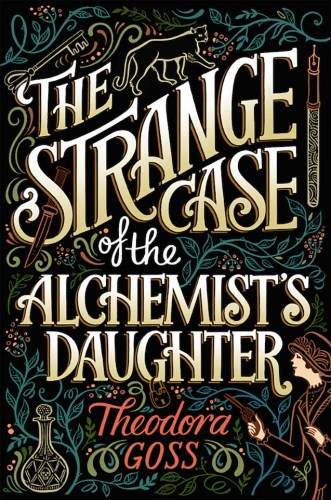
I have a novel coming out this summer. It’s called The Strange Case of the Alchemist’s Daughter, and it’s about Mary Jekyll, daughter of the infamous Dr. Jekyll, who discovers that her father belonged to a secret society of alchemists . . . a society whose members were creating girl monsters. As the novel progresses, she meets Diana Hyde, Beatrice Rappaccini, Catherine Moreau, and Justine Frankenstein, all created through strange experimentation. I’m not giving you any spoilers, by the way. All of this is right on the book jacket!

Since the book is coming out this summer, I’ve started to see some mentions of it online, on various blogs or websites. There was one in particular that made me smile: a blogger listed books she would never, ever read, and mine was on it. Why would she never read it? Because I was rewriting stories written by others, rather than creating stories that were uniquely my own. You know what I would say to that blogger? You’re doing it exactly right. You know what you do and don’t want to read, and you’re not going to read books that don’t interest you. That’s exactly what readers should do. Read what you’re interested in — what makes you laugh, and cry, and happy to be alive. That’s what really matters. That’s what I would tell her.

But I do want to say something, to anyone else who might be interested in this book, about why I’ve written it — why, specifically, I’ve written a book about girl monsters, or in some cases monstrous young women (they range in age from fourteen to twenty-one). Let me tell you their stories, as they originally appeared:

Mary Jekyll:
Of course, Mary does not appear in The Strange Case of Dr. Jekyll and Mr. Hyde. I made her up entirely. But I made her up for a reason. Stevenson’s book has almost no women in it — a couple of maids, a little girl who is trampled, that’s about all. This semester, I’m teaching a course called The Modern Monster, and we’ve talked about why there is a dearth of female characters in the novella. (If you’ve seen the stage or musical versions, you’ll know they both add female characters — predictably, a fiancée and a prostitute.) My hypothesis is that the book is specifically about late Victorian masculinity. Several times, Hyde is presented as symbolically female: he is in part, although not entirely, the female traits inside Jekyll that have to be suppressed for Jekyll to be a proper Victorian man.

Diana Hyde: Diana is entirely made up as well, and for the same reason. Mary and Diana both come out of what is not there, what does not appear, in The Strange Case of Dr. Jekyll and Mr. Hyde. I’m adding women where there were none — and not a fiancée and prostitute!

Justine Frankenstein: There is no Bride of Frankenstein, not in the novel. Frankenstein never creates a female monster because he’s afraid she would mate with his male monster and their offspring would outcompete humanity. He gathers body parts to create her, starts the process of making a second monster, then disassembles her and throws her body parts into the sea.

Catherine Moreau: Dr. Moreau does create a female monster in The Island of Dr. Moreau. He makes a woman by vivisecting a puma. Guess how many speaking lines she gets? Zero. She does exactly one thing: she kills Moreau. And then she, herself, is killed. Are you starting to see a pattern?

Beatrice Rappaccini: Beatrice is made, and she does get to speak! And then she dies. You can read all about it in Nathaniel Hawthorne’s “Rappaccini’s Daughter.” By the way, calling my novel The Strange Case of the Alchemist’s Daughter incorporates two references: to Stevenson’s novel, of course, but also to all the “X’s Daughter” novels. So you see, the references are deliberate, and they’re meant to be at least partly ironic. Although in this case, it really does matter whose daughter Mary is, and the whole issue of being a daughter, what it means to be a daughter, who is a daughter . . . well, the novel should raise some questions about that. But the thing is, all the characters I’m writing about, either they don’t exist or they die. Because that’s what female monsters do, in late nineteenth-century fiction.

That’s why I wrote this book, and that’s why it’s structured the way it is. Some readers aren’t going to like that structure — I already know that. It makes the book a little harder to read, because the central narrative is continually being interrupted. But what is it being interrupted by? Women’s voices. This is a book that, if I’ve done my job right, or at least accomplished what I meant to do, is filled with women’s voices, telling their own stories.

That’s why I rewrote the stories. Because they had no, or little, place in them for female characters. So I decided the stories were wrong, had been told incorrectly. I decided the women had their own stories to tell, their own perspectives. And I wanted to let them speak.

I don’t know how people will respond to what I’ve done — the book is totally out of my hands now. For months, I’ve been working on the sequel, which will take Mary, Diana, Beatrice, Catherine, and Justine deep into the Austro-Hungarian Empire. It’s so much fun to write about late nineteenth-century Vienna and Budapest! Although you have to know pesky things like how to get a passport, the timetables for various trains on the European continent, the exchange rate from pounds to francs to krone — all in the late 1800s! I can’t tell you what the sequel will be called yet, because we haven’t made a final decision about the title, but in my mind I think of it as Monsters Abroad. (No, it definitely won’t be called that.)

So why am I rewriting stories? Because the original versions killed and/or silenced women. I think stories need to be rewritten, just as social institutions like the university, the church, and the workplace need to be reconfigured, to include women and their voices. I listened to the original stories — I read them, I taught them, for goodness’ sake I wrote a whole doctoral dissertation on them. And I heard voices that were not on the page. So I told the stories those voices were telling me . . .

I think that’s pretty such always the way writing happens, whether the voices come from other works of fiction, history, the writer’s own family . . . You hear voices, and then you write down what they’re saying.

(Here is the book cover! Isn’t it beautiful? I can say that because I had nothing to do with its beauty . . . All the credit goes to the artist, Kate Forrester, and the art director, Krista Vossen.)

Posted in Uncategorized | 30 Comments

Template Stories

There are certain stories that are written over and over again. I call them “template stories.”

“Snow White” is a template story. So is Dracula. There are many, many versions of “Snow White”: there’s the Grimms’ fairy tale, of course, but also book versions, movie versions . . . And each version is a reinterpretation of earlier versions, a conversation with those versions. Each version can be very different from the others. It’s the same with Dracula. How is this different from non-template stories? Well, take for instance a novel by Edith Wharton. There may be a movie version, but it will be a version of that particular novel–it will attempt to represent that novel, its plot and characters, in their time period. Same with novels by Henry James, Virginia Woolf, most other novelists . . . But “Snow White” gets turned into Snow White and the Huntsman, which is almost nothing like the original fairy tale. Dracula becomes Count von Count from Sesame Street.

Template stories are a little like vampires, in that they live on and on . . . And they keep transforming themselves. Most myths are template stories. So are many fairy tales, but certain modern stories have taken on this particular quality of fairy tales. They have become modern myths. Hamlet is a template story, as is Murder on the Orient Express. Jane Austen novels are not quite template stories, but are in the process of becoming so as we keep rewriting them — Clueless is one example of how an Austen novel can function as a template. Interestingly, Emma is the novel of hers most often turned to other uses.

I’ve been trying to figure out what turns a story into a template story. I think character is central: you need something that serves as a still point around which the rest of the story can pivot. That’s usually a character: Snow White, Dracula, Hamlet, Hercules Poirot, Emma Woodhouse, Sherlock Holmes, Batman. But the still point can also be something else: the House of Usher or Wonderland, for example. The story needs to have something that lives outside the story, and I think also something that reaches deep into our minds, below the level of consciousness. There’s something in these stories that resonates deeply with us — the stories stay with us, or at least certain components of them do. And if we are creative, we feel the compulsion to engage with them, reimagine them. So we get more stories set in Oz, or stories about Tarzan . . .

I don’t think you can know ahead of time what will become a template story. I don’t think you can set out to write one. Although it does, I suspect, take thinking about story a little differently. Instead of thinking about what issue you want to tackle, what style you want to write in, how you want to engage with the contemporary literary world (and yes, there are writers who think about all those things), you want to pursue your subject a little differently. You want to dip down into the deep well, into the dark water of story, and draw something out — you’re not entirely sure what, at first. Or maybe you’re never sure. But it takes going deep into a mysterious place where you’re not sure entirely what you’re doing. Template stories partake of the structure or substance of myth. Mary Poppins is one of the old gods . . .

Template stories are often not the stories we validate culturally: they are not the intellectual novels, ones that win prizes. They come, more often I think, from popular fiction, children’s literature, comic books . . . Perhaps because those sources are closer to the deep well. They are not trying so hard to be relevant. They usually don’t tell us about social conditions at a particular time and place, although literary critics can analyze Peter Pan in the context of the Victorian concept of childhood or J.M. Barrie’s life. But of course they are relevant, in a different way. They keep getting rewritten. Every generation gets its own Peter Pan, its own Miss Marple. King Lear is always fresh and new.

And template stories are not necessarily the best stories in literary terms. Dracula is a fascinating novel, but it’s not as well-written as anything by Thomas Hardy. Nevertheless, Dracula has a continuing life that Bathsheba Everdene does not. There are movies made of Far from the Madding Crowd, but she’s not a muppet. Maybe you don’t want your characters to become muppets? As for me, I would be thrilled to write a story that turned into a template, that turned into something other people wanted to reconfigure in various ways. I think that would be fascinating. But it does mean I think about story in a slightly different way. I try to go deeper, to send my bucket down into the well that exists in my head, and your head, and all of our heads. And sometimes it means I play with other templates, that I retell the old stories in my own way. Not for any particular conscious reason, but because that’s the sort of writer I am. Perhaps it’s fair to say that I am a teller of tales, that what I’m writing are tales of various lengths rather than short stories or novels? Isak Dinesen makes that distinction, and I think she’s certainly writing tales, which is why I like them so much.

At any rate, there are different ways to tell stories . . . and this is one of mine.

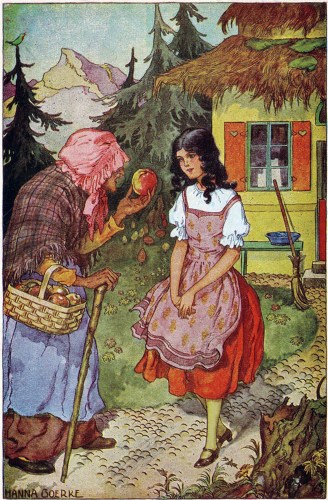
(The image is an illustration for “Snow White” by Hanna Boerke.)

Posted in Uncategorized | 6 Comments

Taking it Slow

Do you remember card catalogs?

Research in them was slow and clunky, but you learned how to do it in elementary or middle school, and then you knew how to do it ever after. I was thinking about card catalogs recently because my university updated its online catalog over the winter break, and when I came back to teach spring classes, I had to learn how to use it all over again. It wasn’t a terrible process — I could, at least, learn to use it well enough to teach students, relatively quickly. But I had just gotten used to the last set of updates, and I’m sure there’s another set coming. Indeed, we seem to be in the midst of a continual set of updates, at this point . . . recently, a page was updated in the middle of the class I was teaching, and my students had to figure out how to get access to a document, trying different URLs in the middle of class. This is the sort of thing we seem to live with now, a world in which we are always trying to figure out how to find or do something, because it’s changed since the last time.

My computer and cell phone are the same way: they are continually updating, and sometimes the updates don’t make a difference, but sometimes I have to figure out how to do something all over again in the new system. One could argue that this is good for us, that we are learning to be nimble, to think on our feet. Except that most of the time these updates are pointless. They do not make the systems any better or easier to use. At this point, if I want to do academic research, I don’t start with my university’s library catalog because the algorithm isn’t very good. I can get better results from JStor or even Google Scholar.

I’m not nostalgic for card catalogs, but I am nostalgic for an earlier version of the university’s online catalog, which worked so well — so much better than the current system! It seems to me that the systems we had in the earlier days of technology were more intuitive, easier to use. They really did help simplify our daily lives. Remember when ATMs were genius? They still are. But somehow or other, so many things have gotten complicated beyond usefulness. I love my iPhone, but I barely ever type on it because the keyboard is not worthy of the name. I still miss the keyboard on my old Blackberry. Now that, you could type on. And speaking of typing, I certainly don’t miss the days of typewriters, but for writing, I still use WordPerfect, which no one else uses anymore. It’s the perfect system for a writer, or at least the type of writer I am. It allows me perfect control over the manuscript, whereas with MS Word, half the time I don’t know what a particular code is doing. I’m not convinced that my students, who use MS Word, do either.

I love technology, but I love technology that makes sense and does its job. And somehow, we’ve pushed so much of our technology past some invisible point of usefulness, where it’s more of a headache to use than not. I barely ever call customer service anymore, because I know that I’ll end up in a briar patch of computerized options. If I need information from my bank, I walk into a bank branch and talk to an actual person. I have a credit card I keep and use specifically because when I call, the voice that answers belongs to a person. It’s such a luxury, nowadays, not having to talk to a computer . . .

Perhaps I’m a modern Luddite. I have nothing against textile mills, but I hate, with cordial passion, the checkout machines at the drug store that always break down when I try to use them, or the reimbursement system all universities seem to use now — it can take longer uploading the information to be reimbursed for the doughnuts at a meeting than you spent in the meeting. Recently, a vendor asked me to use a new system to pay him, and while I wanted to accommodate his preferences, there I was entering my information into yet another new system. I would much rather have written him a check. Remember checks? They’re so easy, and they haven’t changed since I was a child . . .

Here’s what I would say, as a modern Luddite (emphasis on the modern). Some technology helps us. A lot of technology doesn’t. Take what you find useful and use it. What you don’t find useful, avoid as much as possible. It will simply clutter your life, and there’s no reason to upgrade unless you absolutely have to. Choose what serves your interests and passions, reject what doesn’t. Yes, our modern lives will force us into using technology we hate or that wastes time, like when you check into your flight on your home computer, but then at the airport you effectively have to check in again because you have a bag, and then you have to drop off the bag, which is actually a third check-in. But . . . control it as much as you can. Get off the hamster wheel. You are not an hamster.

Take it slow, or as slowly as you want to. I have an iPhone and a laptop. I do not have a smart anything else, except my daughter, who is very smart indeed. I don’t even have a television or microwave . . . But I do have a tea kettle, a sewing machine. I never got an e-reader. I have lots and lots of books. I type my novels, but before that, I write them out by hand. (Yes, really. My antique WordPerfect program is supplemented, and indeed preceded, by an even more antique pen.) I like writing in notebooks, and when it’s not convenient to pay online, I write a check. I still get my tax information on paper, because paper. It feels like something, as opposed to information humming across wires. I like to see things, touch things — even tax forms.

Choose the speed at which you want to live, is what I’m saying. Sometimes we innovate in ways that are not actually useful, and then it’s up to us individually to say, no, not that. That’s a waste of time. After all, if I wanted to learn something complicated and time-consuming, it would not be the university’s online reimbursement system. It would be playing the piano, or knitting lace, or painting in watercolors — something real, solid, slow, and worth my time.

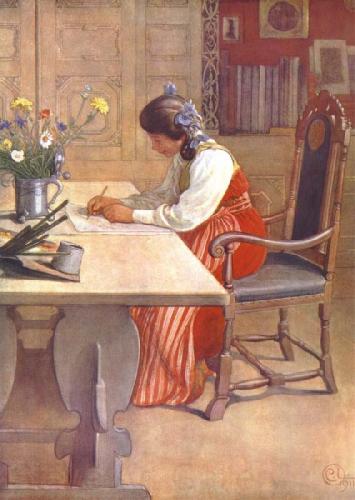
(The painting is Hilda by Carl Larsson.)

Posted in Uncategorized | 9 Comments

Writing in Troubled Times

The truth is that I haven’t felt much like blogging lately. I haven’t felt much like going on Facebook, or Twitter, or anything electronic. I’m forcing myself to write this post now . . . Why? I suppose because I’ve been feeling a bit invisible, as though if I don’t keep touch with the larger world out there, I might disappear. Not really, of course. I’m still a corporeal, very real person. I still wake up in the morning, eat, work. Sleep, sometimes. But I feel as though I do lose something, not being in touch.

It hasn’t been much fun to be in touch, lately. It hasn’t been much fun to look online, see the news, worry worry worry about where the world is going.

I realized this was a serious problem when I did not write any poems, not one, in January. I had promised myself that I would try to write poetry regularly, several times a month. That was why I started a poetry blog. It was incentive: I could write a poem, post it, and right away people could see it. I could get some sort of reaction. But January, nothing.

And now, just now, I realized I hadn’t written a blog post in February, not one. Even though I’ve been promising myself that I will start blogging more, particularly now that Facebook and Twitter are so much less fun. Facebook reaches the same twenty people over and over. Twitter is all depressing political news.

I’ve never found it this hard to write before. Oh, I’m writing . . . I have a book due, and I work on that! I’m working on it as fast and hard as I can. But I’ve always found it easy to write, and to write all sorts of things. Now, all I want to do is work on the book, which allows me to go in deep, to disappear into another time and place, to spend time being my characters rather than myself. All I want to do is escape into my own writing. Not communicate.

Perhaps the problem is, I don’t feel as though I have any particular wisdom to offer.

The sorts of problems I see in the news, I can’t fix, and have no fix for. I’m not the right person to tell you, call your congressman. Yes, call your congressman, but what I write about, what I think about, are deeper systems of values. I write about trees, and rocks, and birds. I write about fairy tales. I write about schools for witches. My writing is about what we should value, about the deeper magic of life. Not political positions, or not immediate ones, although I think politics infuses my writing. How could it not, when I was born behind the Berlin Wall, when my parents lived through 1956 in Hungary, when my grandparents lived through World War II? It’s always there . . . but I have little of value to say on current legislation.

So what do I add to the discourse? I’m not sure.

It’s incredibly facile to say, as some have said, that troubled times result in great art. Troubled times are as difficult for artists as for everyone else. They may result in some great works: great poems, great novels, great paintings. They also result in artists jailed, or prevented from traveling, or simply too poor to pursue the visions they’ve been given. I’m not any of those things — I have an incredible amount of freedom. Still, I find myself disheartened.

I suppose what I’ll have to do is simply force myself. I’ve always found that we cannot control how we feel, but we can control how we act. We can force ourselves to sit down, to stay at the page, to type the words, as I am typing them now. It seems to me that we are living in a cruel time, a time of wilful blindness, a time when so many of our leaders hold values that will result in illness, ignorance, death. In the destruction of the precious environment we live in. And not just our leaders — people all over the world who are greedy, unbelievably greedy. Who simply do not care that their wealth is built on the suffering of others.

I don’t get it.

I don’t know, maybe getting it is not my job. Maybe my job is simply to do the work I’ve been given, which is to teach, to write, to do the best I can, create the best I can, under the circumstances. And, when I don’t want to do it, force myself to, as I am forcing myself to write this now.

Here’s what I can say: Underneath it all, there is a ground to stand on, and that ground is a real system of values. Those values are caring for our world, compassion for our fellow inhabitants of it, love of beauty. Rejection of cruelty. Rejection of treating others as less than they are. Rejection of the idea that you must own and control in order to be happy. Celebration of creativity, which is the path to joy. Yes, that is more complicated in practice than in theory — isn’t everything?

In the end, all you can do is walk your own path, do your own work. My work, I’m pretty sure, is writing. So, onward . . .

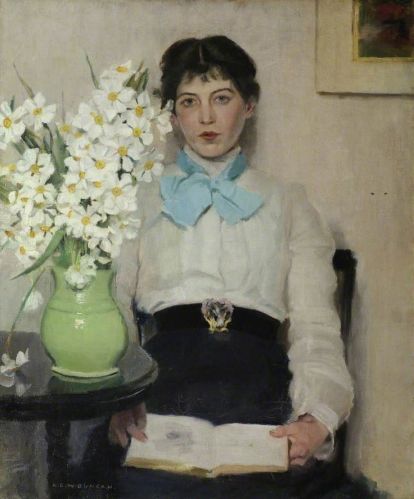
(The image is Woman and Vase with Flowers by A.C.W. Duncan.)

Posted in Uncategorized | 18 Comments

The Politics of Narrative Patterns

There are all sorts of reasons the American election went the way it did, but I think one of them, and perhaps quite an important one, was the way in which our thinking is determined by narrative patterns. What do I mean by narrative patterns? I mean that in narratives, in stories, there are underlying patterns we are familiar with. They recur from story to story: stories are often variations on these patterns. When we encounter these patterns, we feel fulfilled, comfortable — we recognize them, we like to read about them. We like variation, but only a certain amount of variation. Too much variation makes us feel unsatisfied, as though somehow the story is written “wrong.”

Let me give you an example. One narrative pattern is of the couple that dislikes each other but is destined to be together. We can call it the Pride and Prejudice pattern. As soon as we see the bickering but attractive couple on screen, we know the man and woman (it is usually a man and woman) are going to get together. We just don’t know how, or how long it will take. We willingly wait — the length of a book, a television season — for the pattern to be fulfilled. The pleasure is in watching the slow fulfillment of the pattern. But what if the woman decides it’s taking too long, that she would really rather be dating someone else? And then does date him, and then marries him and doesn’t regret it, but settles down happily to have children, grow old with her new and non-destined partner? That breaks the pattern. And at some deep level, a breaking of the pattern is upsetting to us. We might think that the writer isn’t doing it right, the television show has “jumped the shark.” We might feel cheated — after all, destined lovers are supposed to either get married or die for love. We don’t really want them to have any other ending.

Or what if the young hero, having been chosen by the wise old man (Gandalf, Obi-Wan Kenobi), goes on his destined quest, decides he’s tired of being cold and tired and in peril all the time, and just goes home to become a farmer, or an accountant? That’s not a story at all! you might tell me. Well, no, not if we define a story in a certain way — and we do, don’t we? What if instead of oppressing Cinderella, her stepsisters act like ordinary stepsisters, have perfectly ordinary sibling rivalries but nothing that goes so far as relegating anyone to be a servant, sleep by the stove, cover herself in ashes . . . That’s not a story. No, because we define stories in terms of narrative patterns.

Really, of course, anything can be a story. I looked up the word online, to find the most commonly accepted meanings. Here are a few: “an account of imaginary or real people and events told for entertainment,” “a report of an item of news in a newspaper, magazine, or news broadcast,” “a piece of gossip; a rumor.” None of those things have to fit a particular pattern. But that’s not really how we use the term, not when we say Tell me a story. No, then we mean “a plot or story line.” We want to hear about the destined lovers who find each other through hardship or finally recognize each other despite their own pride and prejudice. We want to hear about the hero chosen for a difficult quest who finally, against all odds, fulfills it and his destiny. We want to hear that Cinderella, poor and oppressed, fits the shoe and marries the prince. That’s what we mean by stories, and good stories. These narrative patterns are not unique to fairy tales, or genre fiction — they are everywhere, and what we call realism is as driven by them as any other kind of fiction.

There are writers who have claimed there is only one narrative pattern (for example, Joseph Campbell writing about the hero’s journey). That’s wrong. There are writers who have claimed there are two, or three, or twelve . . . No, there are many narrative patterns, and some are in the process of dying while others are being born. And they are not universal but deeply inflected by culture. The young man who must renounce his earthly love to go on a holy quest disappeared some time ago in our culture, and when we read it now, it sounds funny — like, why give up romantic love for the Holy Grail? That’s because we still value romantic love. The Holy Grail, not so much. However, many of our narrative patterns are thousands of years old. Each age dresses the pattern up in its own clothes, but the pattern persists. A civilized woman can still tame the wild man of the woods, as in the Epic of Gilgamesh, although nowadays the pattern might reverse itself and the woodsy man in a plaid shirt will likely help the woman convinced all she wants is to become a partner in her New York law firm understand that really, she wants to go live in the woods and write poetry, because that’s her deepest authentic self. The pattern persists . . .

These patterns are important because they are woven deeply in us, from the moment we are born to the moment we die, through the stories told to us — by our mothers, our teachers, our media. They weave us into our culture, and they weave us, ourselves — we are made of stories. We experience these patterns as truths and expect to live our lives by them. If we feel as though we are Cinderella, we expect to marry the prince, eventually. And then, if we don’t get our prince, we are often disappointed . . . One reason these patterns are so useful is that they are cognitive shortcuts. If we can understand the world through patterns, we don’t have to think as much or as hard. In the medieval era, accepting the story that the king was ordained by God and could do whatever he wished was a useful cognitive shortcut — if you did not accept it, you had to think so much harder, and for yourself, outside the pattern. You had to become a radical.

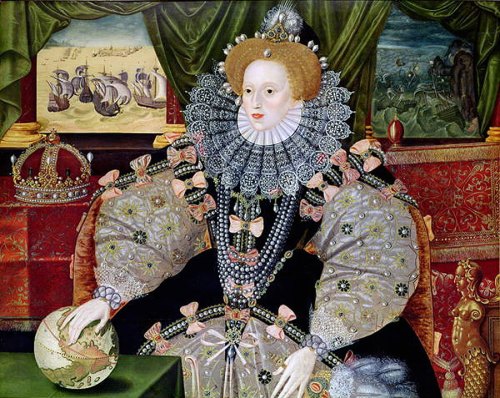
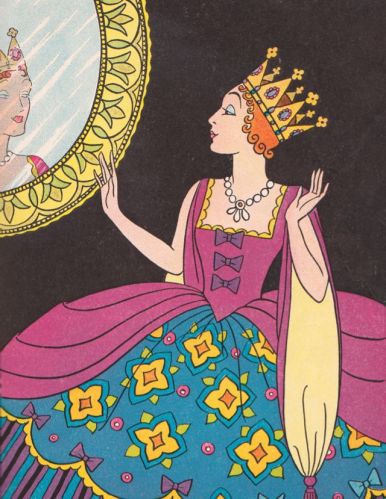
Why am I linking the idea of narrative pattern to politics? Because, while there are many reasons the election went the way it did, one reason, I believe, has to do with narrative patterns. People did not get so excited by Barack Obama, when he first ran, because of his policies. No, he was the young hero who had overcome adversity and triumphed. This was his quest, and when he won, it was his Cinderella moment. He fit the patterns, and voters invested energy and belief in him because of that. Of course they were disappointed — how could they not be, to realize he was a human being after all, one who had to do the complicated work of actually governing, of compromising to get anything done? When Donald Trump came along, he fit another narrative pattern: the stranger who rides into town and imposes order, bringing justice to the frontier. That’s a pattern embedded deep in American culture — you can see it in Clint Eastwood movies. It did not hurt him that he was not morally pure, because we do not expect the gunslinger to be morally pure — no, that’s reserved for heroes. And for women. So what pattern did Hillary Clinton fit? That’s the problem right there. We only have two patterns for older women who want political power. One is the Virgin Queen, like Elizabeth I: a woman is fit to wield power if she is willing to give up other aspects of being a woman, such as marital relationships or children. Her sacrifice makes her worthy. Notice how often Clinton was criticized for not having gotten a divorce, usually by women voters. While that criticism may have reflected a number of things, in part it reflected our underlying expectations about women and power — Clinton’s marriage and motherhood took her out of this particular pattern. What was left? The Wicked Queen. We know what she does — she seizes power (illegitimately) for her own gain, to satisfy her own ambition. She kills people or has them killed (this too was a criticism lodged against Clinton). And the Wicked Queen cannot be allowed to gain power — she must be defeated. All of our stories have told us that, from childhood on.

Did these patterns result in election victories or defeats? Who knows. But I think we can see them in the discourse around the election, in the ways candidates were talked about and thought of. There is a sense in which we live out the patterns, we live by the patterns — sometimes we die by the patterns. The patterns give us meaning. But . . . the patterns can change.

Once, I wondered if there was any use in my being a writer. I mean, I didn’t think it would be useless to me — I like being a writer. But I wondered if I, as a writer, would be of any use. To other people, to humanity as a whole. I wondered if I should have become a human rights lawyer, or something like that. But now I think that one of our most important tasks is telling stories, and I am a storyteller. I am a perpetuator and creator of narrative patterns. That means I have an obligation to be aware of the patterns, to wield them in ways that are good, and true, and useful. And I can create new patterns.

Whatever you think of these candidates individually (and I’m not talking about them here as individuals — that’s not my aim), I think it’s clear that we have a problem with the narrative patterns for women.  If we want women in positions of power, if indeed that is something we would like to see (and I would), then we need to create new patterns. If we want to see other possibilities for women in general, so they are not stuck in binaries of various sorts, we need to create new patterns. Which is what, in my writing, I am trying to do . . .

elizabeth-i-armada-portrait

(Portrait of Elizabeth I (Armada Portrait), by an unknown painter.)

the-wicked-queen-by-bess-livings

(Illustration of the Wicked Queen from “Snow White” by Bess Livings.)

Posted in Uncategorized | 15 Comments

Miss Fisher and the Female Gaze

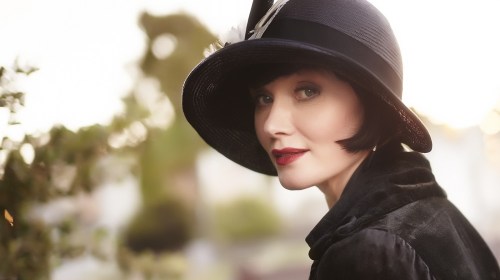
I’ve been re-watching Miss Fisher’s Murder Mysteries, which I like very much — it’s the perfect show to curl up with when you’re thoroughly tired of the modern world we’re living in. You get to go back to another world, equally complicated but in a different way. The show is clever, with twists and turns in every mystery, and has wonderful characters that are deftly developed over time. They have strong, solid, sometimes conflicted relationships. Overall, there’s a lot to like, and I put Miss Fisher in my pantheon of really fun, interesting detectives, up there with Miss Marple, Lord Peter Wimsey, and their ilk. But something particularly struck me, watching the series again. It’s that Miss Fisher is filmed for a female gaze.

I realized this while watching an episode called “Dead Man’s Chest,” in Season 2. The murder weapon, a knife, has been thrown from a pier, so of course someone must search in the water around that pier. We see Miss Fisher and her companion Dot standing on the beach. They are beautifully attired, with flowing dresses and summer hats, and both hold what look like delicious cones of vanilla ice cream in their hands. They are looking at the water, where Detective Inspector Jack Robinson and Constable Hugh Collins are bobbing up and down, rather like dolphins, looking for the murder weapon. Miss Fisher smiles and lowers her sunglasses, presumably to see better. Collins finds the knife, then both men walk out of the water, like in that famous James Bond bathing suit scene with Ursula Andress but in reverse. They are attired in the fetching two-piece men’s bathing suits of the 1920s, which are clinging to their bodies because they are, of course, wet. The camera focuses in a particularly appreciative way on Collins’ chest and arms, and because the top of his bathing suit is white, it becomes translucent when wet. (Don’t even tell me the costume designer didn’t do that on purpose.) Dot towels him off — she is the innocent young woman, not yet aware of what has happened, but Miss Fisher knows. You can tell by her smile, which is, well, knowing. She is perfectly aware of the sexual subtext of the scene, which she has in a sense set up — in the last scene, she asked, with a pointedly innocent look on her face, whether Collins brought his bathing suit. Jack Robinson is also sexualized, but not to the same extent: his bathing suit is dark, his body leaner, more spare. Collins is rather like the ice cream of the scene, in addition to the actual ice cream — he is a delicious dessert, and you realized that Dot has lucked out in a way she doesn’t yet appreciate. But Miss Fisher knows . . . Once out of the water, Collins hands the knife not to Robinson, but to Miss Fisher, who immediately starts analyzing it in the context of the case. End scene.

The perspective of this scene is that of Miss Fisher herself, the heterosexual woman appreciating male bodies. And I find that so interesting, because as I think is clear from years of aesthetic criticism, the heterosexual male gaze has been primary in our culture for a very long time. I’m not interested in abolishing gazes — there is no such thing as no gaze, or a neutral gaze. In art, in film, even in literature where what is seen is entirely imaginary, there is always someone gazing. What I am interested in, though, is the multiplication of gazes. That allows us to see things in different ways, and one reason for Miss Fisher‘s allure, especially among women, is that it allows them to participate in a female gaze (not the only female gaze, but one type).

This is a pattern in the series. In an earlier episode in Season 2, “Death Comes Knocking,” Miss Fisher is in bed with the handsome male assistant of a famous psychic. He is bare-chested — on his chest is a pattern of shrapnel wounds. Miss Fisher is dressed in a beautiful silk gown. The texture of her gown is as sensual, as attractive, as his bare chest. Again we are looking at the scene as though we were Miss Fisher herself — the show turns us all into Miss Fishers, figuring out mysteries, presented with attractive male romantic possibilities. Critics who have written about the show usually focus on its feminist implications, with its liberated female detective who is mature, smart, sexual. The show fairly consistently focuses on issues of women’s equality in the 1920s: driving, work, contraception. But its feminism is deeper than the issues it explores or Miss Fisher herself. It’s woven into every camera shot.

I have to admit, I find it refreshing to watch from the perspective of a female gaze. In the broad tradition of Western art and film, I’m usually watching from a heterosexual male gaze, and I’m used to that — but it does always involve a slight dislocation, as though before truly seeing a painting (of Botticelli’s Birth of Venus, for example), I have to hop to the left. That dislocation can be good — Robert Mappelthorpe’s photographs of male nudes are controversial in part, I think, because they ask us to see from the perspective of a homosexual male gaze, in which the male body is desired in the way female bodies are desired in most of Western art. Western culture is not used to seeing from that perspective. It’s not used to seeing from Miss Fisher’s perspective either. Multiple gazes, as many gazes are we have identifies, which are multitudinous. Let us all learn to see in different ways.

But right now, I’m appreciating Miss Fisher’s gaze. And thinking about what a very clever show this is, to allow me to see in that way.

Essie Davis plays Phryne Fisher, a beautifully attired detective in 1920s Melbourne.

(The image comes from this interview on NPR, and is credited to Ben King/Acorn.TV.)

Posted in Uncategorized | 12 Comments

Learning to Hide

Yesterday, I wrote a poem. I called it “Thumbelina.” It starts like this:

Sometimes I would like to be very small
so I could curl into a snail’s shell,
or a seashell: abalone, nautilus,
even an oyster shell. I would let the oyster
cover me with layer on layer of nacre,
come out shining.

This is something I’ve fantasized about since . . . probably since reading The Borrowers as a child. I’ve wondered what it would be like to be very small, to see the world on a completely different scale. I’ve never wondered about what it would be like to be larger than I am, to see things as tiny — no, I wanted to see them as gigantic. I think part of the impulse came from the realization that there’s nowhere to hide anymore, nowhere one can go to disappear. That’s not entirely true — I could probably buy a small cabin in a remote location and more or less disappear if I wanted to, live simply, disengage from modern life. It could be done. But there would still be satellites overhead. The world is a different place than it used to be.

When I first thought about writing this blog post, it wasn’t about becoming small, but about learning to hide. I was inspired by a sentence from a novel I read as a child. My mother read thrillers, and I think the sentence was in one of her books: Shibumi by Rodney William Whitaker, writing under the pseudonym Trevanian. To be honest, I barely remember the book. The internet tells me that it’s about an assassin, and I do remember that — the main character could kill people with a comb. I don’t remember whether he actually did. I do remember that it details his long training, and that a teacher told him to keep his skills, his very existence, a secret. “Hide, Niko,” was the sentence I remembered. Somehow, in my head, it got mixed up with The Borrowers, the way things do get mixed up. It seemed to me that one could not hide in this world unless one was, perhaps, the size of a mouse.

Later I realized that there was a way to hide: inside oneself. Imagine, your own body is a sort of shell, like a snail’s shell, a seashell: inside it is your mind, and inside your mind could be anything, anything at all, entire worlds of anything, and no one would ever know. This realization was intensely reassuring to me as a teenager. My outside could be monitored, controlled, but inside I could be thinking anything — I could write entire novels that no one would ever know about. We are all worlds, inside ourselves. A death is the death of a world, a universe.

We do not value this sort of interiority very much, nowadays. We are all supposed to be open, vulnerable. We are all supposed to share. But I think there is something valuable and reassuring about it. There is a freedom inside oneself, the freedom to be oneself in at least one place. And there is a freedom to choose: do I share this aspect of myself or not? I think that’s particularly important for artists. The art one sees is in a sense the detritus, the flotsam, of the art that happens inside. That is perhaps why we are fascinated by artist’s biographies — we want to know, what in the world was happening inside to create those paintings, those books? What world was happening inside that left those particular marks on our shared reality?

I think learning to hide is a sort of skill, and one we probably need in our modern world, where so much is open and shared, where we photograph our breakfasts and say look, here is my dog, here is my vacation, here is my life. I know it’s a skill I need, because for me at least, creativity happens in the small spaces, safe spaces, in the dark. It is when I am most alone, most myself, that I can write. (And how ironic, and modern, that I am sharing that information with you! Yet here I am, alone at my work desk, in the morning before anything has happened, before I have had to see anyone. Writing.) Artists in particular often need to lead a sort of double life: there is the public self, which goes to work, pays the bills. And there is the private self, which goes down deep into the recesses of the self, the soul, and creates something — like an oyster layering nacre over an irritant. (Isn’t that what we do when we write? Find something that itches, that we cannot seem to get rid of, and layer it over, make it aesthetically pleasing or at least not so annoying to us? Hope it turns out a pearl?)

Robert Louis Stevenson wrote about this double life when describing how he conceived of The Strange Case of Dr. Jekyll and Mr Hyde. He described himself as a house, with a brownie in the attic (you know, those one of small Scottish fairies). He said that he paid the bills, and all the while the brownie was working, working. All his best ideas came from that supernatural helper. But sometimes I don’t want to have a brownie–I want to be the brownie, the borrower, living in the attic or behind the walls or under the floorboards, just doing my own work (and maybe stealing buttons).

I guess my advice for any artist would be, learn to hide. And then you can decide what to reveal. I know the more I do, the more I am out there in the world, the more my work is public, the more of an impulse I have to carve out a private space for myself. Who knows, perhaps someday I’ll find that cabin in the wilderness, although to be honest I think one can hide just as well in a busy city, where no one much cares who you are or what you’re doing, and the faces you pass are almost always anonymous. But I need my snail’s shell or seashell, a small nest, a room from which the rest of the world is shut out. (When I was a teenager, I had a small room, a sort of closet under the stairs, where usually brooms would be kept). Or even the inside of my brain, which so far despite our technologies is relatively inviolate. Make a space for yourself, or at least your brownie, where the creativity, the magic, can happen . . .

image-by-ida-rentoul-outhwaite

(The illustration is by Ida Rentoul Outhwaite.)

Posted in Uncategorized | 7 Comments