Maid Maureen

So today I went to see the friendly copy shop people, and they told me that it would be easy for them to make a booklet for me. I wouldn’t even have to do the layout or printing myself, I could just bring in a file and they would print that file for me, arranging all the booklet features. (Like, you know, how all the pagination works, and all that.) And we went through all the costs, for paper, printing, binding, folding, cropping if necessary, etc.

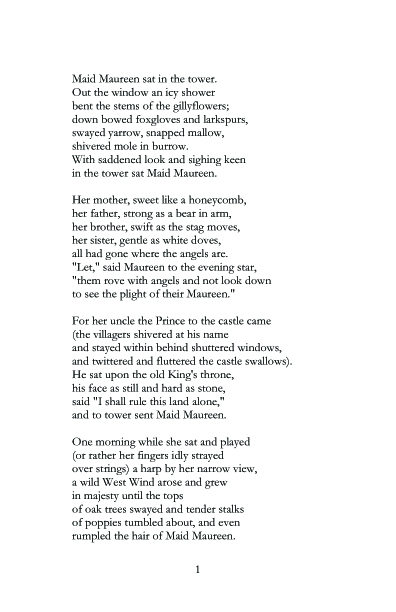
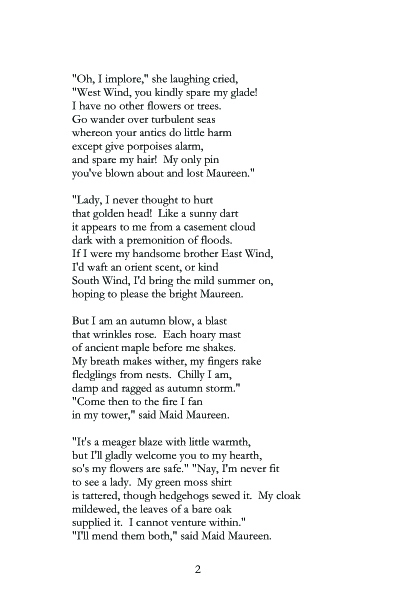
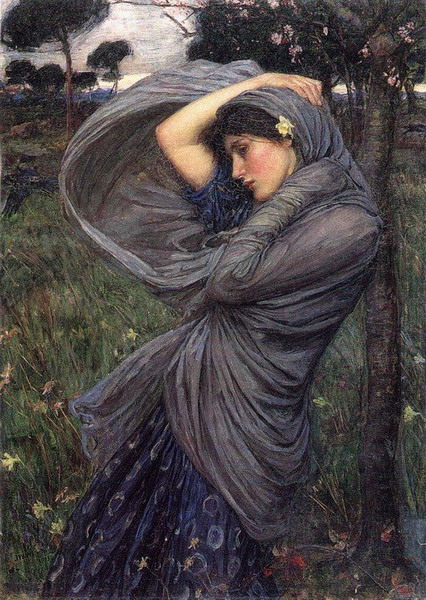
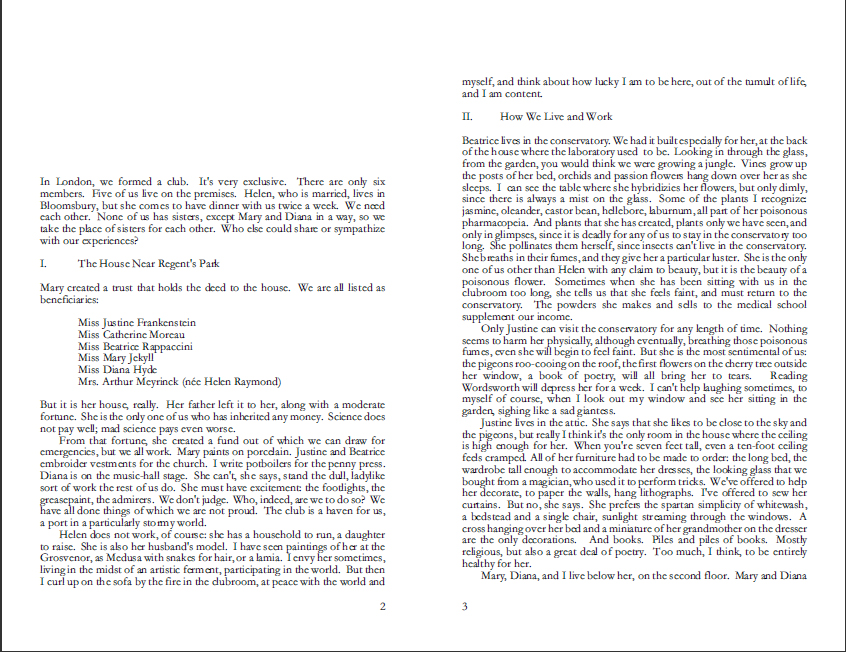
And so I came home and started to make another booklet, formatted differently this time. I took a poem I had written a long, long time ago, a poem called “Maid Maureen.” It’s a sort of parody of an old ballad, and it’s about how the West Wind falls in love with Maid Maureen, trapped in her tower. I used a John William Waterhouse painting that I believe is called Boreas for the cover image.  Here’s what the cover looks like, but you can’t quite tell the size because it doesn’t have a border. That’s because I learned how to save the document as a PDF, then open it in Photoshop and save it as a JPG. Rather than copying and pasting, which is what I did last time. I think I’m getting pretty good at this.

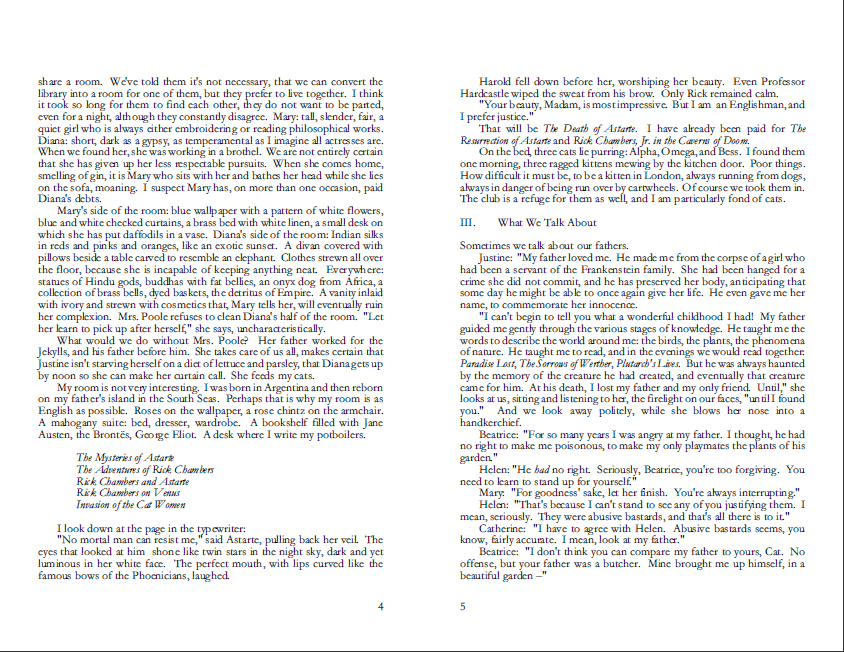
And here are two pages:

I’m really rather proud of myself. You see, my brother is Myk Melez of Mozilla (google him, he gets more hits than I do). He’s, like, a computer whisperer. And I really don’t have an intuitive sense for technology, at all. But I like to know how to do things like create websites and publish small books myself, because those are the sorts of skills that come in handy when you’re a writer.

I don’t know, maybe I’ll actually make “Maid Maureen” into a booklet and then do – what with it? Let me know if you have any ideas.

And here, in case you’re interested, is Boreas, which I think is a gorgeous painting:

Posted in Uncategorized | 4 Comments

Guilty Pleasures

I’m talking about literary guilty pleasures of course, although I have discussed my addiction (seldom indulged except on airplane flights) to chocolate-covered pretzels on various occasions.

One of my guilty pleasures is Agatha Christie murder mysteries. In a strange way, it’s like my pleasure in poetry. It’s the pleasure of pure form. I want to see the form of the murder mystery play out, I want to see her variations on it (because she would rewrite the exact same mystery as a novel and a short story, altering the motive and victim). I don’t care whether I’ve read that particular mystery ten times and know who the murderer is. I don’t care that her protagonists are all going to behave as they should, the countess being a true countess, the butler a true butler. I just like reading them.

Another guilty pleasure, and the one I really wanted to talk about, is the occasional Oprah Magazine. There’s something fascinating about its combination of uplifting articles, fairly aggressive financial and relationship advice, and expensive advertising. I’m supposed to accept myself as I am, save a financial cushion equal to six months of my salary, and buy $200 dresses. It’s enough to make me dizzy with the contradictions of late capitalism.

But what I sometimes get out of the magazine are valuable bits and pieces of – what shall I call them? Magical thinking? Like the following, in the “What I Know for Sure” section of the January 2011 issue:

“Fear comes from uncertainty. Once you clarify your purpose for doing something, the way to do it becomes clear.”

That is magical thinking, isn’t it? Once you know why you want to do something, you can still flounder in the morass of figuring out how. But for the most part I think it’s actually true, and magical thinking is like that. It usually has an underlying veracity and effectiveness to it. (I didn’t say I don’t believe in magic.)

I do think that fear comes from uncertainty. If you’re not sure what you want to do, or why, you’re going to be fearful, you’re going to hesitate. You’re going to make the wrong decisions, and then try to figure out why you made them. And once you clarify your purpose for doing something, it’s not necessarily that the way to do it becomes clear to you, consciously. But things start getting out of the way. It’s as though you suddenly think, but that’s not going to help me get where I want to go. It’s a great opportunity, but it’s not my opportunity. It doesn’t contribute to the ultimate goal I’ve set for myself. And that does help. That does make the process easier.

These particular sentences struck me because they made me ask myself, do I know why I want a writing career? I don’t just want to write. Anyone with a pen and paper can write. Nowadays, anyone with a computer can publish. I want a writing career, which means that I want to write, and be asked to write, and teach writing. I want to be part of the dialog about writing in my time, and perhaps if I’m very lucky after my time. I want to be part of the world of literature.

Why?

I think the answer is that I look at the world around me, and it’s not the world I want to see. It’s filled with things I don’t think it should be filled with: ignorance, cruelty, sordidness. And I believe, on a deep and fundamental level, that we can only change material conditions by changing ideas. That’s why we need to tell stories, that’s why art exists in the first place. It allows us to see things that we can’t see in any other way. So I want to – not make people see things differently, because you can’t make readers do anything, but offer them another way of looking.

That sounds awfully ambitious, doesn’t it? But another thing I’ve learned from Oprah Magazine is that you need to admit to your ambitions. If you don’t, if you pretend that all you want to do is – it doesn’t really matter what I’m going to write, the operative word is “all” – “all” you want to do is whatever, then it’s as though you’re starting by tying one hand (probably your writing hand) behind your back. If you start off admitting that what you really want to do is change the world, because it doesn’t seem to you at all satisfactory in its current state – that does at least give you a sort of freedom. (And a sort of permission to fail, because you’re going to fail, of course. You’re never going to change the world. But you might change a perspective or two or three.)

I’m trying to work all this out as I write, why those particular sentences spoke to me, what I’m getting out of them. I think they gave me a sense of freedom. Once I clarify my purpose, and I think I’m starting to get a clearer sense of my purpose already, then the way to do what I want will become clearer as well. It will still be an enormous amount of work. But I will at least know the way to go, which is something I haven’t been certain about for a long time.

(Shall I tell you the bit of wisdom I’ve always remembered from Agatha Christie murder mysteries? At one point, Hercule Poirot guesses that a suspect is concealing her identity based on her shoes. He tells Hastings something like this: A lady is always careful about her shoes. However cheaply she may be dressed, she will choose her shoes for their quality. I’ve always remembered that, and tried to choose shoes that are of good quality, that will last and can be repaired. Seriously, that’s where I got it, from Agatha Christie. I have no words of wisdom to pass on from chocolate-covered pretzels.)

Posted in Uncategorized | Leave a comment

Making a Booklet

So I was talking with my friend Nathan Ballingrud today about readings, and I said to him, you know what I like to do?  I like to read part of a story and then pass out copies of a booklet with the whole story in it.  That way, the audience members can read the whole story, and if they want you to sign something, they have something for you to sign right there.  And it’s fun to have something that they’re not going to get anywhere other than at that reading, something they can’t buy. Something the writer made.

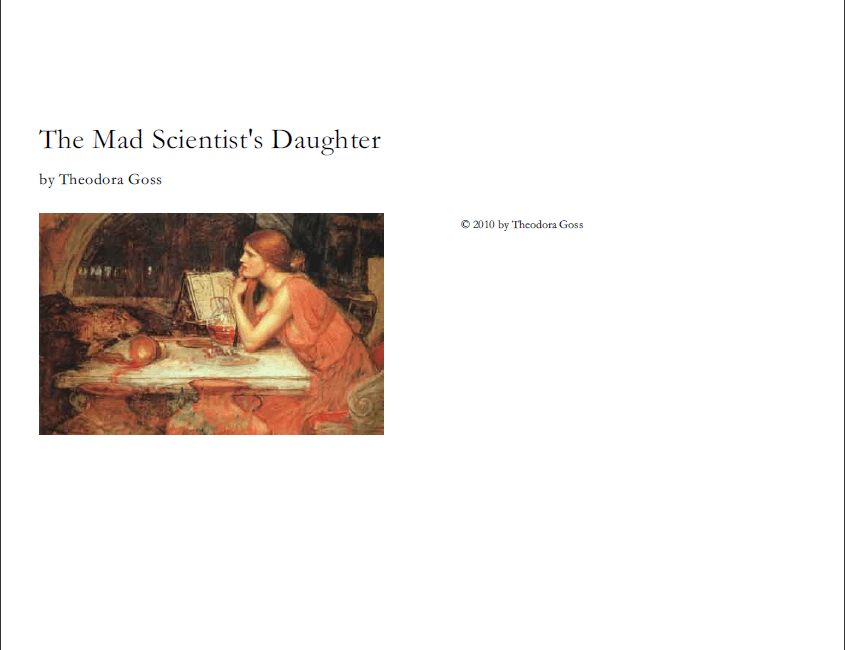
He liked the idea and asked me how I created booklets, and honestly, I could barely remember. It’s been a while. So just to try to remember, I made one out of my story “The Mad Scientist’s Daughter,” which you can read on the Strange Horizons website. It took me a long time to remember how. But here’s what it finally looked like:

This is just three pages, to give you an idea.  (Why are the page numbers on the insides?  Because when I actually print the booklet, they will be on the outsides.  You tell the program to print a booklet, and somehow it rearranges everything during the printing process.)

Here’s the problem. I can do something like this in my favorite word processing program, which is (don’t laugh) WordPerfect 11. I think it’s the most perfect word processing program ever created. Simple, clear, clean. Sort of like a typewriter with word processing capabilities. I have a deep and abiding hatred for Microsoft Word, which I find frustratingly clunky to use.

But it takes me a while to format and print a booklet like this one. What I would really like is a program that would let me create a booklet simply, easily. As easily as I created this website on WordPress. If you know of one, will you tell me? I don’t need all sorts of advanced publishing capabilities. I just want to be able to make a booklet for readings.

So I was telling Nathan, who is of course a fellow writer (check out his latest story in Lovecraft Unbound), to think about the psychology of a reading. What can you do that will make your reading stand out, that will make people want to come and then remember it afterward? I used to do two things. First, I used to let everyone know that at my reading, there would be chocolate. (And of course there was.) And then, I used to give away booklets, as I’ve described. I think I’ll do that again this year at Readercon, which is one of my favorite conventions. (I just received the invitation, and I will most definitely be there.) Those two things gave people something to do at the reading in addition to just listening, and then something to take away.

I’m glad I remembered how to make booklets. Now the question is, how do I do it more easily?

Posted in Uncategorized | 6 Comments

The Hotel Under the Sand

“So awful things happen sometimes, but good things can happen too. The trick is to be as brave as you can through the terrible parts so you can get to the wonderful ones, because they will come along someday,” said Masterman.

“That’s true,” said Emma, looking around at the Grand Wenlocke.

“And when they come, you have to remember how to be happy again,” Masterman added. “That’s very important.”

“But you can’t ever forget the people you lose, can you?” said Emma.

“Of course not,” said Masterman. He picked up his water glass and held it up. “Here’s to making them proud of us!”

Those lines are from The Hotel Under the Sand, by Kage Baker. I finished it today, and I think it’s one of the best books I’ve read recently. Why do I like it so much? Partly because it’s a strange and beautiful story, and partly because of the writing. It’s deceptively simple, but also lyrical. It gives off a beautiful tone, like a glass bell. It’s my favorite kind of writing, straightforward and clear, with a certain lucidity, delicacy, humor. And the story itself is wise.

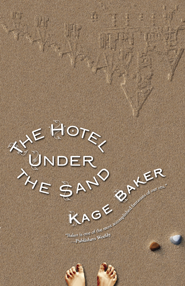
I’d read two of Baker’s stories before, and I have to admit that I’d thought of them as relatively ordinary science fiction stories, although better than most. I picked up this book at the World Fantasy Convention, partly because I liked the title and the cover image of a pair of feet in the sand. Here it is:

And I probably opened the book and read the first few paragraphs, because I tend to do that. It begins,

Cleverness and bravery are absolutely necessary for good adventures.

Emma was a little girl both clever and brave, and destined – so you might think – to do well in any adventure that came her way. But the first adventure Emma had was dreadful.

One day a storm came and swept everything away that Emma had, and everything that Emma knew. When it had done all that, it swept away Emma too.

Isn’t that a wonderful way to begin a book? It’s certainly a way that will engage me at once, because I want to know what happens to little girls who lose everything, even themselves.  I don’t want to tell you too much about it, but it’s the perfect book to buy for yourself, or for anyone you care about. The perfect present. If you’re interested, you can order it from Tachyon Publications or Amazon.

In my last post, I talked about learning from other writers, and this is an excellent example.  From The Hotel Under the Sand I learn that one can still write like this, in a style that reminds me just a little of E.B. White, but more fantastical.  And I learn how: I look at the sentences and ask, how are they constructed, how does Baker achieve that ease, that effortlessness?  And I see where the story places itself, in that liminal space I talk about, where Edward Gorey was working.  (The Hotel Under the Sand reminds me just a little of Edward Gorey with sunlight.  With a happy ending.)  And it makes me ask, what in a story gives us pleasure?  And helps me to see what does.

Like most well-brought-up children, she had always wanted to shoot off a real cannon.

Isn’t that a wonderful line?

Posted in Uncategorized | 3 Comments

Engaging the World

If you’re interested, my blog post “Why Go to the Museum?” was recently reposted on the SFWA blog. If you missed it the first time, feel free to go over and take a look!

Having my post reposted made me think about the importance, for a writer, of being engaged with the writing world – the world of other writers.

We don’t necessarily think of writers as engaged, do we? We think of Marcel Proust in his cork-lined room, the solitary genius sequestered from the world. We don’t necessarily think of writing as a collaborative activity. And yet – I think of the fact that Proust translated the works of John Ruskin into French. There’s a way in which, if you’re a writer, you have to be engaged with the world of other writers, whether past or present – and so much the better if both. You have to allow yourself to be influenced, to feel the words of other writers, their ideas, their style, affecting you, forcing you to think about what you’re doing. That’s not going to the museum – that is, in a sense, going to the library, even if it’s just your own personal library.

But I, personally, need more than that as well. I need to spend time with other writers, sit down with them, talk to them, find out what they’re doing. I need to hear about their projects and their lives, exchange manuscripts with them. That’s what I get from being on facebook, reading writers’ blogs, going to conventions.  And from maintaining personal relationships, even if it means I’m emailing friends I only see once a year.  It’s also what I get from being a member of SFWA. (My dues are due at the end of this month. Note to self: pay SFWA dues!)

Because writing is, almost always, a collaborative activity. When I wrote “Miss Emily Gray,” I collaborated with Henry James. When I wrote “Pug,” which is coming out in Asimov’s Science Fiction, I collaborated with Jane Austen. We are all writing mash-ups, all the time. Most of them are just more subtle than Pride and Prejudice and Zombies.

But talking to other writers, reading what other writers are working on this year, in this century of ours, gives me a sense of my own possibilities. There’s a piece of advice writers are often given, which is to pay no attention to how your contemporaries are doing. That will just, we are told, create discontent. But I do pay attention, and I pay attention specifically to writers who are doing things I’m not, at least not yet. I’m thinking of writers like Nnedi Okorafor, Catherynne M. Valente, and Christopher Barzak. Nnedi and I went to Clarion together, and over the years I’ve seen her publish short stories, then novels – amazing, inventive novels that address important social issues, even though they are also rousing adventure stories. I met Cat years ago in an airport, while we were both headed to Wiscon. I’ve seen her create a world for herself, a fascinating world in which she writes poetic novels that are unlike anyone else’s, puts on fabulous shows with S.J. Tucker, and wears the most fantastic clothing. I met Chris at Clarion, although he had already graduated; he was just back to visit. I read a story of his back then, and it’s been fascinating to watch him refine the style he had into something so direct, lyrical, and affecting. His stories seem to speak directly to you (at least, they do to me). Nnedi, Cat, and Chris are all being successful in their own ways, and watching them makes me think about what I want to do, how I want to be successful. Because their successes reflect their individual personalities, and so I have to think about what I can do that reflects mine. I could not be successful in their ways. But they give me a sense of the possibilities out there.

(If you haven’t read their stories, you’ll find links to their websites on this page. Go buy their books!  You still need to buy presents, don’t you?  If not for others, then for yourself.)

But I called this post “Engaging the World,” and that sort of engagement is not a passive activity. It doesn’t mean simply paying attention to what other writers are doing. It means going out there (which many writers are not very good at doing – many of us are like deer, and prefer to stay in the shadows at the edge of the forest), joining organizations, being on panels at conventions. Putting your own ideas in front of the world, being willing to say what you think. Especially about writing, about where it is nowadays, where it needs to go. That takes a certain level of courage, because you will be contradicted and someone, and maybe a lot of someones, will say you’re wrong. And you may be.

But I think it’s important for writers to be engaged, with the world of other writers and, beyond that, with the world of their readers. Because the readers are what it’s all about, finally. (If you’re a reader, you’re what this is all about, finally. If I don’t reach you, if I don’t engage with you, I’ve failed.)

Reading this post over, trying to correct misspellings, mistakes, I realize how much more random it is than my usual posts. That’s because there’s a thought behind it that I haven’t expressed, that I’ve withheld from you. It is this. I met a writer recently, one of the most talented I’ve met, who is not engaged in this way. And who, therefore, is not in touch with other writers or readers, and misses opportunities to make his writing stronger, and misses publication opportunities, and opportunities to bring his writing to readers who would enjoy it, be touched by it. He will never read this post, because he doesn’t read such things, so it’s as though I’m writing it completely in private, even though it can be read by the entire world. And so this post is a form of mourning for missed opportunities, for him and other writers I’ve known like him who are not engaged, and do not know their own possibilities. And it is a reminder to myself, and to you who are reading this, to engage, even when we feel like curling up in bed, under the fuzzy blanket (pictured in my last post, if you remember).

Posted in Uncategorized | 2 Comments

My Work Space

Terri Windling is one of my favorite writers and one of my favorite people in general (if she is a person, which I have long doubted – I suspect she’s really the Fairy Queen in her mortal form). She has the most wonderful blog, and as soon as you look at it, you will realize that I stole the idea of William Morris wallpaper (get it? wallpaper!) from her, although mine is a sort of sage rather than taupe.

Well, Terri has a wonderful series on the blog, in which she is asking people to photograph their desks and posting the photographs. If you scroll down this post, you will see my desk.

When I saw this picture, I was a little sad, because my work space is so much sparer, and I have to admit so much more boring, than the work spaces of other people she’s featured. It doesn’t quite look like the work space of a creative person, does it? But it is what it is, and I thought on my own blog I would post some more pictures of where I work. Here they are:

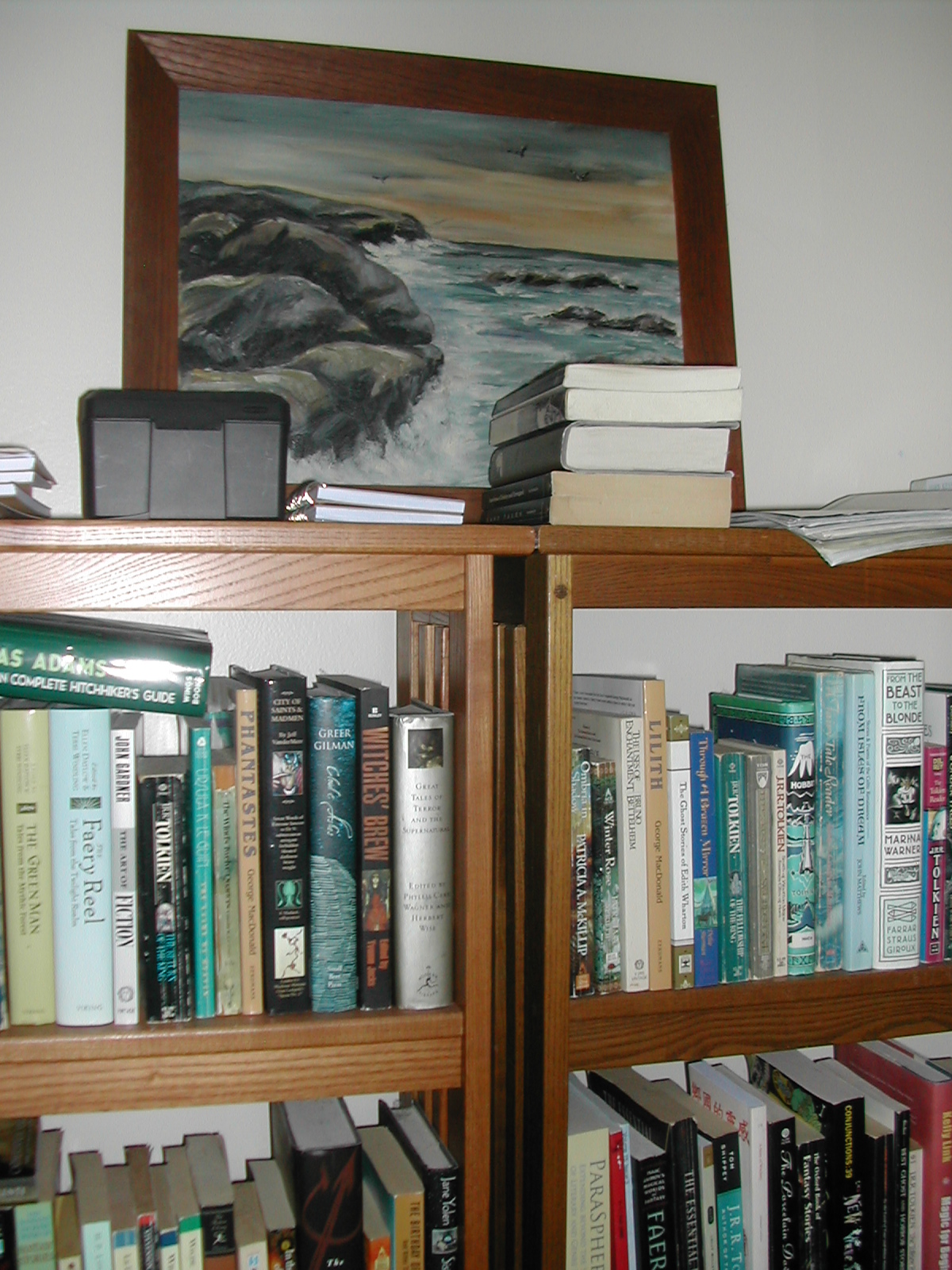
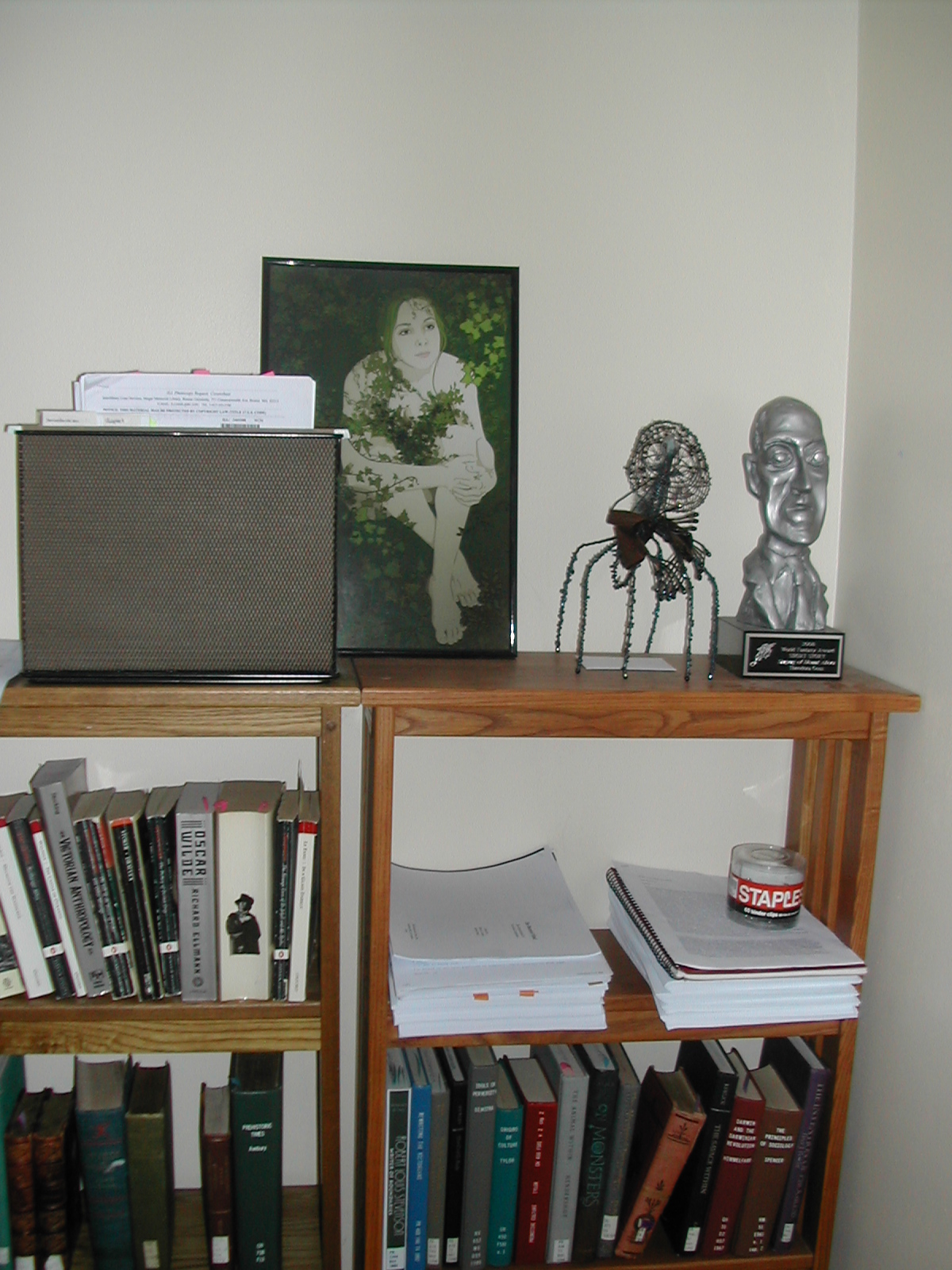
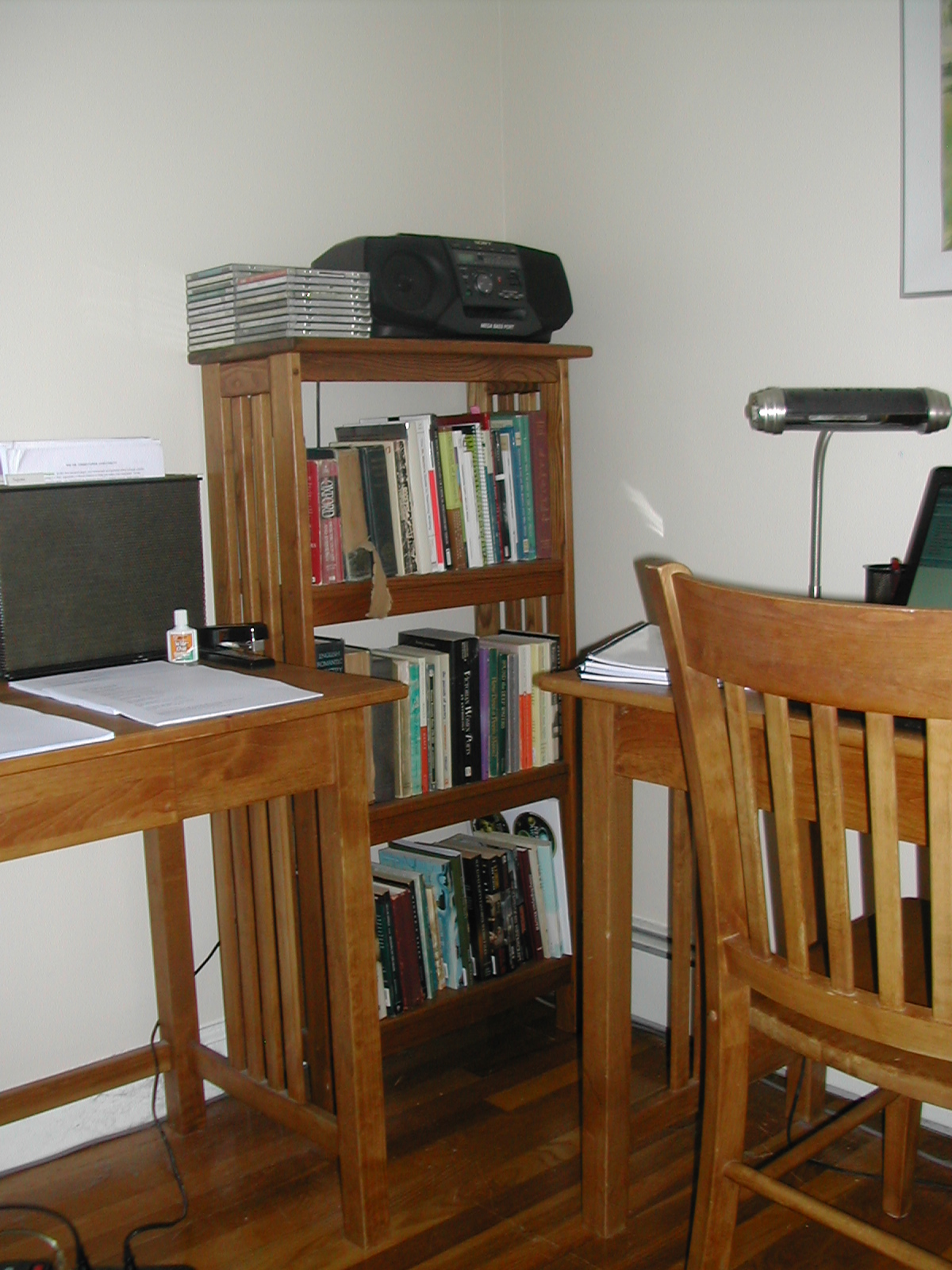
These are two of my shelves, and you can see how messy they are.  On top I have notebooks with stories I’m working on, and a picture I haven’t yet hung up.  That small black box is filled with contact information for people I know in the writing world, people I’ve met at conventions, etc.  It’s my box of professional contact information.  I suggest that every writer have one.

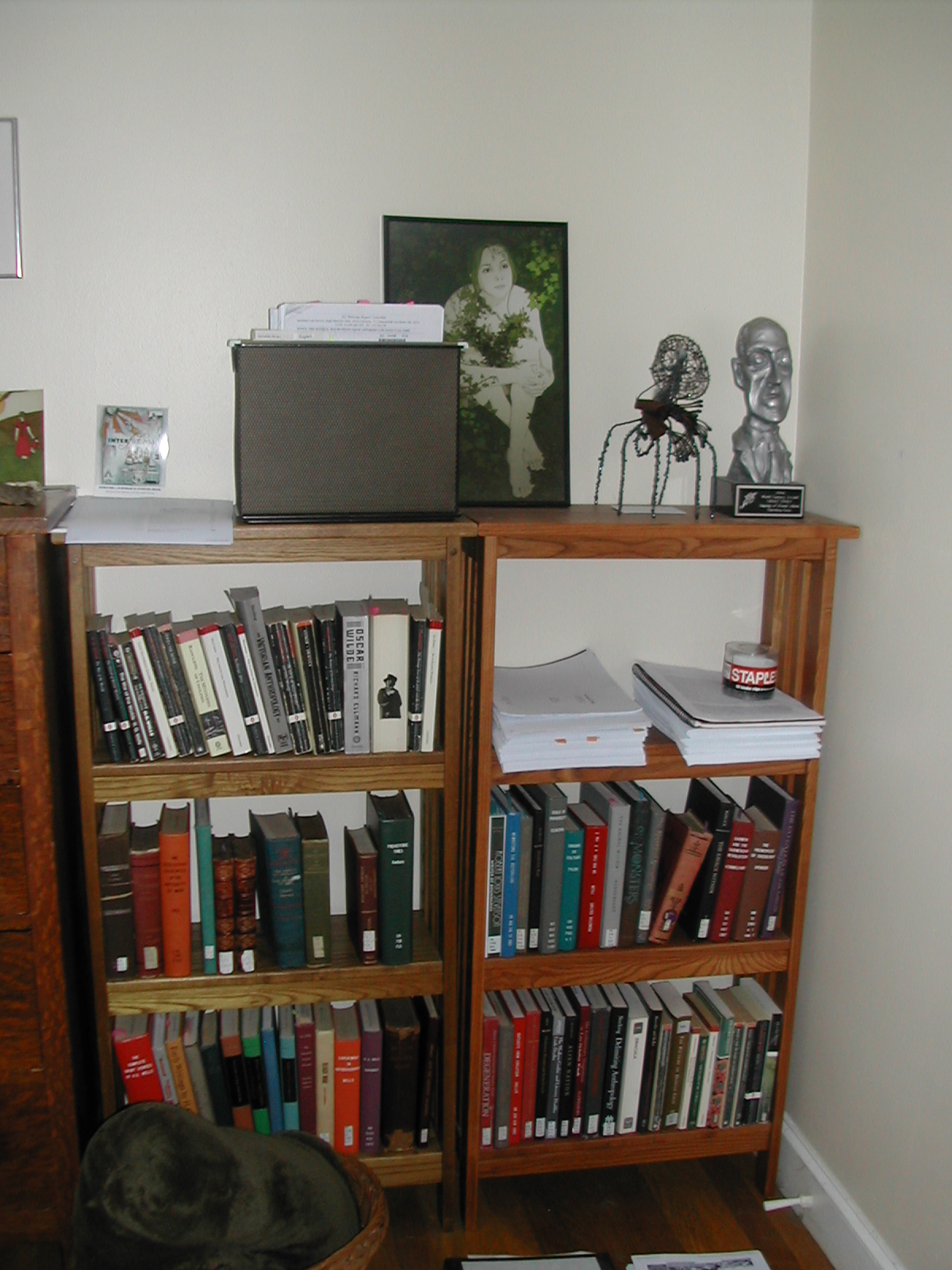
Two more of my bookshelves, with Mr. Lovecraft Head (yes, that’s my World Fantasy Award) and one of the most wonderful presents anyone has ever given me, the poet Elah Gal from “Child-Empress of Mars” sculpted by C. Jane Washburn.  Also another picture (a digital one) I have not yet hung up.

And another view of the same shelves, showing the all-important basket with a fuzzy blanket in it, which I wrap around myself when I’m reading.  These shelves, by the way, are currently my dissertation shelves, meaning that they are filled with library books and copies of my manuscript.  May they someday be put to a nobler use!

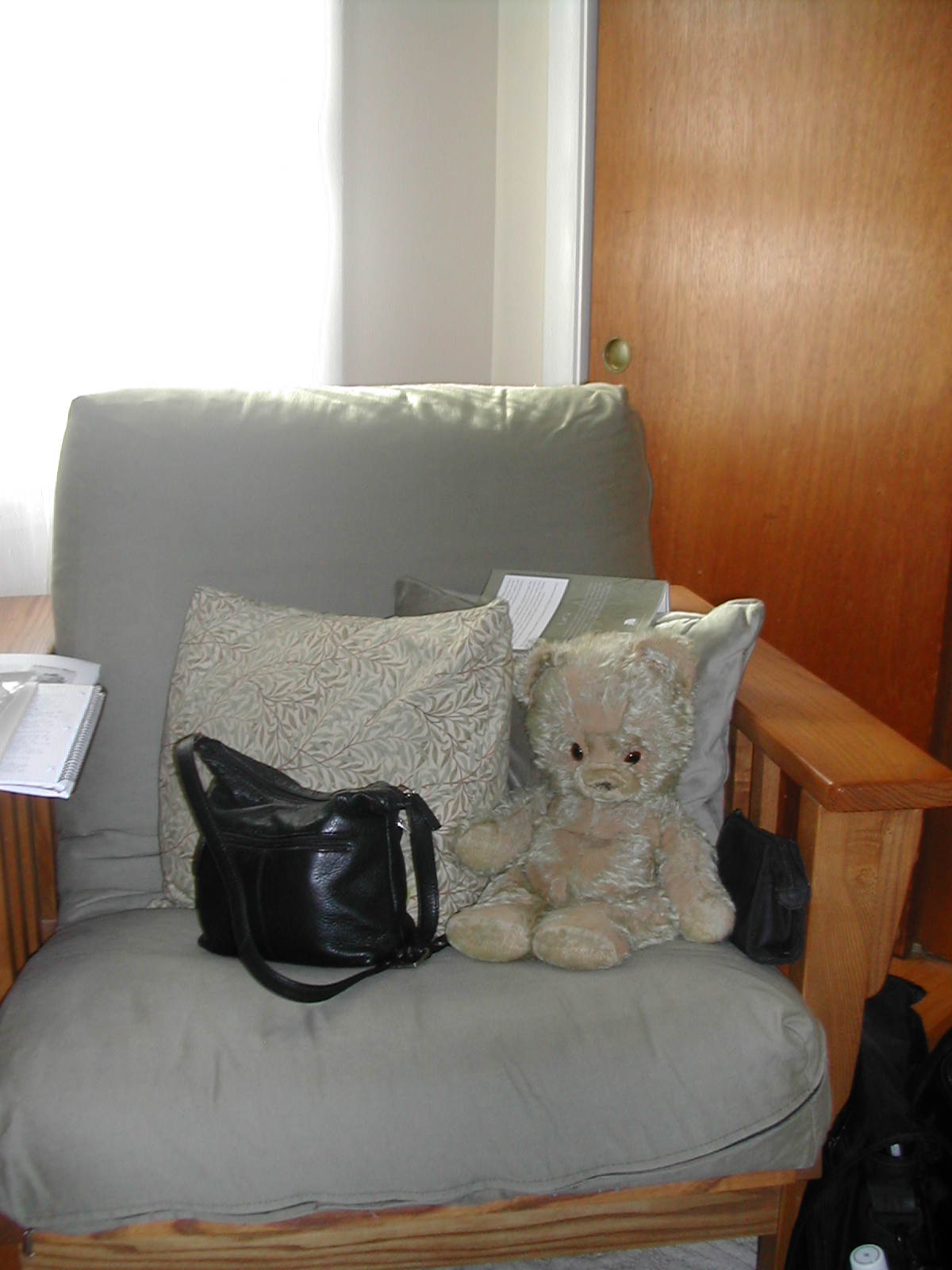
This is the comfortable chair, with Dani, the bear I received for my first Christmas, and a pillow I sewed from William Morris fabric (can you see a theme emerging?), and my purse. (No, I did not straighten anything before taking these pictures. Perhaps I should have.) The book on the pillow is Kage Baker’s The Hotel Under the Sand, which I am currently reading. The books on the arm of the chair are a set of John Carter of Mars novels, which I’m using to research a story I’m currently writing, on top of the notebooks in which I’m writing the story.

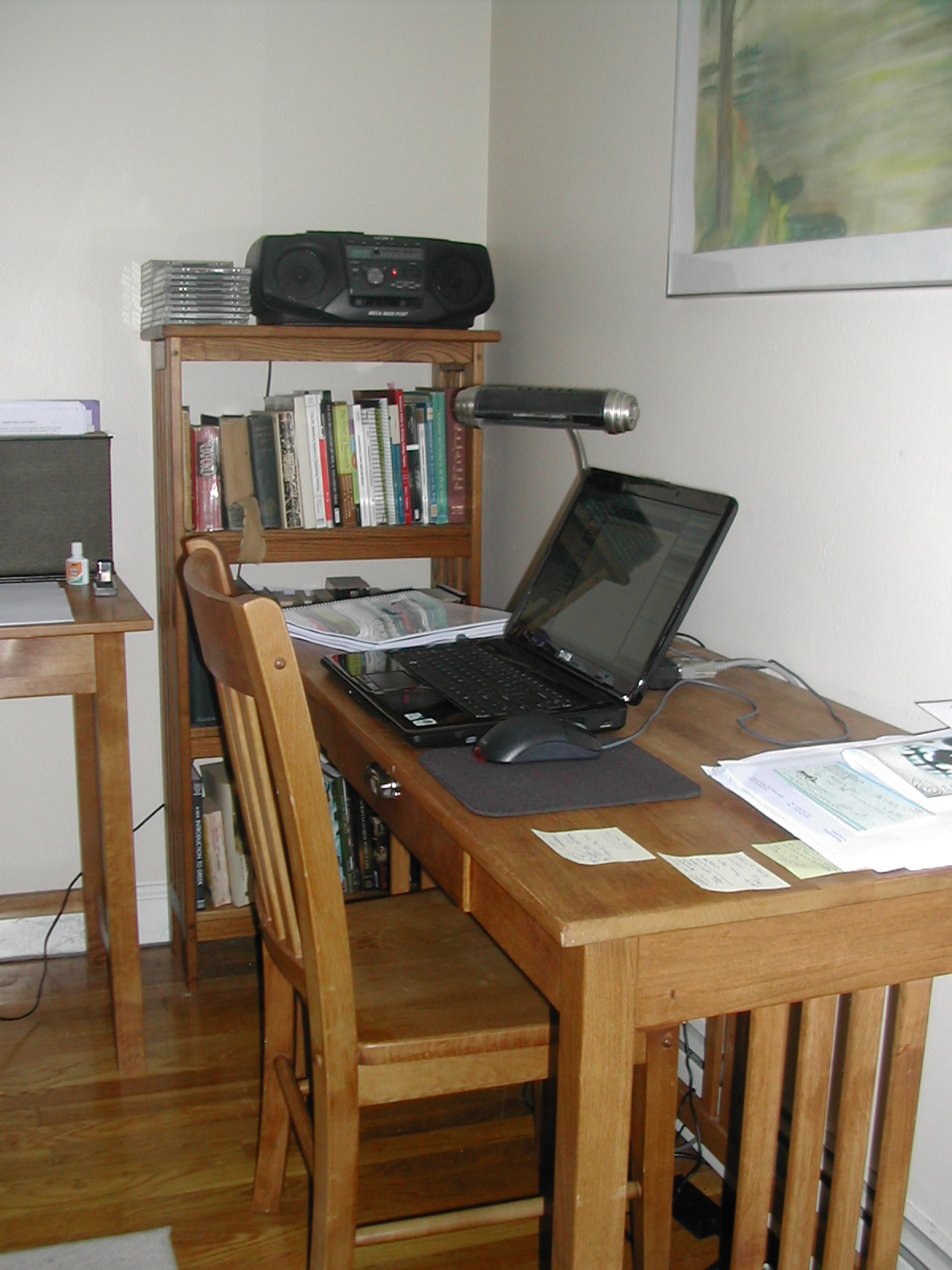
This is my desk, which was also shown on Terri’s blog.  The CDs stacked on the shelf, by the ancient boombox I salvaged from the basement of the apartment building where I used to live, are mostly Loreena McKennitt, music from the Renaissance, or experimental modern music (Eric Satie, Arvo Pärt, Morton Feldman).

And panning over, you get to . . .

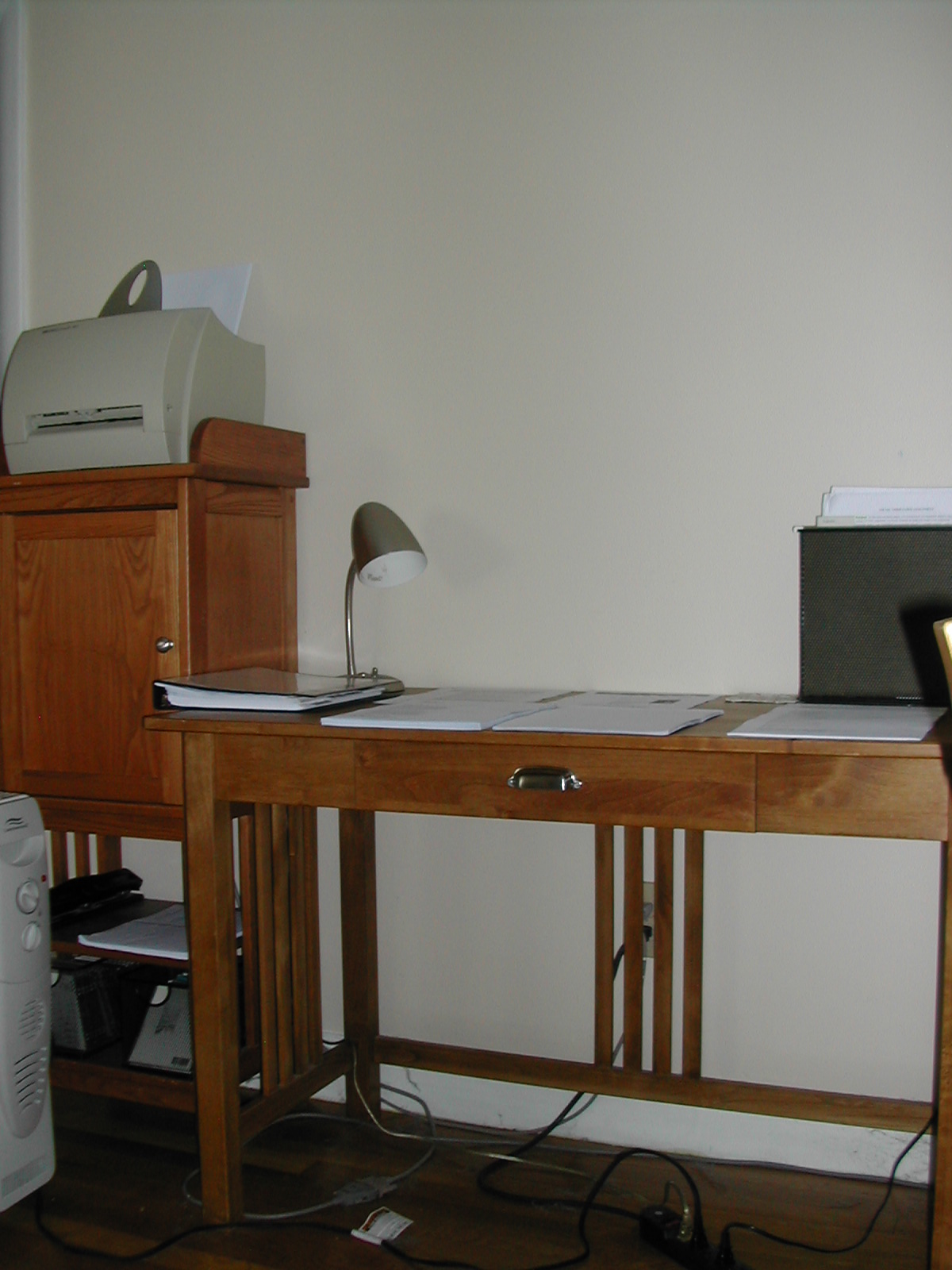
My other desk, where I do anything that does not require a computer.  The cabinet holds writing supplies, and in front of it is my new favorite thing in the world, my space heater.  Because in a drafty old house in Massachusetts, it is never, ever warm enough.

And there you have it, my work space. If I owned this house, it would probably be fancier in some way. But it’s functional, and here I write my stories and poems and essays. I suppose finally that’s what counts, the output. Right?

Posted in Uncategorized | 5 Comments

One of Those Days

It’s been one of those days.  This morning I discovered that my laptop has been infected with spyware, so I can’t use it until the spyware is removed.  As a result, I could not do any work that required a laptop.  I have a netbook, on which I am typing this post, but it’s too small to type on well, and for someone who’s used to touch-typing rather quickly, it’s almost impossible to use for serious work.  So I spent the day doing work for which I did not need a laptop: writing by hand part of a story I’ve promised to an anthology, and then reading through the first chapter of my dissertation.  I need to revise the second chapter in the next two weeks, but in order to do that, I need to understand what I wrote in the first chapter.  And I need to revise that as well.  The final section on anthropology and the monster is not as strong as I want it to be.

So what to do? I promised myself that I would post every day, but my brain is empty of anything interesting and filled with all sorts of things you probably don’t want to read about. Except that I did have some ideas about poetry, coming from having read some of the poems in Mythic Delirium 23.

Recently, I read a blog post about the best poetry books of 2010. It included some of the best lines from each book, and as I read them, I could feel a sort of sinking sensation. Based on those lines, there was almost nothing on the list that I would enjoy reading. And I thought, as I usually do when it comes to poetry, that it must be me – I must just have terrible taste in poetry. (Although I did want to read the Paul Muldoon and a new edition of Ezra Pound. Those sounded interesting.) I mean, when I read a standard Norton anthology of poetry, I love almost everything in it. And I love early modernism, Eliot and Auden and those guys. Even quite a lot of Stevens. And then something happens, and I find very little that I love anymore. Some Anne Sexton. Some Sylvia Plath. But so much of it goes flat for me.

But I do know what I like, what I respond to. As examples, I’m going to give you stanzas from two poems, both published in Mythic Delirium 23.

Ovid’s Two Nightmares
by Sonya Taaffe

Not like Odysseus to his wife’s ever-olive arms
nor like Agamemnon to the unapologetic knife
I return, the patron of exiles repatriated
windburned, ink-stained, grey-haired as the sea
tossing chips of rime on a black shore,
old Daedalus disbelieving the labyrinth’s fall.
So many spilt words, so many missteps
like across my hands like shadows in the afternoon,
ripening lemon and bay, the grape’s bitter leaves.
So many ghosts sent begging for salt and violets
hang back quivering in the August sun.

She Who Rules the Bitter Reaches
by C.S.E. Cooney

In avalanche silence, the unceasing breezes
Sculpt from the mountain a luminous keep
Lay carpets of snowflake and beds all of diamond
Preparing a nest for the Winterbird’s sleep

Here she will live, in an ice-blooming vastness
Her breath forming opal of flesh and of stone
Here she will rest in this radiant fastness
A splendor of silver and feather and bone

If you want to read the rest of these poems, you’ll have to order Mythic Delirium 23 . . .

What I want poetry to do, those two poems do for me. They send me somewhere only poetry can send me, to a place that is like the top of a mountain, where the air is clear. They give me a sense of joy, almost of ecstasy, as though my mind were dancing. That’s what I want from poetry. I don’t want it to make me think, although it can do that too. I want it to make me feel life coursing through me, as though I were breathing clear air at the top of a mountain, as though I were suddenly completely alive.

(Technically? In Taaffe it’s the progression of the vowels and consonants: spilt, missteps. The way she arranges her vowels and consonants, that’s the technical basis for the sensation the poem produces. In Cooney it’s the rhythm, which is both regular and irregular, so that you’re constantly juggling its irregularity, struggling to read it as regular. I’m not sure why, but that’s a strong source of poetic pleasure.)

I think it’s important, if you’re a writer, to point out what you think is good, what gives you pleasure. It’s a way of having and continuing a dialog about what is worthwhile in art. I started that with my last post about modernism, didn’t I? And I suspect that I’ll continue it. After all, I’m pretty opinionated about these things.

Posted in Uncategorized | 2 Comments