Sufficient Unto the Day

Status report: I didn’t exactly take the day off today, but I accomplished much less than I had intended to. It’s because I’m so tired.

I get to the end of a day working on the dissertation, and honestly, I don’t know what to write here. It’s as though my brain has stopped working. As though it’s on overload.

My life is in such a liminal place right now, and I’m not good at the liminal, I think. I want to feel the ground under my feet, and right now it feels as though I’m falling through space, not quite knowing when I will land. Not quite knowing where. But on a sticky note above my desk, I’ve written two things:

What can you do?

What can you do today?

Meaning, know what you have control over and what you don’t. Do what you can do, when you can. And that’s all I can do, for now. So tonight, I’m going to try to finish revising Chapter 1, and anything I don’t finish tonight, I’ll finish tomorrow, so I can start Chapter 2 next week.

(The title of this post is of course from the Bible: “Sufficient unto the day is the evil thereof.” Which I would rephrase as “Sufficient onto the day is the worry thereof, and the work thereof as well.”)

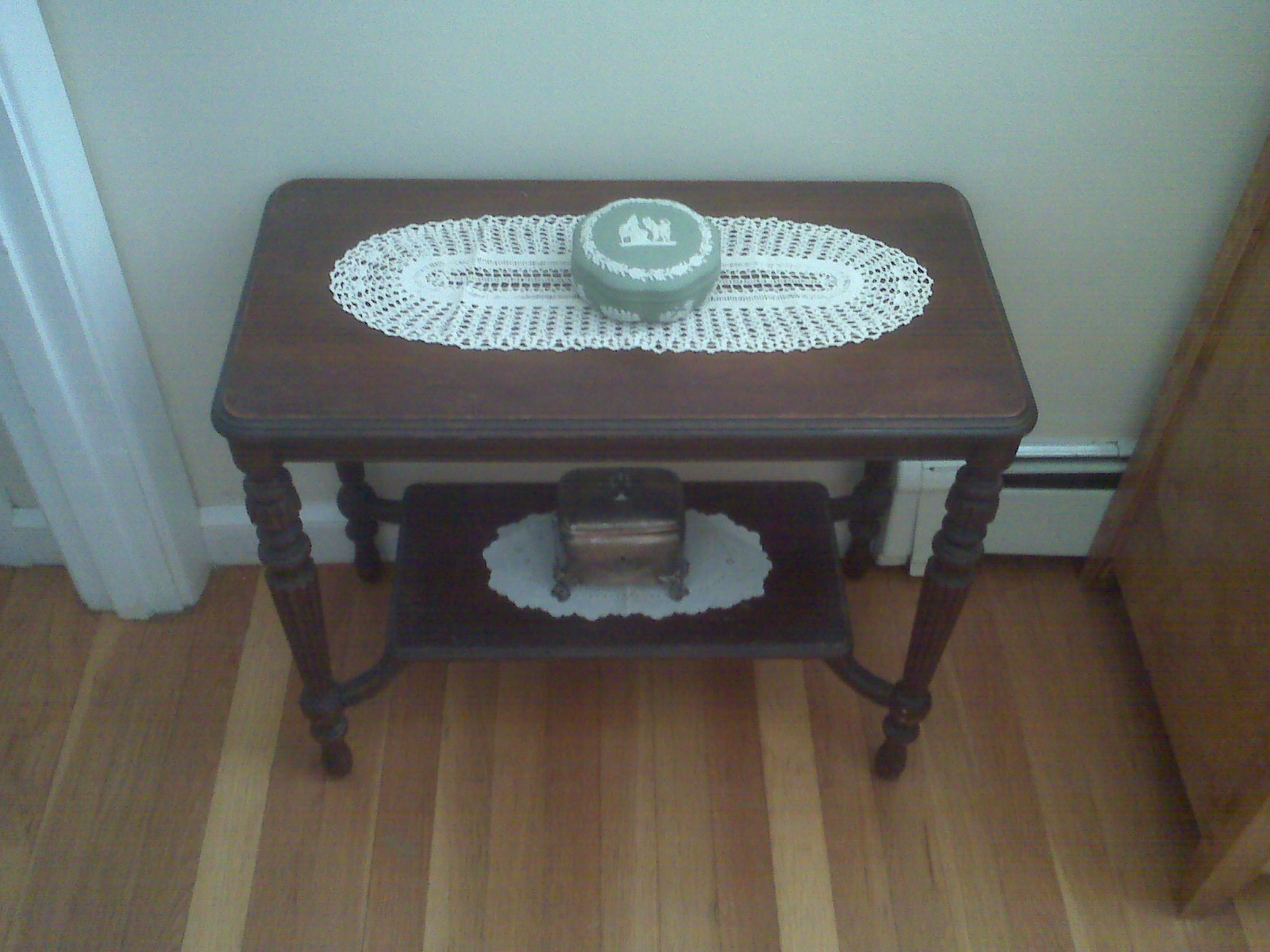
There are a couple of things I can write about. The first is that today, I had a very small adventure. I went back to my favorite antiques store to look at that necklace again. And there was a table I had wanted to buy ($45). I went ahead and bought it. Here it is, at home, with a green wedgewood jasperware box on top and a silver tea chest that is a family piece on the shelf. (I need to have that tea chest repaired. There’s a silver shop on Newbury Street that has given me an estimate. I’ve just never had the time to actually take it in. But I will, eventually.)
And then I thought and thought about the necklace, because it came with a ring and I didn’t really want the ring. It’s a pretty piece, but I don’t usually wear jewelry that large, and it’s a size 5, so it only fits my pinky finger. It has marcasites in it, which means it probably can’t be resized. It’s clear that the two were not originally a set: someone must simply have paired them because of the similarity in design. Finally, after seeing me hesitating, the store owner lowered the price to what it would have been if I were just buying the necklace ($50) and threw in the ring. He thought it would be too difficult to sell alone. So now I have both.

They’re silver, with an agate surrounded by marcasites. The necklace is very deco.

And then I went into Lexington and checked some movies out of the library, so between the library and Netflix DVDs I had a choice of the last two episodes of last season’s True Blood, Dorothy Sayers’ Have His Carcass and Gaudy Night, Terry Pratchett’s Hogfather, and Immortal Beloved (about the secret love of Ludwig van Beethoven). And I thought, what strange tastes I have!  (I watched the True Blood episodes while eating dinner.)

That’s about all I have for you today. I have to get back to writing about Krao, a seven-year-old girl who was brought to England from “Indochina” (I’m not sure what country, that’s how she’s identified in the advertisements) and exhibited at the Westminster Aquarium in London as living proof of Darwin’s theory of evolution. She was advertised as the “Missing Link” because she had fine, dark hair covering her body. She grew up on the show circuit, one of the more famous freaks (and yes, that is the technical term) exhibited at that time. She eventually joined Barnum and Bailey, and then Ringling Brothers.

The problem is, I’m writing about what she signified to Victorian society, how she was presented as living proof of evolutionary theory. How she was both classified and resisted classification. But I’m a writer, so of course what I think about, all the while, is who she was as a person. What it must have been like to be brought to England at such a young age, exhibited in front of hundreds of people. Was she frightened? Did she have time to play? Were there other children for her to play with? When she grew up, she married the man who had originally exhibited her. Did she feel coerced? Did she truly love him? What would love mean in that context? To what extent did she have the power and freedom to direct her own life?

And I think about what a strange thing life is, how we have to create the best lives for ourselves, the ones most full of joy and creativity and adventure, no matter what circumstances we’re born into. No matter how difficult those circumstances are. Compared to so many of the people who have come before me, so many people living today, I’m one of the fortunate ones of the earth, with the power to create the life I want for myself.

That starts today. And tomorrow, it will start today as well. And the next day, and the next.
Posted in Uncategorized | 5 Comments

Finding the Romance

Status report: Today, I’m working on revising Chapter 1 and the introduction. I took four long paragraphs out of Chapter 1. They were paragraphs about the history of gothic literature, as I see it, and they really should go in the introduction, so that’s where I put them. And then I added notes for several paragraphs on Krao, a freak show performer from what was then Indonesia who was advertised as a Darwinian “missing link.” (She probably had a mild case of hypertrichosis? It’s difficult to tell from the advertising material, which of course is as sensational as possible.) The information on freak shows is fascinating, and it reminds me why scholarship is important: we need to understand what happened in the past, so we can learn from it in the present. But I’m trying to stay focused on the task at hand, which is of course making revisions to Chapter 1 and drafting the introduction. I’d like to keep the introduction to 20 pages, but we’ll see. At any rate, it’s going fairly well, although I get so tired of the work. Physically tired of sitting and reading and typing. It’s exhausting.

And before I forget, I should tell you that my short story “The Rapid Advance of Sorrow” has been reprinted on the Apex Magazine website, here. It’s a story I wrote at the Clarion writing workshop, many years ago. If you haven’t read it before, take a look!

In the afternoon, I took a break and went to my favorite antiques store, where I looked at a necklace I’ve had my eye on. Should I get it? I’m not sure. I’ll probably decide tomorrow.

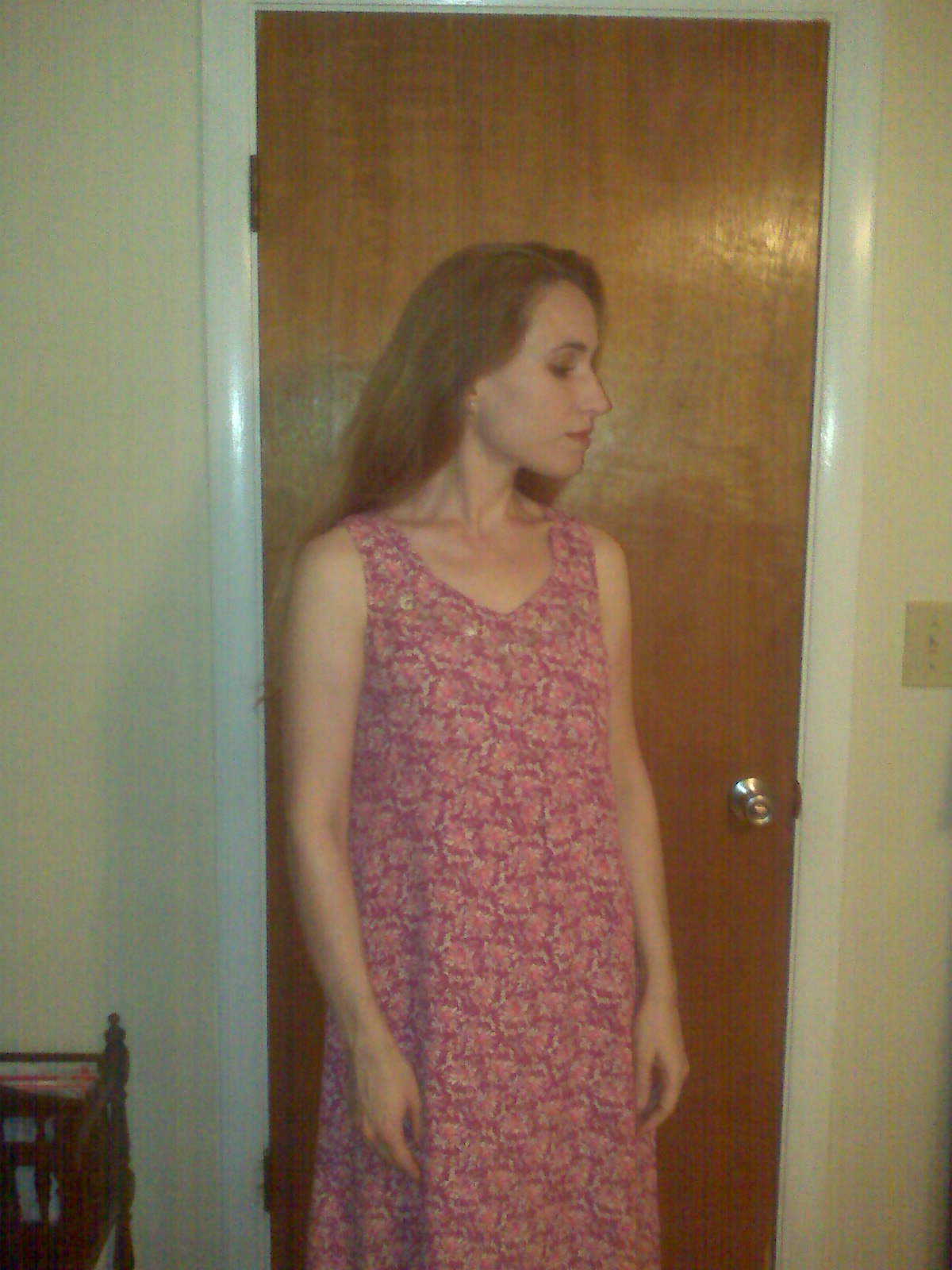
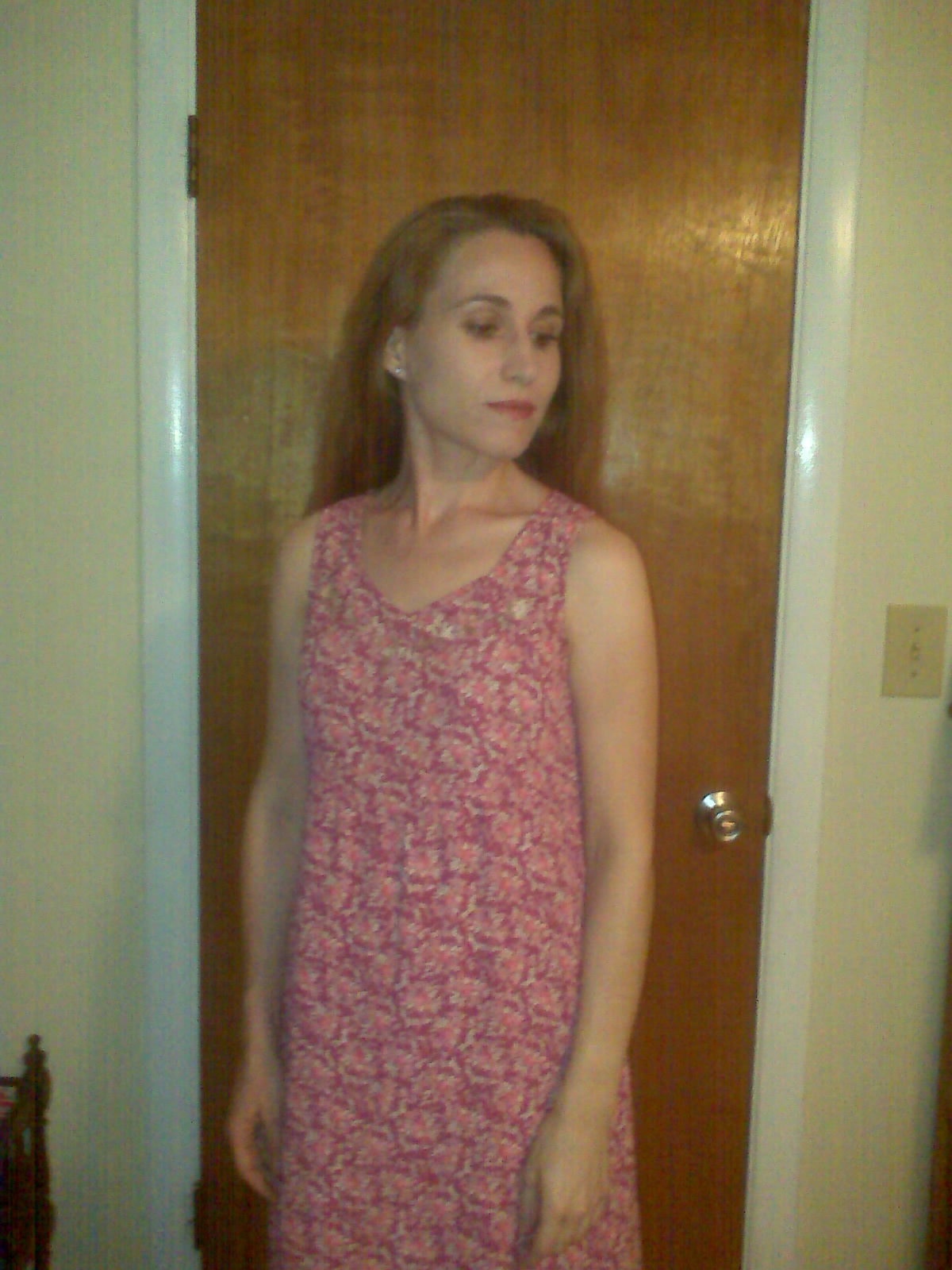
But that reminds me, I promised to post pictures of the dresses I found yesterday. One of them is actually a coat rather than a dress, sort of a coat dress. Here is the first one, an April Cornell:

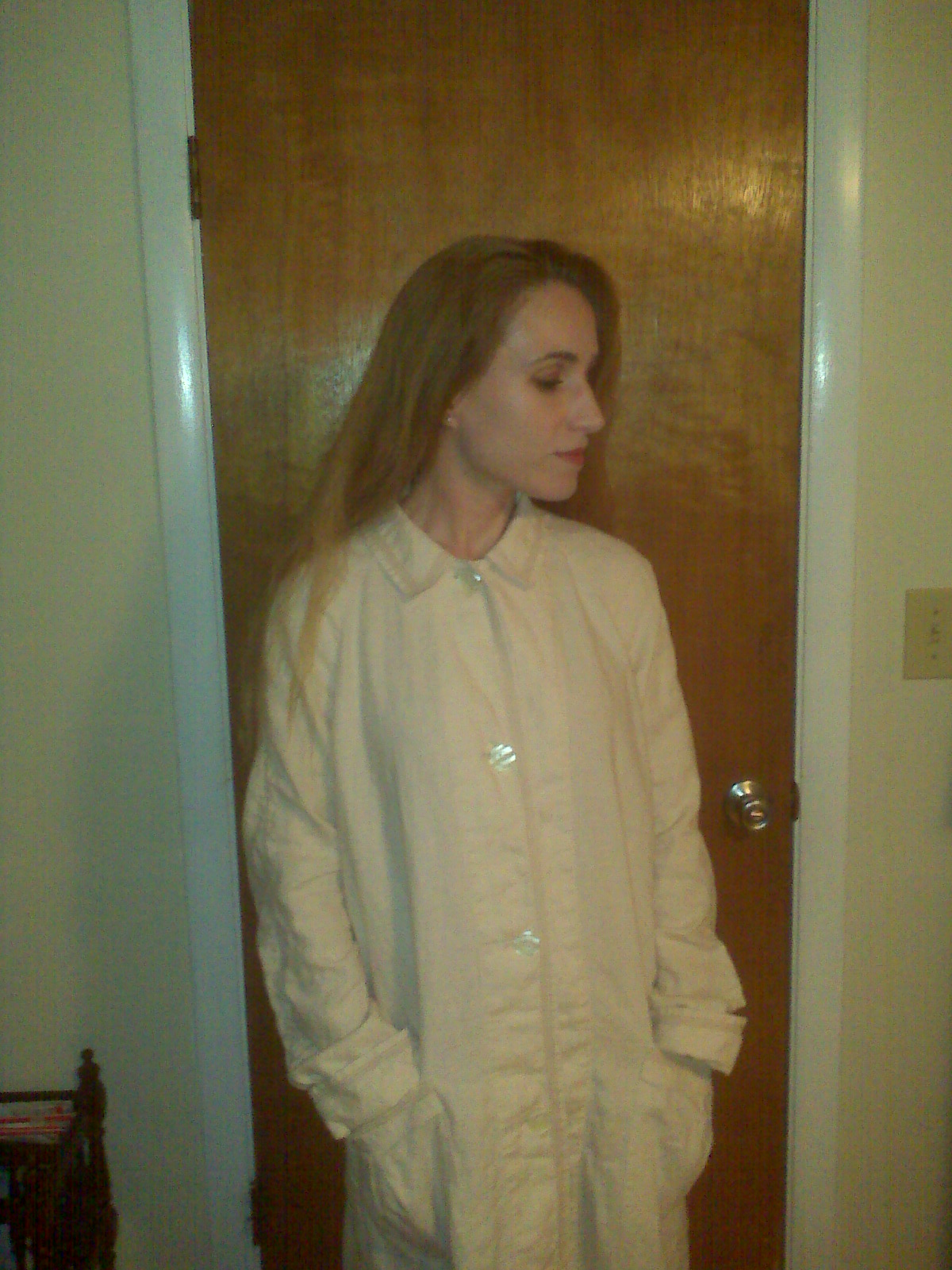
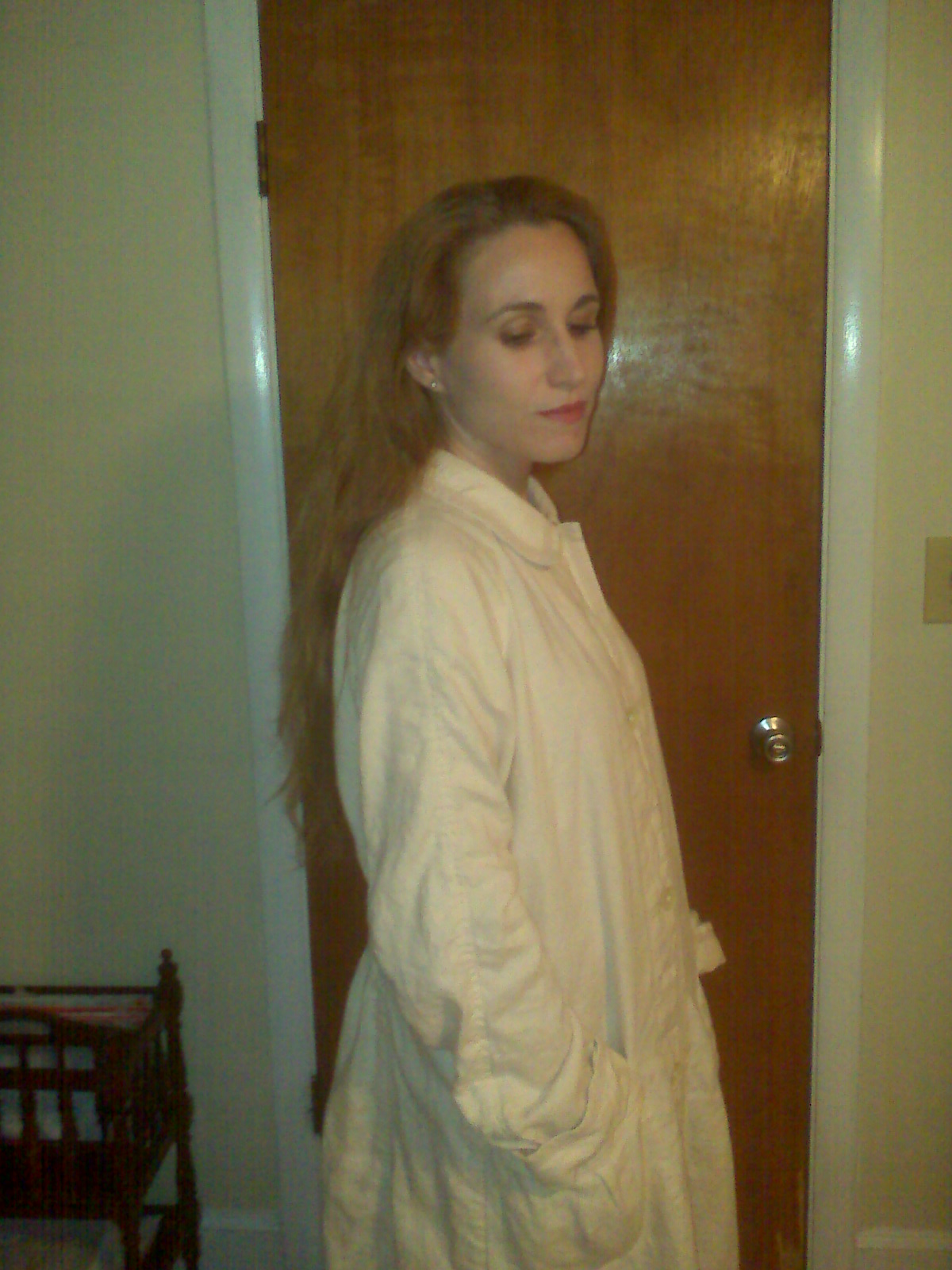
It fits perfectly, and it’s light and long and floaty. I love the way it feels on. And here is the coat dress, a J.Jill:

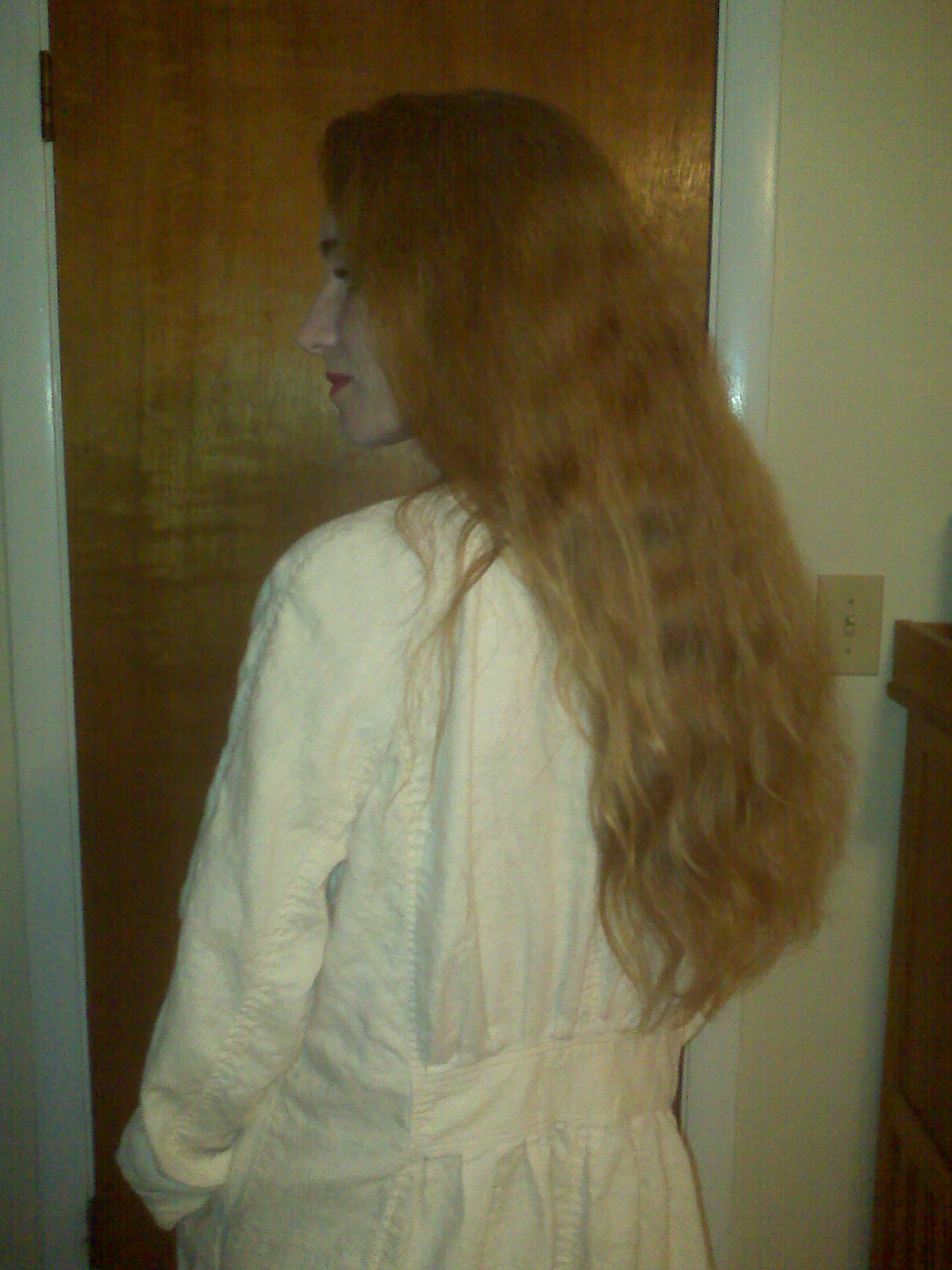
The only problem with the coat dress is that it’s a small, and you can tell it’s actually too large for me. But I loved it too much not to buy it. (I mean, it was $7.) I haven’t ironed it, so it’s all wrinkly. But it has the nicest back detail:

I tried to take full-length pictures of both, but the pictures didn’t come out right, I’m not sure why. They come down to just above my ankles. And they inspired the title to this post, which refers to finding the romance in life.

The word “romance” can mean so many things. It can refer to romantic love, of course. It can also refer to a certain kind of story, a story with adventure in it. Maybe even magic, like the old Arthurian romances. And it can refer to a style, an attitude, a way of looking at life. I suppose by the word “romance” I mean all those things. I’ve said before that the stories we tell about our lives create our reality. Of course, our lives have an underlying reality that we might not be able to change: we might get sick, for example. But we can tell different stories about our sickness.

And we can tell different types of stories. I think the type of story I prefer to tell is a romance, and perhaps that’s why I like buying long, floaty dresses with roses all over them. (Although the photograph readers have clicked on most often, on this blog, is one of me in a mini-skirt. Which makes me smile in a wry sort of way.) It may also be why I think of my dissertation as a battle, with me as Leonidas (in a long, floaty, rosy dress, which is a strange image, isn’t it?).

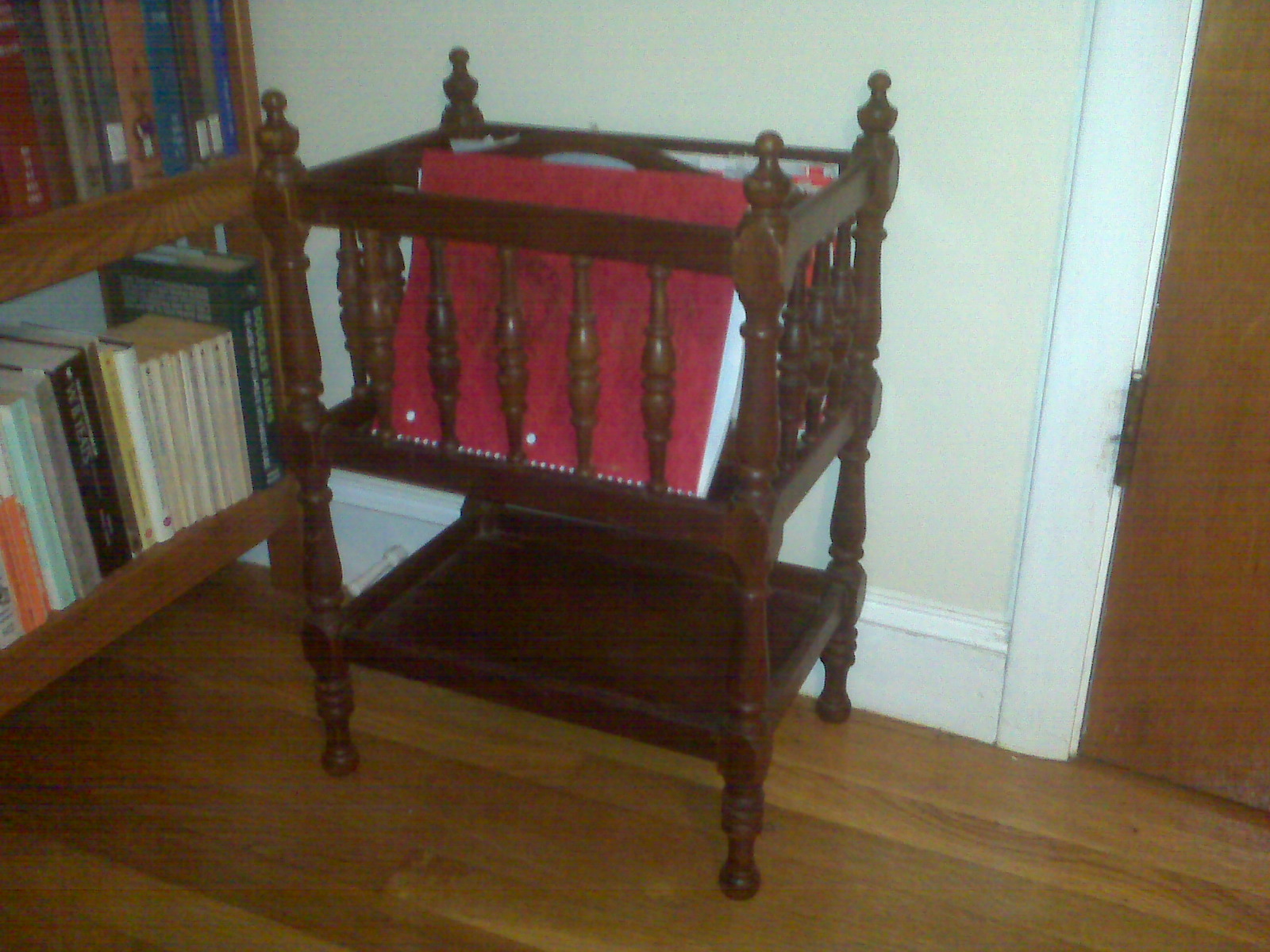
I like beautiful things for their own sake, but I also like to create the appropriate setting for the story I’m telling myself, about my life. For example, I never posted a picture of the magazine stand I bought, several weeks ago:

Isn’t it pretty? At the moment it’s holding my copies of Locus and the notebook in which I’m writing the YA novel. You could call it my writing stand. (I think it was $28).

I know this probably sounds silly, but why not make your life romantic? Why not surround yourself with things that make you feel like a heroine? Such as a long linen coat or a pottery bowl full of pine cones? You have to have furniture, you have to buy clothes. Why not make them part of the adventure?

Even writing a dissertation can be an adventure, but it takes a lot of work to make a dissertation adventurous: quoting poetry, comparing yourself to Spartan leaders, all that stuff.

Honestly, this is the dull, difficult part: revising, revising, revising. To get myself through it, I have to tell myself stories. I have to feel as though my life is not going to be this dull and difficult, not permanently, not even for all that long. I have to find the romance, even in this. (And just wait! What comes after is going to be so much more interesting. I promise.)

Posted in Uncategorized | 3 Comments

Q is for Quality

Status report: This morning, I read about the Great Exhibition of 1851. At noon, I had a conference call about the Secret Project, which I still can’t discuss. This afternoon, I worked on the introduction, making notes on the Great Exhibition and on Victorian freak shows. Then I revised Chapter 1. I need to do more work on Chapter 1 tomorrow, but I’m hoping to have it completely revised either tomorrow or Saturday. Then, I drove into the city. I needed to go to the university library, but I also stopped by my favorite thrift store and picked up some pretty things. Here they are:

The octagonal plates are from one of my favorite ironstone patterns, by Independence Ironstone. You can find it, every once in a while. There was quite a lot of it made. And I like the octagons. The knives are actually from an antique store I went to yesterday, not from the thrift store, but I thought I would show you those as well. They’re sliver plate, and they have a monogram: G. I thought that was significant, so I bought them ($10 for three). I also bought two of the pressed glass bowls today. I had bought the other bowls and the matching plates at another thrift store several weeks ago. As soon as I saw these two, I knew they were the same pattern. One of them still has traces of gilding on the rim, but that will come off in the dishwasher, eventually. I dislike gilding.

Don’t these, the cream-colored plates, the gleaming silver, the glass bowls that would be so perfect for strawberries, make you think of a summer party?

I also bought two dresses, one an April Cornell dress with pink roses, the other a J.Jill coat-dress in cream-colored linen. Unfortunately, I washed them together, assuming the pink dress was color-fast, and got some pink dye on the linen, so there I was, scrubbing it with stain remover, hoping the dye would come out. It did, and thank goodness linen doesn’t take dye well. I don’t think I could have gotten it out of cotton. I always assume that clothes I buy in thrift stores are color-fast because they’ve been washed before, but evidently the previous owner of this particular dress followed the care instructions, which say to dry-clean only. Who does that? I mean, I never dry-clean anything. It’s expensive and horrible for the environment. Anything natural, like wool or silk, can be hand-washed in cold water. And anything so unnatural that it can only be dry-cleaned, you shouldn’t be wearing anyway. I may post pictures of the dresses tomorrow.

And then I drove back home. Driving the Pathfinder on the highway always makes me feel – what’s the word? It’s twenty years old and drives like a truck (it’s a stick, of course), but in my hands it purrs like a kitten. I drove with the windows down and my hair whipping around me, blasting Baroque music, toward the sunset. The grass on the median strip had just been mown, and all the way home, I could smell freshly cut grass.  I thought, when I’m eighty years old, I’m going to have white hair down to my waist, and people are going to think I’m the Queen of the Fairies, and I’m going to be the coolest thing you ever saw.

And now I’m back to work.

What was I going to write about today? Oh yes, quality. When I was in college, I read an article in Vogue about the idea of Q. I still remember that article, but I tried to google Q recently, and got nothing except James Bond and Star Trek references. In that article, Q stood for quality. The idea was that items either had Q or not.

What does Q depend on? The item has to be functional. A wooden bookshelf has Q to the extent that it fulfills its function, which is holding books. But an item also has to have substance. A bookshelf made of solid pine has Q, no matter how cheap it is, whereas a bookshelf made of particleboard does not, no matter how expensive. And it has to have honesty. A particleboard bookshelf with wood veneer does not have Q, no matter how nice the veneer. It’s pretending. An item with Q does not pretend to be something other than what it is. Q has nothing to do with how expensive something is. A plastic bracelet that does not pretend to be anything other than plastic can have Q.

Functional, substantial, honest. Those are the qualities necessary for Q. I’m basing these criteria on what I remember from the article, but I’m also elaborating, because I remember very little about it, really. Just the basic concept.

I think the things I bought today have Q. The substantial ironstone plates, the silver-plated knives, the glass bowls. (Yes, the knives are silver plate, but they don’t pretend to be silver. And they’re completely functional: I put my silver plate in the dishwasher, whereas I would never do that to my silver, which is always hand-washed.)

This concept has been important to me because I’ve tried to make sure that whatever I buy has Q, whether it’s a piece of furniture, or clothing, or even food. I’m going to link to some companies that make products with Q. They make some of my recent favorites. The first is Pacifica, which makes candles and perfumes that smell gorgeous. I particularly like the Persian Rose and French Lilac. The second is LÄRABAR, which makes bars from only a few ingredients.  They are delicious, especially the Cherry Pie. The third is Earth Science, which makes some of my favorite creams and moisturizers. It’s important to choose items with Q. They work better, last longer. And having items with Q in your life improves the Q of your life as a whole.  It gives your life a higher quality.

It’s important to surround yourself with items that are functional, substantial, and honest. Beauty comes out of those qualities. At least it does for me.

Posted in Uncategorized | 1 Comment

The Magician’s Book

Status report: I’ve very tired. I drafted my abstract, and now I’m working on writing my introduction. I’m also in the middle of revising the first chapter. I’m doing quite a lot of reading, making sure I have all the background information I need. Mostly about the Great Exhibition of 1851 and Victorian freak shows. The freak shows are important because the people who were displayed were considered outside contemporary categories, and that’s what I’m writing about in the literature of the time as well. I’m writing about the other, the “monster” as socially defined. After all, my dissertation is called The Monster in the Mirror. But the information about freak shows is interesting as well (and yes, that is the term academics use, the official term), because when Mary finds Justine and Catherine, they’re working in a circus sideshow. Catherine is the Cat Girl, and Justine is the Giantess. The books I’m reading have reproductions of the sorts of pamphlets that were used at the time, and it’s good to get a sense for the language. And I’m tired, and I haven’t posted for two days, I know. They’ve just been those sorts of days.

Here, by the way, is Dissertation Dora:

I still haven’t had time to get my hair cut, and it’s long enough now that I can just knot it at the back of my neck, and it stays. But I thought I’d better include a picture in which I look at least slightly less severe:

But today I want to write about something other than my dissertation, although it is in a way related to it.

When I was writing my Folkroots column on Narnia, I didn’t have a chance to finish Laura Miller’s The Magician’s Book. So I’m reading it now, slowly, before I go to sleep each night. And it’s wonderful. Just as examples, I’m going to quote several passages I particularly liked.

“Narnia is a place so thrilling that you can finally stop imagining you’re somewhere better. It is the place where adventures are transformed from something you read about in books to something you actually get to do.”

That’s where you want to go, isn’t it? The place where you don’t wish you were somewhere else? Honestly, I think that most places I’ve been in my life, I wished I were elsewhere. There were only a few place where I thought, yes, this is it.

“‘Adventure,’ then, is what might otherwise be called a hardship if it were attempted in a different spirit. Turning a difficult task or a perilous journey into an adventure is largely a matter of telling yourself the right story about it, which is one thing that Lewis’s child characters have learned from reading ‘the right books.’ This is surely one of the oldest tasks that stories are called upon to perform.”

I think that’s absolutely true. We tell ourselves stories about the world, and the stories we tell create a large part, although not all, of our reality. But reality is in large part how we perceive it. So we need to tell the right kinds of stories.

“The lives Lewis and Tolkien led might appear sheltered at first glance, but in this respect they endured more than almost anyone in my own circle ever will; middle-class American intellectuals in recent years have seldom gone to war. Tolkien, in a preface to The Lord of the Rings, wrote that by 1918, when he turned twenty-six, all but one of his closest friends had been killed.”

I confess – I had thought of Lewis’ and Tolkien’s lives as relatively sheltered. And yet they weren’t, were they? Miller points out that at the time Lewis was describing those feasts in Narnia, food was rationed. She quotes from letters Lewis wrote to friends in America, fervently thanking them for sending food.

“Lewis dreaded war (especially as his brother became a career officer in the Royal Army Service Corps and was called to active service during World War II), but the literature he studied showed it to be a continuing fact of human existence. He firmly believed that sometimes war was necessary. Religion explains why – sometimes we must be willing to sacrifice ourselves for a greater good – but stories show us how.”

And we’re back to stories again. But stories do teach us how to deal with hardship and pain. That’s how we learn, from stories. Which is why stories have been so important throughout human history.

“People read criticism of work they already know well because they hope to expand their understanding, perhaps even to relive the experience through someone else. Great critics show us new dimensions of a book or a film, but they also articulate what it feels like to encounter the work, a sensation may of us can’t adequately capture on our own.”

I think that based on that criteria, Miller is a great critic. She’s showing me so much about the Narnia books that I either didn’t know or knew and didn’t particularly think about. She’s putting things in context.

“If literary writing has any distinguishing characteristics, it’s that the more you look at it the more you see, and the more you see the more you want to go on looking. It invites a plurality of interpretations.”

Yes, I believe this. And it’s the sort of literature I try to write, despite the fact that I write fantasy. There have been times when I’ve been in places where there was very little to read. And in those places I ended up reading books like Rosamunde Pilcher’s The Shell Seekers or John Grisham’s The Partner (which I have to admit I skimmed). I remember feeling, after I’d read them, as though I’d seen a slick, sophisticated performance. I never wanted to read the books again. I was left with a sense of deep disappointment and wasted time. The books hadn’t given me anything. They hadn’t left anything with me.

What does this have to do with my dissertation? In my last post, I quoted from some academic writing. Miller’s writing is nothing like that. It’s clear, smart, informative. It speaks to everyone, not to a small group that has specifically been educated to read it. And that’s the sort of writing I want to do. I want to be able to write as clearly as she does, to be as insightful about literature.

I’m working on my dissertation, and it’s somewhere between Miller and the academic writing I quoted. But what I want to do after it’s done is write in a way that everyone will be able to read and understand.

I’m seriously thinking of writing Miller fan mail.

Posted in Uncategorized | 2 Comments

Me and Leonidas

“The Spartans on the sea-wet rock sat down and combed their hair.”

That’s the last line of one of my favorite poems, “The Oracles” by A.E. Houseman. Do you know what it’s about? The Battle of Thermopylae, actually. I mean the line, not the whole poem. The story goes that before attacking the Spartans, who had agreed to hold the pass at Thermopylae, King Xerxes gave them four days to retreat. He was certain that such a small force would retreat before the might of the Persian army. But on the fourth day, there they still were, combing their hair and wrestling. This was their way of preparing to either conquer or die. On the fifth day, the battle began.

King Leonidas had a particular reason for not retreating. The Oracle at Delphi had told him that either Sparta would lose its king, or it would fall to the Persians. So, he chose to sacrifice himself for Sparta.

Why am I writing about Leonidas? Because on Friday, I met the last of my deadlines. I don’t have any more deadlines until the end of August. That means I have two months to focus on my dissertation. (And write the YA novel, when I’m so tired of my dissertation that I can’t focus on it any more.) So what did I do yesterday, to prepare myself for battle?

Let’s be clear, first of all, that it is battle. Academic writing doesn’t come naturally to me. I was thinking about this yesterday when I read the following sentence in one of the critical analyses I need to read for the dissertation:

“The impresario that stages this patriarchal drama is called ‘culture,’ itself the production of an emergent capitalist European society; the conflictual structures generated by its imbalances of power are consistently articulated through points of tension and forms of difference that are then superimposed upon each other: class, gender and race are circulated promiscuously and crossed with each other, transformed into mutually defining metaphors that mutate within intricate webs of surreptitious cultural values that are then internalized by those whom they define.”

You know what I thought when I read that sentence? I’ll articulate you! Surreptitiously and promiscuously. Who writes like that? Academics, that’s who. And I can’t do it. I can barely stand to read it. So that’s going to be a significant problem for my academic career, isn’t it? My dissertation doesn’t sound anything like that, of course. But in order to work on it, I have to get back into the correct mindset. Which means that I need to work on it every day, need to have it in my head every day. And that’s hard.

It’s a different kind of writing than my creative writing. I think I can both revise the dissertation and work on the YA novel, but we’ll have to see how it goes.

Yesterday, I prepared myself for battle. I did not comb my hair or wrestle, not being a Spartan. What I did instead was clean my room. I rearranged my physical space, putting my writing projects away on a shelf, placing my chapters prominently on my desk. Everything printed out, ready to work on. Want to see?

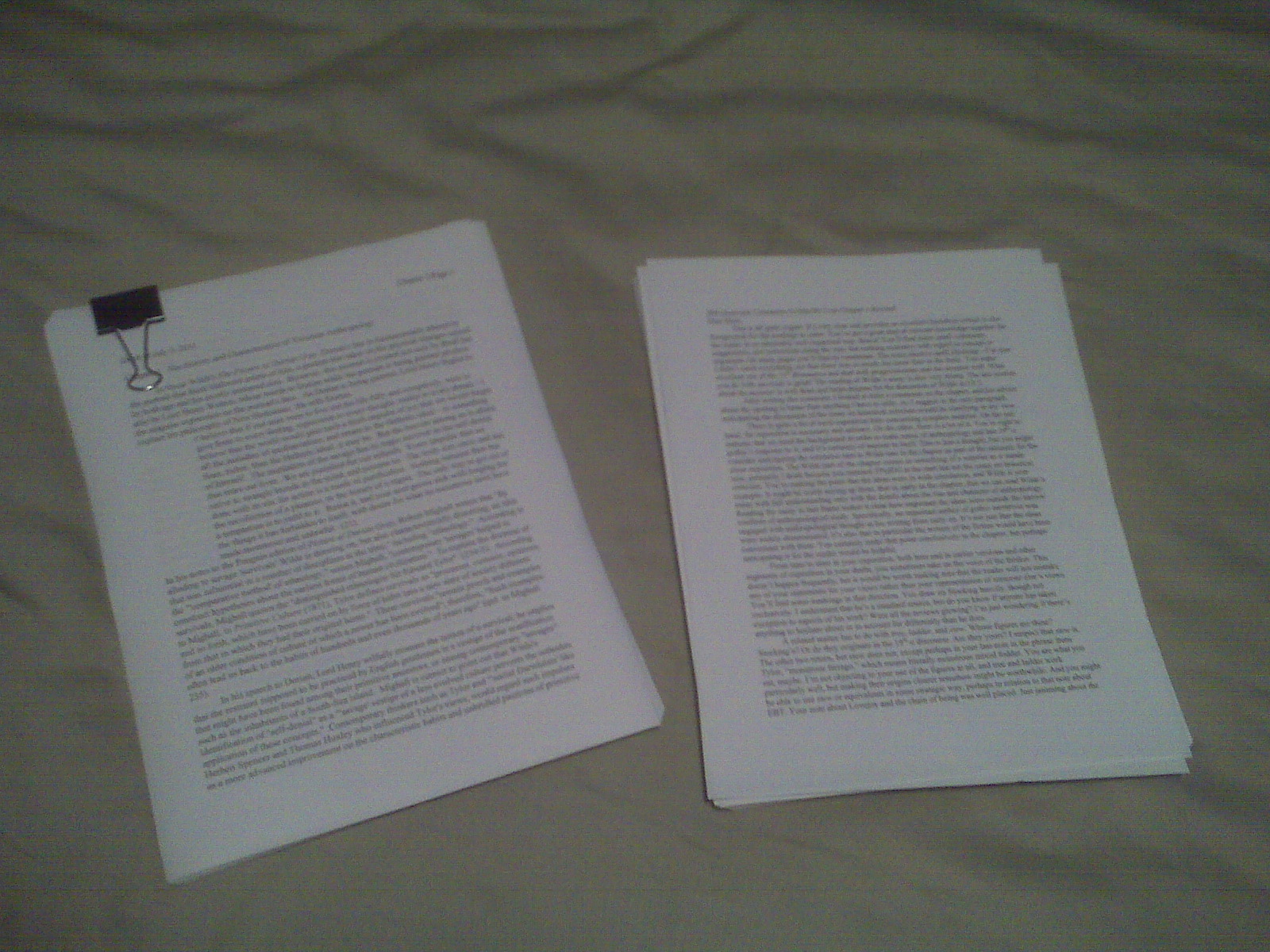
This is Chapter 1 and the comments I need to incorporate, on my coverlet.

These are Chapters 2 and 3 with comments, on my desk. And the binder in which I keep all the chapters.

This is a sticky note I put above my other desk, the one with the laptop on it. It says “Don’t Panic.” Anther valuable lesson learned from The Hitchhiker’s Guide to the Galaxy.

So, just in case you were thinking of asking me to do something that’s due within the next two months: don’t. I won’t be able to do it. I’m going to be working on my dissertation, otherwise known as battling the Persians. And I hope that I’m not going to perish, like poor Leonidas. But you know what Spartan mothers tell their sons: come back with your shield or on it. And that’s what I’m planning to do.

By the way, here is Leonidas at Thermopylae, by Jacques-Louis David. At my dissertation defense, I’m planning on wearing clothes.

And here is that poem I like so much, just because I think everyone should read it.

The Oracles
by A.E. Houseman

‘Tis mute, the word they went to hear on high Dodona mountain
When winds were in the oakenshaws and all the cauldrons tolled,
And mute’s the midland navel-stone beside the singing fountain,
And echoes list to silence now where gods told lies of old.

I took my question to the shrine that has not ceased from speaking,
The heart within, that tells the truth and tells it twice as plain;
And from the cave of oracles I heard the priestess shrieking
That she and I should surely die and never live again.

Oh priestess, what you cry is clear, and sound good sense I think it;
But let the screaming echoes rest, and froth your mouth no more.
‘Tis true there’s better boose than brine, but he that drowns must drink it;
And oh, my lass, the news is news that men have heard before.

The King with half the East at heel is marched from lands of morning;
Their fighters drink the rivers up, their shafts benight the air,
And he that stands will die for nought, and home there’s no returning.
The Spartans on the sea-wet rock sat down and combed their hair.

Posted in Uncategorized | 4 Comments

Hemingway Was Right

So, The New York Times is good for something after all.

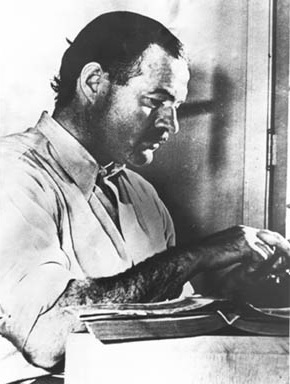
This morning I read an op-ed piece by A.E. Hotchner called “Hemingway, Hounded by the Feds.” Hotchner was Hemingway’s friend for more than a decade. He adapted many of Hemingway’s stories and novels for television and film, and they traveled all over the world together. He’s written several books about Hemingway.

The piece begins,

“Early one morning, 50 years ago today, while his wife, Mary, slept upstairs, Ernest Hemingway went into the vestibule of his Ketchum, Idaho, house, selected his favorite shotgun from the rack, inserted shells into its chambers and ended his life.”

Hotchner writes about the last year of Hemingway’s life, when he fell into depression and paranoia. He describes a particular trip to see Hemingway in Idaho. Hemingway had been through a difficult time, particularly editing an article on bullfighting for Life Magazine. Hotchner had helped him with it, assuming he was only tired and would be his old self again soon.

“In November I went out West for our annual pheasant shoot and realized how wrong I was. When Ernest and our friend Duke MacMullen met my train at Shoshone, Idaho, for the drive to Ketchum, we did not stop at the bar opposite the station as we usually did because Ernest was anxious to get on the road. I asked why the hurry.

‘The feds.’

‘What?’

‘They tailed us all the way. Ask Duke.’

‘Well . . . there was a car back of us out of Hailey.’

‘Why are F.B.I. agents pursuing you?’ I asked.

‘It’s the worst hell. The goddamnedest hell. They’ve bugged everything. That’s why we’re using Duke’s car. Mine’s bugged. Everything’s bugged. Can’t use the phone. Mail intercepted.'”

Sounds like mental illness, doesn’t it? That’s certainly what everyone assumed. Hemingway may have assumed it himself. He was eventually admitted to a psychiatric hospital.

“On Nov. 30 he was registered under an assumed name in the psychiatric section of St. Mary’s Hospital in Rochester, Minn., where, during December, he was given 11 electric shock treatments.

In January he called me from outside his room. He sounded in control, but his voice held a heartiness that didn’t belong there and his delusions had not changed or diminished. His room was bugged, and the phone was tapped. He suspected that one of the interns was a fed.”

Hemingway repeatedly tried to commit suicide. Eventually, he succeeded. Hotchner mourns what happened to his friend.

“This man, who had stood his ground against charging water buffaloes, who had flown missions over Germany, who had refused to accept the prevailing style of writing but, enduring rejection and poverty, had insisted on writing in his own unique way, this man, my deepest friend, was afraid — afraid that the F.B.I. was after him, that his body was disintegrating, that his friends had turned on him, that living was no longer an option.”

It’s a terrible story, a terribly sad story. But you have to get to the end of the article. It goes like this.

“Decades later, in response to a Freedom of Information petition, the F.B.I. released its Hemingway file. It revealed that beginning in the 1940s J. Edgar Hoover had placed Ernest under surveillance because he was suspicious of Ernest’s activities in Cuba. Over the following years, agents filed reports on him and tapped his phones. The surveillance continued all through his confinement at St. Mary’s Hospital. It is likely that the phone outside his room was tapped after all.

In the years since, I have tried to reconcile Ernest’s fear of the F.B.I., which I regretfully misjudged, with the reality of the F.B.I. file. I now believe he truly sensed the surveillance, and that it substantially contributed to his anguish and his suicide.”

You see, it’s not a sad story anymore. It’s a story about a man who saw the reality of his life and the world around him more clearly than anyone else. A man who knew. It’s a story that makes me angry.

And it makes me think the following. If you’re a writer and you think what you’re doing is not that important, remember that all totalitarian societies attempt to control their writers. I know this first-hand, remember. I was born in a society were books were censored, where letters were intercepted and read, where the government listened to telephone calls. Where citizens were under constant surveillance. I understand why, living in this society, you might think writing is not that important. Why it doesn’t much matter what you do. But writing is not a game, not a hobby, not a job, not even a career. It’s a calling. Next time you’re absorbed in whether or not writers should self-publish, or the future of the publishing industry, or any of the questions that seem to get so much attention, think about what it is we’re doing, as writers. Telling the truth, as we see it. Telling the world what it is, what it could become, what it should be. That’s what we are called to do.

And J. Edgar Hoover, I wish I believed in Hell so I could tell you to rot in it.

Requiescat in pace, Ernest.

Posted in Uncategorized | 10 Comments

Reading Narnia

Hello, July. You snuck up on me. I woke up this morning thinking it was still June, but it wasn’t.

I had gone to sleep at around 4:00 a.m. after finishing my Folkroots column. Then I had woken up early to read it one more time before sending it off. Once I sent it off, I went back to sleep and woke up in the afternoon. Tired, but feeling relieved. June was difficult, and I had so many deadlines, but I made them, at least the ones I had to make. And now it’s July and I have a month ahead of me in which all I need to do is work on the dissertation. Honestly, it’s sort of a relief.

The Folkroots column I just turned in is the one on Narnia, and I know some of you have been waiting for that one. I think it’s good – I certainly enjoyed writing it. I had to read all the Narnia books again, and I read Peter Schakel’s The Way Into Narnia: A Reader’s Guide and Laura Miller’s The Magician’s Book: A Skeptic’s Adventures in Narnia. I’m actually still reading Miller’s book. When you’re writing a column, you end up skimming so much, and now I’m going back and reading it in a more leisurely way. It’s making me think a lot about my own writing, because it’s the sort of thing I like reading about literature: both scholarly and intensely personal. And you see, that’s not a way I’m necessarily allowed to write as an actual scholar, an academic. But it’s a way I like writing very much. It makes me think about what I’m going to do with my academic credentials, other than teach. Because I want to write books, but I also want to write about books. I’m just not sure how. Academicese doesn’t come that easily to me. But these Folkroots columns I’m doing – oh, how I love doing them! It’s a great pleasure to write about scholarly subjects – or to treat fantasy as a scholarly subject – in a way that any reader can understand. Not in academicese.

One thing I realized as I was writing this particular column is that the Narnia books still have tremendous power for me. Even when I was skimming, I was tearing up – when Fledge gets his wings in The Magician’s Nephew, for example. Or when the Bridge of Beruna comes down in Prince Caspian. And I still hated reading The Last Battle. It makes me so angry that Lewis created Narnia and then destroyed it. And replaced it with Aslan’s country. Who wants to go to Aslan’s country? Not me, I can tell you. I want Narnia, with all its adventures and perils. There are no adventures in Aslan’s country.

I thought about what gave Narnia this particular power, because when I read The Hobbit, it didn’t have the same magic for me. I loved it, but I didn’t want to go to Middle Earth, particularly.

I think it was in part that Lewis made me a pantheist. Narnia was so alive, with its satyrs, dryads and hamadryads, centaurs, dwarves. The land itself was alive, in a way Middle Earth wasn’t. It was a fairy tale, whereas The Hobbit was a prose epic. It fulfilled all my wishes: in Narnia, you could become a king or queen, you could dance with the trees themselves, you could talk to the animals and they would talk back. I wanted my own world to be that way. Lewis taught me a certain set of values, which weren’t necessarily the values he meant to teach. They had to do with our relationship to the natural world, with valuing each tree, each stream. With believing in magic.

He also made me believe in a certain type of prose. Reading the books again, I realized how well they are written, now clean they are, how quickly they move. It’s a sort of prose I associate with the first half of the twentieth century. I see it in George Orwell, in Dorothy Sayers, in E.M. Forster. I know, completely different writers, but there’s something about their prose – they are working from similar principles. I wish I knew exactly what it was, but it’s a clarity, a facility with sentences. Sayers is much more of a craftsman than Forster, obviously. Forster is the artist. But still, there’s something. And it’s something I don’t often hear in prose nowadays. Modern prose often strikes me as muddy. When I do hear that clear, fluid prose, I always feel a sort of gratitude.

I was thinking of Narnian values today in particular, because this morning I read two stories in The New York Times. The first was actually a series of short opinion pieces called “Why Did Wild Nail Polish Go Mainstream?” The writers were opining on that question. Now, you and I may have different opinions on nail polish. (I don’t understand why anyone would use the stuff, except as a subversive statement. Like, men painting their toenails pink. Have you ever seen what happens to nails under it?) But why in the world is The New York Times hosting a debate about it? Surely there are actual events happening in the world. The second was a story on the names that paint companies choose for their colors: “We Call It Brown. They Call It ‘Weekend in the Country.'” Did you know that Benjamin Moore offers 3,300 paint colors? And that’s just one company. What sort of society needs 3,300 paint colors? So there I was, having just finished my Folkroots column, having just read about battling giants and riding on the backs of centaurs. About the dangers of the desert, the beauty of the forest, the sea of lilies at the end of the world. About Reepicheep and Puddleglum. And suddenly I was confronted with the information that I live in a society in which there are at least 3,300 different paint colors. In which women painting their fingernails blue or green is news. And I thought, no one paints either rooms or their nails in Narnia. And then I thought, we’re doomed.

So here I am in July, and it’s going to be another busy month, but hopefully not quite so busy as June was. And I’m thinking of the blog post I wrote on alternative values, and thinking, they’re Narnian values, and Middle Earth values, and the values of the magical, fantastical lands I love. And I’m going to live by them, even when they make absolutely no sense in this society, which in turn makes so little sense to me. As Puddleglum says to the Lady of the Green Kirtle,

“All you’ve been saying is quite right, I shouldn’t wonder. I’m a chap who always liked to know the worst and then put the best face I can on it. So I won’t deny any of what you said. But there’s one thing more to be said, even so. Suppose we have only dreamed, or made up, all those things – trees and grass and sun and moon and stars and Aslan himself. Suppose we have. Then all I can say is that, in that case, the made-up things seem a good deal more important than the real ones. Suppose this black pit of a kingdom of yours is the only world. Well, it strikes me as a pretty poor one. And that’s a funny thing, when you come to think of it. We’re just babies making up a game, if you’re right. But four babies playing a game can make a play-world which licks your real world hollow. That’s why I’m going to stand by the play world. I’m on Aslan’s side even if there isn’t any Aslan to lead it. I’m going to live as like a Narnian as I can even if there isn’t any Narnia.”

I do love Puddleglum.

Posted in Uncategorized | 12 Comments