What the Fox Said

The hardest thing about this period has been losing contact with friends.

Today a friend of mine emailed to let me know how her novel was going (which was well, mostly). It was wonderful to hear from her. More than anything else, I hate losing touch with people, and I have recently.

That reminds me of what the fox says in Antoine de Saint-Exupéry’s The Little Prince. Do you remember the story? I first read it when I was a teenager, and then I read it again in French when I was studying for my language exam. (For the PhD, I had to show proficiency in two foreign languages. I chose French and Latin.)

The little prince has left his planet and the rose he cared for. He’s traveled to a number of other planets, and finally he comes to earth. While traveling on this planet, he finds a rose garden and realizes that his rose, the rose he treasured, is just a common, ordinary rose, like any other. He falls down weeping. And that’s when he meets the fox.

He asks the fox to come play with him. “I cannot play with you,” the fox replies. “I am not tamed.” The little prince asks what he means by the word “tamed.”

“It is an act too often neglected,” said the fox. “It means to establish ties.”

“To establish ties?”

“Just that,” said the fox. “To me, you are still nothing more than a little boy who is just like a hundred thousand other little boys. And I have no need of you. And you, on your part, have no need of me. To you, I am nothing more than a fox like a hundred thousand other foxes. But if you tame me, then we shall need each other. To me, you will be unique in all the world. To you, I shall be unique in all the world . . .”

The fox asks the little prince to tame him, and the little prince says that he doesn’t have time, he needs to discover things, find friends. But the fox tells him, “One only understands the things that one tames.” He says, “Men have no more time to understand anything. They buy things all ready made at the shops. But there is no shop anywhere where one can buy friendship, and so men have no friends anymore. If you want a friend, tame me . . .”

The little prince asks him how, and the fox explains that they should meet in that meadow every day and sit close to one another, a little closer every day. So the next day, the little prince comes back.

“It would have been better to come back at the same hour,” said the fox. “If, for example, you came at four o’clock in the afternoon, then at three o’clock I shall begin to be happy. I shall feel happier and happier as the hour advances. At four o’clock, I shall already be worrying and jumping about. I shall show you how happy I am! But if you come at just any time, I shall never know at what hour my heart is to be ready to greet you . . . One must observe the proper rites . . .”

So the little prince tames the fox. When it’s time for the little prince to leave, the fox is sad, and the little prince says, “Then it has done you no good at all!” But the fox says that it has done him good. “Go and look again at the roses,” he tells the little prince. “You will understand now that yours is unique in all the world.”

The little prince does go back to the roses, and tells them, “You are not at all like my rose. As yet you are nothing. No one has tamed you, and you have tamed no one. You are like my fox when I first knew him. He was only a fox like a hundred thousand other foxes. But I have made him my friend, and now he is unique in all the world.” And he remembers the rose back on his planet. “To be sure, an ordinary passerby would think that my rose looked just like you – the rose that belongs to me.” But, he tells them, she is more important than any other rose because of the care he has taken of her, because of their companionship. Because “she is my rose.” That has made her unique.

He goes back to the fox, who makes him a present of a secret: “It is only with the heart that one can see rightly; what is essential is invisible to the eye.”

I think that’s my favorite description of friendship. It’s something that needs to be cultivated, that takes time. And I haven’t had much time lately, have I? More than anything else, I hate losing contact. And so it’s time to start working on my own roses, my own foxes. (To actually return emails about how people’s novels are going, for example.)

Because it is only with the heart that one can see rightly, and what is essential (like friendship) is invisible . . .

(Rosa gallica regalis, by Pierre Joseph Redouté. This is very much how the little prince’s rose is described. Multi-petalled, heavily scented, with thorns.)

Posted in Uncategorized | 1 Comment

Thinking about Muses

One of the most difficult things about this period is that I’m not writing.

I know, I was supposed to update you on how the novel was progressing, and I haven’t. I almost don’t want to talk about it right now, because I’m so uncertain about where it’s going, whether that’s the right place for it to go. But I also haven’t even looked at it for a while. I think Ray Bradbury is right, there’s a way in which I get sick when I’m not writing. It’s as though the world is too much with me. Late and soon, getting and spending, I lay waste my powers, and there I am, longing for Triton with his wreathed horn. Or something like that. (Wordsworth, she said, pretending to cough at the same time. Just in case you weren’t sure.)

But what can I do? There’s so much else to get done, and writing will have to wait for now. I’ll just try as hard as I can to stay healthy.

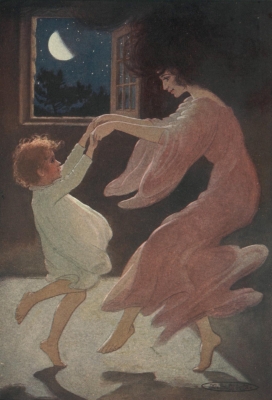
I was thinking about muses, and of course my muse looks very different from Stephen King’s (remember, the guy smoking a cigar, with his feet up on the desk). As I mentioned, mine looks like North Wind from George MacDonald’s At the Back of the North Wind. Something like this:

She has long black hair that flies everywhere, and she soars through the sky. Like a sort of bird, borne up by the winds. I feel as though she helps me soar too. Morgan, in some of my stories, is modeled partly on her, and partly of course on Morgan le Fay.

Have I ever mentioned that MacDonald’s books were some of my favorites, when I was a child? I especially loved The Princess and the Goblins and The Princess and Curdie. There are images in both that stay with me. The Princess Irene’s great-great-grandmother with her long white hair and flock of pigeons. The goblins with their hard heads and delicate feet. The ring Irene is given, which will always lead her back to her great-great-grandmother’s tower. Curdie’s magical ability to tell, from shaking a man’s hand, whether it really is a hand, or some sort or hoof or paw (if the man is really a beast inside).

But my point is that I feel as though I do have a muse of sorts. I can imagine her, I can almost hear her speaking. And I’ve never believed that a story comes completely out of my conscious mind, that it conveys only what I intend it to convey. That’s not my experience of writing. For me, it’s almost as though writing is listening. I have to hear what something – whether another part of myself or something outside myself – is telling me. When I don’t listen, I find that I don’t write as well. And then, whatever I hear, I have to shape: that’s my role, I’m the shaper. Perhaps that’s why all the rules I was taught about writing are useful only to a limited extent. If you listen to the rules, you’re going to ruin the story. You have to listen to the story itself. It will tell you its own internal rules.

I know, all of this sounds so nebulous. I realize that. What I’m trying to do is describe the sense I have of a muse, a something that inspires me and speaks to me. Part of my problem with the novel, I think, is that I’m trying to write a more conventional novel than my own instincts are telling me to write. I think I’m at the point where I have to reevaluate. Is that always the case – that when we’re stuck, it’s a message to us (from our muse, perhaps), telling us that we need to stop, think again? That something is not right?

Perhaps one thing I’m trying to say here is that writing consists not just of speaking, but also of listening. To something beyond ourselves – or someone, who at least in my case has long black hair. I’d like to curl up in it, as Diamond does in the book, and be carried through the night, over the cities. No, she’s definitely not King’s muse. But I need to get back to her, stop putting her on hold, get back to writing again. Soon, soon.

Posted in Uncategorized | Leave a comment

Going to Innisfree

I’m having flashbacks to the New York State bar exam. I know that’s ridiculous, for two reasons: first, a dissertation defense is nothing like a bar exam. It doesn’t even involve snakes. Second, I didn’t actually stress out all that much about either of the bar exams I took, New York and Massachusetts. In a way, the dissertation defense will be more stressful, because although it will be half the length (only three hours), they will be three hours of speaking in front of people I know and respect. The process will be more active than sitting and filling in bubbles (which I’d gotten very good at, by that point in my career).

Tonight, I’m going to make a list of the books I want to look over again before the defense. Tomorrow, I’ll go to the library. I’m not sure it’s a matter of being prepared, because I think I am prepared. I just need to make sure I feel prepared.

In the meantime, I’m going to deal with the stress as best I can. Which involves creating sanctuaries of various sorts. (I’m glad I came up with that concept. It’s coming in so handy just now.)

So here is a sanctuary:

I will arise and go now, and go to Innisfree,
And a small cabin build there, of clay and wattles made;
Nine bean rows will I have there, a hive for the honeybee,
And live alone in the bee-loud glade.

And I shall have some peace there, for peace comes dropping slow,
Dropping from the veils of the morning to where the cricket sings;
There midnight’s all a-glimmer, and noon a purple glow,
And evening full of the linnet’s wings.

I will arise and go now, for always night and day
I hear lake water lapping with low sounds by the shore;
While I stand on the roadway, or on the pavements gray,
I hear it in the deep heart’s core.

That’s W.B. Yeats, of course: “The Lake Isle of Innisfree.” When I was a child, I used to fantasize about going away somewhere, a magical valley or island. There I would have a cottage, a garden, a hive for the honey bee. (Well, actually I think there were magical trees from which I could gather food, sort of like in the Oz books. After all, I could gather food from the magical refrigerator . . .) Would I actually want bees? Sometimes I think about having chickens, like my friend Cat Valente, and gathering eggs. But I don’t know how well chickens would go with the writing life that is, fundamentally, at the heart of all the plans I have for the future: a life in which I can spent a lot of time dreaming and writing, and doing all the things that go with writing. Like traveling to conventions. I’m not sure how well bees and chickens fit with that, no matter how romantically bucolic they sound! But I will have the garden, and the cat on the windowsill. Those are non-negotiable.  (And honestly, although as a child I fantasized about being completely alone – I was such an introvert – now I would want a place where friends could gather, writers and artists sharing their work, connecting with each other.)

Here is Yeats, as an old man, reading his poem:

What I would also like to do, one day, is go to Ireland, where I’ve never been. Better yet, go to the British Isles and spend a few weeks wandering around, going to Devon where friends like Terri Windling live. And going to all sorts of other places, seeing Wales and Cornwall and Scotland.  And of course going to Ireland as well.  I even have a practical reason, because for a long time now I’ve had an idea for a children’s book that takes place in an alternative version of the British Isles. It is, in a way, my response to the Narnia books, as Phillip Pullman’s Dark Materials series is a response to the Narnia books. But a very different response. So, you know, it would be research.

Can you tell how tired I am? I’m rambling terribly. I think that in a way I still haven’t recovered from completing the dissertation. I’m not sure I will recover completely until after the defense. That’s why I need those sanctuaries: the dance classes, the music, the poems. They, and the knowledge that this process will eventually end, keep me going.

In the meantime, I’m going to dance, and listen to music, and read poetry – and of course try to get some sleep, because I don’t do enough of that either. And I’m going to dream of Innisfree, with those nine bean rows, and maybe some honey bees, and maybe some chickens. But definitely a desk and computer, and time to write.  And friends around me.

Posted in Uncategorized | 1 Comment

Getting Organized

This morning I woke up, terribly worried about how things are going to go between now and the end of October (you know, the defense and all). When I’m worried, there’s really only one thing I can do, which is organize. So I organized.

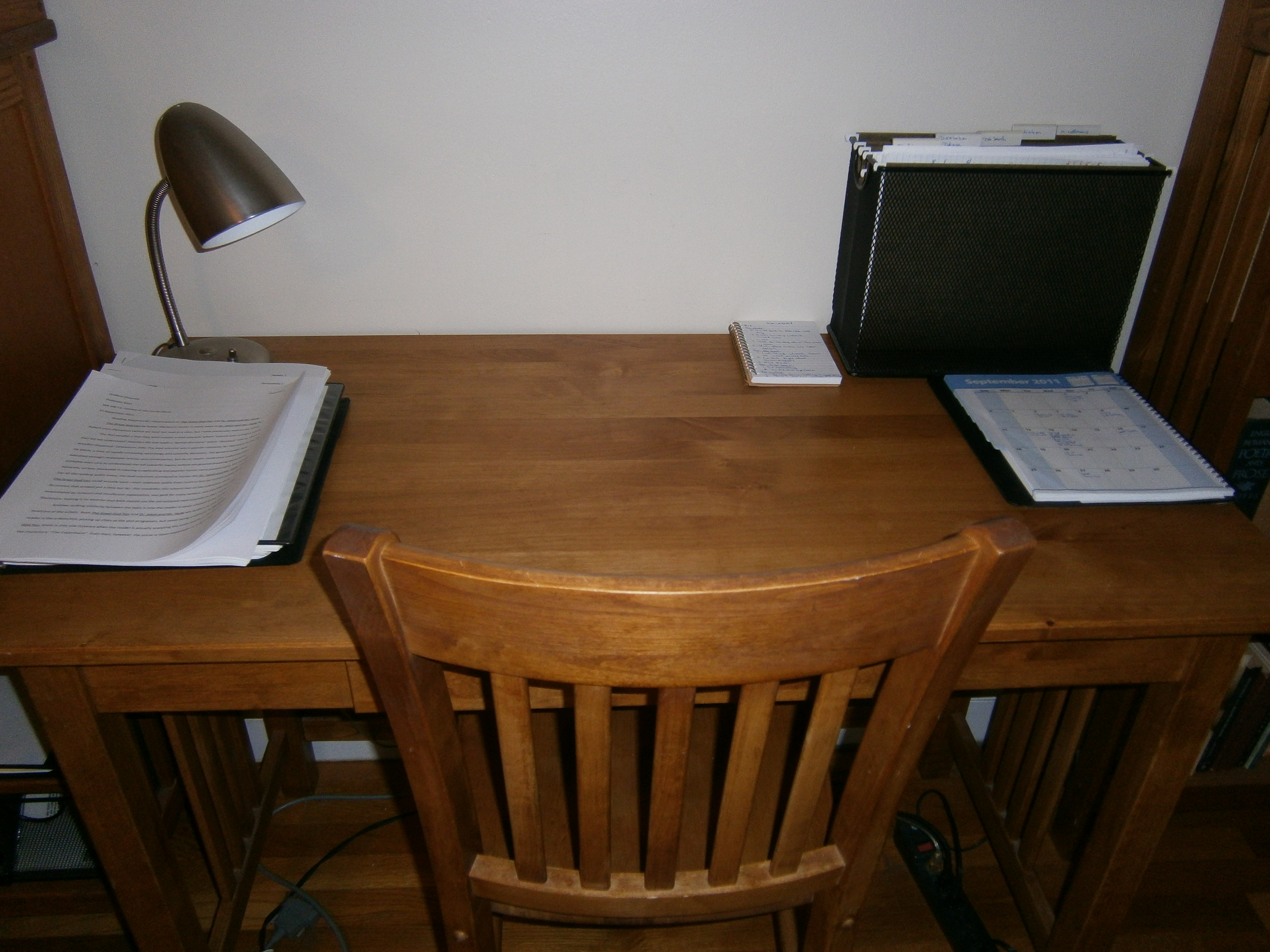
This is what my desk looks like now:

Those files are labeled with all the things I need to do in the next month and a half: teach, defend the dissertation, etc.  Then I have my calender, my to-do list, and some papers I need to mark on top of my teaching binder.  Notice what’s no longer there: the dissertation chapters!  Those are now all together, in a large binder on the shelf.

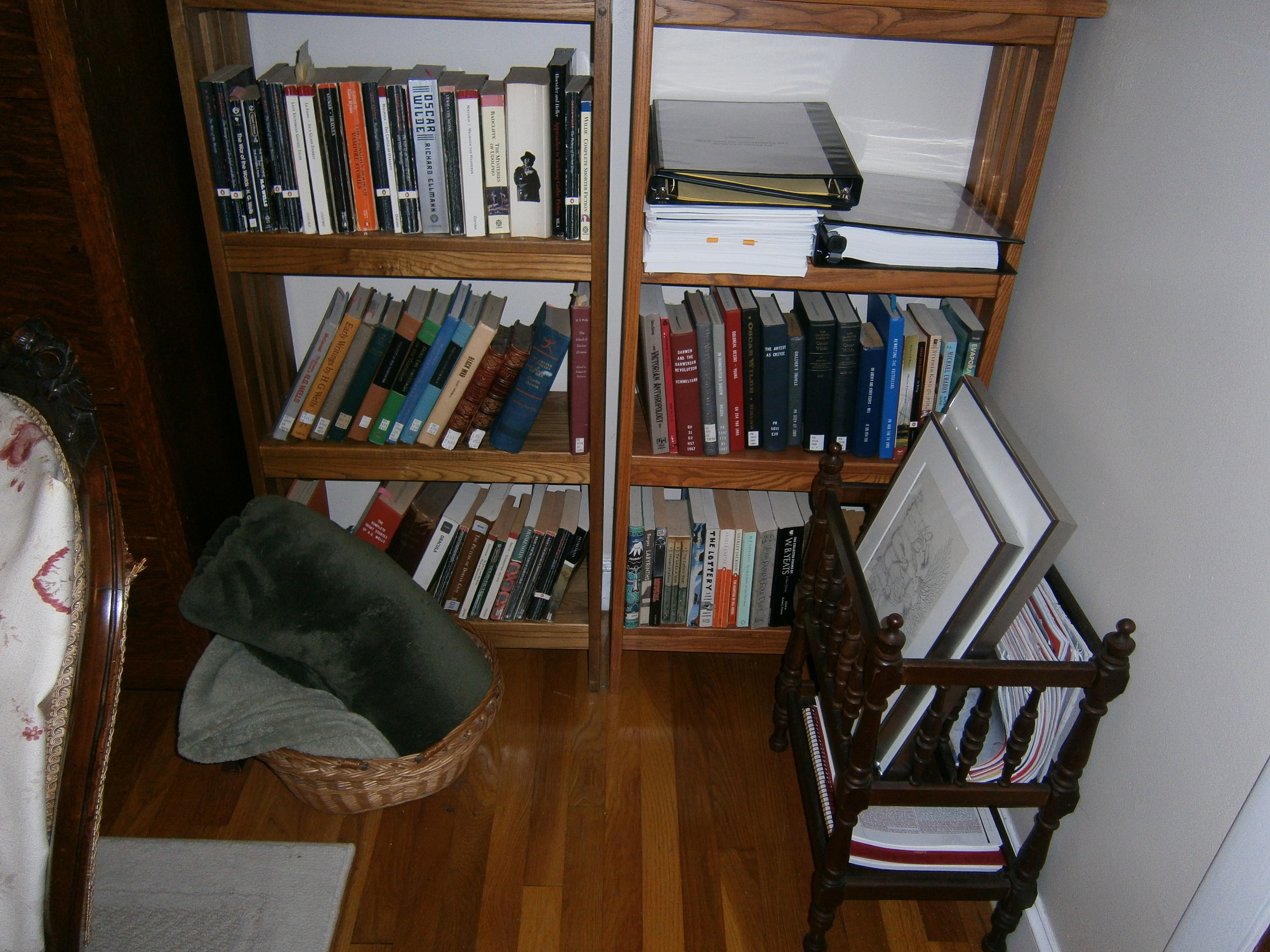
And here is my other desk, with the computer on it.  Some things on the right that I still need to sort through, but otherwise it’s bare.  Ready for typing.

Oh, there it is, the dissertation binder.  It’s the large one on the top right shelf, to the right.  At least it was there this morning, when I took these pictures.  Now it’s by my bed, ready to go through so I can prepare for the defense.  (The magazine rack to the right is holding my Locus magazines, one of my writing notebooks, and some pictures that I may never get around to hanging up.)

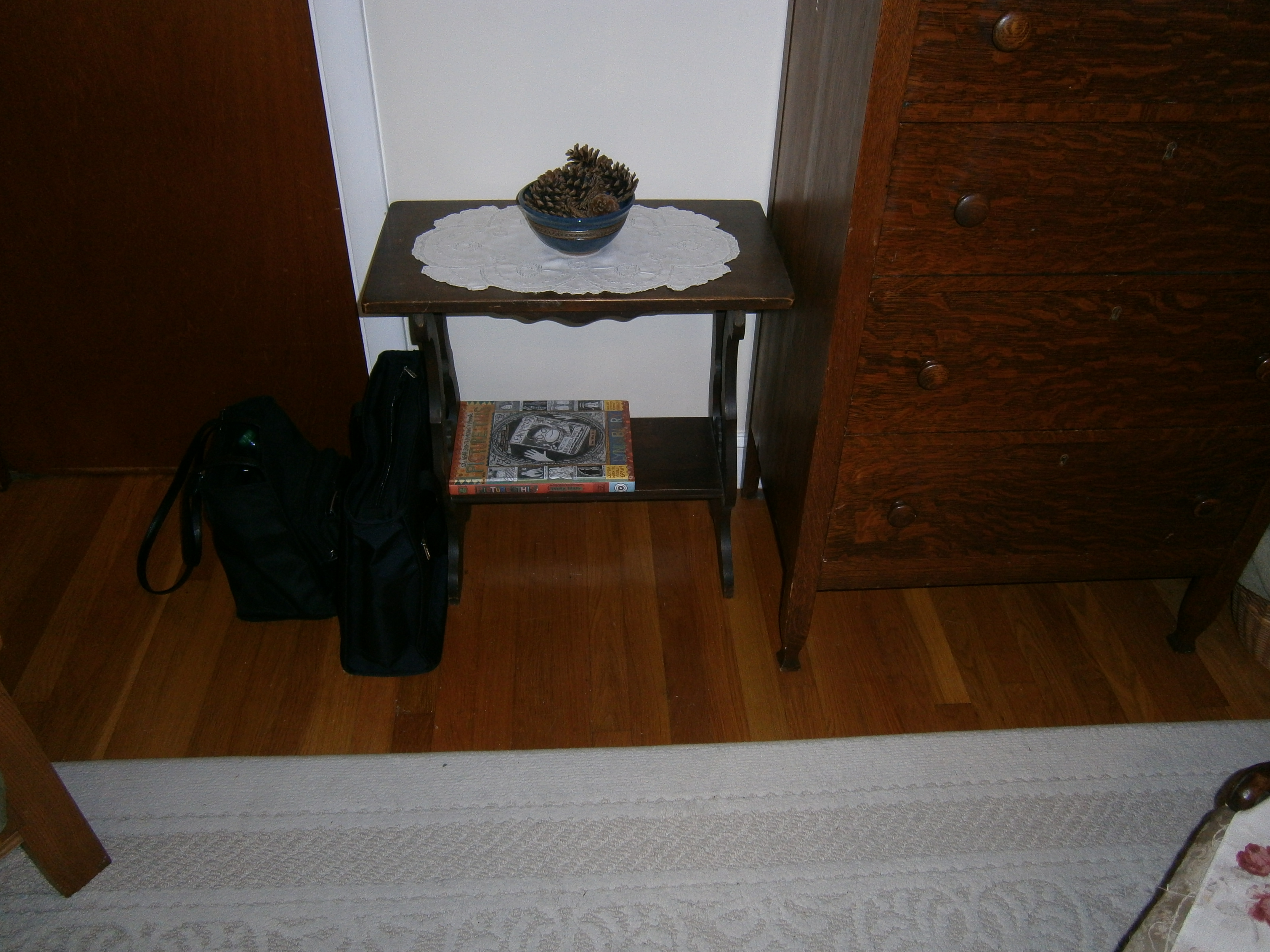
When I go to the university, I sling these two black bags over my shoulder.  But notice how neat everything looks.  Do you see what’s missing?  No piles!  No books or manuscripts piled up on the floor!  Oh, there are still manuscripts piled on top of some shelves, but those are stories and essays that need to be sorted, and I probably won’t get to them for a while.  Not until after the end of October.

Predictably, my printer broke just before I had to turn in my dissertation, so I brought up the downstairs printer, which works better anyway.  I put it on a rather nice shelf I found in one of my favorite antiques stores (for $28, I think).  So you know, my room isn’t exactly neat yet.  It won’t get there until after the dissertation is defended and I can really organize.  (This is temporary organization, just to get me through to the end of next month.)  But it will do for now.

Once the room was organized, I felt as though I could breathe a little more easily. And then I started working.

All the work I need to do has been so stressful lately that I’m consciously holding on to certain things. Dance is one of them, and I’m endlessly grateful that I’ve gone back to ballet just now. Music is another, so I’ll give you my new favorite song by Mumford and Sons, “White Blank Page”:

I love great lines, and this song has two of them:

“But tell me now where was my fault, in loving you with my whole heart?”

“Lead me to the truth and I will follow you with my whole life.”

The way they’re sung in the video, they’re romantic but in a way that is also raw and powerful.  And I love the half-rhymes: fault/heart, I/life.  (You’d expect the second line to end “until I die,” but it doesn’t. That’s what makes it interesting.  How do you follow someone with your whole life, exactly?  It sounds like a choice, something intentional.  As though you’re consciously taking your whole life, putting it in a basket or backpack, and following – like in a fairy tale.)

And going into the woods, to the extent there are woods here, walking around under the trees, sitting on the rocks. Those are the sorts of things that get me through. Also, a story by Isaak Dinesen that I remember reading, about a prince who, when he becomes king, is given a ring with an inscription on the inside. He is told to read it in good times and in bad. The inscription reads, “This too shall pass.”  (And it will, because dissertation defenses do.  As do difficult months filled with way too much work.)

Posted in Uncategorized | Leave a comment

Getting Back to Work

This morning, I felt restless, so it’s good that I had a ballet class. It was a combination Beginner/Elementary class, except that it wasn’t. It was really an Elementary class in which the teacher showed more of the moves. (As opposed to just marking them for you.) It was perfect: difficult because I no longer have the strength and flexibility I used to have, but I remembered all of the vocabulary. My body remembered how to move, what a développé or a grand battement felt like.

(My pirouettes? Terrible. But I can still jump.)

I’m feeling it now, the fact that my muscles did unaccustomed things this morning. But I think I’m going to get used to taking classes fairly quickly. In some ways, I’m in better shape than the last time I took ballet.

One of the nicest things about the ballet class is the live accompaniment. The teacher tells us how she wants us to move, and the piano player starts playing whatever is appropriate, a waltz or polonaise. Once you’ve had a class with an actual piano player, it’s difficult to imagine dancing to music that is recorded, rather than produced on the spot so the teacher can change the tempo in the middle.

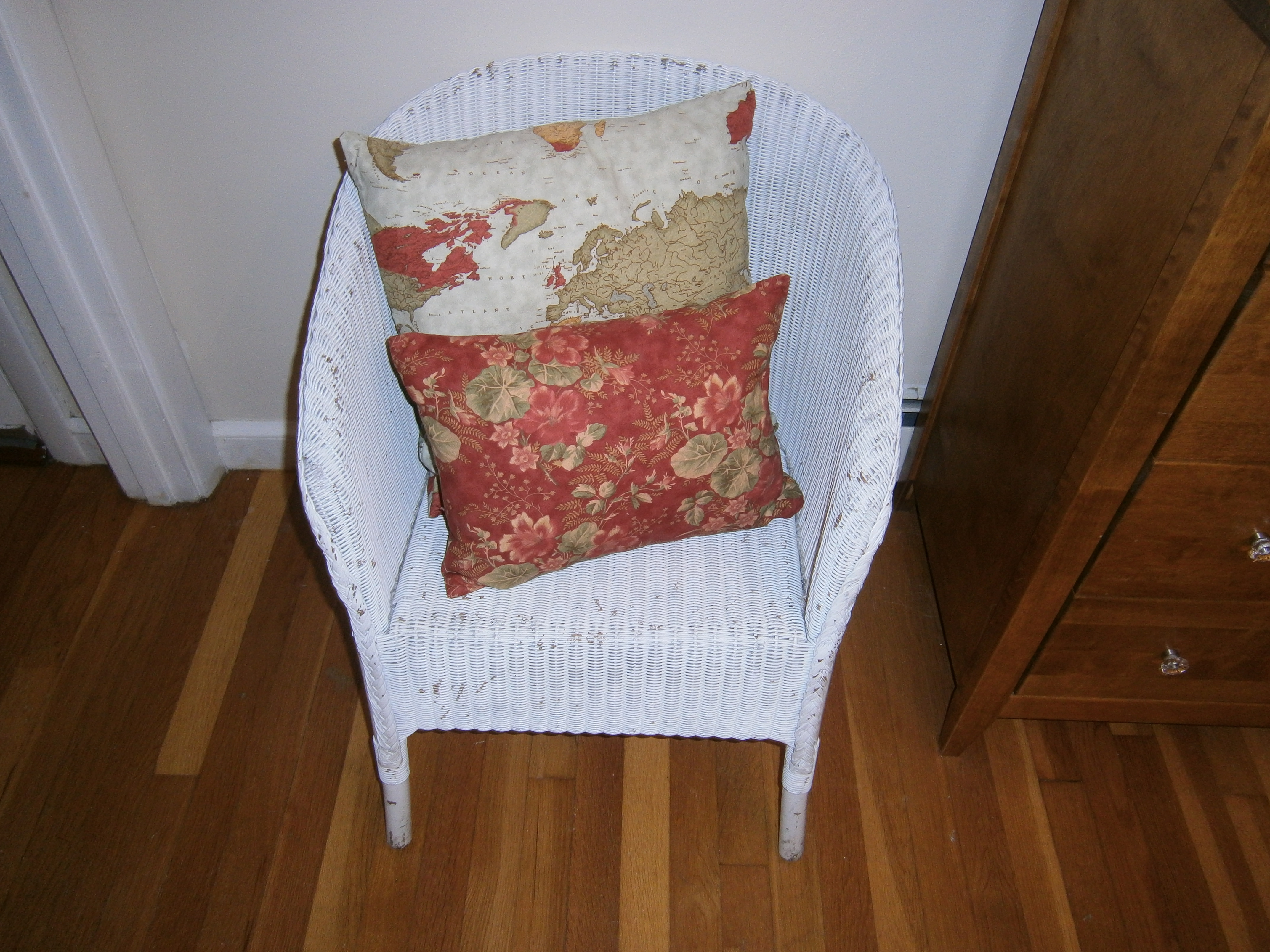
So I had a productive morning, and then, still feeling restless, I went to Concord and wandered around the antiques shops. I bought a wicker chair. It needs a little cleaning, then some paint. After that, it will belong to Ophelia. Here it is, with some pillows I sewed for her, ages ago:

And then I went to Helen’s and had a slice of apple pie with maple walnut ice cream.

I’m still feeling restless, even as I write this, but it’s time to get back to work. I have so much to do before the end of October. Most importantly: defending my dissertation. So today I’m going to sit down and strategize about how to study for the defense. I think I’m going to start by reading some books my first reader recommended, and then go through the dissertation, looking at the most important sources again. And thinking about what sorts of questions I might be asked, which will almost certainly have to do with the greater significance of the project. (Professors being who they are, you know.) I have a nice fresh notebook to makes notes in.

And then there are all sorts of other things to work on. I tried to remember when I had handed in the dissertation, and couldn’t. It feels as though it happened ages ago. And yet I think it was only last week. Somehow, I don’t think my sense of time is going to go back to normal until it’s all over. November is going to be such a relief.

So, I’m going back to work, to do all the things I need to get done. But before I do, I’m going to leave you with a short clip from one of my favorite ballets, Matthew Bourne’s Swan Lake. This is how to make ballet beautiful and frightening and relevant.

Posted in Uncategorized | 1 Comment

The Ballet Class

I wanted to take a ballet class on Tuesday, but it didn’t fit into the schedule, and I thought I would need to wait until Saturday. But I actually got some time tonight to go off for a couple of hours, to the Boston Ballet School studio in Newton. And I took the first ballet class I’ve taken since – well, certainly since Ophelia was born.

Because I had not taken a ballet class in so long, I took the Beginners class. Which was not a mistake, really. I mean, you always learn a lot by going back to the beginning. I was able to work on placement, on how I was standing, the positions of my arms and legs. The teacher explained all the moves, how they were supposed to both look and feel, and it’s been a long time since I’ve gotten those sorts of explanations, so it was a good reminder.

But the class was too slow for me. And less than a half hour of floor work, with no jumping. The jumping was always my favorite part of class. And I like to move fast, to be challenged. So this weekend I’m going to a Beginners/Elementary class, which will transition me to the Elementary class next week. And we’ll see how that goes. I suspect it will be my level for a while, since I’m just starting again.

I wonder if I’ll ache tomorrow? I suspect not, because we didn’t do a lot of the things I used to.  Still, the class made me realize how tight my muscles have gotten. The thing about ballet is, it’s the most difficult and athletic of the dance forms. There are no loose, resting sorts of positions. You have to move so that everything looks easy, but in every move, all of your muscles are engaged. So tonight I’m feeling the small of my back, the muscles under my feet. But it was lovely to be there – I felt, for the first time in a long time, fully physically alive. As though my whole body were engaged.

And another thing about ballet: it’s all about the patterns. So in class the teacher tells you what the patterns are, which moves you’re doing in what order, and you have to remember them. Often a long string of them, after being told once. I used to be able to do that, but my brain is out of the habit. It’s as though I’ve lost a muscle memory. But I think after a few more classes, it will start coming back.

I’ve posted pictures of Dissertation Dora, so today I thought I would post one of Ballet Dora. She doesn’t look quite as bedraggled, does she?

And this is just for fun, a video of what looks like a class of professional dancers doing part of George Balanchine’s Serenade. I actually think it’s more fun to see it this way than in a staged performance.

After the class, I pulled my jeans on over my leotard (dancewear: leotard, footless tights, ballet skirt and shoes), changed into sneakers, and drove back through the darkness, with nineteenth-century music blasting on the car radio. Feeling alive.

Posted in Uncategorized | 5 Comments

Thinking about Fairies

On my bookshelf, the one that stands by my computer desk, there is a copy of John Crowley’s Little, Big. It’s almost time to reread it. I heard, somewhere or other, about a couple that read it out loud every few years, and I thought, what a wonderful way to pass the time. Because Little, Big really is poetry. It just happens to be poetry in novel form.

I was thinking about fairies today, about what makes us so interested in them. I think they  represent the possibility of magic itself. Fairies don’t make magic, they are magic. They show us an alternative magical reality that we desire, but that also frightens us, because it’s both more beautiful and more dangerous than ours. We want to dance in the fairy hill (who wouldn’t dance in the fairy hill?), but it might mean losing a hundred years, all of our family and friends. Fairies give you everything and exact a terrible price. (They give you the gift of poetry, but you have to serve the Fairy Queen for seven years and then tell the truth, even to attractive women.)

I think that aspect of the fairies is captured in one of the iconic fairy poems: W.B. Yeats’ “The Stolen Child,” which I’ll include below. I’ll also include a musical version of it by The Waterboys. I listened to that version over and over again, when I was in college.

Here is Yeats’ poem:

Where dips the rocky highland
Of Sleuth Wood in the lake,
There lies a leafy island
Where flapping herons wake
The drowsy water rats;
There we’ve hid our faery vats,
Full of beriess
And of reddest stolen cherries.
Come away, O human child!
To the waters and the wild
With a faery, hand in hand.
For the world’s more full of weeping than you can understand.

Where the wave of moonlight glosses
The dim gray sands with light,
Far off by furthest Rosses
We foot it all the night,
Weaving olden dances,
Mingling hands and mingling glances
Till the moon has taken flight;
To and fro we leap
And chase the frothy bubbles,
While the world is full of troubles
And anxious in its sleep.
Come away, O human child!
To the waters and the wild
With a faery, hand in hand,
For the world’s more full of weeping than you can understand.

Where the wandering water gushes
From the hills above Glen-Car,
In pools among the rushes
That scarce could bathe a star,
We seek for slumbering trout
And whispering in their ears
Give them unquiet dreams;
Leaning softly out
From ferns that drop their tears
Over the young streams.
Come away, O human child!
To the waters and the wild
With a faery, hand in hand,
For the world’s more full of weeping than you can understand.

Away with us he’s going,
The solemn-eyed:
He’ll hear no more the lowing
Of the calves on the warm hillside
Or the kettle on the hob
Sing peace into his breast,
Or see the brown mice bob
Round and round the oatmeal chest.
For he comes, the human child,
To the waters and the wild
With a faery, hand in hand,
From a world more full of weeping than he can understand.

And here is the musical version:

Tonight I am very tired, and I’m still thinking of the concept of sanctuary.  Both Crowley’s novel and Yeats’ poem function in that way for me. They are sanctuaries, telling me that there is more to the world than I can understand: there are magical possibilities in it.

Posted in Uncategorized | 6 Comments