Solstice Night

Last night was the longest night of the year.

Today I’ve been sitting at my desk and working, working, working. Which is actually not all that good for me. I need to get out into the world, or at least take a break and read. And I haven’t been doing much of that. But the work needs to get done.

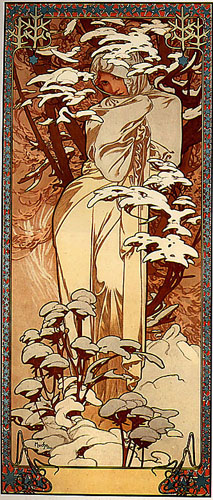
Today, on the Tor blog, there was a post called Picturing Winter: A Solstice Celebration. Tor asked fantasy artists to send their favorite images of winter, and it’s a wonderful collection. I’m going to include a few of my favorites here, but go and look at them all. Here you go, my favorites:

Last night was the longest night of the year, and I have a strange feeling, as though I’m stuck in a sort of trench, a dip in the year, a time when nothing much happens. Or at least when nothing much seems to be happening, but things are happening underneath, secretly, where I can’t see them. And I’ll see the results of them later, maybe not for months. It’s a strange feeling, and like all intuitions, I question it – I wonder if I’m simply making it up. But my intuition has generally led me right before.

I think the only thing to do, when you’re in a trench, a dip, a time when nothing seems to be happening, is wait. I think it’s the time of darkness, when nothing seems clear, when the way doesn’t seem to be there. And you just wait, and look at pictures of winter, and do the work you have to, and trust that somehow, somewhere, things are coming right.

Posted in Uncategorized | 4 Comments

Early Poetry

The new issue of Stone Telling has a very interesting article called “The Poetry of Joanna Russ, Part I: An Introduction,” by Brit Mandelo. It’s on the poetry that Joanna Russ wrote when she was young, just in college actually. It starts like this:

“Joanna Russ (1937-2011) is well-known for her incisive, transformative work in science fiction, feminist theory, and literary criticism—often, all three at once—but her early works, which include a considerable amount of poetry, are rarely discussed. While her first publication in the SF field was a short story, “Nor Custom Stale,” in The Magazine of Fantasy and Science Fiction in 1959, it was not her first magazine appearance by far: she had already been published several times as a poet, from the age of seventeen onwards, and much of that poetry was what we would now deem speculative in that it dealt with apparitions, fantasies, and myths.”

Joanna Russ wrote poetry: who knew? I certainly didn’t. But it makes sense. So many of us do start writing poetry, and so many of us give it up. The article speculates as to why she would have given it up, and then makes a case for paying attention to that early work. What it doesn’t do, and I wish it did, is reprint any of the poems. For that, I think we need to wait for Part II. Mandelo writes, “In the second installment of this study, I will discuss the actual poems that are the subject of the preceding histories and speculations, the poems that are so generally invisible in the critical conversation about Russ-the-artist.” I assume that means she will at least be quoting from them. I’d love to see them – evidently they’re not actually available anywhere, and a Google search yields nothing. This is where scholars become important. They preserve and bring to our attention what would have been lost otherwise.

The article made me think of the poetry I wrote when I was younger. I don’t have time to write a real blog post tonight, because I’m still finishing some work from the semester. So I thought I would include a few of those poems. They’re from 1993-1995, when I was just graduating from law school and starting to work as a lawyer. I knew that I wanted to be a writer – I’d written part of a first novel, The Queen of Myr, during law school, when I should have been studying. (I’m sure it’s still somewhere, although I have no idea which of the boxes it’s in.) But I didn’t know how to get there. I would sit in my office on the 42nd floor of the MetLife building, during my lunch hour, and write poetry. I was pretty desperate, back then. And I’m not sure I could have imagined where I am now – in a place where I can write whatever I want to, where I’m not exactly financially free (because you know, stockings and fans), but where I don’t have the crushing burden of debt I did then. Anyway, because I have work to get back to, I’ll just give you these poems. The first one has been published (and I may have posted it here before). The others haven’t.

Beauty to the Beast

When I dare walk in fields, barefoot and tender,
trace thorns with my finger, swallow amber,
crawl into the badger’s chamber, comb
lightning’s loose hair in a crashing storm,
walk in a wolf’s eye, lie
naked on granite, ignore the curse
on the castle door, drive a tooth into the boar’s hide,
ride adders, tangle the horned horse,
when I dare watch the east
with unprotected eyes,
then I dare love you, Beast.

I Knew a Woman

I knew a woman kind as any star.
She wrapped the night wind warm about her neck.
She sang like crickets chirping in a jar.
She called the violet twilight her true home
and dusted constellations. For her sake
the moon swept out its pewter-powdered dome.

Black clouds would scorn to sail on common ponds
and light upon the liquid of her mind.
They flared and ruffed their fluted wings like swans.
And when she spoke the poplars strove to hear,
and when sometimes she cried out in the wind,
her voice was more than all the stars could bear.

The Genius

If you have met him shining among the cobbles,
that genius whose yowl will frighten the moon,
that werewolf-man, if you have witnessed him at noon
whistling, walking tattered with the natty rabbles,
if you have seen him among bankers and bakers, ragged and shining,
and thought him lucky: every night the night devours him.

(I may have posted that last one here before as well, I don’t remember.) So that’s what you get today, my early poetry. Back to work:

(Almost. I found one more I want to post. And if they bother you as well, you will immediately know what this poem is about.)

The Goblins

I have frequented the ways, even the byways of men,
I have gone forth silently, still-countenanced and cold;
they have not noticed clustered at my hem
the tattered-earned smirking little goblins bold.

I have bowed and seemed to smile and seemed to converse with them,
while my face remained pale and my words retained their chill,
and the little goblins chattered and clattered at my hem
in voices triumphant and shrill.

Posted in Uncategorized | 3 Comments

True Vocation

I didn’t post anything last night because I was at a performance. It was called Gloria: A Renaissance Christmas Pageant, and it was in one of the churches near Harvard Square. There’s nothing quite like going out at night, into the cold, then walking into a beautiful space, sitting quietly – then hearing glorious music and singing, and seeing beautiful dance to accompany it.

The music and singing were by a group called Cappella Clausura. The dancing was by a company called Creationdance.

I found a video of the performance that seems to be from two years ago. But looks just like the performance I watched last night. (Well, thirty seconds of it.)

I went because my ballet teacher told me about it. She’s Helena Froehlich, the director of Creationdance. In the video, she’s the dancer on the left, with red hair. In person, she’s tall and French, and she looks like a dancer, meaning that although she’s my age, if you just saw her walking down a street, you might assume she’s a teenager. That’s how she moves. (That’s how all professional dancers move, no matter their age. I wish I could move like that!)

So imagine the darkness of a church, and Renaissance music played on old instruments, and voices raised in song. And dancing.

I mention all this not only because it was glorious, but also because seeing it made me think about true vocation. It’s obvious when you see someone who has found theirs. They’re joyful – you can see it on their faces. (Look at Helena’s as she dances.)

That joy is the sign – when you see it, when you feel it, that’s when you know. And once you find it, you can’t let go of it. You have to keep doing it, whatever it is – whether it’s dance, or teaching, or medicine. I’ve been fortunate enough to know a number of people who have found their true vocations. They are all successful, but more than that – they are joyful people. They work very hard, harder than other people I know. But they love that work.

I was thinking about all this because that’s what writing is for me. It’s what writing has been since I was very young – even at the most difficult periods of my life, I could write stories, poems. It was always a source of joy. There’s so much advice out there now about writing and publishing: how to boost your word count, how to epublish, why not to . . . That’s why it’s good to remember – at the heart of any true vocation is joy.

Find your true vocation. And then follow it. Everything else is just the details.

Posted in Uncategorized | 3 Comments

Why Fantasy? Part 2

Yesterday, I wrote about why I write fantasy, or fiction that is at least tinged with the fantastic. I wanted to write about that again today, because there were a couple of things I wanted to make clear. First, I don’t think of fantasy as a genre. Fantasy is one pole of literature; the other pole is realism. Fantasy imagines, realism represents. All stories can be ranged somewhere along the continuum between these poles: they are more or less fantastic or realistic. Horror may be a genre, science fiction may be a genre, but fantasy is not. It’s a way of writing, a way of thinking. Both horror and science fiction may be more or less fantastical.

Yesterday, I quoted from a blog post by Lev Grossman in which he argues that our interest in fantasy has to do with our desire for a more authentic connection to the world, which we see in many fantasy novels. And I think that’s part of it. But there’s another component to fantasy as well – it’s the fantasy that we find in Kafka, Borges, in much of magic realism. It’s the fantasy that represents how we actually live in the world, how the world itself breaks with the rules we associate with realism. So for example, in the real world, people aren’t supposed to just disappear, but under certain regimes they do – that inexplicability is almost magical. It’s as though a Dark Lord waved his hand and suddenly people go missing. And even parts of what we commonly accept as reality are magical. I’ve talked about our technology, but there is also, of course, our economic life: I would argue that much of what happens in the stock market is the product of magical thinking. (Invisible hand, anyone?)

Today I want to quote from a blog post by Michael Cisco about why he believes the realist novel is becoming increasingly irrelevant. Michal connects the realist novel to the rise and importance of the middle class:

“We know that the Western novel (as distinct from long prose narratives in general, and so not including The Tale of Genji or The Golden Ass) develops in parallel with the Western middle class, and that this parallelism is not a coincidence. The middle class strives to vindicate itself socially alongside the aristocracy by demonstrating a moral superiority predicated on the cultivation of an elaborate personality or interior life. The novel is the model of this kind of interior life and the obsessively general, all-surveying point of view it takes on the world and its society. Any people anywhere in the world, irrespective of class, may have elaborate Freudian inner lives; my point is that the middle class have turned the elaborate inner life into a fetish which serves as one of the fundamental components of class identity. In principle, every middle class person lives a novel. Middle class life is a novel. Not every novel is a middle class life.”

But, he argues, the middle class is disappearing:

“The middle class has less clout in American society now than ever. Given current conditions, the status of the solid bourgeois citizen of two generations ago has disappeared. The US is now a society with two classes only: the filthy rich and the rest.”

So the realist novel becomes less and less important, while the genre novel (in which he includes fantasy) retains its vitality. Why? He gives different answers for horror, science fiction, and fantasy. Here is his answer for fantasy:

“Fantasy fiction: because it reflects a desire for a connection between individuals in a greater scheme of things, particularly to fictionalized traditions, histories, and societies. Adopting, if only in fancy, a substitute history, which blocks out the reality. Trying to validate middle class values in the same way that aristocratic values are validated. Tolkien is replete with this: the hobbits are English 19th century middle class values incarnate. However, the appeal of fantasy is hard to understand without realizing that middle class life feels hollow, divorced in practice from the values it espouses in theory. This is especially true of its meritocratic rhetoric; in fantasy, individuals really do make a difference. In many cases, the fictional history is appealing not because it blocks the view of an uncomfortable true history, but because that true history is blocked out in any event, and this in turn creates a yearning for a history, even if it makes all history look like fiction. Fantasy also reflects a frequently fanciful nostalgia for a less alienated life, lived closer to the land and the tribe. For values that are not well realized or really meaningful in a middle class capitalist milieu, like compassion, wisdom, kindness, selflessness, courage, blessings and curses, justice.”

This is very much what Grossman was saying, and again I would extend the definition of fantasy further, to include writers that Cisco might discuss under other categories. But what strikes me about both of their posts is that they discuss fantasy as a way to create alternatives. Fantasy is about imagining ways of being that do not currently exist – alternatives to the world we live in. Realism explores and seeks to understand the world we live in – or think we live in. Fantasy tells us several things: (a) that world may not in fact be real, (b) there may be a better, even realer, world, and (c) we can make it come into being.

Fantasy is dangerous because it is inherently subversive. To depart from reality is to question it as reality – to imagine alternatives. And that’s why I write it. Because it seems to me that much of what passes for reality is in fact an illusion, which often functions to maintain certain hierarchies and structures of power. I don’t think of these things when I write a story. Then, all I think about is story. But the underlying ideas and motives are there.

(Just one final note. Cisco says, “the hobbits are English 19th century middle class values incarnate.” This is certainly true, and it has been pointed out before to argue for a fundamental conservatism in Tolkien. Cisco isn’t making that argument – nevertheless, I want to point out that the hobbits are living an illusion. They are living in a world that is larger and more dangerous than they will ever understand. So in that respect, Tolkien is saying something about 19th century middle class values that is not particularly conservative – and it is not those values that save Middle Earth, but values the hobbits don’t understand or live by.)

Posted in Uncategorized | 5 Comments

Why Fantasy? Part 1

The political news has been making me feel particularly sick lately. So tonight I’m going to talk about why I write fantasy, as opposed to more realistic fiction. Why I write about women who marry bears or cities invaded by sorrow or how all the mad scientists’ daughters get together and form a club.

This won’t be a long post, because I’m still very, very tired. This morning I woke up and went to dance class, where I realized once again just how much I lose if I don’t go to class for a couple of weeks. It’s not the steps – I remember all of those. What I lose is the way it’s supposed to feel, the way the parts of your body separate, move independently. I lose balance. And of course flexibility: from working for weeks at the computer, I’m terribly stiff. But it felt wonderful to be dancing again. And then I came home and fell sleep, then woke up and ate lunch and read an academic article written by a friend that I want to respond to, then fell asleep again. And since then I’ve been grading. But I keep falling into hours of deep, deep sleep, as though my mind and body desperately need it. Which I think they do.

Where was I? Oh yes, fantasy.

Let’s start with a blog post on this subject recently written by Lev Grossman. He says,

“Something is up with fantasy – I feel like the zeitgeist is taking an interest in it. Like the Great Lidless Eye of Sauron, the zeitgeist has turned away from the big science fiction franchises of the 1990s (Star Wars, Star Trek, The Matrix, The X-Files) and swung towards big fantasy franchises instead (Harry Potter, The Lord of the Rings, Twilight, True Blood, Game of Thrones). [ . . . ]

“But what is the Great Eye seeking? What questions does it have that fantasy answers? Or at least asks? Like I said, I get asked this periodically, in public, and it’s a hard question to answer. Probably impossible.

“Though one place to start is with longing. It’s something fantasy does especially well. Lewis and Tolkien were virtuosos of longing. They had, after all, lost a world, the world of their Victorian childhoods, which had been erased by the calamities of the 20th century: automobiles, the electrification of cities, the rise of mass media, psychoanalysis, mechanized warfare. They lived through, if not a singularity, then a pretty serious historical inflection point, and they longed for that pre-inflected world.”

I think that’s a good place to start. Fantasy did have to do with longing for me, when I was a child. I longed for so many things – for a place that felt like home, for a life that felt significant. Middle Earth, Narnia, Hogwarts are all about that sense of longing. The experiences you have in those places are difficult and dangerous, but they’re with friends, and they’re meaningful – you get to save the world, and it’s worth saving. Meaning, friendship – aren’t those the things we’re always longing for? Even as adults? And of course, a home to go back to once the adventures are over. In the sort of world where you want to live your life.

Grossman goes on to say,

“Longing for what exactly? A different kind of world. A world that makes more sense – not logical sense, but psychological sense. We’re surrounded by objects that we don’t understand. Like iPods – they’re typical. They’re gorgeous, but they’re also really alienating. You can’t open them. You can’t hack them. You don’t even really know how they work, or how they’re made, or who made them. Their form is abstractly beautiful, but it has nothing to do with their function. We really like them, but it’s somehow not a liking that makes us feel especially good.

“The worlds that fantasy depicts are very different from that. They tend to be rural and low-tech. The people in a fantasy world tend to be connected to it – they understand it, they belong in it. People in Narnia don’t long for some other world (except when they long for Aslan’s Land, which I always found unsettling). They’re in sync with it. (iPods and Macs kind of mock us, don’t they, the way they’re always sync-ing with each other but never with us.) [ . . . ]

“This longing for a world to which we’re connected – and not connected Zuckerberg-style, but really connected, like a dryad with its tree – surfaces in a lot of places these days, not just in fantasy. You see it in the whole crafting movement – the Etsy/Makerfaire movement. You see it in the artisanal food movement. And you see it in fantasy.”

I don’t have an iPod or a Mac, so I can’t say to what extent they’re alienating. But I suspect that in some sense human beings have always been surrounded by what they didn’t understand – once it was bacterial infections, invading armies. There’s a reason witches are not a new phenomenon – people have always needed a way to explain the unexplainable. It’s what we don’t understand that changes.

I do think we have a longing for some sort of authentic connection to the world, for an understanding of it. I suspect we always did – there have always been legends of lost golden ages, fairy islands to the West. That connection has always been located in an inaccessible distance or past. But fantasy isn’t always about that connection. It’s also about alienation, about the destruction of the world, the ways we no longer fit into it. Frodo has to leave. Narnia is destroyed. Dumbledore dies. And that’s just in what we might call consolatory fantasy. It doesn’t even begin to address the work of fantasists such as Jorge Luis Borges or Angela Carter.

You could turn Grossman’s argument around and say, fantasy is so popular nowadays because it is the air we breathe. We live in a fantasy world in which our technology works like magic. (What do you do when your computer isn’t working? Turn it off and turn it back on again, hoping it will work. Right?) Fantasy isn’t what we turn to because our tech is alienating. Our tech is fantasy.

Grossman does conclude by saying, “Other people’s fantasy is probably about lots of other stuff, and I shouldn’t go around theorizing about it, except that I occasionally get asked to and, weakly, I give in.” But I’m glad he’s theorizing about it, because it allows me to theorize about it as well. And what I want to say, through the tiredness, is that I do write fantasy in part because it allows me to speak about longing and connection. But I also write fantasy because it allows me to describe the world we actually live in – a world which can be profoundly alienating, which is at its core fantastical. And it allows me to imagine a world that is different from the one we live in – because imagining different worlds may be the only way we can actually understand and change our own.

Posted in Uncategorized | 7 Comments

Cleaning the Mess

This is going to be a completely personal post. I’ve been writing about things like literature and art lately, but today the most important thing I did was vacuum the rug. No, I’m serious. My room has a hardwood floor, and on top of that is a cream-colored rug, and I don’t remember when it had last been vacuumed. But too long ago.

So today I vacuumed it and started thinking about all the other messes I have to clean up.

There’s the mess around me: piles of paper on the tops of shelves that need to be gone through. I don’t even remember what some of them are anymore, but I know that at least a few of the notebooks contain unfinished stories. At least all the poetry is in one place, so I can start working on putting together the poetry collection. There’s a special shelf for that. But I have manuscripts in piles, notebooks, some envelopes (what is in them? I knew once). Books in the wrong places.

And then there is the mess that is email. I have so many things I need to follow up on – some contracts I need to get out, interview questions I need to answer, and just plain responses to send. Oh, and facebook messages I haven’t answered either. Ugh.

And then there is the mess that is my life in general – people I’ve promised to meet for coffee that I seem to keep putting off, friends to catch up with. Seriously, I don’t know why my friends put up with me. I’ve been so awful at keeping in touch. They have the patience of saints.

And then, finally, there is the mess that is me, and that’s the biggest mess of all. I’m so used to staying up half the night working that I can’t seem to go to sleep before 3 a.m., I don’t remember the last time I stretched or exercised (other than running up and down flights of stairs in my normal routine), and it’s time to once again face the fact that organic brownies and ice cream sandwiches only sound healthy. (Also, simply to stay awake, I’ve been drinking coffee, which I love but to which I’m exquisitely sensitive. That’s probably why I’ve been able to stay up the way I have.)

You know I hate messes. I hate, most of all, being a mess.

So it’s time to clean up. Yoga, pilades, ballet. Dinner is Manhattan clam chowder, vegan whole-wheat pizza, and probably steamed broccoli (one of my favorite vegetables). Tonight, I’m going to get to sleep by midnight (all right, I’ll try). Tomorrow, dance class.

And then I’m going to keep cleaning (getting the books back in their proper places, doing laundry – yes, I’m even behind on laundry). Because when things are a mess, I can’t think. And that’s what it’s been like recently – not being able to think, being both restless and bored at the same time, unable to settle down. That’s not the way I work well.

Most people seem to work to live – that is, they work so they can have the lives they want, in a nice location, a nice house. So they can spend their leisure time doing other things. But that’s not quite what the arts are like, is it? My work is not what I do in order to have something else – it is primary. Everything else I do is, in a sense, to support the work. So that I can create the things I want to. I don’t write stories so I can go on a nice vacation. I arrange my vacations so I can write stories.

And that’s what I want: a life that allows me to do the art as seamlessly, as easily, as effectively as possible. Which is why I need to clean up the messes, including the mess that is myself. I want to be and feel at my best, so I can think clearly, so the ideas and words can come out. So I can dream my dreams and turn them into realities.

(But I’m still going to have an organic ice cream sandwich for dessert.)

Posted in Uncategorized | 2 Comments

World Fantasy

Yesterday, I finished everything except the final grading for the semester: there are no more conferences, no more committee meetings, no more emails in the middle of the night to students who are having difficulty with their final portfolios. Today, I met with some of the wonderful people who will be involved in distributing and publicizing The Thorn and the Blossom. And I finally got some sleep.

Tonight, I wanted to write about a blog post that Nnedi Okorafor posted yesterday. In case you don’t know, Nnedi is a wonderful writer, the author of books such as Zahrah the Windseeker, Who Fears Death, and Akata Witch. (I was fortunate enough to have her in my Clarion class.) The post was called “Lovecraft’s Racism & the World Fantasy Award Statuette, with Comments from China Miéville.” This year, Who Fears Death won the World Fantasy Award for Best Novel. Nnedi is the first black writer to have won the award.  All of the World Fantasy Awards look like the head of H.P. Lovecraft. Like this (on the right, next to the poet Elah Gal and some other wonderful works of art that I need to frame, hang, or both):

The post is about her realization that Lovecraft was a racist, and her thoughts about having a statue of his head on her shelf. It’s smart and thoughtful, and it includes some additional thoughts from China Miéville, last year’s Best Novel winner for The City and the City, who has written on Lovecraft.

Nnedi writes,

“Anyway, a statuette of this racist man’s head is in my home. A statuette of this racist man’s head is one of my greatest honors as a writer. A statuette of this racist man’s head sits beside my Wole Soyinka Prize for Literature in Africa and my Carl Brandon Society Parallax Award (an award given to the best speculative fiction by a person of color). I’m conflicted.”

Toward the end of the blog post, she asks,

“Do I want ‘The Howard’ (the nickname for the World Fantasy Award statuette. Lovecraft’s full name is ‘Howard Phillips Lovecraft’) replaced with the head of some other great writer? Maybe. Maybe it’s about that time. Maybe not. What I know I want is to face the history of this leg of literature rather than put it aside or bury it. If this is how some of the great minds of speculative fiction felt, then let’s deal with that . . . as opposed to never mention it or explain it away. If Lovecraft’s likeness and name are to be used in connection to the World Fantasy Award, I think there should be some discourse about what it means to honor a talented racist.”

I think this is a wonderful conversation to have, and a wonderful time to have it, and I’ll tell you where I stand: I think the award should be changed, although not because of Lovecraft’s racism.

That racism is real, and not excusable: the sort of instinctive and virulent racism you see in some of his writing was more accepted during the time period (I’ve seen plenty of examples in my research), but there were plenty of people then, as now, fighting those attitudes. I’ve seen evidence that Lovecraft may have changed his views later in life, but I think Miéville is right to point out that fear and hatred of a racial other was at the heart of many of Lovecraft’s stories. So we need to talk about how we read Lovecraft.

But the award itself should be changed because it purports to be a “world” “fantasy” award, and Lovecraft does not represent either of those terms adequately. He is an important American writer who represents one particular strain in the long, rich history of fantasy. That history originates in myth and folklore, and its recent development includes other figures such as George MacDonald, Lord Dunsany, C.S. Lewis, Hope Mirrlees, and of course J.R.R. Tolkien, who also influenced the development of the genre in important ways. The award should not be a bust of any one person. Tolkien talked about the soup of story, about the ways in which writers put something into the soup and take something out. We are all drawing out of the soup, and there have been many cooks involved.

I’ve heard some suggestions about what the award should be, so I’ll add my own. I think the award should be different each year, and it should be designed by a contemporary fantasy artist. Imagine winning an award designed by Shaun Tan or Charles Vess or Omar Rayyan! That would also recognize the wonderful work being done in fantasy art, which is such an important part of book publication in this “genre” (a word I use for convenience, since I don’t think fantasy is a genre).

Now, back to Lovecraft. How do you read a writer when some of his views are reprehensible? This is how I think about the issue. For me, literature has a life of its own. It is never reducible to its creators. I know that when I write a story, when it’s good and it’s vital and it lives, it contains more than I consciously put into it. And if that story truly is alive, it contains internal contradictions – just like a living person. (Noticing those internal contradictions is part of a critical stance that, in graduate school, I learned to identify as deconstruction. A classic example is the way in which Milton, attempting to justify the ways of God to man, inadvertently turned Satan into a tragic hero.)

So for example, the Narnia books contain an obvious Christian message, but as I have argued before, they also contain a less obvious longing for the glories of classical paganism. Even as a child, I could see and feel that. To the extent they inspired faith in me, it was a deep and abiding faith in the spirits of trees and waters, in the potential magic of the world. And of course, they inspired the great love that a girl can have only for a talking lion. (If they converted me to anything, it was to Aslan.)

So, how to think about Lovecraft? The reason he remains important is that his best stories do exactly this: they deconstruct themselves. That is, in fact, part of their vitality. My example here is a story called “The Rats in the Walls,” in which Lovecraft gives us a protagonist who has a black cat with a racist name. If you want to read the story, go do it now before reading the next paragraph, because I’m about to describe the plot. But if you’ve decided, after what I’ve already written, that you never want to read Lovecraft again, that is of course your right.

The story focuses on an American who restores his family’s ancestral house in England, only to discover a horrible secret: that for aeons, its members have maintained vast underground chambers filled with human beings that they have used for food. They are cannibals. That secret had been lost for generations, while the family lived respectably in Virginia – as slave owners. When I teach the story, I highlight both its racist component (the cat’s name) and the way in which the final gruesome discovery of cannibalism parallels the earlier account of life in Virginia. The story implies that the dénouement, which drives the protagonist mad, is the literalized, fantastical version of what the family was doing, respectably and openly, on its plantation. Slavery is cannibalism – a way of consuming other human beings.  It is the real, historical version of the supernatural horror that concludes the story. Did Lovecraft intend that message? I seriously doubt it, and yet it’s there. The story is not the writer. The story is always, if it’s a living story, smarter than the writer. (So for example, did Lovecraft consciously intend to name the family’s Virginia plantation Carfax, the same name that Bram Stoker uses for Dracula’s house in England? I doubt it, and yet it implies that the family is metaphorically vampiric, which reinforces that message.)

That’s how I, personally, read writers like Lovecraft. But you are, of course, free to disagree with me. This is and should be, as Nnedi suggests, a conversation.

Posted in Uncategorized | 6 Comments