Thinking about Fear

Reminder: Book Giveaway #3 ends tomorrow night at midnight! If you want to win copies of The Thorn and the Blossom and In the Forest of Forgetting, look at Book Giveaway #3 below for the rules, and post your answer in the comments section of the post!

I’ve been thinking about fear recently. There’s always fear involved when you’re attempting to do something new, and writing a book is always something new, something that is at least a little fearsome. You’re afraid that once you write the book, people won’t like it, or won’t buy it, or will buy it but won’t like it afterward, or any of the various combinations of things that can make you wonder why in the world you bothered writing a book in the first place. Rather than, you know, watching television and eating chocolate.

(Yesterday, I had dinner with friends who are writers, and one of them said to me, you never learn how to write a story. You learn how to write that story, that book. You have to learn all over again how to write the next one. So the experience is always different, always new.)

I should point out here that despite my fears, The Thorn and the Blossom is doing so much better than I could ever have anticipated. Some people will like it, some people won’t, and that’s always the way things are. But it’s selling!

Today, I saw three things other people had said about fear. The first one is something I see every day, because it’s tacked to the bulletin board above my desk. I originally took it from Terri Windling’s blog:

“What would you do if you weren’t afraid”?

It’s on a post-it note, but I should probably have it typed up, or even tattooed on me somewhere, because it’s quickly becoming my motto. I ask myself that question often: what would I do in this situation if I weren’t afraid? There are several projects I’m working on at the moment. One is a poetry collection, which I think I’ve mentioned, and that’s attended with all the fears one always has about a book: what if no one likes it? What if my poetry is terrible? And there’s a secret project of sorts that will accompany the poetry collection, which I’ll tell you about soon. And then there’s a super secret project that I’m just starting to work on, and that one I really had to think about. But I thought, what would I do if I weren’t afraid? And the answer was, I would do it. So there.

The second thing I saw today came from Twitter:

“A most insidious form of fear is that which masquerades as common sense or even wisdom.” – Aung San Suu Kyi

Yup. Especially common sense. We think it doesn’t make sense to do something, or do it in a particular way, and so we don’t do it. Well, common sense is just shorthand for what other people would say. And what do you care about what other people would say? You are you, you have your vision, and you have to follow it. Despite common sense. You have to do it sensibly, in that you need to make sure you can eat and have a roof over your head while you’re following that dream. But there’s also such a thing as uncommon sense. Your uncommon sense is that small voice inside you that tells you which way to go. If you don’t think you have one, that’s because you haven’t been listening to it. Listen, and it will be telling you all the time where you should go next.

And then, I saw this on Jeff Vandermeer’s blog, in a post called “Things I Know?“:

“Fear and taking the short-term view will harm not just your career but your creativity. Conversely, taking chances while keeping the long-term in mind will often reward you. But the important thing here is beating the fear. Even writing itself is often about beating the fear – evading the fear that comes with the editorial mind-set, which can rob you of the confidence to write. In the broader sense, it’s fear that makes us not push outside of our comfort zones. It’s fear that tells us we’re not worthy of an opportunity. It’s fear that tells us this new thing isn’t something we can actually accomplish. Jumping in with both feet while being aware of the long-term effects of what you’re doing is so important. Saying yes is so important. As important? Don’t fall into patterns of paranoia and bitterness. Something is always going to go wrong in your career. There’s no getting around that. You can lose yourself in circles of why that turn your world into a place where you only see the negative. This just feeds the fear more, and gives you more excuses to not do something.”

I can’t add anything to that – it says what it needs to so perfectly. Oh, and that question about why I bother to write books in the first place? It’s because I look at the world around me, and there are things about it I don’t like. And so I want to change it. Changing the world: that’s why I do what I do. Despite the fear, following my uncommon sense.

(Do you think we’d still be talking about Joan of Arc if she hadn’t followed her uncommon sense?)

Posted in Uncategorized | 6 Comments

Three Women

It’s been such a busy day, filled with teaching, and then a faculty meeting, and then dinner with friends. I’ve had no time to sit down and write a blog post. And now I’m too tired to write anything coherent. So instead, I’m going to give you three poems by one of my favorite poets, H.D. When I’m tired, I go to H.D., the way I go to the ocean. These are poems about three women. The second one, “Helen,” is one of my favorite poems in the whole wide world. But I very much like the other ones as well.

Leda

Where the slow river
meets the tide,
a red swan lifts red wings
and darker beak,
and underneath the purple down
of his soft breast
uncurls his coral feet.

Through the deep purple
of the dying heat
of sun and mist,
the level ray of sun-beam
has caressed
the lily with dark breast,
and flecked with richer gold
its golden crest.

Where the slow lifting
of the tide,
floats into the river
and slowly drifts
among the reeds,
and lifts the yellow flags,
he floats
where tide and river meet.

Ah kingly kiss –
no more regret
nor old deep memories
to mar the bliss;
where the low sedge is thick,
the gold day-lily
outspreads and rests
beneath soft fluttering
of red swan wings
and the warm quivering
of the red swan’s breast.

Helen

All Greece hates
the still eyes in the white face,
the lustre as of olives
where she stands,
and the white hands.

All Greece reviles
the wan face when she smiles,
hating it deeper still
when it grows wan and white,
remembering past enchantments
and past ills.

Greece sees, unmoved,
God’s daughter, born of love,
the beauty of cool feet
and slenderest knees,
could love indeed the maid,
only if she were laid,
white ash amid funereal cypresses.

Evadne

I first tasted under Apollo’s lips,
love and love sweetness,
I, Evadne;
my hair is made of crisp violets
or hyacinth which the wind combs back
across some rock shelf;
I, Evadne,
was made of the god of light.

His hair was crisp to my mouth,
as the flower of the crocus,
across my cheek,
cool as the silver-cress
on Erotos bank;
between my chin and throat,
his mouth slipped over and over.

Still between my arm and shoulder,
I feel the brush of his hair,
and my hands keep the gold they took,
as they wandered over and over,
that great arm-full of yellow flowers.

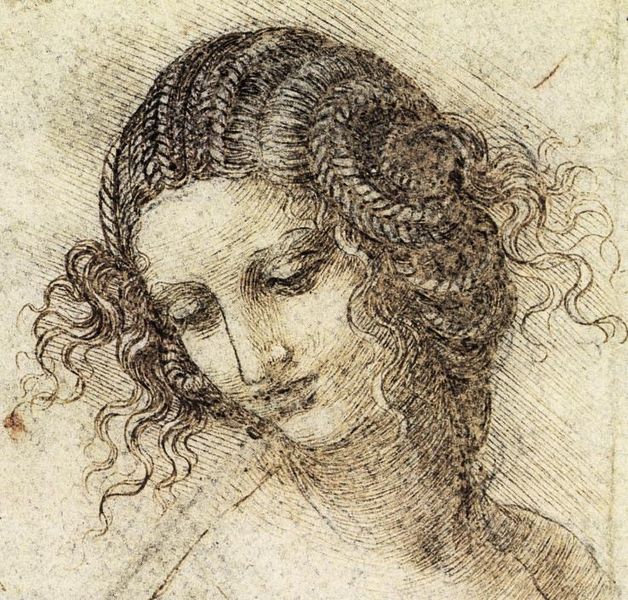
And I thought this would illustrate them well. It’s a study for the head of Leda by Leonardo da Vinci.

Posted in Uncategorized | Leave a comment

On Strike

Posted in Uncategorized | Leave a comment

Imaginary Travels

This one was very, very hard. There were fewer entries than last time, but all of you outdid yourselves. Of course, two of the entries didn’t “count” since they came from past winners, but they were nevertheless wonderful, and I could see how much effort went into every description. Wow.

Since there were fewer entries this time, I only chose four honorable mentions, but even those were difficult because the quality of the writing was so uniformly high. But I did have to make a choice. The two winners are Emily Gilman, who chose to travel to the City at the End of the World, and whose description of it was both mysterious and magical, and meabhchildhoodreads, whose description of the forest that no longer exists was so beautiful and sad. The past is a foreign country we will never be able to access. I loved both of these descriptions – thank you both for posting them!

I’ll be in touch with the winners by email!

From Emily Gilman:

For years I have wanted to make a pilgrimage to the City at the End of the World. I want to stand in the desert heat and feel how cool the stones of the white Wall are even at noon, how deceptively soft the winds have worn them. And I want to see for myself how the powder that coats my palm afterward glitters starlike – so different from the sand kicked up by the bus’s tires.

I want to sit up late into the night listening to the story of the woman who wept. I want to hear her story in the strange syllables that are no language and every language, that all can understand but only those who make their home in the City learn to speak. I want to hear how the woman stood and wept so long that her hair turned white as bone and her clothes turned to rags and at long last the merciful wind blew her away, like sand, over the Wall to her beloved.

I want to watch the lights that churn and dance through the night dark above the Wall until they fade into persistent hallucinations with the dawn.

One thing stops me: I am afraid that if I travel to this City, if I feel the Wall under my hand like a cat that ever wanders and ever returns to this one spot, I will never leave. I am afraid that if I learn this of all languages I will never speak another, and that I could only truly love someone who spoke it back to me.

I fear that, for better or worse, if I meet the eyes of one of the silent priests I will be called to join them, to climb their tower and gaze deeply as we reach out to set the ashes of the dead free of our world.

From meabhchildhoodreads:

The entrance to a forest lies at the end of my small country road. Flanked by a green field and small brown bog water river, the tall conifers stretch into an almost always greying sky. The entrance is marked by a particularly muddy stretch of land: the kind you have to gingerly tiptoe through, for fear of sinking down to your ankles in muck. There’s nothing really special about the forest, that exists purely for the harvesting of timber, deliberately filled with pine that grows quick and chops easy. But there are small moments of beauty inside.

Unintended willows grow upon ledges, whose branches drape over passers-by. There is a tiny bridge that an equally tiny river flows beneath. During the summer if the weather stays dry the cress starts to flower above the water, creating a river of white buds. Tree stumps sit idly covered in moss while pink ragged robin snakes around their roots. And, on those rare days when the stars line up and the clouds part ways, there is sunshine. Sunshine that escapes through the clouds and sends shafts down through the tall trees that are off the path. Rays of light that make the very dust in the air sparkle and land upon the pine needle carpet of the forest floor. I can almost imagine the ghost of a little red-haired girl in a white dress racing among the trees.

That was my very favourite place in the world. Last summer when I returned home to walk in the woods I discovered a heart-breaking sight. My grove of trees that had always caught the sunlight so perfectly, was gone. It was replaced by the open air and a sea of fresh tree stumps, raw and wounded. Their flesh was open to the sky, where I could count the rings. The little dancing girl was gone, forever.

If I could go anywhere in the world I would go back to when my forest was still whole and watch the sun amid the trees, just one last time.

As I said, I also have four honorable mentions, but the truth is that I loved all the entries, and although I didn’t reprint it here, I would love to go on a journey to Middle Earth with Wendy S.! Seriously, after I had read all the entries at least once, I sat rereading them for at least an hour, trying to make a final choice.  Finally I had to, because it was almost midnight.  So here are the honorable mentions, but please do look at all of the entries, since they are quite wonderful.

From Shannon Blue Christensen:

I was told to pack lightly. It would be necessary to disturb unused paths to reach my destination.

So, I packed my books and my music and my boots and toothbrush and a change or two of underwear and my sentimental jewelry. I checked my tattoo for verification. I leafed through pages and pages to find the right paper and drawers and shelves to find the right pen. I brought no food, for this was a passage of purification; not of curiosity. My passport and car keys were unnecessary.

I began my journey in an overstuffed beaten leather chair. No footstool. I curled up and pulled an over-stuffed blanket over me.

My books didn’t fit and had to be left on the floor.

I thought, “Surely a tiny iPod must be fine.” But it didn’t fit either.

My chair was full of me, the thoughts I feared most, the noise in my head, and the paper and pen daring me to write it all down.

It was terrifying. I was statue-like with solitude, frozen with confrontation. I could not hide from myself for my hiding spots were all on the floor. My fingers grew stiff with cold and I began to hyperventilate. “Quiet!” I told myself. “Quiet, or you’ll find you!” And I tried. I tried until the tears slowly washed my face and my hands were numb. Exhausted, I stopped running. Closed my eyes. Took a deep breath. And peeped inside.

I saw a young girl, underfed but otherwise lovely, with the same pen and paper as I. I sat down across from her. She began to write – dreams emptied, wishes still floating, daydreams birthing. And I looked at my own paper. I had written the same pictures. We wrote together for ages and seconds until she looked at me. “You will return? No more shadow?”

After so many quests, so many vehicles of hunting and escaping, I finally found my prey. Sitting unobtrusively inside my soul, the one place I had always feared most. Yes, I will always return, now that I know where you are.

From emily:

I’ve always wanted to go see the Northern Lights, because I’m the kind of person who likes lights and colors and looking at the sky. So I would head somewhere north, Alaska perhaps? I’ve heard you can see the aurora borealis from most anywhere there during the spring in Alaska, considering 2012 is amongst the years of peak solar storms – one of the “reasons” the world is going to end this year. Once in Alaska, I would ask the locals for the best location to see the lights. “Any empty field with a clear view of the northern horizon will do, but one with a backdrop of a mountain range will add to the spectacle,” they would say. So I would find myself an empty field with a clear view of the northern horizon and a mountainous backdrop to sit and wait, shivering because I never dress warm enough.

I don’t want to expect anything of the aurora borealis for fear of disappointment. But it’s too late for that. I can’t pretend I don’t expect it to be a fury of green streaks similar to a lighting storm without the thunder. Or swirls of green lines lingering in the sky in the pattern of my fingerprints. I can’t pretend I didn’t have that dream where time traveling was possible when the clouds turned green and the sky bright red, banded with more green. I mean how can I not expect anything short of spectacular of the Northern Lights, who once induced enough current into manmade telegraph lines that people could communicate cross-country without a power source? It’s definitely too late to not expect anything of the Northern Lights.

From Jenny @ Stone Soup Books:

I have never seen this place, but I look for it wherever I go.

It is a small house with badly peeling white paint and a sagging front porch grown over with star jasmine and clematis. Ivy has infiltrated the house, crawling inside through a broken diamond paned window. The house has planted itself firmly on top of a hill that is covered in cornflowers, poppies, ox-eye daisies, sweet William, rocket, and Indian blanket. Small birds fly out of the grass that scratches my thighs as I approach.

Gossamer dresses and faded floral pillowcases are draped over the clothesline peeking out from behind the house. There are trees by the road; weeping cedars and a crab-apple. There is a pond almost hidden between two small hills. It is filled with arrowroot and snakes and the sunken remains of a rowboat.

I would walk up to the front porch and sit down on the rotting steps. I would let the sun spin my hair into gold and dazzle my eyes. I would let ants and ivy cover my skin. I would hold the house and the hill and the pond against my soul and thrill to the thought of being
very

very

vastly

alone.

From Margaret Fisher Squires:

In the Runcible Spoon restaurant, unique blend of smart bistro, Irish pub, and hippie coffeehouse, a Portal gives entry to the realm of Dalreyn, and its Friendly Forest. I have paid for my lunch and tipped. The wooden booths are empty of other patrons. This is my moment. I duck into the small cupboard below the stairs . . .

. . . and emerge in a grove of tehagon trees. Tall and straight, they bear summer foliage in shades of wine and gold and cream. Their spicy resinous fragrance exhilarates me.

I have come prepared, and dig into my pocket for a small bag. Kneeling, I heap nuts and fruits onto a cushion of moss as an offering to Derith, the forest’s spirit. The forest is called Friendly, but isn’t always. Best to be careful.

Following the chuckle of running water, I find a stream and walk beside it, accompanied by a large blue dragonfly that hovers over the dancing current. I wonder if I will hear the song of the Joy Bird, who was created by Yeshal the All Mother and her daughter Ayshulan of the Moon as they sat eating strawberries with Derith. Ayshulan designed its plumage, a tracery of pearly gray and indigo, silver and shadow-purple, and on its breast, an ivory circle glowing faintly like the full moon. Yeshal gave it a ravishingly sweet song. The three divine ladies rejoiced in this beautiful creature until the goddesses began to bicker over whose contribution was the best. They argued back and forth until Derith had had enough. She decreed that the Joy Bird would be visible only at night, and audible only during the day. Only on the Autumn and Spring equinoxes would the bird be both visible and audible. So saying, she sprinkled the bird with a dusting of iridescent laughter.

Either goddess could have reversed Derith’s will; but sometimes mother and daughter are quietly glad when someone smooths the friction between them. So all remains as Derith decreed. And it is said that if the Joy Bird sits on your shoulder, you will be the happiest of mortals.

Deeply content, I walk listening to the chirping of finches. My stream flows out of the trees into a meadow, dividing into a score of interweaving purling strands. I stand surveying a mosaic of islets. An oak shades the largest of these, and a rowan tree graces one the size of a living room carpet. Others are no bigger than a dining table, a footstool, a slipper. Amethyst spirit flowers and yellow sun-badges spangle the grass. Stepping among them, I discover that every isle, every mossy pebbled bank, is home to a small frog, and each frog is a different color: Spring green, turquoise, tangerine, golden . . .

With my back against the oak’s bole, I gaze in reverie until I am drawn through the Portal to share what I have seen.

Posted in Uncategorized | 1 Comment

Domythic Bliss

Some time ago, Grace Nuth, who blogs at The Beautiful Necessity, mentioned that she might start a blog specifically focused on mythic and fairytale decorating. And now she has!

It’s called Domythic Bliss, and although she only has three posts up so far, they are just as interesting and beautiful as you would expect from Grace. I’m going to quote from her first few blog posts, because Grace expresses so much of what I’ve come to believe about decorating. She describes why she created the blog:

“I love interior decorating. I never get tired of looking through a really great book of interior design, and I’ve been known to spend hours on blogs and websites devoted to the fine art of turning a house into a home. But there has always seemed to be a gap in the blogosphere and book market. There were books and websites devoted to Victoriana. There were books and websites devoted to Country and Cottage style, Tuscan style, Bohemian and even Steampunk Style. I would peruse these books and websites and find bits and pieces here and there that spoke to me and seemed like what I wanted. But like Goldilocks, I was still in search of the decorating style that seemed ‘just right.'”

I’ve felt this too. I love elements of cottage style, and bungalow style, and French country style, and Scandinavian style, but somehow none of those styles was exactly right. The books I bought could give me ideas, but none of them made me say, yes, this exactly.

“I love a room that spreads out before you like a feast to the eye no matter where you are looking. Even though it is often the opposite of sparse or minimalist, it shouldn’t just be a jumbled mess of random objects. Instead every view should be full of magic and enchantment. It’s a golden standard to which a homeowner can strive for years and decades before just the right combination is obtained, and usually is an amalgamation of family heirlooms, flea market finds, and one-of-a-kind artworks, sculptures, and handicrafts.”

Well, that’s certainly what I have: an amalgamation of family heirlooms, flea market finds, and one-of-a-kind artworks, sculptures, and handicrafts. But I think the important words in that paragraph are “magic and enchantment.” The things you have should be magical. They should create a space that enchants. I think that’s what is missing from most decorating books. There’s loveliness, but no magic.

“Every room is laid out like a story – a fairy tale told right in front of you, full of magic, secrets, and wonder. And in fact, the decoration of the room revolves around narrative and storytelling . . . sometimes literally, as fairy tale volumes are displayed as decoration, and sometimes figuratively as a room is set up to remind you of an enchanted forest cottage or a queen’s boudoir. That is the ideal Mythic Home, to which all of us who love the style strive. But don’t despair! The process is a wonderful journey, and my goal with this blog is to share homes with all sorts of different degrees and levels of mythic accents and themes. And together we can work on identifying just what it is that makes a house transform from decoration to imagination – from practical to enchanting.”

Exactly! The home needs to tell a story. And for the home to be enchanting, that story needs to be a magical narrative. Are you the princess? The witch? The fairy in the woods? What character are you, and what story are you telling about yourself? And if you think that’s silly, remember that we are always telling stories. A home can just as easily say, “I am an investment banker” or “I don’t spend a lot of time here” or “I don’t really care how things look.” It’s always telling a story about you. This is about telling a more interesting story. Grace also gives some very useful advice:

“Here’s a thought for decorating mythically and adding enchantment to your home: First see your home through the eyes of an adult, and then see your home through the eyes of a child.

“The house should be useful and practical, appealing to the senses and showing some sort of unifying theme of color or style (or multiple styles that somehow work together). But then once the “bones” of the decorations are in place, you can and should approach the rooms again, looking through the eyes of your child self. Did you love dragons? Tilt at windmills? Read fairy tales? Have invisible friends? Starting the decoration of a room by keeping in mind the ‘rules’ of decorating just means that when you reach the second phase, you can feel free to break every rule you just made, and create a chaotic wonderland just for you. Hang paper chains from the doorways. Attach fairy wings to the wall when you aren’t wearing them. Paint your ceiling with glow-in-the-dark stars. The sky was the limit to your imagination when you were a child. Try to rediscover what you dreamed about, and make it a reality as an adult. Create a home that the younger-you would enter and stare around in thrilled awe.”

Reading these two paragraphs made me realize what’s wrong with my decorating style. When I was a teenager, I tried to have a sophisticated, grown-up room, although even then it had elements of enchantment: the walls were a light, pale, dusty pink, and there was a tapestry on the wall that showed a view into a forest, in which there was a castle, with mountains in the background. And I had a very large, impractical old mirror with a chipped frame painted sage green. Also, curtains over my bed. Since then, I’ve had a sort of assumption that I should have a sophisticated, adult space – without really thinking about it. But why? There have always been touches of whimsey: I buy old silver plate in flower patterns, so it looks as though I’m eating with a silver garden, and I have ceramic bowls of pine cones and acorns on low tables. But the space, overall, is practical rather than enchanting.

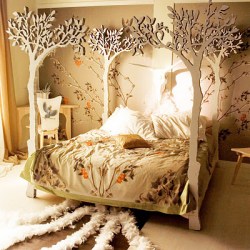
I think it’s time for me to rethink my decorating. And just so you have a good sense of what Grace is talking about, here is one of the pictures that she’s posted on her blog. Enjoy, and then go over and see the rest of them!

Posted in Uncategorized | 4 Comments

Fairy Tales

Today I have been working very hard, but one thing I’ve tried to do for a couple of hours is revise poetry. Because, as I may have mentioned, I’m putting together a poetry collection.

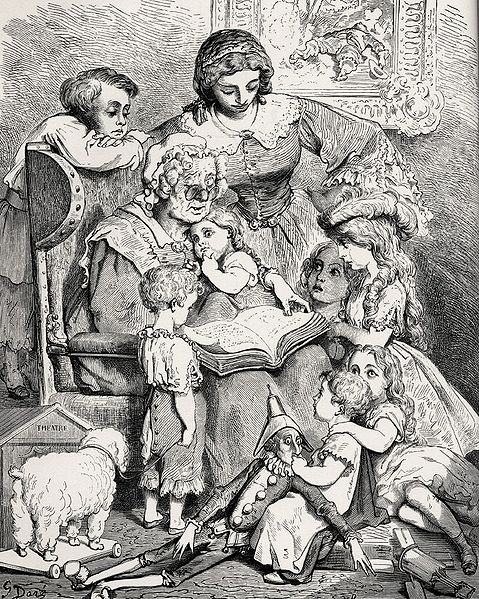
I’m so tired that I’m not going to write much of a blog post, but I am going to show you some of what I’ve been working on. These are three older poems that I’m in the process of revising. They’re all rather strange, and I’ve been seeing if I can make them work. All three are fairy tales of sorts (or snippets of fairy tales) that I’ve made up, so I’m going to give you Mother Goose telling her tales to the children:

And here are the poems.

The Mountains of Never

I went to the mountains of Never, which flourish their peaks for the moon,
white as the wrist of a lady, white as a fountain of may,
and the journey lasted forever, although it was over too soon,
for the mountains of Never are nearer, and farther, than away.

At the mountains I met a lady whose wrist was as white as the snows.
She sat with her white face lifted, blankened and blind, to the east.
I sat and watched her eyelids as a thousand moons arose,
and slowly the snows on her shoulders, flake by flake, increased.

Finally, where her face had been, there was only a hillock of white,
the white of the mountains of Never, that flourish their peaks for the moon,
so I turned to the hills and valleys that ranged beyond my sight
and sat with my white face lifted, still, and still, as stone.

Lucy

Lucy walked into the forest; the moon hung like a scythe
over a harvested landscape, bared by autumn and death,
and above the clouds moved silently with the swiftness of a breath.

She carried a wicker basket filled with necessary things:
a flask of dew, a tortoiseshell comb, a pair of butterfly wings
found on a budding rosebush, mysteriously, last spring.

She walked into a clearing and uttered a low, sweet cry
(I will not tell you the words of it, an ancient lullaby),
and then she stood and waited, and frowned a bit to see.

Then suddenly the Elder began to sway and turn,
and all of that grove of branches similarly to churn,
as though a command had animated the artwork on an urn.

The brown trunks twisted and trembled, the roots were pulled from the ground,
thick with the mud of ages, and ivy wreaths unwound,
and the trees stepped from their places, with a snap and a creaking sound.

Now Lucy stands among them, and gives them a smile and a glance,
and scattering the last of their leaves they bow and they advance,
and the Elder invites Lucy to participate in the dance.

The moon hangs over the mountains, curved like a scimitar,
and the clouds have gathered together to cover every star,
and the place where the trees are dancing appears as a long bare scar.

Far off in the towns the men are dreaming in their degrees,
but above the forest the death’s-head of the moon sails on and sees
Lucy, laughing and prancing among the dancing trees.

Our Lady of the Nightmoths

When, one night, the nightmoths came,
powdered wings against her skin,
she lay down and closed her eyes,
slept and dreamed, and went with them.

Clutching tresses of her hair,
furred and squeaking like a mouse,
spread like parachutes in air,
they went any wind to north.

Nightmoths squealed behind her ears,
rubbed against her elbow joints.
She flew over valleys where
artist earth with icebergs paints.

She flew over mountains where
wolves elope with hungry ease,
where the caribou prepare
merger with the antlered trees.

Soon the nightmoths brought her north,
to the land were snows respire,
where each night the sky consumes
itself in multicolored fire.

There they settled her to wait
while her hair grew white like glass,
where the snow’s white termites bit
through her legs and diamond grass

sprouted from her cheeks and chin.
She had waited half a year
when the Nightmoth Lady came,
winging steady through the clear,

dropping powder from her membranes,
clouded in the nightmoth swarm.
Furred antennae felt the cold maid,
slender feelers closed and made her warm.

I know, I used to write some pretty strange stuff. But then, I still do.

Posted in Uncategorized | 4 Comments

Long Sentences

I feel as though I’ve spent the entire day reading and sending emails! I haven’t, of course: this morning I went to a ballet class, which reminded me that my body was made to move, not just to sit and type. But I have spent a lot of time on the computer today.

That reminds me of an article by Pico Iyer published in the Los Angeles Times called “The Writing Life: The Point of the Long and Winding Sentence.” Here’s how the article begins:

“‘Your sentences are so long,’ said a friend who teaches English at a local college, and I could tell she didn’t quite mean it as a compliment. The copy editor who painstakingly went through my most recent book often put yellow dashes on-screen around my multiplying clauses, to ask if I didn’t want to break up my sentences or put less material in every one. Both responses couldn’t have been kinder or more considered, but what my friend and my colleague may not have sensed was this: I’m using longer and longer sentences as a small protest against – and attempt to rescue any readers I might have from – the bombardment of the moment.

“When I began writing for a living, my feeling was that my job was to give the reader something vivid, quick and concrete that she couldn’t get in any other form; a writer was an information-gathering machine, I thought, and especially as a journalist, my job was to go out into the world and gather details, moments, impressions as visual and immediate as TV. Facts were what we needed most. And if you watched the world closely enough, I believed (and still do), you could begin to see what it would do next, just as you can with a sibling or a friend; Don DeLillo or Salman Rushdie aren’t mystics, but they can tell us what the world is going to do tomorrow because they follow it so attentively.”

I love the phrase “the bombardment of the moment.” And I feel that – don’t you? The bombardment of now, of what is happening now, and now, and now, every moment that we live in the world? If you become too involved in it, you begin checking the news regularly to make sure you keep up. Or even your facebook or twitter feeds, to make sure you don’t get behind. It’s as though we always have to know what’s going on.

I understand Iyer’s initial idea that the writer is supposed to gather and transmit information about the world, but it’s wrong: we are not televisions. DeLillo and Rushdie may be able to tell us what the world is going to do tomorrow, but it’s not because they follow it so attentively. It’s because they have something else, a deep historical sense, a sense of intuition. That’s not something that comes from focusing only on the now.

Iyer realizes some of this. He writes,

“Yet nowadays the planet is moving too fast for even a Rushdie or DeLillo to keep up, and many of us in the privileged world have access to more information than we know what to do with. What we crave is something that will free us from the overcrowded moment and allow us to see it in a larger light. No writer can compete, for speed and urgency, with texts or CNN news flashes or RSS feeds, but any writer can try to give us the depth, the nuances – the “gaps,” as Annie Dillard calls them – that don’t show up on many screens. Not everyone wants to be reduced to a sound bite or a bumper sticker.

“Enter (I hope) the long sentence: the collection of clauses that is so many-chambered and lavish and abundant in tones and suggestions, that has so much room for near-contradiction and ambiguity and those places in memory or imagination that can’t be simplified, or put into easy words, that it allows the reader to keep many things in her head and heart at the same time, and to descend, as by a spiral staircase, deeper into herself and those things that won’t be squeezed into an either/or. With each clause, we’re taken further and further from trite conclusions – or that at least is the hope – and away from reductionism, as if the writer were a dentist, saying “Open wider” so that he can probe the tender, neglected spaces in the reader (though in this case it’s not the mouth that he’s attending to but the mind).”

And you know, I see his point. We do need, not more, but a deeper relationship with what we have. Not knowledge, or not just knowledge, but understanding. That’s what writers give us. I think it can happen in ways other than by writing long sentences. You can achieve depth and nuance through a variety of techniques. But the important thing to remember is that the writer is not a television, just as the artist is not a camera. Both the writer and artist are there to convey what is underneath, rather than on the surface. To engage not the eye but the imagination, the inner eye.

Iyer’s article makes me want to experiment with longer sentences, to see what I can do with them. Toward the end of his article, he gives a wonderful example, quoting Annie Dillard:

“Watch Dillard light up and rise up and ease down as she finds, near the end of her 1974 book Pilgrim at Tinker Creek, ‘a maple key, a single winged seed from a pair. Hullo. I threw it into the wind and it flew off again, bristling with animate purpose, not like a thing dropped or windblown, pushed by the witless winds of convection currents hauling round the world’s rondure where they must, but like a creature muscled and vigorous, or a creature spread thin to that other wind, the wind of the spirit which bloweth where it listeth, lighting, and raising up, and easing down.'”

What’s so wonderful about that sentence, what makes it work, is that it’s preceded by the short “Hullo,” which functions as a sort of anchor, a strong beat that grounds us before the lilting sentence begins, and the fact that the sentence itself moves like that windblown maple key. We can feel it moving as the sentence moves.

So, long sentences. But more important than that, nuance and depth. Those are the lessons for today.

Reminder: Book Giveaway #2 will be going on until Sunday night at midnight! If you would like to participate, look below for the rules.

Posted in Uncategorized | 3 Comments