More Imaginary Gardens

My computer is working: for now. Sometimes it does and sometimes it doesn’t.

As soon as the parts come in, it goes back to the It Help Center, where it will have the monitor replaced. After that, it should work again. It’s an old computer, but I do need it to work: without it, I feel as though I’ve lost an important part of my life.

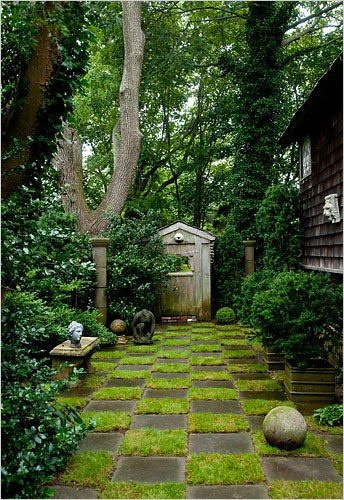
I have so much to do right now, and I’ve been doing a lot of it today, although I’m still terribly behind. But you can understand why I need something, some glimpse of something brighter, better, wilder. And so today I’m going to post some pictures of imaginary gardens. These come from The Hanging Garden, which I described several days ago as the most beautiful blog on the internet. They are of course pictures of real places, but I think of them as imaginary because to me, they are parts of a country of the mind, which I’ll explain in just a moment.
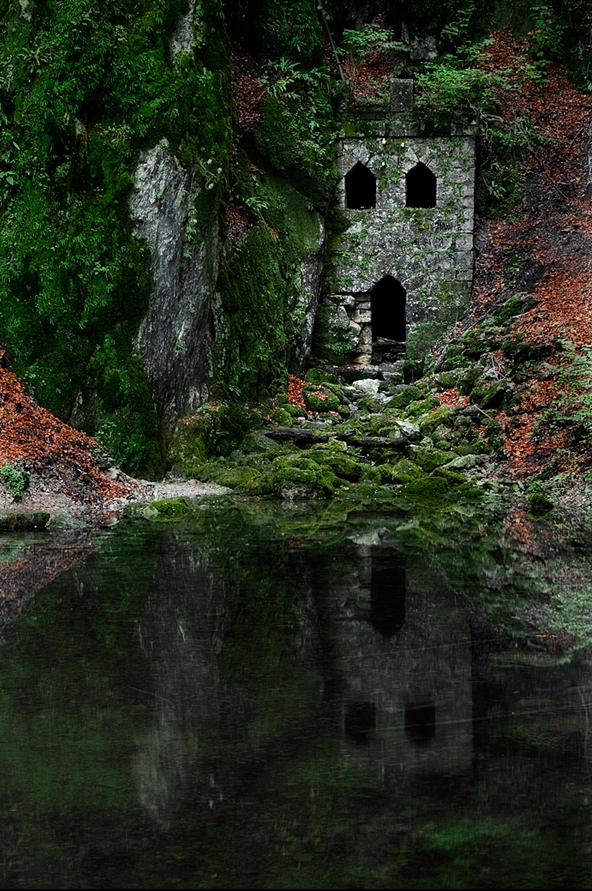
And as I’m posting these, I’m going to start thinking about the story I was writing online, a while back. You remember it, right? It was about Thea. She took a train to the town of Shadow, which is the town where Mrs. Moth, Miss Lavender, Miss Gray, and Hyacinth all have a house. On the outskirts of town. That house has many doors, and some of them, sometimes, lead to the Other Country, which is Mother Night’s country.
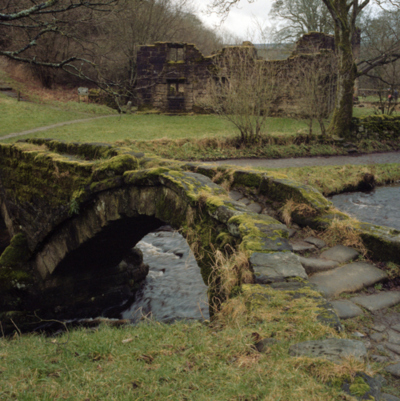
Thea went to that country, and there she met Mother Night and saw the tapestry she is weaving. She even caught a glimpse of the front of the tapestry. And she met the Gentleman, and Mother Night’s children, Morgan and Merlin. Especially Merlin. And she was accompanied at least part of the way by Cordelia the obnoxious Cat.
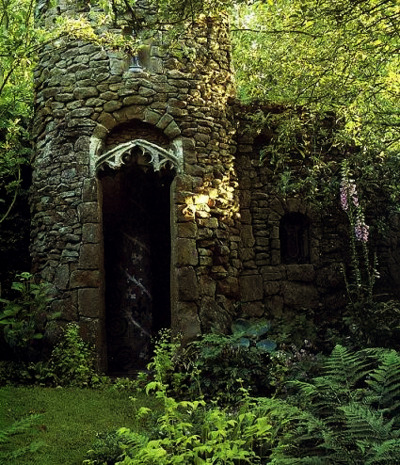
What I think about gardens is, I think the best of them are glimpses of Mother Night’s country. That’s what makes them magical. They are earthly glimpses of something unearthly. So if you want to look at portions of that country, reflections of it as it were, look at these gardens.
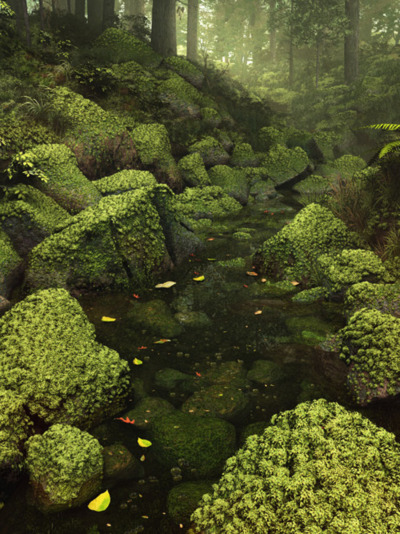
These old towers and bridges and streams, that’s what you would find there, if you could find your way there.  But that takes magic.  Cats have that magic, and witches have that magic.  And sometimes writer do too.  The problem is, if I go back to telling that story, where would I start?  I’m just not sure anymore.
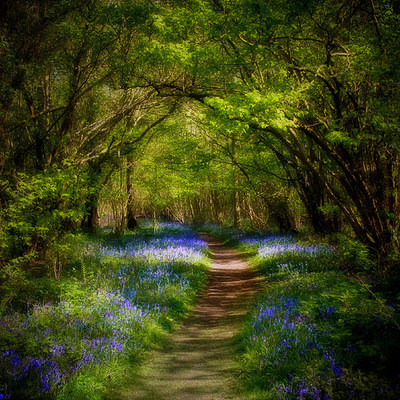
Would I tell the story of Thea and Merlin?  That was a story that came out of a particular time, and I don’t know if I can go back to it.  Or perhaps I can.  Perhaps this is the time to write it, to capture it.

Since I finished the PhD, I have not been much of a writer.  I’ve been an author, sure.  But I haven’t been writing, haven’t been creating the things I should be creating.  It’s as though there’s been something in the way.  As though I haven’t been able to get back, myself, to Mother Night’s country, that country of and in the mind. So what I need to do, of course, is find the magic again. Because the thing is, if you know how to get there, any door is the door to that country.  Every threshold becomes the threshold. For witches, every door connects to every other. Spaced and time mean nothing to them. (Or to cats.)

So how to go back, where to start? I don’t know. I’ll have to think about it . . .

Posted in Uncategorized | 1 Comment

On Monsters

Yesterday, I didn’t write a blog post. I’m trying to write one each day of at least 500 words, but my laptop is still being repaired and it’s difficult to write on the netbook. I think the laptop is going to be at the IT Help Center until next week. It needs a new monitor, and the part will be about $400, which means that I need to write and sell a story to pay for it. Well, at least it’s incentive. (So if you want a story from me and you pay at least $.05 a word, this is a good time to let me know!)

Today I wanted to announce that my essay “A Brief History of Monsters” just went online at Weird Fiction Review. It’s part of the magazine’s Twelve Days of Monsters, which is going to include some wonderful stories and essays.

I’m going to give you a preview of the essay, just the first few paragraphs, so you can decide whether you want to go over and read it. (Of course, I hope you will.) Here you go:

If you happened to be in New York City in the summer of 1842, you could see a rare and wonderful creature: a real mermaid. She had been caught by a naturalist named Dr. Griffin off the coast of the Feejee Islands. Dr. Griffin himself had been reluctant to display her, but his friend P.T. Barnum had persuaded him that the public should be allowed to see such a marvelous sight. He had offered the newspapers a woodcut of a beautiful woman with the tail of a fish, and they had printed it. He had also distributed copies of a pamphlet with her picture on it throughout the city. Anticipation ran high: the crowds to see the mermaid were enormous.

Those allowed into the exhibition hall were given a lecture by Dr. Griffin detailing how he had found the mermaid and explaining that since there were sea-horses and sea-lions, there must certainly be sea-humans as well. And they were shown the mermaid herself. I wonder how many of them realized that they were looking at a clever hoax: the dried head and torso of a monkey sewn onto the tail of a fish. A reporter from the Philadelphia Public Ledger who seems to have been fooled wrote,

“The monster is one of the greatest curiosities of the day. It was caught near the Feejee islands, and taken to Penambuco, where it was purchased by an English gentleman named Griffin, who is making a collection of rare and curious things for the British Museum, or some other cabinet of curiosities. This animal, fish, flesh or whatever it may be, is about three feet long, and the lower part of the body is a perfectly formed fish, but from the breast upwards this character is lost, and then approaches human form — or rather that of a monkey.” (1)

Dr. Griffin was as much of a fake as the mermaid herself. He was actually Levi Lyman, Barnum’s collaborator. Both men had conspired to fool the public. But the public seemed to enjoy being fooled. After the initial exhibition, the Feejee Mermaid was displayed at Barnum’s American Museum, where she significantly increased ticket sales. She remained a popular attraction, both in museums and on tour, until she was destroyed in a museum fire in the 1880s.

The Philadelphia Public Ledger reporter was right to call the Feejee Mermaid a “monster.” We often think of monsters as large, frightening creatures, such as Polyphemus from the Odyssey or Frankenstein’s monster. The Feejee mermaid was neither large nor frightening. But monsters come in all sizes, and some of them are attractive — at least initially. The vampire Carmilla is beautiful and seductive before she sucks your blood. What separates monsters from ordinary creatures is something more subtle, having to do with the way we perceive the world. As we grow up, we learn to place the phenomena around us into categories. Monsters are what do not fit into those categories. They are giants with one eye, assemblages of corpses, beautiful women who can turn into cats — or monkeys with the tail of a fish. Because they do not fit, monsters make us feel what Sigmund Freud has described as the unheimlich, which is usually translated as the uncanny, a sensation that can range from discomfort to outright fear. And yet, as the New Yorkers who paid to see the Feejee mermaid demonstrate, we are also fascinated by monsters. They inhabit the myths and legends of our earliest history as well as Hollywood blockbusters. There is a direct line of descent between Polyphemus and the Terminator.

To illustrate this excerpt, I thought I would use Head of Medusa by Peter Paul Rubens:

Medusa is a classic monster. What makes a monster, I think, is that it crosses the boundary between the fundamental categories of the self and other. Medusa, the beautiful woman with snakes for hair, is both like and unlike us. She is what does not fit into either category. Which gives me the idea for a story . . . (After all, I have to pay for my laptop monitor.)

Posted in Uncategorized | 2 Comments

Love Recklessly

This was one of those days.

First thing this morning, my computer screen stopped working: it was black. I had already been planning to drive into the city because I had a series of errands to run. The computer became the most important. I dropped it off at the place where computers are fixed (which is a part of the university), and then went on my errands: to the optometrist to get my glasses lenses replaced, to Small Pleasures on Newbury Street to drop off a strand of pearls that needs to be restrung and a pair of marcasite earrings that are missing a few of the marcasites, to Pandemonium to pick up the last two months of Locus because I’ve let my subscription lapse (although I shouldn’t have of course, it’s just that I’ve been so busy) and I’m mentioned in both issues.

While I was in the optometrist’s office, the fire alarm went off and the building was evacuated, so I had to leave my glasses there and go back later. And of course I had to leave my computer. I’m writing this post on a netbook, and I continually have to correct my spelling because the keyboard is so much smaller than I’m used to.

So it was that sort of day.

While I was standing on a subway platform, I saw a sign. It said “Live Humbly, Love Recklessly.” I liked it so much that I later posted it on Facebook, and a friend of mine replied that when he loved recklessly, he always had his heart broken. So I started thinking about what you can love both recklessly and safely: what won’t break your heart. And I came up with a sort of list.

I think one of the reasons the sign resonated with me so much is that I do live that way: I live fairly humbly (although, if I dare say so myself, with lovely things), but the things I love, I do love recklessly. That was just an aside. On to the list.

Things you can love recklessly without getting your heart broken (almost for certain):

1. Books. You can love as many books as you want (you can be a polybibliophile), and you can love them as deeply and sincerely and recklessly as you like. And they will never betray you. Jane Austen will never say that she loves another better than you; Agatha Christie will never decide that you should just be friends.

2. A Garden. There is a caveat here: individual plants will break your heart. The blossoms killed by frost, the young vegetables eaten by rabbits, will cut you to the bone. You will mourn over them. But the garden will always be there. Even in winter, you will be able to see its bones and pour over gardening catalogs, imagining its summer glory.

3. Music. No matter what mistakes you make, no matter what a mess you make of your life, music will always love you as recklessly and extravagantly as you love it. Just sit back, listen to Liszt or Dylan, and let it wash over you. It will tell you that although the world may be all wrong, you are going to be all right.

4. A cat. I don’t think a dog is the same: dogs are too close to human, too prone to causing heartbreak. But if you lose a cat, no matter how beloved, you lose something that was never yours anyway. A cat will return your love, but it is always already half somewhere else. It already belongs to another state of being. When a cat dies, you can imagine it entering the land of the dead as though returning to its own country.

5. Nature. When you need something to love recklessly and you can’t find anything else, nature is always there. You can love trees, the mountains, the ocean. (I love the ocean extravagantly myself.) And if you are trapped in some sort of prison, there is always the sky. Nature, the great mother, will respond to you by being herself, beautiful and infinite, and by making you feel as though whatever heartbreaks you have are small things after all, when you can look up and see the moon and stars. As Wordsworth says in “Tintern Abbey,” “Nature never did betray the heart that loved her,” and I think he’s right.

There are so many things in the world that will cause you heartbreak. People of course, but also houses, countries, sometimes the work of your own hands. Ideas, when you find they are not as grand as you originally believed, can break your heart. But those five? I think they’re safe.

My new favorite garden from The Hanging Garden, which is one of the most beautiful blogs I’ve seen:

Posted in Uncategorized | 9 Comments

In Recovery

Honestly, I think I’m still in recovery. Last year was so stressful – you know, you were there. And I’ve been working so much since I finished the PhD that it’s been difficult to find the time simply to be still, to recover from all the stress and work.

It’s only recently that I’ve started to feel free again, to feel as though the future exists, rather than seeing simply a road through dark forest. To see, in the distance, the possibility of sunlight.

A friend of mine sent me a song that’s become my new anthem: Tom Petty’s “Wildflowers.” It seems to express so perfectly where I am now in my life.

I’ve started planning for this summer, which will include some wonderful things: writing and travel and spending time with friends. I can’t wait. Right now, there’s still a lot of hard work to do. I’m going to be doing a lot of it this week, so I can go to ICFA and not have to worry about it. It would be nice if I could spend spring break doing something other than catching up, but that’s all right. (When I say catching up: I sorted through and deleted about 600 emails from my inbox this morning. And yes, those accumulated within the last two months, since the last time I deleted that number. And yes, I delete most of my emails daily. So that gives you an idea of the volume I get.)

Another friend of mine sent me a smart, interesting talk by Susan Cain about being an introvert:

Cain is right to talk about introversion as a way of describing response to stimuli. Introverts respond to stimuli differently. She doesn’t, at least in this talk, discuss what it feels like when you’re overwhelmed by stimuli, both internal and external. That’s when you’re overwhelmed, and that leads to breakdown. I went there at several points in the dissertation process: to the point of breakdown. It’s not a place I want to be again. Recovery is slow, and I am often tired. I still need what I don’t have on a daily basis: time without stress. But you know, I’m getting there.

And I hope that I can get back to writing soon. I hope the stress will get better, and I will feel the sense of freedom and power I need to create something. As I said, I’m starting to see light among the trees.

I worry sometimes that it will be like that scene in The Hobbit where it’s not sunlight, just some tricksy elvish light that will disappear again. But it looks brighter than that.

I’m looking forward to wildflowers . . .

Posted in Uncategorized | 7 Comments

What Winterson Said

There’s a wonderful interview with Jeanette Winterson in Lambda Literary: “It is the Imagination that Counts.” I want to quote from it a bit here so you get a sense of the article. And some of what she said is important to me personally.

“Life . . . we understand it differently at different stages. It’s what is interesting about getting older, you realize your relationship with the past is always negotiable. There is a lot of freedom in that, because you realize you can go back to what you did such a long time ago. You can talk with the dead, talk with your lost self, your disappeared self, and you can visit those places again, and understand it differently. That makes a huge difference.”

Perhaps that’s the importance of memoir: it allows you to go back and, in a sense, rewrite the past. Or perhaps just write the past, because the past exists to the extent that we remember it. So perhaps it exists to the extent that it is written, and the act of writing it allows us to revise, to reinterpret what happened. The act of revision and reinterpretation changes it, just as observation changes quantum phenomena.

“There is a bit where I talk about ‘keeping the heart awake to love and beauty.’ That’s very difficult in our world, even when things are going well. It’s not a world with much room for love and beauty. The daily news is [filled with] everything that goes wrong in our world, and everything horrible and unpleasant. I think that saturates your mind with negativity. I really think we need something to counteract that. I don’t think it’s Pollyanna or sentimental to focus on the ways we support one another on the micro level.”

Just this one part makes me want to read her memoir. I believe strongly that we need to keep the heart open to love and beauty, so it can recognize them and take them in. It’s easy to become cynical, to believe they don’t exist. But they do, and they’re important – as important as what we see on the nightly news, I think. And they do counteract that flow of negativity. We need love and beauty just to survive. And I know so many people who don’t have them, who are missing those basic things . . .

(My blog post was interrupted here by the need to play a recorder duet. I played the harmony. It’s been so long since I’ve played that I can’t remember the difference between the Baroque and German fingering.)

“Everyone’s talking about the death and disappearance of the book as a format and an object. I don’t think that will happen. I think whatever happens, we have to figure out a way to protect our imaginations. Stories and poetry do that. You need a language in this world. People want words, they want to hear their situation in language, and find a way to talk about it. It allows you to find a language to talk about your own pain.”

There are writers who are clever, and writers who are wise. I think Winterson is one of the wise ones. I don’t think the book will ever disappear either. The codex is too perfect a format.

“If you want to seek happiness, or a person, or vision, or commitment, does that mean you will always be at odds with the larger society? If you’re in the larger society, does that mean personal neuroses and depression? Those are the things we see when gay and transgender people try to conform. They are trying to part of society because we all want to be loved, but the price to the self is so high. We feel we are so tolerant, but we pay it lip service. So many kids find the world isn’t so tolerant when they try to be themselves.”

We do all want to be loved, and the price can be very high when we don’t fit into social norms. Sometimes too high – when the price is the self, you can’t pay it. That’s too high a price, no matter what you get in return.

“My whole life is trying to get this balance right. There is this bigger world and I want to contribute to it, but I must limit my exposure to it so I don’t go mad. This is a personal quest for a sense of worth and a sense of self. It is a lifetime effort, and it’s not going to be accomplished by guru speak or self help books. It’s a conversation that happens with the self every day. Of all the things I need to stress, it is that we cannot be passive in our own lives. We can’t coast along. We can’t be unreflective. It’s that everyday focus that’s important. This really is your day; what are you going to do with?”

This is the quotation I wanted to end with, because I think it’s the most important one. It’s about what you’re going to do, how you’re going to save yourself. That final question: it’s the one I ask myself every day.  This my day, what am I going to do with it?  And then I try to do something meaningful

Here is a review of Winterson’s memoir, and the book itself: Why Be Happy When You Could Be Normal?

I know I definitely want to read it!

Posted in Uncategorized | Leave a comment

More Writing News

It’s probably time for me to post some writing news, isn’t it?

First, as I’m sure you know, The Thorn and the Blossom has been out for more than a month now. It’s gotten some lovely reviews from Publisher’s Weekly and School Library Journal, as well as other publications and blogs. If you’ve read it and haven’t written a review, please consider writing one on either Amazon or Goodreads!

Also, I have two new stories coming out. “Beautiful Boys” will be in Asimov’s Science Fiction, and “Estella Saves the Village” will be in an anthology called Queen Victoria’s Book of Spells, edited by Ellen Datlow and Terri Windling. Here is the Table of Contents:

Preface Ellen Datlow and Terri Windling
Introduction Terri Windling
“The Fairy Enterprise” by Jeffrey Ford
“From the Catalogue of the Pavilion of the Uncanny and Marvelous, Scheduled for Premiere at the “Great Exhibition (Before the Fire)” by Genevieve Valentine
“The Memory Book” by Maureen McHugh
“Queen Victoria’s Book of Spells” by Delia Sherman
“La Reine D’Enfer” by Kathe Koja
“For the Briar Rose” by Elizabeth Wein
“The Governess” by Elizabeth Bear
“Smithfield” by James P. Blaylock
“The Unwanted Women of Surrey” by Kaaron Warren
“Charged” by Leanna Renee Hieber
“Mr. Splitfoot” by Dale Bailey
“Phosphorus” by Veronica Schanoes
“We Without Us Were Shadows” by Catherynne M. Valente
“The Vital Importance of the Superficial” by Ellen Kushner and Caroline Stevermer
“The Jewel in the Toad Queen’s Crown” by Jane Yolen
“A Few Twigs He Left Behind” by Gregory Maguire
“Their Monstrous Minds” by Tanith Lee
“Estella Saves the Village” by Theodora Goss

I think this is going to be a wonderful book, and can’t wait for it to come out!

Also, “Pug,” originally published in Asimov’s, will be reprinted in Rich Horton’s The Year’s Best Science Fiction and Fantasy, 2012 Edition. As always, it’s an honor to be included in Rich’s anthology.

I’ve already told you about my other recent publications and upcoming reprints, so I won’t tell you here, although I do have to update the About page, don’t I? But what I do want to say here is that I had the most wonderful time in New York with my writing group, and I’m still processing the trip. By which I mean, seeing all those wonderful people writing, and hearing them talk about writing, has made me even more committed to my own writing. And I have to figure out how to spend more time doing it. I haven’t written anything for a month, and it’s driving me mildly crazy. I’m trying to plan a lot of writing time this summer, but I think it’s time to get working on the novel I didn’t finish last summer. I’ve finished my dissertation, so really, I ought to have time for it. (Although lately, I’ve felt as though I have no time to breathe.)

I want a writing career. And at this point, the only think standing in the way is my own commitment to other work. But the writing should be primary.

Posted in Uncategorized | 2 Comments

Spring Flowers

There’s still snow on the ground. I know I haven’t been very good about updating, but I’ve been very tired. There’s been so much to do.

I spent last weekend in New York, where I met with my writing group for the first time. It’s called The Injustice League and includes Ellen Kushner, Delia Sherman, Catherynne Valente, Lev Grossman, Kathleen Howard, and Claire Cooney. I had the most wonderful time. And even more importantly, I learned so much from listening to the perspectives of such wonderful writers.

I’m going to write about it at some point, but tonight I’m so tired that I want to think about something completely different: spring flowers. There’s still snow on the ground, and I’m tired of winter, so I’m going to talk about some of my favorite spring flowers. If I had the house I wanted, that witch’s cottage, these are the flowers I would plant.

First, the species crocuses come up, poking through the snow. I used to scatter them all over the lawn.

And then come the snowdrops, so delicate, and the sturdy grape hyacinths. There’s nothing quite so cheerful as a bunch of grape hyacinths in a vase.

At the same time, you can see the daffodils start to come up. My favorite of them is Thalia.

And them come the tulips, all the flowers taking their turns. I love the pink Angelique, like a small peony, and the dark burgundy Queen of the Night.

I’m doing this from memory, because it’s been so long since I’ve planted a garden. (Too long.) I may be getting some of the blooming times wrong. And then there’s my favorite spring flower of all, the strange and wonderful snake’s head fritillary.

It looks so exotic, but it will grow almost anywhere.

Today, as I was driving along, I saw a witch hazel with yellow flowers all over it. That means spring is coming (the plants always know). It can’t come soon enough for me.

(I almost forgot: all these flowers can be bought from, and the pictures are found in, the John Scheepers catalog, which is my favorite catalog for bulbs.)

Posted in Uncategorized | 6 Comments