Ray Bradbury

This morning, it was all over the news and social media: Ray Bradbury had died. Can something be a shock without being a surprise? This afternoon, I found his book on writing, Zen in the Art of Writing, which had somehow gotten into a pile of other books, about five books down, even though I was in the middle of reading it, on p. 59 to be exact. I think I’m going to finish it now.

But it’s a bit superfluous, because for me at least, Bradbury is one of those writers I absorbed into my DNA — I think because of the poetry with which he wrote the fantastic. I was lucky enough to grow up on writers of the fantastic who were also poets (Bradbury and Ursula Le Guin among them), so I never thought there was one particular way to write science fiction and fantasy. I always thought one should have literary aspirations.

I’m not even sure, now, what I read by Bradbury: Farenheit 451, of course; The Martian Chronicles; a whole bunch of short stories. I read him knowing that in his writing I would find a particular mixture of poetry and seriousness. He was at once in deadly earnest and intensely playful. His death reminds me of a poem by Stephen Spender, “I Continually Think of Those.” It goes like this:

I think continually of those who were truly great.
Who, from the womb, remembered the soul’s history
Through corridors of light where the hours are suns,
Endless and singing. Whose lovely ambition
Was that their lips, still touched with fire,
Should tell of the spirit clothed from head to foot in song.
And who hoarded from the spring branches
The desires falling across their bodies like blossoms.

What is precious is never to forget
The delight of the blood drawn from ancient springs
Breaking through rocks in worlds before our earth;
Never to deny its pleasure in the simple morning light,
Nor its grave evening demand for love;
Never to allow gradually the traffic to smother
With noise and fog the flowering of the spirit.

Near the snow, near the sun, in the highest fields
See how these names are fêted by the waving grass,
And by the streamers of white cloud,
And whispers of wind in the listening sky;
The names of those who in their lives fought for life,
Who wore at their hearts the fire’s center.
Born of the sun, they traveled a short while towards the sun,
And left the vivid air signed with their honor.

Bradbury was one of those who were truly great, who remembered the soul’s history. I still remember the conclusion of Farenheit 451, of people gathered around a fire in the darkness — people who are also bits of literature, who carry in them our human and cultural heritage. That is, in a sense, an image for what we should all be. We should all carry in ourselves the highest, the best, that we as human beings can produce. We should participate in it, absorb it into us. And if we are fortunate enough to be able to, create out of it.

So often, I am so tired. But I would like to be one of those who fought for life, the life of the spirit — who wore at their hearts the fire’s center. I suppose the height and purpose of human life is to try.

Here is what Bradbury himself said about writing, and it really can’t be said any better:

“And what, you ask, does writing teach us?

“First and foremost, it reminds us that we are alive and that it is a gift and a privilege, not a right. We must earn life once it has been awarded us. Life asks for rewards back because it has favored us with animation.

“So while our art cannot, as we wish it could, save us from wars, privation, envy, greed, old age, or death, it can revitalize us amidst it all.

“Second, writing is survival. Any art, any good work, of course, is that.

“Not to write, for many of us, is to die.

“We must take arms each and every day, perhaps knowing that the battle cannot be entirely won, but fight we must, if only a gentle bout. The smallest effort to win means, at the end of each day, a sort of victory. Remember that pianist who said that if he did not practice every day he would know, if he did not practice for two days, the critics would know, after three days, his audience would know.

“A variation of this is true for writers. Not that your style, whatever that is, would melt out of shape in those few days.

“But what would happen is that the world would catch up with and try to sicken you. If you did not write every day, the poisons would accumulate and you would begin to die, or act crazy, or both.”

And then he says the following:
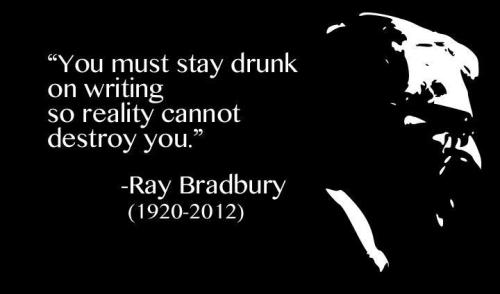
Rest in peace, master.

Posted in Uncategorized | 11 Comments

The Workshop

Tonight, I am in the Slough of Despond. That’s a reference to Pilgrim’s Progress, although Christian’s slough has to do with his sins and guilt for them, and my particular slough has to do more with my complete exhaustion. This is how the slough is described in the book:

“This miry Slough is such a place as cannot be mended; it is the descent whither the scum and filth that attends conviction for sin doth continually run, and therefore is it called the Slough of Despond: for still as the sinner is awakened about his lost condition, there ariseth in his soul many fears, and doubts, and discouraging apprehensions, which all of them get together, and settle in this place; and this is the reason of the badness of this ground.”

Well, the fears and doubts and discouraging apprehensions are right on, anyway. I think I’m feeling them because I’ve been going and going and going, as though I’m some sort of automaton, and of course I’m not. Eventually, I wear myself out.

Last week, I revised the first five chapters of the novel, and this weekend I took the bus to New York so I could workshop them with my group, The Injustice League. Some of us could not make it, but Catherynne Valente, Delia Sherman, and Ellen Kushner were all there. When we workshop, we do it a little differently from most groups. Here’s what happened this time: over lunch at a Thai place, we workshopped Cat’s story, then over dessert at a coffee shop (where I had a wonderful tiramisu) we workshopped my chapters, and then finally, over dinner at a Japanese place, we workshopped Delia’s story. Each manuscript was discussed for more than an hour, and each was discussed more intensely than I’ve ever seen a manuscript discussed in any other workshop. That’s what makes this workshop so special, I think. I’ve never talked to other writers about writing at such a high level.

And the critiques were intensely useful. I now know why I’m writing this novel and what I need to do next and after that and after that.  Before, I didn’t have a clear path; I have one now.  I know where to go, and how to get to the next place when I don’t–when what I do know runs out. Thank you, Cat and Delia and Ellen! You are all brilliant, and I don’t think I could do this without you.

But by the time I was sitting on the bus back to Boston, I was completely exhausted–to the level where I always become an emotional mess. It’s a combination of exhaustion, sensory overload, mental distress–a sort of stew of different things that all add up to a feeling as though I’m about to break. And that’s how I felt, sitting on that bus on the way back.

So I did the logical thing, which was to text my friend Nathan Ballingrud, who had the perfect solution. He said, let’s both write a story, under 5000 words. And I said, I’m going to start now. Actually, I had already started while standing in line, waiting to get on the bus. The first few lines had come to me then. But now, I sat there with my Moleskine notebook and my pen, scribbling. By the time I arrived in Boston, I had a very rough first draft. But I knew what the story was about, and I knew that I could type it up and give it the right shape, the narrative arc it needed.

I’m going to try to type it in the next two weeks, which is the deadline Nathan and I agreed on. Then, we will exchange stories for critiquing. But the immediate lesson for me was this:

If you’re a writer, whatever your problem, the solution is always writing.

Writing a story distracted me, calmed me, made me feel as though life was worth living again. I’m still not recovered, and I suspect recovery will take another week or so. I’ve just been working too hard. But at least I feel a little better.

I wanted to find an image of a woman writing to go with this post, and you know what? There are quite a lot of them. So here is your image: Woman Writing a Letter by Gerard Ter Borch II.

Posted in Uncategorized | 6 Comments

Victorian Hats

Tonight, I’m packing to go to New York, so this will be a short post with lots of pictures. Of hats.

Last night, I was up very late revising the first five chapters of The Mad Scientist’s Daughter. Around 3:00 a.m., I sent the revised manuscript to my writing group. In my email, I apologized for the roughness of the manuscript, and it really is rough at the moment: it’s at the stage where I’m still trying to get all the elements of the plot right. I’m trying to figure out the pieces of what will eventually be the central mystery of the novel. And at the same time, I’m trying to get a feel for my characters, for how they will act and interact. Since this is a historical fantasy, that includes figuring out their environment, including such seemingly mundane elements as what they wear, what rooms they go into and what furniture those rooms contain, when and what they eat. How they interact with their physical surroundings. I have to be able to imagine all those things in order to make them move through space smoothly.

In order to do that, I often have to consult research sources. Last night, for example, I was trying to figure out exactly what Mary Jekyll would look like. Here is how I started the first chapter. This may or may not be the eventual beginning of the novel.

Mary looked at herself in the hall mirror.

The face looking back was pale, with dark circles under the eyes. A halo of pale gold hair was visible under the brim of the black hat, and a high-collared black dress made the girl in the mirror look particularly sepulchral.

“What are you going to do?” Mary asked her.

“No sense talking to yourself, Miss,” said Mrs. Poole. “That’s what your poor mother started doing, toward the end. And much good it did her.”

“I doubt it did any harm,” said Mary. She turned to look at the housekeeper. “Is it still raining?”

“Yes, and you’d better take a cab or you’ll be soaked,” said Mrs. Poole.  “A week it’s been, and when will it stop, I wonder?  I’ve never seen London in such a foul mood.  Mr. Byles about snapped my head off when I asked for chops for your dinner, and the children in the park looked as though they’d been told there would be no Christmas this year.”

There are several reasons I started this way. First, the monster looking at itself in the mirror is a classic scene. I won’t go into the whole history of the scene, but I could: Frankenstein’s monster looks at himself in a pool, Jekyll uses a cheval glass to confirm his transformation into Hyde, etc. Second, in writing workshops, you’re always told not to have characters look at themselves in mirrors, and I like breaking writing rules. Third and most importantly, it simply felt right.

But the main issue for me was, what does Mary actually look like in this scene? Originally, I had her wearing a bonnet, but then I realized that a bonnet would have been worn earlier in the century. So I did some research, and found these pictures of late nineteenth-century hats. There were so many of them, so many different styles. I had to decide what sort of hat my character, Mary Jekyll, would wear.

They were a little earlier than the time during which my novel is set: the 1890s, when the New Woman movement became prominent.  Hats became more masculine, and therefore more sensible, during those years.  And Mary herself is a sensible girl.  She would wear a sensible hat. But these pictures could at least give me some ideas.

The ones below were far too feminine, too fancy. Mary would never wear anything like that.

These, too, were too fancy, and far too extravagant for a girl like Mary who has no money and must make her own way in the world. In the Victorian world, financial status was almost everything (social status was everything else). And so it has to be in my novel as well, even though it’s a fantasy.

No, no, no.  Seriously? Did women actually go around wearing these things?

Now we were getting closer.  These were hats specifically for sports, but some of them resembled the sorts of rather plain hats that Mary might wear. The one in the upper right, which looks almost like a woman’s black bowler, would fit both her pocketbook and her personality.

The last set were hats for children, and while Mary is of age, she is still young.  These hats gave me a better sense of what a younger woman might wear.  I decided that she was wearing something like the hat in the upper left, the black one.

The nice thing about being a writer is that you can leave so much to the reader’s imagination. So I don’t have to tell you exactly what sort of hat Mary is wearing. But it does become important later in the novel when she comes home and takes her hat off. Does she first take out a hatpin? I decided that she does not, that her hat is simple enough to just be taken off her head, and that her hair is probably in some sort of low bun that would allow her to wear a close-fitting hat. At least, that’s what I think for now. As I write the novel, I’ll get a better sense of who Mary is and what she looks like.

So there you have it, a small glimpse into what I was doing after midnight last night: revising a novel, but also looking at pictures of women’s hats from the 1880s-1900s.

Posted in Uncategorized | Leave a comment

Cat Country

Daisy died this morning.

Daisy was a cat, a small gray and orange and white cat. She had come to me more than twenty years ago, when she was just a kitten, rescued from a vacant lot. She lived a long life for a cat, being her own sweet self. Everyone who saw her remarked on her eyes, where were a particularly vivid shade of green.  I usually give cats fancier names (Nicholas, Cordelia).  But she came to me named Daisy, and the name suited her perfect: day’s eye, a simple, familiar name.

She had been getting older, slower, visibly thinner. Had stopped grooming herself. Seeing her had reminded me of my grandmother, whom I had taken care of before she died, also of old age. It was the same process, in a person and a cat.

So this morning we went through one of the rituals of childhood: the death of a pet. I’ve had many cats in my life, and I hope it doesn’t sound callous when I say that I’m used to them dying. It’s always sad, but part of the natural cycle of our lives. And there is a great beauty in that cycle. I remember thinking, even while taking care of my grandmother, that the human body was beautiful in decay. That death itself could be beautiful rather than frightening. The experience was a revelation to me, and I thought, that’s how I want to die: peacefully, suddenly, perhaps while eating breakfast one morning.

Of course, Ophelia did not have the philosophical tools to understand it that way. She responded purely emotionally, the way I would have as a child. So I told her about Cat Country.

Cat Country is a secret, so you must not tell anyone about it. I’m only sharing it here with you, and you must only share it with friends you trust. Have you ever looked for a cat everywhere, and not been able to find it–but then seen it come out from the place you just looked? It’s not that you missed the cat. It was in Cat Country.

In Cat Country, the rivers flow with milk. The berries that grow on the bushes are chicken or salmon or lamb. the trees are perfect for climbing with claws, and their leaves are like paper, easy to chew and rip. There are birds and salamanders and mice, but no dogs of any sort. There are many insects to chase in the grass, which is particularly succulent. In Cat Country there is a castle filled with pillows, and sunlit windowsills, and dark closets to explore. It is ruled over by the Lady of Cats, who adjudicates any disputes, brushes knots out of hair.

Cats, who are magical, can go to Cat Country at any time. The one thing Cat Country does not have is human beings, so they like to come into our world for what they can’t get there: hands to pet them, laser pointers. When they die, they leave their bodies and go to Cat Country.

I told Ophelia about Cat Country, and by the end, she was telling me what she thought was there, how there were fish in the streams and entire fields of catnip. By the time we buried Daisy and marked her grave with stones, she was all right–still missing Daisy of course, but able to handle her emotional response to death.  (I think that’s one thing we are responsible for teaching children–how to handle their own emotional responses.  And telling stories is a wonderful way to handle, to understand and create a context for, our emotions.)

Cat Country is a fairy tale, of course, but it expresses what I deeply believe about death–that it is not an end but a transition, and that what lies on the other side is another series of adventures. I believe that nothing wonderful is ever lost, that all the things we have created still exist somewhere, even though the library of Alexandria burned and entire cities have been buried under the earth. Death happens so quickly, and the sense I have, seeing a body just after the moment of death, is that something has left–has gone elsewhere. That was the sense I had with Daisy this morning.

By now, I think she’s probably in the catnip fields . . .

Posted in Uncategorized | 8 Comments

Fantasy and Biography

This is going to be a short post, because I’m very, very tired today and I still have a lot of work to get done.  But I wanted to write about a blog post by Damien Walter: “Fantasy Must Be a Struggle With Life.”  Walter writes about a lecture by Jonathan Franzen that was reprinted in The Guardian, in which Franzen says the following:

“My conception of a novel is that it ought to be a personal struggle, a direct and total engagement with the author’s story of his or her own life. This conception, again, I take from Kafka, who, although he was never transformed into an insect, and although he never had a piece of food (an apple from his family’s table!) lodged in his flesh and rotting there, devoted his whole life as a writer to describing his personal struggle with his family, with women, with his Jewish heritage, with moral law, with his Unconscious, with his sense of guilt, and with the modern world. Kafka’s work, which grows out of the night-time dreamworld in Kafka’s brain, is more autobiographical than any realistic retelling of his daytime experiences at the office or with his family or with a prostitute could have been. What is fiction, after all, if not a kind of purposeful dreaming? The writer works to create a dream that is vivid and has meaning, so that the reader can then vividly dream it and experience meaning. And work like Kafka’s, which seems to proceed directly from dream, is therefore an exceptionally pure form of autobiography. There is an important paradox here that I would like to stress: the greater the autobiographical content of a fiction writer’s work, the smaller its superficial resemblance to the writer’s actual life. The deeper the writer digs for meaning, the more the random particulars of the writer’s life become impediments to deliberate dreaming.”

Walter writes about the two conflicting impulses that have driven his own writing. One is the impulse toward autobiography (taking materials from one’s own life):

“When I began writing I found myself tugged back and forth between two seemingly conflicted urges. One was to write about my life. My first half-dozen published stories, all now hidden on my hard drive out of public sight, were very direct explorations of the tough bits of my own life. These stories, recounting for instance the exacting details of watching my mother die of cancer, felt uncomfortably like bludgeoning an emotional response from readers. (I have the same feeling even looking back at that last sentence) In literary terms I’d had the advantage of of a traumatic childhood. I had a lot of dramatic experience to draw upon and wasn’t afraid in my early twenties to beat the shit out of people with it. In fact I enjoyed the sensation and found some needed emotional resolution in it. But I couldn’t avoid the idea that this was an unfair way to treat the reader, and I could see that this was a limited kind of writing.”

The other is the impulse toward fantasy (making stuff up):

“Fortunately, the other tug on my writing sensibilities was the urge to write fantasy. By which I mean everything from Tolkienesque high fantasy to Gibsonesque cyberpunkian sci-fi fantasy. It’s all fantasy to my way of thinking. These were the writers I’d grown up with, the imaginary worlds I had retreated in to as an escape from all that traumatic childhood stuff. But whenever I tried, or sometimes return to trying, to write fantasy as an escape, I found that what I wrote died on the page. I have half a dozen novels worth of failed fantasy that will remain locked away until and hopefully after the day I die. It all needed to be written, it has all contributed to the million words every writer must write for their apprenticeship. But none of it ever needs to be read. I can’t quite bring myself to burn/delete it all, but I could do so with no great loss.”

He concludes, “The stories I have written that pass my internal quality tests, and which I have therefore left lying around for interested people to read, have all satisfied both my urges for biography and fantasy.”

I’ve quoted so extensively from Walter here because I think his blog post states, wonderfully, what I feel when I write: those two impulses, which are not necessarily conflicting impulses for me, perhaps because my biography has been so strange anyway. So fantastical. I find that the only way I can actually write about myself, about the story of my life, is through fantasy. I’m going to link to two stories of mine that I think of as deeply personal, even though only one of them reads as personal, and both read as at least somewhat fantastical:

The Rapid Advance of Sorrow
Her Mother’s Ghosts

In a way, “Her Mother’s Ghosts” explains a bit about the more personal elements of “The Rapid Advance of Sorrow.” I also once gave a talk at an APA convention about those elements. The talk was published as an essay: “Writing My Mother’s Ghosts.” Maybe that conjunction of the biographical and fantastical is what James Patrick Kelly and John Kessel were thinking about when they reprinted “The Rapid Advance of Sorrow” in Kafkaesque: Stories Inspired by Franz Kafka.

Walter ends by saying, of Franzan’s formulation,

“Whilst it might seem counter-intuative to some, all the fantasy writing I consider truly great conforms to that conception of the novel. Tolkien’s Lord of the Rings struggles with his own story of surviving the trenches of World War One. China Mieville’s Bas Lag novels struggle with his own story of living as an intellectual and marxist in one of the worlds great capitalist cities. William Gibson’s novels from Neuromancer to Zero History struggle with his own story of understanding a world reshaped by the emerging web of media he calls ‘the net.’ It’s the thing I find missing in most of the fantasy writing I encounter. However brilliantly it builds a world, tells a story, spins out remarkable idea . . . if the author isn’t engaged in the struggle with their own story, it all adds up to little more than a calcified shell, missing the fleshy pulp of life within.”

And I agree with that.

Posted in Uncategorized | 4 Comments

Unnatural Woman

I’m going to go back to writing about social class, really I am. But something happened yesterday that made me think, and I want to put some of that thinking down. I was testing the camera on my new BlackBerry, and I took a photo of myself. You know, the traditional photo in the bathroom mirror. It looked like this:

In the caption, I mentioned that this was a photo with no professional makeup artist or photographer, taken in harsh bathroom lighting after I’d been refinishing furniture for hours. I was making fun of myself. What surprised me was that it got quite a lot of responses, and many of them used the words “natural beauty.” Quite a few of them also mentioned that I looked just fine without makeup. Now, I had said without a professional makeup artist. Of course the woman in the picture is wearing makeup. If she weren’t, she wouldn’t look natural, because the harsh light would have washed her out completely. (And by her, I mean me, of course.) But what really caught my attention was the concept of natural beauty. It reminded me of a comment someone had once made on a photograph of mine that I had posted on Facebook. It was, “I love the red hair. I hope you are natural woman.” I’m not sure on what basis he was hoping that, because the photograph he was commenting on was heavily photoshopped. I had meant it to be edgy, not natural. Here it is, in case you’re curious:

Granted, he was probably talking about the color of my hair. But I remember my first response to the words “natural woman”: I thought, you’ve got to be joking. Because in the modern world, there is no such thing as a natural woman.

And then I thought about all the things about me that were unnatural, from my toes up to the top of my head. Even if you took the curls out of the hair (because my hair was curled that day), there would be the haircut. Hair is not naturally cut in long layers by a genius named Robert, but mine is. And you would have to remove years of the sunscreen and moisturizing creams that have made my face what it is, because faces look very different without that sort of daily care. And you would have to replace about half of the eyebrows. Also, unmanicure and unbuff the nails, unmoisturize the hands and feet. But even if you did all that, you would have to take away all the years of dance that make me stand and move the way I do, of pilates and watching what I eat that give me the shape I have. Because none of those are natural either.

Since I was a child, I have been created and constructed, as we all are. I believe in the concept of natural beauty, but I think only children have beauty that is truly natural. The rest of us are made, like mad scientists’ monsters, but in this case the mad scientists are custom and society. When they go too far, we become truly and frighteningly artificial, like certain celebrities. But when we go only as far as we need to, and people say that we have “natural beauty,” what they mean is really that we have constructed something that looks like nature the way we wish it were, nature in a dream, the way a beautifully manicured park can look like nature at her best.

I wrote in a note to myself, earlier today, “There is no such thing as a natural woman, because being a woman is performative.” But beauty is a sort of performance as well, a sort of dance that takes place over time. Women, in particular, learn the steps when they are young, as I learned it back when my mother used to tell me, “You must suffer for beauty.” (No, I’m not joking. That’s exactly what she said, and I bet all European mothers, and many American ones, say exactly the same thing!)

If there is truly natural beauty in a woman, it’s not what we think it is. It’s at the level of the bones. Shortly before she died, I visited my great-grandmother. She was almost bedridden at that point, a ninety-year-old woman with white hair haloing her face. But lying on her pillow, she was beautiful: that beauty was written into her bones, which were more prominent than they had ever been in her life. They were sharp and delicate and lovely. But that is a beauty closely allied to death. It is the opposite of the natural beauty of a child.

I’m not sure where this train of though has led me, except back to where I often end up: the idea that beauty has a necessary darkness to it, that it is allied to our mortality. Which is probably as good a place as any to stop.

Posted in Uncategorized | 15 Comments

More Photos

I’ve had a very busy day. Ophelia is in Virginia with her father, riding horses and finding crawfish in the creek, and I’ve been preparing for our trip to Europe. I made sure our passports were still valid, applied for a travel credit card at the bank so I wouldn’t be charged for credit card transactions, asked about the best way to exchange dollars for forints and pounds (take money out of the ATM, evidently), and tried to figure out how to get telephone service in Hungary and England. I think I’ll be taking an unlocked cell phone and buying minutes, which means I won’t have my BlackBerry (the new one, since the old one stopped working two weeks ago, taking everything with it: contacts, texts, emails). It will be difficult being without a smartphone for five weeks, but at least I’ll have my computer, and I’ll have wifi in Debrecen, London, and Budapest. The plan for Europe looks something like this: Ophelia and I will be flying Swissair to Budapest, but going almost immediately to Debrecen, where she will stay with her grandparents. I will be flying Wizzair from Debrecen to London, where I will be staying with friends for a week and doing research. Then back to Debrecen, and on to Budapest to meet the wonderful Catherynne Valente for a writer’s vacation. We will be writing in Budapest for two weeks. Then I will meet up with Ophelia and bring her back to Boston. At that point, her Hungarian will probably be better than mine!

But before any of that can happen, I have all sorts of things to do. Administrative things, first of all, but also I have to get as far into the novel as I can. My writing group meets on June 3rd, and I’ve promised them about 10,000 words. Which I have written, but not completely revised. So it’s down to New York again next weekend, but I think that will be the last trip before Budapest. I write all this to explain that since I’ve been running around today, instead of writing a blog post, I’m going to post some photographs I received last night.

Remember the photoshoot during ICFA? Well, while I was in Florida working with Walker1812 Photography, I made a list of additional photos that I particularly liked, and would like to see edited. I received some of them last night, and I thought I would post my absolute favorite, and then an example of each of the outfits we used during the photoshoot. So here you go, this is my favorite of all.

And here are examples of the three outfits.

The hardest thing about the photoshoot, for me, was overcoming my own anxiety about it. After all, I’m not a model. What I am, most days, is that geeky high school student–at least, that’s how I still think of myself, even though I look almost nothing like her anymore. I still expect to see her in the mirror. And so I think I was probably more self-conscious than I should have been. But you know what? It was so much fun! If I ever have an opportunity to do something like this again, I certainly will. And next time, I’ll be better at it.

I just have to post one more of the pictures, because this is one of my favorites as well.

Eventually, I’ll post all the photos on the press page. There are more of them coming, as well as some special projects that I’ll post once I receive them. I’m very lucky to be able to do such interesting things . . .

And now, back to work! Because I go to Europe in three weeks, and there’s still so much to get done!

Photos by Jesse Walker

Posted in Uncategorized | 4 Comments