Keeping it Simple

Today was one of those days you spend running around, trying to do all the things that need to get done, and they’re all such small things, but they need to get done or there will be trouble and inconvenience to follow. For example, while I was in New York, one of the nose pieces on my glasses fell off: you know, those small pieces of plastic that keep the glasses on your nose. Of course, you can’t wear the glasses without them. So an important errand today was running to my optometrist’s and having the nose piece fixed. Such a small thing, and yet so necessary.

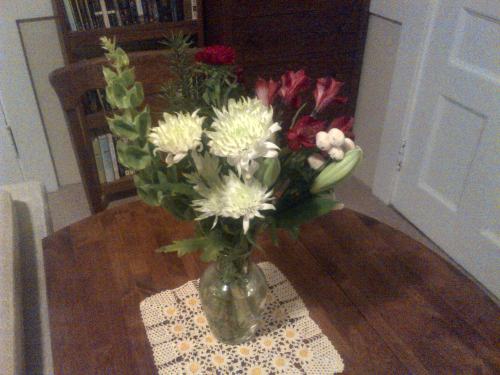
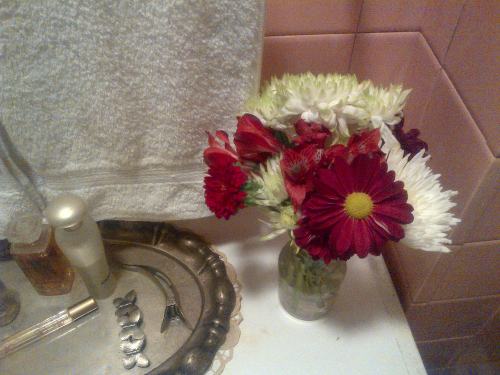
And I had to buy milk, because while I was gone the milk had gone sour, which means that I can’t make myself oatmeal for breakfast. And while I was out, I bought groceries just in general, including new flowers, because my flowers had mostly died. I’m not sure why, but in a fit of extravagance, I bought two bouquets, so I had plenty of flowers left over. Here is the main arrangement, on the table:

Flowers 1

And here is the arrangement in the bathroom:

Flowers 2

There are so many of those fiddly little things in our lives: glasses nose pieces, and cell phone batteries, and keys. Heels on shoes. They need to be fixed, or copied, or recharged, or glued on. Oh yes, and on my way home I had to pick up a new toaster, because I had spilled water on the counter and my toaster no longer worked. So I stopped in the hardware store and bought a new one.

I mention all this because life is full of such things, such errands. And if you want to live an interesting life, an artistic life, you have to minimize them. You can’t always be concerned with the fiddly things. I try to do that, conscientiously: to simplify. To have as few bills to pay as possible, to arrange my life so that I’m not endlessly taking care of things. So that the fundamental activities of life are simple. That’s partly why I’m so glad that I don’t have a car, which takes endless care. Last week, I packed my bag, got on the subway in Boston, got on a bus to New York, got on a subway in New York, and there I was: spending almost a week in New York, going to see and do fabulous things. This summer, although I’m not sure about this yet, I may well be doing the same thing, except in Europe. You would be astonished at how easy it is for me to pack, get on the subway, get on an airplane, get on the subway, and be in an apartment in Budapest. Or a house in London. Or anywhere.

That’s not to say that my life isn’t very full. Right now, it’s too full. I had a long meeting with a friend of mine in New York who is also in the publishing industry, and I told him that what I really needed right now were an agent, an accountant, and an assistant. And honestly, if I keep doing the sort of work I’m doing, steadily, those things will be necessary in the next year. But at least they’re part of my work. I try to simplify my life so that my work can be as complicated as it is.

And so that I can live fully, think and feel deeply. Create the complicated work I want to. That’s where I want the complication to be: on the page, in the story. So in life, I’m trying to keep it simple. Not that it always works, of course. But I do try. (My glasses are fixed, I have milk in the refrigerator, my toaster can even toast hot dog buns. And I have new flowers in my apartment. That means I’m good to go . . .)

Posted in Uncategorized | 1 Comment

Finding Your Core

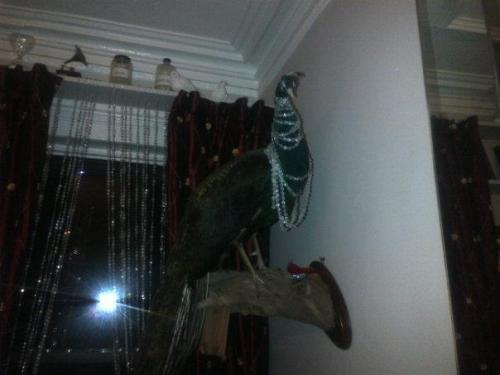
I’m sitting in an apartment in Brooklyn that belongs to the fabulous Maria Dahvana Headley. I came down by bus on Saturday, and I’ll be going back to Boston again on Thursday. My schedule here has been very, very full. On Sunday, I had lunch with Ellen Datlow, who has edited so many wonderful magazines and anthologies, and then on Saturday night, Nancy Hightower and I went to a magical party. It took place in a beautiful apartment belonging to the artist Cynthia von Buhler, in Manhattan. The guests were some of the most fascinating women in the arts that I’ve ever met: writers, artists, actors, creators in various media. The apartment itself was gorgeous: high ceilings, antique French furniture, mirrors and crystals and candlelight. It will give you just an idea if I post a picture of the stuffed peacock:

Dangerous Tea 2

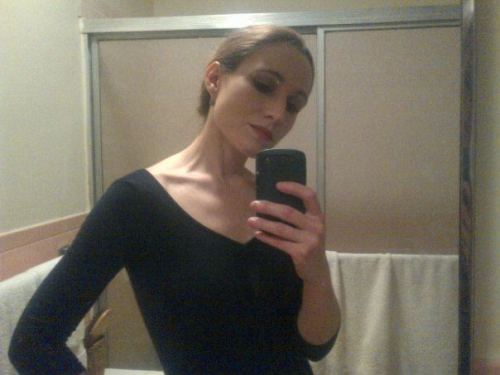
Yes, there was a stuffed peacock on the wall, and a lovely little dog so well-behaved that he did not bark at all at two white doves (not stuffed like the peacock, but performing doves that perched on our hands and flew around the room). It was like being in an enchanted palace for a little while. We talked about our lives and read from our work, and everyone there was beautiful and talented, and involved in such interesting projects. Here is me, underneath the stuffed peacock:

Dangerous Tea 1

I didn’t get back to Maria’s apartment until very late, around 3:30 a.m. Today, I had lunch with Asimov’s editor Sheila Williams. I have more lunches and dinners and coffees planned with writers and editors this week, and then on Wednesday night I’m going to the KGB Bar reading with Ben Loory and Mary Robinette Kowal.

It’s a very busy visit.

And it’s made me think about something that you learn in dance classes: movement comes from the core. Your core is the set of muscles around your abdominal area, the area from which moment in dance usually starts. When you move your arms and legs, you want to move them from the core. They don’t just move by themselves. They are supported by those strong muscles, from the hips to the middle of the rib cage. In order to dance well, you have to strengthen your core.

I think that over the last year, I’ve developed a strong core, metaphorically, in terms of my writing. I know what I’m doing and where I want to go. I have a clear vision of the sorts of stories and novels I want to write. What I need now is a strong core personally. I feel as though I’m still missing that, and when I travel, as I am doing now, I feel it: I can tell that I’m missing something. A sense of stability, a sense that I belong somewhere. If you don’t belong anywhere, all places are alike to you, which reminds me of a Kipling story but I don’t remember which one. Sitting here in an apartment in Brooklyn, I feel somehow rootless. I want to put down roots somewhere, so that when I go traveling, I always know where I will return to. Perhaps that’s the work of the next year.

That, and of course writing.

Writing this entry made me think of a sort of mantra: I am a ship made for sailing, and I shall not fear the storm. But I would like to know there is safe harbor somewhere.

Posted in Uncategorized | 3 Comments

Being Liminal

Sometimes, I annoy myself.

Tonight, for example. It’s cold outside, and my calves still hurt from a dance class I took on Monday, and I don’t want to go to another. But guess what I’m going to do? Go to a dance class, because it’s cold, and my calves hurt, and the class is going to be hard. I’m going because it would be easy to stay home and stream something on the computer, lying in my warm bed. But that’s not what I do, is it? No, I do the hard thing, because I’m me, and that’s what I always do. Annoying.

But I feel as though I have to do something, or anything, or perhaps everything, because at the moment I’m in a liminal state and it’s driving me mildly crazy. You know what a liminal state is, right? Arnold Van Gennep wrote about them in The Rites of Passage. According to Van Gennep, all rituals have three states: the pre-liminal, the liminal, and the post-liminal. The pre- and post-liminal are both stable social states. The liminal state is the state in between, the threshold over which you need to step to assume a new position. Except sometimes you get stuck in the threshold. Or sometimes the threshold just takes a lot longer to get through than you thought it would.

Well, I’m in that liminal state, between things: and I have no idea where I’m going. In a sense, I’m waiting for the universe to tell me, because I simply don’t know myself. The liminal state is the state of transformations, the state in which you change. In a ritual, it’s the state in which a young man goes out and becomes an animal for a period of time, living in the wilderness. It’s the state in which a young woman is socially out, but not yet engaged. It’s carnival. In life, it can often be a period of indecision, a period during which you feel as though there’s no ground under your feet. At the moment, I can’t feel the ground. I don’t know where I belong.

The problem with the liminal state is that it’s dangerous: Van Gennep tells us this. He says that the person on the threshold is at risk, particularly vulnerable. I can feel that — the vulnerability, the reaching out to something that might be more stable but not knowing where to find it. Liminal states last as long as appropriate: you don’t know when they’re going to end. They weaken you, and there are days on which I feel weaker than I would like, more tired.

I think that’s why I find comfort in things that are ordered. The ritual of teaching, the rigor of learning Hungarian (since I will probably go to Hungary next summer — unexpectedly, since I did not think I would be able to go), the language of ballet. When the teacher says tombé, pas de bourrée, glissade, pas de chat, I know the combination of steps to take. It’s nice knowing what steps to take, even if it’s only the next six.

My image for today is me after Monday’s ballet class:

Ballet Dora

I’ve had way too much uncertainty in my life to be comfortable with being liminal for long. I think I will end up with some sort of stability — I just don’t know when.

Posted in Uncategorized | 8 Comments

Being Responsive

Today, I looked at the date of my last post and realized it was November 17th, which startled me. I haven’t been good at posting, or at responding to comments. I wanted to explain why, because I think it goes to the problem that many writers have, keeping up with their writing lives as well as whatever other lives they might be leading.

There are so many people to whom I’m supposed to respond, in one way or another. The most important group is my students, who often need my help with their writing. But I get emails about all sorts of other things as well: things for me as a professor, for me as a writer. And then there are facebook posts and messages, twitter posts and messages. On an average day, I can end up responding to a hundred people or more.  (Not necessarily individually, of course.  But on Friday I taught, and was therefore responsive to, 48 students.  You see how the number can climb.)

A friend of mine who is an extrovert told me that contact with other people energizes her. Because I’m an introvert, it wears me out. All of those responses are little bits of energy, going out from me to whomever I’m responding to. And right now, there isn’t very much replenishing that energy. It can be replenished in various ways: rest, beauty, pleasure. Contact with close friends, which is replenishing rather than draining. But those are all things I have very little time for right now, and as a result I am almost always tired. Too tired to be as responsive as I need to be.

Too tired to write, which is a problem. Writing is interesting because it’s the one thing that both drains and replenishes you. Writing a scene leaves me both exhilarated and exhausted. But I need to at least have enough energy to start. (And time. It’s the end of the semester, and there’s so little time right now.)

I don’t have any particular wisdom to impart here. I just need to figure out how to live differently. I understand why some writers become recluses: they can pour all that energy into their work. I can’t do that: I’m not enough of an introvert, and I would be lonely. But I need to find a balance, and I don’t know where it is.

So if I’ve failed to respond to you about something in the recent past, that’s why.

Over the last few days, I’ve had the last two lines of Dylan Thomas’s poem “Fern Hill” going through my head. You know what I mean, right? Here is the last stanza:

“Nothing I cared, in the lamb white days, that time would take me
Up to the swallow thronged loft by the shadow of my hand,
In the moon that is always rising,
Nor that riding to sleep
I should hear him fly with the high fields
And wake to the farm forever fled from the childless land.
Oh as I was young and easy in the mercy of his means,
Time held me green and dying
Though I sang in my chains like the sea.”

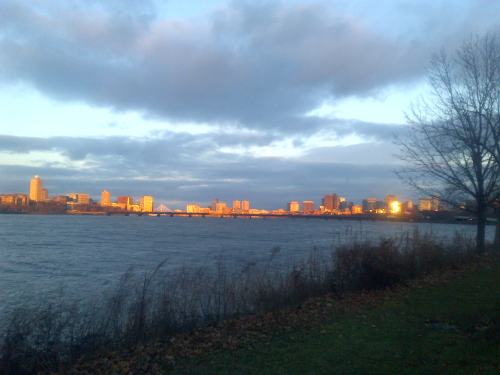
It’s beautiful, isn’t it? But when words go through our heads repeatedly, it’s the unconscious speaking to us. (That’s how it speaks to us: through dreams, through poetry). And that’s not a good message to get. It means that I’m feeling like a free thing chained, even though I’m singing. But this is a problem to solve, a dilemma to get out of. Maybe I need to go down to the sea? I mean actually go down to the water, which is only a subway ride away from me. Sometimes, when your mind gives you metaphors, it helps to actualize them. Which reminds me, oddly enough, of John Masefield’s “Sea Fever”: “I must go down to the seas again, for the call of the running tide / Is a wild call and a clear call that may not be denied.”

Maybe if I hear that wild, clear call, I’ll figure out what to do.  Or maybe the sea itself, in its ancient beauty and wisdom, will spare me some of its energy . . .

Meditation by the Sea

(This is a painting called Mediation by the Sea that is hanging in the Boston Museum of Fine Arts. I don’t think the painter has been identified. It comes from the 1860s.)

Posted in Uncategorized | 6 Comments

Being Ruthless

Today, I stumbled upon an interview with William Faulkner in the Spring, 1956 edition of The Paris Review. In it, he says this:

“The writer’s only responsibility is to his art. He will be completely ruthless if he is a good one. He has a dream. It anguishes him so much he must get rid of it. He has no peace until then. Everything goes by the board: honor, pride, decency, security, happiness, all, to get the book written. If a writer has to rob his mother, he will not hesitate; the ‘Ode on a Grecian Urn’ is worth any number of old ladies.”

I remembered this quotation particularly because the author Dan Simmons had posted it once, and gotten some fairly negative responses. (Dan is one of the first people who ever encouraged me, and I am forever grateful to him for it.) I remember one of them: a man who wrote that Faulkner was wrong, that a writer had a primary responsibility to his family, his community, his country — oh, this particularly man had a long list of things the writer was responsible to, all of which were supposed to take precedence over his writing. And I thought, no wonder I’ve never heard of him. He’s not a writer.

If you read the entire interview, you’ll see that Faulkner is being egotistical in a humorous way, in a sense posing as William Faulkner, playing himself. I like that about him. I like that he created a persona. Why shouldn’t he? Why shouldn’t writers write themselves as well as their stories? It’s certainly more entertaining for us, who read them. I mean, I’m glad J.K. Rowling went off and bought a castle. I’m glad Anne Rice used to arrive at readings in a coffin. I like it when writers have a sense of drama, of story.

But the quotation itself: I think it has a hard core of truth to it. And here’s that hard core. When you start writing, nobody cares whether you write or not. Your family wants what is best for you, which is often not writing, because writing involves making hard choices, including hard financial choices. I left law because I knew that I would never become a writer if I stayed in it. I think at some level, my family still doesn’t understand how I could have left a such a lucrative career. Your friends don’t care, because most of them don’t understand why you would want to be a writer in the first place. It’s only when you start becoming a writer that you make friends who are writers, and they do care — but that comes during the process. And when you start out, you have no readers. Once you have published some things that people have responded to, all this changes — then editors ask you for stories, agents want novels, readers let you know that your writing means something to them. But to get to that place, which can take a decade or more, you have to be ruthless. You have to prioritize your writing, because no one else will.

Of course, once you become successful and you’re making money, there are other things to be ruthless about — for example, ruthlessly following your own vision rather than writing the series that your editor or agent wants. It’s always best to have people around you, whether professionals or friends, who are on your side, who understand what you ruthlessly want to do, and actually support it. Then you can be a little less ruthless.

It’s the word “ruthless” that bothers people so much, I think. No, you shouldn’t actually rob your mother. But you may well rob her of a dream that you will someday be a successful lawyer or doctor. You may well disappoint her. That’s when I think it’s useful to remember Faulkner. To be a writer, you have to have a hard core yourself. You have to be willing to disappoint people, to say no, to take rejection. To be ruthless even to yourself, to refuse to put up with your own laziness and cowardice.

The arts are not for the faint of heart, you know.

Posted in Uncategorized | 9 Comments

Our Need for Romance

When I was a graduate student, I had money for necessities, but not luxuries. (Necessities were things like rent and heat. Luxuries were often things like clothes. That was when I got into the habit of shopping in thrift stores.) At some point, I mentioned to a friend that I missed being able to buy perfume. She sent me a whole bottle of Chanel No. 5. I used to wear it every day, and some days, I used to put just a little bit on before I went to bed, so I could smell it even in my sleep. I still have some left.

I don’t know if we all have a need for romance, but I think at least some of us do. I know I do . . .

I define romance broadly: in its modern meaning, it usually refers to romantic love, but in an older sense, it refers to the medieval romances, which were tales in the native vernacular (French, Italian, Spanish) rather than in Latin. They often involved knights, ogres and giants, ladies who lived beneath lakes or could turn into animals. They were tales of adventure and magic. I think we all need tales of adventure and magic in our lives.

I feel my own need for romance the most when I’ve been working very hard (as I have been recently). It feels as though I’m not truly living, merely existing. That’s when I want something interesting to happen. Something that tells me there is an underlying magic to the world, that life can be an adventure. Of course, as you can tell by this blog post, I’ve been feeling that way lately. It’s November, so the work is constant and it’s never done. But I hope there is some sort of magic and adventure in the near future, waiting for me. Sometimes I think that rather than making the future, we are pulled toward it, that there are certain nodes that draw us onward. It’s as though life is a matter half of fate and half of intention, both what we make it and what the universe wants of us. Sometimes I think of it as a dance: we are dancing with the universe, toward our futures, our fates.

I’ve gotten esoteric, I know. But what I meant to say was, I think many of us have a need for something other than ordinary life. We need it as a reminder that ordinary life is not all there is, that there is more. (And there is. I believe that.) There is courage, there is passion, there is beauty in the world. We can’t always see it, but it’s there. Those are all large things, and often we don’t have time for such large things, not in our daily lives. We only have time for smaller things, for small indicia of them. So we buy perfume; or wear long, elegant coats; or hang pictures of landscapes that remind us of our dreams. It is the most we can do, and some days that is enough. But it also reminds us that there is more to life, that the larger things exist.

I’m going to include one of my favorite pictures, which I may have posted before. It is John William Waterhouse’s My Sweet Rose, and it reminds me of our need for romance: our need to smell the roses on the wall, before winter takes them.

Posted in Uncategorized | 4 Comments

Finding the Time

I’m so tired! It’s the middle of the semester, and I’ve spent all week meeting with my students about their papers. I have 48 students, and it takes at least half an hour to go through a paper and meet with a student (about fifteen minutes each). So I spend about 24 hours meeting with students, in addition to teaching and holding office hours. And then there are all the administrative meetings, which have been particularly numerous this week. Both of the classes I’m teaching this semester are new, and I’m trying to make them interesting and innovative, so there’s quite a bit of preparation involved. Because of all that, I’ve been feeling overwhelmed with work, and very tired.

So the question is, what happens to the writing? Well, the answer at the moment is that I haven’t written in several days. No, that’s not true: I wrote a couple of paragraphs yesterday, but not of the novel. I was waiting to vote, and I wrote several paragraphs of a short story while standing in line. (Voting took about an hour and a half, and it was the end of a long day of meeting with students.) If I had brought a book, I would have read — it would have been Jane Eyre, which I am currently teaching, so my reading would actually have been preparation for class. But I didn’t have a book, so I took out the Moleskine notebook I always have with me, and one of my Pilot pens, and started the story I want to write.

But I haven’t been working on the novel, and that really bothers me. The problem is that working on the novel takes a certain amount of energy: I can’t be exhausted. And I’ve been exhausted most of this week.

How does one find the time to write?

I wanted to find an icon for this blog post, and I found what I think is an appropriate one: a picture of a woman writing from a mural in Pompei.

I wonder if she had the same problems I do? It seems as though all of my time is needed simply to do the work that supports me. The advantage of teaching at the university level is that it does allow me to have a flexibility that many people don’t, and I do genuinely love it. And it gives me ideas that I would never have gotten otherwise: for example, I was reading the fairy tales that the students in my Fairy Tales and Literature class had written, and I thought, what I really want to do is write a series of stories about Sylvania, my imaginary Eastern European country. (My stories “Fair Ladies” and “Princess Lucinda and the Hound of the Moon” both take place there.) I want those stories to tell the history of Sylvania, and somehow I want to include the Sylvanian versions of the fairy tales we all know. I wonder what those versions would be like?

But the problem with teaching is that it takes the same kind of creative mental energy as writing. So by the end of the day, my brain is already tired, and of course that’s when I write. I know some people write in the morning, but I can’t do that. I can’t write knowing that I will need to stop in order to get dressed, or eat breakfast, or go off to teach. I have to sit down at my computer knowing that I have as much time as I need, that if I need to stay up later to finish something, I can. And writing is tiring: I can’t go and teach afterward.

So there’s my dilemma. Next semester may be a bit easier, I don’t know. And then I’ll have more time over the summer, although I’ll be teaching part of the summer as well. I envy people who have some sort of financial support, because for me, it’s all me. I have to support myself and do what I love to do in the time that’s left. On the other hand, I know people who have a lot more support than I do, a lot more time, and who talk about writing without necessarily writing. I suppose what you have to have, in the end, is determination. You have to find what time you have, and write then. I don’t know if I can tonight: I’m honestly worn out. But I have to find a way to plan better, take care of myself better, so I can do it. I’ll find a way. I always do.

Posted in Uncategorized | 6 Comments