Teaching at Stonecoast II

This is the second in my “Teaching at Stonecoast” series, about what I did during this summer’s Stonecoast MFA Program residency. In this post, I want to talk more about the sorts of things we covered in my two workshops. The first workshop was for new students: it oriented them to Stonecoast and got them started workshopping stories. The second workshop focused specifically on short fiction, and was co-led with my own former teacher, the science fiction writer James Patrick Kelly.

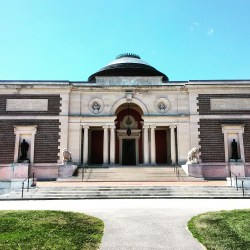
This is the first building I would enter every day: where we held our graduating student presentations. I told you Bowdoin is beautiful!

Stonecoast 12

In my first workshop, after we had workshopped the two stories for the day, I walked about elements of a story: setting, character, plot, and style. (We only had four days, so four elements). For each, I had three examples, and toward the end of the workshop we would read and discuss them. Here’s one:

“You never saw such a wild thing as my mother, her hat seized by the winds and blown out to sea so that her hair was a white mane, her black lisle legs exposed to the thigh, her skirts tucked around her waist, one hand on the reigns of the rearing horse while the other clasped my father’s service revolver and, behind her, the breaker of the savage, indifferent sea, like the witness of a furious justice. And my husband stood stock-still, as if she had been Medusa, the sword still raised over his head as in those clockwork tableaux of Bluebeard that you see in glass cases at fairs.

“And then it was as though a curious child pushed his centime into the slot and set all in motion. The heavy, bearded figure roared out aloud, braying with fury, and, wielding the honorable sword as if it were a matter of death or glory, charged us, all three.

“On her eighteenth birthday, my mother had disposed of a man-eating tiger that had ravaged the villages in the hills north of Hanoi. Now, without a moment’s hesitation, she raised my father’s gun, took aim and put a single, irreproachable bullet through my husband’s head.”

This is from a story called “The Bloody Chamber,” by Angela Carter. If you’re looking at it as a writer, there are all sorts of things you notice: the point of view, for example (first person, talking directly to us). The pacing, which stops and starts: the movement of the mother, the stillness of the husband, the movement of the husband, then the pause in narrative momentum as we learn about what the mother did when she was eighteen. And then, suddenly, the shot. The pacing is brilliantly handled. Word choice: “seized,” “blown,” “exposed,” “tucked,” “rearing,” “clasped” . . . all the active verbs. And then the opposition of Medusa and Bluebeard, two different mythical figures, almost as thought the story were posing a hypothetical question: in a matchup between Medusa and Bluebeard, who would win? Medusa, duh.

My goal was to get the students to think, not like readers, but like writers. That creates its own problems . . . you can’t read stories the way you used to, anymore. But putting together even the shortest story is an act of craft, and writers need to learn the craft. (There’s art too, but you don’t learn art. You become an artist. Art isn’t taught but embodied.)

Stonecoast 13

So that was my first workshop, and I was very happy with how it went.

Oh, I’ve forgotten something! I also gave the students an exercise: they had to write pieces of flash fiction (no more than 1000 words) and send them to me. For the last class, I compiled them, then gave the students the stories without the authors’ names. I had written one myself, because if you make a student do something, you should always be willing to do it yourself as well. During our last workshop, we discussed the stories — then they had to vote on who had written which one. I was the only one who knew. If you’re a teacher, steal this exercise — I stole it myself from Jim Kelly. Every time I’ve done it, I’ve gotten writing from students that was actually more creative, more innovative, than the polished stories they had turned in. In the short format, students felt free to try something new. At least once, when I tried an exercise like this, it turned into a student’s first published story.

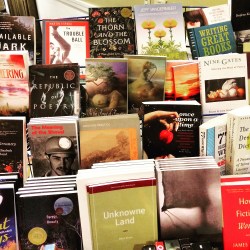
This is a small part of the book table, with my books on it. We would pass the book table every day on our way to lunch . . .

Stonecoast 16

And what about the second workshop? That was filled with students who had been at Stonecoast for at least one semester, students who were already writing steadily, some of them starting to publish. That workshop was really about how to turn short stories that were already interesting and well-written into stories that would hopefully be published by one of the genre markets. Jim and I took turns leading the workshop. On our days, we both also lectured briefly on aspects of writing short stories. On my first day, I talked about the components of a short story, the things I wanted a short story to do and have, taking examples from my own stories. Here are the things I covered:

1. I want a short story to start quickly. The setting, central characters, and theme should be established by the second paragraph. But while the first two paragraphs are about establishing, about creating stability for the reader, they are also about destabilizing the reader. I want to create the forward momentum that will carry the reader through the story. What does the reader not know? Give your reader both a jumping-off place and a direction to jump, I told them.

2. I want to create a setting that is dense, appealing to multiple senses. The setting should be both immediate (where are the characters now?) and expansive (what is their larger world like?). A good description of setting should do both.

3. I want to describe characters quickly, with descriptions that give a sense of the inner and outer at once: both what the character looks like and what the character is like. And if another character is doing the describing, the description should say as much about that character as the one being described.

4. I want to continually advance the plot. Here I talked about my favorite definition of plot, from E.M. Forster’s Aspects of the Novel. Actions, if they are to be part of the plot, should have consequences. So think through the consequences of each action . . .

5. I want to raise the stakes, and the stakes are always emotional. The plot means nothing if we don’t care. (I don’t think I mentioned Vladimir Nabokov’s injunction that the author should put her character up a tree and throw rocks at him. But I think that sort of rock-throwing is important.)

6. I like to reveal secrets, things the reader doesn’t know, and maybe the character doesn’t know either. I like to lead up to the revelation of a secret. I think this makes the story more interesting, like a mystery . . . The revelation should be both inevitable and surprising.

7. I want to conclude effectively. The conclusion should bring together both the inner and outer arcs of the story: the emotional arc and the arc of the action.  It can be a big ending or a small one: an ending that underplays the emotional consequences is often more effective than a big fireworks-going-off conclusion. In the example I chose, two men are walking together, talking about breakfast, and the important thing is mentioned as an aside: one of them has chosen to stay in his homeland and fight the Germans.  We know that World War II is coming, although they’re talking about sausage and eggs.

Stonecoast 18

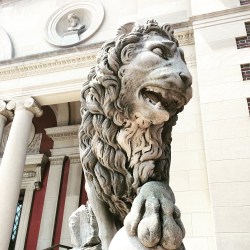
This post is already a bit longer than I intended, so I see that I’ll have to go on to a third one! In it, I’ll talk about what I discussed on my second day leading the workshop: breaking the rules and becoming an artist. The handsome beast above is one of the stone lions in front of the Bowdoin art museum, and a close personal friend.

And below you’ll see one of my favorite things in Brunswick, which is Heath Bar frozen yogurt with Heath Bar topping, from an ice cream shack named Cote’s that is about a block from the inn. This is a “mini” and sells for three dollars (the next size up is a small, which is, you guessed it, not particularly small).

Stonecoast 31

Posted in Uncategorized | 2 Comments

Teaching at Stonecoast I

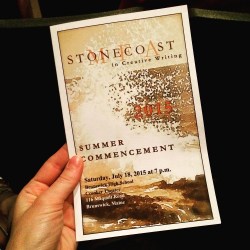
I’m recovering from the Stonecoast summer residency. What, you may ask, is Stonecoast? And what is a residency? Stonecoast is the MFA program in which I teach, and the residency is a ten-day period when all the students and faculty get together, twice a year, for workshops, seminars, and readings. It’s the most intense teaching I do, and I love it.

For those of you who are interested, I thought I would describe what it’s like teaching in one of the top low-residency programs in the country, and one of only a few that have a Popular Fiction track. That’s what I teach: Popular Fiction. My students write science fiction, fantasy, mystery . . . And of course they also write literary fiction, poetry, essays. Being on the Popular Fiction track doesn’t prevent you from writing, or taking workshops in, other modes or genres. But most of what I do in the program tends to focus on popular genres, in one way or another — or the places where genres intersect.

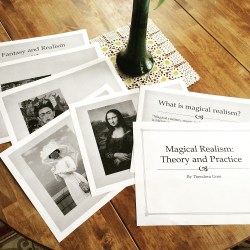
So what was I doing, exactly? Well, first I had to prepare for the residency. That meant reading and commenting on the stories from the two workshops I would be leading. The first half of the residency, I would be leading a workshop for the newly-admitted students, which would prepare them for workshopping at Stonecoast in general. It would be both workshop and orientation. I’d never done that before, so I was particularly looking forward to it. The second half, I would be co-leading a workshop focused specifically on writing short fiction with James Patrick Kelly. Now, Jim Kelly is a friend and mentor of mine — he was my own teacher at Clarion! So you can imagine how much I was looking forward to that. I would be co-teaching with my own teacher! Also, Jim is a fantastic writer of short fiction as well as a fantastic teacher in general, so I knew that I would be learning as much as I would be teaching. During the residency, I would also be giving a presentation called Magical Realism: Theory and Practice. So I created a PowerPoint, and a series of presentation notes for myself, and a reading list to hand out. Here you can see the slides from my PowerPoint presentation, which I printed out so I could proofread them:

Stonecoast 3

The presentation took a lot of work, because I am not an expert on Magical Realism. As I told the students, there are things I am genuinely an expert on, because I’ve studied them intensively for years. But Magical Realism is not within my field of expertise. That’s what made doing a presentation so exciting: I had to learn about a whole new field! Of course I’d studied it a little, starting with a class on magical realist fiction in college. But I had a lot of reading to do before I could present on the topic in any coherent way. That took a couple of months! By the time I started preparing for the residency in earnest, I had enough of a background to put together my presentation — more or less confidently. So that was most of the preparatory work. I also knew I’d need to prepare a 20-minute reading, but I’d recently written a story that I wanted to read . . . so that was taken care of.

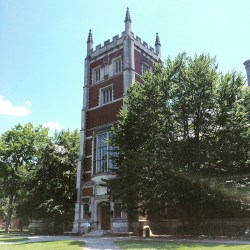
The residency took place on the campus of Bowdoin College, in Brunswick, Maine.

Stonecoast 7

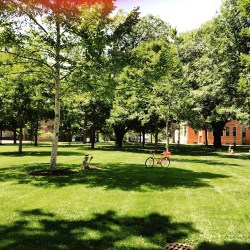
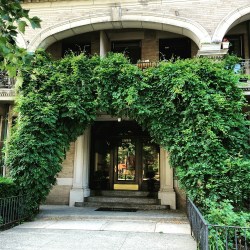
If you’ve never been on the campus of Bowdoin, I will tell you that it’s ridiculously beautiful. You can just take a look at the pictures here! It looks exactly the way you would expect a New England liberal arts college to look, all green campus and stone or brick buildings. First, of course, I had to get there. I’m lucky in that I live in the Northeast, where it’s easy to get around by train. I took the Amtrak Downeaster up to Brunswick and walked from the station to the inn where faculty members were staying. For ten days, my room at the inn would be my home. I unpacked, putting clothes away, hanging blouses and dresses from the hangers — if you move in, I’ve found, you feel much more at home, even in a hotel room. And then I went shopping for supplies. Of course I could have ordered breakfast at the inn, but I found it so much easier to buy cups of oatmeal and powered chai, so that, with only the coffee maker in my room, I could make myself oatmeal and chai in the mornings. Also cereal bars and chocolate, in case I got hungry during the day — because if I get hungry, I get cranky.

Stonecoast 8

So there I was, with my clothes put away, my manuscripts ready, my supplies purchased. Time to start the residency.

The residency day starts at 8:15, with graduating student presentations. This summer, I had a graduating student whom I had mentored — I had been the first reader on her thesis, and had guided her through the thesis process. Her presentation was one of the first, and I was so pleased to see how well it went, how smart it was. For her third-semester project, she had researched the history of monsters, and in her presentation she explained how conceptions of monsters had changed, from the mythical monsters, to the medieval, to the modern (particularly post-World War II). Then, after student presentations, we have workshops for two and a half hours. With my first-semester students, we generally workshopped one story, took a break, workshopped a second story, and then went on to talk about particular writing issues. I had brought a handout that included a variety of passages — for example, I’d just started reading Patrick Süskind ‘s Perfume: The Story of a Murderer, and I included the first two paragraphs, in which he describes the stench of 18th century Paris. It’s a brilliant description, a brilliant and unconventional way to start a novel. We talked about the choice of words and images, the way the author directs our attention (always conscious of the fact that we were dealing with a translation from the German).

Stonecoast 10

After workshop, we had lunch, all of us together in the Bowdoin cafeteria. And then in the afternoon there were faculty presentations. After those, there was other programming, typically graduating student readings but also orientations of various sorts, such as for students going to the Ireland residency (yes, Stonecoast has an optional Ireland residency! Send me to Ireland, Stonecoast . . .). Then it was time for dinner, and then faculty readings. So the days ended at around 8:15 p.m., unless there was something even after that, like student open-mic’s. Yes, I know, twelve-hours days! That’s what a residency is like . . .

I’ve written so much already, and I haven’t really even started to describe what I did at the residency! I’ll have to write another blog post on this subject. In the meantime, here is me, sitting in one of the rocking chairs on the inn porch, going over manuscripts . . .

Stonecoast 15

Posted in Uncategorized | 4 Comments

Ordinary Pleasures

Last summer, I spent a month in Budapest, taking a class in Hungarian. This summer, I organized my taxes.

I’m not kidding, I really did organize my taxes. It’s such a relief, having all that paperwork organized into individual folders, appropriately labeled. I know, it’s a lot less exotic than flying to Budapest. But this summer has been about trying to catch up on all the ordinary things that, to be honest, I’ve neglected. I’ve lived in my apartment for a year, and it’s still not entirely decorated. Granted, decorating takes a while, at least the way I do it, but still . . . I’d like to have a nice place to live in. And that takes putting in the time, doing the work. So this summer is about doing the ordinary things: working, organizing, catching up.

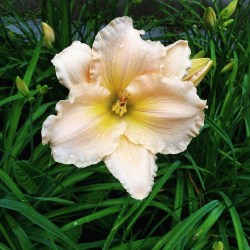
What I’ve found, staying in Boston this summer, is the pleasure of the ordinary. The pleasure, for example, of watching the procession of flowers. Luckily, I live in the midst of gardens: there are gardens in front of the brownstones all up and down my street, more formal gardens in city squares or close to children’s playgrounds, and even conservation areas where I can go for walks beside rivers or ponds, under tall trees. Just now the roses and clematis are almost over, although this week I still found some perfect roses in a formal rose garden not too far from me. This was one of them:

Rose 1 1000

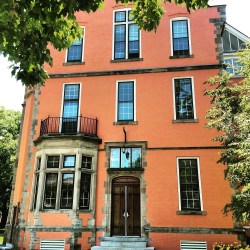
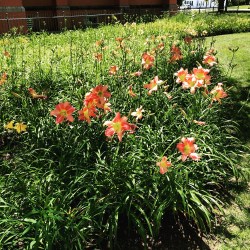
The lilies have started blooming, and the linden trees are in flower. I’m lucky to live on a street with linden trees, so I can smell the sweet odor every time I step outdoors. It seems to fall from the trees . . . Every time one type of flower fades, I feel sad because it means that summer is passing. But at the same time, it’s fascinating to see them, like the best fashion show ever. Nothing we create is as beautiful as the flowers. Mother Nature is, after all, the greatest artist. And I love walking around the city, looking at the old buildings with their beautiful details. Architecture lost both beauty and detail for a while — we were poorer for that, and are just starting to find those two things again.

Park 1 1000

What we really lost, I think, is the understanding that beauty and joy come from the small, the ordinary. Take those enormous contraptions of steel and glass created by the most famous contemporary architects. They are rarely beautiful, and they rarely give us joy. If we got rid of every single one of them, it would not impact our lives in a significant way. Compare them to a honeybee, so small and intricate. Isn’t the bee more beautiful? And if we got rid of every single one of them . . . well then, we’d be in trouble.

I don’t know what happened to our sense of the small and ordinary, but I think we need to get it back. Recently, I started watching a television show from the 1960s, and I was startled by how small things were: hotel rooms, women’s clothes, international crime syndicates. (All right, if you must know, it’s Mission Impossible. I love watching a show that is almost pure plot . . .) There are ways in which we live in a better world. No Cold War, for one. But I think as we progress, we always lose something. In this case, at least, I think we can get it back.

After I went to the rose garden, I walked to the conservancy I mentioned, which is a wetland. There is a path through the woods . . . (I thought this would be a good place for a metaphor.)

Park 3 1000

We can make a conscious decision to reclaim the small, the ordinary. We can care more about honeybees than skyscrapers. Knitting than international finance. (Don’t get me wrong: you should try to understand international finance. We need to understand what is being done to our world, if only because voting intelligently is one of those small things that make a large impact, like honeybees.) We can learn to cook or play an instrument. We can organize our taxes. Clean our bathrooms. (That’s on the agenda for today.) There is so much meaning in those small acts, and the truth is, when we do something large, the meaning of it usually comes from the small components anyway. If we write a novel, the meaning comes from all those hours we spent at our computer, trying to find the right word. From each edit. From the lessons we learned about ourselves while writing.

Park 4 1000

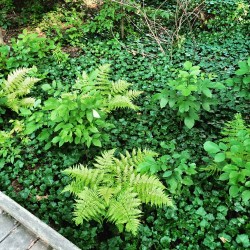
Aren’t the ferns gorgeous? I had to take a picture of them as I walked through the forest. It was like walking through a green world, made up of all the small things: beech leaves rustling overhead, white trunks of birches, ferns by the path, rabbits hopping under the bushes, looking at me as though wondering what I was doing in their living room, and the magnificent blue heron that was standing in the pond, with a blue heron reflected in the pond water beneath him. I thought, I’d like to have something like this, a connection of this sort, every day of my life.

Then I went home and did the small things there: made dinner, finished some sewing I’d been putting off for a while, intimidated as always by my sewing machine because tension is so complicated . . . but no, my Singer behaved perfect. And then I did something I’m really quite proud of: I figured out how to use my new mat cutting board and cut some mats. It took a while to get used to, but look:

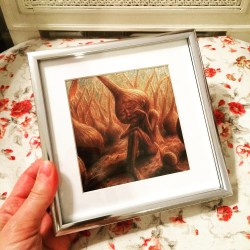
Mat 1000

That’s a small card by the artist Virginia Lee, of a weeping Onion Man. I found the square frame at Goodwill, and I thought, it will be too small. But with a one-inch mat, it fit the picture quite well. (I had to cut the mat twice. The trick, I found, is to use a real mat board under the mat board you’re cutting, rather than the cardboard included with your mat cutter.) Virginia gave me the card when I visited her village, in England. So I’m not saying don’t do the large things — I would not have missed my trip to England for the world. But remember to do the small ones, because those are where we mostly find meaning . . . and joy.

Posted in Uncategorized | 2 Comments

A Forgotten Poet

I’ve been working on a project of mine: Poems of the Fantastic and Macabre. It’s an online anthology of poetry with fantastical elements, from as far back as poetry has been written in what is identifiably “English.” It goes all the way from medieval ballads of the thirteenth and fourteenth centuries to modern poetry, by which I mean poetry of the early 20th century. Since the semester ended and I’ve had a little more time, I’ve been adding poetry, and I’ve also updated the design of the site. I’m going to keep working on it, because this is very much a long-term project. I’ll keep adding poets and poems when I can.

Recently I added a poet that particularly interested me. Her name is Ruth Mather Skidmore, and she wrote this poem:

Fantasy

I think if I should wait some night in an enchanted forest
With tall dim hemlocks and moss-covered branches,
And quiet, shadowy aisles between the tall blue-lichened trees;
With low shrubs forming grotesque outlines in the moonlight,
And the ground covered with a thick carpet of pine needles
So that my footsteps made no sound, —
They would not be afraid to glide silently from their hiding places
To the white patch of moonlight on the pine needles,
And dance to the moon and the stars and the wind.

Their arms would gleam white in the moonlight
And a thousand dewdrops sparkle in the dimness of their hair;
But I should not dare to look at their wildly beautiful faces.

Isn’t it beautiful? I found it in an anthology called Poems of Magic and Spells, which sent me back to Walter de la Mare’s anthology Come Hither: A Collection of Rhymes and Poems for the Young of All Ages, which send me back even farther: to an anthology called Off to Arcady : Adventures in Poetry, published in 1933. I very much wanted to include it, but I knew nothing about the poet. And at a minimum, I needed to know when she had been born and when she had died. I needed those dates for the table of contents.

So I went to the internet, expecting to find something. Not necessarily a biographical entry, but something . . . after all, the poem is accomplished. She was obviously a talented poet — surely she had published something else. But for the first time, researching poets for my online anthology, I drew an almost complete blank. She had not published anything else. And she, herself, appeared almost nowhere. I found exactly one reference: in a photocopy of the June 13, 1934 Vassar Miscellany News, I learned that she had graduated from Vassar that spring. Was it the same Ruth Mather Skidmore? There could not be two — the name was too unusual. So I had one small piece of information. I searched again, using various forms of her name, and came across another photocopy. This time it was a page from a local newspaper paper published in Castile, New York called The Castilian, which recorded the social activities of prominent residents. A Mrs. Ruth Mather Skidmore Remsen had visited her mother, Mrs. Ida Mather Skidmore. This must be the same Ruth? And Remsen must be her married name. I couldn’t find the exact date of the newspaper, but it had been printed sometime between 1942 and 1945. On the same page was a list of the specials at Hubbard’s Clover Farm Store: five pounds of cane sugar for 34 cents, a pint of Leadway Floor Wax for 29 cents . . . An advertisement reminded you to Buy War Bonds and Stamps. I was beginning to build a history.

So I searched again, this time for Ida Mather Skidmore, thinking that if I could finedinformation on the previous generation, I might be able to find Ruth’s birthdate. Under her mother’s name, I found an obituary for Ruth’s brother, which told me that he had been predeceased by a sister, Ruth Remsen. So I had been right, that must been her married name. I tried Ruth Remsen as a search term, but there were too many women under that name. I did find an obituary for a Ruth S. Remsen in 2002, but could it be her? I didn’t know. And then I got lucky: I found a wedding announcement for Remsen-Skidmore in The Daily Brooklyn Eagle for July 16th, 1939 — again, a photocopy. That announcement gave me the most information I had found on Ruth Mather Skidmore. Her father had been a Harry B. Skidmore of Elizabeth, New Jersey, and he was described as “the late.” She was a graduate of Vassar Collage, and had spent her Junior year at the Sorbonne. After college, she had gone on to get a Master’s degree at Teachers College, Columbia University. The day before, July 15th, she had married a man named Alfred Soule Remsen, Jr., the son of a Mr. and Mrs. Remsen who lived in Jamaica. He had graduated from the University of Michigan. There was a whole story there, one I wasn’t going to learn more about. Because there was nothing else, at least not online.

I had enough information to call the Vassar Alumni Association, which confirmed that Ruth Skidmore Remsen had been born in 1913 and had died in 2002. And that’s all I know about Ruth Mather Skidmore, the college student whose poem “Fantasy” was published the year before she graduated from college. Who was she, this girl who dreamed of the fair folk in a forest glade? Who wrote at least one fantastical poem, and then . . . nothing else? I have no idea. Perhaps there are more poems somewhere that were not published. Girls who write poetry tend to write more than one, and “Fantasy” is the product of a talented hand and mind.

As far as I can determine, given the confusing state of copyright for poems published around that time, the poem is out of copyright. (If I find that it’s not, I’ll have to remove it or find a descendant who can give me permission.) I’m glad I can reprint it, and that is after all the point of the anthology — to bring attention to poets and poems who may have been forgotten, who may not be getting the attention they deserve. And of course to highlight the long history of fantastical images and themes in poetry.

I’m pretty sure part of what I’m here for is to bring attention to the literature and writers I love. It’s not just about writing — it’s about allowing people to see the world in a different way, whether that is by writing my own poetry or researching and publishing one forgotten poet who wrote at least one wonderful poem.

Painting by Marie Spartali Stillman

I chose this painting to represent the woman poet. It’s by Marie Spartali Stillman (1844-1927), who would have been alive at the same time as Ruth Mather Skidmore. It’s important to remember the woman artists too . . .

Posted in Uncategorized | 10 Comments

Seeing Potential

I have a tendency to see things not as they are, but as they could become.

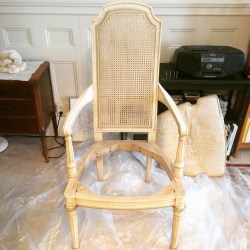
Last week, I bought a chair at my local Goodwill store. It took me a while to buy it. I saw it, hesitated. Bought another chair, a lovely armchair that is now in my living room, and then came back for it several days later. Why did I hesitate? Well, it looked like this:

Chair 1

Not very attractive, is it, in this picture? I can’t tell if it’s from the late 1970s or early 1980s. The paint was a sort of faux French country that was popular in the early 80s, but the upholstery said 70s to me. It was yellow satin, which was bad enough, but also stained. And yet, there was something. I think it was the tall rattan back, which I knew could look quite different, and the sweep of the arms. The underlying chair, the form of the chair, was better than its surface. And structurally, the chair was completely sound. So in the end, I bought it. If I ended up hating it, I would have lost $27. I could live with that.

The first thing I did was take off the cushion on the back, which was attached with buttons. I cut them off and exposed the rattan. Then, I took out the long screws that attached the seat and removed that as well, to see what I had. Which was this:

Chair 2

Much better, right? Now you can see the form. It’s a graceful chair, actually. A graceful chair marred by an ugly surface. So I started to paint. I have a favorite paint color for furniture: it’s called Flax, and it’s a sort of rich cream. Everything I paint with it looks fresh, modern but also traditional, and it’s particularly good on rattan. As I painted, I noticed the maker’s name on the chair: Henredon, a company that makes good, solid furniture. No wonder the chair worked so well, structurally. Henredon furniture is also aimed toward an upper middle-class purchaser who wants tradition, but in the current style. It tends to be quite expensive. That explained why the chair was such an odd combination. Underneath was a timeless form, but it was overlaid with the paint and upholstery of a particular era. In taking off the upholstery, I had exposed the form — and it was lovely.

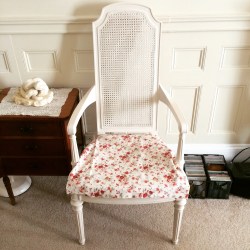
I painted the chair, a little at a time because it was the busiest part of the semester and I didn’t always have time to eat or sleep, much less paint. But the painting was restful, a way to get away from thinking about classes and papers for a while. And now, in my hallway, I have this:

Chair 3

You can tell it’s not finished yet, right? The painting is finished, but I need to have the cushion professionally replaced, so for now I’ve just laid a piece of cloth on top of it. (It’s one of my favorite Waverly patterns.) I feel as though I’ve taken a dancer who was trapped in stained yellow satin and let her dance again.

The important thing, I think, is to see the potential. Not just in chairs, but in everything around you. It’s good to see what’s in front of you, but there are so many things that could still become. That’s my job as a teacher, really. To see the potential in a paper or manuscript — even more importantly, to see the potential in a student. To understand that my time with a student is part of his or her larger journey. It’s also (even more so) my job as a mother, to see both my daughter now and the woman she could become, and to help her become it. And it’s one of my own tasks, as just me. To see the potential in myself and work toward it.

One of the difficulties it that we often don’t see the potential in ourselves. We’ll see it in chairs, or in students. We know they’re not yet where they could be, we know they’re a work in progress. But we don’t see ourselves that way. We think we just are. However, we’re not chairs. Once my chair is reupholstered, it will be done. I will not change it again unless it becomes stained or damaged. It will stand in my hallway, a beautiful cream color with a flowered seat, for many years.

But I will change. There is no final stage, for people — unless it’s death, and that’s not something I need to work toward. What I need to focus on is doing, with myself, what I did with the chair. Finding my true form, the form underneath time and fashion. And creating out of that.

I know — I turn everything into a lesson! But I think even chairs can teach us, and here’s what the chair taught me.

You need to see the potential as well as the current situation. The potential is underneath, so you have to develop a good eye — for seeing the potential of a chair or of a person. You have to understand not just what is, but also what’s possible. And you have to trust your instincts. I knew, as soon as I saw the chair, what I could do with it. But I hesitated, because I had made mistakes before. I went back twice before I finally decided to buy it. We hesitate even more when we think about ourselves. We distrust our own potential, our own sense of what we could become. I need to work on that . . .

Also, we need to be willing to make mistakes. We need to assess them honestly: I could accept a $27 mistake, if that was going to happen. I would have wasted time, but at least I would have learned something. The value of a mistake is always in what we learn from it. (So when you make a mistake, make sure you’re learning.)

There’s an obvious lesson here for artists: find the potential, find what’s structurally sound and work with that. It’s what I’m always trying to do with my poems and stories. Cultivate your eye and ear so you can see it, hear it. In a really satisfying work of art, beauty is not on the surface but in the structure. And, if you think about it, that’s true of people as well . . .

Posted in Uncategorized | 3 Comments

A Simple Diet

I decided to write this blog post because whenever I go into the bookstore, I see books on diets, most of them filled with advice that I think is actually harmful. And whenever I go on social media, I see friends going on diets, which may or may not help them. I’ve also had friends ask me how I stay in shape, and say to me, “You must be one of those people who can eat anything she wants.” No, I can’t. I have a long history of going on diets of various sorts, back to my teenage years. None of them worked or helped me, and it took me a long time to figure out a way to eat that is healthy and makes me happy, both with myself and the food I’m eating.

If you’ve been reading this blog for a while, you’ll know that I like to figure things out: my life is so busy that I like to figure out how to make parts of it as simple and intuitive as possible. Like cleaning, or exercise. I like to hack my own life and happiness. I want it to be easy so I can spend time on the things that really matter: my teaching and writing, my daughter and other relationships.

So how did I figure out how to maintain what I feel is a healthy weight for me, and more importantly, find a way of eating that gives me energy and makes me happy? Because if a diet (I use the word here to mean a way of eating, not a way of losing weight) doesn’t give you energy and make you happy, it won’t be your diet for much longer. It’s very hard to motivate yourself to do anything that makes you tired and unhappy — and honestly, those are signs that whatever you’re doing is unhealthy anyway.

I’ll start with my premise: no one diet is healthy and effective for everyone. We are all unique, with unique cultural and personal histories, as well as unique tastes. This is why I call foul on diet books: they tell us that everyone should be following one (their) diet. But I have a friend who was trying to lose weight, and simply could not — until she realized that she was lactose intolerant. She had to cut out dairy products entirely before she could find a weight that felt right for her. On the other hand, I’ve been told and have read that dairy products are unnecessary for adults, and that I would be healthier if I cut them out of my diet. So I tried, but it was as though my body said to me, “What do you think you’re doing?” I got sick. I was so used to following “expert” advice that it took me a while to realize what I should have understood about myself: my ancestors were nomadic horsemen. They lived on the milk from their herds for a thousand years. Without dairy products, they would not have survived. I have the body that evolved in that environment: I’m short, slight, compact. I gain weight easily, but I also gain muscle easily. I’m good at things like gymnastics and riding horses, and terrible at things like running, especially long distances. My friend and I have different bodies: mine needs diary products. One diet will not work for both of us.

So if the diet books are expensive wastes of time, how do you figure out a diet (as a way of eating) for yourself? I do think it’s important to figure it out, because we live in an environment we weren’t designed for. We evolved to eat in environments in which finding food was difficult — we had to hunt or grow it, and then prepare it. We exercised regularly simply as part of our daily lives. Obviously, we don’t live in that environment anymore. So if we want to be healthy, most of us need to be conscious about our food choices. This is how I did it, which may or may not work for you:

1. Learn about yourself.

When I realized that I kept trying different diets, none of which made me feel healthier or helped me lose weight (which was my real concern — it should not have been, but it was), I started to keep a food journal. I wrote down what I ate, when, and why. And I kept track of calories. Keeping a food journal taught me things about my body that I had not realized before. First, it made me confront the fact that my body was very precise about weight, which makes sense. After all, it’s precise about maintaining my temperature, my hormone levels . . . If I ate around 1600 calories a day, it would slowly lose weight. If I ate around 1800 calories a day, it would slowly gain weight.  Between those two numbers, my weight would stay around the same.  And it didn’t much matter what I ate, in terms of weight: my body cared about calories. But I also learned that what I ate mattered a great deal in terms of my energy level. White bread and sugar made my energy level rise, but then it would crash suddenly several hours later and I would be hungry again. Whole wheat bread, especially if I ate it with cheese, would give me energy for a whole afternoon. I found dark chocolate more satisfying than milk chocolate: I could eat a little and not want more. Raw sugar and white sugar affected me differently, probably because raw sugar had a more complex and therefore satisfying flavor.

And I learned about myself psychologically. I learned that I ate when I was hungry, but also when I was bored, or anxious, or depressed. I learned that I ate to give myself a treat. Food is an excellent way to deal with hunger, but a terrible way to deal with boredom, anxiety, or depression, because it doesn’t actually help. I had to find other coping mechanisms. And I found other treats to give myself: makeup, books, walks in the park. I found that in order to eat healthily, for hunger and not other reasons, I had to actually take better care of myself as a person. I also learned that I eat when I’m tired, to substitute for sleep. Also not a good idea. I still do this sometimes, but at least I recognize that I’m doing it, and when I gain weight after a week of late night snacks, I’ll know why.

I also learned about my habits, tastes, and preferences, which are just as important as learning about yourself physically and psychologically. For example, I don’t particularly care about cooking as an art, or fancy food. A bowl of pasta with sauce and cheese for dinner makes me perfectly happy. When I bake, it’s usually banana bread or brownies. Going out to a restaurant is fun as a treat, but otherwise I’m not interested in gourmet cooking. I have friends who are, and they need to take that into account when create their own preferred diets. On the other hand, I have a serious sweet tooth, and if I don’t indulge it on a fairly regular basis, I’m unhappy. So I have to make sure that my diet includes chocolate on a regular basis . . .

In a way, I hacked myself, which would have been a useful exercise even if it hadn’t led to a change in my diet and my attitude toward food.

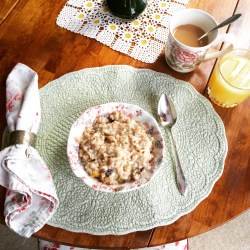
Breakfast

(Breakfast: oatmeal with milk and raisins, orange juice with fizzy water, chai latte.)

2. Create your own system.

I’ve used “diet” in this blog post in two ways: as a way of losing weight, and as a way of eating. Here I mean a way of eating. Whether or not you want to lose weight is up to you, and between you and yourself. No one else is part of that conversation. But what I can say with some confidence is that losing weight as a goal does not work if it relies on changing what you eat temporarily, until you reach your “goal.” What I’m talking about is not reaching a goal but creating a new system, a way to eat that you will follow. So it needs to make you healthy and happy, to give you energy.

My diet is pretty simple. It’s a mix of grains, meats, dairy, vegetables, and fruit. The grains are whole wheat: brown rice and pasta, and whole wheat bread, because of the havoc that the white stuff wreaks on my energy levels. The meats are usually lean. The dairy is usually low fat (like 2% milk), but I don’t eat anything fat-free. I buy bags of frozen vegetables, steam them, and add butter. And the fruit is usually fresh, unless I buy frozen fruit and make something like peach crisp. I have raw sugar in my oatmeal and tea, honey in my yogurt (which I buy plain). I eat four meals a day: breakfast, lunch, snack, and dinner. The snack includes chocolate, and the dinner includes dessert (although it’s usually something like yogurt with honey, or a slice of banana bread). I try to make sure that each meal includes different types of food: grains, proteins, vegetables or fruit. I find that a combination feels me fuller and more satisfied than any food alone. Oh, and I use butter and canola oil for cooking.

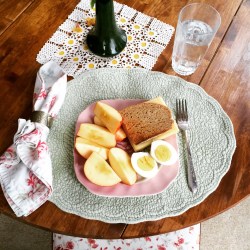
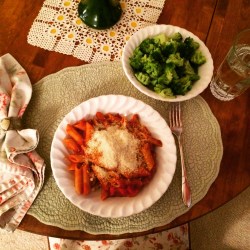
I eat mostly simple, unprocessed food that I cook myself. I’m a creature of habit, so breakfast is usually oatmeal with milk and raisins, orange juice with fizzy water, and a chai latte. Lunch is usually a cheese sandwich on whole wheat bread and an apple, which I can carry with me and eat between teaching classes. Snack varies, but almost always includes chocolate as well as healthier things, like dried fruit. And dinner is usually brown rice or pasta with vegetables and meat or cheese, plus dessert. And then always a mug of herbal tea before bedtime.

I still keep a simple food journal: what, when, and calories. It’s a way of making sure that I’m conscious about my food choices, not a way of controlling what I eat. I usually stay in the 1600-1800 calorie range, because that’s where I’m not hungry, where I have lots of energy, where I feel at my best. But if I’m hungry, I always eat. There are times when I’m under stress, or very active, when I simply need more calories, or more protein, or even more chocolate . . .

And I schedule treats. Once I week, I make sure I have something extravagant that I don’t usually have — today, for example, it will be ice cream at a shop that opened downtown. A very fancy shop. When I have treats, I make them count!

Lunch

(Lunch: cheese sandwich, hard-boiled egg, apple.)

3. Follow it most of the time.

This one is pretty self-explanatory. Once you’ve developed your system, one that makes you healthy and happy, one in which you don’t have to give up any food you want to eat (although you may need to eat it in moderation), just follow it most of the time. Goals are problematic because you spend most of your time feeling as though you need to reach your goal, you haven’t reached your goal, your goal is out of reach . . . A system is better because you can congratulate yourself for sticking with a system that is making you healthier and happier. And if you go away from it for a while, you can go back to it. You can’t go back to a goal, by definition.

Even better, you can build exceptions into the system. I try to follow my own way of eating, my own diet, most of the time. But if I’m at a restaurant with friends, I’ll have a wonderful meal, whatever it consists of. A burger, sushi, tapas . . . I’ll have the best meal I can. And then the next day I’ll go back to eating the way I usually do.

So that’s it, really. We live in an environment in which we’re getting conflicting messages about food all the time. We see advertisements telling us how much fun it would be to have dinner at Olive Garden, and diet books telling us that we have to cut out X, Y, or Z foods, or live like our Neolithic ancestors (while giving us completely inaccurate information on what they ate). Or cut out “toxins.” We’re caught between two damaging messages.

Sometimes I wish I could write a diet book to counteract all the diet books I see on the bookstore shelves! It would probably not sell very well, though. It would consist of these very simple messages:

We live in an environment in which to be healthy, most of us need to be conscious about what we eat.  We are bombarded with messages, most of which are not helpful.  You are yourself, different from anyone else.  What works for me may not work for you.  In this, as in everything else, you will need to find your own way.  Here’s how:

1. Learn about yourself.
2. Create a system you can follow.
3. Follow it most of the time.

Dinner

(Dinner: whole wheat pasta with marinara sauce and parmesan, broccoli with butter. Dessert was plain yogurt with honey.)

Posted in Uncategorized | 12 Comments

A Luxurious Life

I was thinking recently about how luxurious my life feels, nowadays.

And I wondered why it felt that way. After all, I’m a university lecturer. It’s not as though I make a lot of money, or spend a lot of money on things I don’t need. When I was a lawyer, I met plenty of people who lived in ways we usually think of as luxurious. They had enormous houses — often for only two or three or four people to live in. They had expensive clothes, expensive cars. They flew to exotic places on vacation. And yet I didn’t think of their lives as particularly luxurious. Their lives seemed, rather, empty and cold — like their large houses. Clichéd, like their vacations.

I certainly didn’t grow up with a sense of luxury. I grew up with a sense of lack, of the things I couldn’t have — things that often my friends could have. There was an awful lot I wanted, back then. So why, I wondered, do I have a sense of luxury now? To try and make sense of it, I listed the things that make me feel luxurious.

1. I have four closets and a storage space. It’s ridiculous, really. In one of the most expensive rental markets in the country, I somehow managed to find a one-bedroom apartment with four closets. And a storage space. My hypothesis is that luxury is having everything you need, plus a little extra. A lot extra doesn’t do anything, doesn’t increase your sense of luxuriousness. I have all the storage space I need, plus a little. And one of them is a linen closet! There are some things that are incredibly useful but feel like extras, nowadays. We wish for them but don’t expect to get them. A linen closet is one of those things. (I also have very high ceilings. In a small apartment, ten foot ceilings make you feel as though you have room — to breathe, to grow, to become.)

2. I have enough clothes to go two whole weeks without doing laundry. That’s a long time! I don’t think I ever had that, when I was a student. I was always trying to find quarters, just so I could have something to wear the next week . . . (I still feel guilty spending quarters — I default to saving quarters for laundry, even when I don’t need to.)  And I have more clothes, probably, than I’ve ever had in my life. Oh, they all fit in two closets and a chest of drawers, so it’s not as though I’m becoming a fashionista or anything. It’s just that eventually (this took a very long time) I found out what sorts of clothes I loved, what suited me. So I stopped making mistakes. Also, I learned how to shop at thrift stores . . .

3. I have extra household items. I mean, if I run out of light bulbs, I have extra light bulbs! (In the linen closet.) I never had that, as a student. When I ran out of something, I didn’t have more. I had to check and see if I could afford light bulbs that week. There’s something so satisfying about having a stash of things: light bulbs, paint, glue. Plenty of trash bags. Nails to hang pictures with. And a whole stack of soap. (Also, an extra tube of toothpaste. I find the toothpaste is key.) And, just in case my watch stops, I have an extra watch!

4. I have plenty of books, but also bookshelves to put them in. Books are a necessity, of course. What’s a luxury is having specifically the ones I want to have, the ones I really need and treasure. I’ve given myself permission to give away books that don’t mean much to me, books that feel temporary. The latest bestsellers, that I read specifically to learn how they became bestsellers, for example. Gone Girl went. But I have almost everything Isak Dinesen wrote, and Virginia Woolf, and Willa Cather. I’m surrounded by the writers who mean most to me. And I have enough shelves. It’s such a luxury, having enough shelves!

5. I can buy small treats. An expensive bar of chocolate. Bubble bath (the good kind). Even sometimes an antique ring I want from Etsy, or a print that I can frame and put up on my wall. Small things, but they make me feel as though I can gather things around me, things that are delicious or beautiful. I can make them part of my life. And they change my life. I don’t agree with people who say that you should spend money on experiences rather than things. Experiences are wonderful, but I love the ring I bought, silver with marcasites, shaped like a flower. I had it resized so that it fit me perfectly, and now I wear it almost every day. That means a much to me as having gone to the ballet, or traveling in Europe. It’s a small part of my everyday life.

6. I live in a city where I can go to libraries and museums, anytime. Where the streets are lively, and there are bookstores and cafés, and a river to walk beside. There really isn’t much excuse for being bored here, because there’s so much to do. And although technically the city doesn’t belong to me, it sort of does. I don’t own Monets, but I have a museum membership, so I can walk into a room with my Monets anytime I want to. Oh, there are all sorts of annoying things about the city! Sure. Sometimes the crowds, and the expense of it. But there are wonderful things about it as well, so as long as I’m living here, I’m going to experience them all.

7. I have enough money to buy beautiful things. Like that ring I mentioned, but also flowers every week. And the next-to-cheapest tickets to the ballet. (It makes a difference in your view, whether you buy the cheapest or the next-to-cheapest. And there can be quite a big difference in price.) More than anything else, beauty gives you a sense of luxury. I think that was the main thing missing in my life, when I was growing up. I come from a practical family, and I didn’t want to be practical. I wanted to be romantic. I painted my walls pale pink, and had curtains over my bed. It’s a luxury, now, to be able to indulge my taste for beauty, for romance.

(If you want to feel a sense of luxury, that’s what I would advise: go for the small extras.  You don’t need the large extras, not really.  Just the small ones.  A little more room, a little more beauty, a little more chocolate . . .)

That’s quite a list, I think. There are certainly things I still want in my life. (I have a list of them — I’m working on that list!) But when I sit in my living room in the morning, with sunlight streaming through the window, I realize how lucky I am. What luxuries I have now, that I didn’t have when I was younger. For so long, I approached life out of that sense of lack — I didn’t expect to have more than enough. (I barely expected to have enough.) And now I’m rich in soap, and light bulbs, and chocolate. And closets.

Here are a couple of my recent luxuries:

Cheesecake Cupcake

A cheesecake cupcake at the local cupcake shop, Sweet.  It’s like a mini-cheesecake.  With frosting.

Hokusai Wave

Hokusai’s The Wave, which I photographed at the museum. It’s currently having a huge Hokusai exhibit.  I want to go back once the semester is over.

New Chair

My brand new armchair, bought for $27 at Goodwill. Well, brand new old armchair. It just needs to be cleaned, and doesn’t it fit perfectly, right there?  I’ll sit in it when I want to have tea, in the sunlight . . .

Posted in Uncategorized | 17 Comments