How We Live Now

I’ve been anxious and stressed for several weeks now. One reason, of course, is the election. Another is that I simply have so much work to do this semester — it’s been overwhelming. The world seems darker than it did, and life in it seems more difficult, less certain. It feels as though life is one never-ending cycle of work and worry — as though this is all there is, and all there ever will be until, well, death I suppose. Last night I could not get to sleep for hours. When I finally did get to sleep, I dreamed that I was on an island, looking for a house, and first I could not find it, second I did not have the key, and then I went for a swim in the ocean and worried about drowning. I don’t think we need Freud to interpret that one! In terms of the political situation, I have not felt this particular sensation since before the Berlin Wall fell — I still remember what that was like, when I was a teenager. Suddenly, the world felt more free. Now, suddenly, I’m worried that it will become less so.

When I’m not sure what to do, how to live, I give myself principles to live by. I find they help because, no matter what happens in the world outside me, at least I know what I should do in response. At least I can control the world inside myself, to some extent. I thought about how we live now, how we should live now. Really, this is no different than what I would have written a month ago, a year ago. But now, I think, it may be particularly helpful. Here, then, are some principles for living in our difficult, complicated world:

1. Don’t be evil. Don’t condone or collaborate with evil.

This isn’t really that complicated. Don’t hurt people. Don’t exploit them. Don’t treat them as though they were less important, less worthy of respect. Don’t lie to them. This may seem overly simplistic, but if people refrained from being evil, from participating in or condoning evil — from abusing each other, exploiting each other for profit — I mean, that would be a very different world, wouldn’t it?

We may disagree in some cases about what constitutes evil, but I think in most instances, most people will agree: Allowing children to drink water tainted with lead is evil. Stealing employees’ wages is evil. Making a racist joke is evil. (Yes, words can be evil, and they can create the conditions for evil acts.)

All this requires is negative action — don’t do it.

2. Do the most good you can, to the best of your ability.

This requires positive action — figure out what you can do, and do that. Help to the best of your ability, whatever that is. Is it donating money to an organization that fights for social justice or helps the needy? Is it doing something directly yourself to help another person? Is it doing your job well and honestly? Is it taking care of one child, one animal? Well, do that.

Figure out what you can do, make a plan, and do it. And then keep doing it.

3. Take care of yourself, because you matter.

You’re not going to do anyone any good if you don’t take care of yourself. You know this, right? Do the best you can to make sure that you’re staying healthy, and that your bills are paid. By extension, take care of your family and your home. You’re not going to be effective in the world if you’re stressed, tired, overwhelmed. (These are words I try to remember, when I myself am stressed, tired, overwhelmed — as I am now.)

Taking care of yourself is not selfish or a cop-out. It’s a necessary precondition for (1) doing good and (2) not being evil. It’s much easier to do, and not do, those things when you yourself are well.

And by the way, accept that you will sometimes fail at the things I’ve listed above, as you will fail at anything you do. Pick yourself up and try again.

4. Live as though the world you wanted to live in already existed.

Imagine the world you want to live in. For me, it’s a world where we are all more environmentally conscious, where we support the arts and cultural institutions, where everyone is valued. So, you know, I try. I take public transportation, I buy organic produce, I try to recycle. I buy yearly memberships to the art museum. I splurge on the ballet, because I want to live in a city with a ballet. I subscribe to newspapers I want to make sure survive. I try to be a good, effective teacher — fair to my students, kind but also challenging them to write better, think more deeply.

I want to live in a world with less consumerism, where repairing items is valued over buying new ones, so I mend my clothes. I take my boots to the cobbler to be re-soled. I want to live in a world where literature matters, so I buy books. I support small businesses and environmental causes.

These things also make me feel better: they make me feel as though at least I’m doing something, not simply accepting things as they are. Because, and this is the last thing I’ll say, no one person will save the world. Trust me on this: no one is coming out of the sky to make this world better. We all have to do it ourselves, one small gesture at a time. But those small gestures add up to something much larger, which is the whole point.

You are not responsible for saving the world. But we are all responsible for doing our part.

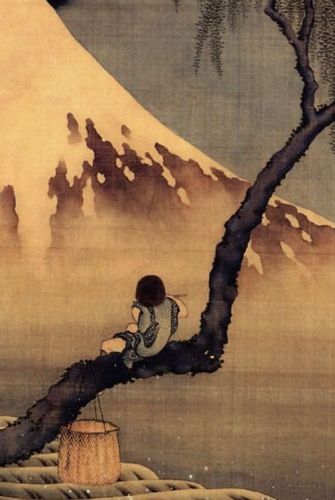
print-by-hokusai

(The print is by Hokusai. I thought it captured the feel of what I was trying to say here . . .)

Posted in Uncategorized | 9 Comments

Writing Is/as Work

Confession: last night I was up until 3:30 a.m. working on a novel. Was that good for me? Well no, probably not. But it was good for the novel, because I wrote a scene that I really like. Today I’m tired, but I have that scene on my typing stand. Tonight I’ll revise and add to it, although I can’t stay up that late again because tomorrow I have to teach. Why do I push myself in this way? Because writing is part of my job. I have deadlines to meet, novels to write and get out there into the world. I’m a writer . . . so I write.

Recently, there was an article published, somewhere or other, making the argument that writing is not a job. Well, I guess that depends on how you define a job. I mean, if you define it as something that provides you with steady income, health benefits, and a retirement plan, then no, writing isn’t a job. But then, a lot of other freelance work doesn’t qualify either.

I like the idea of writing as a job, because that’s what it feels like when I’m actually doing it. When I started thinking about this subject, I remembered two quotations that have always bothered me. Here’s the first one:

“There’s nothing to writing. All you do is sit down at a typewriter and open a vein.” –Ernest Hemingway

I don’t know if Hemingway actually said this — it’s simply one of the things attributed to him on the internet. And it sounds good, doesn’t it? It’s pithy, and truthy . . . it feels true. We often think of writing as self-expression, so it feels true to say that writing is like bleeding. Why don’t I like the quotation? Because I’ve written before, and I’ve bled before, and bleeding is a lot easier. More painful, but easier in that you’re not sitting there bleeding for hours at a time, mentally engaged in bleeding, trying to bleed well, bleed so the reader can follow along, so she doesn’t put the book down and say, “What boring blood. I think I’ll go see what’s on Netflix.”

Of course the quotation isn’t talking about actually bleeding, but what it implies is that writing involves sitting down at your typewriter/keyboard and letting your emotions pour forth, as though you were bleeding. That attitude is expressed in the second quotation I dislike:

“No tears in the writer, no tears in the reader. No surprise in the writer, no surprise in the reader.” — Robert Frost

Maybe Frost really did say that? What I dislike about it is that it assumes the writer is a sort of emotional conduit. He or she must feel something, so the reader can later feel it. If you want your reader to cry, you must first cry . . . But that’s not true. Writing is an art, but it’s also a craft, and I can make a reader cry without, while I am writing, feeling anything in particular myself. All I have to do is describe something likely to make a reader cry, and then hopefully the reader will respond.  But the reading experience exists independently of the writing experience. The reader and writer are not in a symbiotic relationship. The reader may well decide that the scene I wrote so emotionally myself is really quite funny. If I’m a good writer, I should be able to make most readers cry, depending on my knowledge of what makes most people cry. Hemingway supposedly wrote a devastating six-word story: “For sale: baby shoes, never worn.” I read that, and it makes me tear up. He supposedly wrote it on a restaurant napkin in response to a bet. I don’t think he was tearing up as he wrote it.  If he did write it, I think he did so feeling rather smug that he could pull it off.

My point here is that writing takes craft and skill, and the writer is like any other artist: a painter, a composer. A Monet may well make you cry, but I don’t think Monet was crying as he painted it — he was painting. Yes, he may well have drawn on moments he had cried in the past, and writers do that — sometimes, when I’m stuck on an emotional scene, I’ll think about how I felt at an analogous moment and remember that. I’ll try to reproduce the emotion inside myself, based on memories.  But it’s in the service of description, and I know that if I don’t describe whatever it is I’m describing well, it’s not going to raise any sort of emotional response in the reader. That depends on my craft and skill.

Writing is a job, and it feels like a job — there are deadlines, there is work to be done. Sometimes I love doing it, sometimes I don’t, but I do it anyway because it’s my job to finish that particular story, that novel.  And honestly, I find the idea of writing as a job reassuring. If I woke up in the morning thinking, “I need to be an artist today,” I would probably go hide under the covers again. But if I think, “I need to get out of bed and write a chapter,” I will go do my job, using everything I have learned, all my intellect, whatever techniques I have. Because that’s how it’s done.

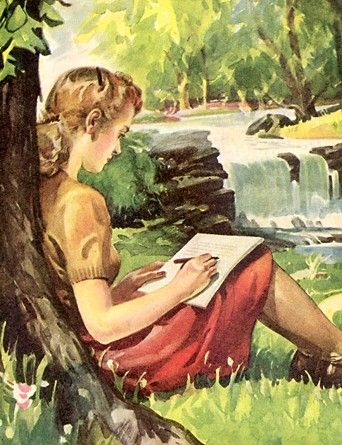
girl-writing

(I don’t know where this image is from, but I love that it’s of a girl writing.)

Posted in Uncategorized | 4 Comments

Me and Edna and May

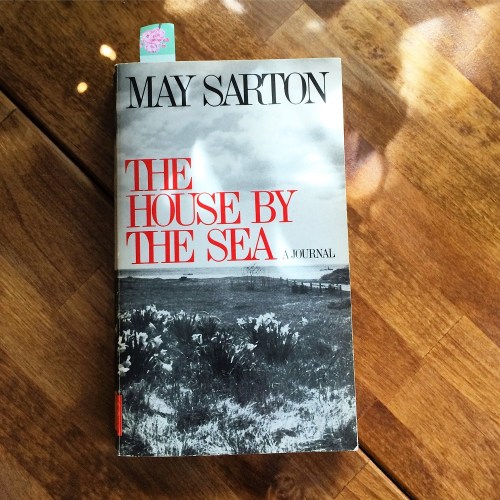
On my last day in Brunswick, Maine, I walked into a second-hand bookstore and bought several books. One of them was The House by the Sea by May Sarton. I started to read it — she has such a beautifully lucid style. That’s what I look for when I read — lucidity, a sense of light shining through the words. That and wisdom.

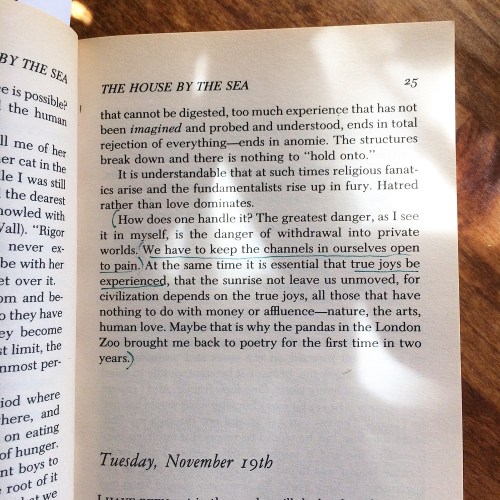
As I flipped through it, on one page I noticed a passage marked with green pen, placed in parentheses and part of it underlined. You can see it in the photograph below. But here is the passage, in case it’s difficult to read in the photograph:

“How does one handle it? The greatest danger, as I see it in myself, is the danger of withdrawal into private worlds. We have to keep the channels in ourselves open to pain. At the same time it is essential that true joys be experienced, that the sunrise not leave us unmoved, for civilization depends on the true joys, all those that have nothing to do with money or affluence — nature, the arts, human love. Maybe that is why the pandas in the London Zoo brought me back to poetry for the first time in two years.”

What an interesting passage this is! It’s about leaving yourself open to the pain of the world, because that is the only way in which you can also experience its joys. It starts with a question: “How does one handle it?” How indeed? There is so much wrong, and painful, and to be wounded by. And yet Sarton says that withdrawal is dangerous, because it’s necessary to experience pain — probably because that’s the only way we can sympathize with it. But at the same time she warns us that we have to experience the joys also, or we are only partially living. Civilization, both our own (being “civilized”) and civilization as a whole, depend on the things that money can’t purchase: nature, the arts, love. If we can’t experience those things, we are poor indeed.

And then she mentions the pandas. I have no idea what that means. I haven’t gotten to that part yet. I’m looking forward to finding out what pandas have to do with poetry.

But there is another mystery here. The entire passage is in parentheses, but a particular sentence is both placed in additional parentheses and underlined: We have to keep the channels in ourselves open to pain. Whoever underlined that sentence did so for a reason: it meant something to her. If I were to play detective, I would speculate that she underlined it because she was in pain, and it was a reminder to herself that the pain was necessary, not to close the channels. Another part of a sentence is underlined, but not placed in parentheses: true joys be experienced. I think that was a reminder to herself too, that you don’t get the joys without the pain. And she was reminding herself that the joys were there, even if she might not be noticing them at that particular moment.

It’s funny, what a little underlining in green pen can tell you. The underlining is light: she did not want to mark up the book, and indeed, there are very few marks in it. This is the first, and the only one in pen — after this, she marked in pencil. The passage was important to her, so important that she marked it. I think she did not want to lose it.

Why do I say she? Partly because the delicacy of the lines makes me think of a woman. But also partly because on the inside back cover, there is a name and address. The first name is Edna. I won’t tell you her last name or where she lives, because who knows, she may be out there, somewhere. Throughout the book, there are a few other passages underlined:

. . . “at some point one has to make choices, one has to shut out the critical self and take the leap.”

“We are lonely when there is perfect communion. In solitude one can achieve a good relationship with oneself.”

“I am simply too isolated and starved.”

“For one person who would focus this beautiful world for me” . . .

. . . “loneliness like starvation” . . .

. . . “a rainstorm to blow off in time” . . .

Under the handwritten (in cursive) word “gardens” (and again this looks to me like a woman’s writing):

“Do I spend too much time at this ephemeral task? In spring, summer, and autumn I work harder at it than at waiting, and I expect that looks crazy, but what it does is balance all the anxieties and tensions and keep me sane. Sanity (plus flowers) does make sense.”

. . . “create the space necessary for achievement, little by little” . . .

What you can see here is a mind moving, selecting, the particular things that feel pertinent. You can see an intellect, you can see thought and even growth. The later passages are more hopeful than the earlier ones, although I don’t know if that has to do with the reader or Sarton. As I read this book, I am not only reading Sarton, I am also reading the previous reader’s reading of it. May is filtered for me through Edna.

And what I want to say about that is, I like you, May. And I like you, Edna. We are a chain of three women, writing and reading and annotating. Living and feeling and thinking. It’s as though we form a small community, right here in the pages of this book. That is the sort of joy, the sort of art, the sort of love that will save the world. Slowly, eventually . . .

May Sarton 1 1000

May Sarton 2 1000

Posted in Uncategorized | 5 Comments

Sabotaging Yourself

I was thinking about this recently: ways you can sabotage yourself as a writer. I’ve done some of these myself, and I’ve also seen other writers doing them. I thought I would make a list of ways to sabotage yourself, as much for me as for anyone else. So here goes. (I’m sure this applies to the other arts as well, so adjust the wording as necessary.) Instructions for how to sabotage yourself:

1. Stop writing.

A lot of people just stop writing. I know this sounds so simple, so elementary, almost insultingly so. But if you want to be a writer, someone who writes and hopefully eventually gets published, you have to actually write stuff. You have to write a lot of stuff, because especially at first, a lot of it isn’t going to be very good, so it’s not going to get published.

Writing means writing. It doesn’t mean creating a website or social media presence. It doesn’t mean thinking about writing. It means butt in chair, hands on a pen or the keyboard. It means the actual hard work of making stuff up and putting that stuff down in words.

Recently, I talked to the Clarion Writing Workshop students, and I told them something that could sound depressing, but that I actually find heartening. Of the people I went to Clarion with, the ones who kept writing now have writing careers. There weren’t many. Most people don’t actually want to spend the next fifteen years of their lives butt in chair, writing. It’s fun to put stories down on paper, not so much fun to do it day after day after day, and then submit, and then maybe revise, and then certainly copyedit. And then do it again from scratch. But if you want to be a writer, that’s what it takes.

2. Stop growing as a writer.

This one is a little more subjective — I at least think it’s important to keep growing as a writer, to push yourself. If you write short stories, and you gain a reputation as a short story writer, write poems. If you’re a poet, write memoir. If you’re a memoirist, try a novel. Push yourself, do what you haven’t done before. I sometimes take on writing tasks simply because I haven’t done them before. This year, I wrote an academic review and an introduction to a short story collection. I’d never done either of those things before . . . I did them specifically because they were new to me, because they required me saying “yes” and then figuring out how to do it.

I think you have to scare yourself a little, as a writer. You have to move out of that comfortable space, go where you’re afraid of failing. That’s how you learn . . .

And there’s more to it than that. You have to read books you haven’t read, look at art you haven’t seen before, maybe even travel to countries where you’re never been. Learn a new language. Those are all ways of growing as a writer.

3. Don’t listen to advice.

I ran across this quotation the other day: “The good artist believes that nobody is good enough to give him advice.” –William Faulkner

I thought, Oh Faulkner, you were such a good writer, and such a basket case! I’m certainly not going to give you advice (I mean, you’re dead . . .), but for other writers, I would say, listen. Listen judiciously, of course, and reject anything that doesn’t apply to you. But really do listen. And by advice I mean a lot of things: when your teacher tells you the plot isn’t working, when your writing group tells you a character needs to behave differently, when an editor says she can’t see your setting. When your agent shakes his head as you describe a project. Listen, disagree if you need to, argue if you need to. But listen.

4. Be jealous of other writers.

You will be jealous of other writers. You just will be. I am, Anne Lamott is, maybe Stephen King isn’t I don’t know, but most of us are. How can we not be? We want so much to be heard, to have others understand. Writing is such a personal endeavor. We want publication and prizes and more than either of those, attention attention attention. We want people to listen to us.

But jealousy’s not going to get you that. Only writing is: writing well, writing true, writing strong.

And the only way to get there is to practice, practice, practice. I have a trick I may have mentioned before. I tell myself that I’m allowed to be jealous of another writer if I’m willing to be jealous of everything, the good and the bad. So I can be jealous that another writer is a bestseller, if I’m also jealous of the fact that a year ago, she couldn’t make rent. I can envy another writer’s advance if I’m also jealous of the fact that before he received it, he was trying to figure out how to afford health insurance for the year. When you do that, you get over being jealous pretty quickly, because there’s always something in someone else’s life that you wouldn’t want in your own.

In the end, I always decide that I would rather be myself, with my own flaws, my own failures.

5. Be angry or mean to others.

Anger only helps if it’s the righteous anger that makes you reject an unfair contract. Mean is never helpful. Firm, on the other hand, is sometimes called for. Firm-and-polite is more powerful than mean.

6. Always expect the worst.

This is my own example of magical thinking: I’ve come to believe that your expectations can in fact determine what happens to you. I know a woman who always expects the worst, and it always seems to happen. Planes develop engine trouble, plumbing leaks, checks go astray. I also know people who generally expect life to go well, despite some setbacks, and for them it does. I don’t know, perhaps I’m imagining it, but it seems to me that somehow, magically, what you expect life to be like does determine what your life is like.

It’s the opposite of a magnet: negativity seems to attract more negativity . . .

I can’t always be positive. I’m human, after all. But I do mostly try not to complain. If something is wrong, of course I try to set it right (see firm-and-polite, above). But just complaining . . . if I started doing that, I would get bored with myself! And after all, being a writer is what I want to do. I’m doing it because I chose to — no one forced me into this. No one forced me to write books, go to conventions, even teach. This is the life I chose for myself, and even when it’s difficult, I’m grateful for it.

So there you have it, six ways that I believe writers can sabotage themselves . . . Do the opposite!

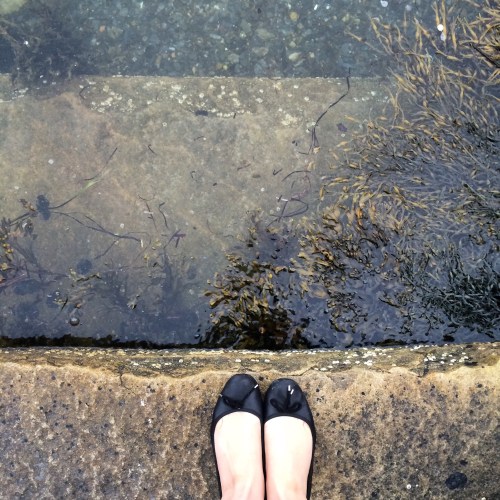
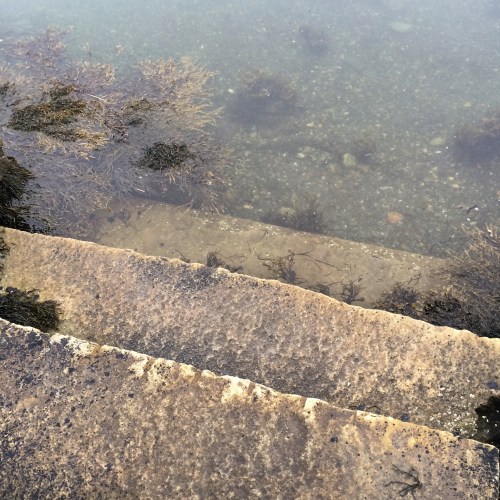
Steps to the Sea 1

Steps to the Sea 2

(Both of these photographs are from Casco Bay in Maine. I was there for the Stonecoast summer residency . . .)

Posted in Uncategorized | 7 Comments

Health and Happiness for Writers

At the Stonecoast MFA Program residency this summer, I led a seminar that I called Health and Happiness for Writers. The seminar was in the form of a panel, with five of us on it — five writers who were trying to maintain their health and happiness, which can be difficult when you’re writing intensively. I know, because I’ve been writing that way all week: I have a novel to finish by the end of the summer, and three weeks before things get busy again, so I’m trying to do as much as I can now. I get up in the morning and write, and then I just keep writing. When I do that, when I’m so completely in the narrative, the rest of the world seems to fade away. I’ve come out of an intensive period of writing to realize that I don’t remember the date, or even the year . . .

And writing comes with so many other issues that aren’t directly related to the writing itself: financial problems, the stress of trying to do something intensely difficult in the face of the world’s indifference to it, continual rejection . . . I’ve been lucky, I write and get published, I even make money at it. But it’s taken a long time to get here, and I could not support myself financially if I did not teach. And yes, I too get rejections. I always will. We all do.

For the seminar, I put together a handout of quotations from the four books I’d assigned (students were supposed to read any one of them): Annie Dillard’s The Writing Life, Stephen King’s On Writing, Dani Shapiro’s Still Writing: The Perils and Pleasures of a Creative Life, and Anne Lamott’s Bird by Bird: Some Instructions on Writing and Life. I really wanted students to think about not just the craft, for once, but also the life: how to create a good writing life, how to keep it going. Because you know, a writing career isn’t a sprint, and it isn’t a marathon. It’s just running. You start running and you keep on going, as hard, as far, as well as you are able. For a lot of people, it’s just too hard: I think it’s fair to say that most people who want to be writers stop once they realize there’s no ribbon at the end, and in fact no end. The people who stick with it are the people who love to run . . . I mean write.

So, let’s look at a few of those quotations (there were a lot more on the handout, of course):

“How we spend our days is, of course, how we spend our lives. What we do with this hour, and that one, is what we are doing. A schedule defends from chaos and whim. It is a net for catching days. It is a scaffolding on which a worker can stand and labor with both hands at sections of time.” –Annie Dillard, The Writing Life

I think this is so true! What I’ve found, with other things (eating heathy meals, exercising daily, even making my bed in the morning) is that once you create a routine, and once that routine becomes ingrained, you tend to stick to it. We are such creatures of habit. We tend to follow a routine because it’s easier than not. So find your writing routine, stick to it until it becomes ingrained, and then keep going.

“If I waited to be in the mood to write, I’d barely have a chapbook of material to my name. Who would ever be in the mood to write? Do marathon runners get in the mood to run? Do teachers wake up with the urge to lecture? I don’t know, but I doubt it. My guess is that it’s the very act that is generative.” –Dani Shapiro, Still Writing: The Perils and Pleasures of a Creative Life

I could have put this quotation up with the last one, because writing when you’re in the mood or inspired is the opposite of having a routine. But I wanted to point to something here specifically: the act is generative. It’s the sitting down to write that makes you come up with ideas. And if you create a routine, you’re telling your brain that when you sit down to write, it’s expected to come up with ideas. What I’ve found is that it does, inevitably. There is no idea bag with a limited number of ideas in it. The more I write, the more ideas I have. It’s like one of those magical bags in fairy tales: the more you pull out of it, the more you find inside.

“Appealing workplaces are to be avoided. One wants a room with no view, so imagination can meet memory in the dark. When I furnished this study seven years ago, I pushed the long desk against a blank wall, so I could not see from either window.” –Annie Dillard, The Writing Life

“You should have a bulletin board above your desk, if at all possible. Some place where you can tack images, quotes, postcards, scraps of thoughts and ideas that will help remind you of who you are and what you’re doing.” –Dani Shapiro, Still Writing: The Perils and Pleasures of a Creative Life

I actually disagree with the Dillard quote above, but then I’m one of those people who can hyperfocus. Once I start on something, I’m actually quite hard to distract. In fact, you’ll talk to me and I won’t hear you — I’ll be completely unaware of your existence. I would not be bothered by a lovely view; in fact, it would inspire me and make me happy. On the other hand, I do agree with Shapiro that a bulletin board is a good idea, and I have one over my desk. I have all sorts of things tacked to it, mostly inspiring quotations. I rarely actually look at it, but it’s there, just in case I need a little push . . .

“The idea that creative endeavor and mind-altering substances are entwined is one of the great pop-intellectual myths of our time. . . . Any claims that the drugs and alcohol are necessary to dull the finer sensibility are just the usual self-serving bullshit. I’ve heard alcoholic snowplow drivers make the same claim, that they drink to still the demons.” –Stephen King, On Writing

This was kind of the whole point of the seminar: that writers do their work best when they’re healthy and happy. So they need to actually take the time to make themselves healthy and happy.  Whatever your addictions, get help, get clean.  Create your best non-writing life to create your best writing life.

“Those writers will get the place on the best-seller list, the movie sales, the huge advances, and the nice big glossy pictures in the national magazines where the photo editors have airbrushed out the excessively long eyeteeth, the wrinkles, and the horns. The writer you most admire in the world will give them rave reviews in the Times or blurbs for the paperback edition. They will buy houses, big houses, or second houses that are actually as nice, or nicer, than the first ones. And you are going to want to throw yourself down the back stairs, especially if the person is a friend.” Anne Lamott, Bird by Bird: Some Instructions on Writing and Life

Ah yes, jealously! It’s so easy to be jealous of another person’s success! I told the students that I have two things I do, to deal with jealousy and also those times when your work is criticized or reviewed badly. (a) I tell myself that I’m only allowed to be jealous of someone if I’m willing to take the bad with the good. There are writers I know who became successful, but only after going through serious financial crises. There are writers I know who have won prizes, but are also dealing with difficult medical conditions. Would I be wiling to be them? If not, then I’m not allowed to be jealous of them. I have to take my own bad, with my own good. (b) I read famous writers’ bad reviews. The one-star reviews, the ones that are critical or just plain mean. Especially when they are writers I admire! And I think, if he or she can take such criticism, well, so can I . . .

“Writing can be a pretty desperate endeavor, because it is about some of our deepest needs: our need to be visible, to be heard, our need to make sense of our lives, to wake up and grow and belong. It is no wonder if we sometimes tend to take ourselves perhaps a bit too seriously.” Anne Lamott, Bird by Bird: Some Instructions on Writing and Life

This is the hardest part, isn’t it? We tend to pour our hearts and souls into writing, perhaps to be met with criticism . . . or what may be worse, indifference. The world will not stop spinning if you don’t write. But I do believe that if you are compelled to write, or to create any other kind of art, and if that art isn’t created, the great human tapestry is less rich for that one missing thread. Imagine our great tapestry, the tapestry of human life. Woven into it are the music we make, the dances we dance, the paintings we paint. The poems we write. The gardens we plant, the children we raise, anything that involves creativity, love, joy. When we write, we add to that tapestry.

I believe, fervently, that it matters. Even if no one else reads what you’re writing, it matters.

“I think I was forty before I realized that almost every writer of fiction and poetry who has ever published a line has been accused of wasting his or her God-given talent. If you write (or paint or dance or sculpt or sing, I suppose), someone will try to make you feel lousy about it, that’s all.” –Stephen King, On Writing

Don’t listen to those people. Just don’t. Or write despite them, even to spite them . . .

“Learning what you need to do your best work is a big step forward in the life of any writer. We all have different requirements, different ways of working.” –Dani Shapiro, Still Writing: The Perils and Pleasures of a Creative Life

In the end, all of this advice is just for you to consider, to think about. What in it applies to you? What helps you? You need to create your own writing life, a life that enables your writing. You need to make it as healthy and happy as possible. One of the last things we did in the seminar was create a list. I said to the students, write down five things you can do to create a good writing life for yourself (some of them you may be doing already). If you, reader, want to do that? This is as good a time as any . . .

I’ll send with four photos of beautiful Casco Bay, at the final dinner we all have together at the residency.
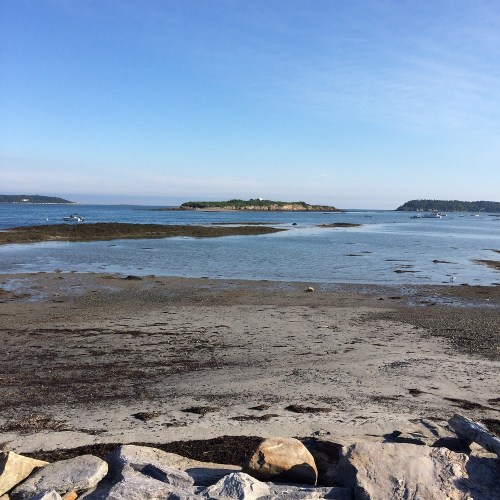
Casco Bay 1 1000

The bay . . .

Casco Bay 2 1000

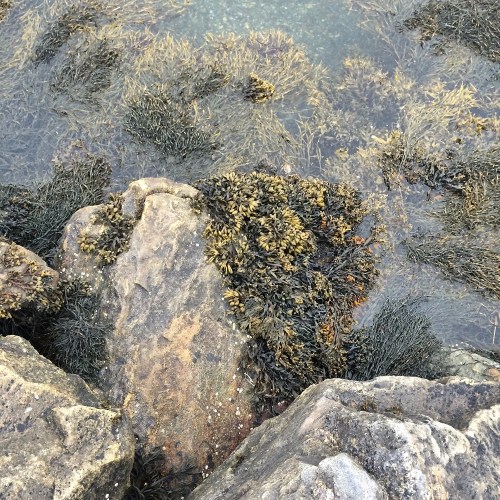
And rocks, covered with seaweed.

Casco Bay 3 1000

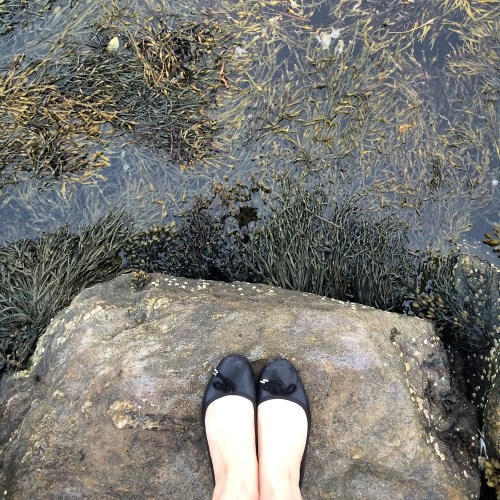
And me on the rocks, at the edge of the land, which is one of my favorite places to be.

Posted in Uncategorized | 9 Comments

Research for Writers

I’m back from Budapest! This month will be very busy: first I’ll be attending Readercon, where I’m an author guest. I’ll have a reading, a kaffeeklatsch, and a whole bunch of panels. Then I’ll be teaching at the Stonecoast MFA Program summer residency. While I’m there, I’ll be on a panel about research for writers, which makes perfect sense considering that I just got back from five weeks of doing research in Europe. Well, not all of it was doing research — some of it was sleeping and eating. But otherwise? Yes, pretty much all research.

First I flew to Budapest, where I spent one day in my grandmother’s apartment before heading by train to Vienna. In Vienna, I stayed with wonderful and very generous friends who live within walking distance of the Ringstrasse, which semi-circles the center of the city. Every day I was there, I would set out in the morning and just walk, as long as my legs would carry me. I ended up so tired! But I did all the research I needed to, in order to write the central chapters of the book I’m working on now. Honestly, I don’t think I could have written this book without going to Vienna — I hadn’t been in so long, and Vienna has a completely different character than Budapest, although they are related. It’s like the relationship between the sensible older sister who became an investment banker and the rebellious younger sister who ended up a performing artist — she has a lot less money, but she makes up for it in style and individuality. That’s how I think of Budapest. I really needed to see Vienna, smell Vienna, taste Vienna. I needed to get a sense of her, to internalize her just a little, so I could capture her in my novel.

One of the things I want to say at Stonecoast is that research for writing is completely different from the sort of academic research most of us are taught. I was taught more academic research than most: my PhD dissertation was on late nineteenth-century gothic literature, and as you can imagine, it required a lot of research. Around two years’ worth. When I started to write my first novel, I thought, easy peasy. I’ve done the research for this. Ha! The first time my characters wanted to buy anything and I had to figure out how many shillings were in a pound, I realized my previous research had been a bare beginning. You can write a PhD dissertation about the late nineteenth century not knowing very much about the sewage system, or contagious diseases, or how an oven works. But not a novel! For a novel, you need to know all sorts of things so you can imagine even more, so your characters can walk around in a world that has the texture of reality. You need to know about mourning customs, and when indoor plumbing was introduced, and what your characters would have heard walking down the streets. What were the costermongers crying? How did carriage wheels sound on cobble stones? When your characters climbed onto an omnibus, how did they do that?

There are different places you can do that research: of course you can find some information online and in modern books about the time period. But in order to write the first book, I also read all the books I could from that time period, including every single Sherlock Holmes story, paying particular attention to things like when characters drew on their gloves, where they looked when they needed to consult the train timetables. I also used primary sources, such as nineteenth-century maps. That became particularly important while I was researching the second book, because in that one my characters travel, and I wanted to make sure I had the exact same Baedeker they would have used (although mine is a PDF). But nothing quite substitutes for actually going there. I realized that one day while I was researching the first book, two years ago. I was in London, standing in an alley behind a row of houses facing Lincoln’s Inn Fields. My characters needed to stand in that alley, and one of them needed to climb up to a window on the second floor of one of the houses. How was that to be accomplished? And then I saw it: the drain pipe. My character would climb up that drain pipe! Judging by its look, it had been there in the late nineteenth century. Even if it hadn’t, it could have been — an external drain pipe would have been entirely possible in 1897. It’s fair to say that the most important thing I saw on that trip to London was the drainpipe.

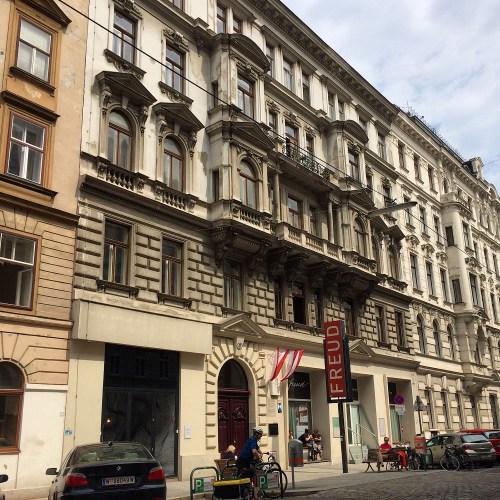
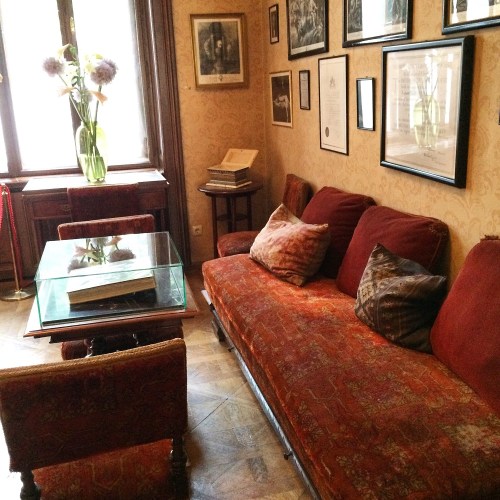
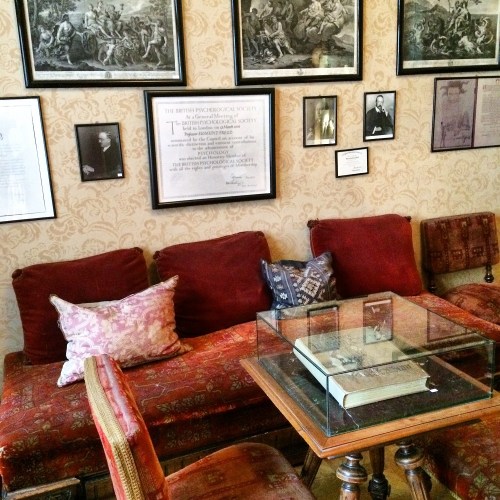
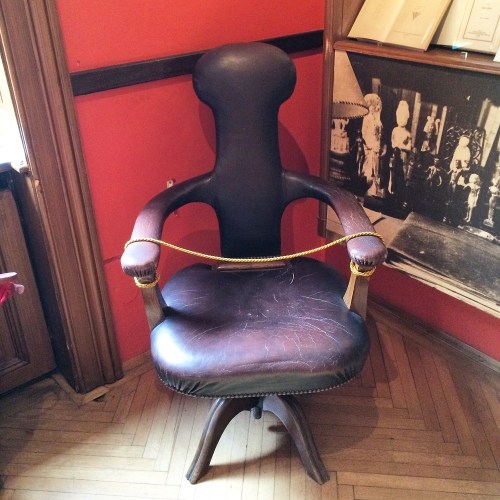
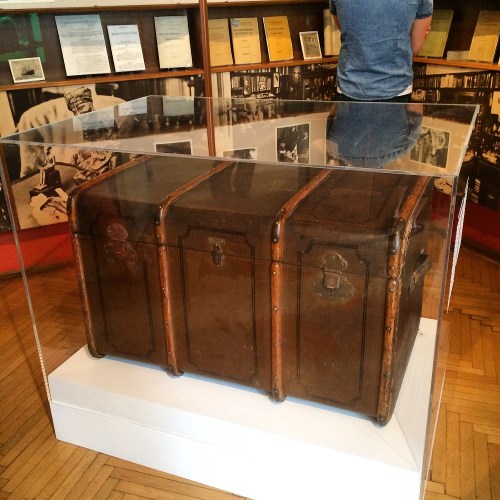
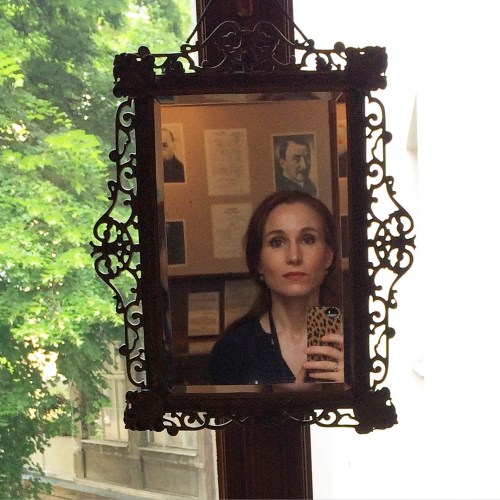
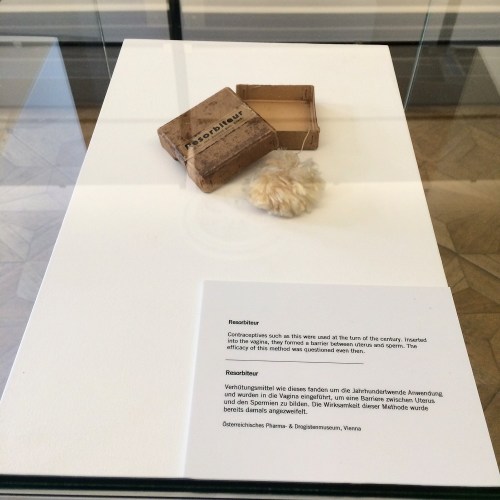
One of the most important things I saw on this trip to Vienna was the Freud Museum, and I’m including some pictures here so you can see what sorts of photographs I take when I’m doing research. I needed photographs of the museum because it’s actually where Freud’s apartment and consulting office were located. My characters go to that office, and I wanted to describe it accurately.

This first photo is the Freud Museum itself. You can see that it’s simply on an ordinary back street. I almost got lost going there. (It’s very easy to get turned around in Vienna, unlike in Budapest, where you can always orient yourself by the river.)

Freud 1 1000

You walk up two flights of stairs and there you are, at Freud’s apartment. If you walk to the right, you come to his waiting room, which is still furnished the way it would have been when he was seeing patients in Vienna.

Freud 6 1000

Here is a second photograph of his waiting room. I have several others: I wanted to make sure I captured it completely. I bet that settee was actually not very comfortable, for those waiting to see him . . .

Freud 7 1000

The rooms that used to be his office are now a museum, so they aren’t furnished the way they used to be, but you can still see photographs of them on the walls.  The surfaces were covered with ancient pottery and statues, since he was interested in archaeology.  The shelves were filled with books.  The famous couch stood in the center of the room.  Below is his custom-made reading chair.

Freud 18 1000

And below you can see the trunk he kept packed, not at the time of my novel but later.  It was packed in case he and his family had to flee the Nazis, and of course they did finally have to.  This was the trunk they fled with.

Freud 16 1000

He used to look at himself in this mirror.  You see, he had oral cancer from smoking, and several surgeries for that cancer.  In this mirror he could see how they affected his face.  It felt uncanny taking my own photograph in it — which is exactly why I did it, of course.

Freud 17 1000

And finally, here is an example of the sort of thing you just have to see for yourself: a late nineteenth-century intrauterine device, used for birth control.  I wonder how effective it was!

Freud 23 1000

Research for writers is always in the aid of imagination. What writers do is take bits and pieces of reality and build a credible world out of it, whether that world is New York or Middle Earth. What you’re doing when you research is, at its simplest, paying attention. What does it actually feel like to climb up into a carriage? To wear a wool walking suit? To fire a revolver? What does the city smell like? What vegetables would have been sold in the markets? And then, you put your characters there, and imagine . . .

Posted in Uncategorized | 7 Comments

The Caretakers

The year I was finishing my PhD, I would go to a therapist once a week. I was trying to manage depression, which honestly I think is pretty normal when you’re finishing a PhD. That sort of intensive work, for that long, can be so difficult — you spend your days staring at a screen, trying to make the words and ideas fit together, and then you try to manage the rest of your life at the same time. It was one of the most difficult periods of my life.

Anyway, we talked about my childhood, and one thing she told me was that I was a “caretaker.” I think she said that partly because when I was about twelve years old, I became responsible for taking care not only of myself, but also my little brother. Then later I started babysitting, taking care of other children. Even later, I worked at summer camps. Almost all the jobs I had before going to law school involved taking care of people, in one way or another. But it started with taking care of my little brother.

There is another way of being a caretaker. Somewhere along the way, I was taught to do what we now call emotional work: that is, taking care of the emotional needs of other people. Being not only responsible, but also responsive. This is something a lot of women are taught, of course. I think I learned it because I was raised in a Hungarian family, where you were not only supposed to do the appropriate thing, you were also supposed to feel the appropriate thing. To respond in a way the family thought was appropriate. If you didn’t, you were called an ungrateful American child. Or spoiled. I’ve been called spoiled many times in my life. It’s an interesting word, with an implication of rottenness — if you don’t behave or feel the way you should, you are somehow rotten. I think a lot of people were raised this way, although it was starting to change when I was a child — there was already a sense that children should develop their own sense of self, should learn to stand up for themselves, to create their own boundaries. But that was not part of my upbringing.

So I became a caretaker, and for the most part I remained one. As I lawyer, I took care of clients. Later, as a teacher, I took care of students, and of course I still do. In some ways, it’s like taking care of your little brother. It doesn’t mean giving him everything he wants — it means making sure he heats a healthy dinner, does his homework, goes to bed at the right time. Taking care of students means sometimes giving them things they don’t want, like grades they will be unhappy about — because hopefully they’ll learn from getting a “bad” grade, and do better. It means doing what you believe is best for someone else.  It also means listening, intuiting what is not said, caring.

There are good things about being a caretaker: if you’re doing it well, it’s helpful to other people. It makes conversations and interactions better, smoother, easier. This would be a difficult world without nurses and teachers, the types of people who are tasked most directly with caring for someone else. I don’t just mean helping — a surgeon can help you without exchanging a word with you. But nurses do both the emotional and physical work of caring, and that’s really what I’m talking about.

The danger of being a caretaker is that it can consume you. Taking care of other people is one of the most exhausting things you can do, as anyone with small children knows — in that situation, you are responsible for all their needs, physical and emotional. When my daughter started daycare and I went back to work,  I was surprised by how much of a relief it was to do that sort of caretaking instead.  I loved being with my daughter, but taking care of undergraduates, even sixty of them, was so much easier than taking care of a single two-year-old! That was of course because two-year-old children have no boundaries at all, physical or emotional, whereas teaching creates boundaries as well as connections — the emotional work of interacting with students was much easier.

Most women will know what I’m taking about when I say that caretaking requires emotional work, different amounts depending on the situation. Women are usually taught to do that work as they grow up — they are taught to be caretakers, to make others feel comfortable. They are taught to agree, to be agreeable. To defer when they are told they are wrong, to respond when a response is asked for. They are taught to take care of homes, men, children — and anyone they are in conversation with. If you’re a woman reading this, you probably have an instinct, in conversation, to make sure the person you’re talking to feels comfortable. It’s like putting a pillow under someone’s head. Smoothing a coverlet.

There are good things about that kind of work — another word for it is politeness, and back in the nineteenth century, gentlemen, as well as ladies, were praised for their ability to do it. Somewhere along the way we stopped asking men to do that sort of emotional work, and in male discourse we began to value authenticity. Speaking your mind became a masculine trait, although in women we still valued the ability to soothe, to make comfortable, to take care. That’s changing, although we’re at the point where women are being given the advice to speak up and ask for what they want, then penalized for doing so. It’s a confusing time. The bad thing about it is that, once again, it’s exhausting. Have you ever been in a conversation with someone you disagree with, but that person is also someone you need to treat with respect and politeness — maybe an older relative? Nodding, smiling, saying the soothing thing? Not getting into an argument? And ended up with a splitting headache afterward? Yeah.

What I want to say here is that being a caretaker can be a good thing, but you can’t do it all the time. You lose too much — to much energy, too much of yourself. There are times when you have to draw boundaries, when you have to retreat behind your own walls. You have to take care of yourself. That’s a cliché, but it’s true. There are times when you have to prioritize your own work, your own needs and desires, or you will burn out from trying to provide heat and light to other people. And caretaking can become a place to hide.  A substitute for finding your own way, doing your personal work. It’s so easy to say “Everyone else needs me” and ignore yourself. It’s so easy to find emotional fulfillment in meeting everyone else’s needs, at least for a while. Parents sometimes realize that as their children grow older and they think, wait, what was I going to do with my life again?

Caretaking is not enough. Taking care of other people’s needs isn’t enough. Even saving the world isn’t enough if you lose yourself in the process. Although saving the world is a very good thing to do, of course. Society needs caretakers, and honestly we could probably use more of them. Some of the people who are supposed to be caretakers aren’t doing a very good job (politicians especially — anyone remember that they’re supposed to advance the common good?). But don’t let yourself be trapped in being a caretaker. That’s not good for you, or ultimately anyone else.

Take care of yourself too. It’s not new advice, but I think it’s good to be reminded of it every once in a while.

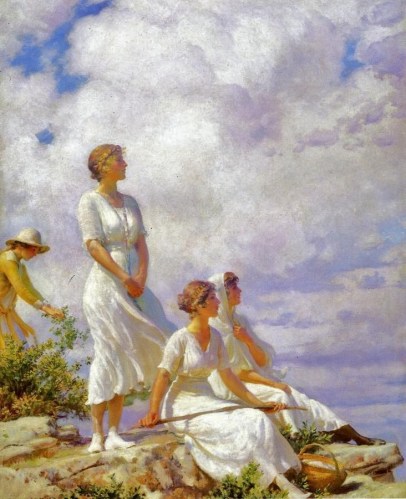
Image by Jessie Wilcox Smith

(The painting is by Jessie Wilcox Smith.)

Posted in Uncategorized | 6 Comments