It took a long time for me to realize that I was burned out.
It also took a long time for me to understand what burnout actually was. After all, I wasn’t depressed. I’ve been to depression, I know what that particular landscape looks like, and I wasn’t there. Instead, I was irritable. Tired all the time, but also anxious and distracted. I didn’t want to do anything — somewhere along the way, I had lost my motivation. I did my job, and did it as well as I usually do, I think — but sometimes I was angry about how much I was expected to do, how much people assumed I could take on. There was never time to rest . . .
Burnout is when you’re stressed for so long that eventually you just have no reserves left — of energy, of motivation, of optimism. I was used to having all those things, and it was unsettling to find that suddenly they were gone. If you had asked me what I wanted to do most in the world, I would have said something like disappear for a while, somewhere no one could find me. I wanted to be left alone. I daydreamed about things it seemed I could not have . . . time to walk along a beach or read a book.
If all of this sounds confusing, it was certainly confusing in my head — a mass of conflicting impulses and responses. It resembled depression only in that I was unhappy, but now I was angry as well, which I had never been when I went through a period of depression while finishing my PhD dissertation. I didn’t think therapy was going to help this time. I needed something else.
Why was I burned out? Some of the reasons are still present in my life, and I’m writing this as I’m starting to come out of it for the first time in . . . I don’t know, probably a year. First, I have a full-time job teaching undergraduates. Then, I have a part-time job teaching graduate students. I love both those jobs, and my students are wonderful — yes, even the ones who have problems of various sorts, even the ones who don’t do well. They are all fascinating human beings, and it’s a privilege working with them. But I teach writing, which means a lot of personal attention to how a student is expressing herself, growing as a writer, developing skills. I don’t give exams, I comment on essays and short stories and sections of novels. It’s intensive work. On top of that, I’m a writer, and at the time I was trying to finish a fantasy trilogy on a relatively tight deadline. A fantasy trilogy that required a lot of research, that was very hard to write . . . Plus I was turning in short stories, essays, articles, all sorts of things — partly for money, partly because I was asked to write various things to publicize the novels. And I was traveling to conventions, reading at bookstores, all those things you do as an author rather than a writer.
Underneath all of that was me, the person I am: an intense introvert who is drained by interactions and distractions, who needs to recharge like a battery on being alone and silent. I was also in the middle of the continual barrage we all face nowadays: the online world of social media, where the most horrifying events scroll by as though they meant nothing, and people express their horror with clicks, but little changes . . . There are good things about social media, and I try to maximize my connection with people who post about poetry, and gardening, and knitting, and saving the environment. But it can also be a monotonous river of despair.
And I have a few other traits that really don’t help: I’m driven by my love of the work, conscientious about getting it right, and a perfectionist. If you are already dealing with burnout, these will make dealing with it harder. Especially the perfectionism.
Finally, at some point, I realized I was burned out — months after I should have, because obviously the problem was me, right? It couldn’t be that I was simply trying to do too much. I just needed to work harder, be more organized. I don’t remember how I realized it . . . maybe reading an article somewhere in the endless scroll of pixels? There are worthwhile things online as well, as I said. That was when I started thinking about what I could do. Luckily, it was almost summer, and I’m a teacher, so summers are times when my schedule is more flexible — not free, because I still teach graduate students, I still have writing deadlines. But I was not teaching regular classes. And I came to the following conclusions:
1. I need to stop multitasking. I had spent so much time trying to maximize, optimize, use time efficiently. I was writing papers on trains and airplanes, because that was free time, wasted time, right? I decided that when I was on trains and airplanes, I was going to sleep. Or maybe watch the in-flight movie. But I was going to use that time to rest.
2. I need to do things that have no immediate utility. I had stopped reading anything that was not work-related, simply for pleasure. I had stopped doing anything other than my work, and that was why I did not feel joyful, or even free. It felt as though there was no time to sew something, bake something, create a garden. I’m still not at the point where I can do all those things, but I’m trying . . .
3. I need to live in the real world. The online world had its uses, but I needed to get away from it, to live in the world that has sunlight, trees, the sound of rain. I needed to touch books, walk on streets. Go into small cafés and buy cakes, then sit and eat them without checking my status (what does that mean anyway? I want a life, not a status). I needed to put away the addictive glowing screen.
4. I need to take care of my physical health. I was starting to eat unhealthily, because if I was unhappy, I deserved snacks, right? And I was never getting enough sleep, because there was always something more important to do. “I’ll sleep on the plane” had become my mantra (but then I didn’t sleep on the plane either). I don’t know who came up with the saying “I’ll sleep when I’m dead,” but I would say to that person — if you don’t sleep now, you’ll get that chance much earlier than you would otherwise! I’m still not good at getting enough sleep, but I’m working on it. I’m trying to think of it as the recharge my brain needs every day. My phone needs to recharge, right? Well, so do I. And just like my phone, I don’t run as well at 10%.
5. I need to find joy. Perhaps this is as much creating as finding? But think of joy as a vitamin you need every day. How many milligrams of joy have you taken today? Is it enough milligrams to get your daily dose of joy? Of course, while doing this, I had to figure out what joy meant to me, where my sense of joy comes from. Roses. Perfume. Warm, clean sheets. A cup of tea. Dark chocolate. A skirt that swooshes around my ankles. Writing poetry, not for a market but just for myself. I didn’t realize, for a while, that I was taking the Marie Kondo principle of what to keep and what to discard — does it spark joy? — and applying it to my life. What in my life sparked joy? I needed to find out, and then do some of that every day. Not everything in your life is going to be joyful — life is filled with small irritations, like the tram conductor telling you, with a frown and in a tone of admonishment, that you need to ring the bell to signal when you want to get off, when you’ve been riding that line for ten years, probably longer than he’s been at his job. But it’s also filled with small wonderful things, like your favorite scarf. And when it is, you can give that tram conductor your best “Thank you, that was unnecessary and I think you’re kind of an idiot” smile, because you know that scarf makes you look romantic and sophisticated.
Stop, rest, smell the roses, find joy. I’m not always good at doing those things. But I’m working on it.
(I’m also going to stop traveling so much for a while, except to Budapest, which is my ultimate place to rest, because when people ask you to do things, you can say, “Sorry, I’m in Budapest.” And then they say, “Oh, when will you be back?” And they don’t expect you to do things until you get back. Also, there are narrow streets to walk along, and a lot of small cafés to sit in. If you’re burned out and you can afford it, I recommend the Budapest rest cure.)
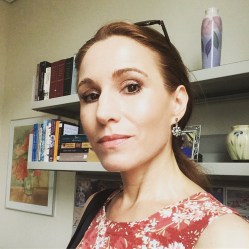
This is me in my office, in the middle of summer, going in to get some work done. I think you can see the stress and tiredness in my face. But now I’m going to get some rest . . .