
Salem, Massachusetts is one of my favorite towns. If I could live there — if the commute from Boston were not so far — I would. Luckily, I sometimes get to visit, as I did last week, although with seventy students. I will have to go back so I can spend some time there by myself, browsing in the small boutiques, drinking hot chocolate at my favorite chocolate shop, even going back to the Peabody Essex Museum, which is where I went with the students last week.
There, I saw two sculptures that got me thinking. The first was a bust of Medusa. The second was a full-sized sculpture called Zenobia in Chains. Both were by the American sculptor Harriet Goodhue Hosmer (1830-1908), who has been called the first professional woman sculptor. She was born and raised in Massachusetts, but in 1852, she went to Rome, where she joined a society of women sculptors — in Rome, women artists could flourish in a way they could not in the United States. They could study from live models, form their own studios, strive for artistic excellence and fame. Hosmer worked in an artistic and literary world that included figures such as Elizabeth and Robert Browning, Nathaniel Hawthorne, George Eliot . . . She was in good company.
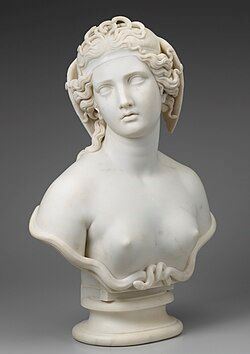
(Medusa by Harriet Goodhue Hosmer)
Hosmer was a neoclassicist, and I was startled to see, on the wall of the Peabody Essex next to her sculptures, the term “Feminist Neoclassicism.” I knew what neoclassicism was, but feminist neoclassicism? According to the text, although these women sculptors were inspired by classical antiquity, they “looked to stories of courageous female protagonists for their most ambitious sculptures.” Their “sculptures of historical and mythological women, defiant in the face of bondage or triumphant in death, celebrated female self-determination and the artist’s own fierce independence.”
In other worlds, feminist neoclassicism is a kind of conversation with history and historiography. It says, “Let’s look back at the stories we have been telling, and see what the women were doing. Let’s reinterpret them.” And so it reinterprets Medusa — look at Hosmer’s Medusa, and you will see that she is beautiful. Her snakes, which are supposed to be so scary, are tastefully arranged. They curl above her forehead, echoing the curls of her natural hair, as though they were an ornament rather than a punishment from Athena — as though they formed a crown. The snakes beneath her breast seem decorative as well: they frame her bust. Coming out of the sides of her head are . . . wings. I don’t remember those in the original myth, do you?
Zenobia was the queen of Palmyra. After her husband’s death, she became regent for her son. During her reign, she launched an invasion against Rome that brought most of the Eastern empire, including Egypt, under her rule. She tried to make her son emperor, but her forces were defeated by those of the Emperor Aurelian, who captured her and forced her to live in Rome. During the height of her power, she ruled over a multiethnic court that became an intellectual and cultural center in the East, where Semitic and Hellenistic ideas met and mingled. She supported significant public works, such as restoring ancient monuments in Egypt. Why did she launch an invasion? It’s not clear, but from what I read, she may have been trying to consolidate power, for her son or herself, in the Eastern part of the empire. That had been acceptable to the previous emperors, Claudius and Quintillus, but Aurelia wanted to consolidate power himself — this was a time when Roman emperors rose and fell in rapid succession. Aurelian himself would only reign for five years. However, he reigned long enough to march east and defeat Zenobia’s forces. The captured queen was paraded in Aurelian’s triumph, and then . . . it’s not clear, but accounts suggest that she was allowed to live in a villa near Rome for the rest of her life. In Syria, she is still seen as a heroine who fought for her country — after all, if we’re talking empires, Rome did the invading first.
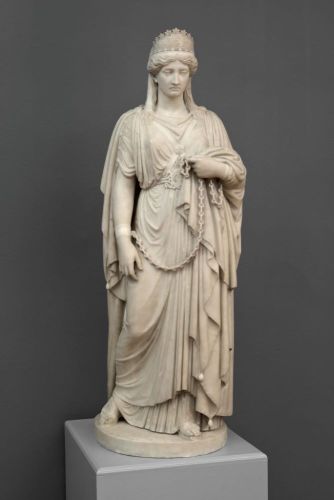
(Zenobia by Harriet Goodhue Hosmer)
Hosmer’s Zenobia maybe be in chains, and she does look troubled, as though contemplating her own defeat and the fate of her country. But she is still very clearly a queen, crowned and regally robed. Apparently, Hosmer wrote, “I have tried to make her too proud to exhibit passion or emotion of any kind; not subdued, though a prisoner; but calm, grand, and strong within herself.” I’m not certain, and none of my research sources seem to say, but I think that central clasp on her belt . . . I think it’s the head of Medusa? And the belt itself curves into two snake heads. So there is a connection between the two sculptures.
In marble, Hosmer seems to be carving her own history, her own mythology — she is creating her own ancestresses, or perhaps all of ours. These are the women we came from, she seems to say. Look: Medusa and Zenobia, beautiful, powerful, strong.
After the trip to Salem, I finished reading a book I had been enjoying for several weeks: Jane Austen’s Bookshelf by Rebecca Romney. I had picked it up in the local bookstore because it promised to examine the women writers whose works shaped Jane Austen. I had studied some of those writers in a class on eighteenth-century literature: Fanny Burney, Charlotte Smith, Maria Edgeworth. And of course I had read Ann Radcliffe — after all, my doctoral dissertation focused on the Gothic. Romney’s book, which is filled with history, anecdote, and personal reflection, fulfilled that promise beautifully. She examines the life and legacy of each writer, focusing in part on the ways in which they were erased from the canon, so that only Austen was left — like the one superheroine on the Marvel movie poster. It occurred to me, as I read the final chapter, that Romney was doing the same thing as Hosmer — she was resurrecting our ancestresses. She was making the case that these eighteenth-century women writers were worth reading (certainly Austen had thought so), and also that we would not really understand the history of the novel without them. (She also made the case, convincingly I think, that Fanny Burney really should be called Frances — the diminutive was part of her diminishment as an important author.)

When I was in college, we didn’t study many women artists or authors from before the twentieth century. There was an assumption, I suppose, that there simply weren’t that many. The few we studied were the geniuses, the exceptions who proved the rule that women, in the past, did not sculpt or paint or write. But when you look at the history, you find that actually there were many women doing exactly these things. Some of them were creating artistically because they were ambitious. Some of them needed money, and activities like writing were among the things women could do while maintaining their respectability — better, for an educated woman, than being a seamstress. But there were women creating throughout history. And they were written out.
What I’ve tried to do in my own life is find my ancestresses. Look for the ancient goddesses and queens, of course. But also the women like Hosmer and Frances Burney. Before that class on eighteen-century literature, I had not heard of Burney. Before seeing her sculptures at the Peabody Essex Museum, I had not heard of Hosmer, even though she inspired a character in Hawthorne’s The Marble Faun, which I had read many years ago. I might reread it now, but Romney’s book has also inspired me to reread Evelina, which Jane Austen apparently loved.
I might go on a hunt for some of my ancestresses . . .

 Theodora Goss