
To be honest, I have not been feeling much joy lately.
I’ve been sick for about two weeks. Over the spring break, I went to London and Bath, and I think I picked up something — I came back from Bath coughing a bit. Then I went to the International Conference on the Fantastic in the Arts in Florida, where it got worse, and at this point I’ve been coughing for two weeks. I’m sure that traveling so much did not help, and when I have not been traveling, I’ve been working — there’s a lot of work to catch up on just now.
Both of those trips were wonderful — Bath was a joy, so beautiful, all England and primroses and spring. And at ICFA I met so many old friends, whom I had not seen for at least a year. It was certainly worth going, even to stay for several days in an airport hotel in Orlando, which I would never choose to do otherwise. So I’m glad I went.
But now I’m sick and dispirited. So what to do?
What I’m trying to do is find small moments of joy. This morning I woke up, opened the back door to breath in some (very cold) fresh air. On the fence was sitting a robin, with brown feathers on its back and a plump red chest, singing. There it was, joy!
One of the best things I’ve done recently is left my knitting on the sofa. It’s a bit messy, but across the sofa is draped a scarf of rainbow yarn, green and yellow and orange and red and blue and purple, all fading into each other, like the stages of sunset. I chose the easiest project imaginable — I’m literally just knitting one row after another, with the colors of the dyed yarn making the only pattern. That means at any time of day, I can sit down for a few minutes and knit another row, without thought or planning. Sit, knit, watch the colors develop. Joy!
The sunlight coming through the lace curtains as I write this is joy. My lace curtains have a pattern of birds and twining stems, with leaves and flowers. Here and there is a dragonfly. More joy!
Later today I will spend a lot of time commenting on student essay proposals, annotated bibliographies, and reading journals. I would not describe that as joyful, although when I see what the students are doing — when I see their individual thoughts and ideas developing — I feel a sense of deep satisfaction. But I listen to music on a CD player, and that is joy.
Later I will walk outside a bit, and as I walk from my back door to the street, I will pass the garden, where things are beginning to peek up out of the soil. The peonies are pushing their red stems out of the ground. The hostas have not started coming up yet — they are smart, the hostas. They know that spring isn’t really here, not yet. But the daffodils have their leaves up already. And the small leaves of Snow on the Mountain, which will eventually spread all over the side garden, are already growing — they start as miniature versions of the plants they will eventually become. Most gloriously, a hellebore is almost blooming — it’s hiding a bit, still too shy to come out, but almost here. The periwinkles never really went away — they are more or less evergreen, as are the rhododendron and azaleas. But everything else is still brown and in waiting. My assistants, the rabbits, pruned a bit excessively last fall. We will see what comes up and when, but the garden is a daily adventure. A daily joy.
Other small joys: A cup of hot chocolate (instant, with hot water poured over the cocoa powder). The book I’m reading now, Jane Austen’s Bookshelf by Rebecca Romney, which I’ve almost finished. It’s been a wonderful read. Romney talks about all the female novelists who influenced Jane Austen (Frances Burney, Ann Radcliffe, Charlotte Lennox, Hannah More, Charlotte Smith, Elizabeth Inchbald, Hester Piozzi, and Maria Edgeworth). She tells the story of each writer, and also tells the story of what they wrote — there are stories within stories, and the overarching story is of Romney herself, who is a rare book dealer, trying to purchase editions of their novels. She also tries to understand why they fell out of the cannon, and that is a fascinating story — it’s the narrative of how women’s writing was trivialized and marginalized, so that only one would emerge as the best, the exemplary. The one perfect female novelist in a male lineage, the exception to her sex, because there can only be one — Jane Austen as Smurfette. But Austen didn’t experience herself that way — she consciously lived in a world of female novelists, whom she sometimes revered, sometimes emulated, sometimes disliked, depending on what they wrote. (It seems she generally disliked didactic literature, for example.) But whom she consistently read.
One joy I’m missing now is sleep, because I wake up during the night coughing. There are dark circles under my eyes. But another small joy I will try to give myself today is tidying, because I love trying to make a space clean and sensible — I love tidying and organizing, so that everything looks as it should. As I’m commenting on student work, I give myself tidying and knitting breaks.
I realize these are very trivial joys. But they’re what are available to me while I’m still coughing my lungs out, like a nineteenth-century consumptive. (I thought one went to Bath to recover, not to catch a cold.) Someone needs to write me a prescription that reads “You need fresh mountain air. Take yourself off to a sanatorium in Switzerland.)
(I have not mentioned, because I don’t want to think about it, how much the geopolitical situation has affected me, as I’m sure it has affected all of us. The fact that this country, of which I am a citizen, to which I pay taxes, has started a war — the fact that the war began with bombing a girl’s school, that more than a hundred girls who went to school that day are dead — it’s the stuff of nightmares. I don’t know how to deal with it psychologically, and I suspect many of you are in the same situation. So I knit and drink hot chocolate and comment on student essay proposals, because what the hell else can we do?)
Small joys. Try to find the small joys. They will get you through — they are, sometimes, the only things that will get you through. And then, when you can, work for a better world.
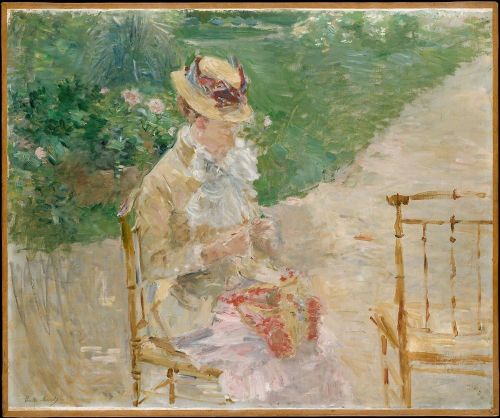
(The image is Young Woman Knitting by Berthe Morisot.)

 Theodora Goss