
At the beginning of the semester, I asked my students, all of whom are freshmen, how many of them had been told in high school not to use AI. Some hands went up. I asked how many of them had been told to use AI. Other hands went up. In my classes, I would say about 40% had been instructed to use AI in their schoolwork, and another 60% had been forbidden from using it. I told them my AI policy, which allows some judicious use with a metacognitive element, in which they have to reflect on their use of digital technologies. We’ll see how the semester goes.
Like every other professor right now, I’m in the middle of the AI quandary. What to do about student use of AI, particularly when the university is encouraging “AI literacy” (whatever that means)? It seems useless forbidding student use of AI. Far better, I believe, to help students make decisions about when and how to use it, making them aware of the problems with AI use — not least, the problems it creates for their own cognitive development. I’ve told them, and it’s written on my syllabus, that as their professor I do not use AI. I’m far too nervous about the effect it may have on my own cognitive development — on my ability to think and write for myself.
But there’s a larger issue here, that has to do with more than individual students or classrooms. I’ll try to explain what I mean as well as I can.
The message we’ve been getting from the AI companies is that all the negative effects of AI development — the social costs, the environmental problems — will be worth it once we achieve AGI, Artificial General Intelligence. At that point we will have a machine capable of solving all our problems. Of course, the machine will be owned by a small elite, and we will all pay and pay and pay, probably even more than we are paying now, to access its wisdom. Who knows if those companies will ever achieve AGI (I’m a doubter). But there is something everyone seems to be discounting:
Human General Intelligence.
Human general intelligence is what we have as human beings when there are a lot of us, and we work in places like laboratories and libraries, places where research is done and information is found, all over the world. And then we share the knowledge we have developed in journals and conferences, or by posting about it online. It is a vast network of human minds, doing their own thinking all over the world, creating things. That is Human General Intelligence. It is decentralized, somewhat random, imperfect. But it has brought us cures for diseases, ways of governing, great works of literature. It has brought us where we are today, as a global society.
Of course, it has brought us terrible things as well — colonialism, racism, eugenics, the list goes on. The evil that human beings have created gets programmed into AI, because after all AI is just a distillation of us. It will be there in AGI, if AGI is ever achieved. It might end up being smarter than us. It’s not going to be better.
The problem, as I see it, is that the emphasis on AI and AGI seems to be replacing our focus on HI and HGI — on human intelligence. While I don’t consider test scores a great metric for judging students, it does seem clear that reading and mathematical abilities are declining. As a society, we are not getting smarter — or, more importantly, wiser. AI is not necessarily to blame for this. The way we use the internet, with its emphasis on the endless scroll, is a more likely culprit. Children whose brains are raised on the endless scroll are going to have a hard time with Anna Karenina or even Little Women. (Confession: I, a professor with a PhD, have a hard time with Anna Karenina, but partly because I want to sent all the characters to therapy.) However, AI is going to make it worse.
When you eat highly processed foods, you are offloading the act of digestion to Unilever and its ilk. They have partly pre-digested the food for you, which sounds kind of gross, right? Your stomach is not getting enough to do — there’s not enough dietary fiber to keep it properly occupied. The same thing happens to your brain. If it’s not given enough mental fiber, enough difficult things to do — if all it gets is predigested material, if you’re offloading thinking to a computer — well. It’s like eating cognitive fast food. You end up with an unhealthy brain, and we end up with an unhealthy human society.
If we listen to the tech companies, AI and AGI are meant to replace human intelligence. Indeed, their funding model does not work otherwise. AI is only worth investing in if companies can replace their human workers with it — if they can cut the cost of employing human beings. Just using AI to supplement human work and “boost productivity” does not make or save enough money. And for college students, my students, using AI makes the most sense if it replaces some of the work they have to do. Of course, that’s not how I want them to use it. I want then to use it, if they choose to use it, as a tool to supplement their own thinking. My goal, in designing my assignments, is to make them as time-consuming to complete with AI as they would be to complete without AI, because they would still involve finding real sources, making choices about how to present research, revising any AI writing to make sure it has an engaging human voice, etc.
And, in many places, human intelligence is being defunded and devalued. I’m writing this in the United States, where universities have had their research funding cut. But it’s the same story in other countries where artists can no longer support themselves — the arts are part of human intelligence as well. It’s the same story anyplace where schools are too expensive, where teachers are not paid enough to live on, where children are deprived of education. The problem goes all the way from elementary schools in which children aren’t given the nutritious food they need to learn and thrive, to NASA’s archives being destroyed or information on slavery in the US being taken down from public parks. It’s a kind of war on the development and maintenance of human intelligence.
The thing is, the central thing I want to say is: We can’t afford to lose HGI. I believe that decentralized human intelligence — human beings creating and discovering things all over the world — is the most powerful, wonderful thing we have as human beings.
And here I’m going to write about science fiction, specifically the Hitchhiker’s Guide to the Galaxy series. Do you remember those books? The last time I was in Highgate Cemetery, I saw Douglas Adams’ grave. People leave pens. It’s wonderful to see how people remember his work, how they still express appreciation for that particular human intelligence. The human is gone, but he left us his work, and we are so grateful.
In his series, we learn that an alien species build a supercomputer, Deep Thought, to provide the answer to “life, the universe, and everything.” After a long period of thinking deeply, Deep Thought announces that the answer is 42. Then, it helps the aliens build an ever larger supercomputer to figure out the question. That larger supercomputer is the Earth. I thought that was so funny, the first time I read it!
It was only recently, when I read the series again for maybe the third time, that I realized it’s not really a joke. The Earth is, in fact, an amazing organic computer of sorts, for figuring out life, the universe, and everything. Human beings have been trying to figure out life, the universe, etc. for most of human history. Perhaps the entire history of the planet, until today, when I am sitting here typing this on my laptop, has been a long attempt to ask the right question (but I bet there’s more than one) and the right answer (but I bet there’s more than one of those too), and human beings are just one part of that long attempt. It’s possible that AI might become part of that attempt, but not, I think, by replacing human intelligence — for the simple reason that it will be owned and monetized by central entities who will control what it produces. If that changes, if AI becomes cheaply and easily available without enriching tech overlords or creating environmental destruction, and if it’s used to supplement human intelligence, than maybe.
We need HGI — the decentralized human intelligence that lives in organic human bodies. It I could make one wish for the world, it would be that every child on this planet could be educated to the full extent of its abilities. That means it would be safe, well-fed and housed, and of course well-taught. If we had that, if every child could achieve its potential, can you imagine what amazing things could happen? Sure, some would grow up to become scientists or artists — those are the fields we tend to associate with human creativity. But others would be thoughtful, creative plumbers, gardeners, nurses, car mechanics, yarn shop owners, elementary school teachers, furniture restorers — like my uncle the master furniture restorer, who knew everything there is to know about Italian literature.
That’s the future I would like to see on this planet.
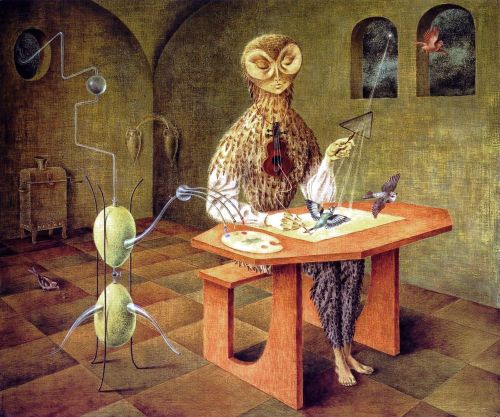
(The image is Creation of the Birds by Remedios Varo.)

 Theodora Goss
I am so happy to see this idea in print.
I taught in various universities for 35 years. During that time, my colleagues were often concerned about tools and behaviors that students might use to avoid the work and learning value of assignments. We always discussed how to prevent students from using such tools and engaging in such behaviors, often through detection and penalties intended as counterincentives.
Instead, I wished to find ways to change the form of teaching and assignments so that students could work without restriction and would still learn. This wasn’t easy, and my ideas sometimes failed.
For example, in some classes I assigned “open” projects. Students were invited to use whatever tools and take whatever help they wished. At the end, they had to present the results orally to me and/or the class. This worked very well sometimes, but not always.
I am totally retired now. I hope that other teachers will eventually work in this general direction and achieve more than I did. I hope that your design of assignments allowing the use of AI will advance that notion.
A reminder…the machine could not exist without us. But we could exist without it. Thank you for this insightful analysis.
I SOOOO relate to your recent Posts on this subject and referenced ” The Real and the Unreal: A Manifesto” in a recent Post of mine.
One of our dear friends, bless his heart, had AI construct a menu for the upcoming Super Bowl Party which he is hosting and one of the dishes was an Heirloom Tomato Salad. Now if the menu had been put together by an actual human being who understood seasonal produce it probably would’ve opted for something different. I reminded him that this was NOT the season for Heirloom tomatoes and would do the best I could to produce the dish assigned to me.
Another friend is a bassist who thinks it’s fine to have AI assist musicians. In my Post I mentioned one blogger’s young son who was TERRIFIED of musicians disappearing altogether, as he plays guitar and writes songs.
Some humans just don’t get it and I don’t get why they don’t get it; however, I’m glad I’m NOT them.
I even wrote a poem “Romancing My Senses”
The feel of my cat’s fur,
Smelling a delicious meal,
Reveling in the beauty of a flower,
And listening to the robin’s song in the early morn…
There’s nothing like living in a sensory-rich, tactile world.
Only three people who read that Post enjoyed it., I think I need to find new friends…
HGI is a project worth supporting. Thank you for describing it so well.
From what I’ve seen mention of AI at the moment, it’s all fantasy. It “will” do this; it “will” change that. So might fairy-dust and unicorns, but who believes in them these days? 😉