Finding our Ancestresses

Salem, Massachusetts is one of my favorite towns. If I could live there — if the commute from Boston were not so far — I would. Luckily, I sometimes get to visit, as I did last week, although with seventy students. I will have to go back so I can spend some time there by myself, browsing in the small boutiques, drinking hot chocolate at my favorite chocolate shop, even going back to the Peabody Essex Museum, which is where I went with the students last week.

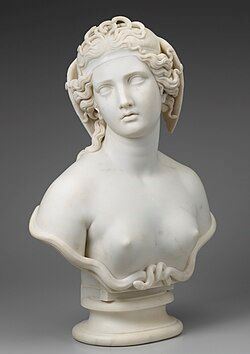
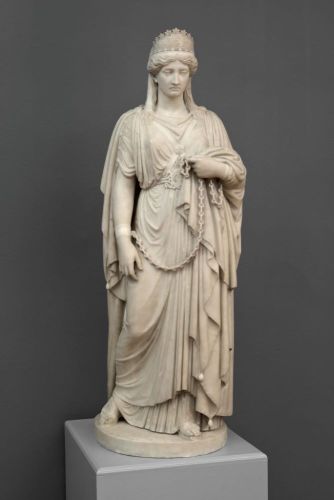
There, I saw two sculptures that got me thinking. The first was a bust of Medusa. The second was a full-sized sculpture called Zenobia in Chains. Both were by the American sculptor Harriet Goodhue Hosmer (1830-1908), who has been called the first professional woman sculptor. She was born and raised in Massachusetts, but in 1852, she went to Rome, where she joined a society of women sculptors — in Rome, women artists could flourish in a way they could not in the United States. They could study from live models, form their own studios, strive for artistic excellence and fame. Hosmer worked in an artistic and literary world that included figures such as Elizabeth and Robert Browning, Nathaniel Hawthorne, George Eliot . . . She was in good company.

(Medusa by Harriet Goodhue Hosmer)

Hosmer was a neoclassicist, and I was startled to see, on the wall of the Peabody Essex next to her sculptures, the term “Feminist Neoclassicism.” I knew what neoclassicism was, but feminist neoclassicism? According to the text, although these women sculptors were inspired by classical antiquity, they “looked to stories of courageous female protagonists for their most ambitious sculptures.” Their “sculptures of historical and mythological women, defiant in the face of bondage or triumphant in death, celebrated female self-determination and the artist’s own fierce independence.”

In other worlds, feminist neoclassicism is a kind of conversation with history and historiography. It says, “Let’s look back at the stories we have been telling, and see what the women were doing. Let’s reinterpret them.” And so it reinterprets Medusa — look at Hosmer’s Medusa, and you will see that she is beautiful. Her snakes, which are supposed to be so scary, are tastefully arranged. They curl above her forehead, echoing the curls of her natural hair, as though they were an ornament rather than a punishment from Athena — as though they formed a crown. The snakes beneath her breast seem decorative as well: they frame her bust. Coming out of the sides of her head are . . . wings. I don’t remember those in the original myth, do you?

Zenobia was the queen of Palmyra. After her husband’s death, she became regent for her son. During her reign, she launched an invasion against Rome that brought most of the Eastern empire, including Egypt, under her rule. She tried to make her son emperor, but her forces were defeated by those of the Emperor Aurelian, who captured her and forced her to live in Rome. During the height of her power, she ruled over a multiethnic court that became an intellectual and cultural center in the East, where Semitic and Hellenistic ideas met and mingled. She supported significant public works, such as restoring ancient monuments in Egypt. Why did she launch an invasion? It’s not clear, but from what I read, she may have been trying to consolidate power, for her son or herself, in the Eastern part of the empire. That had been acceptable to the previous emperors, Claudius and Quintillus, but Aurelia wanted to consolidate power himself — this was a time when Roman emperors rose and fell in rapid succession. Aurelian himself would only reign for five years. However, he reigned long enough to march east and defeat Zenobia’s forces. The captured queen was paraded in Aurelian’s triumph, and then . . . it’s not clear, but accounts suggest that she was allowed to live in a villa near Rome for the rest of her life. In Syria, she is still seen as a heroine who fought for her country — after all, if we’re talking empires, Rome did the invading first.

(Zenobia by Harriet Goodhue Hosmer)

Hosmer’s Zenobia maybe be in chains, and she does look troubled, as though contemplating her own defeat and the fate of her country. But she is still very clearly a queen, crowned and regally robed. Apparently, Hosmer wrote, “I have tried to make her too proud to exhibit passion or emotion of any kind; not subdued, though a prisoner; but calm, grand, and strong within herself.” I’m not certain, and none of my research sources seem to say, but I think that central clasp on her belt . . . I think it’s the head of Medusa? And the belt itself curves into two snake heads. So there is a connection between the two sculptures.

In marble, Hosmer seems to be carving her own history, her own mythology — she is creating her own ancestresses, or perhaps all of ours. These are the women we came from, she seems to say. Look: Medusa and Zenobia, beautiful, powerful, strong.

After the trip to Salem, I finished reading a book I had been enjoying for several weeks: Jane Austen’s Bookshelf by Rebecca Romney. I had picked it up in the local bookstore because it promised to examine the women writers whose works shaped Jane Austen. I had studied some of those writers in a class on eighteenth-century literature: Fanny Burney, Charlotte Smith, Maria Edgeworth. And of course I had read Ann Radcliffe — after all, my doctoral dissertation focused on the Gothic. Romney’s book, which is filled with history, anecdote, and personal reflection, fulfilled that promise beautifully. She examines the life and legacy of each writer, focusing in part on the ways in which they were erased from the canon, so that only Austen was left — like the one superheroine on the Marvel movie poster. It occurred to me, as I read the final chapter, that Romney was doing the same thing as Hosmer — she was resurrecting our ancestresses. She was making the case that these eighteenth-century women writers were worth reading (certainly Austen had thought so), and also that we would not really understand the history of the novel without them. (She also made the case, convincingly I think, that Fanny Burney really should be called Frances — the diminutive was part of her diminishment as an important author.)

When I was in college, we didn’t study many women artists or authors from before the twentieth century. There was an assumption, I suppose, that there simply weren’t that many. The few we studied were the geniuses, the exceptions who proved the rule that women, in the past, did not sculpt or paint or write. But when you look at the history, you find that actually there were many women doing exactly these things. Some of them were creating artistically because they were ambitious. Some of them needed money, and activities like writing were among the things women could do while maintaining their respectability — better, for an educated woman, than being a seamstress. But there were women creating throughout history. And they were written out.

What I’ve tried to do in my own life is find my ancestresses. Look for the ancient goddesses and queens, of course. But also the women like Hosmer and Frances Burney. Before that class on eighteen-century literature, I had not heard of Burney. Before seeing her sculptures at the Peabody Essex Museum, I had not heard of Hosmer, even though she inspired a character in Hawthorne’s The Marble Faun, which I had read many years ago. I might reread it now, but Romney’s book has also inspired me to reread Evelina, which Jane Austen apparently loved.

I might go on a hunt for some of my ancestresses . . .

Posted in Uncategorized | 1 Comment

Small Moments of Joy

To be honest, I have not been feeling much joy lately.

I’ve been sick for about two weeks. Over the spring break, I went to London and Bath, and I think I picked up something — I came back from Bath coughing a bit. Then I went to the International Conference on the Fantastic in the Arts in Florida, where it got worse, and at this point I’ve been coughing for two weeks. I’m sure that traveling so much did not help, and when I have not been traveling, I’ve been working — there’s a lot of work to catch up on just now.

Both of those trips were wonderful — Bath was a joy, so beautiful, all England and primroses and spring. And at ICFA I met so many old friends, whom I had not seen for at least a year. It was certainly worth going, even to stay for several days in an airport hotel in Orlando, which I would never choose to do otherwise. So I’m glad I went.

But now I’m sick and dispirited. So what to do?

What I’m trying to do is find small moments of joy. This morning I woke up, opened the back door to breath in some (very cold) fresh air. On the fence was sitting a robin, with brown feathers on its back and a plump red chest, singing. There it was, joy!

One of the best things I’ve done recently is left my knitting on the sofa. It’s a bit messy, but across the sofa is draped a scarf of rainbow yarn, green and yellow and orange and red and blue and purple, all fading into each other, like the stages of sunset. I chose the easiest project imaginable — I’m literally just knitting one row after another, with the colors of the dyed yarn making the only pattern. That means at any time of day, I can sit down for a few minutes and knit another row, without thought or planning. Sit, knit, watch the colors develop. Joy!

The sunlight coming through the lace curtains as I write this is joy. My lace curtains have a pattern of birds and twining stems, with leaves and flowers. Here and there is a dragonfly. More joy!

Later today I will spend a lot of time commenting on student essay proposals, annotated bibliographies, and reading journals. I would not describe that as joyful, although when I see what the students are doing — when I see their individual thoughts and ideas developing — I feel a sense of deep satisfaction. But I listen to music on a CD player, and that is joy.

Later I will walk outside a bit, and as I walk from my back door to the street, I will pass the garden, where things are beginning to peek up out of the soil. The peonies are pushing their red stems out of the ground. The hostas have not started coming up yet — they are smart, the hostas. They know that spring isn’t really here, not yet. But the daffodils have their leaves up already. And the small leaves of Snow on the Mountain, which will eventually spread all over the side garden, are already growing — they start as miniature versions of the plants they will eventually become. Most gloriously, a hellebore is almost blooming — it’s hiding a bit, still too shy to come out, but almost here. The periwinkles never really went away — they are more or less evergreen, as are the rhododendron and azaleas. But everything else is still brown and in waiting. My assistants, the rabbits, pruned a bit excessively last fall. We will see what comes up and when, but the garden is a daily adventure. A daily joy.

Other small joys: A cup of hot chocolate (instant, with hot water poured over the cocoa powder). The book I’m reading now, Jane Austen’s Bookshelf by Rebecca Romney, which I’ve almost finished. It’s been a wonderful read. Romney talks about all the female novelists who influenced Jane Austen (Frances Burney, Ann Radcliffe, Charlotte Lennox, Hannah More, Charlotte Smith, Elizabeth Inchbald, Hester Piozzi, and Maria Edgeworth). She tells the story of each writer, and also tells the story of what they wrote — there are stories within stories, and the overarching story is of Romney herself, who is a rare book dealer, trying to purchase editions of their novels. She also tries to understand why they fell out of the cannon, and that is a fascinating story — it’s the narrative of how women’s writing was trivialized and marginalized, so that only one would emerge as the best, the exemplary. The one perfect female novelist in a male lineage, the exception to her sex, because there can only be one — Jane Austen as Smurfette. But Austen didn’t experience herself that way — she consciously lived in a world of female novelists, whom she sometimes revered, sometimes emulated, sometimes disliked, depending on what they wrote. (It seems she generally disliked didactic literature, for example.) But whom she consistently read.

One joy I’m missing now is sleep, because I wake up during the night coughing. There are dark circles under my eyes. But another small joy I will try to give myself today is tidying, because I love trying to make a space clean and sensible — I love tidying and organizing, so that everything looks as it should. As I’m commenting on student work, I give myself tidying and knitting breaks.

I realize these are very trivial joys. But they’re what are available to me while I’m still coughing my lungs out, like a nineteenth-century consumptive. (I thought one went to Bath to recover, not to catch a cold.) Someone needs to write me a prescription that reads “You need fresh mountain air. Take yourself off to a sanatorium in Switzerland.)

(I have not mentioned, because I don’t want to think about it, how much the geopolitical situation has affected me, as I’m sure it has affected all of us. The fact that this country, of which I am a citizen, to which I pay taxes, has started a war — the fact that the war began with bombing a girl’s school, that more than a hundred girls who went to school that day are dead — it’s the stuff of nightmares. I don’t know how to deal with it psychologically, and I suspect many of you are in the same situation. So I knit and drink hot chocolate and comment on student essay proposals, because what the hell else can we do?)

Small joys. Try to find the small joys. They will get you through — they are, sometimes, the only things that will get you through. And then, when you can, work for a better world.

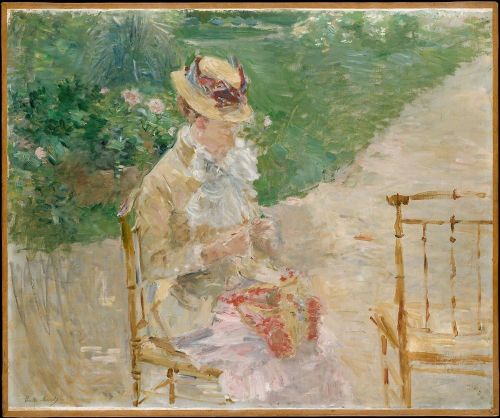
(The image is Young Woman Knitting by Berthe Morisot.)

Posted in Uncategorized | 1 Comment

My Eye/My I

Two weeks ago, I went to the symphony with our teaching team — four faculty members and seventy-two students. We heard a modern piece, which happened to be a very good modern piece — I’m not always fond of modern classical music, but this was lovely, like being under water and seeing aquatic creatures all around you, jellyfish floating, fish flashing by, even whales passing like shadows underneath. And then Mozart, and then Tchaikovsky. So it was a bit like traveling from the twentieth to the eighteenth and then to the nineteenth centuries through music. The students enjoyed it — I was not sure they would, but many of them have grown up playing musical instruments, and they all seemed to like the music, as well as the physical act of going to the symphony, sitting in that magnificent hall, and just listening for a while.

At the end of the symphony, my left eye was bothering me. I was seeing something — like smudges? Or bits of string? I thought, I must be tired . . . I went home, and then to sleep.

The next morning I woke up, and the smudges and bits of string were still there. Then, when I closed my eyes, I saw something new — flashes of light. I was frightened, of course. You’re not supposed to see things when you close your eyes, certainly not flashes of light at the periphery of your vision. My first thought was to ask Dr. Google what was going on. Dr. Google told me that I might have retinal detachment, in which case I would need surgery within the next 72 hours. He’s great at scaring you, Dr. Google.

I had three things to do that day: a meeting, a lecture, and a presentation. But the first thing I did was go to my optometrist’s office, which luckily is close by. The sign said it would not open until 10:30, so I went to the bookstore and bought the complete poems of Stevie Smith, because what else do you do while you’re waiting for the optometrist? At 10:30 I went back and spoke to the receptionist, who said that he was on vacation in Gibraltar, but she would call him for me. The advantage of having an optometrist who has known you for twenty years is that you can talk to him while he’s on vacation in Gibraltar, and he will tell you to look out the window and cover one eye, then the other, and then tell you that you probably don’t have retinal detachment, but you should go see an ophthalmologist to make sure. And by the way it’s been raining all week in Gibraltar, but the weather is nicer today — the sun is shining.

I called and made an appointment with the ophthalmologist for later that day — luckily the eye clinic was able to fit me in. Then I cancelled my lecture, which was at the same time as the appointment with the ophthalmologist, and went to my meeting. From my meeting I took a Lyft to the ophthalmologist, where my eyes were dilated and placed in front of machines, a lot of machines — they all took pictures of my eyes, and then I sat for a while and made small talk with other people there for eye procedures, and then there were more pictures, and then I talked to the ophthalmologist, who told me I did not have retinal detachment, at least not yet, but I did have vitreous detachment, which is a normal thing that happens when you get older, especially when you’re nearsighted. But older in this case could mean in your thirties or in your eighties, there was no particular rhyme nor reason — it was just one of those things that happened. And by the way I had a mild case of lattice degeneration in both eyes, which made this sort of thing more likely. Apparently, however, that isn’t as bad as it sounds, which makes me wonder, as a teacher of rhetoric–if it’s not that bad, why call it “degeneration”? I mean, there are other words in the English language that would not sound so dire!

It’s hard living in bodies, isn’t it?

We have to live with all the slings and arrows of outrageous fortune, plus all the aches and pains and accidental injuries, the times we stub our toe, the headaches, the arthritis, the heart disease. All the natural shocks that flesh is heir to. And while we live in these mortal bodies, subject to time, there is something within us that endures, that feels immortal. Is it immortal? I don’t know, but it certainly feels that way. I know that objectively I’m getting older, but it’s always a shock to feel anything related to aging, because inside I would say that I’m still fifteen, that I haven’t really changed that much from the teenager who read books about dragons. I am, as a matter of fact, rereading those books about dragons.

And yet, those natural shocks do shake my sense of self. I am not as confident in myself as I was before the thyroid surgery two years ago, which turned out to have been unnecessary. Or the dental stuff to fix a problem with my bite, which is ongoing. Or now this eye thing, which is natural and will likely happen to my other eye as well. There is no cure, by the way — it just gets better by itself over time. It’s starting to feel as though my body is a problem, rather than a miraculous biological phenomenon that allows me to participate in the glorious physical world. That allows me to smell lilies of the valley and taste hot cocoa, and stroke a cat’s fur, and hear the wind in the leaves. I keep worrying that I’m somehow running out of time.

We are such a strange mixture of spirit and flesh, aren’t we? And now along comes AI, that other kind of I. It’s neither spirit nor flesh, but we are asked to believe that it will somehow replace us, that it will outpace us. I’m going to venture a tentative hypothesis: that there is no spirit without flesh, that it is our mortality, our temporal boundedness, which gives us imagination, creativity, the elusive thing we call soul when we see it in a human being or a painting or a poem. (Or a dog’s eyes. Don’t tell me dogs and bats and octopuses don’t have souls. I’m quite sure trees have souls.)

When I open my eyes now, the left one reminds me of my own fragility. What do I do with this knowledge? I knew it before, of course — but more theoretically. Now there it is, in front of my eye, my I. The only thing I can think of, at the moment — the only response that comes to mind — is to make the spirit blaze brighter. However much time I have left, I want to spend it smelling lilies of the valley and drinking hot cocoa and stroking cats and listening to the wind in the leaves and reading (and writing) about dragons.

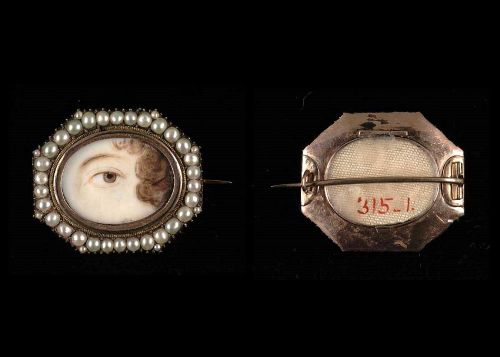
(The image is a miniature painting of a woman’s eye, probably from the 18th century.)

Posted in Uncategorized | Leave a comment

Human General Intelligence

At the beginning of the semester, I asked my students, all of whom are freshmen, how many of them had been told in high school not to use AI. Some hands went up. I asked how many of them had been told to use AI. Other hands went up. In my classes, I would say about 40% had been instructed to use AI in their schoolwork, and another 60% had been forbidden from using it. I told them my AI policy, which allows some judicious use with a metacognitive element, in which they have to reflect on their use of digital technologies. We’ll see how the semester goes.

Like every other professor right now, I’m in the middle of the AI quandary. What to do about student use of AI, particularly when the university is encouraging “AI literacy” (whatever that means)? It seems useless forbidding student use of AI. Far better, I believe, to help students make decisions about when and how to use it, making them aware of the problems with AI use — not least, the problems it creates for their own cognitive development. I’ve told them, and it’s written on my syllabus, that as their professor I do not use AI. I’m far too nervous about the effect it may have on my own cognitive development — on my ability to think and write for myself.

But there’s a larger issue here, that has to do with more than individual students or classrooms. I’ll try to explain what I mean as well as I can.

The message we’ve been getting from the AI companies is that all the negative effects of AI development — the social costs, the environmental problems — will be worth it once we achieve AGI, Artificial General Intelligence. At that point we will have a machine capable of solving all our problems. Of course, the machine will be owned by a small elite, and we will all pay and pay and pay, probably even more than we are paying now, to access its wisdom. Who knows if those companies will ever achieve AGI (I’m a doubter). But there is something everyone seems to be discounting:

Human General Intelligence.

Human general intelligence is what we have as human beings when there are a lot of us, and we work in places like laboratories and libraries, places where research is done and information is found, all over the world. And then we share the knowledge we have developed in journals and conferences, or by posting about it online. It is a vast network of human minds, doing their own thinking all over the world, creating things. That is Human General Intelligence. It is decentralized, somewhat random, imperfect. But it has brought us cures for diseases, ways of governing, great works of literature. It has brought us where we are today, as a global society.

Of course, it has brought us terrible things as well — colonialism, racism, eugenics, the list goes on. The evil that human beings have created gets programmed into AI, because after all AI is just a distillation of us. It will be there in AGI, if AGI is ever achieved. It might end up being smarter than us. It’s not going to be better.

The problem, as I see it, is that the emphasis on AI and AGI seems to be replacing our focus on HI and HGI — on human intelligence. While I don’t consider test scores a great metric for judging students, it does seem clear that reading and mathematical abilities are declining. As a society, we are not getting smarter — or, more importantly, wiser. AI is not necessarily to blame for this. The way we use the internet, with its emphasis on the endless scroll, is a more likely culprit. Children whose brains are raised on the endless scroll are going to have a hard time with Anna Karenina or even Little Women. (Confession: I, a professor with a PhD, have a hard time with Anna Karenina, but partly because I want to sent all the characters to therapy.) However, AI is going to make it worse.

When you eat highly processed foods, you are offloading the act of digestion to Unilever and its ilk. They have partly pre-digested the food for you, which sounds kind of gross, right? Your stomach is not getting enough to do — there’s not enough dietary fiber to keep it properly occupied. The same thing happens to your brain. If it’s not given enough mental fiber, enough difficult things to do — if all it gets is predigested material, if you’re offloading thinking to a computer — well. It’s like eating cognitive fast food. You end up with an unhealthy brain, and we end up with an unhealthy human society.

If we listen to the tech companies, AI and AGI are meant to replace human intelligence. Indeed, their funding model does not work otherwise. AI is only worth investing in if companies can replace their human workers with it — if they can cut the cost of employing human beings. Just using AI to supplement human work and “boost productivity” does not make or save enough money. And for college students, my students, using AI makes the most sense if it replaces some of the work they have to do. Of course, that’s not how I want them to use it. I want then to use it, if they choose to use it, as a tool to supplement their own thinking. My goal, in designing my assignments, is to make them as time-consuming to complete with AI as they would be to complete without AI, because they would still involve finding real sources, making choices about how to present research, revising any AI writing to make sure it has an engaging human voice, etc.

And, in many places, human intelligence is being defunded and devalued. I’m writing this in the United States, where universities have had their research funding cut. But it’s the same story in other countries where artists can no longer support themselves — the arts are part of human intelligence as well. It’s the same story anyplace where schools are too expensive, where teachers are not paid enough to live on, where children are deprived of education. The problem goes all the way from elementary schools in which children aren’t given the nutritious food they need to learn and thrive, to NASA’s archives being destroyed or information on slavery in the US being taken down from public parks. It’s a kind of war on the development and maintenance of human intelligence.

The thing is, the central thing I want to say is: We can’t afford to lose HGI. I believe that decentralized human intelligence — human beings creating and discovering things all over the world — is the most powerful, wonderful thing we have as human beings.

And here I’m going to write about science fiction, specifically the Hitchhiker’s Guide to the Galaxy series. Do you remember those books? The last time I was in Highgate Cemetery, I saw Douglas Adams’ grave. People leave pens. It’s wonderful to see how people remember his work, how they still express appreciation for that particular human intelligence. The human is gone, but he left us his work, and we are so grateful.

In his series, we learn that an alien species build a supercomputer, Deep Thought, to provide the answer to “life, the universe, and everything.” After a long period of thinking deeply, Deep Thought announces that the answer is 42. Then, it helps the aliens build an ever larger supercomputer to figure out the question. That larger supercomputer is the Earth. I thought that was so funny, the first time I read it!

It was only recently, when I read the series again for maybe the third time, that I realized it’s not really a joke. The Earth is, in fact, an amazing organic computer of sorts, for figuring out life, the universe, and everything. Human beings have been trying to figure out life, the universe, etc. for most of human history. Perhaps the entire history of the planet, until today, when I am sitting here typing this on my laptop, has been a long attempt to ask the right question (but I bet there’s more than one) and the right answer (but I bet there’s more than one of those too), and human beings are just one part of that long attempt. It’s possible that AI might become part of that attempt, but not, I think, by replacing human intelligence — for the simple reason that it will be owned and monetized by central entities who will control what it produces. If that changes, if AI becomes cheaply and easily available without enriching tech overlords or creating environmental destruction, and if it’s used to supplement human intelligence, than maybe.

We need HGI — the decentralized human intelligence that lives in organic human bodies. It I could make one wish for the world, it would be that every child on this planet could be educated to the full extent of its abilities. That means it would be safe, well-fed and housed, and of course well-taught. If we had that, if every child could achieve its potential, can you imagine what amazing things could happen? Sure, some would grow up to become scientists or artists — those are the fields we tend to associate with human creativity. But others would be thoughtful, creative plumbers, gardeners, nurses, car mechanics, yarn shop owners, elementary school teachers, furniture restorers — like my uncle the master furniture restorer, who knew everything there is to know about Italian literature.

That’s the future I would like to see on this planet.

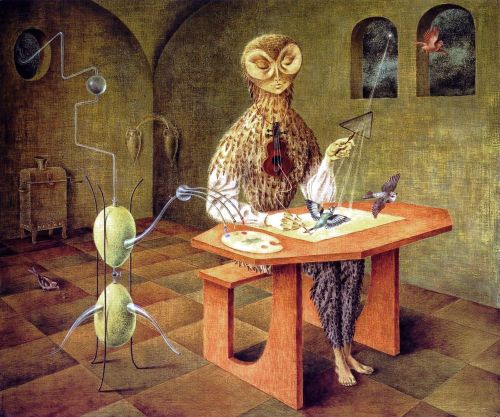
(The image is Creation of the Birds by Remedios Varo.)

Posted in Uncategorized | 5 Comments

Mother Night’s Tapestry

First, you have to get to Mother Night’s country. It’s both through and beyond: through any doorway, but also beyond the place you’re stepping into, so you can’t just step through and end up there. You have to, in a sense, take two steps. Both through the doorway and beyond the reality you’re currently in.

I wrote about Mother Night’s country in a short story called “The Other Thea,” which you can find in The Collected Enchantments. In that story, Thea goes back to the combination middle and high school she graduated from, Miss Lavender’s School of Witchcraft, in Hartford, Massachusetts. She’s been having some personal problems lately — trouble focusing, lack of motivation, a general sense of existential unease. She consults her old teachers, including the mysterious Miss Emily Gray (who appears in several other of my stories). They tell her that the solution to her problems lies in Mother Night’s country.

I won’t tell you more about that story — you can read it for yourself. What I want to talk about is Mother Night’s country and what Thea sees there. Of course, Mother Night is a character in the story, but also the primordial darkness from which all things originally arose. She is the mother of all things, including light and time. And, simultaneously, a wise old woman who can look any which way, as well as any age. In fact, every time you see her she might appear different, but you will always be able to tell she is Mother Night.

In her own country, she lives in a castle that looks sort of like a sea shell and sort of like a dinosaur skeleton and sort of like a bunch of other things, with towers and various architectural features, many of which don’t seem to go together. Think of an Escher print. In that castle, in the highest tower, her tapestry is continually being woven.

Let’s go into the castle — Mother Night has beckoned us in. We follow her to the tower, which is so tall that we can’t see the top of it — it’s taller on the inside. Down from the top of the tower, wherever that may be, come the warp threads. And weaving through them is the weft — the threads that make up the picture the tapestry is showing. Who does the weaving? Golden spiders. No, I’m not making this up, or rather of course I’m making this up, but if you go to Mother Night’s castle, you can see them. They are quite beautiful.

What are the threads? They are you and I and all of us. Each of us is a thread in Mother Night’s tapestry. Some of the threads are shorter, some longer. They are all different colors — deepest burgundy, lapis lazuli blue, malachite green, the yellow at the center of daisies and the yellow at the center of the sun, orange like autumn leaves, the red of poppies, indigo like twilight. All the colors possible. What picture are those spiders weaving? That’s the most important thing I’m going to tell you: we don’t know. Only Mother Night knows.

We are all part of a great tapestry, and we don’t know what is on the front, or which part of the picture we make. Are we a unicorn’s nose? A flower petal? An ocean wave? We have no idea. Only Mother Night knows what is being woven. All we can see is the back of the tapestry, which is a bunch of threads.

What do we know? That every thread is important. That every thread is equally important, because if you pull out one thread, you alter the tapestry. And that we don’t know the picture it’s making, but we know we’re part of it. The not knowing is what makes us human — if we knew, we would be something else, something supernatural I suppose.

Yes, this is a sort of allegory, at least a loose one. It’s also an argument. I’m trying to make a point about human life, which is that we are part of a greater whole, and we are all part of that whole, and we are all important in some way we don’t understand. We may never understand it, at least not while we’re alive. We don’t get to see the front of the tapestry. We are living in a time of hierarchies of value, when some human lives are treated as more important than others, but that’s the height of arrogance, isn’t it? Because we don’t know what the front of the tapestry looks like. It doesn’t make sense to say that a CEO is more important than the Uber driver who gets him to work. Both of them are threads in the tapestry.

It really seems to me as though our society is looking at a lot of things the wrong way round. Perhaps if we could get to Mother Night’s country, we would come back wiser, or at least a little less certain of ourselves, a little more humble in our approach to the magnificent world that emerged from that primordial darkness, and which we, however rich we become, however much we accumulate, however powerful we are, only inhabit for a little while.

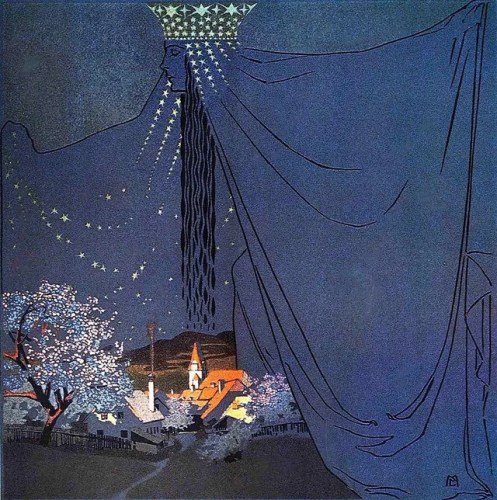
(The image is Queen of the Night by Mila von Luttich.)

Posted in Uncategorized | 4 Comments

The Sky Above Budapest

What I love about the sky above Budapest is that I can see it.

There are strict limits on the height of buildings in Budapest. Traditionally, they could not be build taller than Parliament or Saint Stephen’s Basilica, both of which are 96 meters tall. There was symbolic value to this choice: it emphasized the importance of government and religion, as well as their equal contributions to the life of the nation, at least theoretically. In 2018 this tradition was codified — after that year, no buildings could be built over 90 meters, and anything between 65 and 90 meters required government approval. The only exception was the MOL tower, which had already been approved — it was completed in 2022 at a very tall (for Budapest) 143 meters. MOL (Magyar Olaj- és Gázipari Nyrt.) is the Hungarian oil and gas company, so its height is symbolically appropriate: church and government are less important, now, than the interests of fossil fuel. The tower itself rises above the much lower buildings that surround it. One could compare it to the tower of Sauron. It has also, less charitably, together with the “campus” at its base, been compared to — how shall I put this delicately? A certain portion of the male anatomy. Or it could be a raised middle finger, from Buda to Pest. It looks as though it belongs in Frankfurt.

Most of Budapest still consists of old buildings, low enough that you can see the whole sweep of the sky above you. I love looking at it, especially around sunset. When I walk down Rákóczi út, from Blaha Lujza tér to Astoria, I can see the sun setting over the Danube. The whole sky turns pink and orange, and the old buildings bask in that evening glow, becoming even mellower. Then twilight begins to fall. Because I can see the sky, even in the middle of the city I feel connected to something larger, to the natural world of which I am a part. And it’s even more beautiful seeing the sun set while I’m standing on the Szabadság híd (the Liberty Bridge, one of the seven famous bridges of Budapest). Then, you can see the sun setting among pink and orange clouds over Castle Hill, and the green snake of the Danube flowing beneath. You can think — at least I always think — about the thousands of years during which people have seen the exact same view, before there were bridges over the Danube, while they were built over the years one by one, when they were destroyed by bombs, during my grandmother’s lifetime, my mother’s . . . and now mine. Seeing the sky in that way places me geographically as well as in time. It makes me feel grounded as well as — what do we call grounded in time? It reminds me of my place in the scheme of things. It gives me a sense of my possibilities and limitations as a human being.

I mean no disrespect to other cities, not even Frankfurt. But Budapest, more than any other city I have been to, feels as though built on a human scale. (With the exception of the MOL tower, but then the fossil fuel industry, which reaches back into the time of the dinosaurs, bringing forward energy laid down in the earth long ago, is not in fact on a human scale, it is?) And it seems to me that we need the human scale now, more than ever.

I suppose the reason I’m writing about this is that in my lifetime, everything seems to have gotten larger. The beautiful old skyline of New York, already probably too high and aspirational for human beings, now feels as though constructed to be demolished in Hollywood superhero franchises. Its tall glass towers feel appropriate for supervillains, while all the interesting life (in my opinion) happens at street level, the level of the parks and little bodegas. The old corporations I remember were bought by larger corporations, and now it feels as though every industry is dominated by approximately five major entities. Yet interesting human life continues at street level — beneath the five major publishers are ecosystems of smaller independent publishers releasing some of the most innovative books of our time. I suspect the same thing is happening in other media, in music and art. At least when the larger entities don’t strangle the smaller ones, as they currently threaten to do with the rise of AI, which steals all media to create its own ubiquitous sludge.

What I want to argue here is that we need the human scale, and we should actively choose the human scale. It’s hard, now — I recently ordered some used books from AbeBooks, feeding the Amazon beast. It’s almost impossible to escape this era of hyper-conglomerization. But I would like to.

I would like to make the argument that the human is fundamentally important, and that even before the advent of AI, we were in danger of losing sight of humanity. We created buildings and cities that made us feel insignificant, rather than expanding our souls. When I am in a forest or a cathedral, it feels as though my human soul takes flights. Even the older buildings of New York can do that. But walking beneath the glass towers of London’s financial district just makes me feel small, and somehow excluded. They seem to belong to people who arrive in helicopters and shop at stores that were once associated with a specific human creativity but are now themselves just parts of large conglomerates, such as Dior and Chanel.

I suppose what I believe, or perhaps want to believe, is that creativity always happens down in the streets, at the human level. It happens among people who are not particularly powerful, who are scrambling to make ends meet and create literature, art, and music that might endure. From that level it rises up, but perhaps not all the way to the top of the Gherkin or MOL tower. Perhaps the highest it can go is 96 meters, at least in Budapest.

When I was in my 20s, I worked at a corporate lawyer in the MetLife Building above Grand Central Station. Every day, I rode the elevator up to the 42nd floor and went into my small office, which had a view of the city. There, I spent my days in billable 15-minute increments, helping large corporations make more money. I left for the human scale of a PhD program studying literature, teaching students in run-down classrooms. I still work at that human scale (the classrooms are still run-down). Teaching is changing — the university is also being invaded by the corporatification, the AI-ification, of everything. But I will hold on to the human scale as long as I can. Unless we are taken over by the machines, I suspect that will be the rest of my lifetime.

Hopefully, the sky over Budapest will remain as visible as it as now, for as long as my own human life — for as long as I can see it, walking down Rákóczi út.

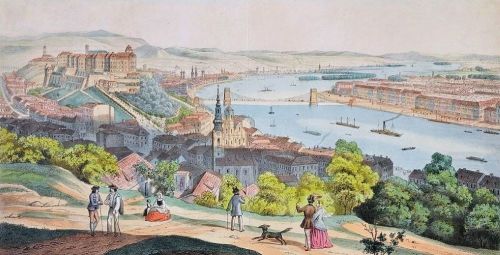
(The image is a nineteenth-century engraving of Budapest.)

Posted in Uncategorized | 1 Comment

I Miss the Operator

Recently, I was reading a book of essays by E.B. White (author of Charlotte’s Web and other children’s books, as well as an excellent essayist). In one essay, he lamented that in his small town in Maine, the rotary phone was replacing the old operator system. Now everyone had to remember numbers rather than simply picking up the handpiece and talking to the operator. Under the old system, he said, there was always a comforting voice at the other end of the line, immediately available, to connect you with someone else, figure out what to do in case of an emergency, even dispense advice. The operator knew everyone, and generally knew what was going on. A human connection was going away with the advent of the rotary phone.

Rotary phones were already rare when I was growing up — all the phones were push button. But we still had an operator. You could still dial zero and get a voice, who would find a number for you or connect you to emergency services if necessary. There was always someone on the other side of the line that you could reach out to. I was wondering what would happen if you dialed zero now, so I — no, I did not initially dial zero, but I looked it up on the internet. Since this is 2025, I got an AI overview. Here is what it told me: “When you dial zero today, nothing specific happens on a phone line, as operator and directory assistance has been phased out by many providers. On modern landlines or mobile phones, dialing zero likely results in a message indicating the service is unavailable, directs you to a different number for customer service, or provides instructions to use online resources instead.” Then of course I had to try it for myself. What happens when you dial zero from a mobile phone? Sure enough, you get a message: “The service you are trying to use has been restricted or is unavailable.” That is the operator’s sad requiem.

Will I sound old and ridiculous (I am not that old, but am willing to take “ridiculous”) when I say that I am sad to see good things passing away and being replaced by things that, while convenient, are somehow not as satisfying? Like film for photographs. I used to take photos on my mother’s old Minolta camera. They are filed in a photo box with older photos that my mother took, and even older photos that her mother took. I’ve also taken a lot of photos on my phone camera. They are in iCloud, and at some point I really should print them out, right? But do we? Print them out, I mean. If we remember, but we often don’t.

Somehow, when we can take so many photos, each one means less. Now that we carry our phones around with us all the time, we seldom make calls. We carry televisions around in our pockets, yet the shows don’t affect our culture the way they used to. In all of these instances, we have lost little bits of human connection.

There are ways in which our lives in 2025 are easier and wealther than they used to be. And yet, I remember when we had something we don’t seem to have anymore. Didn’t we have more time? Things took longer — you could not order from Amazon and had to find whatever it was you wanted at the store, or order it by phone and wait for it to arrive. I still remember calling catalog companies and ordering by phone from a sales clerk. Is that even possible anymore? And yet I don’t remember life being as rushed, even ten years ago, as it is now. I don’t remember this sense that everything is happening too quickly, that no one knows what will happen next year, or the next financial quarter. Will you lose your job to AI? Who knows.

Sometimes I take refuge from the pace of the present by retreating into the past. Today I am still spending time in Maine with E.B. White, but also looking through What Shall I Wear? by Claire McCardell and reading The Brownie and the Princess, a collection of stories by Louisa May Alcott. So parts of my brain are in the 1950s, parts are roaming through various points from the 1930s to the 1970s, and parts are all the way back in the 19th century. All of these books give me a different sense of time — different, I mean, from our time. It goes most slowly in Alcott, where people walk or ride horses or drive carriages to get around. But you can feel it even in White’s motor cars and McCardell’s trains from New York to the countryside. Everything is slower.

Not too long ago, we had movements that attempted to recapture a slower sense of time. Movements may be too glorified a term — I’m thinking of Cottagecore, Forest Girl, Dark Academia. We still have BookTok, which is at least focused on the much slower pleasure of reading. And I still remember, from the 1990s, the allure of Shabby Chic. I would call my own decorating a mixture of Mission Style and Shabby Chic. Shabby Mission, as it were–which means that I love old oak, and pick it up from the side of the road or carry it home from Goodwill. Somehow, these movements seem to have gone away, and we are all in a moment where time is speeding up. We are so afraid of it that celebrities are literally trying to stop its passage by purchasing new faces. At least, their new faces don’t look much like their old faces. It seems as though, despite various books on Wabi Sabi, our culture is afraid of the old, the imperfect, the temporal. We do not value the things that take time.

I don’t know about you, but the speed at which our society is moving gives me a sense of nausea, like motion sickness, and a fear of being permanently behind. I will literally never catch up on my emails.

I don’t think we can get the operator back. But I will have to think about what to do in my own life to slow down a bit, to make sure my feet are on the ground. I really should knit something. I really should paint something. I’m already writing something (by hand, as I always do with fiction and poetry). In the midst of the storm, I need to catch my breath. I bet you do too, so breathe, and then do something that allows you to feel time passing.

(The image is Telephone Operator by Gerrit A. Beneker.)

Posted in Uncategorized | 7 Comments