Mother Night’s Tapestry

First, you have to get to Mother Night’s country. It’s both through and beyond: through any doorway, but also beyond the place you’re stepping into, so you can’t just step through and end up there. You have to, in a sense, take two steps. Both through the doorway and beyond the reality you’re currently in.

I wrote about Mother Night’s country in a short story called “The Other Thea,” which you can find in The Collected Enchantments. In that story, Thea goes back to the combination middle and high school she graduated from, Miss Lavender’s School of Witchcraft, in Hartford, Massachusetts. She’s been having some personal problems lately — trouble focusing, lack of motivation, a general sense of existential unease. She consults her old teachers, including the mysterious Miss Emily Gray (who appears in several other of my stories). They tell her that the solution to her problems lies in Mother Night’s country.

I won’t tell you more about that story — you can read it for yourself. What I want to talk about is Mother Night’s country and what Thea sees there. Of course, Mother Night is a character in the story, but also the primordial darkness from which all things originally arose. She is the mother of all things, including light and time. And, simultaneously, a wise old woman who can look any which way, as well as any age. In fact, every time you see her she might appear different, but you will always be able to tell she is Mother Night.

In her own country, she lives in a castle that looks sort of like a sea shell and sort of like a dinosaur skeleton and sort of like a bunch of other things, with towers and various architectural features, many of which don’t seem to go together. Think of an Escher print. In that castle, in the highest tower, her tapestry is continually being woven.

Let’s go into the castle — Mother Night has beckoned us in. We follow her to the tower, which is so tall that we can’t see the top of it — it’s taller on the inside. Down from the top of the tower, wherever that may be, come the warp threads. And weaving through them is the weft — the threads that make up the picture the tapestry is showing. Who does the weaving? Golden spiders. No, I’m not making this up, or rather of course I’m making this up, but if you go to Mother Night’s castle, you can see them. They are quite beautiful.

What are the threads? They are you and I and all of us. Each of us is a thread in Mother Night’s tapestry. Some of the threads are shorter, some longer. They are all different colors — deepest burgundy, lapis lazuli blue, malachite green, the yellow at the center of daisies and the yellow at the center of the sun, orange like autumn leaves, the red of poppies, indigo like twilight. All the colors possible. What picture are those spiders weaving? That’s the most important thing I’m going to tell you: we don’t know. Only Mother Night knows.

We are all part of a great tapestry, and we don’t know what is on the front, or which part of the picture we make. Are we a unicorn’s nose? A flower petal? An ocean wave? We have no idea. Only Mother Night knows what is being woven. All we can see is the back of the tapestry, which is a bunch of threads.

What do we know? That every thread is important. That every thread is equally important, because if you pull out one thread, you alter the tapestry. And that we don’t know the picture it’s making, but we know we’re part of it. The not knowing is what makes us human — if we knew, we would be something else, something supernatural I suppose.

Yes, this is a sort of allegory, at least a loose one. It’s also an argument. I’m trying to make a point about human life, which is that we are part of a greater whole, and we are all part of that whole, and we are all important in some way we don’t understand. We may never understand it, at least not while we’re alive. We don’t get to see the front of the tapestry. We are living in a time of hierarchies of value, when some human lives are treated as more important than others, but that’s the height of arrogance, isn’t it? Because we don’t know what the front of the tapestry looks like. It doesn’t make sense to say that a CEO is more important than the Uber driver who gets him to work. Both of them are threads in the tapestry.

It really seems to me as though our society is looking at a lot of things the wrong way round. Perhaps if we could get to Mother Night’s country, we would come back wiser, or at least a little less certain of ourselves, a little more humble in our approach to the magnificent world that emerged from that primordial darkness, and which we, however rich we become, however much we accumulate, however powerful we are, only inhabit for a little while.

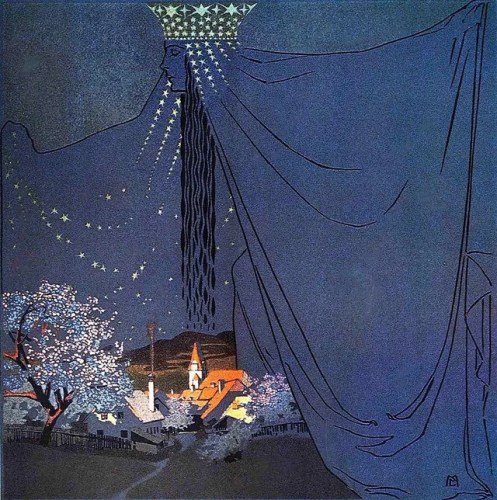
(The image is Queen of the Night by Mila von Luttich.)

Posted in Uncategorized | 2 Comments

The Sky Above Budapest

What I love about the sky above Budapest is that I can see it.

There are strict limits on the height of buildings in Budapest. Traditionally, they could not be build taller than Parliament or Saint Stephen’s Basilica, both of which are 96 meters tall. There was symbolic value to this choice: it emphasized the importance of government and religion, as well as their equal contributions to the life of the nation, at least theoretically. In 2018 this tradition was codified — after that year, no buildings could be built over 90 meters, and anything between 65 and 90 meters required government approval. The only exception was the MOL tower, which had already been approved — it was completed in 2022 at a very tall (for Budapest) 143 meters. MOL (Magyar Olaj- és Gázipari Nyrt.) is the Hungarian oil and gas company, so its height is symbolically appropriate: church and government are less important, now, than the interests of fossil fuel. The tower itself rises above the much lower buildings that surround it. One could compare it to the tower of Sauron. It has also, less charitably, together with the “campus” at its base, been compared to — how shall I put this delicately? A certain portion of the male anatomy. Or it could be a raised middle finger, from Buda to Pest. It looks as though it belongs in Frankfurt.

Most of Budapest still consists of old buildings, low enough that you can see the whole sweep of the sky above you. I love looking at it, especially around sunset. When I walk down Rákóczi út, from Blaha Lujza tér to Astoria, I can see the sun setting over the Danube. The whole sky turns pink and orange, and the old buildings bask in that evening glow, becoming even mellower. Then twilight begins to fall. Because I can see the sky, even in the middle of the city I feel connected to something larger, to the natural world of which I am a part. And it’s even more beautiful seeing the sun set while I’m standing on the Szabadság híd (the Liberty Bridge, one of the seven famous bridges of Budapest). Then, you can see the sun setting among pink and orange clouds over Castle Hill, and the green snake of the Danube flowing beneath. You can think — at least I always think — about the thousands of years during which people have seen the exact same view, before there were bridges over the Danube, while they were built over the years one by one, when they were destroyed by bombs, during my grandmother’s lifetime, my mother’s . . . and now mine. Seeing the sky in that way places me geographically as well as in time. It makes me feel grounded as well as — what do we call grounded in time? It reminds me of my place in the scheme of things. It gives me a sense of my possibilities and limitations as a human being.

I mean no disrespect to other cities, not even Frankfurt. But Budapest, more than any other city I have been to, feels as though built on a human scale. (With the exception of the MOL tower, but then the fossil fuel industry, which reaches back into the time of the dinosaurs, bringing forward energy laid down in the earth long ago, is not in fact on a human scale, it is?) And it seems to me that we need the human scale now, more than ever.

I suppose the reason I’m writing about this is that in my lifetime, everything seems to have gotten larger. The beautiful old skyline of New York, already probably too high and aspirational for human beings, now feels as though constructed to be demolished in Hollywood superhero franchises. Its tall glass towers feel appropriate for supervillains, while all the interesting life (in my opinion) happens at street level, the level of the parks and little bodegas. The old corporations I remember were bought by larger corporations, and now it feels as though every industry is dominated by approximately five major entities. Yet interesting human life continues at street level — beneath the five major publishers are ecosystems of smaller independent publishers releasing some of the most innovative books of our time. I suspect the same thing is happening in other media, in music and art. At least when the larger entities don’t strangle the smaller ones, as they currently threaten to do with the rise of AI, which steals all media to create its own ubiquitous sludge.

What I want to argue here is that we need the human scale, and we should actively choose the human scale. It’s hard, now — I recently ordered some used books from AbeBooks, feeding the Amazon beast. It’s almost impossible to escape this era of hyper-conglomerization. But I would like to.

I would like to make the argument that the human is fundamentally important, and that even before the advent of AI, we were in danger of losing sight of humanity. We created buildings and cities that made us feel insignificant, rather than expanding our souls. When I am in a forest or a cathedral, it feels as though my human soul takes flights. Even the older buildings of New York can do that. But walking beneath the glass towers of London’s financial district just makes me feel small, and somehow excluded. They seem to belong to people who arrive in helicopters and shop at stores that were once associated with a specific human creativity but are now themselves just parts of large conglomerates, such as Dior and Chanel.

I suppose what I believe, or perhaps want to believe, is that creativity always happens down in the streets, at the human level. It happens among people who are not particularly powerful, who are scrambling to make ends meet and create literature, art, and music that might endure. From that level it rises up, but perhaps not all the way to the top of the Gherkin or MOL tower. Perhaps the highest it can go is 96 meters, at least in Budapest.

When I was in my 20s, I worked at a corporate lawyer in the MetLife Building above Grand Central Station. Every day, I rode the elevator up to the 42nd floor and went into my small office, which had a view of the city. There, I spent my days in billable 15-minute increments, helping large corporations make more money. I left for the human scale of a PhD program studying literature, teaching students in run-down classrooms. I still work at that human scale (the classrooms are still run-down). Teaching is changing — the university is also being invaded by the corporatification, the AI-ification, of everything. But I will hold on to the human scale as long as I can. Unless we are taken over by the machines, I suspect that will be the rest of my lifetime.

Hopefully, the sky over Budapest will remain as visible as it as now, for as long as my own human life — for as long as I can see it, walking down Rákóczi út.

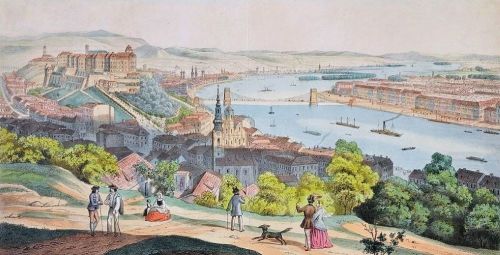
(The image is a nineteenth-century engraving of Budapest.)

Posted in Uncategorized | 1 Comment

I Miss the Operator

Recently, I was reading a book of essays by E.B. White (author of Charlotte’s Web and other children’s books, as well as an excellent essayist). In one essay, he lamented that in his small town in Maine, the rotary phone was replacing the old operator system. Now everyone had to remember numbers rather than simply picking up the handpiece and talking to the operator. Under the old system, he said, there was always a comforting voice at the other end of the line, immediately available, to connect you with someone else, figure out what to do in case of an emergency, even dispense advice. The operator knew everyone, and generally knew what was going on. A human connection was going away with the advent of the rotary phone.

Rotary phones were already rare when I was growing up — all the phones were push button. But we still had an operator. You could still dial zero and get a voice, who would find a number for you or connect you to emergency services if necessary. There was always someone on the other side of the line that you could reach out to. I was wondering what would happen if you dialed zero now, so I — no, I did not initially dial zero, but I looked it up on the internet. Since this is 2025, I got an AI overview. Here is what it told me: “When you dial zero today, nothing specific happens on a phone line, as operator and directory assistance has been phased out by many providers. On modern landlines or mobile phones, dialing zero likely results in a message indicating the service is unavailable, directs you to a different number for customer service, or provides instructions to use online resources instead.” Then of course I had to try it for myself. What happens when you dial zero from a mobile phone? Sure enough, you get a message: “The service you are trying to use has been restricted or is unavailable.” That is the operator’s sad requiem.

Will I sound old and ridiculous (I am not that old, but am willing to take “ridiculous”) when I say that I am sad to see good things passing away and being replaced by things that, while convenient, are somehow not as satisfying? Like film for photographs. I used to take photos on my mother’s old Minolta camera. They are filed in a photo box with older photos that my mother took, and even older photos that her mother took. I’ve also taken a lot of photos on my phone camera. They are in iCloud, and at some point I really should print them out, right? But do we? Print them out, I mean. If we remember, but we often don’t.

Somehow, when we can take so many photos, each one means less. Now that we carry our phones around with us all the time, we seldom make calls. We carry televisions around in our pockets, yet the shows don’t affect our culture the way they used to. In all of these instances, we have lost little bits of human connection.

There are ways in which our lives in 2025 are easier and wealther than they used to be. And yet, I remember when we had something we don’t seem to have anymore. Didn’t we have more time? Things took longer — you could not order from Amazon and had to find whatever it was you wanted at the store, or order it by phone and wait for it to arrive. I still remember calling catalog companies and ordering by phone from a sales clerk. Is that even possible anymore? And yet I don’t remember life being as rushed, even ten years ago, as it is now. I don’t remember this sense that everything is happening too quickly, that no one knows what will happen next year, or the next financial quarter. Will you lose your job to AI? Who knows.

Sometimes I take refuge from the pace of the present by retreating into the past. Today I am still spending time in Maine with E.B. White, but also looking through What Shall I Wear? by Claire McCardell and reading The Brownie and the Princess, a collection of stories by Louisa May Alcott. So parts of my brain are in the 1950s, parts are roaming through various points from the 1930s to the 1970s, and parts are all the way back in the 19th century. All of these books give me a different sense of time — different, I mean, from our time. It goes most slowly in Alcott, where people walk or ride horses or drive carriages to get around. But you can feel it even in White’s motor cars and McCardell’s trains from New York to the countryside. Everything is slower.

Not too long ago, we had movements that attempted to recapture a slower sense of time. Movements may be too glorified a term — I’m thinking of Cottagecore, Forest Girl, Dark Academia. We still have BookTok, which is at least focused on the much slower pleasure of reading. And I still remember, from the 1990s, the allure of Shabby Chic. I would call my own decorating a mixture of Mission Style and Shabby Chic. Shabby Mission, as it were–which means that I love old oak, and pick it up from the side of the road or carry it home from Goodwill. Somehow, these movements seem to have gone away, and we are all in a moment where time is speeding up. We are so afraid of it that celebrities are literally trying to stop its passage by purchasing new faces. At least, their new faces don’t look much like their old faces. It seems as though, despite various books on Wabi Sabi, our culture is afraid of the old, the imperfect, the temporal. We do not value the things that take time.

I don’t know about you, but the speed at which our society is moving gives me a sense of nausea, like motion sickness, and a fear of being permanently behind. I will literally never catch up on my emails.

I don’t think we can get the operator back. But I will have to think about what to do in my own life to slow down a bit, to make sure my feet are on the ground. I really should knit something. I really should paint something. I’m already writing something (by hand, as I always do with fiction and poetry). In the midst of the storm, I need to catch my breath. I bet you do too, so breathe, and then do something that allows you to feel time passing.

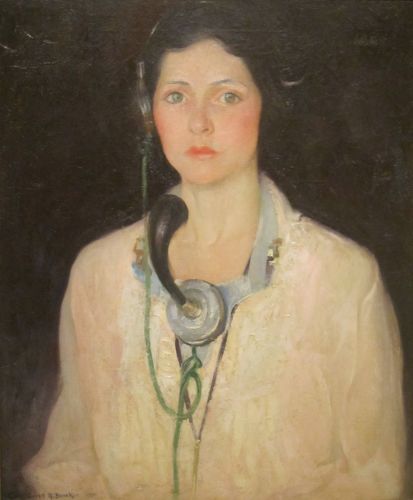
(The image is Telephone Operator by Gerrit A. Beneker.)

Posted in Uncategorized | 7 Comments

The Real and the Unreal: A Manifesto

When I was in college, the task of the researcher was to find information. When I was in graduate school, it was to sort through information. This spring, when my students arrive at the university, I will tell them their task is to resist misinformation.

In the last twenty years, our relationship with information has changed radically — and that means our relationship to reality has as well. We are on the cusp of an age of unreality, and the danger it poses to us, and to the planet we inhabit, is enormous.

I’m sure that I sound alarmist, but let me explain what I mean. And let’s start with what I saw when I first entered Alderman Library at the University of Virginia as a college freshman: a long row of cases filled with drawers containing the library’s card catalog. My family was on the cutting edge of the technological revolution. As soon as we could afford one, we had purchased an Apple IIe, and I had typed my college application essays on it. But some of the freshmen on my hall were still using electric typewriters. By the time I graduated, we could all use the campus computer lab and print out our papers on dot-matrix printers, waiting our turn in the print queue. The card catalog had already been replaced by an online catalog, accessible from terminals in the library.

In graduate school, I learned to search for material not only in the library stacks and among the rows and rows of bound academic journals, or the back issues preserved in the basement on microfische, but also online, on databases like JStor. When I started teaching, I taught my students the arcane process of using the library’s online catalog, until one summer it was redesigned and I returned to find that it now looked and functioned like Google.

While I had been working on my PhD, the challenge had been finding information — locating my initial sources and following the trail of citations back to other relevant sources, eventually gathering a core group of texts. For my students, who arrived already starting every research project in the Google search bar, and many of whom did not even know how to click over to the more reliable Google Scholar, the challenge was sorting through the barrage of information — the 10,000 sources Google would spit out in response to a research question. Even the university library website, which now included what had previously been individually searchable databases, could return over 1000 sources to sort through. My students and I adapted. Like Aschenputtel, we learned to pick the lentils out of the ashes, the useful sources from the irrelevant ones.

This year, my students are arriving to a research landscape that is once again starting to radically alter. Last year, I started seeing the traces of AI writing in their papers — rhetorically perfect sentences in which they did or observed a, b, and also c, or experienced x, however y. In paper after paper they “queried,” as though ChatGPT had chosen its favorite word of the week. Unlike teachers who had forbidden the use of AI, I did not receive papers that were entirely AI-generated. I think because I had spelled out when and under what circumstances they could use AI, as well as the problems it poses (among other things, we watched Ex Machina), my students used it in smarter and more subtle ways. Despite the traces of AI vocabulary and rhetoric, I could still see their individual intellects and hear their distinct voices in their papers.

But this year, I’m a little scared. Not that they will use it in their writing — I have policies for that. But that they will use it in their research and turn in papers containing information fabricated by AI, citing sources that don’t exist. As I write this, the internet is being flooded with information and images that are not real or true. When I search for information on Google, the AI summary that my eye immediately and automatically rests on gives me facts that are not facts. For example, when I asked Google, “How many grammatical genders does German have?”, it initially told me that it has none. Someone, somewhere, must have caught that, because it now correctly answers that German has three.

My students have already been told, by busy high school teachers, to put their sources into online bibliography generators, which will produce the correct citations. But at least 50% of the time those citations are not, in fact, correct. Their high school teachers did not have the time to check all their sources for accuracy — or, indeed, existence. It takes half the semester for the students to realize that when I say I do, I really mean it. I check. I check everything.

We are about to enter a great age of misinformation. It will affect not only my classes but our society as a whole. Students have been told not to trust Wikipedia. What are they supposed to do with Grokipedia? What are we all supposed to do with Sora — especially once the identifying mark has been removed, as it inevitably will be?

In “On Fairy-Stories,” J.R.R. Tolkien wrote that writers of fairy tales are blamed for writing things that are not true — frogs turning into princes, for example. But, he argued, the existence of those tales is premised on a deep understanding of reality. If we did not know the difference between frogs and princes, the tale would be meaningless. Reading fantasy literature, he argued, requires knowing what is real and what is not. But he also contrasted real reality with what we often assume is reality — the human civilization we have created around us. A tree, a horse, a sword, are all real, he might have said. The office building in which you work from nine to five is half real (concrete) and half imagined (the idea that it’s an office building, rather than a cathedral). In Sapiens, Yuval Noah Harari writes that the basis of any human civilization is an imagined reality — the reality we have created by imagining it into being and agreeing that it’s real. That imagined reality includes money, governments, nations, laws, borders — even, as I tell my students, our university.

Starting now, we are going to have to get a whole lot better at differentiating between what is real (the moon), what is part of our imagined reality (NASA), and what is sheer unreality (the idea that the moon landing was faked). Teachers will have a role to play in that effort, but so will writers of fantasy. We should, by working on the boundary between the real and the unreal, between frogs and princes, be deeply attuned to the difference between them. Our creative work is threatened by the erasure of that boundary — if readers don’t understand the difference between the real and the unreal, our genre disappears. And our genre is precious, not just as a source of entertainment (although fantasy has served that crucial human function for generations, in the form of fairy tales, legends, and myths), but also because it has an even more important function.

Realistic literary forms represent the world as it is — they allow us to understand the society we are living in. They take the human imagined reality (social codes, the stock market) as a given. Jane Austen explores, in exquisite detail, the norms and conventions of her time. Fantastic literary forms represent the world as it isn’t. By presenting alternatives to it, they allow us to imagine other possibilities, other ways of being. They imply that our imagined reality is, in fact, imagined — a human construct that could be constructed in other ways. In doing so, they return us to reality — the underlying real reality on which our lives are fundamentally based. To the reality of the planet we stand on, the environment we live in and that we share with other very real animal species, and the fact of our own eventual deaths. They remind us that while princes only exist in imagined reality, frogs are deeply and fundamentally real, as well as threatened by pollution and climate change.

So we have a duty, I think — we writers of the fantastic. We need to forcefully make the point that fantasy is different from unreality, just as a fairy tale is different from a Sora video. Fantasy is a deep, rich tradition that has an important human function, which is to make us question what is real and help us understand that anything the human imagination creates (religions, governments, maps) can change. It helps us escape from the world of illusions created by tech overlords, who start to look like frogs croaking that they are digital princes.

In a world that is careening into unreality, let us continue to write about dragons, in the knowledge that we are doing the deeply important work of showing the richness of the human imagination, as well as the very real natural world that nurtures it and without which it would be impoverished. And let us resist the machinification, the AI-ification, of our field, our creative work, our own voices.

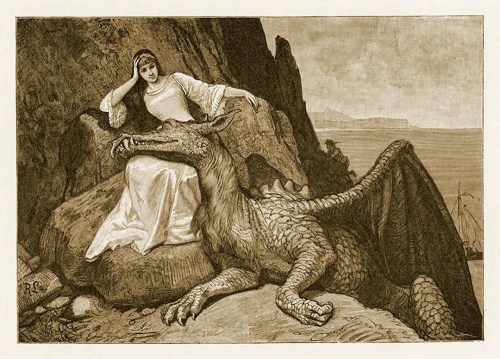
(The image is an engraving by Anton Robert Leinweber.)

Posted in Uncategorized | 2 Comments

Longing for Home

Recently, I read two quotations about home. The first is from Katherine Mansfield, written in her diary:

“I want so to live that I work with my hands and my feeling and my brain. I want a garden, a small house, grass, animals, books, pictures, music. And out of this, the expression of this, I want to be writing. (Though I may write about cabmen. That’s no matter.) But warm, eager, living life — to be rooted in life — to learn, to desire, to feel, to think, to act. That is what I want. And nothing less. That is what I must try for.”

The second comes from Alain de Botton, in The Architecture of Happiness:

“We need a home in the psychological sense as much as we need one in the physical: to compensate for a vulnerability. We need a refuge to shore up our states of mind, because so much of the world is opposed to our allegiances. We need our rooms to align us to desirable versions of ourselves and to keep alive the important, evanescent sides of us.”

Which reminds me of a third quotation I marked for myself recently — let me go find it. Ah, here it is, in Wind, Sand and Stars by Antoine de Saint-Exupéry, which I stopped reading halfway through. Why? I suppose because he writes so much about traveling and getting lost (in the Sahara!) that it made me feel lost as well, and that’s something I don’t want to feel right now. But I will get back to it soon. Anyway, here is the quotation:

“Ah! the miracle of a house is not that it shelters or warms you, nor that its walls belong to you. But that is has slowly deposited in us all those stored resources of gentle joy. And that deep within the heart it forms the shadowy range of hills in which our dreams like spring waters, are born . . .”

It seems as though all my life I’ve been longing for a house of my own. Not just an apartment, but what Katherine Masefield described: a house with a garden, where there are animals and books and pictures. Perhaps I feel that longing more acutely this semester because I’ve been moving around so much. This summer I went from Boston to London, then London to Budapest, then briefly to Vienna, then back to Budapest to Boston to Budapest and in a week I will be going to London. Then Budapest then Boston and I forget where next. I don’t mind traveling — I actually love traveling and seeing new places, especially when I can stay for a while and experience them more deeply. I even loved being in Vienna with my daughter for a few days this fall, having cake at the Belvedere, seeing the Klimts . . . I feel enormously privileged to be able to travel and see beautiful places at this point in my life. (I remember being a poor student and longing to be able to travel.)

But I do wish I had a house of my own, specifically with a garden, specifically with closets where I could put my clothes and bookshelves where I could put my books — a place that did not feel temporary. I’m longing for a refuge to short up my state of mind, to align me to the desirable version of myself — the creative version, the scholarly version, the one who reads and thinks and writes, and who can get rather lost in the endless corridors of airports. I think the important, evanescent side of me is the one that creates. I’m also longing for a place where I can store not just clothes and books but also time spent — where I can say, oh yes, I did this here a year ago, five years ago. Where I have memories.

The place I am now, the apartment in Budapest, does function in that way. After all, I lived here as a child. I came back when I was sixteen, twenty-three . . . I came back many times before I officially inherited it, so it does belong to me now, and I’m incredibly grateful to have a place that belonged to my grandparents and will one day belong to my daughter. It does form, perhaps not the shadowy range of hills, but the bricks and mortar from which at least some of my dreams are born. There is a part of me that belongs here, and that writes from here.

But there is another part of me that is still looking for home. I know it’s because we moved around so much when I was a child — there was never a childhood home to return to, never even a city I could identify as mine other than Budapest, which I lost for so many years. But it’s also because for me, a home is not just the walls you live inside; it’s also the garden around it, and we lived for so many years in apartments or townhouses where there were no gardens or the garden was a patio in the back. Perhaps I was too influenced, in my childhood, by books like The Secret Garden and The Wind in the Willows, but my idea of home has always been a house surrounded by a natural space. In Boston I have two shelves of gardening books — mostly collections of essays by people who created gardens, like Eleanor Perényi’s Green Thoughts: A Writer in the Garden. I still have not finished reading her memoir, More Was Lost, about her marriage with her husband, Baron Zsigmond Perényi, and moving to his estate in what was then rural Hungary but is now part of Ukraine, and having to flee to the United States during World War II. Her husband had been conscripted into the Hungarian army, and she was pregnant with their first child. Somehow, they never managed to reunite, and eventually divorced. Green Thoughts is about how she created a garden for herself in Connecticut. While writing this paragraph, I tried to find my copy of More Was Lost, but it does not seem to be in this apartment. Did I bring it to Boston? Is it on one of my bookshelves there? I am constantly having this experience, of realizing that a book or a pair of pants or something-or-other is in another country.

I suppose the reason I haven’t finished reading either Wind, Sand and Stars or More Was Lost is that I know things are going to be lost — neither of those stories have happy endings. Saint-Exupéry’s plane was eventually lost over the Mediterranean, and Perényi lost her home. Yes, she found a new one — she created an new one for herself — but I know her memoir is permeated with loss. Perhaps Green Thoughts is her way of writing her own happy ending. Perhaps all happy endings involve a garden.

Anyway, I am longing for a home, and I don’t yet know how I can find or create one. Meanwhile, I am grateful to be here in Budapest, where I was born, and to have my apartment in Boston, where I teach. I can’t stay there much longer, because I can’t afford the rent increases, so I will have to find another apartment soon. Then, I am sure, I will feel displaced and uprooted and evanescent again, especially because I will have to leave the little garden I created by the side of the building. It was my piece of earth, filled with hostas and astilbes and peonies — anything that can grow in the shade and survive rabbits. And of course, affording anything in Boston, especially on a university lecturer’s salary, is an exercise in insanity.

I don’t know how this story ends, but I’m not Perényi fleeing Hungary in wartime, nor Saint-Exupéry carrying mail over the desert, so I’m sure I will figure it out somehow. Whatever happens, the best way for me to deal with it is to write about it, because writing is how I think things through. As Mansfield write, “And out of this, the expression of this, I want to be writing.” This being whatever I’m living through at the moment, wherever I am at the time. Which right now is here, at my desk in the Budapest apartment, writing.

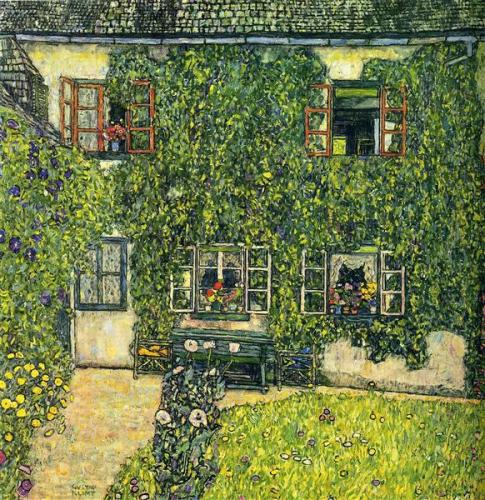
(The image is Schloss Kammer on the Attersee IV by Gustav Klimt. I chose this image because it looks a bit like the Hungarian home that Eleanor Perényi left behind.)

Posted in Uncategorized | 8 Comments

A Quiet Revolution

I am not a revolutionary. I am far too introverted, too much inside my own head most of the time. I went to a march once, back in 2017, and found it both inspiring and ineffective. But I look at the world around me, and I see so much that I’m unhappy with.

I see an economic system that rewards some people way out of proportion to what they actually contribute. I see a healthcare system that is not available to all, and does not focus on keeping us healthy. I see an educational system that is far too expensive, while the teachers who work within it struggle to make ends meet. An environment that is in serious trouble, governments that are playing political games rather than trying to solve problems, technology used to replace rather than help us . . . You probably see the same things, if you look around.

The question I asked myself is, what can I do about this? I am not a politician, and not by nature an agitator. I also have a constitutional bent toward ambiguity, which is perhaps why I’m a writer. What do I mean by those rather complicated words? That I tend to see history as complicated. The Soviet army helped defeat the Germans (good) and then imposed itself on Central Europe for the next forty years or so, half of my mother’s lifetime (not so good). The history of Hungary, where I’m writing this, and the history of the United States, where I was a week ago, both contain contradictions. The US has supported dictators in the name of freedom. But among the contradictions and complications, there are things which are, I believe, absolutely clear: the clear evils of slavery, of taking away people’s rights to self-expression, self-determination. Creating income and educational inequality. Destroying the environment on which we all depend.

This post has already become more serious and convoluted than I intended. What I wanted to say, very simply, is that if you’re not by nature a revolutionary, there is still an option. There is a way to wage a quiet revolution in your own life, which is by opting out.

What do I mean by that? I mean at a minimum, not accepting a system you don’t believe in. If you hate how the development of AI is funneling money into the pockets of powerful people who don’t seem to have the interests of humanity at heart, don’t use it. That’s an easy example, but I want to provide a few more. What I’m talking about is, in a sense, going on strike: on an individual strike in which you don’t accept that the way things are is the way they have to be. Without necessarily waving a placard (although you can, of course, if you want to), living your life in such a way that you are in quiet rebellion against the things you dislike about our modern world.

I’ll give you some examples, some action items. Pick and choose as you wish.

1. Know the difference between the real and our imagined reality. The term “imagined reality” comes from Noah Yuval Harari’s Sapiens: A Brief History of Mankind. I don’t agree with everything in Harari’s book, but I think this central concept is both useful and accurate. Harari argues that human beings live in real reality (the world of apples, trees, gravity), but also a reality we have created through language (money, corporations, our legal system). When I teach this concept in my class on rhetoric, I give my students the example of our university. What about it is really real? The people in it, the land it was built on, the buildings themselves. But what about the university itself? The very idea of a university, the idea that they are students, that they will finish a course of studies and earn a diploma that will get them jobs in which they earn money — all those things are part of our imagined reality. We human beings have quite simply made them up. They are real in that they really do affect our lives — the money my students will earn at jobs will buy them food. But if we all suddenly developed amnesia, we would find ourselves sitting on desks in the middle of a bunch of buildings. The university itself would have disappeared. The imagined reality exists because many people believe in it — it is, as Harari says, intersubjective. But unlike gravity, it’s not inevitable. It can be changed. As Ursula K. Le Guin mentioned, there was a time when many people believed in the divine right of kings. Until they didn’t.

2. Try to spend time with what is real — with apples, not just stock reports. Try to stay close to the world of real reality: of gardens and animals, of cooking dinner, going for walks outside, looking at the stars. I think this sort of thing keeps you sane and grounded. Take an interest in birds. Play musical instruments or listen to a concert with human performers sitting on a stage in front of you. Keeping in touch with what is really real, with what would not disappear if we all forgot about it, also keeps us sane. It keeps us from spiraling into the world of illusion that our twenty-first century culture spins for us — an online culture that is controlled by people we don’t know and who don’t have our interests at heart.

3. Try go do something real in your profession. This is probably a controversial statement, but I would urge young people to do real, valuable work — be a doctor, a teacher, a plumber, a garbage collector (which is probably the most valuable work of all, since it underpins all of human society), someone who makes coffee in a coffee shop, an artist, a scientist, a farmer . . . There are many jobs that involve touching real reality, whether that is a human body or mind, a piece of plumbing, a canvas, a cup of coffee. And then there are jobs that involve manipulating our imagined reality. Recently, I’ve had students whose ambition in life is to be a “private equity asset manager.” I’m not going to criticize them, but I was a corporate lawyer. I put words on a page to create or merge companies. It was an empty, unsatisfying way of making a lot of money. And was that money worth the twelve-hour days I put into my job as a corporate lawyer? Was it worth that portion of my life? Not to me.

3. Try to buy what you need, or what you find beautiful, rather than what advertisers tell you to want. Fashion is part of our imagined reality. Do you need to be “on trend”? No, of course you don’t. This is one of my personal downfalls. It’s not that I’m particularly fashionable, but that I have a bad habit of buying clothes I don’t actually need. I’m working on that. On the other hand, I am very good at buying beautiful books! This summer, I went to Vienna with my daughter, who is interested in museum studies, and we went to the Kunsthistorisches Museum. There is one part of the museum, an entire corner, dedicated to the knickknacks that the Hapsburgs collected. Room after room of gold and ceramic tchotchkes. By the time we got out of that section, we had headaches. Don’t be like the Hapsburgs. One ostrich egg on a golden pedestal is enough.

4. Try to create things as well as consuming them. Our society values us as consumers. Our economy is judged by what we buy, not the songs we sing, the paintings we paint. But as individuals, we usually value what we create more than what we buy, and the act of creating gives us a joy that no amount of putting things on credit cards ever well. The ultimate creator is Nature herself, and we are evidently created in her image, because the greatest power we have as human beings is our creativity. It does not separate us from the animals — birds create nests, octopuses create gardens using shells and colorful rocks. Rather, it allows us to join a great ongoing work of creation, in which whatever we create has one small part.

5. Develop a sense of yourself. Who are you, in the midst of all the messages you receive from the society we live in? I believe that as we grow up, we are inevitably formed by our societies, but underneath we also have an essential core — that essential core is what decides which cultural messages it will receive and how it will respond to them. The more you can be aware of that deciding self, the more you can decide. It’s like finding a ground to stand on, in the swirl of influence and information that surrounds us. Find your ground. Decide how you want to stand on it.

The most fundamental ground we all stand on, whether we want to acknowledge it or not, is that we are all on this earth for a little while. We will pass away, and we won’t be able to take anything with us. “Shrouds have no pockets,” as the Irish saying goes. So how will we live our lives? What will make them feel meaningful? I would argue that living a meaningful life is itself a revolutionary act, and if we all do that — all of us individually, which would also mean together, it would change the world.

That’s my idea for a quiet revolution. It’s a way of seeing what is real and holding on to it, seeing what is imagined and choosing how you want to relate to it, which parts of our imagined reality are worthwhile. Democracy, for example. Human rights, animal rights, the rights of rivers and trees and the sky.

I have a pink sticky note beside me as I write this. It says, “Live as though you are in constant rebellion against human cruelty, stupidity, and greed.” I should put that up somewhere, as a reminder.

(The image is Julie Daydreaming by Berthe Morisot. I chose it because Julie looks very thoughtful — as I think we should all be.)

Posted in Uncategorized | 15 Comments

Real Beauty

In summer, while I was in Budapest, I went into a DM store. I think DM means drogerie markt? It’s a German chain of what in the United States we would call drug stores, but in Hungary only pharmacies sell drugs. DM sells shampoo, soap, toothpaste, laundry and dishwashing detergent, vitamins, foods like sugar-free chocolate and gluten-free cookies, toilet paper, trash bags — most of the things an American drug store would sell except actual drugs. It also sells cosmetics.

As I was walking down the aisle toward the cosmetics section, having picked up some Persil for my laundry, I saw a woman looking into the mirror where you can examine whether the test cosmetics suit you. She was brushing some test blush onto her cheeks. That was not so surprising, of course — but she looked old. I don’t just mean in terms of her age, although she must have been in her eighties. She had a delicate network of wrinkles across her face, like a spiderweb or the map of a city. But I mean old in terms of how she presented herself. She wore “old lady” clothes — a wool skirt, a soft blouse that tied at the neck, a knitted wool cardigan, all in shades of brown except the cream blouse, and brown old lady shoes. (I suppose she was around the same age as my mother, but my mother, who lives by the ocean in Los Angeles, usually dresses like a teenager. Judging by our clothes, I would look older than she does.) It struck me, suddenly, that I’m not used to seeing old women looking at themselves in mirrors. And then I thought, She is the most beautiful woman in this store.

Why was she so beautiful? I suppose it was partly her delicacy. She was a small woman, and her face, although lined, looked almost like a child’s, or perhaps a fairy’s from an illustration in a children’s book. She looked into the mirror so intently, with curiosity, applying pink blush to her cheeks. I’ve written about beauty before, because it has always fascinated me — what makes something (not only a person but also a tree, a building, a city) beautiful? In graduate school I took a class on the beautiful and sublime, and now I include those topics in my course on rhetoric, because they are part of the oral, written, and visual rhetoric that I’m trying to teach my students.

So what makes something beautiful? Edmund Burke, in A Philosophical Enquiry into the Origin of Our Ideas of the Sublime and Beautiful, thought the beautiful was the opposite of the sublime. We find something beautiful, Burke thought, if it’s small, smooth, pleasant. He associated beauty with rolling hills and gentle valleys, and with women (who were supposed to be small, smooth, pleasant). He also associated it with love — we love the beautiful, whereas we fear and are in awe of the sublime.

I think he had something in terms of the opposition between the beautiful and sublime, but I don’t agree with his definition of the beautiful. When I see something beautiful, it doesn’t make me feel ease and contentment. It doesn’t even necessarily make me feel love. What it does is give me a sort of pain in the chest, right around the area of my heart. It’s a pang, a wound. Seeing something truly beautiful hurts. And I think I know why. Beauty is not timeless. It’s bounded by time. Beauty always has a hint of mortality in it.

Why are flowers beautiful? Because they are temporary. Why are human beings beautiful? Because they grow old. The sublime, on the other hand, is what transcends mortality, or comes as close as possible. Mountains are sublime. The stars are sublime. The sublime seems eternal, and we are in awe of its grandeur, its seeming timelessness. The sequoias in California remind us that they have been around much longer than we have. Perhaps this is why in the myths, gods always fall in love with mortals. The gods are sublime, eternal. Only human beings, who die, can be beautiful. The most beautiful building in the world, the Taj Mahal, is a tomb.

Some years ago, while scrolling through YouTube, I came across a movie called Real Beleza, directed by Jorge Furtado. I’m not sure why it caught my interest, but I watched it even though it’s in Brazilian Portuguese, and at the time, it was only available without subtitles. It’s about a photographer named João, played by Vladimir Brichta, who needs to find a new model, a fresh young face, to revive his flagging career. As he goes around the country photographing women, he meets Maria, whom he believes could become a great model. However, she is under eighteen, so he needs her parent’s permission. He drives into the hills to find her parents and initially meets her mother Anita, played by Adriana Esteves. He falls in love with her, and she with him (Brichta and Esteves are married in real life). But she also genuinely loves her husband Pedro, magnificently played by Francisco Cuoco as perhaps the most interesting character in the film. Pedro is much older, a scholar and lover of literature — he is also ill, and now almost blind. The movie is an exploration of what it means to love someone, and also a deepening exploration of what we mean by “real beauty.” Who is beautiful? Is it Maria, the lovely young model? Or her mother Anita, who is of course older, more complicated? Is it the love she shares with João or the love she and Pedro have for each other? Or Pedro’s love of art and poetry, his ability to find beauty even when he can no longer see? Is it the sacrifices the characters are willing to make for each other? Is it the Brazilian countryside?

I mentioned Real Beleza because I think it helps make my case that beauty is bound up with time and mortality. I won’t tell you any more about it here — you can watch it for yourself. The movie is now available with English subtitles, so if you like slow, thoughtful films, I recommend it.

What I will talk about is Keats’s “Ode on a Grecian Urn” and Pamela Anderson. The Grecian urn deserves a post all to itself. Many scholars have written about it, and I will probably not add anything original to what they have already said. What I do want to say is that Keats seems to make an argument opposite to mine: that true beauty is eternal. Or perhaps I should say, the urn seems to make that argument, but there is plenty of evidence in the poem itself that the urn is misrepresenting itself a little. That the urn is itself about time and mortality. Keats calls it the “foster-child of silence and slow time,” but slow time is still time, you know? On the urn is a representation of action that will never be completed — the lover will never embrace his beloved, the heifer will never be sacrificed in a religious ritual. It seems as though time is stopped and captured forever. But the urn itself will continue to age, just like its human observers. Its promise of eternity is only temporary.

As I said, the poem deserves its own post. But what about Pamela Anderson? I mention her because when she stopped wearing makeup, it caused a sort of cultural commotion. Why? When she was younger, she would have fit Edmund Burke’s definition of the beautiful — soft, curvy, non-threatening. Suddenly, she was older and much more opinionated. I want to argue that as attractive as Ms. Anderson was, she did not become truly beautiful until she aged and showed her age. She was lovely to look at, but she did not create that pang to the heart, that deeper response we have to beauty. What she gained, with her visible wrinkles, was vulnerability and a kind of truth.

I’m not done writing about beauty, because I think it’s something deeper than the philosophers have admitted so far, and I think it’s important. There was a movement, the entire time I was growing up, to denigrate the beautiful in art and architecture. Beauty was seen as trite, clichéd. I think that’s the absolute opposite of real beauty, and we need to reclaim the idea of the beautiful as a serious artistic category. So more on this, sometime . . .

(The image is Portrait of an Old Lady with Fur Hat by Carl Heuser.)

Posted in Uncategorized | 3 Comments